History of the Russian Orthodox Church — Topic 10
- The future Patriarch Nikon and his election
- The Russian Church under the Patriarch Nikon
- The Old Believers schism
The future Patriarch Nikon and his election
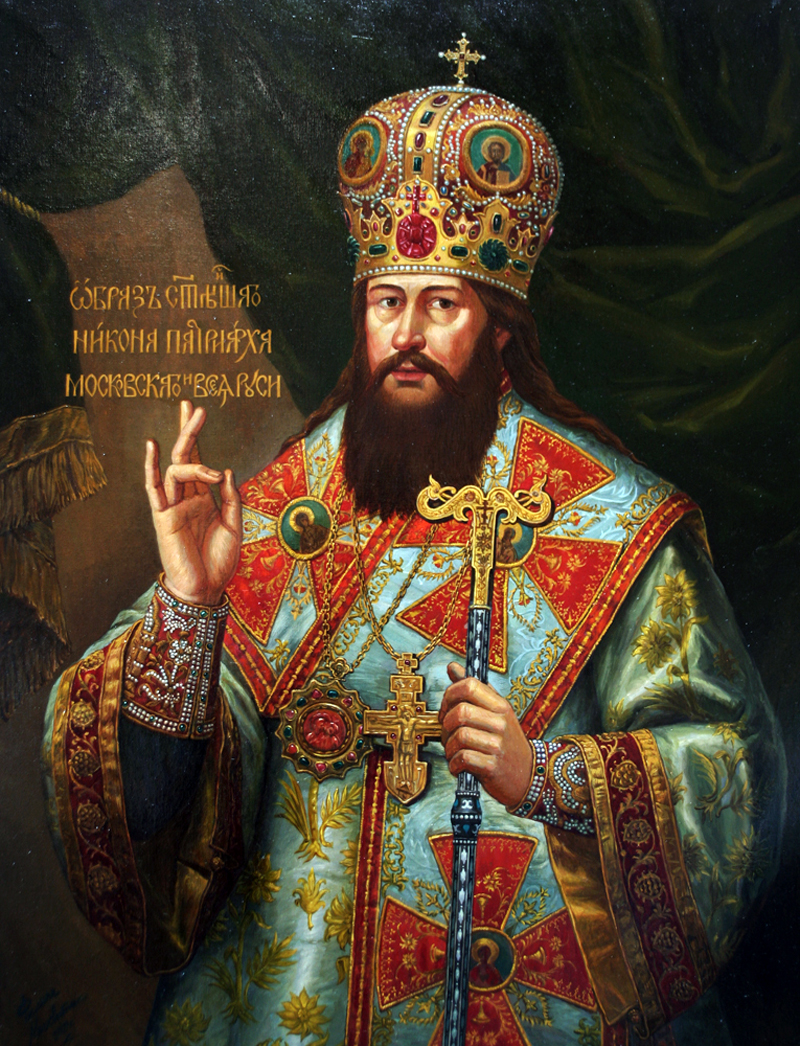
After Patriarch Joseph I, who was disliked by Tsar Alexey Mikhailovich, Nikon (1652-1658)1 was destined to become the new Primate of the Russian Orthodox Church.
He was born on May 24, 1605 in the land of Nizhny Novgorod, from the family of a Mordovian peasant Mina. His name was Nikita. He was tall, strong in build and charismatic. As a child he was strongly weighed down by the harsh routine of rural life and the harsh temper of his wicked stepmother. She hated him fiercely, beat him, and once nearly burned him in an oven.2 As a boy Nikita ran away to the Makariev Zheltovodsky monastery, where he did his novitiate and studied. He returned home as an adult, aged 20. After his father’s death he married and became a priest. However, all three of his sons soon died, one after the other. Nikita saw in this a sign from God - a call to “leave the world”. He sends his wife to the Moscow Alexeevsky Kremlin Monastery and in search of a true ascetic life he leaves for Solovki where he takes monastic vows with the name Nikon. Here he became famous among the brethren as a zealous ascetic and a very literate man.
But as a result of a conflict, he had to leave the monastery (the reason for that was the building of a stone cathedral, which Nikon wanted to build, but the hegumen refused to allow him to do so, having considered it an unaffordable luxury). From Solovki to the mainland he set out in a small boat under his own power and was nearly killed during a storm. He survived by finding and landing on the island of Kiyu, near the mouth of the Onega. To commemorate that escape Nikon built here the Monastery of the Cross. Nikon settled at the Kozezersk monastery, where in 1643 he was elected hegumen.
In 16483 he came to Moscow on monastic business. By customary tradition the hegumen had to present himself to the Tsar in person. The young Tsar Alexey at their first meeting wished to have Nikon with him - he so charmed him with his words and appearance. He was made Archimandrite of the Novo-Spassky Monastery, which was the family burial-vault of the Romanovs. Nikon always had a weakness for building and was an aesthete. His monasteries (New Jerusalem, Iveron, Kiisky) were images, designed as icons to raise the mind to the heavenly city. That is why he beautified the monastery and imposed strict orders on it.
Frequent meetings and conversations began between the Tsar and the Archimandrite of Novo-Spassky. The Tsar initiated his new spiritual friend into his dreams of the greatness of the Russian Church and state. Apart from the Tsar, Nikon was also loved by the people. Through him, as their intercessor, they began to pass on their petitions which he and the monarch would then examine. A circle of trustees began to form around him: the boyars, the clergy… Thus, the way was opened for him to the pinnacle of Church administration.
In 1649 the Tsar promoted him to the metropolitanate of Veliky Novgorod. Moreover, Nikon, as a close friend of the Tsar, was exempted within the boundaries of his diocese from the decree of the Sobornoye Ulozhenie of 1649: he (and not the state monastic institute - the Prikaz) was given the right to judge all the population of the Church lands in his metropolitan see as before by a Church court. Moreover, in his diocese he was given the right of supreme supervision over the state court. This added to Nikon’s popularity among the people. Nikon widely spent the funds of the cathedra on charity. He set up four almshouses. In times of famine, he fed the people and established a burial chamber for the poor.
During the people’s rebellion in 1650, he behaved courageously. He exhorted the rebels with words. After the suppression, when the rebels begged Nikon for intercession and pardon, he persuaded the Tsar to forgive them. This, of course, enormously raised his spiritual and moral authority, both in the eyes of the people and in the highest circles of government. Already in his Metropolitanate Nikon resolutely reformed the old rite: he introduced the harmonic singing of the Kiev model.
In 1652 Patriarch Joseph died. It went without saying that Nikon was the candidate the Tsar desired. However, the chosen one suddenly strongly resisted. He referred to his foolishness and incapacity. A confused Alexey Mikhailovich, the clergy, the people - all kneeling began to beg, to entreat Nikon to become Patriarch. Nikon tearfully and anxiously answered: “If it pleases you that I should be Patriarch, give me your word that you will obey me as a bishop and father. Give me your word that you will allow me to arrange the Church of Russia according to the laws of the Evangelical and the rules of the Holy Fathers. Such a promise was made. It was July 22, 16534. Nikon was still in the prime of his powers. He was only 47 years old.
The Old Believers schism
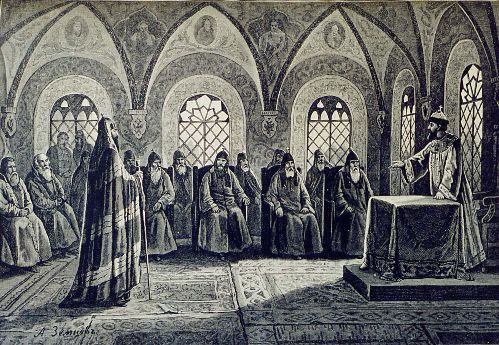
In November 1666 the so-called Great Council of Moscow was opened with the participation of two patriarchs: Paisius of Alexandria and Macarius of Antioch. Both patriarchs were at that time deprived of their cathedras by the decision of the Council in Constantinople, but the news was received in Moscow after the trial of Nikon. The ex-patriarch was accused of abandoning the cathedra without permission, of reproaching the Decree and the Tsar’s activities in the Church and many other things. The verdict handed down on December 12, 1666 was the full removal of Nikon from the priesthood and leaving him in a mere monastic state.
There were, however, more questions. The Council could not pass over in silence the fundamental problem which was put forward by Patriarch Nikon: the question of the separation of powers between the Tsar and the Patriarch. And here, paradoxically, Nikon’s position was accepted and defended by the whole Russian hierarchy. Only his personality and his tactics were condemned. The final formula of the Council’s debates on this question at a session on 24 January 1667 was the thesis: “the Tsar has priority in civil affairs, and the Patriarch in ecclesiastical ones”. The Russian hierarchs thus achieved from the council and the Tsar what Nikon strove for. The state made a great demonstrative concession to the Church. The monastic order (the Prikaz) was closed.
The disgraced Patriarch himself was sent to the Ferapontov monastery. They placed him in a hospital cell with iron bars. It was forbidden for him to go out. Nikon was placed under guard. However, Tsar Alexey was tormented by the severity of the consequences of the trial of Nikon. He ordered new cells to be built in the monastery for the prisoner, allowed communication with the inhabitants of the monastery and even with the pilgrims. These favours were succeeded by new regime reinforcements. Before his death (January 29, 1676) Alexey Mikhailovich begged Nikon’s pardon in his testament. At the same time the Tsar expressed his desire to return Nikon to the Patriarchal office. Having learned about the death of Tsar Alexey and the text of his will asking Nikon to forgive him, Nikon wept but did not forgive him in writing.
Under Tsar Fyodor Alexeevich, Nikon’s regime deteriorated: a party of Nikon’s enemies became favourites at the Tsar’s court. At the next Church Council in May of the same year (1676) he was again condemned for his incorrigibility and new crimes. It was decided to transfer him to the Kirillov monastery. He was again placed in a cold and dark cell from which he was not allowed any exit, except to the church, and no one had access to him either. Nikon was deprived of both paper and ink. Only four years later did relief appear. Tsar Fyodor’s loyal aunt, Tatiana Mikhailovna, with the support of new people in the church of Moscow, such as Simeon Polotskiy and the brethren of Nikon at the Resurrection Monastery, all clamored for the return of Nikon. And Tsar Fyodor himself was inclined to do this. He ordered the former Patriarch to be taken to the Resurrection Monastery. They were already taking him along the Volga and were in front of the Tolga Monastery near Yaroslavl, when on 17 August 1681 Nikon died.
The Tsar ordered the funeral service for Nikon as a bishop, and he himself carried the coffin with the body to the tomb, kissed the hand of the deceased and the Tsar followed with all the others. In 1682 the eastern Patriarchs sent a letter of permission. It commanded to count Nikon among the Patriarchs and to commemorate him openly in the Church with this rank.
After the memorable Council of 1667 the leaders of the opposition - dissenters
- were exiled to the North Pechora region, to Pustoozero Ostrog. Here, however, no obstacles were put in their way to their preaching. Gradually a new ecclesiology, canonry and liturgy was being formed. Protest leaders like Avvakum acquired the halo of apostles, martyrs with the power to anathematise and command. To Avvakum, like a prophet, the masses flock, thirsting for miracles and healings.
But inside the schismatic consciousness there matures a sense of tragedy: soon there will be no priesthood, no one to administer the sacraments. This is why the norm of “lay priesthood” is proclaimed. The laity must act themselves within the limits of what is permissible: baptise, receive confession, give Communion with the substitute gifts. Spiritual practice and doctrine were becoming obscure. Without a tangible hierarchy, anarchy was established. Some sang in a single voice, others sang according to local old habits. At the same time, in the coastal north of European Russia, the schism was taking on a new history. Here, on the Solovki, a new hotbed of resistance to Nikon’s introductions erupted. From here open propaganda spilled over to the whole north - to stand up for the old things. After 1666 this protest, so far tolerated in Moscow, came under intense scrutiny.
The Council, which had approved the book and ritual corrections, could no longer keep silent about the rebellious position of the Solovetsky monastery and took some administrative measures to end the revolt. Some monks were summoned to Moscow for personal interrogation and Sergius, the archimandrite of the Yaroslavl Spassky monastery, was sent to Solovki as a reviser with an order to obey the church authorities. This was not followed. In September 1667 the monks wrote a lengthy petition which set out all the motives for the revolt, and became something of a manifesto for the Old Believers’ schism. They proclaimed their belief in the imminent end of the world, the apostasy, the culprits of which were the Greeks. Moscow, following them, had already committed a whole series of apostasies from the old faith. It was therefore more likely to die than to embrace the way of the antichrist.
The Tsar ordered all the fiefdoms of the monastery to be occupied by military forces and began the actual siege or island isolation of the monastery. The anger of the besieged turned from religious to total, to the psychology of civil war. It was decided to take the rebels by force, and such a siege lasted for a full eight years. In 1670 the mutineers were the first to start shooting at the Tsarist troops. The Tsarist troops, however, did not fire. The siege dragged on. The rebels grew weary. At the end of 1673 a monastic council assembled which decreed: “for the great sovereign to leave the monastery”. The hieromonks and priests refused to do so. They were thrown into prison on hunger strike. Internal disintegration began. The defectors began to increase. Scurvy began. They died in great numbers, without communion. They were buried without funeral rites. On January 22, 1676 monastery was taken. Five years later, on 1 April 16815, Avvakum and the others were put to death by fiery execution “for blasphemies against the Tsar’s House”. The executed were burnt in a log house. This form of execution was intended to suppress the veneration of graves and remains. Avvakum was canonised by Old Believers.
The Russian Church under the Patriarch Nikon
The fight against the tendencies of the Edict of 1649. Nikon, having become Patriarch, confessed that, as an archimandrite, he was once forced to sign the Sobornoye Ulozhenie reluctantly and harboured a protest in his heart. Later he wrote: “I constantly asked the Tsar about this damned book so that laymen would not judge the clergy. But apart from humiliation I got nothing”.
In addition, one must take into account the psychology of the newly elected Patriarch. Having spent his entire life in the system of monastic coordinates, he has absorbed in himself a special monastic mentality, the foundation of which is obedience, the feat of voluntary self-denial in favour of the abbot. In the same way he looked at the patriarchate - as an abbot in a large Russian monastery. Abbotry, not tyranny. “Who is a patriarch,” he said, “but a spiritual father who cares for the salvation of his children. It was this kind of obedience to himself as father and all-Russian abbot that Nikon sought. Otherwise, he could not and did not want to think of his ministry. In this logic Russia appeared as something like a huge monastery, with its own written and unwritten statutes, way of life and traditions. They tried jealously to protect “their monastery” from foreign influences. It was Nikon who was now assuming the priesthood of this “monastery”. Therefore, these requirements were clear to everyone, and his contemporaries were not perplexed.
Moreover, he clearly understood that not everyone in this “monastery” was as pious and obedient as he wanted. Especially the Moscow nobility, pushed away by Nikon from the sovereign. Having no illusions on this score, Nikon reasonably demanded guarantees of loyalty. It is important to note that obedience was not the only condition of the Patriarch. He personally asked the sovereign ”… in three years let me go, … to a monastery, to rest, to prayer and a quiet life”. Tsar Alexey did not keep his promise and Nikon asked for the same three years later, but again in vain. All this adds new touches to his portrait: he did not seek power, there was not that passionate thirst for power and control, of which it is customary to blame Nikon. He was overbearing - this fact is indisputable, but only as long as he ruled - but not overbearing overall.
It is well known that in 1649 Alexey Mikhailovich issued his Edict where the rights and property of the Church were substantially limited by the Monastic Office-Prikaz. Patriarch Nikon tried to weaken the influence of this document which was only the first stage of the State’s attack on the Church. To fight against it ideologically, Nikon printed his famous Church Slavonic Lamentations6 from ancient manuscripts for the first time in 1653. Although the position of the Patriarch himself was exceptional. The land fund of the Patriarch’s court not only did not diminish, but, on the contrary, increased by royal grants. Nikon used them to establish his own monasteries: Iversky on the Valdai, Krestny on Kiy Island, and Voskresensky Novoyerusalimsky on the Istra River. This latter became as it were the main theme of St Nikon’s life. This was the realisation of his dream of the Russian Church as the centre of world Orthodoxy.
In fact, the whole programme of the new Patriarch’s activities was subordinated to the same idea. This program might be called the Moscow program of ecclesiastical greatness, which demanded urgent and emergency reforms in the Russian Church to correct and glorify it. The Greek model was taken for the sake of approximating the Russian Church to the Greek perception in the event of her entry into Constantinople. The basis of the reform was a book and ritual reform. In Nikon’s opinion it was not the ancient Slavonic sources which were to be used, but the new Greek editions. Actually, it was the traditional model adopted under Patriarch Joseph. The editors who were called in from Kiev started at once, from 1649, to correct their books according to the Greek models. They also borrowed some elements of the Greek ritual practice: a three-fingered cross, and a change in the office of Lent bows for the Ephraim the Syrian prayer. And this was done in a very incorrect, directive form, which caused widespread opposition from the clergy in the capital.
After all, hitherto issues of ritual had been discussed in a circle of zealots, in a friendly council. For Nikon’s friends this offensive autocratic order was a declaration of war. In addition, Nikon touched a rite of the cross that was close to his heart, moreover, protected by a special order of the Stoglav council. At the Council of 1654 Nikon proclaimed a course towards full harmony in all things between the Moscow church and the Greek church. He enumerated a long series of statutory differences. These were clockwise (instead of counter-clockwise) processions, the double (instead of triple) singing of the Hallelujah, a different spelling of the name Jesus (“Исус” but not “Иисус”), etc.
The abruptness and procedural incorrectness of the reforms aroused discontent among a considerable part of the clergy and laity which also fueled personal antipathy towards the intolerant and ambitious Patriarch. After the Council of 1654 protests against the new developments began. Those who protested were condemned, and many were exiled. It was the beginning of a schism. But Tsar Alexey needed this reform for political reasons: in 1654 Ukraine joined Russia7. He had to take care about ecclesiastical and ritual convergence with Kiev which was still under the jurisdiction of Constantinople Patriarchate.
Meanwhile, relations between the Patriarch and the Tsar deteriorated. This was caused both by intrigues on the part of the Boyars against Nikon and by the personal evolution of Tsar Alexey who was in line with the European political trend which had at its core the autocracy: unlimited, absolute royal power. The state in this logic encompassed everything: politics, religion and the life of each individual. Nikon read this mood of the monarch in his verbal and non-verbal expressions, and as a silent protest on 10 July 1658 he left the cathedra: without giving up the patriarchate he withdrew for six years to the New Jerusalem Monastery. In 1660 a council decided to deprive Nikon of his bishopric and even the priesthood. However, the trial did not take place as it was decided to refer the matter to the court of the Eastern Patriarchs. The former bishop of Jerusalem Paisii Ligarides8, who did not obviously take part in the council although he was invited by the Patriarchs to a secret meeting and acted as an interpreter for the eastern patriarchs, recommended the same solution to the tsar later on. It must be said of him separately. Actually, the whole “Nikon case” is the work of Paisius. It was he who formulated the charges in the lawsuit of 1666. However, in Moscow at that time there was no idea that Ligarides was a secret paid agent of the Vatican9. On his advice the eastern patriarchs were summoned.
Patriarch Nikon. The Old Believer’s
schism
Editorial Footnotes
Related Concepts
- abbacy
- abbotry
- anarchy
- avvakum
- book-and-ritual-reform
- canon-law
- canonical-trial
- church-property
- church-reforms
- defrocking
- dissenters
- ecclesiastical-reform
- great-council-of-moscow
- greek-apostasy
- greek-influence
- greek-model
- greek-practice
- liturgical-reform
- liturgical-reforms
- monastic-obedience
- monastic-prikaz
- moscow-as-new-jerusalem
- new-jerusalem-monastery
- obedience
- old-believer-ecclesiology
- old-believer-manifesto
- old-believers
- old-rite
- paisius-ligarides
- patriarch-nikon
- patriarchal-commemoration
- prophetic-authority
- raskol
- russian-church
- russian-church-as-monastery
- self-denial
- sobornoye-ulozhenie
- solovki
- solovki-petition
- solovki-uprising
- substitute-gifts
- symphony
- symphony-of-powers
- tsar-alexey-mikhailovich
- tsarist-autocracy
- world-orthodoxy
Footnotes
-
Nikon’s patriarchate is conventionally dated 1652–1666. He withdrew from active exercise of the office in July 1658, but he was not formally deposed and stripped of the patriarchal dignity until the Great Moscow Council of 1666. The span “1652–1658” therefore marks only his period of active ministry, not the legal duration of his tenure. ↩
-
The vivid details of Nikon’s early life — the cruel stepmother, the beatings, the near-burning in an oven — descend from the near-contemporary hagiographic Life written by his cell-attendant Ioann Shusherin and from later devotional biographies. Episodes of this kind follow a conventional hagiographical pattern of the persecuted saintly child and are best read as edifying tradition rather than independently documented fact. ↩
-
The standard date for Nikon’s journey to Moscow and his first meeting with Tsar Alexey — after which he was made archimandrite of the Novospassky Monastery — is 1646, not 1648. The 1646 date yields the roughly three years he served as archimandrite before his elevation to the see of Novgorod in 1649. ↩
-
The date is in error. Nikon was enthroned as patriarch on 25 July 1652 (Patriarch Joseph having died in April 1652), as the surrounding text implicitly acknowledges in giving “In 1652 Patriarch Joseph died.” The stated age of 47 is consistent with a man born in 1605 being enthroned in 1652; the year 1653 — and the day “22” rather than 25 — appear to be mistakes. ↩
-
The archpriest Avvakum and his fellow prisoners were burned at Pustozersk on 14 April 1682 (Old Style), under Tsar Fyodor Alekseevich — not on 1 April 1681. The surrounding passage also loosely conflates his execution with the fall of the Solovetsky Monastery in January 1676. ↩
-
“Lamentations” appears to be a mistranslation. The major canonical work Nikon had printed in 1653 was the Kormchaia Kniga — the Slavonic Nomocanon, or book of church law — which he issued in part to reinforce the Church’s jurisdiction against the newly created Monastic Prikaz. ↩
-
This is an anachronistic framing. The 1654 Pereyaslav Agreement bound the Cossack Hetmanate of Bohdan Khmelnytsky to the Muscovite tsar in a relationship whose character (protectorate, military alliance, or incorporation) is still debated by historians. Neither a unified “Ukraine” nor a “Russia” in the modern national sense existed, and treating the event as a simple accession oversimplifies it. ↩
-
Paisios Ligarides held the see of Gaza (Metropolitan of Gaza, under the jurisdiction of the Patriarchate of Jerusalem), not the see of Jerusalem itself; by the time of the Nikon affair he had been suspended and anathematized by the Patriarch of Jerusalem, Nektarios. Educated at the Greek College of St Athanasius in Rome, he was long suspected of Latin (crypto-Catholic) sympathies. ↩
-
The description of Ligarides as a “secret paid agent of the Vatican” reflects a polemical tradition within Russian Orthodox historiography. Although he was Rome-educated and credibly suspected of Uniate leanings — and was indeed under censure from his own patriarch — the specific charge of a salaried Vatican commission is not firmly documented and should be treated as a contested interpretation rather than established fact. ↩