History of the Russian Orthodox Church — Topic 9
- The Russian Church under Patriarch Philaret
- The Russian Church under Patriarch Joasaph I
- The Russian Church under Patriarch Joseph
The Russian Church under Patriarchs Filaret, Joasaph I and
Joseph
- The Russian Church under Patriarch Filaret
- The Russian Church under Patriarch Joasaph I
- The Russian Church under Patriarch Joseph
The Russian Church under Patriarch Joasaph I
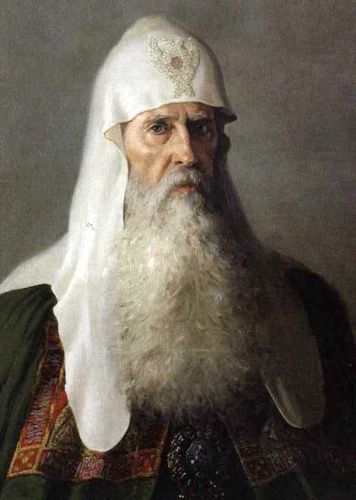
After Philaret, Joasaph I (1634-1640) became patriarch. He was Archbishop of Pskov. Joasaph I, had far less ambition than the previous head of the Church. It was Philaret, in fact, who appointed him as his successor. Under the tutelage of his father, Mikhail Feodorovich matured as a sovereign and politician, became strong in power, and now it was necessary to put this power of Michael incomparably above any figure of the patriarch. Therefore, Philaret had chosen as his successor a man not stupid, but inconspicuous - Joasaph I.
And so, as it happened. The position of the patriarch in the state changed at once. The title Great Lord has disappeared. The patriarch began to be called simply Great Sovereign.1 True, sometimes, probably by force of habit, or tradition, the Tsar asked advice on purely state affairs to the Patriarch. But Joasaph always tried to avoid any interference in these matters, thus revealing his different character from that of Philaret. Thus, for example, when once again there was a conflict with the Crimean Khanate, the Patriarch defiantly avoided the question of the outbreak of war. He replied that the business of the priesthood was to be prayerful and that state government was a royal affair. As a cleric he appealed for humanity: to ransom the prisoners with the treasury. As for vengeance, this is not the business of the hierarchs.
At the same time the attention of the Moscovites is increasingly attracted to questions of ritual and piety. Thus, under Joasaph there were considered such problems as polyphonic singing, lack of order and harmony during services, not only among the laity, but also among the clergy; questions of the unnecessary reduction of statutory liturgy, etc. However, in his attempts to bring order and decorum to the liturgical life of Moscow, Joasaph did not dare to make daring changes. These, however, were present in the highly active improvements in correction and printing of liturgical books. Ancient manuscripts from various monasteries were brought out for the purpose of comparing texts. An army of fresh, intelligent copyists was being created.
Patriarch Joasaph died on November 28, 1640. Election of a new Patriarch was postponed for more than a year. They were looking for a candidate loyal to the Tsar. The fact is that the last years of the life of Michael Fyodorovich and later of the reign of his son Alexy was a time of transition in the history not only of Russia but also of all Europe. It was a time of transition from the Middle Ages, with its domination of the role of the Church in the affairs of the state, to the Modern Age, when the state is on the contrary trying to free itself from this interference. The same processes are beginning in Moscow. Not yet openly, but steadily increasing.
From a period of stability after the Time of Troubles, under Patriarch Philaret in Russia, the ruling nobility - the big feudal lords - were heavily squeezed by the increasing influence of the Church. The influence and power of the clergy and hierarchy, of course, found its material equivalent in real estate: land, villages, estates… And the desire of the secular aristocracy was quite understandably upset: to put it mildly - that the future Patriarch was not able to lead the Church opposition in solving the urgent problems. Therefore, Tsar Michael decided to conduct an electoral procedure in the form of a careful filtering of the names of candidates.
The Tsar himself proposed his list of candidates, to be chosen by a three- stage drawing of lots. The choice fell on Joseph, Archimandrite of Moscow’s Simonov Monastery. On 27 March 1642 he was consecrated and had dinner with the sovereign.
The Russian Church under Patriarch Joseph
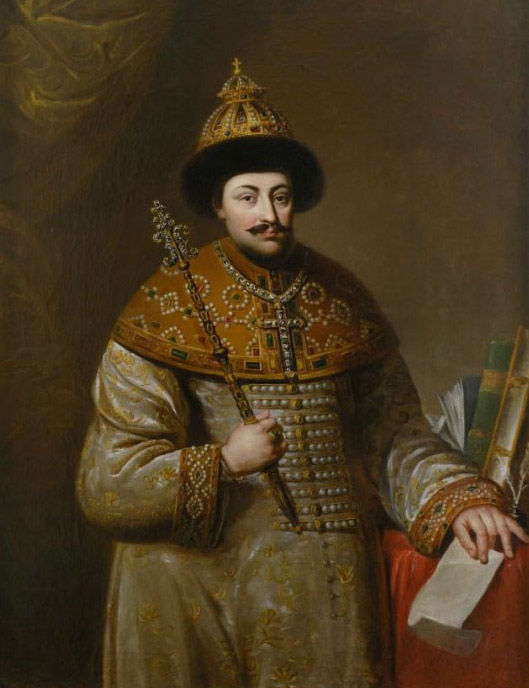 J
oseph was a representative of the old Moscow patriarchal era. He became uncomfortable when the 16-year-old Alexy Mikhailovich Romanov came to the throne in 1645.
The young sovereign took a new look at Moscow’s problems, including the structure and role of the Church in the state. He brought a new team with him, with new ideas and new energy. These westernized boyars tried to get their hands on church lands and therefore sought support in new church figures. They found them in the “zealots of piety”. That was the name given to a group of the capital’s clergy who sought to rectify church and civil life in Russia through the establishment of piety on the basis of strict adherence to church statutes and decrees of the Stoglav council of 1551. It was intended to regulate the whole ceremonial matter, to correct the liturgical books, to introduce every kind of piety into the churches and to establish schools. Thus, these were peculiar “reformers-restorers” who wished progressive changes on the basis of the conservative traditions of piety.
They were headed by the Tsar’s confessor, Protopopop (protopresbyter) Stephan Vonifatiev. Ivan Neronov, Protopop of the Kazan Cathedral on Red Square, was also here. These energetic and relatively young churchmen, reflecting in their sphere the reformist inspiration of their state friends and the general pacification of the country after the Time of Troubles, revived the dream of Moscow as the Third Rome. In general meetings with the Tsar (Patriarch Joseph was also invited) they decided to enhance the spiritual prestige of Moscow by dragging all the beauty and pride of the provincial clergy, particularly the popular priests - preachers - from the provincial cities to Moscow. It was necessary to show everyone with their own eyes the spiritual power and splendour of the Third Rome. Thus, Avvakum and Nikon, then little-known provincial priests, found themselves in Moscow.
As for the printing business, the Patriarch had practically no control over it. And the school business was arranged without his knowledge at all. Neither was the Sobornoe Ulozhenie (The State Edict) of the Tsar Alexey Mikhailovich, published in 1649. Concerning the Church, it dealt with the issues of Church land ownership and Church jurisdiction. The Ulozhenie forbade the clergy to acquire new lands - fiefdoms. Thus, the Church was deprived of the legal opportunity to increase its land holdings by purchasing fiefdoms and mortgaging fiefdoms “for the commemoration of the soul”. It was a bold decision for that time, so the Tsar relied on the authority of the whole Zemsky Sobor.
The Ulozhenie of 1649, however, did not stop the growth of the ownership of land by the Church. It continued afterwards, mainly due to royal grants. Thus, for example, the monasteries newly built by Patriarch Nikon: Voskresensky, Istrinsky, Iversky and Krestny2, - received extensive estates. Notwithstanding the Tsar’s grants of land to the Church, the rate of growth of Сhurch land tenure declined considerably. All monastic and Сhurch lands were transferred to the Monastic Prikaz (the state office) established by the Decree of Alexey Mikhailovich. It was the highest central judicial body for the clergy in the Moscow State. Thus, the Church landholding came under the control of the state.
In addition, the Ulozhenie of 1649 deprived the Church of some judicial privileges. As is known, Stoglav council established the jurisdiction of the clergy to the civil court only on criminal cases. Other cases were decided by the courts of bishops. The Ulozhenie significantly “corrects” this norm. The right and duty of the clergy court was now transferred to the Monastic Prikaz, a ministry of ecclesiastical affairs under the civil vertical of power. One of its main functions was specified in the text of the Ulozhenie: ”… for metropolitans, archbishops, and bishops, and their clerks and courtiers, and their peasantry, and monasteries… in all plaintiff’s lawsuits to be tried…”. Thus, the judicial privileges of the Church were diminished and the jurisdiction of clergy was brought under the general provision. Under ecclesiastical jurisdiction the Ulozhenie left all trespasses and crimes against religion.
The establishment of the Monastic Prikaz had significance also for the church- administrative field. In Russia before the adoption of the Ulozhenie a special department, a sort of state in a state, was the Patriarch’s court which included four offices: the Palace (in charge of the general management of the patriarchal fiefdoms), the Department (in charge of personnel), the Treasury (finances) and the Court.
The Ulozhenie of 1649 left under the Patriarch’s court control only the patriarchal region. To administer the other regions belonging to the Church organization was the same Prikaz. The creation of this new bureaucratic body was evidence of the strengthening of the state apparatus. According to the compilers of the new code, the establishment of the Prikaz was to secure the subordination of Church corporation to the general system of state authorities.
In general, assessing the provisions of the Ulozhenie, one can note the dual attitude of the legislator towards the Church. On the one hand, the Ulozhenie sought to limit the economic power of the Church and subordinate it to the state system of centralization, on the other hand, it “protected the dignity of the Orthodox Church”. The Church was taken under the protection of the law in order to protect its teaching, ideas and organization of Church life “from encroachments of its ideological opponents and violators of the established order”.
Of course, in creating the Statute the Tsar had not asked the permission of the aged Patriarch Joseph. But it would be unfair to reproach him for passivity. A number of Church “reforms” were carried out in direct opposition of the Patriarch. In 1649 the Patriarch had a conflict with Protopop Stephan Vonifatiev and indirectly through him with the Tsar himself.
The matter concerned ceremonial innovations introduced under the influence of the “zealots”. The Patriarch opposed the introduction of unanimity in singing and reading. At the beginning of the year 1649, he summoned a Council, the members of which condemned the opponents of polyphony, when different parts of the divine service were sung in different places of the church simultaneously. For example, in one place the sixth psalm was read, in another the kathisma, in a third the canon was read or some verses were sung. However, the initiator of this work was Metropolitan Nikon of Novgorod, who in the last years of the life of Patriarch Joseph enjoyed great influence in Moscow and controlled church affairs.
The Tsar supported Vonifatiev and did not approve the council act sent to him. Moreover, he refused the Patriarch’s demand to punish Fr. Stephan for publicly insulting the Patriarch and members of the “Consecrated Council”. It was precisely because of the decision of the Council of 1649 that the sharp exchange of words between the Patriarch and the Tsar’s confessor took place.
In Moscow, meanwhile, the book industry continued to expand and develop. However, for a full and systematic criticism of the texts of the books there was a lack of scientific knowledge, or proper explanatory and authoritative sources. The books continued to reproduce errors, grammatical and semantic, which were based on a fundamental flaw of the whole editing process (“sprava”): they were corrected according to the Slavonic models, without the Greek original.
The solution to these problems found expression in two events.
1. In order to equip his Scribes with the necessary knowledge, Tsar Alexey decides to break the ideological fence, erected around Moscow - the Third Rome, the guardian of the purity of Orthodoxy. Putting aside his fear of Latinism, he turns to Kiev: he writes to the Metropolitan of Kiev to send learned elders who know Greek and Latin. The creation of a school began.
This idea very soon found a living zealot for it in the person of boyar Fyodor Mikhailovich Rtishchev.
He was a favourite of the tsar and, fortunately, quite a wealthy man of means. He used his money for public charity: he set up a hospital in Moscow, an almshouse, and an infirmary for the wounded prisoners of the Polish campaign. This was a novelty for Moscow. But young Rtishchev was not only an innovator as a philanthropist. He was also the first Russian patron of the arts. He loved books and wanted to learn methodically.
In 16403 the boyar Fyodor decided to give shelter to learned monks sent from Kiev, on the model of the brotherhood monastery in Kiev. Not far from Moscow he arranged the Preobrazhensky monastery - a kind of monastic school, where the Kievers “learned the Slovenian and Greek grammar and even rhetoric and philosophy, wishing to listen to its teaching”. Rtishchev himself became a student in this school. During the day he served his public service, and in the evening sat at the desk to study Greek grammar under the guidance of elders in Kiev.
However, such a progressive undertaking caused quite an expected reaction: the meeting of Kiev’s schooling with Moscow’s unschooling caused a sharp ferment, intellectual and spiritual. The native Russian milieu, Moscow and provincial, reacted very negatively to the newly arrived scholarly outsiders. It was an oblique defensive reaction, based on the idea of spiritual superiority over both Greeks and Kiev Orthodox, in one way or another, due to the close proximity of the subject to Latin impurity. Paradoxically, such protective views in the style of the “Moscow is the Third Rome” idea also strongly influenced the Westernising Tsar Alexey.
2. In June 1649 the Trinity monk Arseniy Sukhanov was sent from Moscow to the Greek East. The aim of his mission was to collect the most ancient Greek manuscripts, as well as to observe the modern liturgical practices of the Greeks. Arseniy was a well-educated man: he knew Greek, Latin and Polish. He knew grammar, rhetoric and dialectic. He had three such journeys in all, and each time he returned with a large collection of books, as well as his own notes.
By the way Arseniy pointed out, that a lot of things between the Greeks and Moscow, didn’t agree: Greeks sang Hallelujah three times, they had five prosphorae, not seven; the processions were against the sun; baptism through dousing.
Speaking of the time of Tsar Alexey Mikhailovich, it is impossible to ignore the question of his own experience of power. He was firmly convinced of his vocation as an orthodox Tsar, equally responsible for the fate of the state as for the fate of the Church. In this he was a follower of the Byzantine theocratic idea. Moreover, he wanted to convert this ideological succession into an empirical one: to unite all orthodox nations under his rule. In part the Greeks themselves, who wanted to throw off the hated yoke of Islamic enslavement, were the catalysts of such ideas.
However, Moscow’s domination of the Orthodox world required convergence with the Greeks in ritual. The Tsar understood this too. It was on such grounds that Alexey’s motivation in his ceremonial and liturgical reform was based.
Seeing the future of Church affairs in Russia, Patriarch Joseph by the end of his life no longer wished to be Primate of the Church. As Kartashev writes, “Patriarch Joseph had a bitter resentment simply because the naturally sentimental Tsar Alexey transferred his sympathies to other clergymen, more flamboyant, particularly Nikon. The Tsar had no thoughts of self-rule in Church affairs. This is proved by his scrupulousness in the trial of Nikon: he did not dare to judge him without the direct participation of the Eastern Patriarchs”.
On 5 April 1652 Joseph fell ill with a cold and on the 15th - on Holy Thursday
- he died after the funeral service. After his death a large sum of money remained, which he had collected as he wished to buy a plot of land for his “repose”. Patriarch Joseph left no will, and all his savings, as directed by the Tsar, were mainly distributed to monasteries and churches.
The Russian Church under Patriarch Philaret
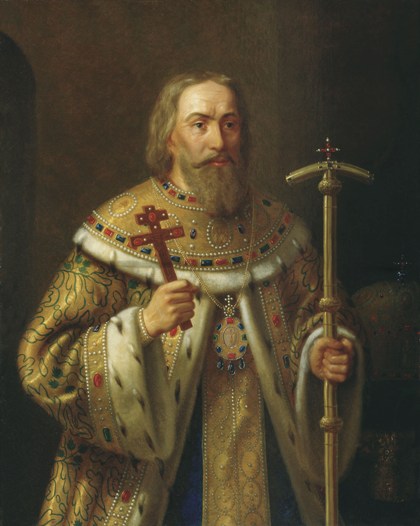
The period of absence of a Patriarch from the Russian Church ended on 1 June 1619, when Metropolitan Philaret Nikitich (Romanov), father of Tsar Mikhail Romanov, was released from Polish captivity following negotiations. The future Patriarch came from a boyar family, and was the maternal nephew of Ivan the Terrible.4 From his youth Feodor (as Philaret was called before his monasticism) was brought up in the court environment. Such memories have been recorded about him: “Intelligent, sharp-witted, inquisitive and well-read, he was amiable both with Russians and strangers… No one was able to ride better than he, there was no man in Moscow more beautiful than he, so his beauty has become a proverb: if the tailor, having created a costume, wanted to praise the customer, who was trying it on - he would say to him: “You are now quite Fedor Nikitich”.
After the death of the Tsar (Feodor Ioannovich) Feodor Nikitich became one of the legitimate pretenders to the Russian throne. But it was Godunov who rushed to power. Under false pretence, the whole Romanov family was punished. To get rid of his political rival Godunov banishes Fyodor to the North - to the Antony-Siysky monastery, where under pressure he takes the monastic vows of Philaret. False Dimitri I, who had replaced Godunov, begins a programme of rehabilitation for his “relatives” who suffered under Tsar Boris, to legitimise his power in the eyes of the people. Philaret is returned to Moscow and elevated to metropolitan of Rostov and Yaroslavl.
Little is known of Philaret’s relations with False Dimitry. Probably Philaret was waiting for the right moment, for the time being not showing his real attitude to the obvious impostor and his pro-Catholic sentiments. He was well acquainted with the mores of contemporary Moscow society, and even better acquainted with the world of politics. When the second False Dimitry appeared, Philaret zealously supported Patriarch Hermogenes in the struggle against the impostor and his accomplices. The metropolitan sends letters to the towns, calls for loyalty to the legitimately elected Tsar, warns against betraying the faith.
In 1608 the troops of False Dmitry II seized Rostov, where Philaret was. He was sent to the camp of the impostor. In order to create his alternative vertical of power (both secular and ecclesiastical) False Dimitry II appoints Philaret as patriarch. Patriarch Hermogenes was still alive. Interestingly, Hermogenes himself did not regard Philaret as a traitor, but as a prisoner. The freed Philaret participated in negotiations with Poles concerning the candidacy of the Polish tsarevitch Vladislav for the Russian throne. This diplomatic mission, however, came to a standstill. The Poles dispersed the Russian embassy and Philaret was sent to Poland. This was in 1611.
By the time Philaret returned (1619) his son had ruled for almost 6 years. Actually, it was for Philaret that the patriarchal throne had been left vacant for 7 years. Therefore, when he returned the question of the patriarchate immediately arose. On 24 June 1619 his enthronement was carried out by the former Patriarch Theophanes III of Jerusalem5 in Moscow.
The new Patriarch, a man of strong character and experienced in public affairs, immediately took power in his own hands. He began to help his inexperienced son in government. Above all he removed from the throne those whose influence on the sovereign was, in his opinion, not useful. And yet Philaret was specifically the Patriarch of the Russian Church, not a politician, so it was in this direction that he directed most of his energies.
For him there were many problems which he zealously undertook to solve. Particularly close to his heart was the question of the reception of Roman- Catholics and Uniates into Orthodoxy. The question was clear: by what means should they be accepted? Through baptism? Or by anointing? Or perhaps through repentance? These questions were placed on the agenda of a regular session of the Bishops’ Council on 16 October 1620. This was also an attempt (quite successful) to critically reassess the former practice, to which Metropolitan Jonah adhered, namely the reception of Roman-Catholics through chrismation. In condemning this view, Philaret made an accusatory speech. He argued that heretical baptism was not baptism. It was a triumph of Moscow conservatism. However, at the same time, the whole theological logic of Patriarch Philaret testified to a terrible decline in the level of knowledge of the Russian hierarchy of that time (and especially of Philaret himself) with a passionate anger towards Roman-Catholics. As a result, the all-Russian Church custom - to cross Roman-Catholics (it existed before) was confirmed as obligatory.
The second session of the same Council dealt with the question: by what rite should the Russians from Lithuania and Poland (“Belarusians”) be received into Orthodoxy? There were three Christian communities: Orthodox, Uniates, and Protestants. And here the nuance was the ritual side of Baptism: either through immersion, or through dousing. It was established that if the recipient was baptized through dousing, he had to be baptized again.
The time of the Patriarch’s absence was a period of stagnation in church printing. This was another area where Patriarch Philaret’s administrative talents were applied. The revival of the printing business began. In 1620 a printing-house, temporarily operating in the Kremlin after a fire, was transferred to the old place on Nikolskaya street, and it already had 70 printing presses.6 The editors there were very literate and highly educated people at that time. For them a special room, the so-called “Editor’s Room”, was set up. The business was so improved that during the time of Philaret’s patriarchate more printed books were published by the Moscow printing-house than during the whole period of Russian printing from its beginning under Tsar Ivan IV.
In order to take care of the order of worship in the Russian Church, the Tsar and the Patriarch generously sent out books to the churches at no commercial profit, at cost price, and to distant Siberia even completely free of charge. It is true that the high quantity was not always equal to the quality of the text. The work of correcting the books was woefully incomplete. Many inaccuracies were retained and even more so, legalized, as a true orthodox confession. Very soon this would lead to disagreements in the understanding of the text, to blind faith in its correctness and finally to schism.
During the Russian Time of Troubles of the 17th century many churches were destroyed or burnt down, there were no priests and no one to perform worship. Many pulpits lost their bishops, who had been tortured or who had fled the Polish intervention. All this had to be dealt with as a matter of urgency: to restore and build new churches, to ordain priests… The time of turmoil passed, and the state seemed at last to have entered a tranquil course of development. Now it was time for the spiritual and cultural restoration of the country. Moscow’s blatant backwardness from the West and even from the Polish Orthodox communities consisted in the complete absence of a systematic general and theological school.
Therefore, Philaret decided to establish a patriarchal school. In 1632 Archimandrite Joseph, a scholar who had been in Western Europe, but who knew the Slavonic language and partly Russian, arrived in Moscow as a protosynkell (a close aide) of the Alexandrian Patriarch Cyril Lukaris.7 He was appointed head of the school. True, the Patriarch Philaret never got round to completing the task. He died in 1633 at the age of 80. Joseph died a few months later. The Greek school was temporarily shut down.
Speaking of the significance of the person of Patriarch Philaret in the history of the Russian Church, it is important to note that in comparison with the other hierarchs, he was a peculiar figure in his unique position as the Tsar’s blood father. He was “co-celebrating” his son. All petitions were addressed not only to the Tsar but also to “the Great Sovereign, His Holiness the Patriarch”. Reports on public affairs were heard by the Tsar together with the Patriarch. Decrees and letters of supreme authority were written from both of them. Foreign ambassadors were also presented to the Tsar and the Patriarch.
The exclusive fullness of power of Patriarch Philaret had left its mark in the expansion of judicial and financial authority in his vast patriarchal diocese. Now all administrative and judicial cases (with the exception of criminal cases) were dealt with in special church courts. All former state taxes and his ecclesiastical taxes went into the treasury of the patriarch. This breadth of power of the Patriarch was unprecedented, and in fact a unique phenomenon: neither before nor after Philaret had the Primate of the Russian Church had such authority. Moreover, it was the elevation of the vertical of church power under Philaret that subsequently became a great temptation for the secular powers of Alexey Mikhailovich and, of course, Peter the Great.
And yet Philaret also played a major role in the statesmanship aspect: in strengthening the power of the Tsar in the face of boyar claims after the Time of Troubles. Apart from the weight of the monarch’s parentage, Philaret exercised Mikhail’s nominal autocracy with his supreme hierarchical authority. In the aftermath of the Time of Troubles, which degraded and profaned the mystique of all authority, this impact of Philaret on consolidating state power was unquestionably his historical merit. Patriarch Philaret was succeeded by Joasaph I.
Editorial Footnotes
Related Concepts
- absolutism
- alexey-mikhailovich
- arseny-sukhanov
- avvakum
- bishops-council-of-1620
- boyar-aristocracy
- byzantine-succession
- byzantine-theocracy
- byzantine-theocratic-idea
- church-courts
- council-of-1649
- dousing
- economy-and-akribeia
- greek-convergence
- greek-manuscripts
- greek-orthodox
- greek-ritual-convergence
- immersion
- ivan-neronov
- joasaph-i
- kiev-learning
- kiev-theological-school
- kievan-learning
- liturgical-order
- liturgical-reform
- moscow-as-new-constantinople
- moscow-conservatism
- nikon
- nikons-reform
- orthodox-tsar
- patriarchal-diptychs
- patriarchs-court
- peter-the-great
- philaret
- philarets-co-regency
- printing-house
- roman-catholics
- secularization
- sobornoe-ulozhenie
- sprava
- state-centralization
- statutory-liturgy
- stephan-vonifatiev
- stoglav-jurisdiction
- symphonia
- third-rome-ideology
- tsar-michael
- unanimity-edinoglasie
- zealots-of-piety
Footnotes
-
This inverts the actual change in titulature. Under Patriarch Filaret the patriarch had shared the tsar’s style “Great Sovereign” (Velikiy Gosudar), and it was precisely this exalted title that Joasaph I lost; he reverted to the more modest “Great Lord/Master” (Velikiy Gospodin). So it was “Great Sovereign” that disappeared and “Great Lord” that returned — the reverse of what the text says. ↩
-
The list appears to double-count one foundation. Nikon’s Voskresensky (New Jerusalem) Monastery stands on the Istra River, so “Istrinsky” is not a separate house but another name for the same monastery. Nikon’s three major foundations were the Voskresensky / New Jerusalem (on the Istra), the Iversky on Lake Valdai, and the Krestny on Kiy Island. ↩
-
The date is far too early. Fyodor Rtishchev was born in 1626 and would have been about fourteen in 1640; his “learned brotherhood” of Kyivan monks is dated by historians to roughly 1648-1650 and was established at the St Andrew’s (Andreevsky) Monastery below the Sparrow Hills, not a “Preobrazhensky” house. ↩
-
Filaret (Feodor Nikitich Romanov) was not a blood nephew of Ivan IV, still less a “maternal” one. His aunt Anastasia Romanovna was Ivan the Terrible’s first wife, which made Feodor a nephew of the tsaritsa — a relative by marriage — and a first cousin of Tsar Feodor I Ioannovich, not a nephew of Ivan himself. ↩
-
Theophanes III was the reigning Patriarch of Jerusalem (1608-1644), not a “former” patriarch. He was simply visiting Moscow (where he had come to confirm the election of the new Russian patriarch) when he consecrated Filaret in 1619. ↩
-
Seventy presses is implausibly high for the Moscow Print Yard (Pechatny dvor) of this era, which operated on the order of a dozen or fewer presses (stany). The figure most likely reflects a textual corruption or a confusion of units. ↩
-
By 1632 Cyril Lukaris was Ecumenical Patriarch of Constantinople, a post he held (with interruptions) from 1620 until 1638. He had earlier been Patriarch of Alexandria (until 1620), so describing him as the “Alexandrian Patriarch” at this date is anachronistic. ↩