History of the Russian Orthodox Church — Topic 7
- The Russian Church under Metropolitan Macarius
- The Stoglav Council
- The Russian Church in the last years of Ivan (John) IV’s life
The Russian Church under Metropolitan Makarius. The Russian Church in the
last years of John IV’s life
- The Russian Church under Metropolitan Makarius
- The Stoglav Synod
- The Russian Church in the last years of Ivan (John) IV’s life
The Russian Church in the last years of Ivan (John) IV’s life
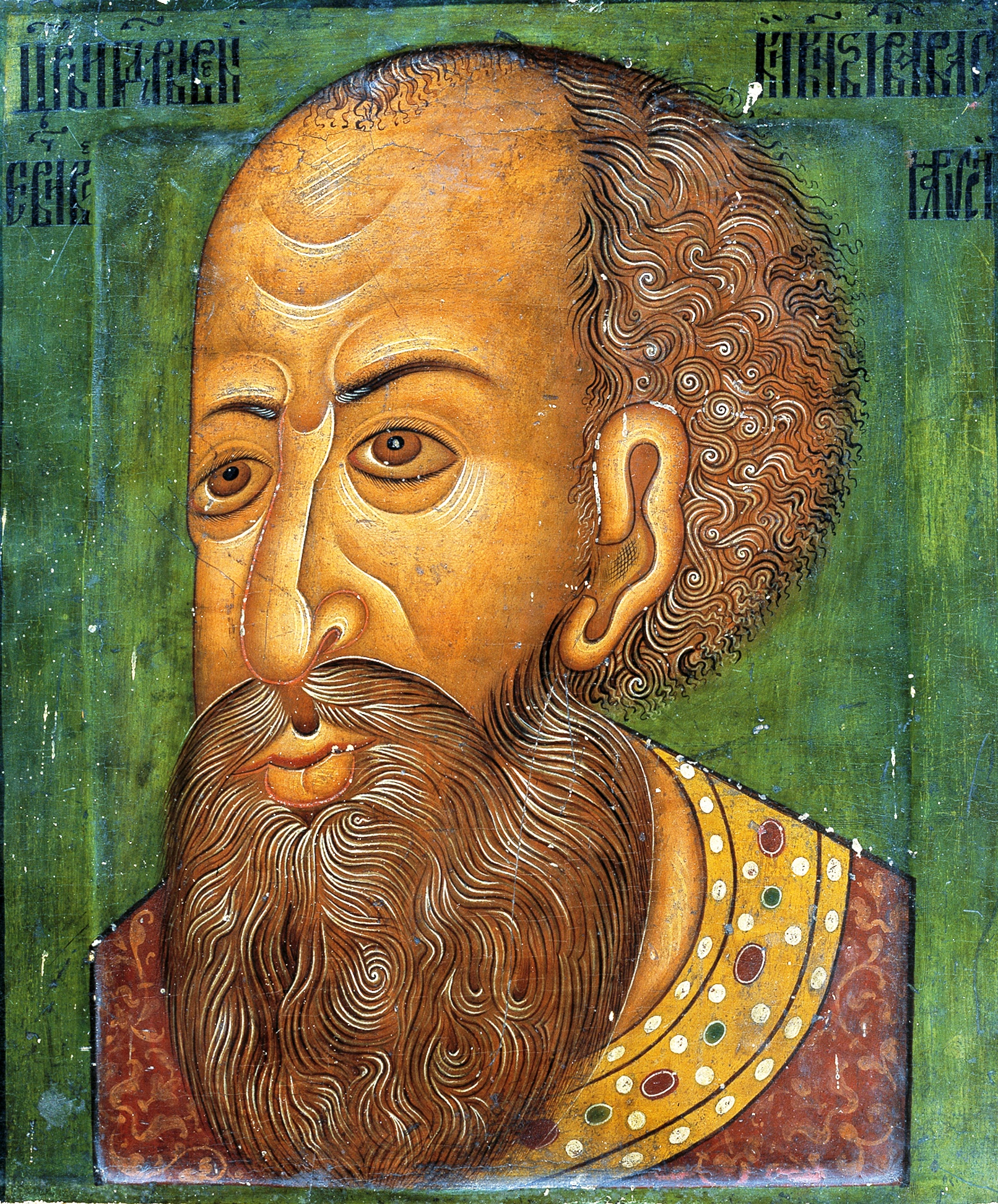
After the coronation, which took place on January 16, 1547, the power of Ivan IV in the affairs of the church increased even more than before. He takes an active part in the reorganization of church life. This was shown by the example of Stoglav, where Ivan participates in the discussion of church needs with a clear understanding of his duty to “take care of the organization of Orthodox Christianity” under the fear of God’s punishment for neglect.
Metropolitan Macarius, who in his literary activity was a zealous servant of the idea of the exaltation of the Moscow tsar, also contributed to the growth of the Russian monarchy. The Eastern patriarchs, who had been struggling under the Islamic yoke for almost a hundred years, stood on the same path. In anticipation of financial support from the Russian sovereign, they tried in every possible way to flatter his power. Ivan did not fail to take advantage of this, and decided to ask the Ecumenical patriarch for a formal confirmation of the royal title he had accepted. Rich charity had done its job. In 15621 Patriarch Joasaph II sent a “conciliar letter” to Russia, which gave Ivan Vasilyevich the right to be called the tsar-vasilevs. In a special message, the patriarch declares the Moscow sovereign “the tsar and sovereign of Orthodox Christians of the entire universe from East to West and to the ocean,” informs Ivan Vasilyevich that his name will be remembered in the East in holy diptychs - “may you also be among the kings, like the equal-to-the- Apostles and glorious Constantine.” Thus, the idea of “Moscow – the Third Rome”2, which reigned in the minds of Russian intellectuals, was directly or indirectly perceived in the East.
The Russian Tsar’s recognition as the patron saint of all Orthodox Christians in the world, Constantinople silently liquidated its previous excommunications imposed on the Russian Church for the unauthorized installation of Metropolitan Jonah.3 The difficult situation of the churches of the East was solved by another case in favor of Moscow. In general, Tsar Ivan Vasilyevich had many reasons, mainly given to him by representatives of the Church, to look at his power as theocratically absolute. And over time, he himself begins to perceive his own power as a God-established principle. Resisting her is equal to resisting God.
In 14644, Metropolitan Macarius was succeeded by the former royal confessor Athanasius (1564-1566).
The time was not the most favorable: the power of the tsar, both in fact and in the mind of the ruler, swelled enormously. Any force that stood in his way was inevitably doomed to destruction. And since historical tradition did not allow metropolitans to completely withdraw from politics, but on the contrary, obliged them to participate in it (at least morally), the position of the primate under such an absolutist regime became very dangerous.
The death of Metropolitan Macarius, and three years earlier – in 1560 – of his beloved wife Anastasia greatly influenced the inner life of Tsar Ivan IV. Now there were no restraining factors that corrected his temperament. The explosion did not take long to happen. And its first wave fell on the boyars – the very ones that so greatly humiliated his royal dignity in his youth. In addition, the obstinate boyars were a serious obstacle to strengthening the absolute power of the monarch.
On December 55, 1564, the Tsar left Moscow, taking with him the wife, children, court boyars, bodyguards, the palace treasury and shrines. He stopped in Alexandrovskaya Sloboda, from where on January 3, 1565, he wrote a letter to Metropolitan Athanasius, in which he enumerates the abuses and treasons of the boyars, accuses the clergy of interceding for traitors. The Tsar knew that the common people would come to repentance, they would not be able to do it without the Tsar, which would untie his hands. He writes to the people of Moscow that he has no anger against them.
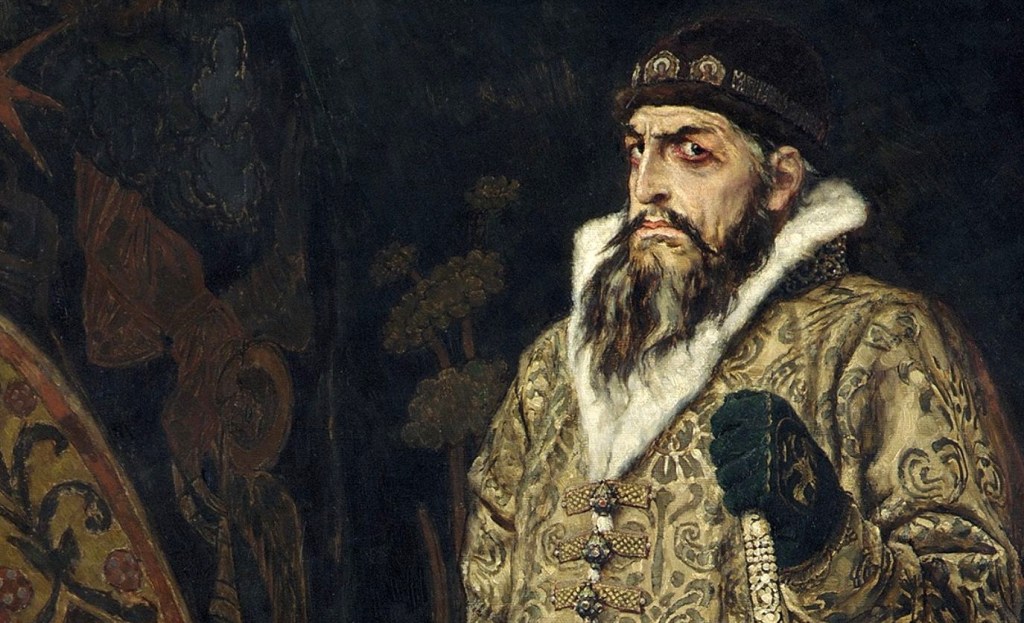
The trick worked. Struck by this news, the Moscow society of all classes began to entreat Metropolitan Athanasius with a request to beg the Tsar not to leave his state. They organized a deputation of elected people, headed by Archbishop Pimen of Novgorod. The Tsar said that for the sake of the metropolitan and ordinary believers, he agrees to take power over the state, but on condition that the clergy do not interfere with him with their petitions when he executes traitors.
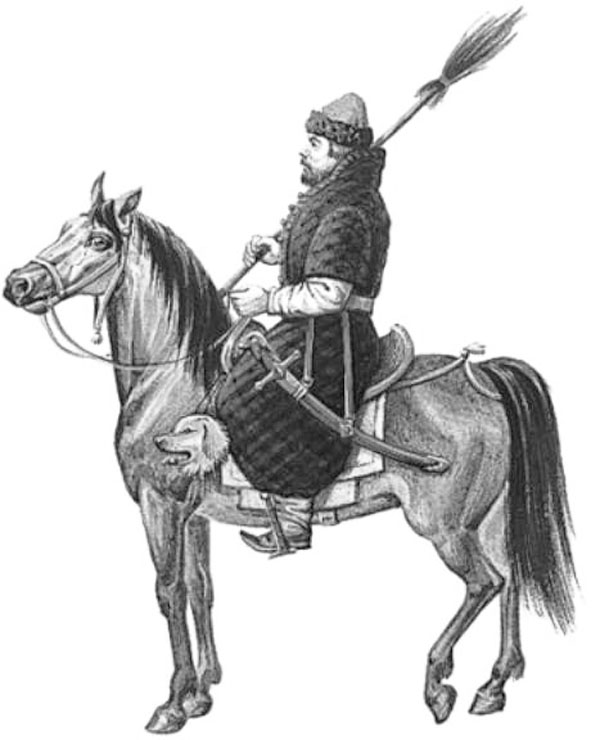
The condition was accepted, and Ivan immediately announced the establishment of a new government body — the oprichnina. There was its own vertical of power, composed of oprichniks subordinate only to the Tsar, to whom the monarch appointed ancestral princely lands. He sent the old boyars to new distant and alien regions. By depriving them of their land, he deprived them of their former power. But it was not only by migrations that the Tsar fought with the old boyar aristocracy. There were simpler ways - torture and execution.
The Church was a witness to all the horror that flooded the Russian land. And the Church could not remain silent in the face of terror. It could not help but protest, for moral reasons, against the inhuman cruelties of Ivan Vasilyevich that accompanied the policy of the oprichnina. After a little more than two years of administration of the metropolis, on May 16, 1566, Athanasius voluntarily retired from the pulpit to the Chudov Monastery. In July of the same year, the Tsar proposed to the bishops’ council to choose a new metropolitan. The choice fell on Archbishop Herman of Kazan.
The Archbishop of Kazan did not agree for ages, to accept the metropolitan dignity. He was actually forced to accept the succession. Herman, after his election, had an unpleasant conversation with the Tsar, in which he exhorted him to abandon his persecutions and cruelties. This immediately turned the ruler against the metropolitan. The close oprichniks, in turn, told the Tsar that Herman was a bad adviser, that he was a threat to the tsarist government. Ivan Vasilyevich heeded the voice of his entourage and expelled St. Herman.
The new metropolitan was the abbot of the Solovetsky monastery, Philip (1566-1568). He came from a boyar family – the Kolychevs. His father was in the Boyar Duma under Vasily III. Becoming the abbot of Solovki, Philip quickly showed an extraordinary economic ability. In the early 50s. in Moscow, he met Ivan IV, from whom he earned a special favor. Perhaps, expecting gratitude and agreement in return, the tsar pointed out his candidacy for the metropolitan see.
However, Philip, summoned to Moscow, and confronted with the fact of election, frankly set a condition for his part – to cancel the oprichnina. This could have been enough to expel him, but the king did not show anger. The enthronement took place on July 25, 1566.
A year later, in July 1567, a wave of terror swept through the country. The reason was intercepted letters from the Polish king to some of the boyars. The latter sought support and protection from the Moscow primate. Philip decided to appeal to the Tsar with a pastoral exhortation, but to no avail. Moreover, the metropolitan himself falls under the wrath of Ivan. There were those among the higher clergy who wanted to take advantage of the situation. The bishops of Novgorod, Smolensk and Ryazan, together with the confessor of the Tsar, Evstrafiy, began to inform on the metropolitan.
At the same time, the metropolitan, apparently already feeling the approach of a tragic denouement, raised his voice against the Tsar’s lawlessness. In March 1568, the Metropolitan addressed Ivan Vasilyevich in the Assumption Cathedral with an open denunciation of unjust cruelties. More than once he publicly blamed the Tsar and his entourage.
Denouncing the Tsar, the saint risked his position and even his life. But at the same time, he also won in moral popular authority.
However, in the eyes of the Tsar, the metropolitan had already lost any authority. So, on July 28, during the procession at the Novodevichy Monastery, Philip quarreled with the Tsar. This was the last straw. The council was assembled. It was the most shameful council in the history of the Russian Church, revealing the depth of the crisis not only in the state, but also in spiritual life. Among the accusations against Philip were accusations of witchcraft. Fellow bishops deprived Philip of his metropolitan dignity. However, the king did not let Philip leave so easily. He ordered him, as Metropolitan, to lead the divine service in the Assumption Cathedral on the day of the Archangel Michael.
On November 8, 1568, Fyodor Basmanov, bursting into the church with a crowd of oprichniks, announced to the metropolitan during the service that he had been deprived of his dignity. He was stripped of his holy vestments, dressed in a tattered monastic cassock and expelled from the church. Philip was placed under arrest in the Epiphany Monastery. A few days later, the saint was brought to hear the final verdict, by which he was condemned to eternal imprisonment.
The place of Metropolitan Philip’s last imprisonment was the Tver Otroch monastery. On December 23, 1569, at the behest of Ivan the Terrible, he was strangled by Malyuta Skuratov.6
The example of Metropolitans Herman and Philip forced Tsar Ivan IV to change his approach to metropolitan candidates. Now he deliberately did not allow people of high birth to take up this post, who could look at his policy from the angle of the old aristocratic traditions. The three subsequent metropolitans could no longer oppose anything to the Tsar, and allowed him to “do everything.”
Two years after Philip’s overthrow7 – on November 11, 1568 – the Trinity monastery archimandrite Kirill (1568-1572) was put in his place.
Under him, the ferocity of Tsar Ivan the Terrible reached extreme limits. In 1570, Tsar Ivan defeated Novgorod8, and on the way back he went to Pskov. It looks like the city was waiting for the same fate. At the main Trinity Cathedral, together with the clergy, the Tsar was met by the abbot of the Pskov-Pechersk monastery, Cornelius. By conspiracy or by the spontaneous arousal of the personal suspicions of the Tsar, he was captured. Perhaps the abbot’s acquaintance with Andrei Kurbsky played a role. The king personally killed Cornelius.9
Metropolitan Kirill did not try to resist the arbitrariness being created. He died in 1572 in Moscow.
In May of the same year, a new metropolitan was elected - Archbishop Anthony of Polotsk. Very little is known about him. He was at the bishop’s chair from 1572 to 1581. By him, in May 1573, a church Council was held, at which questions about the monastic lands were resolved. The Council decided that large monasteries with many lands should not acquire them in the future. And small monasteries, which have little land, should be given new territories only with the permission of the sovereign. And the Council of 1580 forbade the Church to acquire and take land holdings as deposits. By these decisions, carried out through the councils by Ivan IV, the secular power weakened, perhaps, the most powerful feudal lord in Russia – the Russian Church. In his time, in 1579, the miraculous Kazan Icon of the Mother of God appeared.
The metropolitan died in early 1581. In February of this year, the Khutyn Archimandrite Dionysius (1581-1587) was appointed metropolitan. He witnessed the last days of Ivan IV’s life and the beginning of the reign of his son Fyodor.
Dionysius was an educated and eloquent man, for which he received the name of the “wise grammarian”. We also don’t know very much about him. The arch pastoral ministry of His Grace Dionysius took place in a tense atmosphere, when there was a struggle for the royal throne between Boris Godunov and the Princes Shuisky. The metropolitan sought to reconcile the warring parties and for a while he achieved success in this. The financial needs of the state were such that this metropolitan had to give up many benefits of church land ownership at the Council of 1584.
In general, by that time the situation of the Russian metropolitans had deteriorated so much that it became possible to remove them from the pulpit at the will of the secular government. So, it happened this time. Taking the side of Shuisky against Godunov, Dionysius denounced the latter. However, an experienced diplomat Boris, in the face of Tsar Fyodor, managed to beat his opponents, and instigate slander and persecution against the Shuisky and their accomplices. In 1587, Dionysius was deprived of the pulpit and exiled to the Khutyn monastery, where he died the same year.
The chosen one and Boris’s favorite, Archbishop Job of Rostov, became the first Russian patriarch.10
The Russian Church under Metropolitan Macarius
The successor of Joasaph on the metropolitan throne was Macarius (1542-1563).
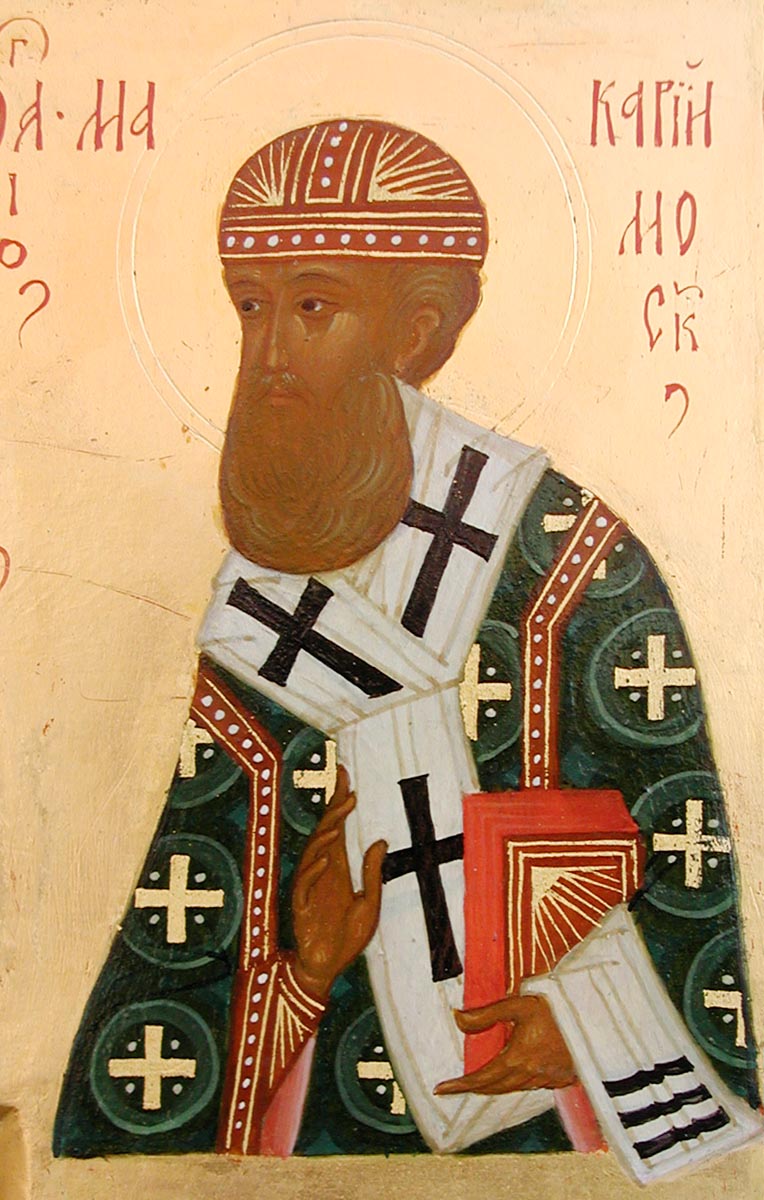
The future Metropolitan was born in 1481 or 1482. He was married, but after being widowed and losing his daughter, he took vows at the Paphnutievo- Borovsky monastery. Then he became the archimandrite of the Luzhetsky Feropontov Monastery (near Mozhaisk). It was probably here that he met Vasily III. In the Luzhetsky Monastery, Macarius showed both his talents and, above all, his talent for teaching.
Macarius was known to his contemporaries as a man of deep intelligence and education. However, it is worth noting that this education should still be understood in the context of the history and culture of the 16th century. At that time, unsystematic quantitative teaching was considered education, and only in the traditional theological sphere. Macarius does not have any special knowledge of non-theological subjects.
One way or another Macarius’s talents were sufficient: Grand Prince Vasily III nominated him in 1526 to the post of Archbishop of Novgorod, which had been empty for 12 years11. Novgorod, although it submitted to Moscow, still experienced separatist inertia – every now and then it boiled up with local discontent against the Moscow rulers. The Grand Prince had been looking for a long time for a man who would be equally pleasing to Moscow and Novgorod, moderate and tactful in his demands. And Vasily found him in Macarius.
In Novgorod, the new archbishop took up the case with pastoral zeal for the observance of church orders, and succeeded in this. He tried not to burden the clergy with taxes and protected them from the arbitrariness of officials. Perhaps because he himself was once a family priest, Macarius sympathized with the married clergy.
As for the monasteries, the archbishop introduced a cenobitic charter instead of the cell rule that reigned everywhere. This created uniformity and order in the monasteries. In addition, general or male/female monasteries were abolished. Several monasteries were allocated to nuns, where only a married priest was placed for worship.
Archbishop Macarius also worked in the missionary field among the Novgorod Finns. Being nominally Christians since the XIII century, they actually still lived in traditional paganism. The archbishop addressed them with exhortation and perseverance. To the negligent clergy, assigned to preach among foreigners – with strict exactingness.
In general, through his pastoral ministry at the Novgorod department, Archbishop Macarius inclined the hearts of the recently conquered Novgorodians to himself and to Moscow, which was a significant contribution to the internal unity of the state.
It was not surprising that Macarius was transferred from Novgorod to the metropolitan see. This happened in 154312. He was invited by the all-powerful Shuisky party, which hoped to see in him not only a wise confessor, but also a public leader of the Novgorod land. However, Macarius himself was not very happy about such a change in life, since he remembered the fate of the two previous metropolitans (forcibly deposed). He was clearly aware that in the midst of the political struggle of two boyar clans – Shuisky and Belsky – all this could happen again, only with him.
After becoming metropolitan, Macarius had to decide on the policy of his actions. Of course, he understood that the boyar struggle would soon stop, the heir would mature and take the rightful parental throne. Therefore, shunning boyar partisanship, the metropolitan tried to maintain neutrality in political affairs, while retaining the traditional right to grieve before the sovereign for all the persecuted and offended.
In addition, at this time he was actively engaged in mostly literary works and systematization of his archeographic materials.
In general, he did not justify the hopes placed on him by the Shuisky party. His dissenting opinion was revealed almost immediately after his elevation to the metropolitan throne. In 1543, when Theodore Vorontsov, who was close to Ivan IV, was attacked by supporters of the Shuisky, Metropolitan Macarius interceded for the boyar. This was a vivid expression of the primate’s independent position, and even more so – contrary to Shuisky. The metropolitan’s mantle was torn, which was not just a manifestation of rudeness or impudence, but a symbolic sign – a reminder and a threat. Fortunately, the conflict was limited to this. The Metropolitan understood that there was still a lot to endure in order to finally start acting for the benefit of the Church and the state after John came of age.
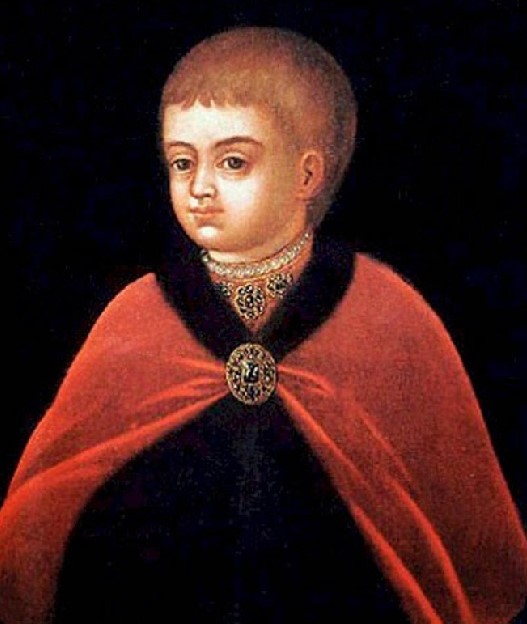
Meanwhile, the future tsar Ivan the Terrible was growing up. His childhood was terrible. He did not know his father, since Vasily III died when John was about three years old. His childhood was marked by the years of the boyar troubles. Bloody feuds, massacres that happened even in the royal palaces - all this, of course, was postponed in the child’s mind, forming the dark sides of his character. When his mother, Elena Glinskaya, died, Ivan was 8 years old. No one considered the little sovereign. He was bullied. He constantly went hungry, poorly dressed, lived in cold rooms. The treasury was being plundered. The future tsar saw all this perfectly and remembered it.
The worst thing was that no one was involved in his upbringing, no one realized that this child needed to be prepared for state activity. The only one who positively influenced the formation of the personality of the future monarch was Metropolitan Macarius. He managed to instill in the young man an interest and taste for literature. However, with a fair amount of reading, young Ivan remained absolutely ill-mannered, rude. The metropolitan restrained his unbridled temper as best he could, which had already formed in him (the saint was elevated to the metropolis when John was already 12 years old).
Of course, under the influence of the metropolitan, the 16-year–old Ivan makes an extremely important decision in the political sense - to get ‘married’ (crowned) to the kingdom. It is known that Macarius was a zealous supporter of the idea of “Moscow – the third Rome”, which elevated the Moscow state to the status of a world Orthodox power. And, consequently, the Russian ruler also presented himself as the successor of the sacred authority of the Orthodox emperors of the East. In this logic, the prestige of the Russian Church rose extraordinarily in the face of the Eastern patriarchates enslaved by the non- orthodox Turks.
Now this idea had to be formalized, placed in a canonical framework. And although Ivan III and Vasily III still called themselves kings, they were not crowned according to the Byzantine rite, so their status was not recognized by other powers.
The coronation took place on January 16, 1547. St. Macarius placed on John the cap of Monomakh, the cross and the barmah.
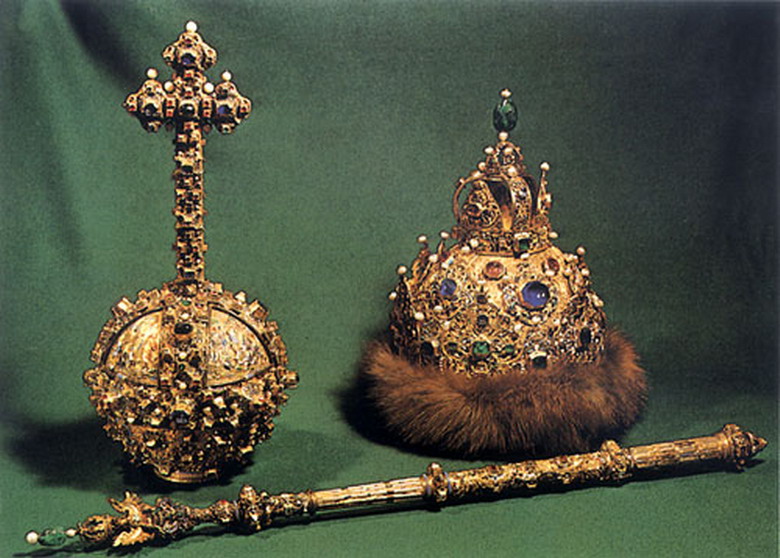
With this act, the metropolitan wanted to touch another internal mechanism in Ivan’s mind. He hoped to motivate him to a policy of elevating Russia internally and externally, so that she would become worthy of her new, high title.
Ivan, by nature receptive and energetic, immediately entered into the spirit of those prospects of power that the metropolitan opened to him in royal dignity. He decided to renew himself internally and renew the kingdom entrusted to him. By the way, his first wife Anastasia Romanovna Zakhariina- Yurieva, who was distinguished by an unusually meek, bright and pious character, helped him in this. She later had a very beneficial effect on the young sovereign.
Thus, Anastasia and Macarius were the restraining forces that not only curbed Ivan’s negative tendencies, but also pushed him to state transformations.
The generator of reformist ideas was the so–called Elected Rada13 - a close circle of like-minded people and friends of Ivan IV. This is not a government body, not a Boyar Duma, but a circle of trusted advisers of non-noble origin: among them is the okolnichy Adashev, Metropolitan Macarius himself, and the Annunciation Protopop Sylvester. The latter also had a special influence on the tsar. Frequent conversations with spiritual friends and advisers gave rise to a strong penitent feeling in the young tsar about his former neglect of his state duties.
But it was not only state life that required reforms. The Russian Church, being the largest Orthodox local Church, and the most powerful, at the same time continued to suffer from obvious everyday shortcomings. Therefore, the metropolitan considered it his vital task to correct the accumulated shortcomings with the help of the Orthodox tsar, and to bring the inner life of the Russian Church to unity of image and action. This was the purpose of the council convened in 1551. His decisions were set out in 100 chapters, which is why the council was called the Stoglav (Hundred-Domed)14.
The Stoglav council
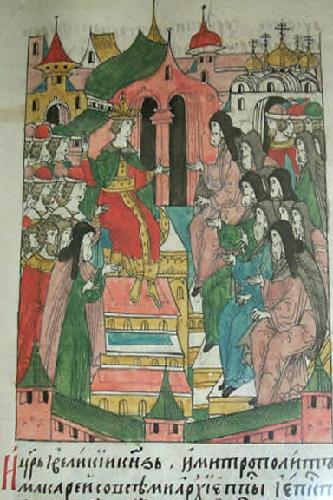
The Stoglav council became an epoch-making event in the life of the Russian Church. It was as if it projected from the past a model of the symphonic structure of the kingdom, in which the ruler, as an external bishop, was aware of the right and duty to take care of the affairs of the Church. Tsar Ivan IV acted in this spirit. He presented to the council on his own behalf a list of issues concerning various church structures. The topics covered were very different: from liturgical to disciplinary. High on the list was the controversy between the Josephites (of whom Metropolitan Macarius was also a supporter) and the party of non-possessors supported by the tsar.
The Council of 1551 was an attempt to revise all aspects of Russian Church life in order to purify it, if possible, from all its shortcomings. To some extent, it became possible to do this: a number of corrective regulations were drawn up regarding the diocesan administration, the diocesan court, the life of the higher and lower clergy, monastics and laity.
However, all these were issues of a local temporary nature. Stoglav’s decisions hardly touched any deep foundations of spiritual life. Moreover, in a number of cases, the decisions of the Council had a directly negative significance for the further church life of Russia. In part, they served as the canonical basis for the future schism in the XVII century. For example, resolutions on mandatory Hallelujahs, double-digit finger formation, on the prevention of shaving, etc. These ritual norms of the 16th century were elevated to the degree of an absolute and enduring norms.
The Western world of the 16th century was experiencing a Reformation crisis, the wave of which reached the limits of the Moscow state. Their conductor was traditionally the neighboring Polish-Lithuanian Commonwealth15, where Protestantism had an impressive spread. In 1553-1554, a council was held that condemned heretics. Under the influence of reformist ideas, a new heresy appeared in Russia, which took on a Protestant doctrinal character: the Deity of the Son and the equality of His Father were not recognized; the Eucharist was considered simple bread and wine. Icons, the sacrament of penance, the works of the holy Fathers, the decrees of councils and all church rites, etc. were denied. Actually, it was Russian outrage at Lutheranism. The method of repair was the traditional exile to monasteries – for repentance and re- education.
Metropolitan Macarius died on December 31, 1563. Before the election of the new All-Russian bishop, Ivan addressed the council with a proposal to give the metropolitan the preferential right to wear a white hood with cherubs, following the example of the saint metropolitans Peter and Alexy.
On February 24, 146416, a new metropolitan was elected – the former confessor of the tsar and protopop of the Annunciation Cathedral, Sylvester17, who took the veil at the Chudov Monastery with the name Athanasius.
Editorial Footnotes
Related Concepts
- 15531554-council
- boyar-aristocracy
- byzantine-legacy
- cap-of-monomakh
- christianization
- church-and-power
- church-crisis
- church-property
- church-protest
- church-reform
- conciliar-decisions
- conciliar-judgment
- coronation
- coronation-of-ivan-iv
- eastern-patriarchates
- ecumenical-patriarch
- martyrdom-of-st-philip
- metropolitan-philip
- metropolitan-resistance
- mission
- monasteries
- monastic-exile
- moscow-as-spiritual-centre
- moscow-third-rome
- novgorod
- oikonomia-in-politics
- oprichnina
- pastoral-administration
- pastoral-care
- pastoral-exhortation
- pastoral-reform
- patron-of-all-orthodox-christians
- reformation-crisis
- ritual-theology
- ritual-vs-dogma
- royal-authority
- royal-priesthood
- russian-church-prestige
- russian-monasticism
- secularization-pressure
- stoglav
- stoglav-council
- tsar-vasilevs
- tsarist-absolutism
- tsarist-pressure
Footnotes
-
The conciliar letter (gramota) of Patriarch Ioasaph II of Constantinople confirming Ivan IV’s imperial title is generally dated 1561 (issued late 1560/1561 and received in Moscow in 1562), rather than 1562. It is also worth noting that modern scholars have questioned the authenticity of some of the hierarchs’ signatures appended to it. ↩
-
The influence of the “Moscow—Third Rome” idea in the 16th century is significantly overstated here. Current scholarship (e.g., Marshall Poe) holds that Filofei of Pskov’s formula was a marginal monastic notion with little political currency at the time; its supposed role as a state ideology is largely a construction of 19th- and early-20th-century historiography and was not, in fact, “reigning in the minds of Russian intellectuals.” ↩
-
The claim that Constantinople had formally excommunicated the Russian Church over the uncanonical installation of Metropolitan Jonah (1448) is traditional but poorly documented. No surviving act of excommunication is known; historians generally describe the post-1448 situation as a de facto breach and non-recognition of Moscow’s autocephaly rather than a formal anathema later “lifted.” ↩
-
Error: this should read 1564, not 1464 (a century slip). As the parenthetical “(1564-1566)” in the same sentence confirms, Macarius died on 31 December 1563 and Athanasius was elected in 1564. ↩
-
Ivan IV’s departure from Moscow for Alexandrovskaya Sloboda, which initiated the oprichnina crisis, is more commonly dated to 3 December 1564. ↩
-
This account derives from Philip’s hagiographic Life. The strangling of the deposed metropolitan by Malyuta Skuratov on 23 December 1569 is the traditional version; while widely repeated, its specifics rest on the saint’s Life rather than on independent contemporary documentation, and some historians treat the circumstances as uncertain. ↩
-
Internal contradiction. Kirill’s elevation is given here as 11 November 1568 — the same year (indeed only days after) Philip’s deposition on 8 November 1568 — so it cannot have been “two years after” that event. Kirill held the see 1568–1572. ↩
-
“Defeated” badly understates the event. The 1570 action against Novgorod was a prolonged massacre and sack of the city by the oprichnina; casualty estimates vary enormously, from a few thousand in cautious modern assessments to tens of thousands in the chronicle tradition. ↩
-
That Ivan personally killed Abbot Kornily (Cornelius) of the Pskov-Caves Monastery in 1570 is a later tradition rather than a securely documented fact; the manner — and even the agent — of his death is uncertain, a tentativeness reflected in the text’s own hedging (“By conspiracy or by the spontaneous arousal of the personal suspicions of the Tsar”). ↩
-
Imprecise. By the time Job became the first Russian patriarch (in 1589, with the participation of Patriarch Jeremiah II of Constantinople) he was Metropolitan of Moscow; “Archbishop of Rostov” was his earlier post, not the office he held at his elevation to the patriarchate. ↩
-
The Novgorod archbishopric had in fact stood vacant far longer than 12 years — roughly 17 years, since the deposition of Archbishop Serapion in 1509 — before Macarius’s appointment in 1526. ↩
-
This contradicts the date given earlier in the same lesson (Macarius “1542-1563”) and the standard chronology: Macarius was installed as Metropolitan of Moscow on 19 March 1542, not 1543. ↩
-
The “Chosen Council” (Izbrannaya Rada) as a defined institution is a debated construct. The term itself comes from Prince Andrei Kurbsky’s later polemical writings, and some historians doubt it ever existed as a formal body; the membership lists (including Macarius’s participation) are correspondingly uncertain. ↩
-
Mistranslation. “Stoglav” means “Hundred Chapters” (Russian sto = hundred, glava = chapter/section), referring to the 100 chapters into which the council’s acts were divided — not “Hundred-Domed.” ↩
-
Anachronism. In the 1550s the territory in question comprised the separate Kingdom of Poland and Grand Duchy of Lithuania; the unified Polish-Lithuanian Commonwealth (Rzeczpospolita) came into existence only with the Union of Lublin in 1569. ↩
-
Error: this should be 1564, not 1464 (again a century slip), consistent with Athanasius’s tenure of 1564–1566 noted earlier in the lesson. ↩
-
Error of identity. The metropolitan who took the name Athanasius was, in the world, named Andrei — the archpriest of the Annunciation Cathedral and the tsar’s confessor. He was not “Sylvester”; Sylvester was a different Annunciation archpriest (the figure associated with the Chosen Council) who never became metropolitan. ↩