History of the Russian Orthodox Church — Topic 2
- The emergence of Christianity on the lands of the future Russian Church
- The pre-history of Bapism of Russia (Rus)
- The Baptism of Russia (Rus)
- The structure of the Russian Church in the Kiev period
The Baptism of Rus
- The emergence of Christianity on the lands of the future Russian Church
- The pre-history of Bapism of Rus
- The Baptism of Rus
- The structure of the Russian Church in the Kiev period
The Baptism of Rus
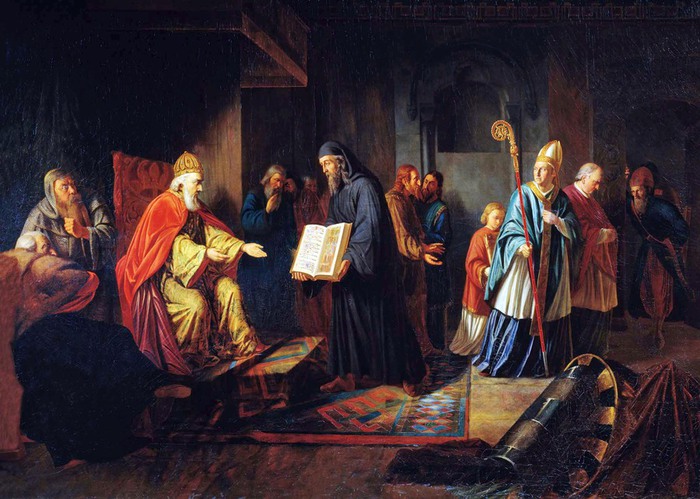
Saint Olga wanted to pass on his Christian beliefs to his son Svyatoslav, but he remained a pagan. After the early death of Svyatoslav, Prince Vladimir began to rule.1 Olga told her grandson a lot about Christianity, but he also did not want to accept it at first. However, the will of God influenced Prince Vladimir to take the right path.
In 9862, various missionaries from Volga Bulgarians (Muslims), from the Roman Pope, Jews from Khazaria and an Orthodox Greek philosopher came to Vladimir in Kiev with an offer of their faiths. Vladimir asked everyone what the faith and moral teaching was, and he himself made a choice. The Mohammedanism proposed by the Bulgarian ambassadors, although the prince liked it for the sake of the sensual paradise promised by Mahomet, was, however, rejected when it turned out that Mohammedanism requires circumcision, not eating pork and not drinking wine. To the ambassadors of the Pope, Vladimir said: “Go back where you came from, for our fathers did not accept this.” A dialogue took place with the preachers of Judaism, which Vladimir ended with the phrase: “How do you teach others, when you are rejected by God and scattered? If God loved you and your law, you would not be scattered in foreign lands. Or do you want the same for us?”
The Greek philosopher’s speech was quite lengthy. He tried to arouse the prince’s displeasure with Mohammedanism and Latinism by pointing out their shortcomings, then revealed the history of the Old and New Testaments and finally showed a picture of the Last Judgment. This had an effect on Vladimir, sighing, he said: “It’s good for these on the right side and woe to those on the left side,” however, he replied to the philosopher’s offer to be baptized: “I’ll wait a little longer.”
In 987 Vladimir called his advisers to decide on the choice of faith. The prince was given this recommendation: “Know, Prince, that no one scolds his own, but praises. If you really want to find out everything, then you have ambassadors. Send them to find out who has what service and who serves God how.” 10 ambassadors were chosen and sent - “kind and sensible men”. They visited the Volga Bulgarians, the Latins and Constantinople. Having learned about the purpose of their arrival, the Patriarch of Constantinople performed a solemn divine service. The impression was strong: “they did not know whether they were in heaven or on earth.” Upon arrival in Russia, they described their impressions to the assembly of boyars as follows: “God is with people there, and their service is better than in all other countries. We cannot forget that beauty, because every person, if he tastes sweet, will not take bitter afterwards.” The boyars remembered the baptism of St. Olga and, for their part, remarked: “If the Greek law were worse, she would not accept it… Olga, who was the wisest of all people.” Vladimir summed up the discussion of the results of the embassies: “Where will we be baptized?” and I received in response: “Where you want”.
In 988 Vladimir with an army went to Korsun, a Greek city - Chersonesus, took it and sent ambassadors to the Greek emperors, Basil and Constantine, demanding that they marry their sister Anna to him. Vladimir promised to be baptized at the same time. Anna arrived with her dignitaries and clergy. Vladimir, who fell ill at that time with his eyes (temporary blindness), really kept his promise and received healing through baptism.3 Many of the squad also crossed themselves after him. Vladimir returned Korsun to the Greeks as a ransom for the princess.
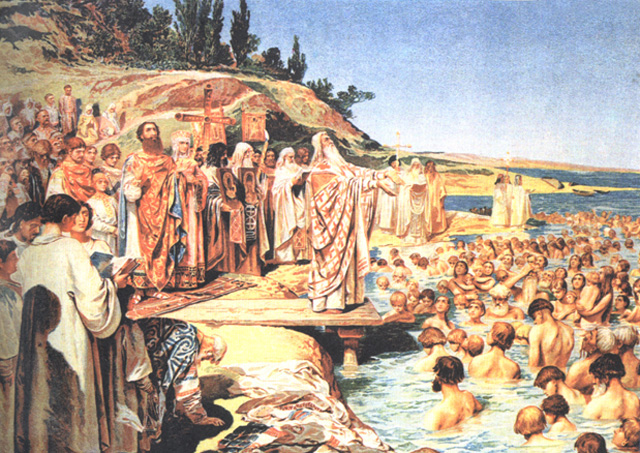
Starting with the baptism of the people, Vladimir took care to prepare unbaptized Kievans for Christianity. To do this, he instructed the clergy, who partly came with him from Korsun and partly, probably, specially arrived from neighboring Bulgaria, to walk around Kiev and enlighten the people with Christian preaching.
Having thus prepared the people for the destruction of idolatry, Vladimir actually proceeds to overthrow the idols. All the statues of the gods were either hacked up or burned. This made a strong impression on many; now even more people have appeared who are ready to accept Christianity. Finally, Prince Vladimir issues an order that all Kievans appear on the appointed day for baptism on the Dnieper River.
Fierce adherents of paganism, fearing the prince’s wrath, fled to the steppes and forests; less ardent zealots of antiquity did not dare to act contrary to the will of the prince, “went to be baptized out of fear to the one who commanded”; others, still hesitating, came to the river, reasoning as follows: “If the new faith was not good, the prince and the boyars would not accept it”; others, finally inclined to Christianity, gladly went to fulfill the will of the prince.
The baptism had a solemn appearance; the prince himself and the boyars, and all the clergy were present at it. Joy filled Vladimir’s soul; the sight of the people who came to be baptized clearly told him about the implementation of his dear thought: Christianity was declared the state religion in the decree, the people now declare by their baptism that they accept such a reform. From that time on, Christianity actually enters life. Kiev itself takes the form of a Christian city: Vladimir commanded to build churches, mostly in those places where idols used to stand; for their part, probably the most zealous of the Kievans themselves voluntarily built either parish or house churches, so that at the end of Vladimir’s reign their number in Kiev is estimated in the hundreds.
Of course, Vladimir could not limit himself to the baptism of Kiev. He wanted to introduce Christianity throughout his realm. To do this, according to relatively recent legends, he himself traveled around Russia together with the clergy, gave orders to his sons and posadniks to plant Christianity. The clergy zealously helped him in this matter. Even the first Metropolitan of Kiev, Mikhail, allegedly accompanied by several bishops, Vladimirova uncle Dobrynya and one Korsun (Anastas), close to the prince, visited the Novgorod and Rostov regions, overthrew idols, put churches and clergy to them and “baptized many”.
The Baptism of Rus
The emergence of Christianity on the lands of the future Russian Church
The tradition of the Ancient Church tells us that, fulfilling the command of the Lord Jesus Christ to go and teach “all nations, baptizing them in the name of the Father, and of the Son, and of the Holy Spirit” (Matthew, 28:19-20), the saints apostles divided the georgrafical areas among themselves, where and among which nations each of them would preach the Gospel. The “father of Church history” Eusebius, Bishop of Caesarea, referring to the work of Origen that has not reached us, writes: “The Holy apostles and disciples of the Savior were scattered throughout the earth. Thomas went to Parthia, Andrew - to Scythia, John - to Asia…”.
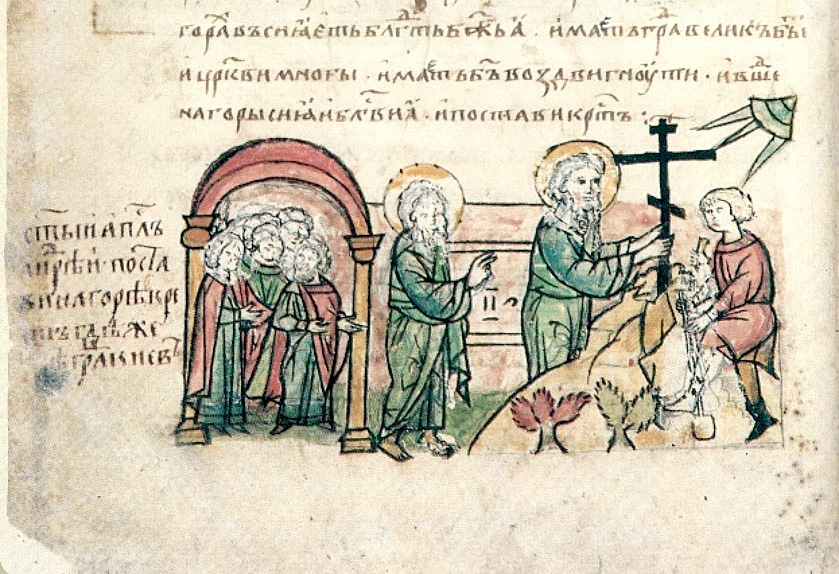
About the sermon of St. Andrew the First-Called in Scythia is also attested by church writers: St. Dorotheus, Bishop of Tyre, St. Epiphanius, Bishop of Cyprus, indicating that the Apostle Andrew first made missionary trips to Asia Minor, then Thrace, Scythia (lands north of the Black Sea) and Transcaucasia.
The apostle’s sermon was addressed to the population of the Greek cities- colonies, which began to appear on the shores of the Black Sea since the VI century BC. The data of modern archaeological research shows that Christian communities existed in Chersonesos (near the present city of Sevastopol) and in Tanais (in the old mouth of the Don) since the second half of the first century, therefore, they could have been founded by the Apostle Andrew.4
The Russian chronicle “The Tale of bygone Years” (also known as “The Rus’ Primary Chronicle”), compiled by the Monk Nestor5, contains a legend dating from the XI century, about the visit of the Apostle Andrew to the Russian land. “When Andrey was teaching in Sinope and arrived in Korsun (Chersonesos),” the chronicler narrates— “he learned that the mouth of the Dnieper was not far from Korsun, and he wanted to go to Rome, and sailed to the mouth of the Dnieper and from there went up the Dnieper. And it so happened that he came and stood under the mountains on the shore. And in the morning he got up and said to the disciples who were with him: “Do you see these mountains? The grace of God will shine on these mountains, there will be a great city, and God will erect many churches”. And he ascended these mountains, blessed them, and put up a cross, and prayed to God, and descended from the mountain, where Kiev appeared after, and went along the Dnieper, and came to the Slavs, where Novgorod now stands”.
The Russian scribes, proving the apostolic succession of the Russian Church, claimed on the basis of this legend, 500 years after the time of the Monk Nestor, that the Apostle Andrew preached “the word of God in Russia and led many people to baptism”. Tsar Ivan IV the Terrible, in a conversation with the papal envoy Antonio Passevino6, said: “We received the Christian faith at the beginning of the Christian Church, when Andrew, the brother of the Apostle Peter, came to these countries… we adopted the Christian faith in Moscow at the same time as you in Italy”.
The significance of the legend told by the chronicler lies precisely in the fact that it expresses the awareness of the Russian Christian society of the XI century of its connection with the disciples of Christ not through the usual historical succession, but through spiritual succession. In terms of history, the legend is a reproduction of the church tradition about the Acts of the holy apostles, which dates back to the time of the Apostolic fathers (Αποστολικοί Πατέρες) (late I — early II centuries).
It is important to note that the canonical territory of the Russian Orthodox Church still includes lands where Christianity undoubtedly appeared in the first centuries of its history: Crimea, part of the Caucasus, and other areas of the Northern Black Sea region. Archaeological finds made in Chersonesos, Kerch and many other Greco-Roman settlements of the Crimea, Azov indicate that Christianity spread there already in the I-III centuries.
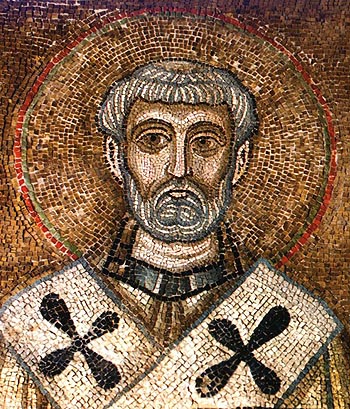
According to a stable and uncontested tradition, in 101 A.D. in Chersonesos, the Holy Martyr Clement, Pope of Rome, exiled here under Emperor Trajan, who since the time of St. Vladimir was revered as one of the heavenly patrons of Russia, martyred.7
The pre-history of Baptism of Russia (Rus)
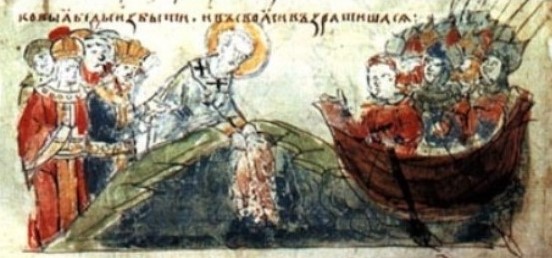
The baptism of Rus took place in 988. But long before this date, the Slavs- Russians began to accept Christianity. The first mention of the mass baptism of the Slavs dates back to 8668, when, under Greek Emperor Michael III and St. Patriarch Photius, the Slavic fleet besieged Constantinople. At that time, the Byzantines were waging war in the East, and there were almost no troops left in the city. There was little hope of getting rid of the barbarians.
The Slavs were already rampaging in the vicinity of Constantinople: they committed unheard-of atrocities that terrified even the habitual Byzantines. Photius took the greatest relic of the capital of the empire (the Robe of the Most Holy Theotokos, kept in the Blachernae Church) and walked with it along the walls of Constantinople, lowered it into the waters of the Bosphorus Strait. After that, a terrible storm arose, which scattered the ships of the Slavs.9
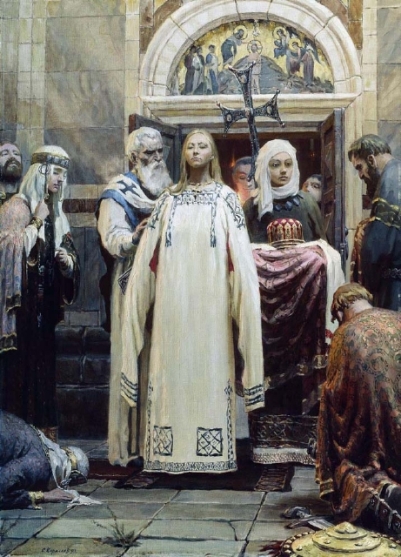
This was the first appearance of the Intercession of the Mother of God. After the defeat of the Russ, negotiations took place with their princes, who wished to be baptized. Photius himself (867), later Emperor Constantine VII Porphyrogenitus (X century) and a number of other authors reported that a bishop was sent to Russia after this event, and the diocese of Russia was created.10 Patriarch Photius, in his district letter of 867, testifies: “And not only this people (Bulgarians) have exchanged their former impiety for faith in Christ, but even the so-called Russ… And at the present time, even they have exchanged the Hellenic and impious teaching that they used to contain for the pure and genuine Christian faith, lovingly placing themselves in the rank of our friends, instead of robbing us and the great audacity against us that they had shortly before. And their desire and zeal for faith has flared up to such an extent that they have accepted a bishop and kiss the beliefs of Christians with great zeal”.
About the same fact of the baptism of the very Slavs-Russians who attacked Constantinople, the Greek historian George Kedrin briefly reports that after the unsuccessful siege of the Greek capital, “an embassy came from the Russians to the reigning city, asking to make them participants in the divine baptism”.
The Emperor Constantine Porphyrogenitus speaks more at length about the baptism of the Slavs: “And the people of Russ, the most warlike and godless, the Emperor, with generous gifts of gold, silver and silk robes, attracted to negotiations and, having concluded a peace treaty with them, persuaded them to become participants in divine baptism and arranged for them to receive a bishop”.
Then it is told how the Prince of Russ gathered all the people and invited them to accept the Greek faith. The elders of the people agreed, but demanded a miracle so that the book of the Gospel was thrown into the fire and not burned. The experiment was done, the miracle was accomplished, and the people were baptized.
A great role in the baptism of Russia was played by Princess Olga, the wife of the Russian Prince Igor (912-945). This prince was killed by rebels in 945. The heir of the deceased Igor was his son Svyatoslav. Since he was still a child, the real government of the state was taken into her own hands by the widow of Prince Olga (945-969). The chronicle tells how Olga, with the cunning and cruelty inherent in the custom of bloody revenge, adopted by the pagans, dealt with the murderers of her husband.
In 957 Olga made a trip to Constantinople, where she conducted negotiations. While in the Greek capital, the Russian Princess was baptized with the name Elena (Helen). The sacrament of baptism was performed by the Patriarch, and the recipient was the Emperor himself.11 Later, Princess Olga made considerable efforts to plant Christianity in Russia, for which our Russian Church rightfully honors her as a saint equal to the Apostles. Princess Olga devoted the last fifteen years of her life to preaching Christianity. From her personal possessions, she built temples and ravaged pagan sanctuaries where sacrifices were offered to idols. It is also known that at her expense at that time the first christian churches in Kiev and Pskov were built.
The pre-history of Baptism of Russia (Rus)
The structure of the Russian Church in the Kiev period
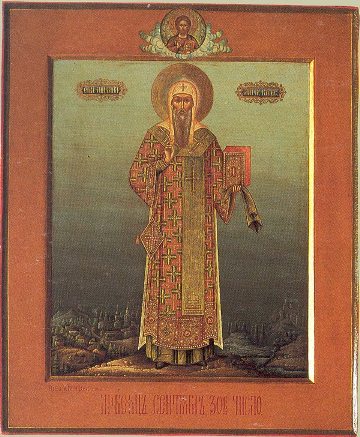
The Russian Church was established as a metropolis of the Patriarchate of Constantinople. Its first metropolitan was St. Michael12, who came with Vladimir from Korsun (+ 992). Throughout the time of his ministry in Russia, there was only the spread of Christianity across the Russian lands and as a result the metropolis had not yet had time to organize itself. The first organizational device was given to her by Mikhail’s successor Leonty (+1008), who in 992 divided her into dioceses and appointed diocesan bishops. Bishops were installed in Novgorod, Chernigov, Rostov, Vladimir in Volyn, Belgorod, Tmutarakan, Polotsk, Turov.
Geographically, the department of the first metropolitans before Grand Prince Yaroslav (the Wise) was located in Pereyaslav (near Kiev), then under Yaroslav, when the Kiev St. Sophia Cathedral with the metropolitan house was built, they moved to live in Kiev. Russian metropolitans were elected and consecrated in Constantinople by the Patriarch (with the consent of the emperor) and, as a rule, from the Greeks. In Russia, they were strangers by origin, by language, and by national sympathies, so they did not arouse the confidence of either the princes or the people.
Besides, the best people were not always sent to the Russian Metropolis from Greece. Of the 25 Greek metropolitans in the first four and a half centuries of the existence of the Russian Church, no more than 5-6 people were distinguished by enlightenment and piety. Such were George (1062), an educated man, but as an alien pastor who left his flock during the conflict of Yaroslav’s children; his successor John II (from 1077), according to the chronicle, was a learned man, but at the same time humble, affectionate, silent, but when necessary, articulate; Nikephoros I, known for his epistles to Monomakh. Others are only mentioned in passing in the annals.
Meanwhile, the Russian-born Metropolitans, have left behind the best memories for the education, piety, and beneficial influence on the flock. Russian grand Princes, it is clear, had the idea of electing metropolitans from the Russians early on. After the death of Metropolitan Theopemptus, the Greeks did not send a new metropolitan for three years. At this time (1046), Yaroslav’s war with Byzantium ended, in which the Greeks barbarously blinded 800 Russian prisoners. And now in 1051 “God put it into the prince’s heart” to place a metropolitan from Russia. The first Russian metropolitan was Hilarion, a priest from the village of Berestovo, near Kiev, where the Grand Prince’s summer palace was located. He was distinguished by enlightenment and piety. A little later, at the end of the XI century, another Russian metropolitan, Ephraim, became famous for the sanctity of life and miracles, and devoted his reign to the construction of many churches and hospitals.
Church life in Russia was influenced by the feudal system of the state. The borders of the dioceses coincided with the borders of the independent principalities. The first division of the Russian Church into dioceses was made in 992 by Metropolitan Leonty. The chronicle lists six dioceses established at that time: in Kiev, Novgorod, Chernihiv, Rostov, Vladimir and Belgorod. At the same time, bishops were also installed in other cities — Tmutarakan, Turov and Polotsk, where Vladimir’s children reigned. During the next period until the middle of the XIII century, several more dioceses were formed, so that, in total there were 15.
The dependence of the diocesan bishops on the metropolitan was small and was limited only to placing them in the dioceses. Each bishop managed the affairs of his diocese independently. He was assisted in this by local councilors and priests.
The metropolitan interfered in the affairs of the diocese very rarely, only in special cases and on some complaints. However, even such dependence on the metropolis was a burden, so the local dioceses tried to weaken it as much as possible. Just as the grand princes sought to limit the Patriarch’s power in electing metropolitans, so, in turn, the appanage princes and the inhabitants of the appanages sought to limit the metropolitan’s power in appointing their bishops.
The young Russian Church also showed examples of genuine holiness. It is surprising how quickly the baptism of Russia bore fruit. An exceptionally strong impression on contemporaries was made by the feat of the young princes
- the children of Vladimir and Anna13 - Sts. Boris and Gleb, who were martyred by their brother Svyatopolk, not wanting to arrange a civil war. Boris and Gleb were the first Russians to be canonized. Their official canonization took place in Constantinople in 1072.14 The national consciousness was struck by the humble death of Boris and Gleb. The veneration of Boris and Gleb spread very quickly and widely, there has been a lot of archaeological evidence. The martyrdom of the young princes had a greater impact on the Christian upbringing of Russians than book learning. A living example of the spiritual transformation of a person in baptism, his spiritual and moral victory over evil was revealed.
Editorial Footnotes
Related Concepts
- anna-porphyrogenita
- apostolic-fathers
- apostolic-foundation
- appanage-princes
- baptism-of-olga-as-elena
- beauty-of-worship
- blachernae
- blachernae-church
- byzantine-commonwealth
- canonical-territory
- catechumenal-preparation
- christian-upbringing
- church-building
- civil-war
- constantinople
- council-of-boyars
- embassies-of-986-987
- feast-of-the-intercession
- feudal-fragmentation
- feudal-system
- hilarion
- holy-land
- kiev
- korsun-chersonesos
- last-judgment
- metropolis-of-constantinople
- metropolitan-leonty
- missionary-preaching
- missionary-work
- parish-and-house-churches
- patriarchate-of-constantinople
- protection-of-the-city
- pskov
- relics
- robe-of-the-most-holy-theotokos
- robe-of-the-theotokos
- russian-saints
- st-olga
- st-vladimir
- state-religion
- the-tale-of-bygone-years
Footnotes
-
Vladimir’s accession was not immediate or peaceful. Svyatoslav died c. 972, after which his sons fought a protracted succession war; Vladimir seized Kiev only around 978–980, after arranging the killing of his brother Yaropolk. The text’s smooth transition omits this fratricidal conflict. ↩
-
The “testing of the faiths” — envoys from Islam, Latin Christianity, Judaism and Byzantium, followed by Vladimir’s dispatch of observers — is preserved in the Primary Chronicle but is regarded by most historians as a literary and didactic construction rather than a factual record. Comparable “choice of faith” tales circulated about other rulers (e.g. the Khazar khagan), and the schematic dialogue chiefly serves to justify the Byzantine choice after the fact. ↩
-
Vladimir’s baptism is conventionally dated 988, but its place and sequence are disputed: the sources variously locate it at Chersonesus (Korsun), Kiev, or Vasilev, and some scholars argue for 987 or c. 990. The account of temporary blindness cured at the font is hagiographical. The marriage to Anna was politically bound up with the military aid Vladimir sent Emperor Basil II against the rebellion of Bardas Phokas. ↩
-
This conflates legend with archaeology. The mission of Andrew to Scythia is a late tradition (first attested via Eusebius citing Origen) with no first-century corroboration, and the archaeological evidence for Christianity at Chersonesos and Tanais is considerably later (largely third–fourth century), so it cannot be connected to Andrew. The inference “therefore they could have been founded by the Apostle Andrew” is not supported by the evidence. ↩
-
The attribution of the “Tale of Bygone Years” to the monk Nestor is traditional and is questioned by modern textual scholarship, which treats the work as a composite compiled and revised c. 1110s–1120s. The specific story of Andrew sailing up the Dnieper and blessing the future site of Kiev is widely regarded as a later interpolation, absent from the earliest layers and serving to assert an apostolic pedigree for the Rus’ Church. ↩
-
The envoy’s name is more correctly Antonio Possevino, the papal legate whose mission to Ivan IV took place in 1581–1582. The apostolicity argument the tsar advanced rests on the Andrew legend rather than on any historical contact. ↩
-
“Uncontested” overstates the case. Clement of Rome is a historical figure (bishop of Rome in the 90s), but his exile to the Crimea and martyrdom by drowning there derive from a much later (fourth-century or later) passio and are legendary rather than securely attested; his traditional death date is variously given as c. 99 or 101. ↩
-
The date is incorrect. The Rus’ attack on Constantinople under Emperor Michael III and Patriarch Photius is firmly dated by Byzantine sources to 860 (the assault began on 18 June 860), not 866. The attackers were the Rus’ rather than a general “Slavic fleet.” ↩
-
The storm that “scattered the ships” is a later embellishment. In his two surviving homilies on the attack, Photius describes the enemy withdrawing after the Virgin’s robe was carried around the walls and dipped in the sea, but records no miraculous tempest destroying the fleet; the storm detail enters the tradition in later chronicles. ↩
-
This is the so-called “Photian baptism” of the Rus’, reported by Photius in his encyclical of 867. The sources are not consistent: Emperor Constantine VII Porphyrogenitus attributes the conversion and the sending of a bishop to the reign of Basil I and Patriarch Ignatius (c. 874), not to Photius, and it is debated whether those baptized were the Kievan Rus’ or another group. In any case the episode produced no lasting Christianization. ↩
-
Olga’s visit to Constantinople is documented by Constantine VII in De Ceremoniis (usually dated 957, though 946 has also been argued), but that account does not mention her baptism, and the date and place of her conversion remain disputed — some scholars place it on this visit, others earlier at Kiev. Having the reigning emperor stand as godfather is part of the hagiographical tradition. ↩
-
The historicity of “Metropolitan Michael” as the first head of the Rus’ Church is doubtful; he appears only in later sources, and the earliest reliably attested metropolitan of Kiev is Theopemptos (c. 1039). The early list of metropolitans and the account of his successor “Leonty” organizing dioceses in 992 are reconstructions drawn from later, largely legendary material. ↩
-
The maternity of Boris and Gleb is uncertain. The Primary Chronicle describes their mother as a “Bulgarian” woman, and most historians doubt they were sons of the Byzantine princess Anna; the identification with Anna here reflects a later, idealizing tradition. ↩
-
Both claims are contested. The event of 1072 is usually understood as the translation (transfer) of the relics, and the brothers’ veneration was a local Rus’ development rather than a formal canonization enacted at Constantinople. The traditional account of their murder by Svyatopolk “the Accursed” has itself been questioned by scholars who, following the Norse Eymund’s Saga, suspect the involvement of Yaroslav. ↩