History of the Christian Church — Topic 16
-
In what year and to which sultan did Byzantium fall?
- What was the legal status of the Church in the Ottoman empire?
- Could the educational system be described as adequate for the Church in this period?
- Which parts of the Orthodox Church enjoyed special privileges under the Ottomans?
-
Stephen Runciman, The Great Church in Captivity: A Study of the Patriarchate of Constantinople from the Eve of the Turkish Conquest to the Greek War of Independence, Cambridge, 1968
- Timothy Ware, Eustratios argenti: A Study of the Greek Church under Turkish Rule, Oxford, 1964
-
The Conquest of Constantinople in 1453
- The treatment of the Church by the Turkish government under Mehmed II
- The position of the Christian population under Ottoman rule
- Religious education
Religious education
The heavy Turkish yoke had long-lasting consequences in the field of Greek religious education. With the fall of Constantinople and the establishment of Turkish rule, all opportunities for education were cut off. The Turks destroyed the cities, churches and monasteries, as well as the schools, libraries, ancient manuscripts, scholarly theological works and so on that were under their auspices. By the same token, the awfulness of Turkish rule placed the Greeks in such a position that all attempts at receiving an education were suppressed. Concerned with simply saving their own lives and obtaining their daily bread, they had no time to think of other things. Those who stood at the head of the Greek nation, the Patriarchs and the Phanariotes, for the most part intrigued among themselves and so any concern for education was pushed into the background. There was absolutely no point in petitioning the Turkish rulers about education and schooling. The Muslim Turkish government was always dead set against the Christian slaves being educated. The consequence of this situation was a decline in education in the Greek Church, not to mention the simple people. Even among the clergy and Pharionites the level of religious education had dropped drastically. The Patriarchal Throne and the episcopal sees were often occupied by poorly- educated men. Priests and deacons could barely read and write and they had to perform the services out of learned habit.
At the same time, enlightenment in the Greek Church had not been extinguished altogether. The Church required that her clergy be educated and so called upon the best Greeks to take on this ministry. The concern for education was prompted in the main by two circumstances. One the one hand, the need to train candidates as bishops who would be educated, and on the other the need to protect Orthodoxy from Catholic and Protestant propaganda. Therefore, in spite of all the unfavourable circumstances, we see in the Greek Church educational activity both in the form of religious instruction in school and the scholarly study of the sacred truths of the faith combined with literary theological works.
Unfortunately, this activity, because of the conditions and circumstances, was not particularly widespread. In the period under discussion the Greeks had only two types of schools: primary and higher.
The primary schools were where the ability to read and write were taught, and the students then got acquainted with liturgical books and used them in church. The purpose of these schools was to give children a primary education, and in particular to train future servitors and clergy. These schools were usually organized under the auspices of churches, with the church or the priest’s house being used as the schoolroom; sometimes lessons were conducted in the open air. The teacher was more often than not the priest of that very church where the school was. There was no division into classes in these primary schools.
The higher schools were distinguished from the primary schools only by their wider range of subjects and better organization of the study process. Yet they did have special teachers who were more or less known for being erudite, and for which they were paid a salary. The students of these schools were often priests and monks, even of a more mature age. They studied both secular sciences and theology. Their general education consisted in the main of studying the works of the Greek writers. Theology was studied from the Exact Exposition of the Orthodox Faith by Saint John of Damascus. Those who progressed in their studies read the fathers of the Churches and the interpretations of them.
These higher schools, however, were unable to provide a theological education for many as, on the one hand, the range of subjects was limited, and on the other, the number of students was limited from between fifteen and fifty at each school. Moreover, none of these schools had firm foundations beneath them: some where in good condition, while others were so poor they had to be closed. They had to subsist on very modest means. The teachers did not receive salaries, or if they did, it was almost worthless. It was only love among many of them for a national education that encouraged them to devote themselves to teaching. Such, for example, were the higher schools in Constantinople (the Patriarchal Higher School), in Ioannina, in Moscopole (Albania), Patmos, Athos and others
Dissatisfied with the education that they had received in the Greek schools, the more gifted and well-off Greek young men journeyed to the West to receive a better education. Nearest for them was Italy, where thanks to Greek scholars who had fled there after the fall of Constantinople, scholarship was experiencing a revival. It was to these places that Greeks thirsty for knowledge set off. The University of Padua and the Collegium of Saint Athanasius in Rome had a large compliment of Greek students for the first two centuries after the fall of Constantinople. Then the Greeks sought out enlightenment in the universities of Germany and other Western countries. There were occasions, though, when they would be unhappy with the education in one university and they would abandon it for another and then a third in order to hear the lectures of a particularly renowned professor.
However, in receiving their education in Western institutes, the Greek young men were rarely enraptured by Catholic and Protestant ideas, and therefore the Greeks then wanted to send their young people to Russia to study. And indeed, when at the end of the eighteenth-century and especially in the nineteenth- century, at a time when Russian places of study were becoming well- established, Greek young men started to come to Russia to study.
As regards higher theological education in the Greek Church, then it was to be found not much in the schools as in the monasteries. The monasteries which had avoided the Turkish pogroms had a remarkable collection of ancient books and manuscripts. Such, mainly, were the monasteries on Mount Athos, which thanks to their remote position even after the fall of Constantinople were more or less free of the Turkish yoke. Here, in quiet solitude, the monks studied Scripture and the writings of the fathers of the Church, and also wrote theological compositions of their own. The Athonite monasteries were in this way a focal point for theological education in the Greek Orthodox Church in the sixteenth, seventeenth and even eighteenth centuries. The most enlightened Greeks made their way here. Even those who had been educated at Western universities devoted themselves to theological studies on Athos.
The state of divine worship
The Turkish yoke also had a detrimental effect on the state of worship in the Greek Eastern Church. After the fall of the Byzantine empire, churches were destroyed, ransacked or turned into mosques. Similar instances of destruction and conversion into mosques happened once more under Turkish rule. At the same time, the Turkish government forbad the construction of new churches and allowed the Greeks only to repair the old ones. In the localities where the people were exclusively Christian, new churches were allowed to be build, but they encountered great difficulties and expenses. The Turkish officials tried every means possible to hinder this, so the only solution was to pacify them with abundant bribes.
Thus, Eastern Christians experienced constraints mainly in terms of where to hold worship. There were few too many churches or they were in such a state that they were not fit for purpose. They were constructed in extended buildings that were quite large without domes and crosses and differed little from usual houses. The iconostases were very simple. They were made of bare wood with no gilding or adornments, there were few icons, and those that were there had no frames around them. The church plate was extremely poor, the clerical vestments were made from wool or calico and only on rare occasions were they made from silk. The vessels were almost always made from copper or tin without any adornments.
Turkish officials, and indeed the Turkish population that lived mainly in places where the population was a mixture of Christians and Muslims, often interfered in the conduct of worship. The ringing of bells and processions of the cross were forbidden, while burial processions were allowed for a certain fee. In addition, it was not unusual for Turks to go into Christian Churches during services and cause disruption. They were aided in this by the old law of Omar which laid down that the doors of Christian churches should be open both day and night to every Muslim. In some instances, the Turkish government would directly oversee Christian worship.
Although essentially unchanged, worship in view of the time and circumstances underwent certain additions in the form of new offices, new church feast days and new hymns.
THE EASTERN CHURCH UNDER OTTOMAN RULE
The Conquest of Constantinople in 1453
Tribulations did not cease for Eastern Christian with the end of the Crusades. The weakened empire in the thirteenth-century came face-to-face with new conquerors in the form of the Ottoman Turks. Having seized the former parts of the Byzantine empire in Asia, the Ottomans penetrated into its European territory and took control of Macedonia, Thessalia and Greece. By the end of the fourteenth-century the Byzantine empire consisted solely of Constantinople and its environs and was obliged to pay tribute to the Turks.
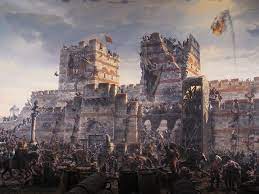 Finally, Sultan Mehmed II laid siege to
Constantinople. The capital was able to summon up to five thousand men1 to
defend her, including soldiers, volunteers, civilians and monks. This small
bunch of badly-armed trooped were of course no match for the Turks, who
eventually took the city.
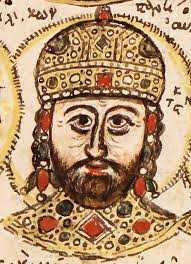 The only hope was the West, to which the
last Byzantine emperor Constantine XI Paleologos (1449-1953)2 turned. He was
prepared at the price of the freedom of his Church to salvage the remains of
his empire. In his plans to get help from the West he colluded with pope
Nicholas V, but this appeal to the pope did not yield the required result. Of
the Western rulers no one extended a helping hand to the dying Byzantium.
Moreover, instead of offering material support, the pope used the desperate
situation of the Greeks to try and conclude a Union with Rome, which he did
there in an underhand manner in 14393, but the Union was not accepted in the
East.
The Union, however, did not save Byzantium. On 29th May 1453 Constantinople was taken when Mehmed’s men attacked. Constantine Paleologos died in the battle, and his body was disfigured to the extent that it was possible to identify the last Byzantine emperor only by his shoes and imperial emblem. The fall of the capital of the Eastern empire made for a picture of terrible destruction and religious brutality. The fanaticism of the Turks was spurned on further by their greed, as a result of which the city was subjected to a wholesale ransacking. Some of the capital’s inhabitants fled, others were taken into captivity and sold into slavery and property was stolen. The Church of Hagia Sophia was turned into a mosque. Its crosses were torn down and destroyed, while the walls, covered with frescoes and mosaics, were whitewashed, daubed and remained without any adornments.
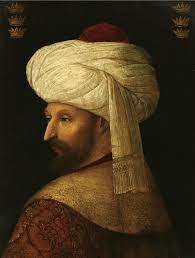 On the very first day after the fall of
Constantinople, Mehmed II entered and announced to his troops that all of the
city’s buildings were now on to be his personal property. As a result of this
intervention by the Sultan, the Church of Hagia Sophia was spared from being
burnt down and from complete destruction, as well as many other churches and
monasteries. Only the city walls surrounding Constantinople were destroyed.
With the subjugation of Constantinople, Mehmed also conquered the outer-lying Greek and Slavic states, which enjoyed political independence. The conquest of these lands was accompanied by the same scenes of violence and robbery which heralded the taking of the capital of the Byzantine empire. Thus, there arose in the place of the Christian empire in the East a powerful Ottoman empire.
The position of the Christian population under Ottoman rule
But if by the laws of Mehmed II, the Orthodox Church, within the confines of the Ottoman empire received for its bishops and clergy, albeit with certain limitations, the guaranteeing of their rights, then a completely different legal situation was created for other religious people. The Christian population of the East was deprived of almost all rights. They could not occupy civil positions or serve in the army. Only service in the navy was granted out of necessity to the Greeks as the Turks for a very long time did not possess any maritime skills. However, the aristocratic and educated Greeks could occupy the position of dragoman, that is, translators at embassies and for high-ranking Turkish officials who did not know Greek or European languages. Up until the nineteenth century they ruled the roost in this aspect.
The remaining Christian population enjoyed only the ‘right’ to pay taxes to the state. Particular hard for the Greeks was the tithe of having to surrender their children to the state. Fortunately for the Christian population, this tax did not apply to all of the regions of the Ottoman empire, and in the latter half of the seventeenth-century it was abolished as a result of protests from the Turks themselves who envied the Christians boys for the careers that awaited them.
Christians were not admitted into court as witnesses as only Turks as witnesses were required. Thus, it is difficult to say how realistic it was for a Christian to win a court case. Quite often it was necessary to drop cases in Turkish courts. Finally, the insignificant elements of everyday life of Christians were also restricted by petty laws, for example, they were forbidden to use material of green as the banner of Muhammed was made of green. A distance was determined according to which a Christian could not go any closer to a mosque. The Christians, in the language of the Turks, were the personification of the raiyah, that is, a herd of beings shorn of all rights. No less oppressive for the Greeks was their awareness of being without rights.
The real-life facts quite often reminded the Greeks of the slavish position they were in. Deprived of rights, Christians often had to endure constant insults from the Turkish rulers. The epoch of Ottoman rule was one of mass robbery of Christians, the humiliation of their dignity and consequent enslavement.
The internal life of the Church under Ottoman rule
** _The renowned Patriarchs of Constantinople:
_**
1. Patriarch Gennadius Scholarius
Gennadius II (born Georgios) Scholarius (1454-1456) was the first Patriarch of Constantinople to live under Turkish rule. Even before his election to the Patriarchal Throne he was renowned among the Greeks. Under emperor John VIII Paleologos (1425-1448), Gennadius occupied the position of ecumenical teacher, i.e., the director and professor of the higher school of Constantinople, and then member of the Supreme Council and state judiciary. In 1438, as a person close to the emperor, he participated in the Council of Florence, trying to reconcile the opposing sides. But when his attempts at reconciliation turned out to be in vain and the Latins continued to insist on the Union with the aim of subjugating the Eastern Church to Rome, Gennadius secretly fled to Venice and so never signed the act of Union.4
Upon returning to the East, he, together with Saint Mark of Ephesus, opposed the Union, but after the death of Mark, he became the leader of the zealots of Orthodoxy. Abandoning his service to the state and becoming a monk, he dedicated himself to fighting the Latins. His erudition, piety and zealotry for the faith drew the attention of all the Greeks in Constantinople during this arduous time under the Turkish yoke, and they unanimously elected him to the Patriarchal throne. Mehmed II not only approved of Gennadius’ election, but also recognized him as patriarch, dispensing favour towards him and respecting him for his personal qualities.
Scant information has come down to us on Gennadius’ abilities as a church administrator, but there can be no doubt that, having once assumed the Patriarchal see, he did everything within his power for the good of the Church at this very arduous time. With the permission of the Sultan, Patriarch Gennadius built a new Patriarchal residence close to the centre near the Church of the Most Blessed Mary of Blachernae5, whence he moved with his clergy. For the enlightenment of the people Gennadius founded the Patriarchal School which turned out future pastors. Finally, he recommended himself as a true zealot in rooting out the long-standing evil of simony in the Greek Church.
Gennadius’ patriarchate lasted only two years. In 1456 he renounced the Patriarchal Throne, supposedly for health reasons, and then settled on Mount Athos in one of the monasteries and soon died there. The exact year of his death is not unknown. The Greek Orthodox Church has canonized this most worthy patriarch as a saint.
2. Patriarch Jeremias II Tranos
Patriarch Jeremias II, called Tranos (meaning ‘bright’) was primate three times. The first time he was elected to the Patriarchal see was by conciliar vote in 1572 and he occupied it up until the end of 1579. The Greek Church had found in this patriarch an erudite pastor who was active, just and irreproachable throughout his life. Jeremias believed it his first duty upon assuming the Patriarchal Throne to take strict and decisive measures against simony. He convoked a council at which, on the basis of the ancient canons, it was decided to defrock those who ordained or who were ordained for money.
The zealous patriarch also turned his attention to other aspects of Church life. Thus, he raised the level of religious education, especially that of the clergy; he strictly ensured that the rules of church piety were enforced, excommunicating those who violated them; he zealously defended the Eastern Church from the propaganda of the Catholics and the Protestants. Within the Patriarchate itself he erected many buildings, including places for bishops who had come to Constantinople, and adorned the Church of the Most Blessed Virgin in Blachernae with such beauty that contemporaries called it ‘heaven on earth’. It was in this manner that Jeremias governed the Church for seven and a half years.
In 1579 he was deposed by order of the Sultan and his place was occupied by the former Patriarch Mitrophanes, who had intrigued to ensure Jeremias’ deposition. However, this time Mitrophanes occupied the Patriarchal Throne for only nine months, and after his death in 1580, Jeremias was restored to his rights as patriarch. It was now that the hardest times came for Jeremias and the Greek Church. Mitrophanes had left huge debts. In order to pay them off, Jeremias was forced to collect money from the bishops, who were extremely displeased with this turn of events.
The relatives of Patriarch Mitrophanes took advantage of this displeasure and formed a large party of clerics and bishops with the aim of once more deposing Jeremias. The campaign of slander against Jeremias ended with the Sultan arresting him and throwing him in prison. This happened in 1580. Then Jeremias was returned for the third time to the Patriarchal Throne. In his absence the Church of the Blessed Virgin in Blachernae had been ransacked and confiscated by the Turks, leaving the Patriarchate with unpaid debts.
In order to collect money to build the Patriarchal administration at the Church of Virgin called ‘the Consolation’ and to pay off the debts, Jeremias in 1588 set off for Russia, from where he returned in 1590 with a huge amount of treasure.6 During his journey through Western Russia, he put all his efforts into combatting the Latin propaganda that held sway there. One of the key aspects of his work was the issue of church discipline. In 1593, with the participation of the Patriarch of Alexandria Meletius Pegas, he convoked in Constantinople a council at which once more the he enforced the rule on monks submitting to their diocesan bishops and the exclusion of bribes for ordination (simony) and so on. In 1594 Jeremias died in office.7
3. Patriarch Cyril Loukaris
Patriarch Cyril Loukaris (1621-1638) was a disciple of the renowned Patriarch of Alexandria Meletius Pegas, who had died in 1561.8 Meletius had provided Cyril with an excellent education at the Greek College in Venice and then at the University of Padua. Upon completing his studies, Loukaris became a monk and soon embarked upon church work. He became exarch and at Meletius’ instigation he travelled to Western Russia and supported the Orthodox people there in their struggle against the Latins, who were agitating for Union.
At the Council of Brest in 1596 which proclaimed the Union, Cyril was among the main defenders of Orthodoxy and was subject to persecution from both Catholics and the Uniates. He was compelled to flee with his life. Later, Cyril undertook a journey to Western European countries in order to study non- Orthodox faiths. In 1600, he was once more entrusted by Meletius to set off for Western Russia in order to attend to the good ordering of church affairs. After the death of Meletius, according to his will, Cyril in 1602 was elevated to the Patriarchal Throne of Alexandria. For twenty years he was Patriarch of Alexandria and during his wise governance he earned the profound respect not only of his own people but also of those in the Patriarchate of Constantinople.
4. Patriarch Samuel I
In 1763 Samuel I (1763-1768; 1773-1774) ascended the Patriarchal Throne of Constantinople. He belonged to one of the aristocratic and wealthy Phanariote families. He was distinguished by his intellect, erudition, strict lifestyle, steadfastness of character, and administrative and diplomatic abilities. He was left with a difficulty legacy of ecclesiastical business. The mercantile Turkish government had turned the Patriarch Throne into an object of sale and purchase, intrigues abounded and so on. The debts of the Patriarchate continued to get larger. Samuel I decided to enact reforms in order to stabilized church governance. The Patriarchal Synod was transformed. Samuel I decreed that there should be eight senior permanent members of the Synod whose dioceses were located near Constantinople. In addition, four laymen (archons) from among the Greek elite and wealthy merchants would also become members of the Synod, as would one of the officials of the Patriarchal Court. The synodal position of Great Logothete attained great significance for Turkish rule as it was only though him that the Patriarch had dealings with the Turkish rulers. All of these persons under the presidency of the Patriarch made up the Synod. It was Samuel who presented the Synod with all the business concerning the Patriarchate which would be resolved by the collegial participation of the Patriarch and all the members of the Synod or at least the majority. All important papers and documents that came from the Patriarchate were sealed by the Patriarchal seal, divided into four parts, of which each would be kept in the possession of one of the four synodal bishops. The Patriarch was left with the middle column or the key to the seal. The bishops who kept the parts of the seal had to be permanently located in Constantinople, and the Patriarch did not have the right to send them to their diocese. Thus, in order to place the seal on an official document the presence of the Patriarch and four synodal bishops was required. The division of the Patriarchal seal into four parts was a means of securing collegial discussion and resolution of church affairs.
Samuel also obliged the Synod to attend to the financial affairs of the Patriarchate. It was established that the Turkish government could depose the Patriarch and appoint a new one after formal representations by the Synod. All of these regulations of Samuel I were confirmed by Sultan Mustapha III. The most important outcome of this reform was that the Patriarchal Throne was no longer a plaything in the hands of the Turkish government. Samuel’s reforms, however, did not bring any vital changes to the life of the Church. Of Samuel’s other actions we know of measures that he introduced to cancel the debts of the Patriarchate and attempts at subjugating independent autocephalous Churches. The Patriarchate’s debts, which Samuel described as being heavier than the pyramids of Egypt, posed a serious problem for him. In order to resolve this problem, he decreed that bishops in taking up their sees, should give written guarantees that they would pay off a certain part of the Patriarchal debts and that they would have to pay a percentage before sending the sum in full.
In 1766 Samuel and the Synod appointed the Patriarchs of Antioch and Alexandria. But these appointments did not lead to these Churches being placed in Constantinople’s jurisdiction. It was a different situation regarding the autocephalous status of the Churches of Peć in Serbia and Ohrid in Bulgaria. With the sanction of the Turkish government, Samuel succeeded in subjugating formally to the Church of Constantinople in 1766 the Church of Peć and in 1767 the archbishopric of Ohrid.
In 1768 Samuel was deposed from his see by the Synod, ironically as a result of the authority he had once invested in them. The main reason for his deposal were the drastic measures that he took and his excessive strictness. In 1773 he occupied the Patriarchal Throne for a second time and stayed there for little more than half a year, and then in 17449 he was once more deposed for the same reasons. Retiring to the island of Halki, Samuel lived there until his death in 1780.
The treatment of the Church by the Turkish government under Mehmed II
As the first ruler of the East, Mehmed II was not particularly noted as a fanatical Muslim. Yet in spite of his religious tolerance, for political reasons Mehmed II felt compelled to put the Christians in a position whereby they had to reconcile themselves to the loss of their independence.
The Sultan treated the Orthodox Church with tolerance. He ordered that a new patriarch be elected to replace Patriarch Joseph who had disappeared without trace.10 The new patriarch was Gennadius Scholarius, a renowned scholar and pious monk. The Sultan received him with full honours and observed the same ceremonial that had formed during the reign of the Byzantine emperors. Mehmed granted the omophorion, a mantle, a silver staff and a richly adorned horse to the patriarch.
Soon he informed the patriarch of a new supreme decree, or firman, which defined the position of the Orthodox Church in the Turkish empire. According to the decree, the religion and religious institutions of the Greeks were retained. The patriarch, bishops and priests received something akin to diplomatic immunity. In all affairs the canons governed inner church governance; not once was church governance violated. The patriarch was allowed to retain his synod. All religious activities and rites were allowed to be conducted freely and without hindrance. The solemn celebration of Pascha was permitted in all the cities and villages.
It was forbidden to turn the Christian churches into mosques. Also forbidden was the forced conversion of Christians to Islam. The Church’s property rights were also protected and seizures did not occur. The property of deceased clergy who left no heirs could not revert to the state treasury. All of the clergy were exempt from paying taxes to the state. However, certain restrictions were in force regarding the outward observance of church rituals as Christians could not organize processions of the cross or burial processions. The crosses were removed from Christian church buildings and the use of bells was forbidden. It was permitted once a year, on the Sunday of Orthodoxy, to celebrate the Office of the Triumph of Orthodoxy which pronounced anathemas, including upon the Arabs (i.e., the descendants of Hagar). And this would happen in Constantinople in the presence of the Turks! Some Turks, it is true, would inform the Pasha (governor) of this, but he would usually ignore these denunciations.
According to the Turkish laws, the Christians were allowed to observe the order of services in their churches, but anyone who dared to call a Turk impious outside of a church would answer before the courts. Such were the religious rights and freedoms that the Greeks had from the time of Mehmed II. But aside from a general concern for the welfare of the Church, the Sultans would grant to the patriarchs, metropolitans and bishops a document called a Berât, obliging the patriarch and bishops to act as heads responsible for their people and thus granting to them civil authority.
The patriarch had the right to travel by horseback (something which the other bishops were not allowed), maintained a suite, and a cross, lantern and staff could be carried before him. He could ordain and appoint metropolitans and bishops and intercede before the Sublime Porte for a bishop to be designated a Berât. He could send from the capital any metropolitan or bishop to their diocese, with the exception of the main four members of the synod. The patriarch could impose a punishment upon any cleric from any diocese. He alone could, without the assent of the other bishops, canonize as a saint those who had led God-pleasing lives, but only with testimonies from a thousand people on miraculous appearances at the tomb of the dead saint. As a result of such circumstances, canonizations of saints were very rare. But with the despotic regime in the Turkish government, the personal arbitrariness of the Turkish administration often changed the existing legislation. The legal status, therefore, of the Orthodox Church in the East quite often did not correspond to its actual position. The history of Turkish rule in the East is one of a great deal of brutal violence enacted towards the religious freedom of the Christians.
The first Turkish Sultan Mehmed II, who allowed Christians freedom in matters of the faith, was also the first to violate his own laws. Having forbad any interference in the rulings of the patriarch, he greatly insulted Patriarch Joasaphus and ordered that his beard be cut off for refusing his blessing to a Greek, who was a favourite of the Sultan, to marry a second time when he already had a legitimate wife. Having forbad changing Christian churches into mosques, he immediately broke his own law by turning the Patriarchal Church of the Holy Apostles into a mosque.11 He also infringed his own ban on the forced conversion of Christians to Islam.
Aside from the usual taxes paid to the state by the Christian population, Mehmed II in some parts of the empire introduced a special poll tax. Every five years children aged seven and younger12 were taken from Christian families. These boys were trained to occupy various state positions and eventually became members of the Janissary of the Sultan’s household troops or personal army. They would be brought up as Muslims and as a result they became the worse enemies of their own people and their own original faith.
Editorial Footnotes
Related Concepts
- anti-islamic-polemic
- anti-latin-polemic
- archbishopric-of-ohrid
- athos
- concepts/berât
- brest-union
- canon-law
- canonical-discipline
- canonical-regulation-of-ordination
- christian-minority
- christian-persecution
- church-administration
- church-architecture
- church-finances
- church-of-constantinople
- concepts/church-of-peć
- church-property
- civil-authority
- clergy
- collegiality
- council-of-1593
- council-of-brest
- cyril-loukaris
- deposition-by-the-synod
- devshirme
- dhimmi-status
- divine-worship
- dragoman
- ecclesiastical-economy
- feasts
- firman
- forced-conversion
- glorification-of-saints
- great-logothete
- greek-elite
- halki
- higher-schools
- humiliation-of-christians
- janissaries
- jeremias-ii-tranos
- latin-propaganda
- legal-inequality
- manuscript-libraries
- metropolitan-peter
- millet
- miracle-testimony
- mount-athos
- ohrid
- orthodox-identity
- ottoman-interference-in-worship
- ottoman-legal-status-of-the-church
- patriarchal-administration
- patriarchal-authority
- patriarchal-debts
- patriarchal-elections
- patriarchal-prerogatives
- patriarchal-reform
- patriarchal-school
- patriarchal-seal
- patriarchal-synod
- patristic-study
- patristics
- pentarchy
- pereslavl-council
- persecution
- concepts/peć
- phanariotes
- primary-schools
- processions
- raiyah
- rayah
- religious-freedom
- renegades
- restrictions-on-worship
- rules-of-kirill-ii
- sainthood
- samuel-is-reform
- simon-magus
- simony
- st-mark-of-ephesus
- sublime-porte
- sunday-of-orthodoxy
- taxation
- theological-formation
- turkish-government
- union-of-florence
Footnotes
-
The standard scholarly figure for the defenders is higher: George Sphrantzes, an eyewitness, counted about 4,773 Greeks plus roughly 2,000 foreign (mostly Italian) troops — some 7,000 fighting men in all, as cited by Runciman. “Up to five thousand” undercounts the usual estimate. ↩
-
Typo for 1449–1453. Constantine XI Palaiologos reigned from 1449 until his death at the fall of the city on 29 May 1453. ↩
-
This conflates two distinct events. The Union was formally proclaimed at the Council of Ferrara–Florence in 1439 under Pope Eugene IV and Emperor John VIII Palaiologos — not negotiated by Pope Nicholas V during Constantine XI’s later appeals. Nicholas V’s involvement was the 1452 proclamation of the Union in Hagia Sophia, more than a decade later. ↩
-
Modern scholarship holds the opposite of what is implied here: at Ferrara–Florence (1438–39) George Scholarius actually argued in favour of union and helped draft conciliatory formulas. He turned decisively anti-unionist only afterwards, under the influence of Mark of Ephesus. The claim that he “never signed the act of Union” reflects his later reputation, not his role at the council itself. ↩
-
The patriarchal seat under Gennadius was not the Church of Blachernae. Mehmed II first assigned him the Church of the Holy Apostles; finding it unsuitable, Gennadius moved the patriarchate in 1456 to the Church of the Theotokos Pammakaristos, which remained the seat until 1586. The text’s references to “Blachernae” throughout this and the Jeremias section appear to confuse the Pammakaristos with the separate Blachernae church. ↩
-
This passage omits the single most significant outcome of Jeremias II’s journey: while in Moscow in January 1589 he elevated Metropolitan Job as the first Patriarch of Moscow, establishing the autocephalous Russian Patriarchate (confirmed by the 1590 and 1593 Constantinople councils). ↩
-
Jeremias II died in office in 1595, not 1594. His three patriarchates are conventionally dated 1572–1579, 1580–1584, and 1587–1595; the narrative above telescopes and slightly misdates these reigns. ↩
-
Factual error: Meletius Pegas died on 13 September 1601, not 1561. The 1561 date is impossible given the text’s own account of his sending Cyril to Russia in 1600 and Cyril succeeding him at Alexandria in 1602. ↩
-
Typo for 1774; the parenthetical dates given earlier in the paragraph (“1773–1774”) confirm the second deposition occurred in 1774. ↩
-
At the conquest the patriarchal throne was effectively vacant because the last patriarch, the unionist Gregory III Mammas, had withdrawn to Rome by 1451. There was no “Patriarch Joseph” who vanished in 1453 (Joseph II had died at the Council of Florence in 1439); this appears to be a confusion of names. ↩
-
The Church of the Holy Apostles was not converted into a mosque. Mehmed II actually granted it to the patriarch as the Church’s first seat after 1453; it was abandoned shortly afterwards and demolished, and the Fatih (Conqueror’s) Mosque was built on the site around 1463. ↩
-
The devşirme (child levy) took adolescent boys, generally aged roughly 8 to 18 (most often 10–15), not “children aged seven and younger.” The levy was also irregular rather than strictly every five years. ↩