History of the Christian Church — Topic 15
-
Where, when and why did Martin Luther expose the abuses in the Catholic Church?
- What was Luther’s main objection?
- What were the basic tenets of the Protestant faith?
- Explain what is meant by ‘Reformed Church?
- Apart from Luther, Calvin and Zwingli, name at least two other leading Reformation figures?
- In what way did the Catholic Church counteract the Reformation?
-
Owen Chadwick, The Reformation, The Pelican History of the Church, Harmondsworth, 1985
- Peter Marshall, Reformation England:148-162, Reading History Series, 2nd edition, 2012
-
The Reformation. The birth of Protestantism
- Thomas Műntzer and Calvin: the conclusion of the Reformation and the appearance of Protestant religious sects
- The theology of Protestantism
- The Catholic Counterreformation
THE BIRTH OF PROTESTANTISM. THE CATHOLIC COUNTERREFORMATION
The Catholic Counterreformation
** _The Tridentine Council (1545-1563)
_**
The Tridentine Council for a long period examined issues of both dogmatic teaching and church discipline. Of the dogmatic teaching it discussed those basics of the Christian faith which were not in agreement with those of the Protestants. In the acts of the Council there participated representatives of the newly-formed Society of Jesus, otherwise known as the Jesuits.
The Tridentine Council resolved many theological issues pertaining to the good ordering of the life of Church. The Council managed skillfully to remove all the bishops of the entire Catholic Church towards full independence from the papacy1 and issued the following rulings:
- The retention of clerical celibacy.
- The improvement of the level of education of future priests.
- The affirmation of good works as a counterweight to the Protestant teaching.
- The retention of the seven sacraments.
- The retention of Latin as the language of worship and the interdiction of the clergy and laity to study Scripture in any other language.2
- The development of missionary work around the world.
The Order of Jesuits
The founder of the Society of Jesus was a Spanish military officer and nobleman called Ignatius Loyola.3 Influenced by a book he had read called the Life of Christ, in 1523 he went on a pilgrimage to Jerusalem. Upon returning to his homeland, Ignatius studied in Barcelona, Salamanca and then in Paris, where he attended lectures at the Sorbonne. A group of like-minded people gathered around Loyola, who endeavoured to dedicate their entire lives to the service of Christ and to realize this ideal through genuine evangelical poverty.
In 1540 Ignatius and his followers gave an oath of unconditional obedience to pope Paul III, who in his bull Regimini militantis established their community and blessed them to conduct missionary work throughout the entire world.
In obedience to the pope’s command and guided by the Constitution or Rule devised by Loyola, the many members of the Jesuit Order went to preach as missionaries to various countries in Europe, disturbed as they were by the Reformation movement, and also set off to the lands newly discovered by the Spanish and the Portuguese.
Thus, in the latter half of the sixteenth-century the Jesuits got as far as India, China and Japan4, and at the beginning of the seventeenth-century they turned up in Madagascar, the Philippines and on the American continent in Mexico, Paraguay, Peru and Brazil. In spite of the successful missionary work of the Jesuits, pope Clement XIV was forced under pressure from the Jesuits’ opponents in the form of the monarchs of Spain, Portugal and France to disband the order in 1773. But forty years later pope Pius VII revived the Jesuit Order.
The Reformation. The birth of Protestantism
The Reformation was a powerful religious movement aimed at reforming the teaching and organization of the Christian Church, which arose in German at the beginning of the sixteenth century and quickly spread to the greater part of Europe, leading to separation from Rome and the appearance of a new form of Christianity. After a large group of German rulers and representatives of free states, accustomed to the Reformation, protested against the imperial decision in the Reichstag in Speier in 1529 which banned the further spread of the reforms, their followers became known as Protestants and the new form of Christianity as Protestantism.
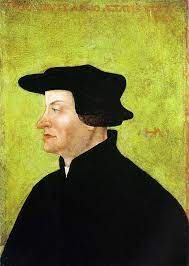
Ulrich Zwingli
Thus, Protestantism was a totality of religious organizations and teachings which arose as a result of the Reformation of the Catholic Church beginning from the sixteenth century. Protestantism grew from religious conflicts which betrayed key problems of social development and their resolution. Protestantism advanced new ideas of the human person and morality, of the place of religion in society and heralded the development of theological, philosophical and legal thought in modern times.
From the Catholic perspective, Protestantism was a heresy, a conscious departure from the divinely-revealed truths and institutions of the Church leading to apostasy from the truth faith and the trampling down of the moral standards of the Christian life. It brought into the world a new seed of discord and evil. The traditional Catholic view of Protestantism was outlined by pope Pius in his 1910 encyclical Editae saepe5: “Then those proud and rebellious men came on the scene who are ‘enemies of the cross of Christ’ … their God is their belly and they mind the things of earth. These men were not concerned with correcting morals, but only with denying dogmas. Thus, they increased the chaos. They dropped the reins of law, and unbridled licentiousness ran wild. They despised the authoritative guidance of the church and pandered to the whims of the dissolute princes and people. They tried to destroy the Church’s doctrine, constitution and discipline … They called this rebellious riot and perversion of faith and morals a reformation, and themselves reformers. In reality they were corrupters. In undermining the strength of Europe through wars and dissensions, they paved the way for those modern rebellions and apostasy.”
By contrast from the Protestant perspective, it was the Roman Catholic Church which had abandoned divinely-revealed teaching and the discipline of the early Christian Church and had thereby separated itself from the living mystical body of Christ. The hypertrophied spread of the organizational mechanism of the medieval Church had paralyzed the life of the Spirit. Salvation had degenerated into a type of mass production with pompous church rituals and a pseudo-ascetic way of life. Moreover, it had usurped the gifts of the Holy Spirit for the benefit of the clerical caste and thereby opened the door to all sorts of abuses and exploitations of Christians, corrupted by clerical bureaucracy at the centre of which was the pope, whose dissolute way of life was already legendary among all Christendom. The Protestant Reformation, far from advancing heresy, wanted to restore completely the dogmatic and morals ideals of genuine Christianity.
The beginning of the sixteenth century in Europe was a time of radical transformation in European culture, a time of noble initiatives and interest in classical culture. The way of seeing the world which heralded the bourgeois era had already begun. But the Catholic Church remained a fierce defender of the medieval order. The papacy, according to Thomas Hobbes, “is none other than the Ghost of the deceased Roman Empire, sitting crowned upon the grave thereof.” The Church enjoyed immense power in the form of the Inquisition, supported by the secular rulers.
The protest led to the appearance of anti-church movements. Their social make- up was quite variegated – rulers wanted independence from Rome, industrialists and merchants protested against the feudal set-up, the nobility and knights were against competition in taking away their subjects, the scientific and cultural community was against dogma and spiritual monopoly, the peasants and the urban lower classes were against oppression and taxation. A common cause had to be found to unite these disparate groups.
Luther and the beginning of the Reformation.
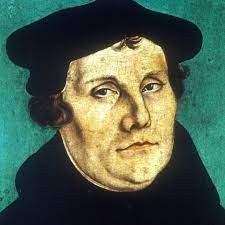 Martin Luther (1483-1546) delivered his famous sermon
on 31st October 1517 in Wittenberg in which he announced his ninety-five
theses6, the reason for which was the condemnation of the practice of selling
indulgences. Engels called this speech “a bolt of lightning into a gunpowder
barrel.” The main theme of the theses was that salvation required a person’s
inner repentance which cannot be substituted by any material donation of
money. Luther’s theses not only condemned this abuse of the sellers of
indulgences, but went further in rejecting the very principles upon which the
sale of indulgences was supposedly justified. He proposed that the pope had no
authority to forgive sins (the exception being the penances that the pope
himself had imposed) and disputed the teaching of the amassing of merit before
Christ and the saints, used by the pope in order to remit sins. Moreover,
Luther was appalled by the fact that the practice of selling indulgences gave
people a false, as he considered, belief in salvation.
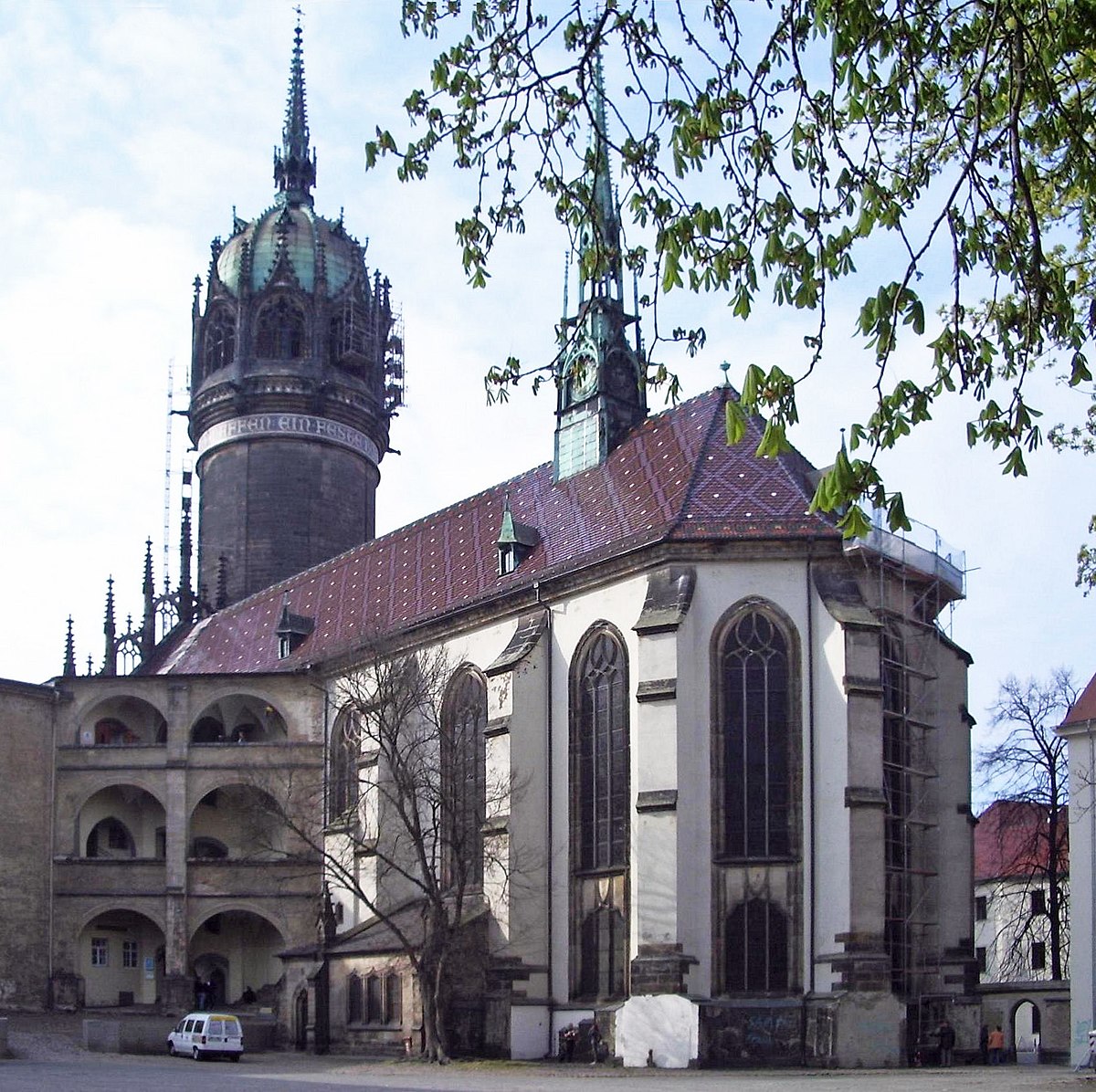
Rome struck back by threatening Luther with excommunication and physical violence. Luther refused to submit, which led to conflict. On 10th October 1520 Luther publicly burnt the papal bull excommunicating him from the Church.7
The reformer published one after the other three pamphlets in which he boldly set out his programme of a reformed Church in its teaching and organization. In the first of these, To the Christian Nobility of the German Nation, he called upon the German princes and rulers to reform the German Church, making it a national Church and transforming it into a Church free from the dominance of the church hierarchy, from superstitious ritualism and laws permitting the monastic life, clerical celibacy and other customs which he viewed to be a distortion of the true Christian tradition. In his treatise On the Babylonian Captivity, Luther attacked the entire system of church sacraments in which the Church was viewed as the official and sole mediator between God and the human soul. In his third pamphlet Of the Liberty of the Christian Man, he set forth his foundational teaching on justification by faith alone, which became the cornerstone of the Protestant theology.
It was impossible to overcome the Church as a feudal institution without destroying its dogmatic foundation upon which it had built its dominance in society, which is that the teaching that peoples’ salvation is impossible without the aid of the Church and without the grace which is contained only within the Church. To this earthly limitation of the Church, it was possible to object only with the power of almighty God: peoples’ freedom from Catholicism could only be asserted by emphasizing the complete, absolute dependence of the human person on the Maker, the impossibility of the sinner through his behaviour to influence the heavenly divine will. Therefore, Luther and the Reformers decisively rejected the Sacred Tradition that the Church is a special divine institution and declared the sole source of faith to be the Bible.
The Catholic Church taught that there was a difference between the sacred actions of the Church for the clergy and for parishioners who made up the laity. The former weas pleasing to God and guaranteed salvation. The latter had no bearing on life beyond the grave and was dependent solely on merit before the Church. The defining factor was to submit to the Church’s rules, who demanded money that would bring the sinner closer to the gates of paradise.
The claims of the Church to represent the interests of heaven were contested ferociously by Luther. Between God and man there could be no mediators; God grants salvation according to how he sees fit, and not by being forced to do so by a sinner who has paid his way. The fate of a human being is determined not by the Church, but by divine grace. And the believer is in no position to attain it by his own efforts. He finds it by being aware of the fact that he is a sinner who has found faith in God and in Christ’s redemptive sacrifice. The teaching on ‘personal faith’ as the basic and sole condition for salvation became the foundation of Protestant dogmatic teaching and the reinterpretation of traditional dogma. Personal faith which saves exists under the influence of the Holy Spirit testifying to the predetermination of salvation. Luther stated that: “I believe that I cannot by my own reason or strength believe in Jesus Christ, my Lord, or come to him; but the Holy Spirit has called me by the Gospel, enlightened me with his gifts, sanctified and kept me in the true faith.”
As a result, the place of religion changes in the life of the believer: all day-to-day earthly activity becomes sacred without regard to church rules. It is not important what a person does, but the awareness of his duty before God; the result of what he does is not important but his inner state, the goal which the person places before God. A new ethics of motivation comes into being.
Personal faith, according to Luther, prompts a radical revolution within a person’s soul and renders him inwardly free. Thus, love of neighbour becomes the same as ministry to one’s neighbour: we are not to abandon the world as monks, but to live in the world by conscientiously pursuing our earthly vocation while recalling the boundless and unmerited mercy of God. “To serve God is the same as to serve one’s neighbour, whether it is a child, a servant, a wife – anyone who has need of our material or spiritual help; this is divine worship.”
If in Orthodoxy and Catholicism a human being hopes to find salvation, then in Protestantism he has to believe that he or she is already saved. The believer thereby is aware of himself as a servant of God, inwardly free from earthly authority as someone entrusted by the heavenly Master. But the will of God means here a social and psychological disposition which is formed by real social practice as the encouraging motive and supreme spiritual value. Protestantism is opposed to the medieval relationship of personal dependence; it makes people equal and imparts to them hope in achieving success.
The theology of Protestantism
The theological structure of Protestantism created by the Reformers is predicated on five fundamental principles (five ‘solelys’)8:
- Sola Scriptura (‘solely by Scripture’)
- Sola fide (‘solely by faith’)
- Sola gratia (‘solely by grace’)
- Sola Christus (solely by Christ’)
- Soli Deo gloria (‘solely to the glory of God’)
Sola Scriptura. The Bible is the solely divinely-inspired and authentic word of God, the sole fount of Christian doctrine, clear and self-interpreting. Scripture contains the Word of God which is aimed directly at the soul and conscience of the Christian and is the supreme authority in issues of faith and church worship, independent of Church Tradition and any church hierarchy. This doctrine became the reason for the rejection from such traditions in Christianity which contradicted the letter and the spirit of the Bible or had no firm basis in Scripture. The Calvinists went further in their rejection of the old traditions than the Lutherans or the Anglicans, but they are all in agreement regarding their rejection of the authority of the pope, salvation for good works, indulgences, the veneration of the Virgin Mary, the saints, relics and sacraments (except baptism and the Eucharist), purgatory, prayers for the dead, clerical celibacy, the monastic life and the use of the Latin language in worship. This doctrine is sometimes called the formal principle of the Reformation as it is the source and basis of sola fide.
Sola fide. Forgiveness can be obtained only through faith with regard to good works and deeds. This does not devalue good works, but their significance is rejected as a source or condition for the salvation of the soul. At the same time, they are the inevitable fruits of faith and a testimony of forgiveness. The Protestants believe that faith produces forgiveness and good works, while the Roman Catholics believe that faith and good works bring forgiveness. This doctrine is sometimes called the material principle of the Reformation, for this doctrine was the central theological issue for Martin Luther and the other Reformers. Luther called it the “article upon which the Church either stands or falls.” This doctrine asserts the absence of other possibilities for the forgiveness of the sinner apart from faith in Christ’s redemptive sacrifice.
Sola gratia. Salvation comes only through the grace of God as undeserved mercy and not as something merited by the sinner. This means that salvation is an unmerited gift from God through Jesus. God is the sole subject of grace (in other words, grace is always effective without any actions on the part of the human person), while the human person cannot ever merit grace for himself through his deeds.
Solus Christus. Christ is the sole mediator between God and the human person, and salvation is possible only through faith in him. In spite of the rejection of other mediators between God and the human person, traditional Lutheranism venerates the Virgin Mary and other saints.9 Each Christian, if he is baptized and one of the elect, receives “sanctification” to be in communion with God, the right to preach and perform worship without mediators such as the Church and the clergy. The dogmatic difference between a priest and a layman is thus removed in Protestantism and the church hierarchy is abolished. Therefore, confession to a priest is not obligatory in Protestantism and there is no granting of absolution by a priest. Yet repentance directly before God remains very important. Also, Protestantism rejected the authority of the pope and abolished monasteries and monasticism.
Soli Deo gloria. A human being must worship God alone as salvation is granted only and solely through his will and action – not only the gift of Jesus’s redemption on the cross, but also the gift of belief in this atonement created by the Holy Spirit within the hearts of the faithful. The Reformists believe that any human creature, even a saint canonized by the Church, the pope or priest, is not worthy of the glory or veneration that has been accorded to him. The Church, which forms the mystical body of Christ, is the invisible community of elect Christians predestined for salvation.
The Reformists asserted that these teachings were to be found in Scripture and that they are a true divine revelation, distorted and neglected in the process of the dogmatic and institutional degeneration of the Roman Catholic Church.
According to the teaching of Saint Paul as understood in the Latin patristic tradition beginning with Saint Augustine, the human person, having lost at the fall the chance to do good and even desire it, cannot attain salvation independently. Human salvation is wholly an act of God. Faith is the first step in this process, and this faith in Christ’s atoning sacrifice on the cross is a gift from God. Faith in Christ means not only trust in Christ but trust accompanied by hope in Christ and love for him, or, to put it differently, it is an active, and not passive, faith. Faith through which the human person is justified, that is, with the aid of which sins are forgiven and he becomes justified in the eyes of God, is active faith. Justification by faith in Christ means that a transformation has occurred in a person’s soul and the human will, with the aid of divine grace, has acquired the ability to desire good and achieve it, and he therefore advances further along the path of righteousness by accomplishing good works.
Beginning with Paul’s distinction between the spiritual or inward person (homo interior) and the material, outward person (homo exterior), Luther came to the conclusion that the spiritual, inward person is reborn in faith, and in being united with Christ, is liberated from all subjugation and earthly chains. Faith in Christ grants him freedom. In order to become righteous, he needs only one thing, which is the holy word of God, the Gospel (i.e., the Good News) of Jesus Christ. In order to describe this union of the inward person with Christ, Luther uses the two comparisons of a spiritual marriage and a heated iron. In the spiritual marriage the soul and Christ exchange between themselves all that they have. The soul offers to Christ its sins, while Christ offers his boundless merits which the soul will now possess. In the process, the sins are eradicated. The inward person, thanks to this exchange with Christ in the soul, is asserted in his righteousness before the eyes of God. Then it becomes evident that the works which have influenced the outward person and which are linked to him, bear no relation to salvation. It is not by works but by faith that we glorify and confess the true God.
Logically it would follow from this teaching that if for salvation there is no need for good works and that sins are extirpated by an act of faith in Christ, then there is no longer any need to respect the moral order of Christian society and of morality itself. Luther’s distinction between the inward and the outward person helps us to avoid this conclusion. The outward person, who lives in the material world and belongs to the community of human beings, is tied by obligation to accomplish good works, and not merely because he can gain some advantage by doing so which would benefit the inward person, but because he is obliged to enable the growth and improvement of human society in the new Christian kingdom of divine grace. One is obliged to devote oneself to the good of the community so that the saving faith may be spread. Christ frees us not from the obligation to do good works, but merely from the vain and empty belief in their benefit for our salvation.
The exclusively passive role which is accorded the human person in the process of salvation led Luther to an even harsher understanding of predestination. His view of salvation differs from the stricter determinism of Augustine. The reason for all things is the supreme and absolute will of God, and we cannot apply to it moral or logical criteria using our limited human mind and experience. According to the interpretation of the biblical texts by the fathers and the experience of the Church (i.e., Holy Tradition) and the official dogmatic teachings (magisterium) of the Church, only active faith manifested in good works justifies and saves the person. Luther, though, asserted that the sole interpreter of Scripture was the Holy Spirit. In other words, the individual rationalization of every believing Christian is free thanks to union with Christ through faith.
The Lutheran principle of justification solely by faith reduces the mystery of salvation to the soul’s experience of the inward person and the abolition of the need for good works and further had consequences in relation to the nature and order of the Church. He had above all annulled the spiritual content and meaning of all the sacraments. Moreover, Luther struck the same blow in abolishing the priesthood in its main function as the celebrant of the sacraments. One other function of the priesthood (sacerdotium, literally, ‘sacrificing’) was that of teaching, and this was also cancelled, since the Reformist rejected the authority of Church Tradition and the Church’s ability to teach. As a result, there was nothing remaining which could justify the institution of the priesthood.
In Catholicism, the priest, thanks to his spiritual authority received during ordination, possesses a monopoly on celebrating the sacraments which are channels of divine grace and as such are essential for salvation. This sacramental power raises the priest above the laity, making of him a sacred persona, the mediator between God and the human person. In the Lutheran system this sacramental power no longer exists. In the mystery of justification and salvation each Christian deals directly with God and achieves mystical union with Christ through faith. Each Christian becomes a priest through his own faith. Deprived of its sacramental functions of teaching and celebrating the sacraments, the entire institutional structure of the Church collapses.
The most significant difficulty created during the Reformation was the Institutes of the Christian Religion (Institutio Christianae Religionis), Jean Calvin’s seminal work of theology. The first edition of this book contains a detailed exposition of the new teaching on salvation. At its basis lay the teaching of Luther with insignificant changes. In subsequent editions (the last came out in 1599)10 the volume of the book grew, and as a result became a compendium containing a complete and systematic exposition of the theology of Protestantism.
In many key issues Calvin disagreed with Luther, and the distinguishing feature of his system was its logical consistency and striking inventiveness in interpreting Scripture. This led to the creation of a new independent Reformed Church, the teachings and organization of which differed from the Lutheran Church. Calvin retained Luther’s foundational teaching on justification solely by faith, but if Luther had subjugated to this teaching all remaining theological theories at the price of inconsistency and compromises, then Calvin submitted his soteriological doctrine (the teaching on salvation) to a higher uniting principle and made it an integral part of the structure of dogmatic teaching and religious practice.
In his exposition Calvin begins with the problem of authority which Luther had confused with his distinction between the word of God and Scripture and the arbitrary application of this distinction. According to Calvin, the human person has an innate “sense of the Divinity” (sensus divinitatis), but knowledge of God and his will is revealed in full in Scripture which therefore from beginning to end is the infallible “standard of eternal life” and source of faith. Along with Luther, Calvin believed that in accomplishing good works, one does not acquire merit or a reward for which one is saved. Justification is the “acceptance in accordance with which God, receiving us into his Grace, regards us as the elect,” which brings with it forgiveness of sins and thus making us righteous before Christ. But, like Saint Paul, he believed that faith which justifies becomes active through love. This means that justification is inseparable from becoming sanctified and that Christ justifies no one whom he has not sanctified.
Thus, justification presupposes two degrees: firstly, an act in which God receives the believer as justified and, secondly, a process in which thanks to the action of the Spirit of God in him, the human person is sanctified. To put it differently, good deeds make no contribution to justification which saves, but they must needs follow on from justification. In order to preserve morality from disintegrating as a result of removing good works from the mystery of salvation, Luther appeals to the obligations linked to the life of society and to the purely human motive of convenience. Calvin, though, sees in good works the necessary consequence of justification and the infallible sign that it has been attained.
This teaching, as well as the teaching connected to it on predestination ought to be examined in the context of Calvin’s notion of God’s universal plan with regard to the cosmos. The highest attribute of God is his omnipotence. All created things have one reason for their existence, which is God, and only one function, which is to increase his glory. All events are pre-established by him and his glory – the creation of the world, the fall of Adam, the redemptive sacrifice of Christ, salvation and eternal damnation – all of these things are part of his divine plan. Saint Augustine, and the entire Catholic tradition with him, recognize predestination for salvation, but reject its opposite of predestination for eternal damnation. To accept it would mean to assert that God is the cause of evil. Catholic doctrine states that God infallibly foresees and without fail predetermines all coming events, but the human person is free to accept grace and choose good, or to reject grace and do evil. God wants everyone without exception to be granted eternal blessedness; nobody is predestined from the beginning either to damnation or sin. From eternity God foresaw the never-ending torments of the ungodly and established hell as a punishment for their sins, but at the same time he unceasingly proposes to sinners the merciful grace of conversion and does not ignore those who are not predestined for salvation. Calvin, however, was not perturbed by the determinism which could be understood in his conception of God’s absolute omnipotence. Predestination is the “eternal degrees of God by means of which he decides what should happen with each individual person.” Salvation and damnation are the two integral parts of the divine plan to which the human notions of good and evil are inapplicable Some are predestined for life everlasting in heaven, while others for eternal damnation in hell, as a result of which they become witnesses to God’s incomprehensible justice. Both heaven and hell manifest the glory of God and increase it.
The Reformation theologians did not cast any doubt on the dogmas of the first Five Ecumenical Councils in relation to the Trinitarian and Christological teachings.11
Thomas Műntzer and Calvin: the conclusion of the Reformation and the
appearance of Protestant religious sects
As a result of social, religious and other contradictions, Protestantism began to divide into various tendencies from the very beginning.
_Thomas Műntzer
_
Thomas Műntzer (c.1490-1525) was the leader and ideologue of the peasant and worker masses in the Reformation and German Peasants’ War from 1524 to 152612. Műntzer was initially a follower of Luther, but then became the main ideologue and leader of the popular Reformation, the embodiment of the world outlook of the popular masses. He shared the formula of ‘justification by faith’, but understood his earthly vocation to be the decisive struggle for the elect zealots of God who had been called upon to establish a new world in which private, egotistical interests would be liquidated and which would be directed against evil in the world. This was a programme to establish God’s kingdom on earth which would happen as a result of the struggle of the people acting in accordance with the will of God.
After the end of the German Peasants’ War, Műntzer’s followers retired from the world and preached non-resistance. Subsequently, they became founders of various Protestant sects, for example, the Mennonites, Anabaptists and other.13
Jean Calvin
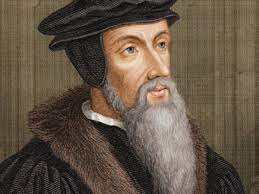 Calvin (1509-1564) was one of the most outstanding
Reformers of the Church. If Martin Luther began the Protestant Reformation of
the Church on the principle of removing everything in the Church which
contradicted the Bible, then Calvin went further by removing from the Church
all that which not required by the Bible. The Protestant Reformation of the
Church under Calvin was characterized by a tendency towards rationalism and
often mistrust towards mysticism. The central doctrine of Calvinism was the
sovereignty of God, that is to say, the supreme authority of God in all
things. From Calvin’s perspective, it did not depend upon the person as to
whether to accept the gift of grace or resist it, for this happens whether he
wishes it or not. It is most likely that he concluded from Luther that as some
accept faith and acquire it in their hearts, while others remain without
faith, then it followed from this that some are predestined by God from all
ages to damnation, while others are predestined to be saved. This was the
Calvinist dogma on the unconditional predestination of some for damnation and
others for salvation. This teaching meant that predestination happened within
the Divine Council by ways of divine providence independent of the will of the
human person, the way his thinks and the way he lives.
Calvin developed the conception of republican theocratism: the structures of the Church and the structures of the secular authorities ought to be independent. Calvin planned to organize the Church by being guided by the Bible and intended to reproduce the original order of the early Church in the form it was possible to imagine on the basis of the New Testament. He derived from the Bible the principles and standards of secular rule and introduced them in Geneva.
The best form of rule was a republic in which power is divided between various magistrates. But their authority comes from God. The duty of the magistrates was in effect to embody the “Divine Law” imprinted in the hearts of true Christians and expounded by the Bible. Citizens were ordered to visit worship regularly; the importing and publishing of books was strictly controlled and a harsh regimentation of life was imposed. Mass entertainments and dancing were strictly forbidden. The members of the ruling consistory were obliged to make regular visits to homes with the aim of controlling peoples’ ways of life and the way they thought. The suppression of all forms of protest and dissent was part of the plan. Thus, the Calvinists attempted to oppose the Counter Reformation with a monolithic organization of society.
In England, the Protestants opposed papal authority and the dogmas of the Catholic Church, but were in favour of the preservation of the teaching on the Church as the mediator in salvation, the episcopal structure and the preservation of the church hierarchy. Protest against this led to the appearance of yet one more Protestant tendency, that of Puritanism.
The Lutheran Reformation was introduced into the Scandinavian countries at the will of the monarchs. Sweden in 1527 and Norway in 1537 became Protestant countries by decree of their monarchs. But in many other European countries where the rulers retained their loyalty to the Roman Catholic Church (Poland, Bohemia, Hungary, Scotland, the Netherlands, France), the Reformation spread extensively throughout all of the social layers, thanks to the work of missionaries in spite of the repressive measures of the governments.
So, in France Protestantism merged with the movement of the Huguenots, which ended in political struggle on 24th August 1572 on the St. Bartholomew’s Eve, when the Huguenots were physically wiped out by the Catholics.14
In modern times Protestantism gradually lost its anti-church direction. Pluralism, on the other hand, became more and more prominent. By the beginning of the nineteenth century the basic Protestant currents had divided into numerous sects and new denominations had appeared. One of the most important of these currents was social Christianity which appealed to the ideals of the early Christians, to complete moral rebirth and the eradication of evil from the heart.
Various Churches which appeared as a result of disagreements within the main branches of the Reformation nonetheless remained true to at least three of the most important theological doctrines. These were offshoots from Lutheranism and in the main part differed from Calvinism on institutional and not dogmatic issues. The most conservative of them, the Anglican Church, retained its hierarchy of bishops and rites of ordination with traces of a charismatic understanding of priesthood. The Scandinavian Lutheran Churches, with their strict Calvinism in their organizational structure15, retained, thanks to their synods, a certain amount of centralization in their organization. Unlike them, the Congregationalists or Independents, recognize each community as the arbiter for their members in issues of faith and worship. The ardent polemics in confessional dogma between the theologians of various Churches and groups continued without abating throughout the sixteenth and seventeenth centuries.
Thomas Műntzer and Calvin: the conclusion of the Reformation and the
appearance of Protestant religious sects
_Thomas Műntzer
_
Jean Calvin
Editorial Footnotes
Related Concepts
- 39-articles
- abolition-of-hierarchy
- abolition-of-sacraments
- augustine
- augustines-predestination
- augustinian-grace
- augustinianism
- authority-of-scripture
- biblical-canon
- calvin
- calvinism
- christian-liberty
- church-as-mediator
- church-governance
- clergy
- council-of-trent
- counter-reformation
- divine-law
- divine-plan
- election
- ethics-of-motivation
- forensic-righteousness
- galatians-56
- geneva-discipline
- god-and-israel
- good-works
- heated-iron-analogy
- homo-exterior
- imputation
- inquisition
- invisible-church
- invisible-church-of-the-elect
- justification
- laity
- lay-preaching
- legalistic-soteriology
- luther
- magisterium
- mission
- monergism
- ninety-five-theses
- papal-authority
- patristic-interpretation
- penance
- predestination
- protestant-reformation
- protestant-theology
- protestant-tradition
- rejection-of-papal-authority
- rejection-of-saint-veneration
- relics
- salvation
- satisfaction
- self-exaltation
- sin
- society-of-jesus
- spiritual-marriage
- treasury-of-merit
- union-with-christ
- veneration-of-saints
- vocation
Footnotes
-
This claim is reversed. The Council of Trent (the “Tridentine Council”) did not move the bishops “towards full independence from the papacy.” On the contrary, it reinforced papal supremacy: its decrees required papal confirmation, and the pope promulgated the final canons. The precise relationship of bishops to Rome — in particular whether a bishop’s jurisdiction and the obligation of episcopal residence derived directly from God or came mediated through the pope — was one of the most bitterly contested and ultimately unresolved questions of the Council. ↩
-
Overstated. Trent (1546) declared the Latin Vulgate the “authentic” edition for public reading and disputation and reaffirmed Latin in the liturgy, but the Council itself issued no blanket prohibition forbidding clergy and laity to study Scripture in other languages. Vernacular Bible reading was later restricted and regulated (notably through the Index of Prohibited Books and its rules), not categorically banned by the conciliar decree. ↩
-
Loyola was a Basque from Guipúzcoa, not “Spanish” in the usual Castilian sense. His conversion famously began in 1521 while he convalesced from a leg wound suffered at the defence of Pamplona, reading Ludolph of Saxony’s Life of Christ and a collection of saints’ lives for want of chivalric romances; the pilgrimage to Jerusalem followed in 1523. ↩
-
The chronology is imprecise. Francis Xavier, the pioneering Jesuit missionary, reached Goa in India in 1542 and Japan in 1549 — that is, in the first half of the sixteenth century, not the “latter half.” Sustained Jesuit mission inside China came appreciably later (Matteo Ricci entered in the 1580s). ↩
-
This is Pope Pius X; the encyclical Editae saepe was issued in 1910. The passage quoted is a deliberately polemical, confessionally hostile characterization of the Reformers and should be read as such rather than as a neutral historical description. ↩
-
Several problems. The Ninety-Five Theses were not a “sermon” or “speech” but a set of Latin propositions drawn up for academic disputation. The traditional account has Luther posting them to the door of the Castle (All Saints’) Church in Wittenberg on 31 October 1517; many modern scholars, following Erwin Iserloh, question the dramatic “nailing,” noting that the firmly documented act on that date is Luther’s letter enclosing the theses to Archbishop Albrecht of Mainz. The date endures chiefly through its later commemoration as Reformation Day. ↩
-
The date is wrong: Luther burned the bull on 10 December 1520, not 10 October. Furthermore the document he burned, Exsurge Domine (issued 15 June 1520), threatened excommunication and gave him sixty days to recant; his formal excommunication came only later, with the bull Decet Romanum Pontificem in January 1521. ↩
-
The enumerated “Five Solas” as a fixed, unified scheme is a much later systematization (largely nineteenth- and twentieth-century) rather than a five-point formula set out as such by the sixteenth-century Reformers, who deployed the individual Latin slogans variously and rarely as a closed list of five. Note also that the text’s list misprints the fourth: the correct form is Solus Christus (nominative, as it correctly appears later in the document), not “Sola Christus.” ↩
-
Overstated. Confessional Lutheranism commemorates and honors Mary and the saints as examples of faith, but — following the Augsburg Confession and its Apology — explicitly rejects the invocation of saints and denies that they should be prayed to or “venerated” in the Catholic sense. “Venerates” therefore misrepresents the Lutheran position. ↩
-
Two errors. The definitive final Latin edition of Calvin’s Institutes appeared in 1559 (the French translation in 1560), not 1599. And the first edition (1536) was a short, catechism-like work of six chapters; the “detailed” and systematic exposition is a feature of the later, greatly expanded editions — as the following sentence itself concedes. ↩
-
It was the first four ecumenical councils (Nicaea 325, Constantinople 381, Ephesus 431, Chalcedon 451) that fixed the Trinitarian and Christological dogmas the magisterial Reformers retained. More importantly, the generalization is too sweeping: radical reformers such as Michael Servetus, and later the Socinians and Unitarians, openly rejected Nicene Trinitarian orthodoxy. ↩
-
The German Peasants’ War is conventionally dated 1524–1525; the main rising was crushed in 1525, when Müntzer was captured and executed after the Battle of Frankenhausen (May 1525), although scattered unrest persisted into 1526 in Alpine and Austrian regions. ↩
-
Misleading. Müntzer did not found these groups, and Anabaptism arose largely independently of him, among the Swiss Brethren in Zurich (Conrad Grebel and others, from 1525). The Mennonites take their name from the Dutchman Menno Simons (active from the 1530s) and are themselves an Anabaptist body, so listing “Mennonites” and “Anabaptists” as parallel, separate categories is imprecise. ↩
-
Both the label and the claim need qualification. The St. Bartholomew’s Day Massacre began on the night of 23–24 August 1572 (St. Bartholomew’s Day falls on 24 August). The Huguenots were not “physically wiped out”: estimates of the dead range from a few thousand in Paris to perhaps 5,000–30,000 across France, and the Huguenot movement survived to wage several further Wars of Religion, eventually gaining toleration under the 1598 Edict of Nantes. ↩
-
Confused. The Scandinavian state churches are Lutheran, not Calvinist, in both doctrine and polity; Sweden in particular retained an episcopate claiming historic succession. To describe their organizational structure as “strict Calvinism” is simply mistaken. ↩