History of the Christian Church — Topic 13
-
Which pope initiated the first attempt at Union and why?
- In which European city and in which century was there a first attempt at Union and why did it fail?
- In which European city and in which century was there a second attempt at Union and why did it fail?
- Explain briefly the role of Mark of Ephesus in Council of Florence.
- Where did the attempts at Union at this time fail?
-
Donald M. Nicol, The Last Centuries of Byzantium, Cambridge, 1993.
-
The cause of the policy of Union in Byzantine politics
- The Union of Lyons
- The Union of Florence
THE BYZANTINE EMPERORS AND UNION
The cause of the policy of Union in Byzantine politics
In the first half of the eleventh century there occurred a rupture between the Churches of the East and the West.1 These hostile relations were worsened by the Crusades during which Greek holy places were desecrated. The Greeks hated the Latins as heretics and as their persecutors, while the Latins for their part hated the Greeks as ‘schismatics’ (as they called them), as hypocritical and underhand people. These hostile feelings often led to bloody clashes between them. But, in spite of this, we can see that the Greeks and the Latins often attempted to unite the Churches. There were particular reasons for them to seek ecclesiastical union.
After the division of the Churches, the popes still hoped to submit the Eastern Church to their authority. They therefore strived with all their efforts to restore communion between the Churches of the East and the West, but restoration meant not a union of the Churches but the subjugation of the Eastern Church to the Western Church.
The political position of the Byzantine Empire in the era under discussion was calamitous. The decayed empire, under attack from both the Muslims and the Crusaders, was ready to collapse like a colossus with feet of clay. It awaited the example of the Rome Empire. The Byzantine rulers, counting upon the help of the popes, who at that time exerted a great influence on the course of political affairs throughout all of Europe, to defend the empire from its numerous enemies and avert it from collapse, sought out a union with Rome. It is not fortuitous that at their negotiations with Rome they discussed above all the issue of the reunification of the Churches, which could not but attract the pope’s attention. Thus, Rome’s calculations to subjugate the Eastern Church, on the one hand, and on the other Byzantine calculations to strengthen the political status of their empire became the reason for the attempts to reunify the Churches. Yet this calculating approach was an indication of how weak the forthcoming union would be. Amidst these calculations, the sincerity in the negotiations among both Latins and the Greeks, under the pretext of uniting the Churches, was completely lacking as both parties pursued their own aims. So, when one of the sides achieved or did not achieve its aim, the issue of the reunification of the Churches was pushed into the background. The weakness of the attempts at unifying the Churches was conditioned by the fact that there was nothing common among them, at least in the East. On the part of the Greeks, it was the emperors who in the main strove for the unification of the Churches. Most of the Greek bishops and the people were against unification as they said it would mean the subjugation of the Eastern Church to the pope. Of the many attempts to reunite the Churches, most of them failures, we ought to highlight two which were brought about by underhandedness and violence ending in sad consequences for the Eastern Churches. These are the so-called Unions of Lyons in 1274 and Ferraro- Florentine in 1438.2
The Union of Florence
The Union of Florence ended with a similar outcome. By the beginning of the fifteenth century the Byzantine Empire was already weakened by attacks from the East by the Ottoman Turks. The Byzantine rulers, following previous policies, sought from the West and mainly from the popes. With this aim the Greek emperors in the last times of the empire often traveled to the West, for example, John V Paleologos (1341-1391) and Manuel II Paleologos (1391-1425). But the West was in no hurry to help. The successor to Manuel, John VIII Paleologos (1425-1448), foreseeing the imminent and inevitable fall of the empire to Turkish arms, decided to save it using the last means available: under the pretext of uniting the Churches he would subject the Eastern Church to the pope in exchange for aid from Western rulers. With this in mind, he started negotiations with pope Eugene IV. The pope agreed to the emperor’s proposal. They agreed to convoke with the participation of Western rulers an Ecumenical Council with representatives of both the Greek and Latin Churches and to decide the issue of reunification at it. It was proposed that the Western rulers could be persuaded to give aid to the Byzantine Empire. After lengthy negotiations on the location of the Council, in was decided that it would be in Ferrara. The pope paid for the travel expenses and for the maintenance of the Greek bishops during the Council’s sessions.
At the end of 1438 the emperor John Paleologos, the Patriarch of Constantinople Joseph II, the representatives of the Eastern Patriarchs and several Greek bishops set off for Ferrara. Even the Russian metropolitan Isidore (by birth a Greek) set off for the Council, with the intention of accepting the Union. At first, upon arriving in Ferrara, the Greek bishops experienced the pope’s harsh policy. He demanded that Patriarch Joseph should kiss the papal slipper upon greeting him, but Joseph categorically refused to do so. Before the opening of the Council there were private consultations between the Greek and Latin fathers on differences of the faith. At these discussions on the part of the Greeks was Mark, metropolitan of Ephesus (he was the representative of the Patriarchate of Jerusalem) and Bessarion, the metropolitan of Nicaea. Mark of Ephesus did not make a single solitary concession to the Church of Rome.
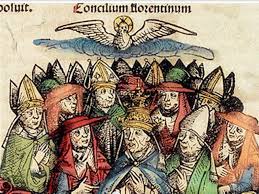 Finally, on 8th October 1438 the pope, with
the agreement of the emperor, opened the Council,3 although none of the Western
rulers had yet arrived. The main controversy was the perennial issue of the
procession of the Holy Spirit from the Son. The Greek fathers examined the
issue from the perspective of the canons of the Church and demonstrated that
the Latin Church had acted wrongly in inserting into the Nicene Creed the
Filioque (‘and from the Son’) in spite of the fact that it had been forbidden
by the III Ecumenical Council to add anything to the Creed. The Latins
asserted that the Latin Church in this instance had not distorted the Creed,
but merely expanded upon it. There were fifteen sessions devoted to such
arguments. The Greek fathers, especially Mark of Ephesus, as previously, made
no concessions. For their defiance, the pope decided to cut their maintenance.
As a result of the plague in 1438, the Council moved to Florence. But the change of location did not solve any problems. The subject of the controversy of the Filioque was transferred by the Latins from the canonical to the dogmatic level. The Latins showed that the teaching on the procession of the Holy Spirit from the Son was in itself correct, and affirmed this by reference to certain places in Scripture and the ancient writings of the fathers, arbitrarily interpreting them. The Greek fathers believed that it was inadmissible to conclude that the Holy Spirit proceeded from the Son as well as from the Father based on the texts the Latins referred to.
The emperor John Paleologos was extremely displeased with the stubbornness of the Greek fathers. He tried to convince them of the need to come to an agreement with the Latins. Bissarion of Nicaea, until then a stubborn opponent of the Latins, was inclined towards agreement, recognizing that the Latin expression “and from the Son” corresponded to the phrase used by the Greeks “through the Son.” But Mark of Ephesus was opposed to this and called the Latins heretics; however, John Paleologos nonetheless continued to do his utmost for reunification. With his supporters he compiled the following exposition of the teaching on the Holy Spirit: the Greeks, recognizing that the Holy Spirit proceeds from the Father, do not deny that he also comes from the Son. But Mark of Ephesus and others rejected this formula. The Latins in the meantime demanded complete acceptance of their teaching on the Holy Spirit. The emperor was left with no other choice than to use arguments and threats to compel the Greek fathers to agree to this demand. At the same time, they did agree to recognize the primacy of the pope. As regarding questions of ritual, there were no substantial arguments as such as the Latins agreed to recognize the Greek rites as equal to the Latin rites. When, thus, agreement was reached, they composed a document on the unification of the Churches setting forth the Latin dogma on the Holy Spirit, the primacy of the pope and purgatory. Thus, the document was signed by the Greek bishops, apart from Mark of Ephesus and Patriarch Joseph, as the latter did not live long enough for the issue to be resolved. The pope, who noticed that Mark had refused to sign the document, stated openly: “Well, we have accomplished!”4 The protocol was solemnly read aloud in the cathedral church in both Latin and Greek, and as a sign of unity and communion, the Greeks and Latins embraced each other and exchanged kisses.
In Constantinople the emperor John Paleologos had occasion to be convinced how unstable the unification of the Churches was, done as it was not on religious but on political grounds. The same Greek bishops who had consented to the Union in Florence, now in Constantinople demonstratively ignored it, without hiding the fact that they had been forced into union with the Latins. The Greek clergy and the people declared the Uniates to be heretics. Around Mark of Ephesus there formed a group of the defenders of Orthodoxy. The Patriarchs of Alexandria, Antioch and Jerusalem were also against the Union. In 1443 they convoked a Council in Jerusalem at which they excommunicated all those who supported the Union. Paleologos, who appointed to the Patriarchal see one Uniate after another, among whom was his spiritual father Gregory Mammas, could not sell the Union to the people. And indeed, the emperor, when the expected help from the West did not arrive, began to become indifferent to the Union. After his death in 1448, shortly before the fall of Constantinople, the Eastern Patriarchs once more condemned the Union at a Council in Constantinople in 1450. At this Council they deposed the Uniate Gregory Mammas and elevated to the Patriarchal throne the true Orthodox Athanasius.5 When in 1453 Constantinople was captured by the Turks, no one had any time to think about the Council of Ferrara-Florence.
The attempt to accept the Union suffered a complete failure in Russia. The metropolitan of Moscow Isidore,6 who signed the protocol in Florence, was deposed in Moscow by grand prince Basil II and imprisoned, from whence he escaped to Lithuania. After his deposition, the Russian Jonah became the metropolitan, and the Russian Church became once and for all a metropolitanate not dependent upon the Patriarch of Constantinople.
The Union of Lyons
After the capture of Constantinople in 1261, the Byzantine emperor Michael Paleologos strengthened diplomatic relations with pope Urban IV and then with pope Clement IV. He sent several embassies to them with abundant gifts and proposals regarding the reunification of the Churches, However, the negotiations with Rome did not lead to any positive results, mainly because the popes did not trust Michael Paleologos. Only in 1271, when the papal throne was occupied by Gregory X, who wished to unite the Churches under the leadership of Rome, was there any progress in negotiations. Gregory, in reply to Paleologos’ proposal, sent him a letter in which he supported his intention to submit to the apostolic see and invited him to the Council in Lyons in 1274, which he had arranged in order to once and for all settle the issue of the reunification of the Churches. The pope, additionally, stated that one of the conditions for reunification should be that the Greeks recognize the primacy of the pope and accept the Latin Creed with the addition of the Filioque.
The emperor Michael Paleologos decided to accept the unification of the Churches on the proposed conditions. The papal embassy handed to the emperor a letter on the Union, which was studied carefully. The Greek clergy, headed by Patriarch Joseph, formally loyal to the emperor, were against the proposed Union. Paleologos tried to persuade the Patriarch and the bishops to unite with the Church of Rome, believing that the conditions put forward by the pope were possible to fulfill: the commemoration of the pope in the liturgy was not humiliating for the Eastern Church, nor was it to recognize him as a brother and the first person of the Catholic Church. Regarding the right of appeal to the pope, then it would not in effect exist as “in contentious issues hardly anyone would want to sail the seas.” On the reading of the addition of the Filioque in the Creed, the emperor remained silent. In general, he tried to sell the Union to the Greek clergy as a political cause.
The Patriarch and the bishops, in spite of these attempts to convince them, were implacably against the Union. The Patriarchal chief advocate, the learned John X Beccus,7 said to the emperor that the Latins, as yet not labelled heretics by the Church, were in fact clandestine heretics. This resistance vexed the emperor, and so he imprisoned John Beccus. Yet, in realizing that Beccus, being a man of learning could do much to aid the cause of Union, Paleologos had to bring him over to his side. This he managed to do: Beccus turned into an ardent proponent of the Union. Meanwhile, he had to dismiss the papal embassy and reply to the papal letter.
Paleologos, who had decided upon Union, wrote to the pope that he would send to the Council of Lyons representatives authorized by the Eastern Church. There was only one difficulty for the emperor: the resistance of the head of the Greek Church Patriarch Joseph, who had sent to the Eastern bishops a circular letter against reunification with the Latins. The underhand Paleologos suggested that Joseph should retire for a time to a monastery on the following conditions: if the Union is not concluded, he may resume his see; but if it is concluded, then he must renounce his patriarchal rule. Joseph had no choice but to agree.
The emperor Paleologos, having drawn up a letter with the help of like-minded bishops on behalf of the Greek clergy to the pope, sent a delegation to the Council of Lyons. Among the delegates were the former Patriarch Germanus and the great logothete George Akropolites. The pope welcomed the delegates warmly.
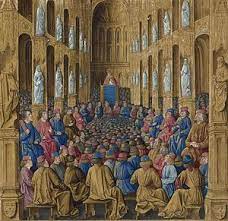 The fourth session of the Council was devoted to
the issue of the reunification of the Churches. It was done in such a manner
that there was no discussion of the differences between the Churches. Above
all, the pope declared to the Council that the Greeks would voluntarily join
the jurisdiction of the Church of Rome. Then there were read aloud the letters
to the pope from Michael Paleologos, and his son Andronicus read the letter
from the Greek clergy. Both the letters and document expressed full submission
to the pope, only in his letter the emperor asked the pope to allow the Greeks
to read the Creed with the Filioque. The great logothete George Akropolites
gave an oath on behalf of Michael Paleologos that he would keep inviolate the
confession of the Church of Rome and recognize her primacy. A similar oath was
also given on behalf of the Greek people and representatives of the clergy
among the delegates. In conclusion, they sung the Te Deum and Creed with the
addition of the Filioque.
It was in this manner that the Union between the Eastern and Western Churches was formally concluded. The Greek envoys received rich gifts and returned to Constantinople. The embassy from the pope also arrived with them. Paleologos was extremely pleased with the outcome of the Council of Lyons as after the affirmation of the Union the pope ordered that a peace treaty be drawn up between him and Charles I of Anjou, whose troops threatened Byzantium. It remained only to introduce the Union into the Greek Church. As he awaited the envoys from the Council of Lyons, Paleologos used all possible means, including force, to incline the Greek clergy into accepting the Union. When the envoys brought the Union, the division between the two Churches was declared not existent and the emperor demanded that all should recognize this as a fait accompli. Patriarch Joseph was deposed, and his place was taken by the supporter of the Union John Beccus. It was ordered that in worship the name of pope Gregory X should be commemorated as the “supreme hierarch of the apostolic Church and Universal pope.” But the Union was on shaky ground. Only the emperor and his party had accepted it. The Greeks, the clergy, the monks and the laity, not desiring and not seeking union, wanted to have no communion with the Church of Rome whatsoever. Curses were hurled at the Uniates and nobody wanted to have anything to do with them. As a result of the unsuccessful attempts by Paleologos to increase the number of Uniates by peaceful means a wave of repressions went through the country. People were sent into exile and imprisoned, some were subjected to blinding and the amputation of their hands and so on. It was the clergy above all who were subject to persecution. The emperor did not spare even his own relatives. Meanwhile, Beccus tried to persuade the people to accept the Union through letters and writings. But neither the repressive measures of the emperor, nor the works of Beccus were successful: the Greeks still refused to accept the Union.
At the same time, in Rome it was known that the Greek Church had rejected the Union. Pope Gregory and his supporters left Paleologos in peace. But pope Nicholas III wanted the Union to be a reality. He sent legates to Constantinople who were to insist on the adoption of the Latin Creed and submission to the pope. Michael Paleologos found himself in a desperate situation. But this flexible politician found a way out of this difficult situation. He received the envoys magnanimously, according them all honours, and assured the pope of the emperor’s fidelity to the Union. Paleologos ordered that the Greek clergy draw up a document (the signatures of the bishops were forged) which would set forth the teaching of the Church of Rome. The document was handed to the legates. They were shown the prisons where the opponents of the Union were being kept, and ultimately two opponents of the Union were sent to be judged by the pope, but the pope sent them back without punishing them. Thus, the emperor Michael Paleologos pacified pope Nicholas III, while the latter concluded with him a secret pact against Charles I of Anjou.
In 1281 Martin IV assumed the papal throne, knowing that the Greek Church was not in union with Rome, he dismissed Paleologos’ envoys with contempt and excommunicated him from the Church. Paleologos, vexed by this action of the pope, forbad clergy to commemorate him at the liturgy, but still retained the Union. Charles of Anjou, no longer constrained by the pope’s interdiction, declared war on Paleologos, which the latter won. As a result of the defeat of Charles, in 1282 the pope once more excommunicated Paleologos. Paleologos died in the same year, and with his death the Union of Lyons came to an end. His son and successor Andronicus II (1283-1328) was a supporter of Orthodoxy.
In 1283 a Council took place in Constantinople which discussed the main issue of the dogma of the procession of the Holy Spirit from the Son. The Council condemned the Uniates and primarily John Beccus, who was deposed and exiled to Bursa.8 The churches in which Uniate worship had once taken place were reconsecrated as they had been considered to have been defiled. Within a number of decades there was no trace of the Union of Lyons to be seen in the East.
Editorial Footnotes
Related Concepts
- afterlife-theology
- augustine
- beatific-vision
- bessarion-of-nicaea
- bonn-conferences
- byzantine-empire
- chalcedon
- church-and-state
- church-separatism
- church-turmoil
- collegiality
- conciliar-anathema
- council-of-constantinople-1283
- council-of-ferrara-florence
- council-of-lyons
- councils-of-the-church
- crusades
- dogmatic-definition
- double-procession
- east-west-schism
- ecumenical-councils
- fifth-ecumenical-council
- filioque
- florence-union-document
- florentine-union
- georgian-orthodox-church
- goths
- greek-metropolitans
- gregory-palamas
- holy-spirit
- holy-trinity
- isidore-of-moscow
- john-1526
- jonah
- justinian
- latin-doctrine
- latin-dogma
- liturgical-purity
- mark-of-ephesus
- metropolitan-isidore
- moscow-church
- mother-church
- nicene-constantinople-creed
- nicene-constantinopolitan-creed
- nicene-creed
- one-principle
- orthodox-resistance
- orthodoxy
- papal-authority
- papal-authority-to-define-dogma
- papal-legates
- papal-policy
- pastor-aeternus
- patriarch-of-constantinople
- patriarchs-of-alexandria-antioch-and-jerusalem
- photius
- prayer-for-the-dead
- purgatory
- re-consecration
- roman-catholicism
- russian-church
- second-ecumenical-council
- st-augustine
- st-constantine
- st-mark-of-ephesus
- st-maximus-the-confessor
- st-metropolitan-jonah
- submission-to-the-apostolic-see
- temporal-punishment
- third-ecumenical-council
- triadology
- trinitarian-theology
- ukrainian-church-council
- unia
- uniate-cardinal
- uniates
- union-of-florence
- union-of-lyons
- unionuniatism
- universal-pope
Footnotes
-
The standard date for the East–West rupture is the mutual excommunications of 1054, which falls in the middle rather than the “first half” of the eleventh century. Modern scholarship (e.g., Steven Runciman, Henry Chadwick) also stresses that 1054 was not perceived as a definitive schism at the time; estrangement hardened gradually and was only decisively sealed by the sack of Constantinople in the Fourth Crusade (1204). ↩
-
The Council of Ferrara-Florence convened in 1438, but the union decree Laetentur Caeli was not signed until 6 July 1439 (in Florence). The event is therefore conventionally dated 1439, not 1438. ↩
-
The council had already been formally opened at Ferrara earlier in 1438 (by Eugene IV’s bull in January and a solemn opening in April; the Greek delegation arrived in March). The session of 8 October 1438 opened the formal doctrinal debates, not the council itself. ↩
-
The traditional report inverts the sense of the original. When Eugene IV learned that Mark of Ephesus had not signed, he is said to have exclaimed “Λοιπὸν ἐποιήσαμεν οὐδέν” — “Then we have accomplished nothing” — i.e., an expression of dismay, not satisfaction. The rendering “we have accomplished!” drops the crucial “nothing.” ↩
-
The historicity of this 1450 synod is seriously doubted by modern scholars (notably Joseph Gill). The surviving “acts” of a 1450 Council of Constantinople deposing Gregory III Mammas are widely regarded as a later anti-unionist forgery; in fact Gregory was still recognized as patriarch and departed for Rome of his own accord in 1451. The patriarchate of “Athanasius” at this date is correspondingly uncertain. ↩
-
Isidore’s title was Metropolitan of Kiev and all Rus’ (he resided under the Muscovite grand prince but was not styled “metropolitan of Moscow”). The autocephalous line beginning with his successor Jonah (installed 1448) is what gave rise to the later Moscow metropolitanate. ↩
-
He was Patriarch John XI Bekkos (Beccus) of Constantinople (reigned 1275–1282), not “John X.” John X Kamateros had been a much earlier patriarch (c. 1198–1206). ↩
-
Bekkos abdicated at Michael VIII’s death (1282) and was examined by a synod, but the decisive council that repudiated the Union of Lyons and condemned his Filioquist theology was the Council of Blachernae of 1285 (under Patriarch Gregory II of Cyprus), which issued the Tomus of 1285. ↩