History of the Christian Church — Topic 11
- Name the two great founders of monasticism in the East.
- Explain the differences of approach to the monastic life in these two founders.
- Under which emperor did monasticism in the East arise and what were the reasons for this?
- Name some of the founders of monasticism in the West.
- In what way was monasticism useful for the Church in fulfilling her mission to the world?
Female monasticism
The first female monastery was founded by Saint Pachomius for his sister Maria, thus laying the foundation for other convents. One wealthy Roman woman by the name of Melania the Elder, the friend of Rufinus, founded a convent on the Mount of Olives. Later, Melania the Younger (+439) was famed for founding many convents. Western nuns lived in Palestine, imitating the Egyptian ascetics. Saint Jerome translated for the nun Paula the extended rules of Saint Pachomius.
The meaning of monasticism for both the Church and society
Monasticism in the Christian Church had great ecclesiastical and social significance. The monastery ascetics were bearers of the light of the faith and godliness. The fame of the lives and deeds of the holy desert-dwellers drew towards them many people who sought out exhortation and consolation. The visitors to the monasteries not only learned a godly way of life from them, but spoke of this to others, wrote down their words and deeds and endeavoured to imitate their examples in life. Hospitals and shelters were built on the territories of the monasteries. Alms would be sent from the monasteries to those places where people had endured all sorts of afflictions and calamities.
Monasticism helped the Church enormously in her struggle against the remnants of paganism and heresies. In settling in remote places on the borders with countries where paganism still held sway, the holy ascetic monks amazed the pagans with their feats, convincing them of the power of the Christian God. Monasticism within the Church also transpired to be an insuperable power in the fight against heresies. Thus, in the struggle for the veneration of icons, the monks courageously defended the iconodules from the attacks of the iconoclasts.
-
Derwas J. Chitty, The Desert A City, Crestwood, 1995
-
The birth of monasticism in Egypt
- The spread of monasticism
- Monasticism in the West
- Female monasticism
Monasticism in the West
Western monasticism arose under the influence of its Eastern counterpart, and quickly developed and grew stronger. The Eastern pattern of monasticism introduced to the West was fundamentally reworked in the spirit and direction of the Western Church. In the first instance, monasticism in the West became a massive cultural power in both church and secular life. It was the middle-ages that were to become the ‘golden age’ of Western monasticism.
Saint Jerome testifies that Saint Athanasius of Alexandria at the time of his second exile in Rome (342-343)1 brought to Italy stories of the hermit Anthony and of the monasteries of Saint Pachomius. In addition, Palladius states that one of the monks from Egypt – Isidore – was to be found in Rome in around 350.
The first monasteries arose in the West in the 370s. Saint Martin of Tours (+397) founded several monasteries in Gaul. In their inner life these monasteries in the West at first copied the Egyptian and Palestinian models of monasticism.
The first person to attempt in the West a codification of the monastic rules was John Cassian (c.360-431). Like Jerome, John was the connecting link between East and West. Born on the border line between East and West, he was initially attracted towards the East. He spent between twelve and twenty years with his friend Herman in the monastery in Bethlehem and among the anchorites of Lower Egypt. In around the year 400 he went to Constantinople where he was struck by the charismatic personality of John Chrysostom and served under him as a deacon and as his disciple. After John Chrysostom was sent into exile, John Cassian went to the West to pope Innocent I. He spent the last third of his life in the West, becoming a priest there and founding two monasteries in Massilia (now Marseilles). His work, written in around 426, deals with the rules of monastic life and is based on the works of the Eastern fathers and his own practical experience. Alongside this, of great benefit were the Rules of Basil the Great, translated by Rufinus and the rules of Saint Pachomius, translated by Saint Jerome.
At the end of the fourth century there were already a great number of monasteries in the West. They appeared on the islands off the shores of Italy, Dalmatia and Gaul. Saint Augustine is considered to be the founder of monasticism in North Africa.
Saint Benedict of Nursia (480-543)2
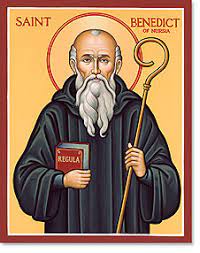 Saint Benedict of Nursia was born to an
aristocratic family in the Italian province of Nursia. He was brought up in
Rome and, seeing there the degradation of morals in the city, at the age of
fourteen he retired to the desert where an elder indicated a place of solitude
for him where he could engage in spiritual labours. Here he was surrounded by
shepherds, and monks from a neighbouring monastery soon found out about him
and elected him to be their abbot. The strict nature of his rules caused anger
among the brethren and he was forced to flee to Florence, where he founded
twelve monasteries, yet the envy of the clergy in Florence compelled him to
abandon the city.3
Benedict founded a monastery on the lonely mountain of Monte Cassino. The saint ordered the pagan temple there to be destroyed and cleared in the grove a sacred space. The small church which he built became the fount of the famous Abbey of Monte Cassino, from which there emerged all of the monastic communities of the West. The Rule of the Abbey of Monte Cassino was similar to that of the Rules of the Eastern monasteries. As there, the fundamental discipline of the monastery consisted of the renunciation of one’s will and obedience to the father superior.
As in the East, those who entered the monastery had first to undergo a period of probation to determine how willing they were to submit to the demands of the monastic Rule, having been read the Rule three times. In addition, they were obliged in writing to give an oath to never leave the monastery. Benedict’s Rule was unique in that it also contained practical elements. The day in the monastery, according to the Rule, began at two o’clock and ended at midnight. During the day worship was conducted at various times, but seven hours were devoted to practical work of various sorts such as the instruction of children, and later Saint Gregory the Great granted them the right to carry out missionary work.
Strict coenobitism lay at the foundation of the monastic life. The monk was not to have any private property whatsoever, even the most insignificant. They received all they needed to sustain themselves from the common monastery means. Regarding food, the Rule did not prescribe the same privations and limitations that were to be found in the Eastern Rules. Only moderation had to be observed. Apart from vegetables, eggs, cheese and fish were also allowed, as well as fowl and fruit. Meat from four-legged animals was categorically forbidden.
Each monk was allowed, moreover, a small quantity of wine. The prescriptions regarding food, though, were not strictly regulated by the Rule. The abbots of the monasteries in this regard were free at their discretion to institute rules in accordance with the climate and season, and the age, state of health and work obligations of the monks.
This reorganization of monastic life was so in step with the conditions of life in the West that even in Benedict’s lifetime his Rule had spread to Gaul, Spain and Sicily, and soon after his death all of Western monasticism adopted his Rule. It was the first example of a great community spread throughout various lands which lived by the same Rule. Thanks to its practical application, Western monasticism exerted a huge influence on the social life of the West, and not merely in the cause of bolstering Western culture. The monks cleared the forests, build roads and transformed the deserts into vegetable and fruit fields by planting vineyards. Thanks to the development of the monasteries the Barbarians learnt agricultural skills. In the so-called ‘Dark Ages’ the Benedictine monasteries were a refuge for books and libraries. The monks copied the works of classical and Christian antiquity, and kept chronicles, thereby adding to enlightenment.
A GENERAL OVERVIEW OF CHRISTIAN LIFE FROM THE FOURTH TO ELEVENTH
CENTURIES
The birth of monasticism in Egypt
There was evidence of monastic life in the Christian Church in the very first centuries of her existence. Its forerunners were those who could not live in the world as genuine Christians, and so retired to the wilderness away from the vanity of everyday life to devote themselves to prayer, fasting and contemplation of God.
But it the fourth century, when there arose within the Church a need to organize her structures with strict discipline, monasticism did not escape this regulation of the spiritual life and so developed along two directions, that of the eremitic and the coenobitic. The meaning of the eremitic lifestyle was that the monks, under the guidance of their abbot, would attend to their individual lives at their own discretion. Each would seek out his own means for existence and use them as he saw fit, each would arrange the time spent in his cell as he saw fit. The other form of monastic life – the coenobitic – was distinguished by its greater discipline. Here, the life of the monks, in both the shared monastery and the cells, was determined in the slightest details by a Rule. There was no right to personal property. Everything that was made by the labour of the monks became common property, from which each monk could take to sustain himself. The presence of private property in a monk was viewed as a crime.
 The place where Eastern monasticism was born was
Egypt. Here, in the Theban desert, the first representative of the monastic
life, Paul of Thebes, spent his life in spiritual endeavours for sixty years.
Egypt was the homeland of the founders of the monastic life as an organized
institution – Saint Anthony the Great and Saint Pachomius. The former
organized the first eremitic lifestyle of monks, while the latter was the
founder of coenobitic monasticism.
Saint Anthony the Great (251-356)
Saint Anthony the Great came from a wealthy noble family in the Egyptian settlement of Coma. He was brought up as a strict Christian. At the age of eighteen, after the death of his parents, he became an orphan. The godly ways that had been inculcated in him throughout his childhood defined his attitude towards the world. Worldly pleasure, which he could enjoy only at his own expense, no longer interested him. So divine providence pointed him towards another path in life. During worship in church his soul was struck especially profoundly by the words of the Lord spoken to the rich young man: “If you wish to be perfect, go, sell your possessions, and give to the poor, and you will have treasure in heaven; then come and follow me” (Matt 19.21).
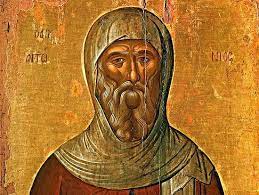 Feeling himself sufficiently fortified for
further spiritual labours, he settled in a cave which was used as a tomb and
spent many years there, sustaining himself with bread and water. The great
ascetic had to struggle against various types of temptations. On the one hand,
he was tempted by images of worldly life full of various pleasures and
entertainments, while on the hand he was confronted by a life of privations.
Once he felt ready for serious spiritual endeavours, he retired further from
these inhabited places and settled in the ruins of a fortress where he spent
the next twenty years. His fame spread among Christians, many wanted to have
him as their monastic spiritual guide. So, there gathered around Anthony a
whole community of ascetics who settled in the neighbouring caves. This was to
become the first ever monastic community.
The great ascetic was granted the gift of miracle-working and foresight. For advice and consolation there came to him people from all walks of life and social positions. The emperor Constantine the Great corresponded with him. But it was the life of complete solitude which was the ideal for him, and he spent his later years for the most part in the so-called inner desert, three days travel to the East from the monastery which he had founded. He only twice appeared again to the world: in 311, when he went to Alexandria at the height of the persecutions of the Christians under Maximinus in order to encourage and console those who suffered for the faith, and the second time when, already one hundred years old, he came to the same city during the controversies of the Aryan heresy. In both instances his appearance was of great benefit for the faithful as in his words and teachings they gathered new strength in their struggle against their enemies. Many heretics and pagans converted to the Church under the influence of his dialogues.
Saint Anthony died at the advanced age of 106.
Saint Pachomius the Great (292-348)
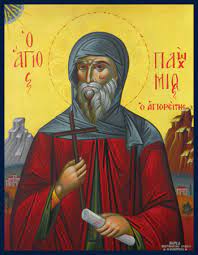 Saint Pachomius the Great was a native of
Thebes, was born to a pagan family and in his youth received an excellent
education. In 312 Pachomius served in the guards of Caesar Maximinus, who was
at war with the emperors Constantine and Licinius.4 Among his labours and
privations, he had occasion to come to know Christians and how they, following
their Teacher’s commandment, treated their enemies mercifully. The life of the
Egyptian ascetics intrigued Pachomius and, upon returning from war, he was
baptized and retired to the Egyptian desert. Here he engaged in spiritual
labours under the guidance of a monastic elder. Thus, as in the case of Saint
Anthony, there gathered around him many admirers of the solitary life. Having
been used to strict order and discipline as a soldier, Pachomius decided to
impart to the community of ascetics a strict form of organization and he
introduced a homogenous pattern of order in it for all. By the river Nile at
the town of Tabennisi, he started to build his monastery. But as this single
monastery could not accommodate all those who wished to be under his guidance,
he founded on the banks of the Nile a number of monasteries.
Life in these monasteries was strictly determined by the Rule: twice a day – once in the daytime and once at night time – the monks at the sound of a trumpet or semantron would gather in church for prayer. On Sundays a priest would come from a neighbouring village to celebrate the Liturgy and give holy communion to the monks. Lest any of the monks started to think too highly of themselves, Pachomius forbad them to become priests and he too never went into priestly orders. Of the ascetic labours, the most valued were those of a contemplative nature: lengthy prayers, lengthy fasting, contemplation of God and the world of the spirit. Physical labour was viewed as a necessity for material sustenance and for helping the poor. He could be seen alongside the simple monks carrying out the most arduous of physical tasks within the monastery. All that was obtained by the monks’ labour became part of the monastery’s common bursary.
The discipline within the monastery was founded upon the complete renunciation of the will and unconditional submission of the will to the father superior. Every deed was begun and was completed with the blessing of the superior. Life in the monastery was ordered in the strictest way possible. The food was modest. It consisted mainly of bread, cheese and vegetables, and was to be taken only once a day. Only on Saturdays and Sundays was there an evening common meal. No personal property was to be kept in the monastery. Pachomius would not accept into the monastic community anyone who so wished to become a monk straight away; he would give them a year to test their monastic vocation. In spite of the strict rules, the number of monks in the eight monasteries which he founded in Pachomius’ lifetime increased to seven thousand.
Saint Macarius of Egypt (300-391)
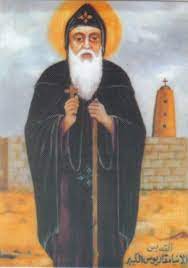 Of the ascetics of the East in the fourth
century Macarius of Egypt is especially renowned. He was born around 300 in
Lower Egypt. Against his own will, but at the insistence of his parents, he
got married, but remained celibate within his marriage. Upon the death of his
parents and wife, at the age of thirty Macarius retired to the desert of the
Scetis valley. He was widely respected for the strictness of his ascetic
labours, and for his meekness and humility became known as the ‘old young man’
(i.e., a young man with an elder’s wisdom). At the age of forty he was
ordained to the priesthood and from this time on for fifty years he was the
leader of monastic life in the Scetis valley. During the reign of emperor
Valens, he was sent into exile for a short while for confessing the Nicene
Creed. In his lifetime he was granted the gift of miracle-working and
prophecy.
Saint Macarius is also famous as a writer. He has left us fifty dialogues of a didactic nature.5 The intimate union of the soul with God as the highest good and aim of human life was the constant theme of Macarius’ writings. He is also the author of a number of morning and evening prayers which have entered into common usage in the Church. Macarius died in 391.
The spread of monasticism
In Asia Minor, between the areas of Pontus and Cappadocia, it was Saint Basil the Great who ensured the spread of monasticism. Helping him in this were the monastic Rules which he had devised.
Saint Euphemius of Egypt (376-473),6 who began his life of monastic endeavours at an early age, had a huge influence on the development of Eastern monastic life. In various places where he laboured, there gathered around him admirers of the life of solitude. In this manner monasteries appeared. His influence was so great that many heretics converted to Orthodoxy.
Monasticism appeared at an early stage on Mount Sinai in Syria.7 Of the ascetics of Sinai in the fifth century we know Saint Nilus the Sinaite (+450) and in the seventh century Saint John of the Ladder (+649). Abbot of the monastery on Sinai, John was so called from his book the Ladder which contained the degrees of ascent to spiritual perfection.
Of the ascetics of Syrian monasticism, we ought to note Saint Isaac the Syrian. He was born in Nineveh, became a monk at a young age and went into the desert to engage in spiritual labours. The people of Nineveh elected him as their bishop but he administered the diocese for only five months and once more returned to his monastery.8 Of his works the most interesting are his homilies and teachings. They are full of the most profound psychological observations and touch upon the life of the human spirit in its most mysterious condition.
In the middle of the fifth century monasticism spread to Constantinople. The Roman patrician Flavius Studius founded a monastery here which later became famous. It was to this monastery that the community of the Acoemetae (‘sleepless’) monks was invited. The monastery’s profile at the end of the eighth and first quarter of the ninth centuries was raised by the famous abbot in Constantinople Theodore the Studite (+826), renowned as the defender of the veneration of icons. The number of the brethren in the Studion Monastery under his direction grew from twelve to a thousand, and in terms of the strictness of discipline there it surpassed all the other Greek monasteries.
Apart from the usual ascetic labours which the monastic Rules set out and provided for, there were also especially extreme forms of asceticism. One of these was the stylite movement whereby a monk would live on the top of a column under the open sky. A representative of this type of asceticism in the fifth century was Symeon the Stylite, who laboured sixty kilometers from Antioch on a column measuring just under a meter in diameter. He spent thirty- seven years in this ascetic labour. His neck was weighed down by an iron chain. He accepted a modest amount of food only once a week and abstained completely during Lent. In the seventh century we see yet another great representative of this type of asceticism in the person of Alypius the Stylite, who prayed at the top of his column for fifty years.
From the eight to the tenth centuries the many ascetics of the Holy Mountain of Athos became known to the Christian world. These were Saint Peter the Athonite (+734), who spent more than fifty years on the Holy Mountain in complete solitude, and Saint Athanasius (+1000, who built on Athos a monastery which became the centre of monastic ascetic endeavour.
Editorial Footnotes
Related Concepts
- abbotfather-superior
- alypius-the-stylite
- apologetics
- arian-heresy
- ascetic-labours
- ascetic-struggle
- benedict-of-nursia
- benedictine-rule
- charity
- common-bursary
- contemplation
- contemplation-of-god
- conversion
- desert-dwelling
- education
- evangelical-counsels
- extreme-asceticism
- hesychia-and-solitude
- hospice
- hospitals
- inner-desert
- john-cassian
- john-of-the-ladder
- ladder-of-ascent
- liturgical-hours
- manual-labour
- matthew-1921
- mission
- missionary-work
- monastic-probation
- monastic-vow
- monastic-witness
- monte-cassino
- nicene-creed
- novitiate
- obedience
- obedience-to-the-father-superior
- physical-labour
- probation-of-novices
- probationary-period
- renunciation-of-the-will
- rule
- rule-typikon
- saint-anthony-the-great
- saint-benedict-of-nursia
- saint-gregory-the-great
- saint-macarius-of-egypt
- saint-pachomius-the-great
- saint-theodore-the-studite
- social-significance-of-monasticism
- spiritual-father-abba
- stylitism
- symeon-the-stylite
- union-of-the-soul-with-god
Footnotes
-
The dates are imprecise. Athanasius’s second exile — most of which he spent in Rome — ran from roughly 339/340 to 346, not merely 342–343. He arrived in Rome around 340 and was present for the Council of Rome in 341, well before the dates given here. ↩
-
Benedict’s death is more commonly placed at c. 547 (traditionally 21 March 547) than 543. His dates are in any case approximate and known almost entirely from Book II of Gregory the Great’s Dialogues, a hagiographical source written around 593, roughly a half-century after Benedict’s death. ↩
-
This appears to garble the traditional account. After leaving the monks who tried to poison him, Benedict withdrew to Subiaco (not Florence), where he founded twelve small monasteries; he then left for Monte Cassino because of the hostility of a jealous local priest named Florentius. The place-name “Florence” and the “clergy in Florence” seem to be a confusion of Subiaco with the priest Florentius. ↩
-
The political framing is muddled. Pachomius was conscripted around 312–313, but in 312 Constantine was campaigning in Italy against Maxentius, not against Maximinus (Daia); Maximinus’s war in the East was fought against Licinius in 313. Sources also disagree on which emperor’s forces conscripted Pachomius, so the specific attribution here should be treated with caution. ↩
-
These are the Fifty Spiritual Homilies traditionally ascribed to Macarius of Egypt. Modern scholarship generally holds them to be the work of an anonymous later author (“Pseudo-Macarius” or “Macarius-Symeon”), active in a Syro-Mesopotamian milieu in the late 4th/early 5th century, whose writings show affinities with — and were later linked to — the Messalian movement. Authorship by the historical Macarius the Egyptian is now widely doubted. ↩
-
This is Saint Euthymius the Great (c. 377–473), whose dates match. He was not Egyptian: he was born in Melitene in Armenia Minor and spent his monastic career in the Judean desert of Palestine, founding lavras near Jerusalem. “Euphemius of Egypt” errs on both the name and the geography. ↩
-
Mount Sinai is in the Sinai Peninsula (Egypt), not in Syria. The monastic settlement there (the site later known as St Catherine’s Monastery) lies in Sinai, far to the south of Syria. ↩
-
Worth noting for context: Isaac of Nineveh (7th century) was a bishop of the Church of the East (the East Syriac, so-called “Nestorian,” church), consecrated by its catholicos, not a bishop of the Byzantine/Chalcedonian church. His ascetical writings nonetheless came to be deeply revered across the Orthodox and wider Christian traditions. ↩