History of the Christian Church — Topic 9
-
Name the maid defenders of the veneration of icons?
- What is the opposite of an iconoclast?
- Explain briefly the Orthodox theology of the veneration of icons?
- Which monastery became the main centre for the defense of the veneration of icons and where was it located?
- Explain briefly the origin of the Sunday of the Triumph of Orthodoxy?
-
John McGuckin, The Path of Christianity: The First Thousand Years, Downers Grove, 2017
- Jaroslav Pelikan, The Christian Tradition: A History of the Development pf Doctrine 2. The Spirit of Eastern Christendom (600-1700), Chicago, 1974
- Arthur Stanley, Lectures on the History of the Eastern Church, London, 1984
Iconoclasm after the VII Ecumenical Council
In spite of the victory of the iconodules at the VII Ecumenical Council, the iconoclast party retained influence for a considerable period of time afterwards – for more than half a century. Some of the iconoclast bishops, who recognized the veneration of icons at the Council simply in order to keep their episcopal sees, secretly remained enemies of icon veneration. The spirit of iconoclasm also held sway among soldiers from the time of Constantine Copronymus, in spite of the purges enacted by the empress Irene.
It was the iconodules who held the dominant position in the Church since Saint Irene had started to rule Byzantium. This was also the time of the life and prayerful endeavours of the great representative of monasticism at the turn of the ninth century Saint Theodore the Studite (759-826), the abbot of the Stoudion Monastery, the largest in Constantinople. In the years when Theodore was abbot, the monastery enjoyed great prosperity: the number of brethren increased from twelve to two thousand, charity ministries grew, and a strict coenobitic rule was introduced. The Stoudion Monastery became the monastery to be imitated throughout the empire, one of the most important centres of its ecclesiastical life. Thanks to Saint Theodore, monasticism underwent a period of revival.
In 802 there was a palace coup, as a result of which the holy empress Irene was overthrown and exiled to a monastery on the island of Lesbos where she soon after died. The throne was taken by the imperial treasurer Nicephorus (802-911),1 a supporter of icon veneration. Subsequently, after military failures, the emperor Michael I was deposed and tonsured a monk along with his son Nicetas, the future Patriarch Ignatius.2
The throne was occupied by Leo V the Armenian (813-820) from among the party of iconoclasts. From this moment there began a period of persecution of iconodules which continued for three decades. Brought up in the spirit of iconoclasm and surrounded by iconoclasts, Leo the Armenian inevitably became a persecutor of the iconodules. But at first, he tried to conceal his hostility towards icons by wanting to reconcile the Orthodox with the iconoclasts. Without declaring his intention to eradicate icon veneration, he tasked his disciple John Grammaticus, the future patriarch, with compiling a list of testimonies by the ancient fathers against the veneration of icons in order to compel the Orthodox to renounce icon veneration. But the iconoclast party insistently demanded that decisive measures be taken against icon veneration and even openly expressed their hostility towards icons.
Thus, there was one occasion when the iconoclast soldiers hurled stones at the famous icon of Christ that had been put by Irene in its former place above the gates of the imperial palace. The emperor, under the pretext of stamping out unrest, ordered the icon to be removed once more.
The Orthodox, headed by the Patriarch of Constantinople Nicephorus (806-815) and Saint Theodore the Studite, understood that there was a renewal of the persecution of the iconodules, and so came together at a meeting at which they decided to adhere resolutely to the definitions of the VII Ecumenical Council. In learning of this, the emperor summoned the patriarch, hoping that he would by means of exhortation eradicate the veneration of icons. Theodore the Studite arrived with the Patriarch, along with other Orthodox theologians, and absolutely refused to be reconciled with the iconoclast party at the suggestion of the emperor or to make any concessions whatsoever to the heretics.
Leo the Armenian, failing to attain the eradication of icon veneration by means of negotiations, turned to forcible measures: he issued a degree forbidding monks to preach icon veneration. The degree was supposed to be signed by all the monks, but only a handful did so. Theodore the Studite wrote a circular letter to the monks in which he exhorted them to submit more to God rather than human beings. The emperor went further in his persecution of the iconodules, and in 815 Patriarch Nicephorus was deposed and exiled, and his place was taken by the iconoclast Theodotus (815-822).
The new patriarch, wholly reliant upon the help of John Grammaticus, convoked in 815 a council at which the VII Ecumenical Council was annulled and the iconoclast wars of Constantine Copronymus were deemed to be legitimate. Theodotus’ council, though, wanted to make a concession to the Orthodox by allowing each to decide for him or herself whether to venerate icons, that is to say, recognize icon veneration not to be obligatory. Only a handful of monks who had been invited to the council agreed to this proposition, but, dissuaded by Theodore the Studite, they refused. Most of them, under the leadership of Theodore the Studite, did not want to know either the new patriarch, his council or his proposals. Theodore the Studite dared to protest openly against the iconoclast definitions. On Palm Sunday he organized a solemn procession through the streets with icons, the singing of psalms and so on. The emperor was extremely displeased with this disobedience of the Orthodox and, like Constantine Copronymus, persecuted them openly, in the first instance turning on the monks.
The monasteries were destroyed, the monks exiled or imprisoned. Theodore the Studite was one of the first to suffer for the faith. He was imprisoned and tortured through starvation, as a result of which he would have died had not the prison guard, a secret iconodule, shared his food with him. From his confinement Theodore sent letters to the Orthodox, supporting them in their love of venerating icons.
In 820 the emperor Leo became a victim of a plot headed by a former servant, who occupied his throne with the title of Michael II ‘the Stammerer’, who became the founder of the Amorian dynasty. Although an iconoclast, he tried not to persecute the iconodules by taking a more considered position. After the death in the 820s of Patriarch Theodotus, he exerted all efforts to prevent the return to the primatial see of Saint Nicephorus the Confessor, preferring to grant it to another iconoclast instead.
In 829 Michael II was replaced on the throne by his son Theophilus (829-842), the last of the zealous iconoclasts and organizer of merciless persecutions against those who venerated icons. In 831 he married Theodora, and with her icon veneration was restored to the imperial palace. In 833 he made his former protégé John Grammaticus (837-843) patriarch,3 to whom he had given a brilliant education and who was an equally fanatical iconoclast.
As seventy years previously, the merit of restoring icon veneration belonged to a woman. After the death in 842 of the emperor Theophilus, his wife Theodora (842-856) became regent under her three-year-old son Michael II.4 She restored the veneration of icons with the consent of the brothers of her late husband.
The iconoclast Patriarch John Grammaticus was deposed and replaced by the zealous iconodule Saint Methodius (843-847). At the beginning of 843 he gathered a council at which the sanctity of the VII Ecumenical Council was re- affirmed and icon veneration was restored.
Then, on 11th March of 843 on the First Sunday of Lent a solemn procession went round the streets of the city with people holding aloft their icons. This day has forever entered the calendar as the day of the triumph of the Church over all heresies, the Sunday of the Triumph of Orthodoxy.
- The first era of iconoclasm. The emperor Constantine Copronymus
- The empress Saint Irene and the VII Ecumenical Council
- Iconoclasm after the VII Ecumenical Council
ICONOCLASM AND THE VII ECUMENICAL COUNCIL
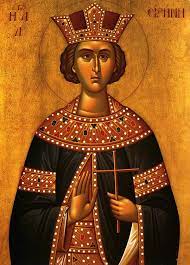
The empress Saint Irene and the VII Ecumenical Council
 The emperor Constantine Copronymus died in 775 and the
head of empire became his son Leo IV the Khazar (775-780), so-called as his
mother, the wife of Constantine, was the daughter of the kagan of Khazaria. He
too was brought up in the spirit of iconoclasm and, in accordance with the
testament of his father, was to take action against icon veneration. But Leo
was a man of weak character under the great influence of his African wife5
Irene (780-902),6 who was a clandestine iconodule. It was under her patronage
that the exiled monks were once more allowed to return to the cities and
eventually to Constantinople, the episcopal sees were occupied by secret
iconodules and so on. It was only in 780, when he discovered icons in Irene’s
bedchamber, that Leo began to apply harsh measures to crush the burgeoning
veneration of icons, but later that year he was to die.
As his son Constantine VI Porphyrogenitus had not yet reached his majority, it was Saint Irene who took into her hands the reins of ruling the empire. Now she could decisively act in favour of icon veneration. The monks took up residence in their monasteries without encountering resistance, while the peoples’ once latent love of icons again appeared on the streets.
The Patriarch of Constantinople Paul, one of the enemies of icon veneration, under the circumstances was now compelled in 784 to abandon his see and enter a monastery. At the wish of Irene, his place was taken by the layman Tarasius (784-906),7 an adherent of icon veneration. Tarasius accepted the Patriarchal Throne with the condition that communion would be restored with Rome and the Eastern Churches that had ceased to be iconoclast and that a new Ecumenical Council be convoked to affirm the dogma of icon veneration. And indeed, with the consent of Saint Irene, he wrote to pope Hadrian I on the proposed restoration of icon veneration and invited him to participate in the Ecumenical Council. Invitations were also sent out to the Eastern Patriarchs.
In 786 at long last the Council of Constantinople was opened. The pope sent his legates. On behalf of the Eastern Patriarchs there came two monks as representatives. A great many Greek bishops also assembled at the Council. But the Council did not take place in that year. Among the bishops, the majority were against icon veneration. They started to organize their own secret gatherings and gave vent to their iconoclastic views. Moreover, the imperial bodyguards, consisting of the old soldiers of Constantine Copronymus, were against the restoration of icon veneration. At one session of the Council the iconoclast bishops objected noisily, while the bodyguards went on the rampage in the court where the Council was being held. Tarasius was compelled to close the Council.
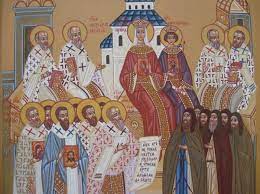
In the following year of 787, when Saint Irene had managed to relieve the iconoclast soldiers from their duties, the Council was quietly reconvened in Nicaea. This was the II Council of Nicaea, the VII Ecumenical Council. Three hundred and sixty-seven fathers gathered.8 And even though iconodule bishops were present, they numbered less than the Orthodox.9 There were eight sessions of the Council.
At first, Tarasius, as the president, gave his speech in favour of icon veneration, and then the empress Irene gave her speech on the same topic. The Orthodox bishops concurred with them both. Tarasius suggested to the iconoclast bishops that if they repented and accepted the veneration of icons, they could retain their episcopal rank. Subsequently, the iconoclast bishops agreed to accept the dogma of icon veneration and signed a document renouncing their iconoclasm. Further, there was read aloud the letter of pope Hadrian on icon veneration, evidence of the spiritual benefit of venerating icons was quoted from Scripture, Sacred Tradition and the writings of the fathers of the Church. The acts of the iconoclast council of 754 were examined and the council was declared to be heretical. Finally, in anathematizing all of the iconoclasts, the fathers of the VII Ecumenical Council issued a dogmatic definition that stated:
 “As the sacred and life-giving cross is
everywhere set up as a symbol, so also should the images of Jesus Christ, the
Virgin Mary, the holy angels, as well as those of the saints and other pious
and holy men be embodied in the manufacture of sacred vessels, tapestries,
vestments, etc., and exhibited on the walls of churches, in the homes, and in
all conspicuous places, by the roadside and everywhere, to be revered by all
who might see them. For the more they are contemplated, the more they move to
fervent memory of their prototypes. Therefore, it is proper to accord to them
a fervent and reverent veneration, not, however, the veritable adoration
which, according to our faith, belongs to the Divine Being alone – for the
honor accorded to the image passes over to its prototype, and whoever venerate
the image venerate in it the reality of what is there represented.”
Moreover, the Council laid down that all the works written by heretics against icon veneration should be put at the disposal of the Patriarch of Constantinople, while those in holy orders who concealed such works should be deprived of their rank and if they are laymen they should be excommunicated from the Church. The sessions of the Council of Nicaea came to an end. The eighth and last session was held in Constantinople in the presence of the empress Irene. According to the Council’s definition, the veneration of icons was restored in all the churches.
The first era of iconoclasm. The emperor Constantine Copronymus
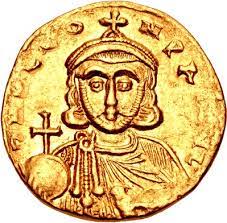 Upon the death of Leo, his son Constantine V
Copronymus (741-775) began to persecute those who venerated icons, only with
ever greater insistence and cruelty. Copronymus wanted to destroy the
veneration of icons with a display of fanfare and legality as a heresy, and to
this end in 754 he convoked a Council in Constantinople10 which was declared to
be Ecumenical. The Council was attended by 338 bishops, but without a single
patriarch. It was argued at the Council that icon veneration was in fact the
worship of idols and that the natural image of Christ the Saviour was the
Eucharist and so on. As evidence the Council quoted from Scripture,
interpreting it one-sidedly and incorrectly, as well as from the ancient
fathers, also with tendentious, distorted or false interpretations. In
conclusion, the Council anathematized all defenders of the veneration of icons
and iconodules, especially Saint John of Damascus, and decreed that
hereinafter those who keep icons and venerate them, if they were in holy
orders, were to be cast out of their rank, or if they were laypeople or monk,
they were to be excommunicated from the Church and subject to punishment
according to the imperial laws. All of the bishops gave their consent to the
Council’s definitions, some out of conviction, others (the majority) from fear
of the emperor.
At the Council the deceased iconoclast Patriarch Anastasius was replaced by bishop Constantine of Phrygia11 and made Patriarch of Constantinople. Constantine was noted for his overt hostility towards icon veneration. The decisions of the Council were implemented with unusual brutality. The persecutions spread as far as domestic icon veneration. It was only in secret places, far from the prying eyes of the guards, that Orthodox Christians could keep their icons.
Copronymus did not stop at icon veneration. He went further by wanting to eradicate the veneration of the saints and their relics and ban the monastic life as superstition. So, at his command the relics of the saints were burnt or thrown into the sea, the monasteries were transformed into barracks or stables, and the monks were sent into exile, while a number of them who openly criticized the actions of the emperor and defended icon veneration, were subjected to a painful death. The emperor’s will was carried out ubiquitously, apart from in the city of Rome.
At the same time as Constantine Copronymus condemned at his ‘Ecumenical’ Council icon veneration, the pope put into effect his plan to separate Rome from the Byzantine Empire. The exarchate of Ravenna, which belonged to the Byzantines, was taken over by the Lombards. Pope Stephen III had invited the Frankish king Pepin the Short to drive out the Lombards, and the lands that he had taken from them he presented to the apostolic see as a gift in 755.12 Byzantine hegemony in Italy came to an end after this. Stephen, who had become independent, without any compunction was free to reject all of the iconoclast decisions of the Council of 754.
Editorial Footnotes
Flashcards
Download Anki flashcards for this topic’s quiz — import via Anki’s File > Import (note type “Basic”, fields separated by Tab, “Allow HTML in fields” checked).
Related Concepts
- 843-council
- adoration
- adorationlatreia
- apologetics
- constantius
- council-of-754
- council-of-815
- council-of-843
- divine-worship
- dogmatic-definition-horos
- dogmatic-definition-of-787
- ecumenical-councils
- first-iconoclastic-council
- first-sunday-of-lent
- hagiography
- horos-of-787
- iconoclasm
- iconodule
- iconodules
- iconodulia
- icons
- image
- imperial-authority
- imperial-church-policy
- john-of-damascus
- kiev-period
- latreia
- liturgical-calendar
- liturgical-commemoration
- liturgical-veneration
- memory
- monastic-revival
- obedience-to-god
- patriarch-nicephorus
- patristic-theology
- patristic-tradition
- patristics
- perestroika
- persecution
- post-soviet-revival
- procession-with-icons
- proskynesis
- prototype
- relics
- religious-policy
- rite-of-orthodoxy
- sacred-images
- saint-irene
- saint-nicephorus
- saint-theodore-the-studite
- scripture
- seventh-ecumenical-council
- soviet-atheism
- soviet-persecution
- stoudion-monastery
- sunday-of-the-triumph-of-orthodoxy
- synodal-period
- theodore-the-studite
- veneration-of-images
- vii-ecumenical-council
Footnotes
-
Nicephorus I reigned 802–811, not “802-911.” He was killed at the Battle of Pliska against the Bulgars under Krum on 26 July 811 — the first Eastern Roman emperor to die in battle since Valens (378). ↩
-
The narrative compresses the succession and omits two rulers between Nicephorus I and Leo V. After Nicephorus I died at Pliska (811), his badly wounded son Staurakios reigned only a few months before being forced to abdicate; power then passed to Michael I Rangabe (811–813), the figure meant here, who was deposed by Leo V in 813. Michael I’s son Niketas was indeed castrated, tonsured, and later became Patriarch Ignatius. ↩
-
John the Grammarian (John VII Grammatikos) was elevated to the patriarchate on 21 January 837, not 833 — a date inconsistent with the parenthetical “(837-843)” in the same sentence. He had served as synkellos under Theophilus until his promotion. ↩
-
Theodora’s young son was Michael III (842–867), not “Michael II.” (Michael II was Theophilus’s father, mentioned earlier in the text.) Michael III, later nicknamed “the Drunkard” by hostile Macedonian-dynasty sources, was about two years old at his father’s death in 842. ↩
-
Irene was Irene of Athens — a Greek from a noble Athenian family — not “African.” The word is almost certainly a corruption (possibly of “Athenian”) introduced in transcription or translation. ↩
-
Irene’s dates are garbled as “780-902.” She served as regent for Constantine VI from 780 to roughly 790, ruled jointly, then reigned as sole empress (the first woman to rule the Roman Empire in her own name) from 797 until deposed in 802; she died in exile on Lesbos in 803. ↩
-
Tarasios was Patriarch of Constantinople 784–806, not “784-906.” He died in February 806 and was succeeded by Nicephorus I (the patriarch, 806–815). ↩
-
The attendance figure is uncertain and debated. Traditional accounts cite around 350 fathers; the final session’s subscription list carries roughly 308 bishops’ signatures. “367” is a high-end figure that may include abbots and other non-episcopal participants. ↩
-
This sentence appears garbled: it is self-contradictory, since “iconodule” and “Orthodox” are synonyms in this context. The intended sense is that iconoclast bishops present at Nicaea II were outnumbered by the Orthodox (iconodule) majority. ↩
-
Constantine V’s 754 council is known as the Council of Hieria: it met chiefly at the imperial palace of Hieria on the Asiatic (eastern) shore of the Bosphorus opposite Constantinople, with only its final session held in the city (at the Blachernae church). No patriarch of the five sees attended, which is a principal reason the Orthodox reject its claim to be ecumenical. ↩
-
The new iconoclast patriarch installed in 754 was Constantine II, previously bishop of Sylaeum (Syllaion) in Pamphylia, not “Phrygia.” He later fell from favour and was executed by Constantine V in 767. ↩
-
Two points: under the standard numbering the pope who appealed to Pepin the Short and crossed the Alps was Stephen II (pope 752–757); the confusion with “Stephen III” stems from an earlier Stephen who died before consecration. And the Donation of Pepin — the handover of the former Exarchate territories that seeded the Papal States — is conventionally dated to 756, following Pepin’s second Italian campaign, rather than 755. ↩