Fundamental Theology — Topic 12. Revelation
Let me draw together the argument of this lecture in its simplest form. We began from silence — the silence that confronts even the finest philosophical intelligence when it asks not merely whether God exists but whether God speaks, whether the ultimate ground of reality has anything to say to the beings it has made. Natural reason can take us to the threshold. It can demonstrate that contingent being points to necessary being, that order implies an Orderer, that conscience points to a moral ground of the universe. But it cannot cross the threshold. It cannot tell us whether God is personal, whether He loves, whether there is forgiveness, whether history has a purpose. The three insufficiencies of natural religious knowledge — its limited scope, its unreliable historical exercise, its inability to produce the encounter it promises — point toward the necessity of a different kind of communication: not a human reaching after the divine but a divine reaching toward the human.
The concept of revelation that answers this need is neither the rationalist reduction that makes revelation a confirmation of what reason already knows, nor the pantheist dissolution that makes everything equally revelatory, nor the supernaturalist caricature that bypasses human personhood. It is the free, personal self-disclosure of the living God through chosen mediators, culminating in the Incarnation of His eternal Son — a disclosure that is recognisable by its internal marks of moral purity, genuine novelty, and abiding relevance, and by its external attestation in miracle and fulfilled prophecy, all converging on a single figure at a single historical moment with a cumulative evidential weight that demands honest reckoning.
The reason this evidence does not compel assent in the manner of a mathematical proof is itself theologically significant. Revelation is addressed to freedom, and freedom means genuine openness to both acceptance and refusal. God does not overwhelm; He invites.
This lecture marks a threshold. Everything we have examined so far — the nature of faith, the definitions of religion, the philosophical arguments for God’s existence, the problem of evil and theodicy — has been, in a precise sense, preparatory. We have been clearing the ground, removing intellectual obstacles, demonstrating that reason neither requires atheism nor is embarrassed by theism. What we have not yet asked is the question on which everything else ultimately depends: does the God whose existence we have argued for speak? Does the Author of the universe address His characters? This is the question of Divine Revelation, and it is, without exaggeration, the most important question in theology — because the answer to it determines whether Christianity is a philosophical school or a religion, whether it offers a set of elegant ideas about the divine or the proclamation of something that has actually happened between God and humanity.
- Introduction
- Section 1. The Silence Before the Word
- Section 2. The Nature of the Word: What Revelation Actually Is
- Section 3. What Reason Cannot Do — and Why That Matters
- Section 4. The Marks of the Genuine: How Revelation Identifies Itself
- Section 5. The Word That Reaches Us: Scripture, Tradition, and the Incarnate Centre
- Conclusion
Begin with a recognition that is simple to state but has consequences that reach into every corner of human life. The questions that matter most to us — not as scientists or historians, but as persons — are questions that no merely natural inquiry can answer. Why is there something rather than nothing? Does conscious existence have a purpose, or is it a brief luminescence in an indifferent dark? Is there forgiveness for moral failure, or does guilt accumulate without remedy? What happens when we die? These are not empirical questions, which observation and experiment can address. They are questions about the ultimate structure of reality and whether that structure is friendly to persons. Natural science, for all its magnificence, is structurally incapable of addressing them — not because it hasn’t tried hard enough, but because they fall entirely outside what empirical method, by its own self- definition, can touch.
Philosophy reaches further. The classical tradition genuinely arrived at important things: that contingent being points to necessary being, that the ordered universe implies an intelligent Orderer, that the moral law inscribed in conscience points to a moral ground of reality. We spent two lectures examining these arguments carefully, and they have real weight. But even the finest philosophy, pursued with the greatest rigour, eventually reaches a wall. It can demonstrate that God exists. It cannot tell you whether God is personal or impersonal, whether God loves the creatures He has made, whether there is forgiveness, whether history has a purpose, whether suffering has a meaning. The Russian theologian Sergei Bulgakov observed this with characteristic precision: philosophy can identify something that functions like the Unmoved Mover, but it cannot learn whether that Mover cares about us. And caring is precisely what we need to know about.
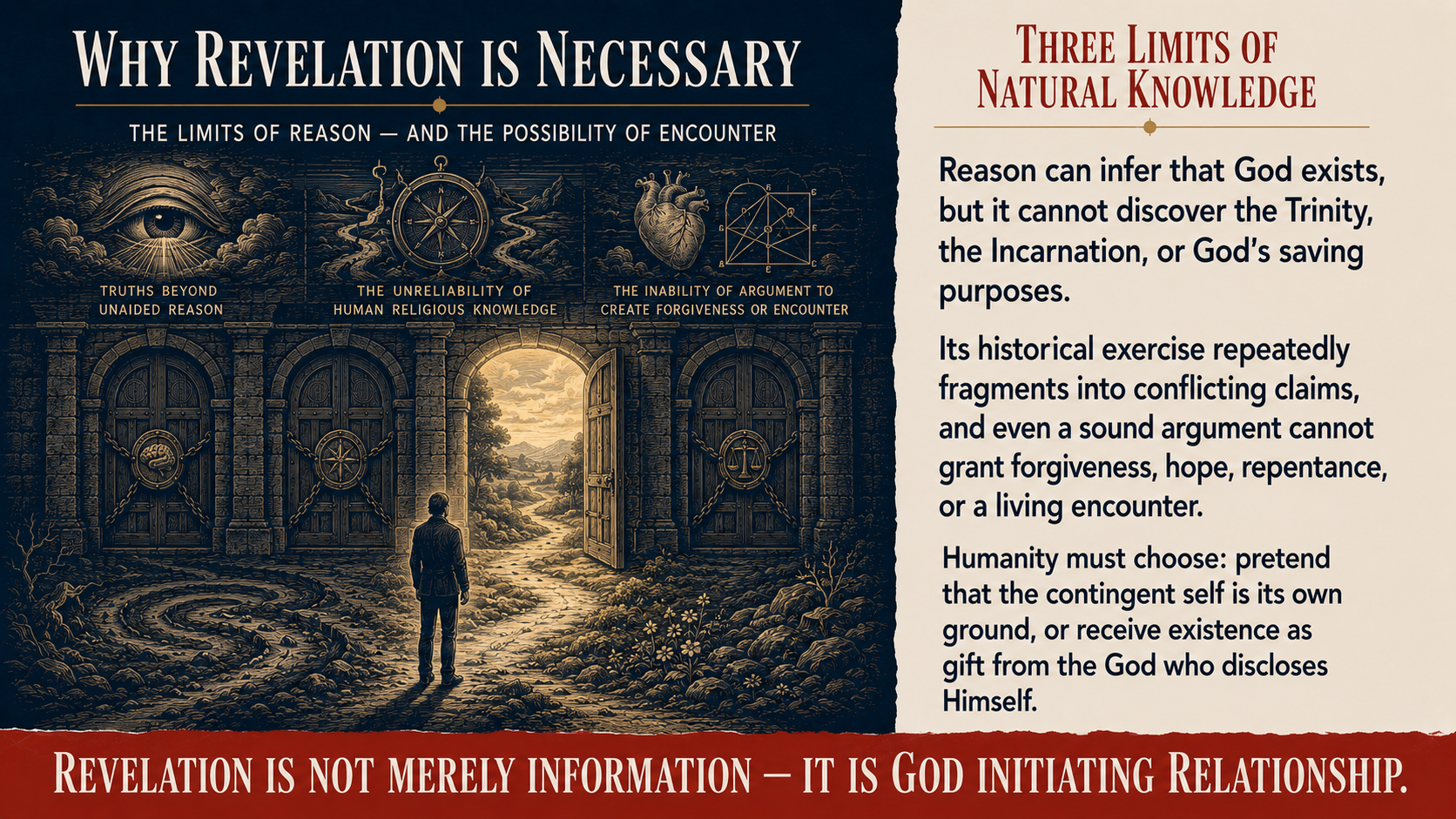
We identifies three distinct ways in which natural religious knowledge falls short, and it is worth distinguishing them carefully because they are three separate arguments rather than one argument in three formulations.
The first is an insufficiency of scope: there are truths about the inner life of God — the Trinity, the Incarnation, the purposes of divine will toward creation — that no creature can penetrate by its own powers. The Apostle Paul states this: no one comprehends the thoughts of God except the Spirit of God (1 Cor. 2:11). You cannot know what is inside another person’s mind unless that person chooses to disclose it; the same applies, infinitely amplified, to the God who is not an object among the objects of the world.
The second is an insufficiency of reliability: even where natural reason is in principle capable of reaching the truth — and the tradition insists it is capable of reaching the truth of God’s existence and the basic moral law — its actual historical exercise has been extraordinarily unreliable. The comparative history of religion presents not a gradual convergence toward clarity but an extraordinary diversity of competing claims: polytheism, pantheism, ritual cruelty, the deification of the state. These are not aberrations at the margin of human religious life; they are its dominant features across most cultures and centuries. Natural religion, left to itself, has never in history actually produced what it promises in theory. The capacity exists; the reliable exercise of it, unaided, does not.
The third insufficiency is one of urgency, and it is perhaps the most practically important: even where natural reason correctly identifies truths about God, it cannot communicate them with the authority and transformative power that human beings in their actual spiritual condition require. A philosophical argument for the existence of God, however compelling, does not produce repentance, does not generate hope in the face of death, does not answer the despairing question of the person who has failed morally and wants to know whether there is a way back. These things require not a correct argument but a genuine encounter with the living God — and such an encounter is possible only if God, who is the active party in any such meeting, chooses to initiate it. Religion, properly understood, is not a human achievement but a relationship, and relationships cannot be generated unilaterally.
But there is a deeper argument still, and it begins not from God’s side but from ours. Every human being is characterised, at some irreducible level, by a desire to exist — not merely to persist for a while and then dissolve, but to exist without qualification, to be secure in one’s being. This desire is not a neurosis; it is the natural expression of what it means to be a conscious, self-aware creature. And yet every feature of our actual situation contradicts it. We are contingent — we might not have existed, and our continued existence depends on conditions we neither chose nor fully control. We are temporal. We are mortal. Faced with this contradiction, there are essentially two responses.
The first is the attempt to secure one’s own existence by one’s own resources — to be the author and guarantor of one’s own being, to live as though the self were its own ground. The tradition, drawing on the narrative of the Fall, calls this the path of autonomous self-sufficiency, and identifies it as the primordial temptation: the desire to be ‘like gods,’ self-determining, unconditioned. Its characteristic feature is that it is founded on a lie — the pretence that a contingent being can become self-sufficient — and because it is founded on a lie, it leads not to the fullness of existence it promises but to its progressive emptying.
The second response is the acknowledgment of contingency as gift — the willingness to receive one’s existence from the One who holds all being, and to enter into genuine relation with that source. This is the path the tradition calls faith and theosis. But here is the crucial point: this second path cannot be walked by human effort alone, because it requires knowing what kind of response the Source of all being invites. You cannot enter into relationship with a Person you do not know. You cannot trust Someone whose character you have no way to assess. We cannot know the inner life of God — what He is, what He wills, how He responds to human failure and longing — unless He tells us. This is revelation’s deepest necessity: not merely epistemological but existential. Revelation is the condition of possibility for the only path of human existence that does not, ultimately, end in self- defeat.
The English word ‘revelation’ conceals a distinction that the Greek of the New Testament preserves. When the Apostle Paul speaks of God making Himself known to the Gentile world through the things of the visible creation (Romans 1:19-20), he uses phanerosis — manifestation, the disclosure of what is in some sense already present and accessible to attentive intelligence. But when he speaks of the mystery of the Incarnation disclosed through the prophetic writings, of what had been hidden since the foundation of the world and is now unveiled (Romans 14:24), he uses apokalypsis — the drawing back of a curtain, the uncovering of what was genuinely inaccessible from any vantage point within the created order. This terminological distinction maps directly onto the traditional distinction between natural and supernatural revelation, and it matters considerably, because the two are not simply more and less of the same thing. They are different kinds of disclosure, operating through different principles.
Natural or general revelation is phanerosis: God manifesting His power, wisdom, and goodness through the structures of the created order — through the beauty and ordered rationality of the cosmos, through the voice of conscience in the human person, through what Justin Martyr in the second century called the Logos Spermatikos, the seed of the divine Word scattered in every rational mind, making every human being in principle capable of perceiving something of the divine ground of reality. This revelation is real. The Holy Traditions insists on this against any account — and there have been such accounts in Protestant theology — that treats fallen reason as so corrupted as to be incapable of reading nature’s testimony to God. Paul is explicit in Romans 1: what can be known about God is plain, because God has shown it through what has been made. Natural revelation is not a polite fiction; the cosmological and teleological arguments rest on its reality. But it is insufficient — insufficient in scope, reliability, and urgency — for the reasons we examined in the first part of this lecture. The seeds are genuine; they are not enough, by themselves, to grow the tree.
Supernatural or special revelation is apokalypsis: God disclosing, through chosen mediators and ultimately through His own incarnate Son, what could not have been discovered by any natural inquiry — the inner life of God, His purposes toward creation, the meaning of history, the path of redemption.
The term: Divine Revelation is the free, personal self-disclosure of the living God to human beings, communicated through chosen mediators and events, for the purpose of bringing human persons into genuine knowledge of and communion with Himself.
Every word in this definition carries weight.
‘Free’: revelation is not compelled by anything outside God. That He reveals Himself is an act of grace — unmerited gift — and the very fact of revelation is therefore already, before any of its contents are examined, a disclosure about the character of God.
‘Personal self-disclosure’: what revelation communicates is not primarily a set of doctrines but a Person. Karl Rahner captured this in his concept of the Selbstmitteilung Gottes, the self-communication of God — revelation in which what is communicated is not information about God but God Himself, making Himself the deepest ground of the human person. The goal of revelation is not correct belief but communion.
‘Through chosen mediators’: revelation passes through particular persons — prophets, apostles, and supremely the incarnate Son — whose unique position in the history of salvation gives their testimony a normative character that cannot be simply replicated.
Three major distortions of this concept have recurred with sufficient regularity to be worth naming and examining.
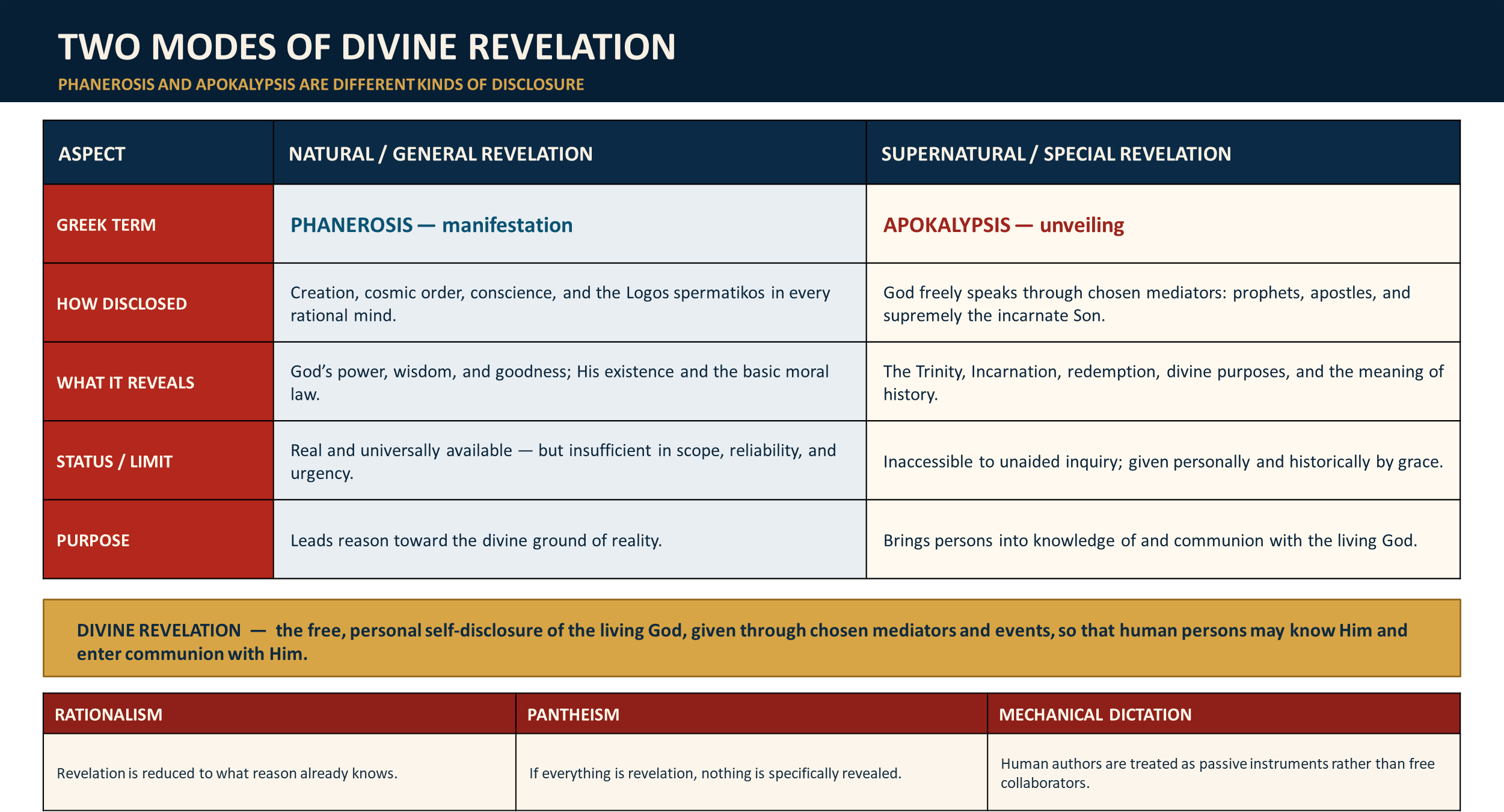
The first is rationalism in the tradition that runs from Kant’s Religion within the Bounds of Bare Reason: the argument that revelation reveals only what reason could, in principle, discover on its own, and is therefore at most pedagogically useful — a shortcut for the morally immature — but dispensable once rational maturity is achieved. The decisive objection is not that this account is impious but that it is self-contradictory: revelation that reveals nothing inaccessible to natural reason is not revelation. It is a reminder at best. And the Christian claim is precisely that what has been disclosed in Christ — the Trinitarian life of God, the meaning of the Cross, the reality of Resurrection — is not accessible to any natural inquiry, because these are facts about God’s personal life that only God could disclose. Strip them away and what remains is not a purified religion but an eviscerated one.
The second distortion is the pantheist account, for which Hegel’s system provides the most rigorous formulation and Schleiermacher’s theology of feeling the most practically influential: if the Absolute Spirit realises itself through the process of history, then every moment of cultural and spiritual development is in some sense divine self-disclosure, and revelation becomes simply another name for the immanent self-expression of the universal spirit. Schleiermacher was right to insist on the intimacy of the divine-human relationship, right to resist a coldly external picture of revelation as mechanical dictation, right to locate its reception in the depths of human experience rather than merely at the surface of rational assent. But the price he paid was too high: if everything is revelation — if the infinite is equally available in Goethe, in Beethoven, in the contemplation of a sunset — then nothing is revelation in any specific sense, and the particularity that is Christianity’s substance dissolves into a general principle of immanence.
The third distortion operates in the opposite direction: the extreme supernaturalism of certain seventeenth-century Protestant Orthodox theologians who, in anxiety to preserve revelation’s divine character against rationalist erosion, described the biblical authors as purely passive amanuenses, mechanical secretaries of the Holy Spirit, contributing nothing beyond the physical act of writing. This account fails on two grounds. Empirically, the extraordinary literary, stylistic, and theological diversity of the biblical texts — why are Isaiah and Amos so different? why does Johannine idiom resemble nothing else in the New Testament? — is simply incompatible with uniform dictation. Theologically, a God who created human beings as free, self-determining persons made in His own image does not ordinarily bypass human personhood but works through it. The Orthodox concept of synergy is not merely a doctrine about salvation; it characterises all of God’s dealings with His creatures.
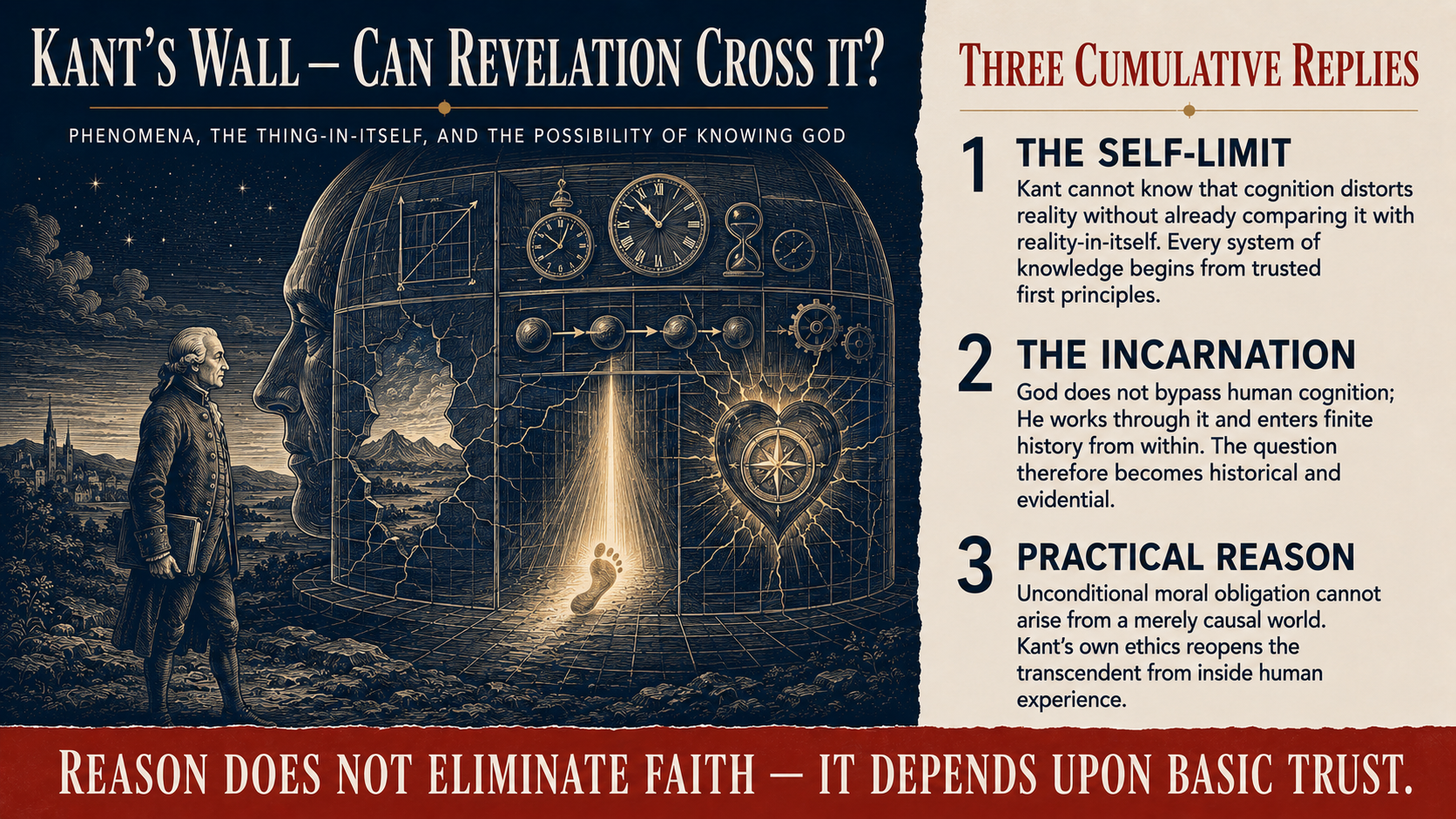
We cannot proceed without confronting the most powerful philosophical objection that the doctrine of revelation has faced in modernity. Kant’s critical philosophy argued that human cognitive faculties are structured in such a way that we can have knowledge only of phenomena — of things as they appear to us within the conditions of space, time, and causality — and never of the Ding an sich, the thing-in-itself. God, freedom, and the soul are ideas of pure reason, necessary for its coherent operation but not possible objects of theoretical knowledge, because they cannot be given in sensory experience. If this argument is correct, Divine Revelation faces a structural obstacle: whatever God might attempt to communicate to a human being would have to pass through the filtering structures of human cognition, and in doing so would be transformed into something that reflects those structures at least as much as it reflects the divine communicator. We cannot step outside our cognitive apparatus to verify whether what arrives has survived the journey intact. Revelation, strictly speaking, becomes unverifiable and perhaps incoherent. This is not an argument to be waved away. It was taken seriously by virtually every major theologian and philosopher of religion in the nineteenth and twentieth centuries, and it continues to underlie much popular scepticism about religious knowledge.
There are several lines of reply, and they are cumulative. The first is philosophical: Kant’s epistemology is not self-evidently correct, and it undermines itself. If we genuinely cannot know the thing-in-itself, we cannot know that our cognitive structures are distorting reality — because to know that, we would need access to reality as it is independently of those structures, which is precisely what Kant denies us. The very precision with which he delineates the limits of human knowledge suggests that he has, in some sense, already crossed them. Fichte saw this immediately: if the Kantian system is taken seriously, the external world dissolves entirely into a projection of the knowing subject, arriving at the conclusion — absurd from the standpoint of common sense — that ‘not the head is in the world, but the world is in the head.’ To avoid this absurdity, the philosopher Jacobi proposed that rational inquiry must begin with what he called epistemic faith, a basic assurance in the reality of the world that is not itself a product of reasoning but its precondition. And this observation points toward something genuinely important: every system of knowledge rests on foundations that are accepted on trust. The axioms of geometry, the principle of sufficient reason, the basic reliability of sense perception — none of these can be established from within the system they underpin. They are received rather than demonstrated. This is not a weakness of knowledge; it is its structure. As Gödel demonstrated with mathematical precision, no sufficiently rich formal system can establish its own completeness from within. The starting points of rational inquiry are always, in this precise sense, taken on faith. Which means that the question is not whether we will operate on faith but which faith to place where — and whether the evidence of reality, taken as a whole, confirms or disconfirms the trust we have extended.
The second reply is specifically theological, and it addresses the Kantian problem at its deepest level. The Christian doctrine of revelation does not claim that the infinite God communicates with finite human beings by bypassing their cognitive structures — by somehow inserting propositions past the filters of space, time, and causality. It claims that God, who created those structures, can work with and through them — and supremely, can become human Himself. The Word becoming flesh is not a circumvention of the conditions of human knowledge; it is their transcendence from within. The infinite enters the finite not by violating it but by inhabiting it. This is why Kant’s theoretical epistemology, with its apparently sealed-off categories, cannot be the last word: the Incarnation, if it happened, is precisely the event in which the infinite entered the finite on the finite’s own terms, and the objection that the infinite cannot be known through the finite is answered not by a philosophical argument but by the event itself. Either the Incarnation happened, in which case Kantian epistemology is not the final account of what is possible, or it did not, in which case the question is historical and evidential rather than epistemological. In either case, the Kantian objection is not a knock-down refutation of revelation but a challenge that shifts the question to where it properly belongs: the historical evidence.
The third reply is the one that Kant himself inadvertently supplied. His practical philosophy demonstrates that the boundary of the phenomenal world is permeable from the inside. The unconditional moral demand — the categorical imperative — cannot be explained in terms of the causal, deterministic phenomenal world, because it is unconditional, and no contingent causal fact can generate an unconditional demand. Kant’s practical reason, followed rigorously, leads not to the elimination of the transcendent but to its postulation as the condition of possibility of moral experience. The door that his theoretical philosophy closes is reopened, from the inside, by his practical philosophy. And the paradox of reason’s self-limitations — its inability, as Zeno showed centuries earlier, to account for simple phenomena like motion without internal contradiction, its inability in Hume’s empiricism to justify its own central principle of causality — points toward the same conclusion: reason, operating in isolation from its proper epistemic partners, inevitably encounters impasses from which it cannot extricate itself by its own resources. This does not make reason useless — it is manifestly not useless — but it does establish that reason without faith, in the broad sense of basic trust in the reliability of what exceeds demonstration, is not a more rigorous mode of inquiry but a less viable one.
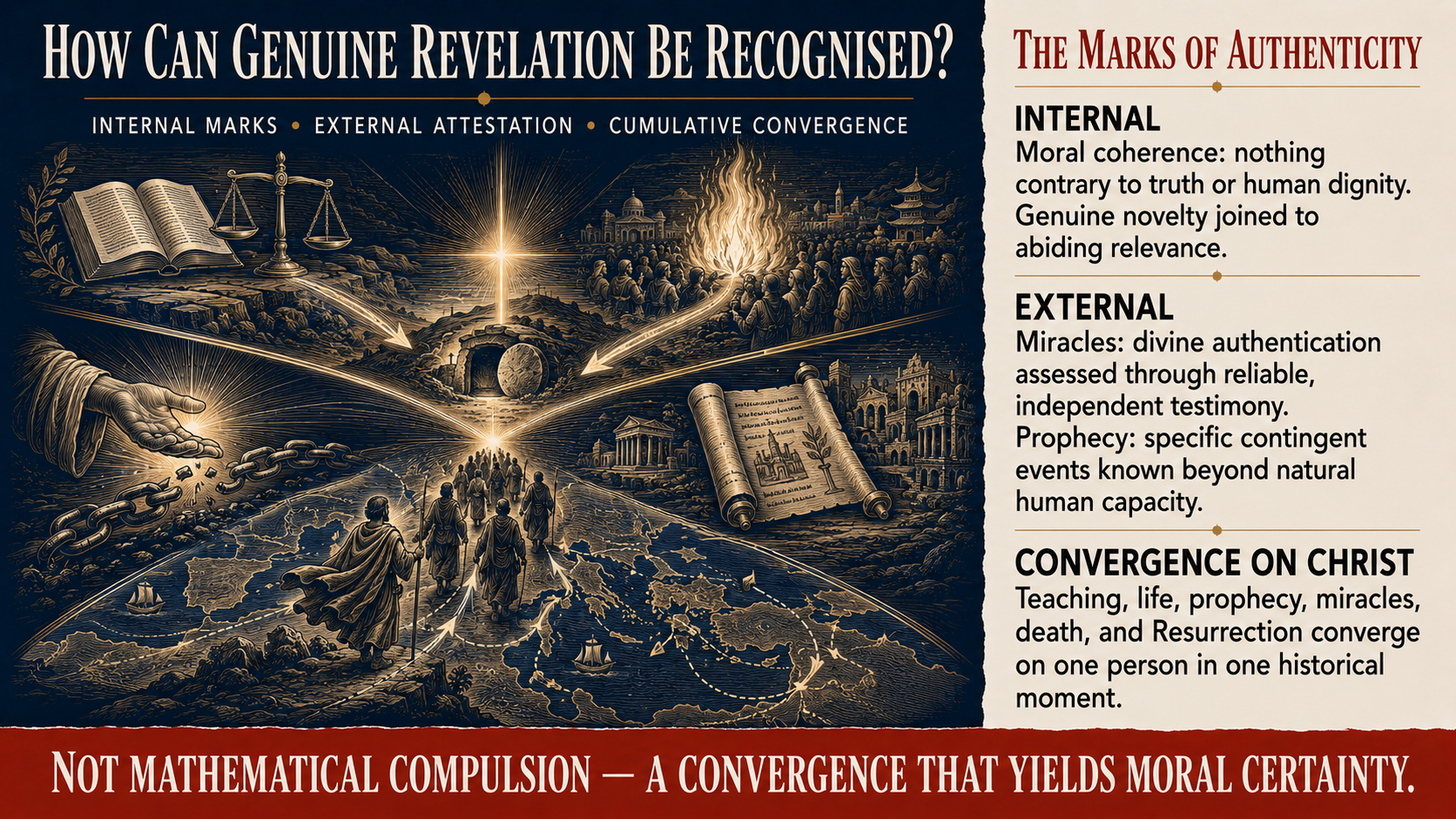
Given that Divine Revelation, if it exists, must pass through the medium of human experience, language, and history, the question of recognition becomes unavoidable. Throughout human history, many things have been claimed as divine revelation — many prophets, many holy books, many purported communications from the divine. On what grounds can genuine revelation be distinguished from its counterfeits, from sincere religious imagination, from fraudulent invention, from the psychological projection that the nineteenth century’s critique of religion proposed as the universal explanation? The Holy Tradition’s answer is that genuine revelation carries recognisable marks. These marks are internal and external, and they are convincing not individually but in their cumulative convergence: each one can, taken in isolation, be questioned or explained away, but their convergence on a single figure at a single historical moment constitutes a form of evidence that demands serious reckoning.
The internal criteria concern the content of what is claimed as revelation, and they operate in two modes:
Negatively, genuine revelation must be free of anything that is incompatible with its claimed divine source: it cannot command cruelty, legitimate deception, sanction the degradation of persons made in the image of God. A claimed communication from the ground of all moral being that contradicts the basic requirements of moral seriousness refutes itself. This negative criterion has considerable critical force when applied across the history of religious claims, and it is not a trivial filter.
Positively, genuine revelation must exhibit what natural religious imagination alone cannot produce: genuine novelty combined with abiding relevance. The combination is precise and important. Genuine novelty means that the revelation discloses something that could not have been reached by any natural inquiry — not a confirmation of what any thoughtful person could have worked out, but an opening onto what Paul calls ‘the deep things of God,’ things that ‘no eye has seen, nor ear heard, nor heart of man imagined.’ A revelation that merely sanctifies the moral consensus of its time and place is not revelation but ideology. But novelty alone is insufficient: the history of religious enthusiasm is full of startling innovations that proved to be the enthusiasms of a single generation and are now forgotten. What distinguishes genuine revelation is that its novelty proves inexhaustible — that the disclosure it makes does not age, does not become obsolete, does not need to be replaced by subsequent insight, but continues to speak with undiminished force across centuries and cultures. The Trinitarian life of God, the Incarnation, the meaning of the Cross and Resurrection — these have proved, across twenty centuries and on every continent, to be truths that sustain rather than exhaust inquiry. They do not age. This combination of genuine novelty and abiding relevance is itself one of the most striking features of the Christian disclosure.
The external criteria concern not the content but the accompanying attestation of genuine revelation, and the Tradition identifies two primary ones. Miracles function as what classical apologetics calls divine authentication — the signature of God on His own correspondence. If God is omnipotent, He can produce effects that exceed the powers of any creature; if God is truthful, He would not use this power to attest a false teaching. The miracle is therefore the credentials of the divine messenger, the evidence that the commission is genuine.
The classical Humean objection — that testimony to miracles can never outweigh the uniform testimony of experience to natural regularity — has been answered many times, but its most decisive refutation is: Hume’s principle, applied consistently, would eliminate the evidential force of historical testimony in general. We accept, on the basis of testimony, events that we have not personally witnessed and cannot independently verify — the existence of Julius Caesar, the French Revolution, the shape of continents we have never visited. We cannot demand personal verification of every historical claim without collapsing into a solipsism that no honest inquiry can sustain. The relevant question is not ‘have I personally witnessed this?’ but ‘is the testimony reliable, independent, and convergent?’ — and it is precisely on these grounds that the resurrection testimony demands to be assessed.
Prophecy — the specific, detailed, accurate prediction of events that were genuinely contingent at the time of prediction, not derivable from any natural reading of present circumstances — constitutes the second great external criterion. The logic is simple: genuine foreknowledge of the genuinely contingent is impossible for any finite mind operating by natural means. If a prophet correctly predicts, centuries in advance, specific events that depend on the free decisions of human beings — the fate of a named empire, the birth of a Deliverer in a specified location, the manner of a death and its unexpected aftermath — the only available explanation is access to a knowledge that transcends natural human capacity. The fulfilment of messianic prophecy in the life, death, and resurrection of Jesus has been, from the first apostolic preaching onward, the most powerful single argument for the truth of the Christian revelation — and it is not an argument that has lost its force under historical examination.
The cumulative weight of these criteria matters more than any individual criterion. Each, taken alone, might be questioned. An unusual event might have a natural explanation not yet identified. A prophet might have made a very good guess. But consider what converges on Jesus of Nazareth: a teaching of unparalleled moral depth and consistency; a life of integrity that even hostile witnesses could not convincingly impugn; specific prophetic anticipations fulfilled in circumstantial detail; miracles attested by those who had every reason to deny them; and above all a death and a reported resurrection that transformed a small group of terrified disciples into a community willing to die for what they claimed to have witnessed, and whose testimony spread, within a generation, across the entire Mediterranean world. When all of this converges on a single person in a single historical moment, the convergence is not easily explained by any alternative hypothesis. It does not compel belief in the manner of a mathematical proof — and we will consider why that hiddenness is itself theologically significant — but it constitutes a case that any honest intellect is obliged to take seriously. As Cardinal Newman’s account of the ‘illative sense’ and the ‘accumulation of probabilities’ has it: we are not dealing with a chain of argument, each link of which must be unbreakable, but with a convergence of independent considerations that, taken together, produce a moral certainty of the kind on which we routinely act in every domain of life that matters.
Revelation happened. At a specific time and in a specific place, the eternal Word of God became flesh and dwelt among human beings; before that, through the long history of Israel’s covenant with God, prophets spoke and events occurred that were genuinely divine acts in human history. But the prophets are dead. The apostles are dead. The events of the Exodus and the Passion and the Resurrection are not repeatable — they cannot be re-staged for each new generation. How does what happened then reach us now? This is the question of transmission, and it is not a secondary question but one that is internal to the doctrine of revelation itself, because a revelation that could not be reliably transmitted would be a revelation addressed only to those present at its first occurrence — which is to say, no revelation at all in the sense the tradition intends.
The question of transmission turns immediately into the question of inspiration — the nature of the relationship between the divine communication and the human documents in which it has been preserved. Three accounts have been proposed, and each illuminates something important even as each, in its unqualified form, falls short.
The first, the propositional account, holds that Sacred Scripture is a direct divine communication in which the human authors served primarily as vehicles for divinely guaranteed propositions — in its extreme form, that the text was verbally dictated, every word supplied by God, the human author contributing nothing beyond the physical act of writing. This account has the virtue of taking seriously the objective character of revelation: it is not a projection of human religious feeling but a genuine disclosure of divine truth. But in its stronger forms it faces difficulties that are not merely modern but classical. The extraordinary literary, stylistic, and theological diversity of the biblical texts — the unmistakable difference between the spare urgency of Amos and the architectonic grandeur of Isaiah, between the argumentative density of Paul and the luminous simplicity of John — is simply incompatible with the hypothesis of uniform mechanical dictation. And the Patristic tradition, examined carefully, does not support a mechanistic understanding of inspiration: the great Fathers understood it as a genuine synergy, the Spirit working with and through the full personhood of the sacred author, not around it.
The second account, arising from the liberal tradition of the nineteenth century, treats the biblical texts as purely human religious documents — valuable records of Israel’s and the early Church’s encounter with the divine, distinguished from other religious literature not by their divine origin but by their historical influence on the community of faith. The consequences of this account are well known: the progressive dismantling of the historical reliability of the biblical narrative, the reduction of prophetic texts to vaticinia ex eventu, the reclassification of miracle accounts as legendary accretions. The result, as the tradition observed with precision, is that the text is no longer a vehicle of divine revelation but merely a record of human religious projection — which, if that is what it is, loses the authority that makes it worth the centuries of argument.
The third account — what we might call the synergistic account — attempts to hold together what the other two separate, and it does so by analogy with the central Christian claim about the Incarnation itself. Just as the eternal Son assumed a fully human nature without ceasing to be the eternal Son — not losing His divinity by becoming human, not losing His humanity by being divine — so the divine Word inhabits fully human language without ceasing to be the divine Word. The result is a text that is simultaneously fully human, with all the stylistic variation, cultural embeddedness, and individual personality that entails, and genuinely the vehicle of divine disclosure. This is not a logical contradiction any more than the Incarnation is a logical contradiction; it is, rather, the specific form that the divine presence in history consistently takes: a presence that works through the created rather than bypassing it, that elevates and transforms rather than replaces. The practical implication is that Scripture must be read as both human and divine simultaneously — with the full apparatus of historical and literary scholarship that any ancient text requires, and with the attentiveness of faith that hears in it the voice of the One who spoke through its human authors without suppressing them.
Sacred Scripture, however, did not arrive from nowhere in its canonical form. It was written in specific historical contexts, gathered and recognised as canonical through a process of ecclesial discernment that occupied the first several centuries of the Christian era, and has been transmitted, interpreted, and applied within the living community of the Church ever since. Tradition — that most contested word in ecumenical theology — designates, at its best, precisely this living continuity: the Spirit-guided transmission of the apostolic faith through the community that received it, of which Scripture is the primary written crystallisation and the liturgy, the creeds, the conciliar definitions, and the witness of the saints are the continuing embodiments. The post-Tridentine Catholic formula that presented Scripture and Tradition as two independent parallel sources of revelation has been persuasively criticised — by Rahner among others — on the grounds that Scripture is itself a product of the apostolic tradition, not prior to it. The normative written expression of the apostolic witness and the living community that bears that witness are not two separate streams but one river from a single source. And the Church, understood in this light, is not merely the custodian of a deposit sealed in the first century but the living context in which the revelatory event continues to address each new generation — in which the Word that became flesh continues to seek out and speak to the persons for whom He became flesh.
This leads to the summit of everything we have been arguing. Every concept examined in this lecture — natural revelation, supernatural revelation, prophecy, miracle, inspiration, tradition — finds its ultimate reference point in the Incarnation: the event in which the eternal Word of God, through whom all things were made, became a human being and dwelt among us. In every previous revelation — the burning bush, the voice at Sinai, the visions of the prophets — God communicated through finite media: physical phenomena, human words, inspired texts. These were genuine vehicles of divine communication; the tradition insists on their reality. But there remained a gap between the medium and the One who communicated through it. In the Incarnation, that gap is closed in the most radical way conceivable. God does not speak through a human being; He becomes one. The medium and the Message are identical. ‘Whoever has seen me has seen the Father’ — this is the claim that nothing in the history of religion before or since parallels. It is not the claim that Jesus teaches the best available philosophy about God, or that he is the greatest of the prophets; it is the claim that in him, in his life and death and resurrection, God Himself has entered human history without remainder or concealment. This is why the Letter to the Hebrews describes the Incarnation as the definitive and unsurpassable divine communication: everything before it is preparation; everything after it is explication. And this is also why the so-called scandal of particularity — the objection that an event occurring at a specific time and place cannot be addressed to all human beings everywhere and always — is not the decisive obstacle it appears to be. Genuine love is always particular. Genuine forgiveness is always addressed to someone. A communication from the personal God to personal human beings had to take the form of a life lived in a specific context, words spoken in a specific language, a death undergone in a specific way. The particularity of the Incarnation is not a limitation to be apologised for; it is the form that a genuine divine address to genuine human persons had to take. The Word became flesh precisely because flesh is what we are.
Related Concepts
- adoption-as-sons
- apokalypsis
- apologetics
- apostolic-faith
- ascension
- choice
- christification
- communion
- communion-with-god
- conquest
- contingency
- cumulative-evidence
- divine-human-cooperation
- divine-inspiration
- fall
- foreknowledge
- foundations-of-knowledge
- freedom
- fulfilled-prophecy
- fundamental-theology
- glorification
- glory
- good-works
- healing
- heart
- hebrews
- history
- holy-humility
- holy-spirit
- human-responsibility
- hume
- john-149
- justin-martyr
- kant
- macarius
- magisterium
- messianic-prophecy
- moral-effort
- mystery
- nuptial-union
- obedience-of-faith
- particularity
- perseverance
- personhood
- phanerosis
- private-revelation
- prophecy
- quran
- rahner
- reason
- resurrection
- revelation
- romans-119-20
- romans-1424
- salvation
- scripture
- sin
- st-gregory-palamas
- st-theophan-the-recluse
- synergy
- theosis
- tradition
- union-with-god
- uniqueness-of-christ
- universal-revelation