Fundamental Theology — Topic 9. New Atheism
In the present lecture, we turn to a phenomenon that is in certain respects continuous with that tradition and in other respects genuinely novel: the movement that entered public discourse under the name “New Atheism” in the first decade of the twenty-first century. Its principal voices — Richard Dawkins, Sam Harris, Daniel Dennett, and Christopher Hitchens, collectively dubbed the “Four Horsemen” — achieved a degree of cultural visibility that no previous atheist movement had attained. Their books became international bestsellers. Their arguments saturated the early internet, the blogosphere, and eventually mainstream media. They gave a generation of religiously unaffiliated people — the so-called “nones” — a vocabulary, a community, and a sense of intellectual respectability.
Yet the very success of New Atheism raises a question that any serious student of fundamental theology must learn to ask: is cultural visibility a reliable indicator of philosophical depth? Is a movement that sells millions of books thereby making a serious contribution to one of the oldest and most difficult questions in human intellectual history? Or might it be, as a number of critics from widely varying backgrounds have argued, that New Atheism is better understood as a publicistic and polemical phenomenon — significant as a cultural symptom, but considerably less impressive as a work of philosophy or theology?
We will examine New Atheism’s arguments on their merits, identify what is genuinely challenging in them, and assess where, on close examination, they fall short of the rigour they confidently claim for themselves. As always, the goal is not victory in a debate, but clarity in the pursuit of truth.
- Introduction
- Section 1. The Emergence and Character of “New Atheism”
- Section 2. New Atheism as a Philosophical and Cultural Phenomenon
- Section 3. Philosophical and Theological Critique
- Section 4. New Atheism in Broader Perspective
§ 1.1 Historical Genesis: From September 2001 to the “Four Horsemen”
The term “New Atheism” entered public discourse in a Wired magazine article of November 2006, written by the journalist Gary Wolf, in which he profiled three thinkers — Richard Dawkins, Sam Harris, and Daniel Dennett — whose recent books had achieved extraordinary popular success while sharing a tone of extraordinary combativeness towards religion. The label “new” was, as even sympathetic commentators quickly acknowledged, somewhat misleading. As Christoph Böttigheimer correctly observes in his Lehrbuch der Fundamentaltheologie, the philosophical arguments of these authors were not new; they were, in substance, recycled versions of positions first advanced by the French Enlightenment materialists, by Ludwig Feuerbach and Karl Marx in the nineteenth century, and by Bertrand Russell in the twentieth. What was genuinely new — and this is a point of considerable importance for any adequate analysis of the phenomenon — was not the intellectual content of the arguments but the tone in which they were presented, the media apparatus through which they were disseminated, and the particular cultural moment to which they were responding.
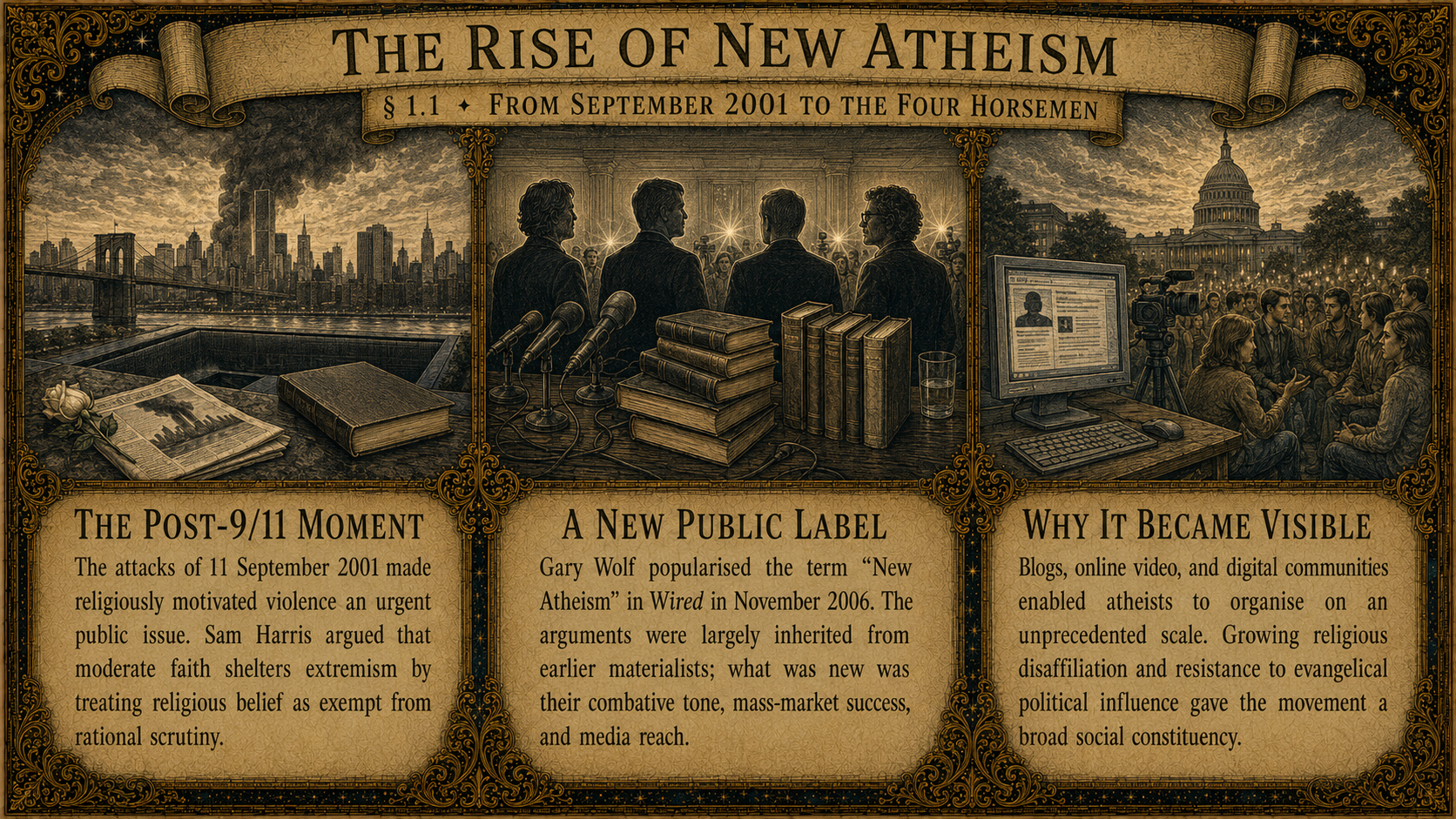
That cultural moment was, above all, the terrorist attacks of 11 September 2001, which destroyed the Twin Towers of the World Trade Centre and killed nearly three thousand people in the name of a religious ideology. Sam Harris, the first of the “New Atheists” to publish in the post-9/11 period, was quite explicit about the connection: his book The End of Faith (2004) opens with a scene of a suicide bomber contemplating his act of martyrdom and reads it as a direct consequence of taking religious belief seriously. Harris’s thesis — which would be echoed, with varying degrees of sophistication, by all the principal New Atheist voices — was that the problem of religiously motivated violence cannot be addressed by moderate forms of faith, because moderate faith provides intellectual cover for extremism by insisting that religious belief as such is immune from rational scrutiny. The argument was polemically effective, even if philosophically questionable. It framed the debate as one between the forces of reason and the forces of superstition, and it recruited the horror of mass terrorism in support of a philosophical position that had existed long before September 2001.
Following Harris, the movement crystallised around three further voices, together with Harris forming the quartet that commentators and the popular press took to calling the “Four Horsemen” — a biblical allusion that not all of them would have relished. Richard Dawkins, the Oxford evolutionary biologist and bestselling populariser of science, published The God Delusion in 2006, a work that sold over three million copies within a year of publication and became, for a remarkable period, the de facto manifesto of organised atheism in the English-speaking world. Daniel Dennett, the distinguished American philosopher of mind at Tufts University, published Breaking the Spell: Religion as a Natural Phenomenon in the same year, offering a rather more academically careful attempt to subject religious belief to the methodology of evolutionary biology and cognitive science. Christopher Hitchens, the Anglo-American literary journalist and polemicist, contributed God Is Not Great: How Religion Poisons Everything in 2007, a work more in the tradition of political pamphleteering than philosophical argument, but executed with brilliant invective and encyclopaedic historical reference. To these four names, the Russian-American physicist Victor Stenger is often added as a fifth representative, contributing God: The Failed Hypothesis (2008), which attempted to argue on specifically scientific grounds that the existence of God is not merely unproven but positively falsified by the evidence of modern science.
The movement generated an immediate and enormous response. Within a few years, a vast literature of replies had accumulated from theologians, philosophers, religious scientists, and other apologists. Alister McGrath, the Oxford theologian and former atheist who holds doctorates in both molecular biophysics and systematic theology, emerged as perhaps the most persistent and philosophically equipped critic, publishing The Dawkins Delusion? (jointly with Joanna Collicutt McGrath) in 2007 and a series of further critiques thereafter. John Haught of Georgetown University offered a more theologically sophisticated response in God and the New Atheism (2008), drawing particularly on the process theology tradition. David Berlinski, a secular philosopher and mathematician with no sympathy for religion, published The Devil’s Delusion: Atheism and Its Scientific Pretensions (2009), attacking what he saw as the scientific pretentiousness of the New Atheists from an entirely non-religious standpoint. Keith Ward, the Oxford philosopher and theologian, contributed Is Religion Dangerous? (2006) and Why There Almost Certainly Is a God (2008). John Lennox, the Oxford mathematician and Christian apologist, published Gunning for God: Why the New Atheists Are Missing the Target (2011). The phenomenon had, in short, generated a theological and philosophical industry.
It is worth pausing to note the particular sociological conditions that made New Atheism so culturally visible in the first decade of the twenty-first century. Several factors converged. The internet, and particularly the early blogosphere and YouTube, provided the movement with a means of mass dissemination and community formation that was genuinely novel: groups of self-identified atheists could now find one another, organise, and propagate their views with a speed and reach that would have been impossible a generation earlier. The rise of the so-called “nones” — those who identify with no religious affiliation — in American and European survey data provided a sociological base that the New Atheists could address and mobilise. And the political climate of the George W. Bush presidency in the United States, in which evangelical Christianity appeared to wield unusual influence over public policy — on questions of embryonic stem-cell research, sex education, intelligent design in schools, and the justification of the Iraq War — gave the New Atheist agenda a specific political edge that broadened its appeal beyond those primarily motivated by abstract philosophical disagreement with religious belief.
§ 1.2 The Key Protagonists and Their Principal Works
Before offering a philosophical and theological evaluation, it is necessary to characterise the principal New Atheist authors with some precision, since the movement is by no means uniform. The four Horsemen differ significantly in intellectual style, philosophical rigour, and the specific targets of their polemic, and an adequate critique must engage with these differences.
Richard Dawkins(b. 1941) is, by any measure, the dominant figure of the movement. A Fellow of the Royal Society and former Professor for the Public Understanding of Science at Oxford, he made his reputation with a series of outstanding works of popular science — The Selfish Gene (1976), The Blind Watchmaker (1986), Climbing Mount Improbable (1996) — which established him as the most gifted scientific populariser of his generation. The God Delusion (2006) represents a dramatic departure from his earlier work in that it is not primarily a work of science but a work of polemic philosophy. Its central argument, stated baldly, is that the existence of God is a scientific hypothesis that can be evaluated by the same evidential standards as any other scientific hypothesis, and that it fails this evaluation. Dawkins introduces what he calls the “Ultimate Boeing 747 gambit” — a reversal of the classic design argument — arguing that a God capable of designing the universe would need to be more complex than the universe itself, and therefore requires more explanation than it provides. He also devotes substantial attention to what he calls the “God of the gaps” argument — the tendency to invoke divine agency wherever current scientific explanation is incomplete — and argues that the progress of science has consistently narrowed the space available for such invoking. The book’s rhetorical strategy is notably aggressive: believers are consistently characterised as deluded, their beliefs as forms of irrationality, and the teaching of religion to children as a form of child abuse. These characterisations, which sit uneasily with Dawkins’s occasional professions of scientific detachment, attracted extensive criticism from allies and opponents alike.
Sam Harris(b. 1967) is in some respects the most intellectually ambitious and the most troubling of the New Atheists. A neuroscientist with a doctorate from Stanford, his central preoccupation is the relationship between reason, science, and morality. In The End of Faith (2004) he argues that religious belief, insofar as it is shielded from rational criticism by appeals to faith, constitutes a unique and uniquely dangerous form of irrationality — dangerous because it provides the motivational basis for the most extreme forms of political violence. In The Moral Landscape (2010), he goes further, arguing that the truths of morality can be derived from the science of human wellbeing — that questions about how we ought to live can be answered by empirical investigation of what promotes flourishing and reduces suffering. This is a significantly more adventurous claim than anything Dawkins or Hitchens makes, and it has attracted criticism from philosophers who regard it as a sophisticated version of the naturalistic fallacy — the illicit derivation of normative conclusions from purely descriptive premises. Harris’s Letter to a Christian Nation (2006) is a brief and characteristically polemical work addressed specifically to the American religious public.
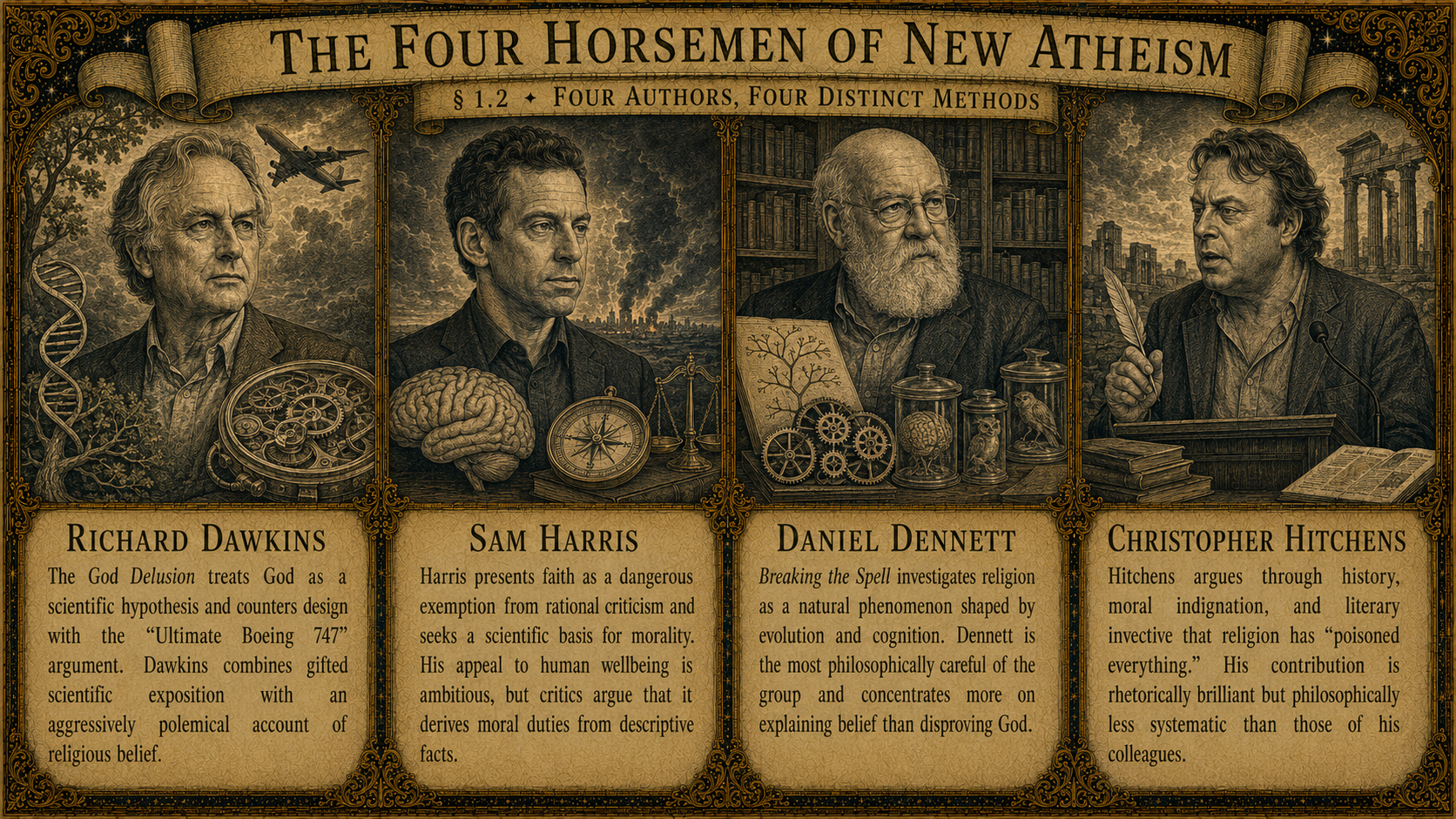
Daniel Dennett(b. 1942) occupies a different register from his colleagues. As a professional philosopher of considerable distinction — his work on consciousness, free will, and the philosophy of mind has earned him a serious place in the analytical tradition — he is more careful about what he claims and more aware of the philosophical difficulties in his own position than the other members of the movement. Breaking the Spell (2006) is less an argument against the existence of God than a proposal that religion, as a natural phenomenon, should be subjected to empirical scientific investigation — specifically the kind of evolutionary and cognitive-scientific investigation that seeks to explain why religion exists and persists by identifying the adaptive or quasi-adaptive mechanisms that sustain it. Dennett explicitly declines to take a strong position on the truth of religious claims; he is more interested in the explanation of religious belief than in its refutation. This makes him, paradoxically, both the most intellectually responsible and the least religiously threatening of the New Atheists. His contribution to the celebrated “Four Horsemen” conversation (2007) is notably more measured in tone than those of his interlocutors.
Christopher Hitchens(1949–2011) is the most purely literary figure in the group, and his God Is Not Great (2007) is in the genre of the great polemical essay rather than of philosophical argument. Drawing on his formidable knowledge of history, literature, and political events, Hitchens argues that religion has been, across history and cultures, primarily a force for oppression, cruelty, and intellectual stunting — that it has “poisoned everything.” His rhetorical gifts are deployed with devastating effect, and the book contains passages of genuine brilliance. But as a philosophical contribution it is the weakest of the four, being composed largely of historical examples and moral indignation rather than sustained argumentation. Hitchens himself readily acknowledged that he was an essayist and polemicist rather than a philosopher. What he provided the movement was not rigour but rhetoric — and rhetoric of a high order that made the New Atheist position emotionally compelling to a wide audience.
§ 1.3 The Conceptual Architecture of “New Atheism”: Core Claims
Despite their differences in emphasis and intellectual style, the New Atheists share a relatively coherent set of core claims that constitute what might be called the conceptual architecture of the movement. Identifying these claims clearly is a prerequisite for evaluating them adequately, and it is a task that requires some care, since the New Atheists do not always distinguish clearly between claims that operate at different levels — empirical, philosophical, and rhetorical.
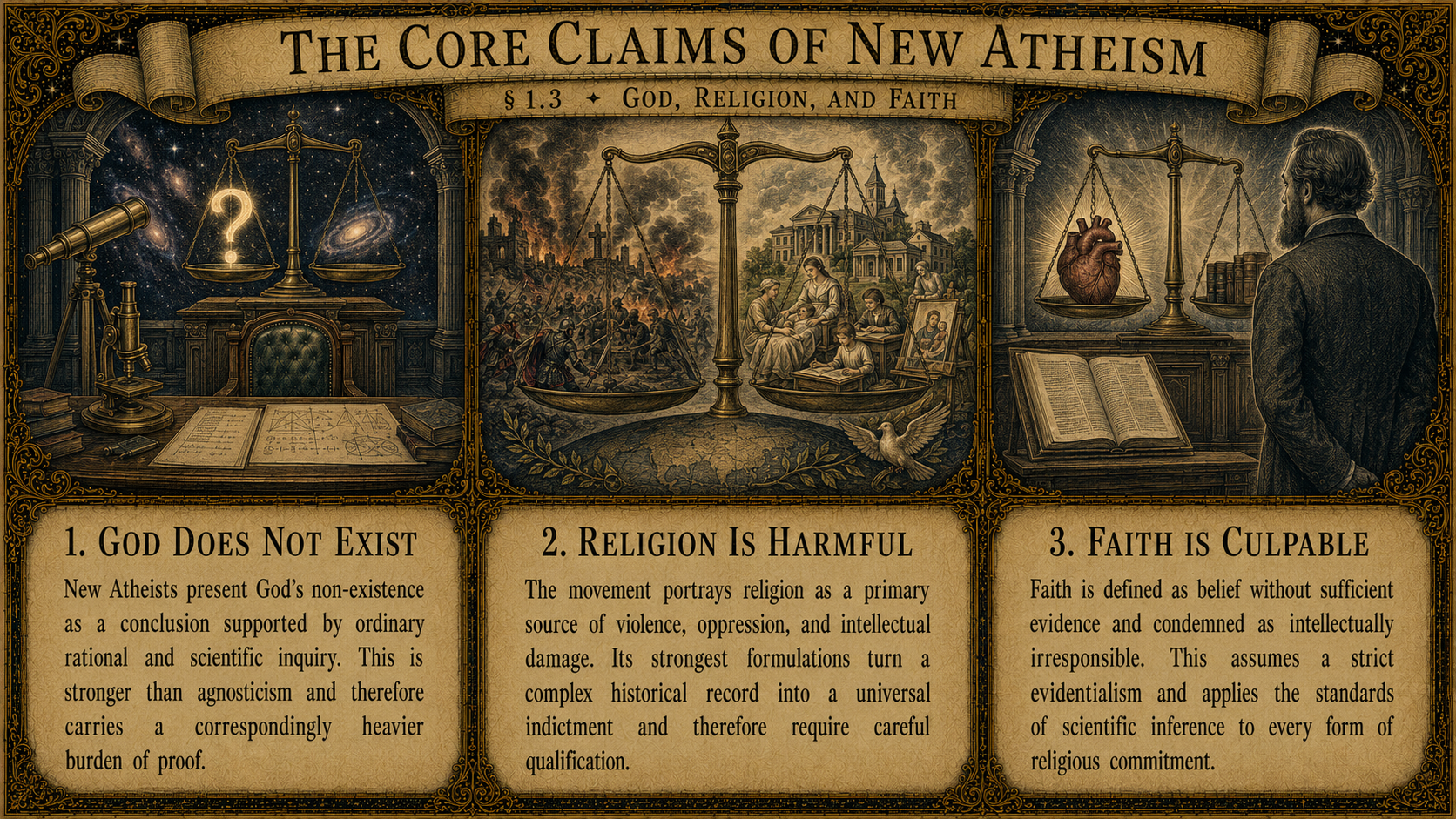
The first and foundational claim is that God does not exist, and that this non-existence is not merely an unproved assertion but a well-supported conclusion, accessible in principle to the ordinary methods of rational inquiry. Dawkins speaks of the existence of God as a scientific hypothesis; Harris treats it as a claim about reality subject to evidential assessment; Stenger argues that it is positively falsified by the evidence of physics, biology, and cosmology. This is a significantly stronger claim than the mere absence of proof that most agnostics maintain, and it carries a correspondingly heavier evidential burden.
The second core claim is that religious belief is not merely false but harmful — specifically, that it is the primary or a primary driver of moral evil in human history. Harris’s slogan — that “most people in positions of power have a deep investment in not recognising the degree to which religion is responsible for the world’s ills” — captures this claim at its most assertive. Hitchens’s formulation in the subtitle of his book — “How religion poisons everything” — is perhaps the most rhetorically extreme version. This claim, which we shall examine in detail in Part III, requires significant historical qualification.
The third core claim is that faith — understood as religious belief maintained in the absence of, or against the weight of, evidence — is not merely epistemically deficient but morally culpable. Harris is the most explicit advocate of this position: he argues that the tolerance of faith as a legitimate epistemic category is itself a form of intellectual irresponsibility. This is a highly contestable philosophical claim that conflates a specific epistemological model (roughly, Cliffordian evidentialism, named after the Victorian mathematician W.K. Clifford who argued that “it is wrong always, everywhere, and for anyone to believe anything upon insufficient evidence”) with the normative standards that ought to govern religious as well as scientific belief.
The fourth core claim concerns science and religion. The New Atheists, with varying degrees of sophistication, maintain that science and religion are incompatible — that the scientific worldview, consistently applied, leads inexorably to atheism. Dawkins, Harris, and Stenger all embrace versions of this thesis, which represents perhaps the most philosophically vulnerable position in the entire New Atheist agenda. Dennett, again characteristically, is more circumspect, acknowledging that the relationship between science and religion is more complex than a simple war of incompatible claims. We shall examine this claim at length in Part II.
The fifth core claim is prescriptive: not only is religion false and harmful, but it should be actively combated. The word “should” here is important. The New Atheists are not merely reporting a philosophical conclusion; they are issuing a moral and political call to action. Dawkins explicitly states the ambition of converting the religious to atheism; Harris’s Letter to a Christian Nation is structured as an act of persuasion directed at the American religious majority; Hitchens’s work is frankly polemical in its intent. This prescriptive dimension of New Atheism marks it off, importantly, from the quieter, more detached atheism of many professional philosophers, and it is one of the reasons why it has been possible to speak of New Atheism as a movement, with all the organisational, sociological, and quasi-religious dimensions that the word implies.
§ 2.1 Scientism and the Myth of the Religion–Science Conflict
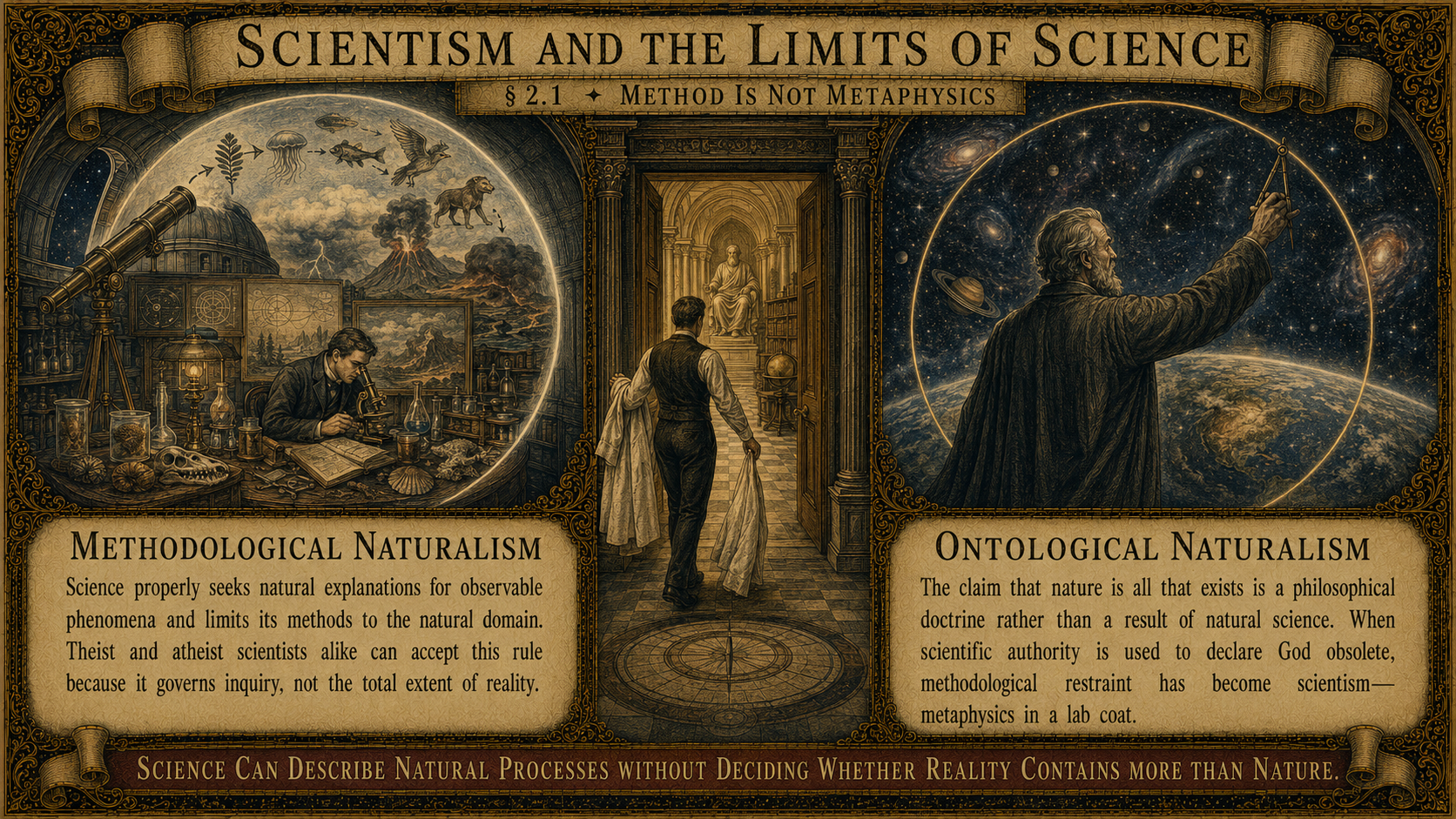
The claim that science and religion are incompatible — and, more specifically, that the natural sciences provide positive evidence for atheism — is the central philosophical claim of the New Atheist movement, and it is the claim that most requires careful examination. The claim rests on two distinct but frequently conflated theses. The first is methodological: science, as a mode of inquiry, should limit itself to natural explanations, and this methodological commitment (what philosophers of science call “methodological naturalism”) is the proper heuristic principle for scientific investigation. The second is ontological: the natural entities and processes that science investigates are all that exists (what philosophers call “ontological naturalism” or “metaphysical naturalism”). The first thesis is uncontroversial and universally accepted by theist and atheist scientists alike. The second is a philosophical claim that goes far beyond what science, as such, can establish.
Richard Dawkins, in The God Delusion, famously does not distinguish between these two theses. His argument that the existence of God is a scientific hypothesis, evaluable by scientific methods, commits him to the view that all meaningful questions about reality are answerable by the methods of natural science — a position that philosophers recognise as scientism. The philosopher of science Del Ratzsch, cited in the preceding lecture, has shown that natural science can deal only with the purely natural and must strictly limit itself to this domain, regardless of whether reality includes something more than the purely natural. When scientists or popularisers of science claim that “the hypothesis of God is obsolete” on scientific grounds, they have stepped outside the proper boundaries of their discipline. They are, in the memorable phrase employed in the previous lecture, doing metaphysics in a lab coat.
The conflation of methodological with ontological naturalism has been identified and criticised by a remarkable range of scholars, many of whom are not themselves religious. The philosopher Thomas Nagel — an atheist of considerable philosophical rigour — has observed that “the project of explaining life and mind as natural phenomena… has run into genuine difficulties that deserve honest acknowledgement rather than suppression by a dogmatic adherence to the naturalist programme.” The philosopher of science Alvin Plantinga has mounted what is perhaps the most devastating philosophical critique of the New Atheist scientism in Where the Conflict Really Lies: Science, Religion, and Naturalism (2011). Plantinga’s central argument is what he calls the “Evolutionary Argument Against Naturalism” (EAAN): if naturalism is true, then our cognitive faculties are the product of a blind evolutionary process that selects for survival-enhancing behaviours rather than for truth- tracking beliefs. But in that case, we have no reason to trust that our cognitive faculties reliably produce true beliefs — including the belief that naturalism itself is true. Naturalism, rigorously applied, is self-defeating: it undermines the very rational faculties that the naturalist invokes in support of it.
The historical claim that science and religion have been in chronic conflict — what historians call the “conflict thesis” or the “warfare model” — has been comprehensively discredited by the academic history of science over the past forty years. The warfare model was constructed primarily by two nineteenth- century authors: John William Draper’s History of the Conflict between Religion and Science (1874) and Andrew Dickson White’s A History of the Warfare of Science with Theology in Christendom (1896). Both works were written with polemical intent rather than historical rigour, and both have been shown by subsequent historical scholarship to be systematically distorted. The historian of science John Hedley Brooke, in his landmark study Science and Religion: Some Historical Perspectives (1991), demonstrated that the actual relationship between science and religion across history has been one of complex interaction — sometimes conflictual, often supportive, frequently mutually enriching — and that the simple warfare model is historically false. C. Stephen Evans and Zachary Manis are correct to argue that “religion and science, in general, are not in conflict — or at least need not be in conflict.” The history of science is populated by committed theists — from Copernicus, Kepler, and Newton, through Faraday, Maxwell, Mendel, and Lemaître, to contemporary scientists of distinction such as Francis Collins (who directed the Human Genome Project), John Polkinghorne, and Alister McGrath — whose faith was not a hindrance but often a motivation for their scientific inquiry. The New Atheist presentation of science as inherently atheistic is not a discovery but a polemical construction.
This point carries an important corollary. The New Atheists frequently present themselves as champions of scientific rationality against religious obscurantism. But the conflation of science with atheism is itself a distortion of both science and rationality. Science, as a methodology, is neutral on metaphysical questions about the ultimate nature of reality. As S. S. Glagolev observed — and his observation retains its force — the materialist claim that matter is eternal and self-moving is not a discovery of positive science but a metaphysical assumption. Atheism, in its positive ontological claims, is itself a form of faith: faith in the ultimacy and self-sufficiency of matter. The pretension of New Atheism to represent pure reason against religious faith is, at this level, an exercise in intellectual self-deception.
§ 2.2 The New Atheist Account of Religion: Critique of the Critique
The New Atheists do not merely argue that God does not exist; they offer a specific account of what religion is, how it arose, and why it persists. This account deserves examination on its own terms, since it shapes the entire logic of their critique.
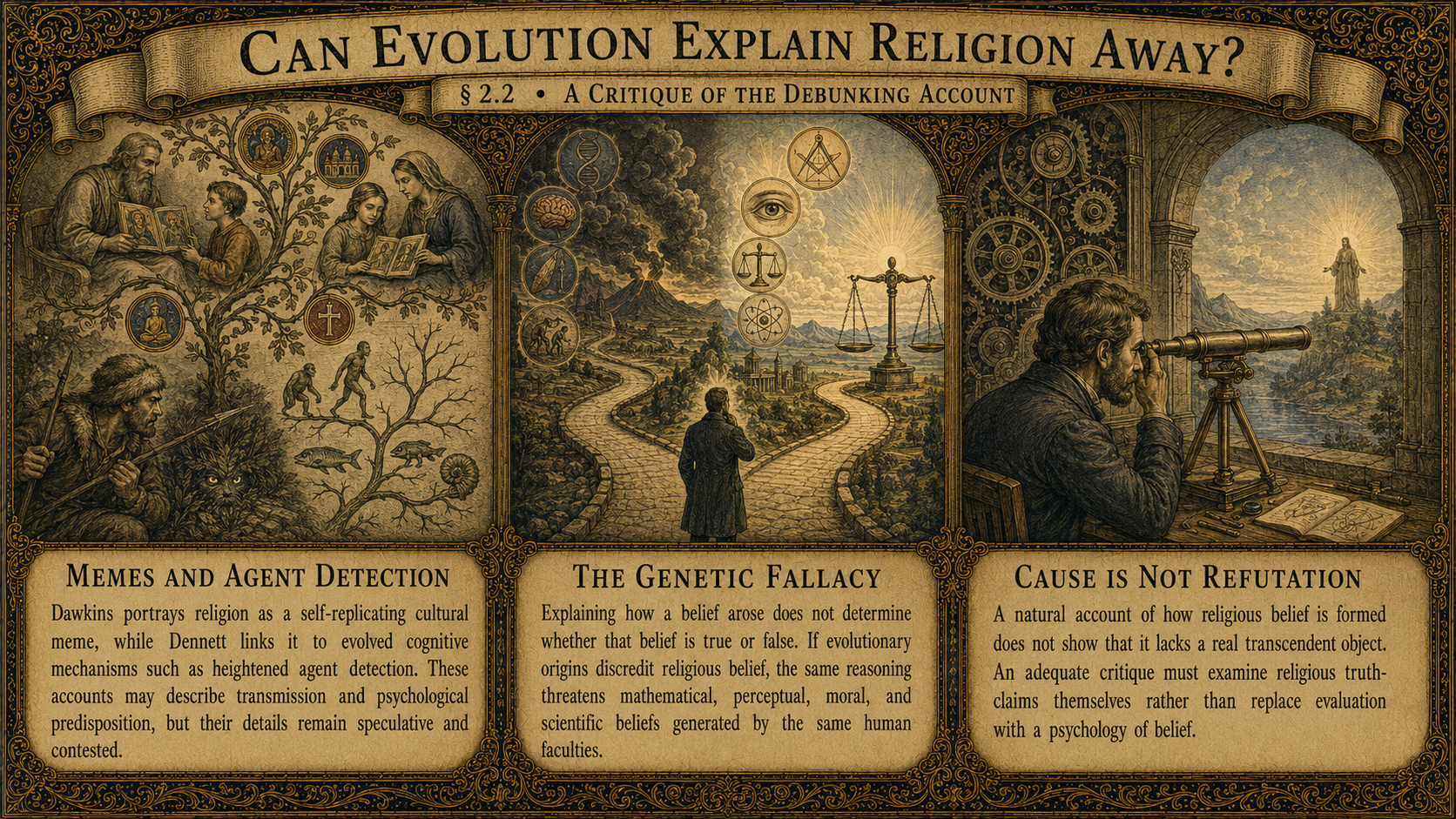
The New Atheist account of religion is, at its core, a debunking explanation: it aims to show that religion can be fully explained by natural causes — evolutionary, psychological, and social — without reference to any transcendent object. Dawkins’s account draws primarily on evolutionary psychology, and in particular on what he calls the “meme” — a unit of cultural transmission or imitation, analogous to the gene in biological evolution, which he introduced in The Selfish Gene (1976). On this account, religious ideas are memes that spread because they are good at replicating themselves, not because they are true. The tendency of children to believe what they are told, adaptive in the context of survival-relevant information, also makes them susceptible to the transmission of superstitious and religious beliefs, which then propagate through the culture. Religion, on this view, is a “virus of the mind” — a meme that exploits the cognitive architecture of human beings for its own replication, producing behaviours that serve neither the individual believer nor the wider society.
Daniel Dennett offers a more elaborate evolutionary account in Breaking the Spell, drawing on cognitive science of religion — particularly the work of Pascal Boyer (Religion Explained, 2001) and David Sloan Wilson (Darwin’s Cathedral, 2002) — to argue that religious beliefs and practices can be explained as evolutionary adaptations or byproducts of adaptive cognitive mechanisms. The “agent detection” hypothesis, which holds that the tendency to attribute intentions to natural events is an adaptive over-generalisation of the very useful tendency to detect predators and prey, provides a naturalistic explanation for animism and theism alike: we are cognitively prone to seeing intentional agents because such a disposition was adaptive on the Pleistocene savannah, and this proneness generates religious experience as a byproduct.
Several important objections can be raised against both versions of this debunking explanation. The first is the genetic fallacy: explaining how a belief came to be held tells us nothing about whether the belief is true. The origins of a belief and its truth-value are logically independent. Even if religious belief can be fully explained by evolutionary and cognitive mechanisms — which is itself highly contested — this explanation would not establish that the belief is false. The same evolutionary and cognitive mechanisms that generate religious belief also generate mathematical belief, perceptual belief, and moral belief. If the evolutionary origins of a belief undermine its epistemic credentials, they undermine the credentials of all human beliefs equally — including the belief that evolutionary explanations are correct. This is a version of the self-defeating character of naturalism identified by Plantinga.
The second objection is that the debunking explanations offered by Dawkins and Dennett are, at the relevant level of detail, speculative and contested. The “meme” theory in particular has been criticised with great thoroughness by McGrath (in Dawkins’s God and in subsequent works), who notes that the concept of a meme has never been given a sufficiently precise specification to generate testable predictions, that the analogy with genes breaks down at multiple crucial points, and that even committed Darwinians in the social sciences (notably Daniel Sperber and Scott Atran) have rejected the meme framework as unworkable. As McGrath rightly observes, Dawkins applies the meme concept not as a scientific hypothesis but as a rhetorical device to make religious belief look inherently irrational and infectious — which is persuasion, not argument.
The third and most fundamental objection is that the New Atheist account of religion systematically confuses a specific empirical phenomenon — the cognitive and social mechanisms through which religious beliefs are formed and transmitted — with the deeper question of whether these mechanisms track something real. The fact that human beings have a cognitive tendency towards agent detection does not imply that there are no agents — real or divine — to be detected. The fact that religious belief is transmitted culturally does not imply that what is transmitted is false. A fully adequate account of religion must engage with the substantive truth-claims that religious traditions make, not merely explain away the psychological processes through which these claims come to be believed.
§ 2.3 Memes, Evolution, and the Reductionist Account of Faith
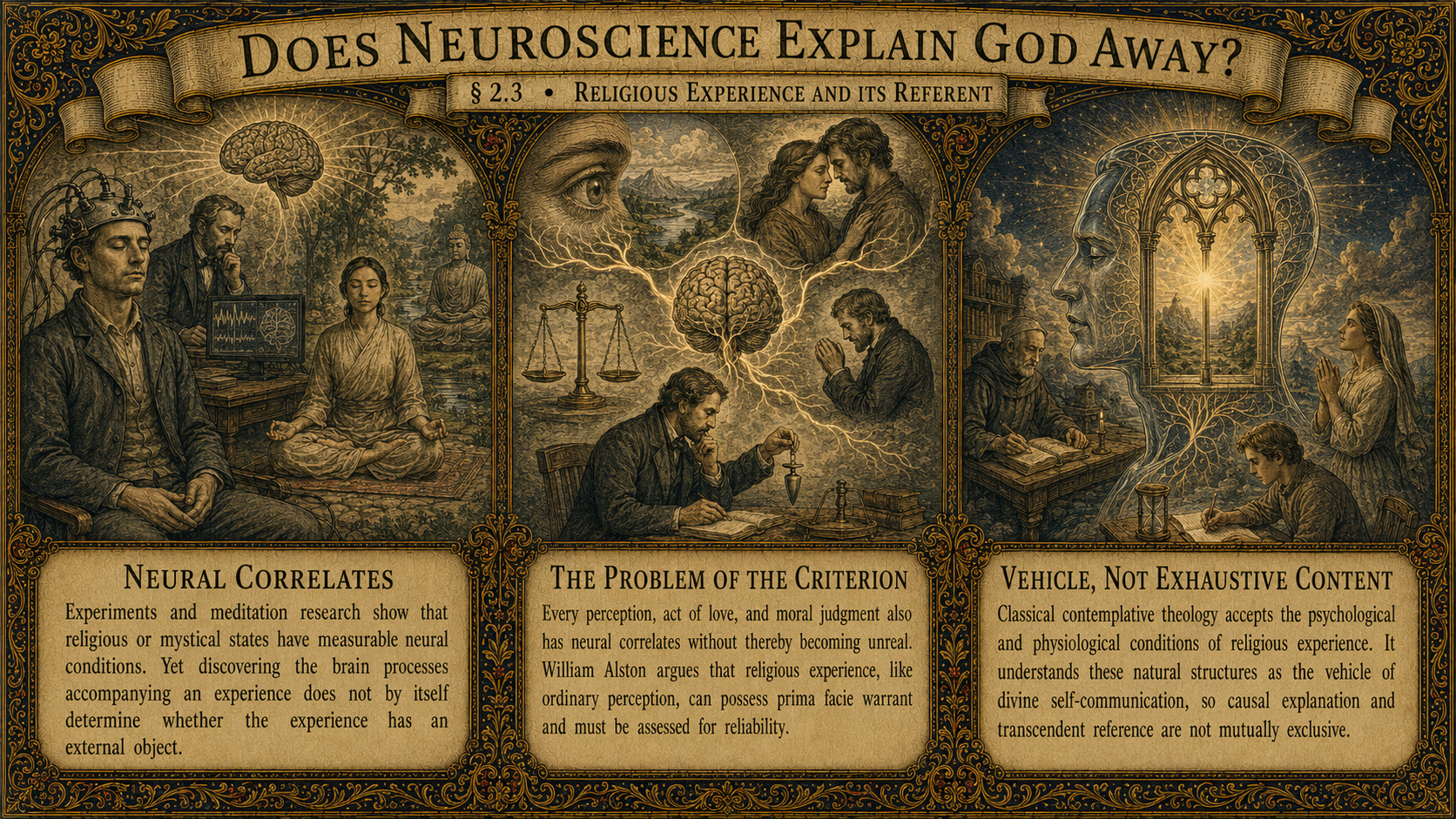
The reductionist strand of New Atheist thought reaches its most extreme expression in the argument that religious experience — the sense of the presence of God, mystical consciousness, the experience of prayer — can be fully accounted for by the neuroscience of the brain, without any need to invoke a transcendent referent. Dawkins refers approvingly to the neuroscientist Michael Persinger’s experiments with the “God helmet,” which apparently produced religious-style experiences by applying weak magnetic fields to the temporal lobes of subjects. Harris, as a neuroscientist himself, is more sophisticated in his treatment of religious experience but similarly committed to a naturalistic explanation: in Waking Up (2014) he argues that the altered states of consciousness achieved through meditation are genuine and valuable, but that they do not require the metaphysical frameworks of traditional religion to be understood or cultivated.
This naturalistic approach to religious experience faces what philosophers call the “problem of the criterion”: on what grounds does the neuroscientist decide that the neural correlates of religious experience do not constitute evidence for a divine reality? The fact that every human experience has neural correlates — including the experience of perceiving the physical world, the experience of loving another person, and the experience of making a moral judgment — does not imply that these experiences lack genuine external referents. As the philosopher William Alston argued in his landmark study Perceiving God (1991), there is no principled reason to treat religious experience as epistemically inferior to perceptual experience: both involve faculties that have been shaped by processes over which we have no control, both generate prima facie warranted beliefs about their objects, and both are subject to conditions of reliability and accuracy that can be examined. The neuroscientific reductionist assumption that a full causal explanation of an experience entails the non-existence of the object of that experience is not a scientific finding but a philosophical prejudice.
It is moreover worth observing that the tradition of mystical and contemplative theology — which is, within any of the major world religions, the most intellectually serious and epistemically sophisticated tradition of reflection on religious experience — has never claimed that such experience is immune from naturalistic explanation at the level of its psychological and physiological conditions. What the tradition claims is that these conditions are the vehicle, not the exhaustive content, of divine self-communication: that God communicates through the natural structures of human consciousness, not despite them. The New Atheist assumption that a naturalistic account of the conditions of religious experience automatically defeats the claim that such experience mediates genuine contact with the divine is, in the context of the best theological thinking on the subject, simply a non sequitur.
§ 2.4 New Atheism as a Publicistic rather than Philosophical Phenomenon
One of the most important and widely noted observations about New Atheism is that it has achieved its cultural influence primarily through publicistic rather than philosophical means. Böttigheimer’s characterisation, cited in the previous lecture, is apt and deserves emphasis: New Atheism is primarily a media phenomenon. Its most effective vehicles are not academic monographs but popular books, YouTube videos, public debates conducted in large auditoriums and broadcast on the internet, and the creation of organised atheist communities around shared symbols of identity — the “scarlet A” of Dawkins’s Out Campaign, the “Flying Spaghetti Monster” as a satirical counter to intelligent design, the organised “de-baptism” ceremonies conducted by some atheist groups.
This publicistic character has important implications for how the phenomenon should be understood and assessed. It means, first, that the philosophical arguments of the New Atheists should not be read primarily as contributions to academic philosophy of religion — they are not intended for, and have not been received by, the academic community as such. They are works of persuasion addressed to a mass audience, and they should be evaluated partly by their rhetorical effectiveness and partly by the accuracy and honesty of their presentations. By the first criterion, they have been extraordinarily successful; by the second, they have attracted substantial and justified criticism.
It means, secondly, that New Atheism has a significant sociological dimension that is independent of its philosophical merits. The sociologists Cimino and Smith, in their research on the New Atheist movement, have described it as engaged in the formation of an “imagined secularist community” — a collective identity defined by shared symbols, shared narratives, and shared opponents. In this sociological sense, New Atheism functions, as Michael Ruse has provocatively but perceptively noted, very much like a religion: it has its canonical texts (The God Delusion, The End of Faith), its public rituals (atheist conventions, de-baptism ceremonies), its heroes and martyrs, its sense of belonging to a persecuted minority, and its millennial hope for a world freed from religious delusion. Whether this structural similarity to religion constitutes an irony or a paradox, or simply reflects the inherently social character of any committed worldview, is a question we shall return to in Part IV.
§ 3.1 The Philosophical Inadequacy of New Atheist Arguments
The critique of New Atheism from within the tradition of academic philosophy of religion has been extensive and, on the whole, withering. It is important to be clear that this critique comes not only from theistic philosophers but from atheist and agnostic philosophers who are simply committed to intellectual standards that the New Atheists frequently fail to meet. The philosopher Terry Eagleton — himself no friend of traditional religion — wrote in his extended critical essay Reason, Faith and Revolution (2009) that Dawkins does not have the faintest idea what sophisticated theologians and religious philosophers have written about the questions he addresses, and that his arguments engage a “village atheist” version of religion rather than the tradition of Christian theology at its best. This charge, though formulated with rhetorical sharpness, is substantively accurate.
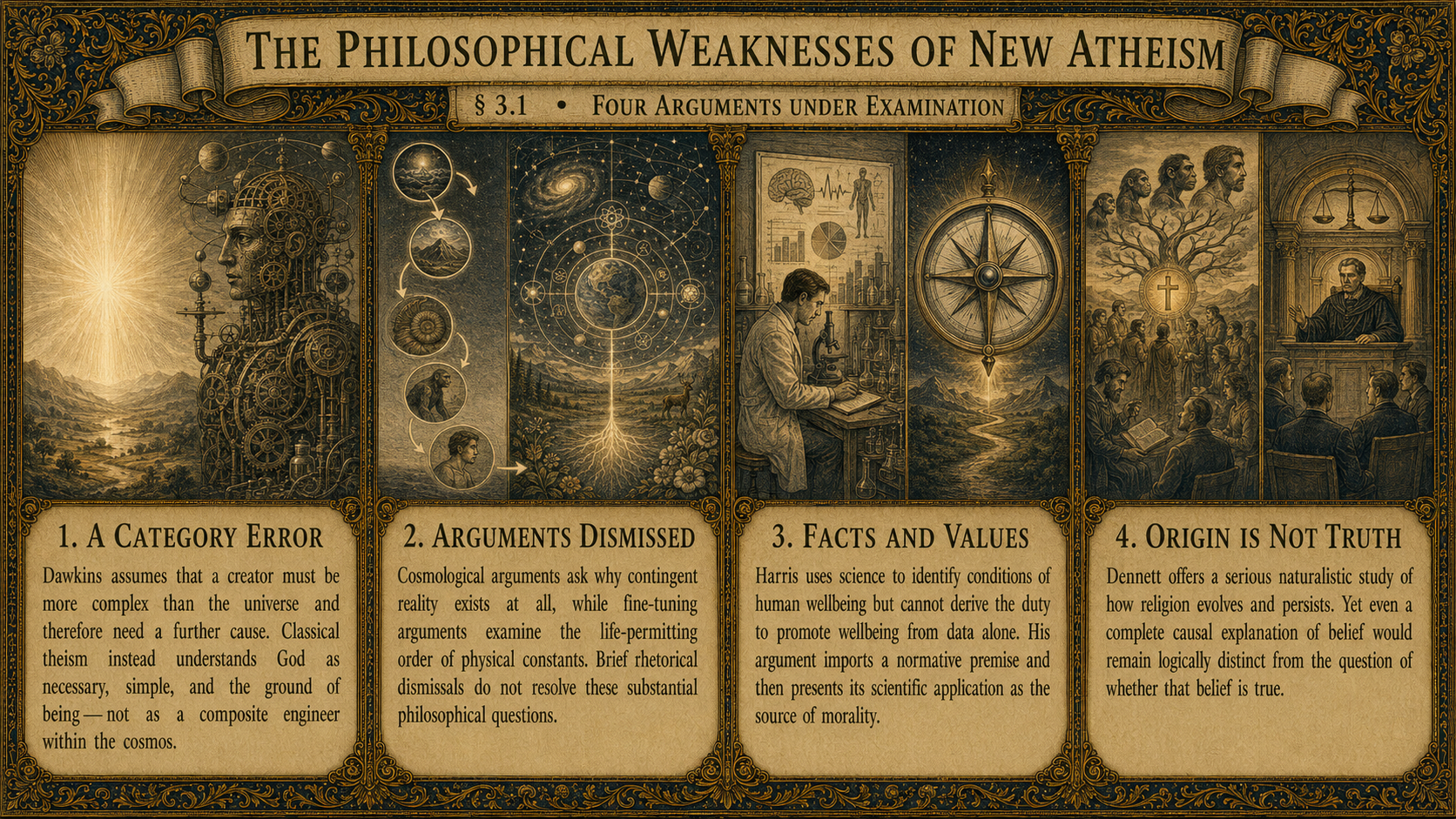
The most fundamental philosophical objection to Dawkins’s central argument in The God Delusion is that the “Ultimate Boeing 747 gambit” involves a category error. The argument runs as follows: God, if he exists, must be enormously complex, since he is capable of designing and creating an enormously complex universe; any being of enormous complexity requires an explanation in terms of something simpler; therefore positing God as an explanation of the universe’s complexity merely relocates the problem rather than solving it. This argument, however sophisticated it may appear, rests on a fundamental misunderstanding of the classical theological conception of God. The God of classical theism — from Aristotle’s Unmoved Mover through Aquinas’s ipsum esse subsistens to contemporary classical theistic philosophers — is not a complex being composed of many parts. He is, by definition, simple: pure actuality, subsistent being itself, without composition of any kind. The question “Who made God?” presupposes that God is the kind of being that requires a cause — that is, a contingent, composite being. But the classical theistic tradition denies precisely this presupposition: God is not a contingent being that happens to exist among other beings; he is the ground of being itself, whose existence requires no further explanation because he exists necessarily. Dawkins’s argument does not refute classical theism; it refutes a naive picture of God as a super-powerful cosmic engineer, which serious theologians have always recognised as theologically inadequate. The philosopher Edward Feser makes this point with characteristic precision in The Last Superstition: A Refutation of the New Atheism (2010), observing that Dawkins’s argument would be recognised as question- begging by any first-year philosophy student familiar with the basic distinction between necessary and contingent beings.
A second fundamental philosophical objection concerns Dawkins’s treatment of the cosmological and teleological arguments for the existence of God. These arguments — in their classical Thomistic forms, as the Five Ways of Aquinas — have been the subject of millennia of philosophical development and refinement, and they cannot be adequately addressed by the brief dismissals that Dawkins offers in The God Delusion. The cosmological argument, in its most sophisticated contemporary formulations (as in the Kalam Cosmological Argument of William Lane Craig or the Leibnizian argument developed by Robert Koons), raises genuine and difficult philosophical questions about the explanation of contingent existence that atheism has not satisfactorily answered. The teleological argument, in its contemporary form as the “fine-tuning argument” — which observes that the fundamental physical constants of the universe appear to be extraordinarily precisely calibrated to permit the existence of complexity and ultimately of conscious life — is a serious scientific and philosophical observation that deserves serious engagement rather than the rhetorical dismissal it receives in Dawkins’s treatment.
Harris’s argument in The Moral Landscape that science can determine moral values raises a set of philosophical difficulties that are no less severe. The argument presupposes that wellbeing is a natural fact that can be objectively measured, and that moral questions reduce to questions about what promotes or inhibits wellbeing. But this presupposition — which is itself a substantive philosophical claim rather than a scientific finding — runs directly into the classical problem identified by G. E. Moore as the “naturalistic fallacy”: the illicit derivation of normative conclusions from purely descriptive premises. Even if we grant that we can scientifically measure the neural and behavioural correlates of what humans report as wellbeing, the further claim that what promotes these states is morally obligatory requires a normative premise — some version of the claim that wellbeing ought to be promoted — that cannot itself be derived from the scientific data. Harris’s argument is ultimately circular: it assumes a normative framework (roughly utilitarian hedonism) and then uses science to implement it, claiming to derive the framework itself from science. This is a claim that most moral philosophers, including many who are themselves thoroughly secular, regard as fundamentally confused.
The philosopher’s philosopher among the New Atheists is Dennett, and his work deserves somewhat different treatment. Breaking the Spell is a genuine philosophical contribution to the naturalistic study of religion, and its call for religion to be examined by the methods of empirical science is not, in itself, philosophically problematic. What is philosophically problematic is the implicit assumption — shared with his colleagues, though expressed more carefully — that a fully satisfactory evolutionary and cognitive account of religious belief would constitute evidence against its truth. As we have argued in Part II, this assumption commits the genetic fallacy, and it is an assumption that Dennett himself, as a sophisticated philosopher, ought to have examined more carefully than he does. The question of whether religion has evolved is orthogonal to the question of whether the beliefs that religion transmits are true.
§ 3.2 The Problem of Morality Without God
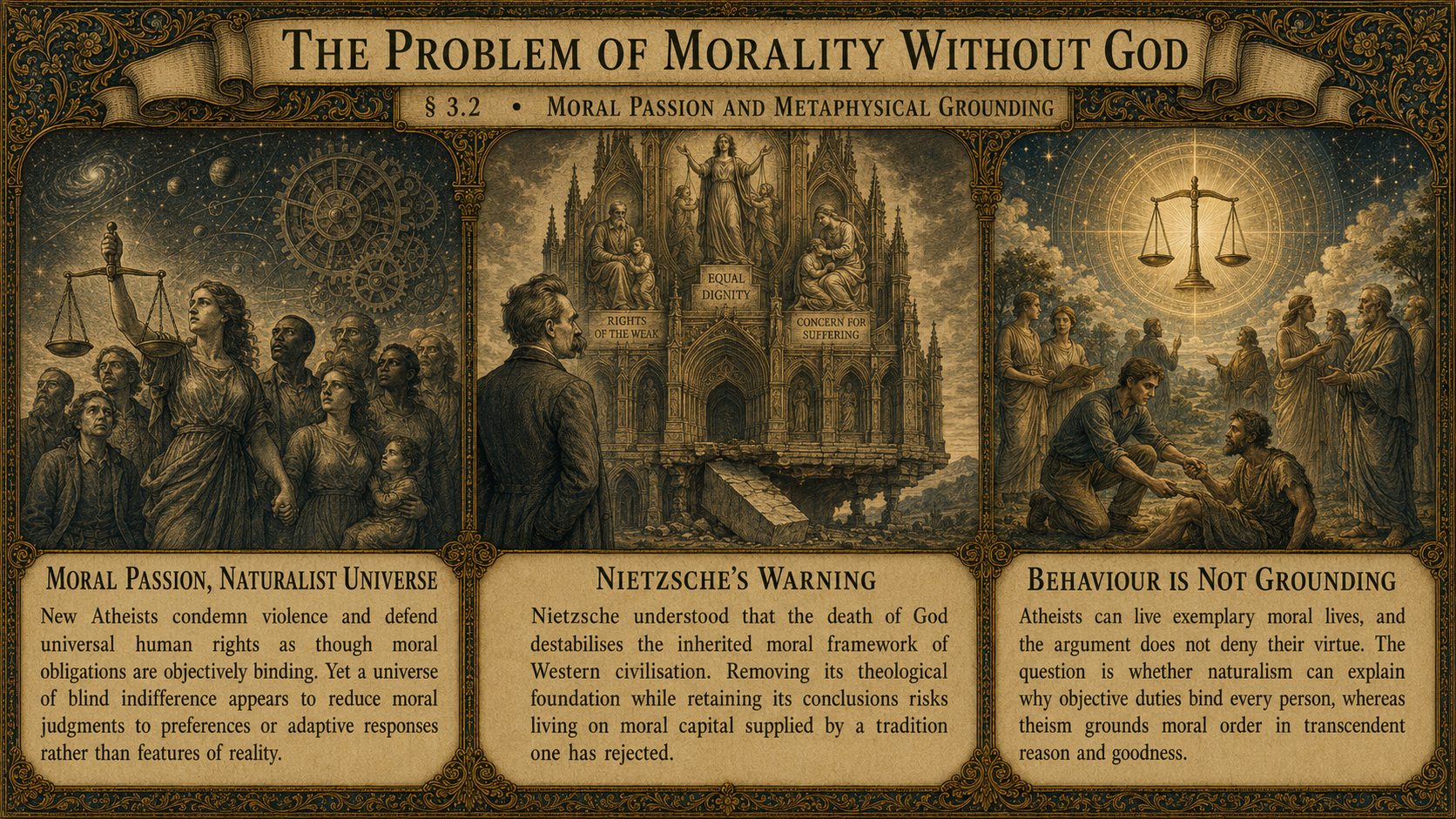
The New Atheists, as noted above, are passionate moralists. They condemn the violence done in the name of religion with great vehemence; they advocate for human rights, freedom of inquiry, and the liberation of the oppressed. They write, in short, as though moral categories are real, binding, and universally applicable. But this moral passion sits in deep tension with the metaphysical commitments of the naturalism they espouse. If, as Dawkins asserts, the universe is characterised by “blind pitiless indifference” at the fundamental level, then moral categories are not features of reality but projections of human preferences or products of evolutionary conditioning. If, as Harris argues, “the morality of our ancestors was more or less biologically mandated,” and our moral intuitions are the outputs of adaptive processes selected for reproductive success rather than truth, then the moral condemnation of religious violence is not a perception of objective moral reality but simply the expression of a competing evolutionary preference.
This is not merely a theoretical problem; it is the central practical problem for any secular ethics that genuinely aspires to the normativity it preaches. The philosopher Nietzsche understood this with a clarity that no New Atheist has matched. If God is dead, Nietzsche argued, then the entire moral framework of Western civilisation — derived, as he correctly saw, from its Judeo- Christian roots — collapses with him. There is no longer any basis for the claim that all human beings have equal dignity, that the weak have rights that the strong are obliged to respect, or that suffering is morally relevant rather than merely biologically disadvantageous. Nietzsche did not find this comforting; he found it catastrophically disorienting. The New Atheists, by contrast, seem to suppose that one can remove the theological foundations of the moral edifice while leaving the edifice itself undamaged. This is not intellectual coherence but, as it was described in the preceding lecture, mere cultural inertia — living off the moral capital of a religious tradition one has officially repudiated.
The theistic tradition’s account of morality — in both its natural law form (from Aristotle through Aquinas to contemporary natural law theorists such as John Finnis and Germain Grisez) and its divine command form (from Duns Scotus through William of Ockham to contemporary divine command theorists such as Robert Adams) — provides a principled grounding for the objective reality of moral norms that naturalism is unable to match. In the natural law tradition, the moral law is not an arbitrary divine imposition but an intelligible participation in the eternal reason of God, accessible in principle to all rational beings through their natural rational powers. This grounds the universality and necessity of moral claims — they apply to all persons regardless of cultural conditioning — in a way that no purely immanent account can. The atheist who wishes to maintain, as the New Atheists wish to maintain, that genocide is objectively wrong — wrong not merely for beings with our particular evolutionary history but wrong tout court — needs a metaphysical account of objective moral facts that naturalism cannot provide. As Frank Turek succinctly puts it: if evil is real, then atheism is false.
It is worth adding that this argument does not depend on the claim that atheists are, in practice, less moral than theists — a claim for which there is no reliable empirical support, and which it would be morally objectionable to make. The argument is not about the moral behaviour of individuals but about the metaphysical foundations of moral discourse. An atheist may live an exemplary moral life; what he cannot consistently do, on naturalist premises, is provide a principled account of why anyone else is obliged to do the same. This distinction between the phenomenology of moral experience — which atheists share fully with theists — and the philosophical grounding of moral normativity is one that the New Atheists systematically fail to draw.
§ 3.3 The Misuse of History: Religion and Violence
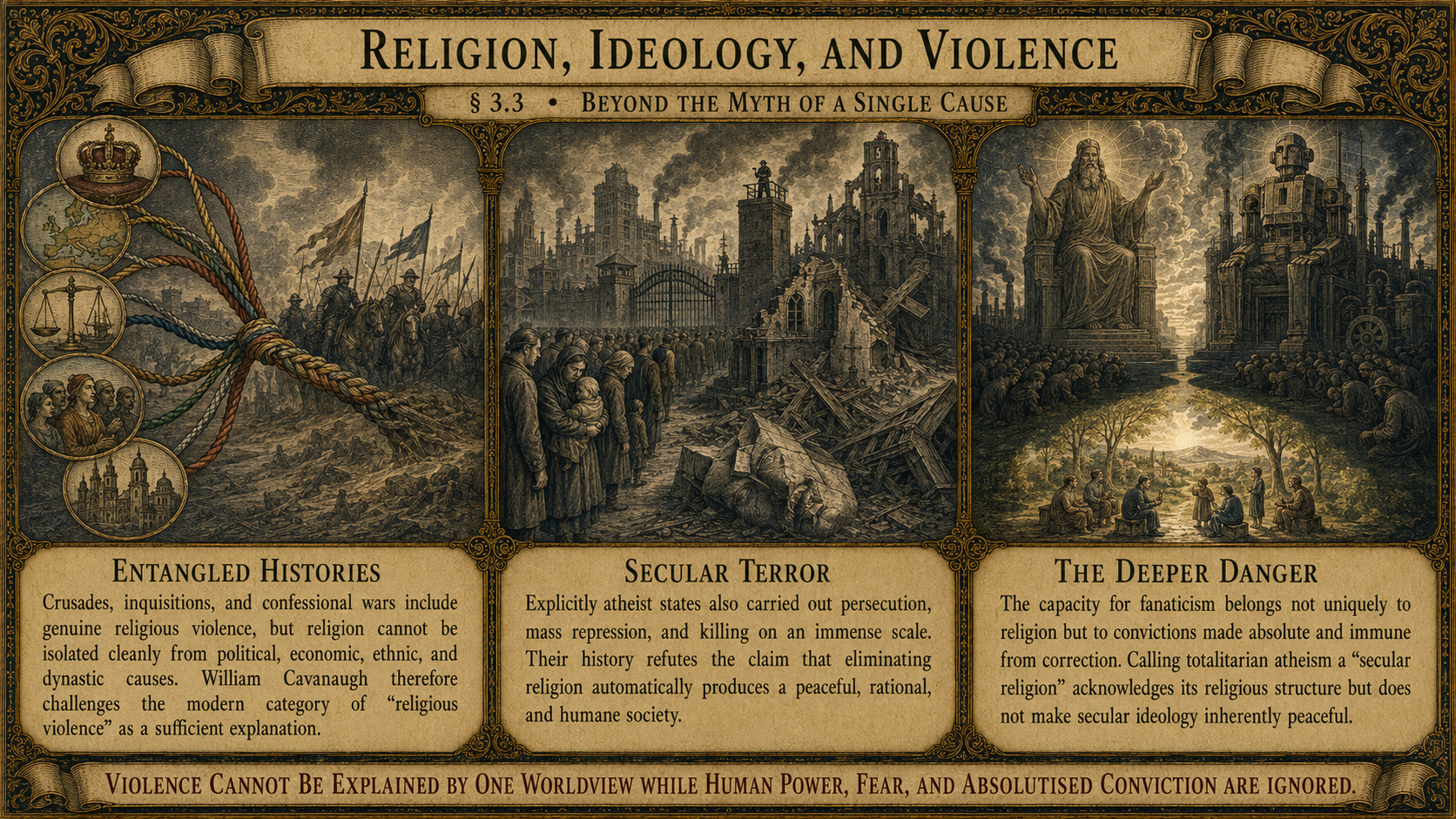
One of the most rhetorically effective and empirically contestable claims of the New Atheist movement is the claim that religion is the primary driver of violence and conflict in human history — that it has, in Hitchens’s phrase, “poisoned everything.” This claim operates at two levels: historical and theoretical. At the historical level, it points to events like the Crusades, the Inquisition, the European Wars of Religion, the September 11 attacks, and numerous other episodes of religiously motivated violence to support the conclusion that religion is inherently productive of conflict. At the theoretical level, it argues that religion, by insulating its claims from rational scrutiny and by promising supernatural rewards for this-worldly sacrifices, is uniquely capable of motivating extreme violence.
The historical argument requires very considerable qualification. The historian of religion William Cavanaugh, in The Myth of Religious Violence (2009), has subjected the historical claim to systematic scrutiny and found it wanting. Cavanaugh argues that the category of “religion” as a distinct, separable domain of human activity — one that can be cleanly isolated from political, economic, and cultural factors and designated as the cause of this or that conflict — is itself a modern Western construction that did not exist in the periods to which the New Atheist argument principally appeals. The European Wars of Religion, for example, were conflicts in which religious allegiance and political power were so thoroughly intertwined that any attempt to attribute them purely or primarily to “religion” distorts their actual historical character. This is not a defence of the violence perpetrated in the name of religion; it is a methodological observation about the difficulty of isolating religious motivation from the complex of political, economic, ethnic, and dynastic factors that always accompanies it.
The theoretical argument is even more seriously challenged by the evidence of the twentieth century. The most catastrophic episodes of mass political violence in recorded history were perpetrated not by religious actors but by explicitly atheist and anti-religious states. The Soviet Union under Lenin and Stalin, the People’s Republic of China under Mao Zedong, Pol Pot’s Cambodia, and Enver Hoxha’s Albania all prosecuted systematic programmes of religious suppression and conducted mass murder on a scale that dwarfs anything that can plausibly be attributed to religious motivation in modern history. The historian Stéphane Courtois and his collaborators, in The Black Book of Communism (1997), estimated the death toll of Communist regimes in the twentieth century at approximately one hundred million people. Whatever one thinks of the precise accuracy of this figure, the order of magnitude is not seriously disputed. The New Atheist claim that religion is uniquely dangerous, and that a world without religion would be a more peaceful and rational world, cannot be seriously maintained in the light of this evidence. As Alister McGrath has argued, the twentieth century demonstrated that the most dangerous worldview is not one that believes in God but one that has abolished God and substituted a secular ideology in his place. The capacity for fanaticism and mass violence is not a property of religious belief as such but of absolutised conviction — a phenomenon at least as common in secular as in religious form.
The New Atheist response to this argument is typically to claim that Communist totalitarianism represents a “secular religion” rather than genuine atheism, or that it reflects the elimination of political religion rather than of all religion. These responses, while not entirely without merit, are considerably more ad hoc than their proponents acknowledge. The fact that politically organised atheism can take on the structural characteristics of a religion — a point to which we shall return in Part IV — is precisely what we would expect on the Christian theological analysis of atheism as a disordered religious impulse. But it hardly supports the claim that religion is the root cause of human violence while secular ideology is inherently peaceful.
§ 3.4 The Theological Response: Alister McGrath and John Haught
Among the many theological responses to New Atheism, two deserve extended attention for their quality and their complementarity: those of Alister McGrath and John Haught. They represent, respectively, the approach of an evangelical Protestant theologian with a background in natural science, and that of a Roman Catholic theologian in the tradition of process thought. Their differences in theological methodology illuminate the range of resources available to Christian theology in this debate.
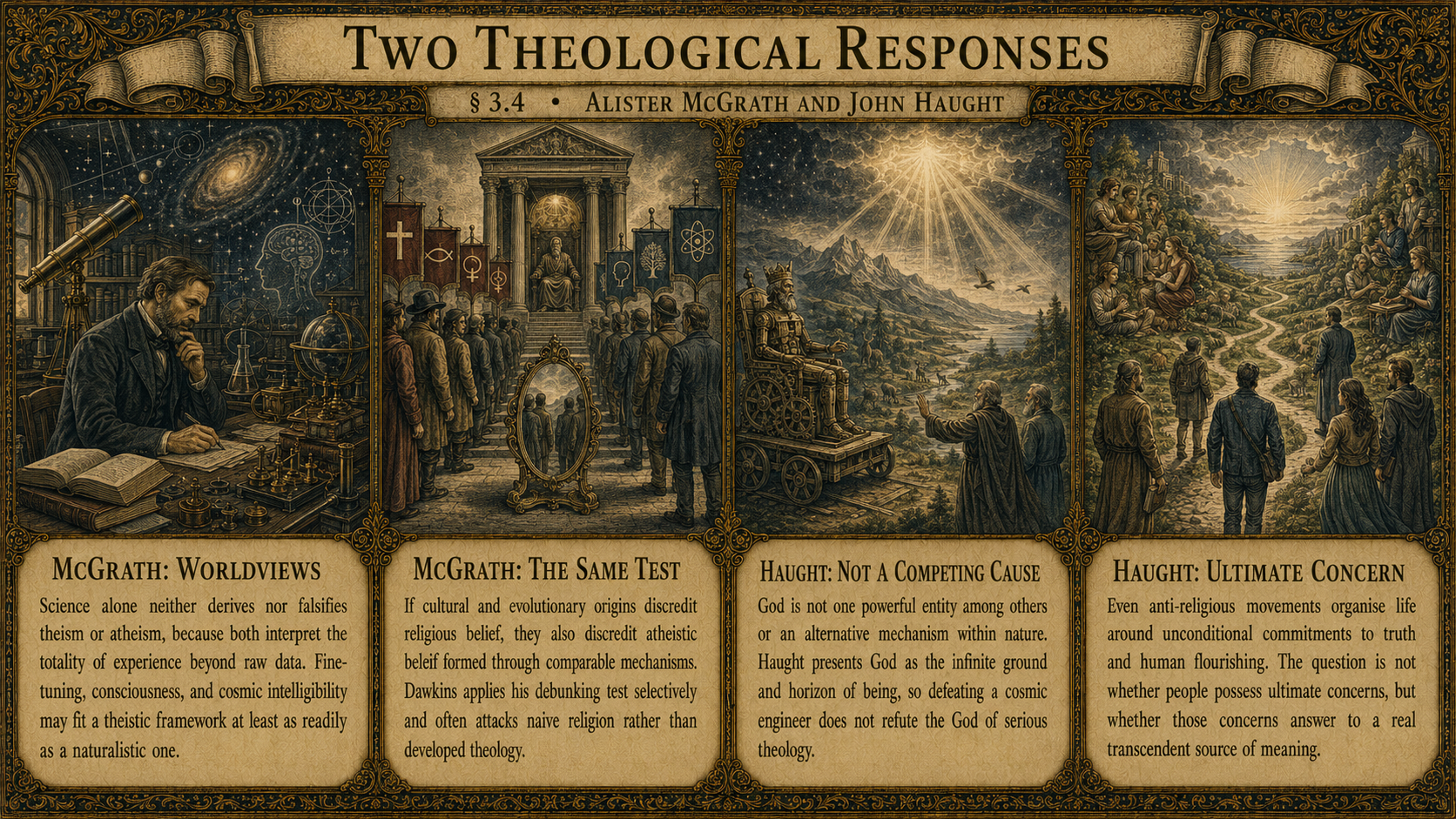
McGrath’s critique of Dawkins is, at one level, an internal critique from within the scientific tradition itself. As a former atheist and a holder of a doctorate in molecular biophysics, McGrath is well positioned to challenge Dawkins’s claim to be speaking in the name of science. His principal argument in Dawkins’s God (2007) and in The Dawkins Delusion? (jointly with Joanna Collicutt McGrath, 2007) is that Dawkins has conflated two quite different questions: the question of whether natural science provides evidence against the existence of God, and the question of whether atheism is a more rational worldview than theism. On the first question, McGrath argues that the evidence is considerably more ambiguous than Dawkins allows: the fine-tuning of the physical constants, the emergence of consciousness, and the intelligibility of the universe to mathematical reason are all facts about the world that are, at minimum, more readily explicable on a theistic framework than on a naturalistic one. On the second question, McGrath argues that both theism and atheism are “meta-empirical worldviews” — frameworks for interpreting the totality of experience — and that neither can be derived from or falsified by scientific evidence alone.
McGrath’s most telling point against Dawkins concerns the self-referential character of his critique of religious belief. Dawkins argues, as we have noted, that religious belief is a “meme” that spreads for reasons that have nothing to do with its truth. But McGrath points out that this argument, if it were valid, would apply with equal force to atheism itself. Atheism is also a culturally transmitted belief, also dependent on cognitive and social mechanisms that have nothing to do with the truth of its claims. If the evolutionary origins of religious belief undermine its epistemic credentials, the evolutionary origins of atheist belief equally undermine the credentials of atheism. Dawkins cannot consistently apply the debunking argument to religious belief without applying it to his own atheist commitments — which would leave him in a position of radical scepticism rather than confident atheism. McGrath also makes the important point, which deserves wider attention, that the New Atheists consistently engage with the most naive and intellectually undefended forms of religious belief — the literal six-day creationism of American Protestant fundamentalism, the most uncritical and anthropomorphic conceptions of God — while ignoring the sophisticated theological tradition that has grappled with the very questions they raise for centuries. This is not argument but caricature.
John Haught’s response, in God and the New Atheism (2008), is pitched at a deeper theological level. Haught argues that the New Atheists have not understood what theology is or what it is trying to do. Theology, in the tradition he represents — drawing particularly on the thought of Paul Tillich, Karl Rahner, and Alfred North Whitehead — does not make claims about God as an entity among entities within the natural world, a competitor with scientific explanations for the same natural events. God, in the classical and process theological traditions, is the infinite horizon of being itself — the ultimate ground within which every finite thing exists and toward which every act of knowing and loving is implicitly oriented. This is the God that Tillich calls “Being itself” and that Rahner calls the “Woraufhin” — the “towards which” — of all human transcendence. Haught’s central contention is that the New Atheists are arguing against a conception of God that sophisticated theology has always itself regarded as inadequate: a god who is a large and powerful agent competing with natural causes on the same ontological level. When Dawkins imagines God as a kind of super-engineer who designs the flagellum of the bacterium in competition with natural selection, he is imagining a god whom theologians have consistently rejected as a misrepresentation of the divine. Haught calls this the “argument from the divine understudy”: the New Atheists defeat a god who was never the God of serious theology.
Haught makes the further important point that the New Atheists, in their rejection of religion, are themselves engaged in what Tillich would call an act of “ultimate concern” — a commitment to truth, to rationality, to human flourishing, that functions, in their lives, as a kind of functional equivalent of religion. This is not to say, as some superficial critics do, that atheism is “just another religion.” It is to say that the human capacity for ultimate concern — for orienting one’s life around unconditional commitments — is inextinguishable, and that it finds expression even in the most vehement anti- religious movements. The question is not whether human beings will have ultimate concerns but what the appropriate object of such concern is. For Haught, the deepest intellectual failure of the New Atheists is their refusal to take seriously the possibility that the human longing for ultimate meaning, for justice, for beauty, and for love is not an adaptive illusion but a genuine apprehension — however distorted and incomplete — of a transcendent reality that both grounds and calls forth that longing.
§ 4.1 Critiques from Within: Secular Thinkers Against New Atheism
A significant and instructive feature of the reception of New Atheism is that some of the most penetrating criticisms have come not from religious apologists but from secular thinkers who share the New Atheists’ atheism but not their tone, their methods, or their intellectual culture. This internal secular critique deserves attention precisely because it cannot be attributed to religious self-interest, and because it illuminates the specifically intellectual failures of the movement rather than its metaphysical conclusions.
The philosopher Thomas Nagel, whose critique of materialist naturalism from an atheist position was mentioned in the previous lecture, has been consistently critical of the intellectual standards of the New Atheism. His review of Dawkins’s The God Delusion for The New Republic noted that the book is aimed at a popular audience and that its philosophical arguments are not addressed to serious interlocutors in the academic philosophy of religion — which means that it largely misses the actual case for religious belief as made by its most sophisticated defenders. Nagel’s broader philosophical project in Mind and Cosmos (2012) — the argument that materialist naturalism cannot account for the existence of consciousness, rationality, and value, and that these phenomena point to the need for a fundamentally different account of nature — is not a defence of theism but it constitutes a devastating critique of the metaphysical framework that the New Atheists presuppose.
The philosopher of science Michael Ruse — himself an atheist and a vigorous opponent of creationism in the American courts — has been among the most persistent internal critics of New Atheism. His central objection is that Dawkins and his colleagues have turned atheism into a quasi-dogmatic worldview, a “secular religion,” that is no more open to rational scrutiny than the religious traditions it condemns. Ruse argues that the intellectual health of atheism requires distinguishing between the philosophical position (the denial of God’s existence, held on rational grounds) and the ideological movement (organised atheism, with its own community identity, canonical texts, and moral certainties) — and that the New Atheists have collapsed this distinction in ways that are intellectually dishonest and socially harmful. His articles “Is the New Atheism a Religion?” and “Why Richard Dawkins’ humanists remind me of a religion” develop this critique with considerable force.
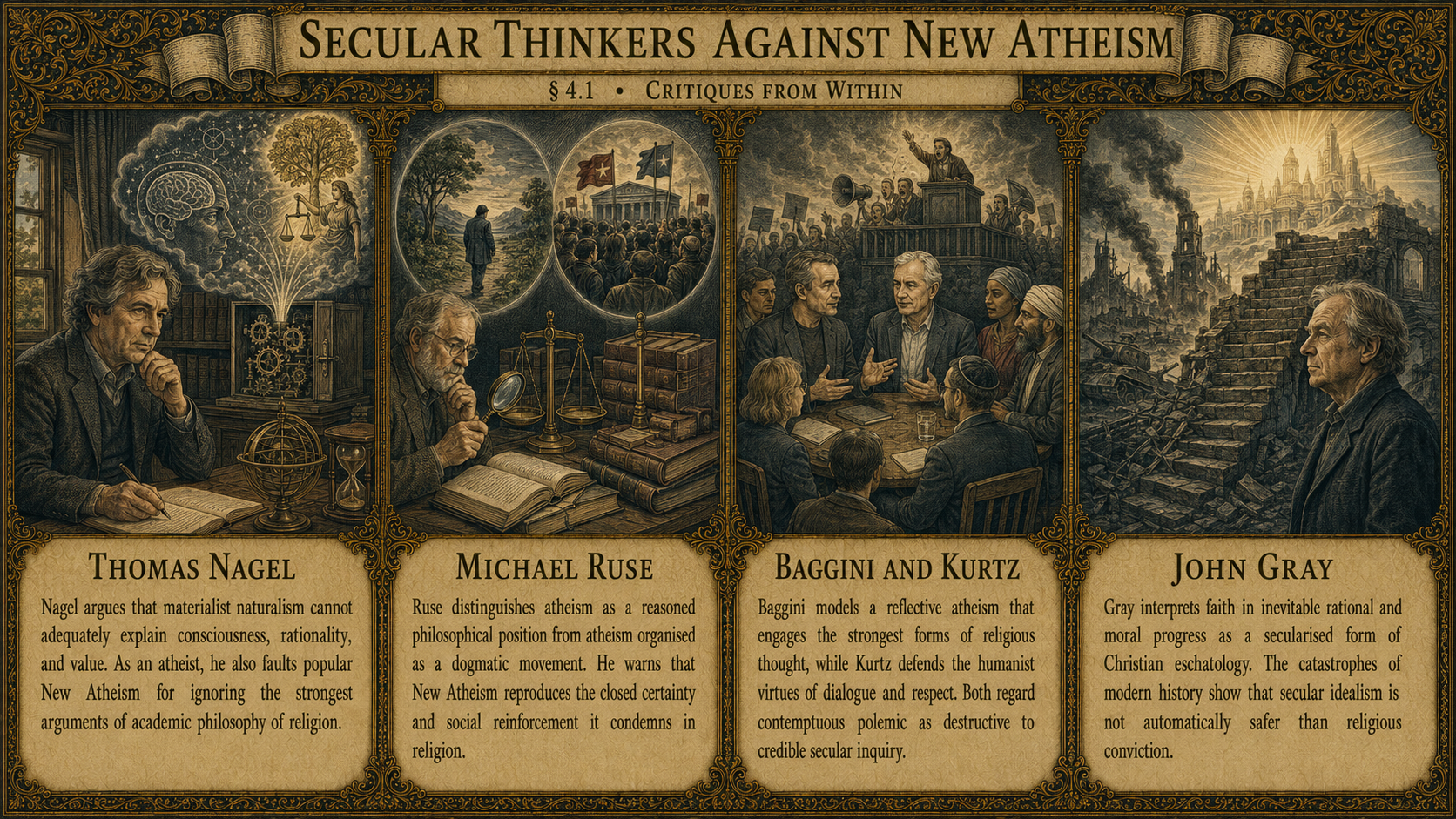
The philosopher Julian Baggini, himself a committed atheist, argued in a widely read article that “the New Atheist movement is destructive” and that it has undermined the credibility of secular thought by its combativeness, its dogmatism, and its failure to engage seriously with the best forms of religious thought. Baggini’s contribution to the atheism debate, which includes The Atheist’s Guide to Reality (2012) and a series of essays in journals of popular philosophy, models a kind of reflective, humble, and intellectually honest atheism that he explicitly contrasts with the confident pronouncements of the New Atheist celebrity culture. Paul Kurtz, the founder of modern secular humanism and one of the most distinguished figures in the tradition of organised freethought, was similarly critical: he argued that the New Atheists had abandoned the humanist tradition’s commitment to dialogue and intellectual respect in favour of a posture of contempt that could only alienate potential allies and entrench religious opponents.
The historian of religion John Gray, himself an atheist, has offered perhaps the most penetrating secular critique of New Atheism in his article “What Scares the New Atheists” (The Guardian, 2015) and in his books Seven Types of Atheism (2018) and Black Mass (2007). Gray argues that the New Atheism is not a critique of religion at all but a secularised form of the Enlightenment faith in human reason and moral progress — which is itself, he maintains, a mutation of Christian eschatological thinking. The idea that humanity is making moral progress, that the arc of history bends toward justice and rationality, that we are moving toward a world freed from superstition and organised around scientific reason — this is not an empirical discovery but a quasi-religious article of faith, one whose credentials are far less secure than its New Atheist proponents suppose. Gray points to the catastrophic history of the twentieth century as evidence that secular idealism is not morally safer than religious conviction, and suggests that the New Atheists are engaged in a flight from this evidence rather than a rational confrontation with it.
§ 4.2 New Atheism as a Quasi-Religion: The Paradox of Militant Unbelief
Several commentators — both religious and secular — have noted the paradoxical structural similarity between New Atheism, as a social and cultural movement, and the religious communities it seeks to displace. This observation is not a mere rhetorical device for embarrassing the New Atheists; it is a substantive sociological and philosophical observation that illuminates important features of the movement.
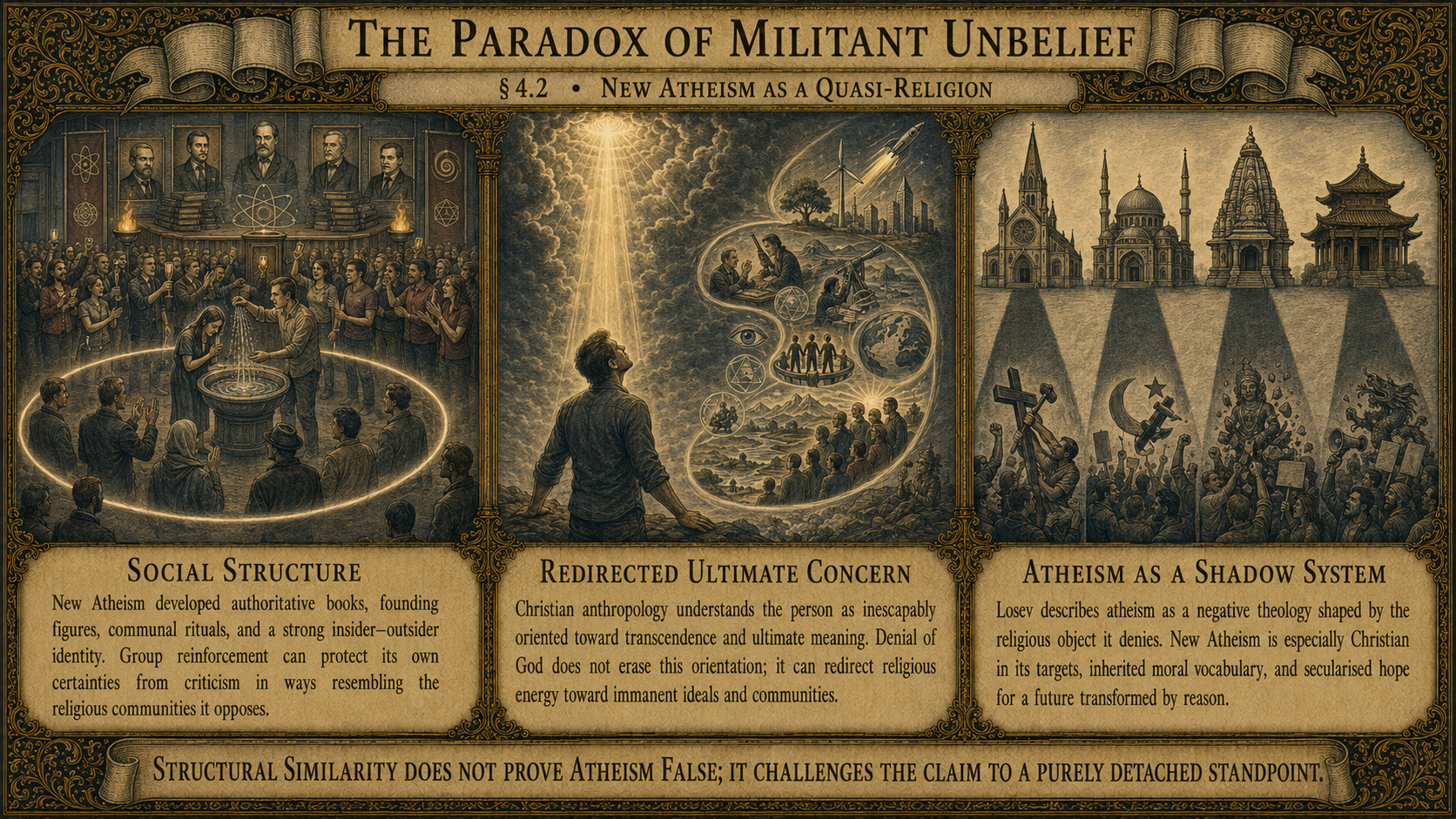
Sociologically, the New Atheist movement exhibits several features that are characteristic of new religious movements. It has founding figures whose writings function as canonical authorities. It has communal rituals — the atheist conventions, the de-baptism ceremonies, the “Darwin Day” celebrations — that create collective identity and reinforce group solidarity. It has a strong sense of insider/outsider identity, in which believers are characterised as deluded, credulous, or morally compromised. And it has, as Ruse and others have noted, a pronounced tendency toward the kind of social reinforcement that insulates belief from rational scrutiny — precisely the phenomenon that the New Atheists condemn as “faith” when they find it in religious communities.
Theologically, this quasi-religious character of militant atheism is entirely intelligible, and it was anticipated in the tradition of Christian philosophical anthropology that we surveyed in the previous lecture. The human person, in the Christian account, is constituted by an ineradicable orientation toward the transcendent — what Rahner calls the Vorgriff auf esse, the pre-apprehension of being, and what Tillich describes as the structure of ultimate concern. This orientation cannot be suppressed or abolished by a philosophical decision to deny God’s existence; it can only be redirected. When it is redirected away from God toward immanent objects — the progress of reason, the liberation of the species, the community of the unbelievers — it takes on the emotional and social forms of religious investment because those forms express what is deepest in the human constitution.
The Russian religious philosopher A. F. Losev made exactly this point: atheism is “a negative theology,” which is to say that it is defined by its engagement with the religious object it denies. Every form of atheism is the “shadow system” of some particular religion — shaped by what it rejects, structured by the negation of the claims it refuses to accept. This is why, as D. V. Pivovarov has argued, there is no abstract atheism-in- general; there is only Christian atheism, Muslim atheism, Buddhist atheism, and so on — each drawing its particular shape from the particular religious tradition against which it defines itself. The New Atheism is, in this sense, recognisably a specifically Christian atheism: its targets are overwhelmingly the claims of Christian theism; its moral vocabulary is largely derived from the Christian tradition (human dignity, equality, the wrongness of cruelty); and its eschatological optimism about the progress of reason is a secularised version of the Christian hope for the coming of God’s kingdom. It is not an escape from the sphere of religion but a transformation within it.
This observation should not be read as a triumphalist point against atheism. It does not establish that New Atheism is wrong. What it does establish is that the New Atheist aspiration to have transcended the religious condition of humanity altogether — to have achieved the pure, detached, rational standpoint from which religion can be seen for what it is — is itself a kind of illusion. The New Atheist is as deeply embedded in the existential situation of the creature that is made for God as the believer; he has simply responded to that situation differently, and his response, no less than the believer’s, is shaped by desires, fears, hopes, and social affiliations that go well beyond the deliverances of pure reason.
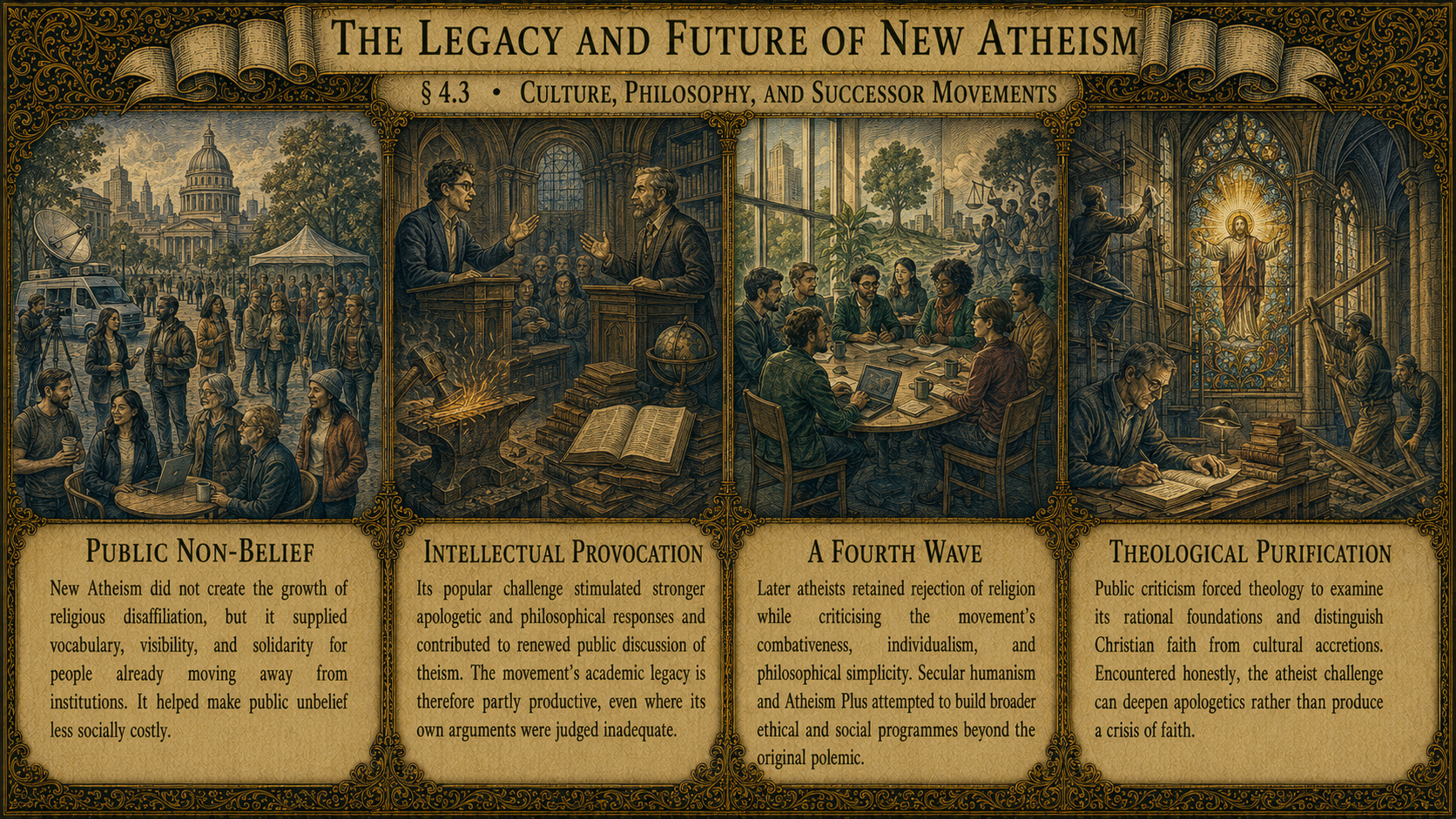
§ 4.3 The Legacy and Future of New Atheism
Two decades after its emergence as a cultural force, what has become of the New Atheism, and what has been its lasting effect on the intellectual and cultural landscape? These questions, which are partly empirical, require some caution in answering, since the movement is still sufficiently recent that its long- term significance is difficult to assess.
At the level of institutional organisation, the New Atheist movement has had real effects. The number of Americans identifying as religiously unaffiliated — the “nones” — continued to grow through the 2010s, reaching approximately twenty-six percent of the adult population by 2019 according to the Pew Research Center. The New Atheist movement did not cause this trend — it was already underway before the publication of The End of Faith — but it likely accelerated it by providing a cultural vocabulary, a public identity, and a sense of solidarity for those already inclined toward unbelief. The “nones” are not, for the most part, ideological New Atheists; they are people who have drifted away from formal religious affiliation for a variety of social and experiential reasons. But the New Atheist movement contributed to the normalisation of public non-belief in a cultural environment where, particularly in the United States, such non-belief had previously carried significant social costs.
At the level of academic philosophy of religion, the legacy is more ambiguous. The New Atheist books prompted a vigorous theological and apologetic response, and this response has arguably raised the level of public discourse about religious belief by forcing apologists to engage more rigorously with the best secular objections to theism. The Plantinga-Tooley debate examined in the previous lecture, the work of William Lane Craig in the field of public apologetics, and the broader renewal of philosophical theology in the analytical tradition — associated with figures such as Plantinga, Swinburne, van Inwagen, Pruss, and Koons — all represent, in part, responses to the challenge of secular philosophy of which the New Atheism is one expression. In this sense, the New Atheist provocation has had a productive effect on the intellectual tradition it sought to undermine.
The work of scholars such as Valeria Sleptsova has identified what might be called a “fourth wave” of atheism following the New Atheist movement — a generation of younger thinkers who have inherited the New Atheist rejection of religion but are critical of its rhetorical combativeness, its philosophical crudity, and its failure to engage with the social and structural dimensions of religiosity. Thinkers like A. C. Grayling in the United Kingdom, who has attempted to develop a more philosophically sophisticated secular humanism in The God Argument (2013), and the “Atheism Plus” movement of the 2010s, which sought to combine atheism with progressive social politics in a way that went beyond the sometimes socially conservative individualism of the original New Atheists, represent this attempt to move beyond the limitations of the founding movement. Whether these successor movements will prove more intellectually durable remains to be seen.
From a theological perspective, it is important to note that the New Atheist challenge, whatever its intellectual limitations, has had a genuine purifying effect on Christian theology and apologetics — a point that several of the more intellectually honest Christian respondents have been willing to acknowledge. McGrath’s observation that we should “thank God for the New Atheism” — provocative but defensible — reflects the recognition that the challenge of articulate, publicly visible atheism forces Christian theology to move beyond the comfort of an unexamined fideism and to engage seriously with the rational credentials of its own commitments. The great tradition of Christian apologetics — from Justin Martyr and Origen through Anselm and Aquinas to Newman and von Balthasar — has always understood that faith, while not reducible to rational argument, cannot be in conflict with genuine reason, and that the discipline of thinking through the grounds of faith is itself a form of faithfulness to the God who created both the world and the rational faculties by which it is explored. In this sense, the New Atheist challenge, encountered honestly and responded to rigorously, can serve as an occasion for theological deepening rather than theological crisis.
§ 4.4 Concluding Remarks: The Christian Theological Assessment
We have now traversed the main features of the New Atheist phenomenon: its historical genesis in the post-9/11 cultural moment, its principal representatives and their central claims, its philosophical and theological weaknesses, the critiques it has attracted from within the secular tradition as well as from theology, its quasi-religious social character, and its broader cultural legacy. It remains to offer a synthetic theological assessment that draws these threads together.
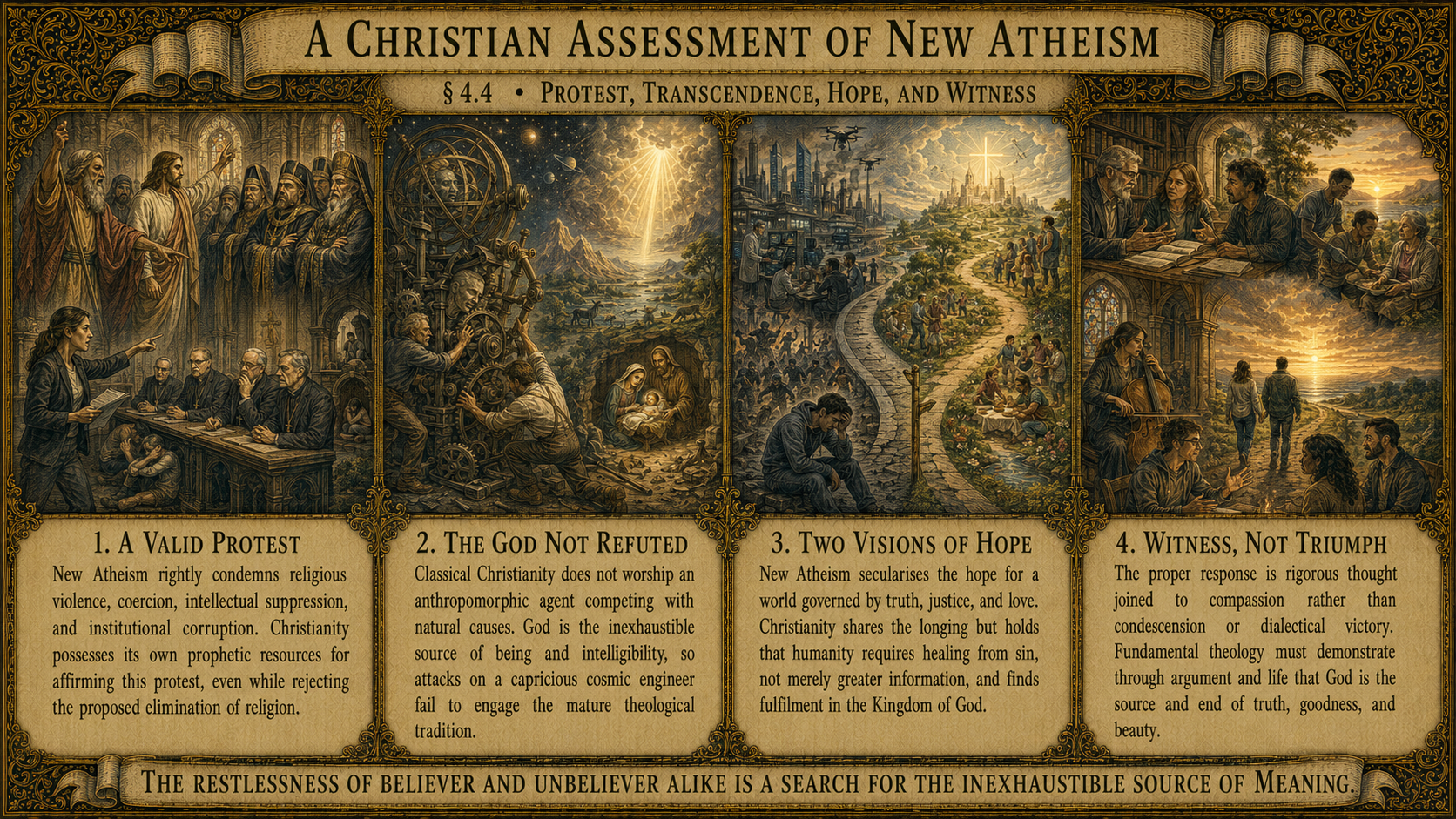
The first and most fundamental observation that Christian theology must make about New Atheism is that it represents, like the forms of atheism examined in the previous lecture, not a coherent philosophical alternative to theism but a reaction — a reaction against specific forms of religious practice, religious violence, and religious intellectual culture that are genuinely problematic and genuinely in need of criticism. Insofar as New Atheism protests against the use of religion to sanction oppression, to suppress rational inquiry, to legitimate violence, and to sustain structures of social and psychological control, it is making valid moral observations that the Christian tradition has its own resources for affirming. The prophetic tradition of the Old Testament is itself a tradition of protest against the corruption of religion; Jesus’s sharpest words were reserved not for the pagan world but for the religious authorities of his own tradition; and the great tradition of Christian reformation and renewal has always involved a confrontation with the ways in which institutional religion falls short of the Gospel it is meant to embody. New Atheism, in its protest dimension, is engaging with a real problem, even if its proposed solutions — the elimination of religion as such — are neither coherent nor adequate.
The second theological observation is that the New Atheists have, throughout their work, been attacking a conception of God and a form of religious belief that the Christian theological tradition has itself consistently criticised. The God of classical theism — the God of Aquinas, of Gregory of Nyssa, of Meister Eckhart, of John of the Cross — is not the anthropomorphic deity who issues arbitrary commands, intervenes capriciously in natural events, and demands the intellectual surrender of his worshippers. He is Being itself, the inexhaustible source of all existence and intelligibility, whose reality transcends every concept and every image, and who communicates himself through the natural structures of creation, through the moral law written in the human heart, and above all through the personal self-giving of the Incarnation. The New Atheists have not refuted this God; they have not attempted to refute him, because they have not engaged with the tradition of theology that speaks of him. In a very real sense, the God whose existence they deny is not the God in whom Christians believe.
The third theological observation is eschatological. The New Atheist vision of the good — a world governed by reason, science, and secular ethics, freed from the superstitions and violences of religious tradition — is itself a secularised version of a genuinely religious hope: the hope for a world transformed by truth, justice, and love. Christian theology does not disagree with this hope; it disagrees with the New Atheist account of its conditions and source. The Christian tradition maintains that the world cannot be transformed into the New Atheist’s rational utopia by human rational and moral effort alone, because the problem of human existence is not primarily an intellectual problem — a problem of insufficient information or insufficient logic — but a spiritual and existential one: the problem of sin, of the structural human tendency to use freedom in ways that damage both the self and others. The Christian hope is not for a world that has transcended the need for God but for a world that has been healed and fulfilled by the love of God — which is, in the language of Christian eschatology, the Kingdom that is both coming and already present in the life of the Church, the Risen Body of Christ.
We may conclude with a reflection on the significance of the New Atheist phenomenon for the practice of fundamental theology. Fundamental theology, as a discipline, is charged with the task of demonstrating the rational credibility of the Christian faith to those outside it, and of helping believers understand the rational grounds of their own convictions. The New Atheist challenge has been, in this respect, a genuinely useful provocation. It has forced theologians to sharpen their arguments, to engage more honestly with the best secular objections to theism, and to distinguish more carefully between the authentic content of Christian faith and the accidental cultural accretions that have accumulated around it. It has also, paradoxically, demonstrated by negative example the truth of the Christian anthropological thesis that the human being is constituted by an orientation toward the transcendent that cannot be suppressed without finding expression in quasi- religious substitutes. The passionate moral concern of the New Atheists, their hunger for a world of justice and rational clarity, their communal solidarity and their sense of mission — all of these are the redirected energies of creatures made for God, who have not yet found the proper object of the orientation that drives them.
The appropriate response to this situation is not condescension but compassion: the recognition that the restlessness of the New Atheist, no less than the restlessness of the believer, is a form of that universal human restlessness that Augustine described with unmatched precision: our heart is restless until it rests in Thee. The task of fundamental theology, in response to the New Atheist challenge, is not primarily to win arguments but to bear witness — to demonstrate, by the quality of thought and the quality of life, that the God of Christian faith is not a consoling fiction for those who cannot face reality, but the inexhaustible source and end of all that is true, all that is good, and all that is beautiful. It is this demonstration, more than any dialectical triumph, that constitutes the most adequate response to the phenomenon we have been examining in this lecture.
Related Concepts
- agent-detection-hypothesis
- being-itself-tillich
- christian-atheism
- christian-philosophical-anthropology
- classical-theism
- cosmological-argument-kalam-leibnizian
- debunking-explanation
- del-ratzsch-on-the-limits-of-natural-science
- divine-action
- doing-metaphysics-in-a-lab-coat
- evolutionary-argument-against-naturalism
- five-ways-of-aquinas
- gods-goodness
- history-of-science
- hugo-grotius
- is-ought-problem
- kingdom-of-god
- losevs-negative-theology
- mcgraths-meta-empirical-worldviews
- meme-theory
- metaphysics
- necessary-vs-contingent-being
- negative-theology-losev
- new-atheism-as-christian-atheism
- new-atheist-utopia
- new-atheist-utopia-as-secularised-hope
- nones
- objective-moral-facts
- objective-moral-norms
- ontologicalmetaphysical-naturalism
- pivovarovs-no-abstract-atheism
- plantinga
- quasi-religion
- rationality-of-faith
- restless-heart-augustine
- romans-215
- scientism
- secularised-eschatology
- self-referential-incoherence
- the-moral-landscape
- theistic-ethics
- toleration
- tureks-if-evil-is-real-then-atheism-is-false
- ultimate-boeing-747-gambit
- ultimate-concern
- verificationism
- vorgriff-auf-esse-rahner
- warfare-model
- worldview