Fundamental Theology — Topic 8. Atheism
There is perhaps no more consequential question for a human being entering this world than the question of God’s existence. The answer one gives to this question directly shapes one’s worldview, and with it, one’s moral judgments, personal conduct, and practical life. It is therefore a matter of no small importance that we approach the study of atheism with the precision and rigour that the subject demands. For although atheism presents itself as a simple negation — the denial of God — it is in fact a multifaceted, historically variable, and philosophically complex phenomenon that resists easy definition and tidy classification.
- Introduction
- Section 1. Etymology and the Contested Nature of the Term. Atheism as a Phenomenon: Historical Background
- Section 2. Taxonomy of Atheisms — A Systematic Classification
- Section 3. Philosophical Critique of the Atheist Worldview
- Section 4. Theological Reflections — Atheism and Christian Faith
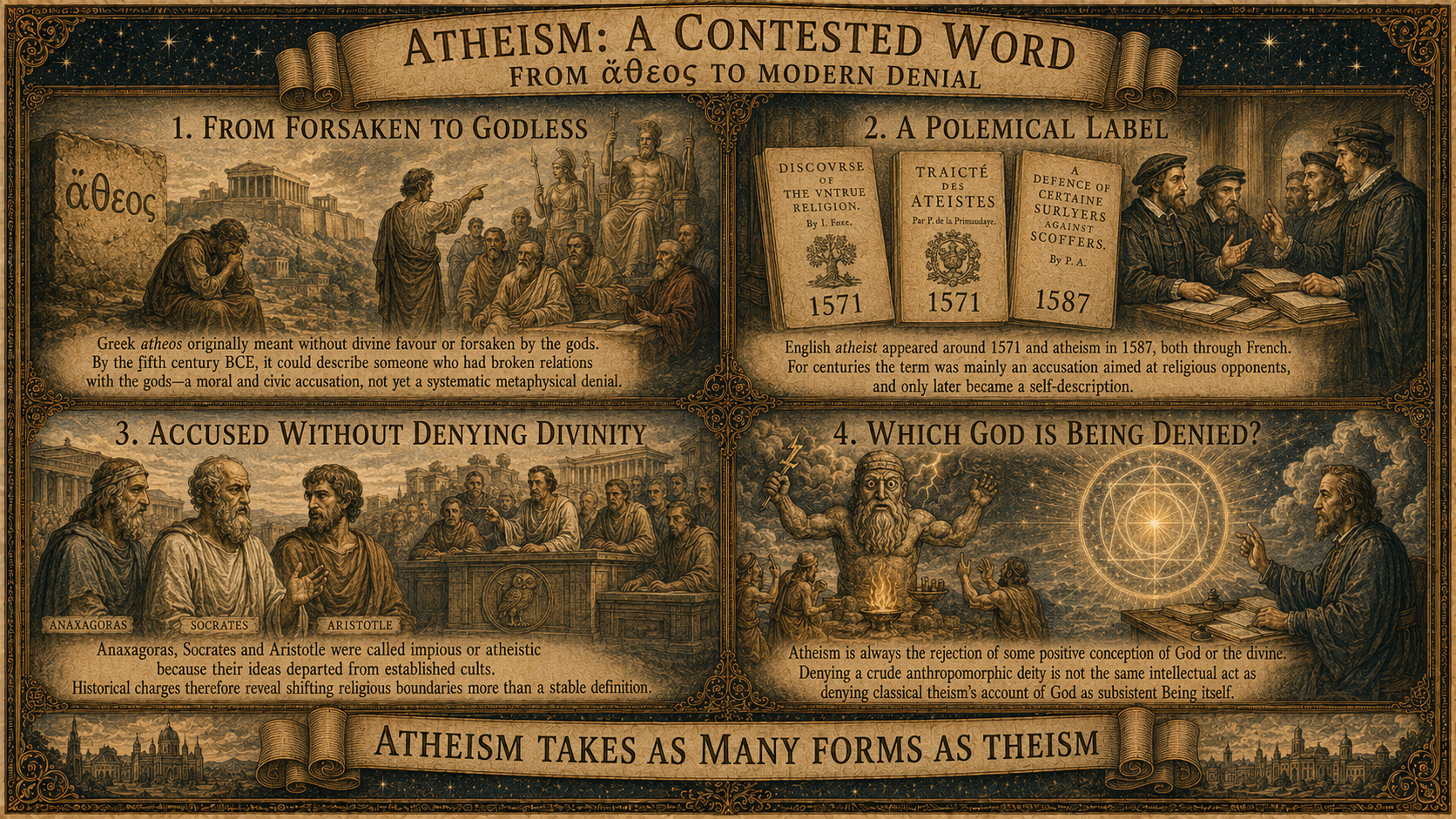
The word ‘atheism’ derives from the Greek ἄθεος (atheos), a compound of the privative prefix ἀ- (‘without’) and θεός (theos, ‘god’). In its earliest usage, this adjective carried the sense of being ‘without divine favour’ or ‘forsaken by the gods,’ and it is found in this meaning in Pindar’s Pythian Odes (4.162), Aeschylus’ Eumenides (151), and Sophocles’ Electra (124). By the fifth century BCE, the term had acquired the more active sense of one who ‘breaks off relations with the gods’ — a charge of moral and religious transgression rather than of abstract metaphysical denial. It is Cicero who provides the Latin transliteration ‘atheos,’ and it is in Latin-influenced European discourse that the word enters its modern trajectory.
The modern English term ‘atheist’ appears in approximately 1571, and ‘atheism’ in 1587 — both borrowed from French. In the sixteenth and seventeenth centuries, the charge of atheism was predominantly polemical: it was flung at opponents in religious controversies and rarely functioned as a self- designation. Only in the eighteenth century did certain freethinkers begin to adopt the label with some degree of intellectual pride. Yet even then — and indeed up to the present day — the term has remained, as Walter Kasper rightly observes, conceptually unstable. One cannot, Kasper argues, derive the content of ‘atheism’ solely from its etymological components. Atheism, properly understood, must be grasped as the antithesis of any positive affirmation of God or the Divine — which in turn implies that atheism takes as many forms as there are forms of theism.
The instability of the concept was already apparent in antiquity. Anaxagoras, Socrates, and even Aristotle were at various times accused of impiety or atheism — not because they denied all divine reality, but because their conceptions of divinity deviated from the established cultic norms. As the Russian philosopher V.D. Kudryavtsev-Platonov observed, the boundaries of atheism have historically expanded and contracted to a remarkable degree: ‘If one were to take into account all the charges of atheism levelled at various philosophers throughout history, one would be forced to include in the ranks of atheists the greater part of them.’ The reason for this conceptual inflation, he suggests, is that judgments of atheism have frequently been made relative to a particular concept of God, so that any deviation from that concept — however subtle — is treated as a denial of divinity itself.
This observation carries important methodological implications for our present inquiry. Before we can evaluate atheism, we must be clear about what kind of theism is being denied. Atheism directed against a crudely anthropomorphic deity is a fundamentally different intellectual move from atheism directed against the classical theistic conception of God — Being Itself subsistent. Much popular atheism, as we shall see, confuses these levels of discourse and attacks a straw-man rather than the sophisticated theological tradition it claims to refute.
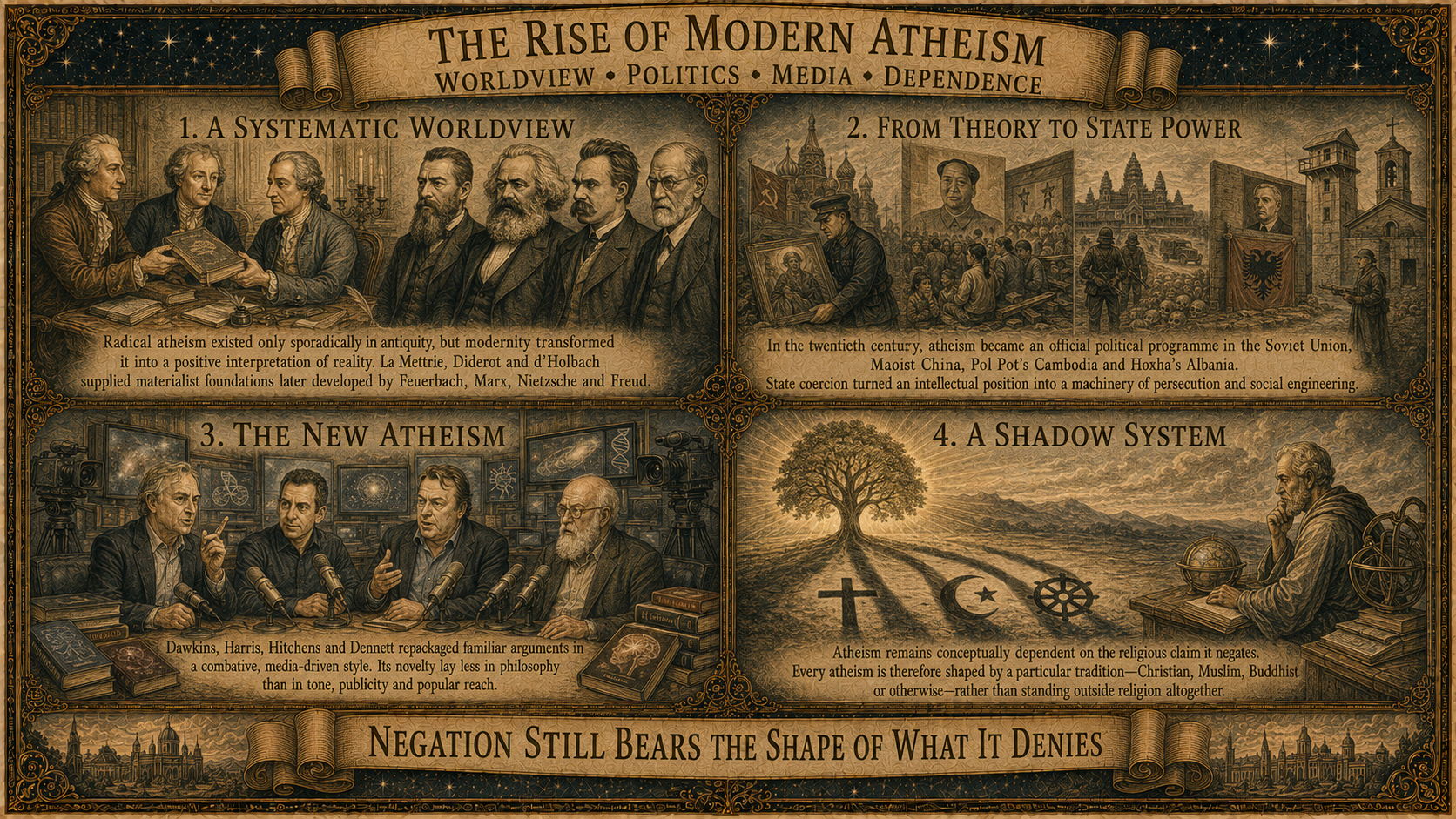
Despite its ancient roots, atheism as a self-conscious worldview — as a systematic and positive interpretation of reality — is largely a product of modernity. Historians of religion such as A.K. Wucherer-Huldenfeld and J. Figl have argued persuasively that radical atheism — the kind that categorically and systematically rejects any form of the divine — was not, in the pre- Christian and extra-Christian ancient world, a mass phenomenon. When it appeared, it did so in isolated cases and without the self-conscious ideological coherence that characterises modern atheism.
The term ‘atheism’ becomes truly current at the turn of the seventeenth and eighteenth centuries, but it is only in the nineteenth century that theoretical atheism takes shape as a systematic worldview claiming to speak in the name of reason and science. The philosophes of the French Enlightenment — Lamettrie, Diderot, Holbach — laid the materialist foundations upon which this edifice would be built. Their successors in the nineteenth century — Feuerbach, Marx, Nietzsche, and later Freud — each contributed distinctive elaborations of the atheist worldview. By the twentieth century, state atheism became a horrifying political reality in the Soviet Union, Maoist China, Pol Pot’s Cambodia, and Hoxha’s Albania.
The early twenty-first century brought what commentators have termed the ‘New Atheism’ — a movement associated above all with Richard Dawkins, Sam Harris, Christopher Hitchens, and Daniel Dennett, sometimes styled the ‘Four Horsemen.’ The label ‘new’ is, as even sympathetic observers have acknowledged, somewhat misleading: the philosophical arguments advanced by these authors are in substance not new. What is novel is the tone — combative, contemptuous of religious sensibility, and deliberately populist — and the media apparatus through which these ideas are disseminated. As Christoph Böttigheimer correctly observes, ‘New Atheism’ is primarily a publicistic phenomenon rather than a rigorous philosophical one.
A crucial preliminary observation is that atheism is, by its very nature, a derivative and dependent concept. As Friedrich Engels remarked — in a surprisingly lucid moment — ‘atheism, as bare negation of religion, constantly referring back to religion, is itself still a religion.’ The philosopher A.F. Losev pressed this point further, arguing that atheism is a species of dogmatic theology — a negative theology, to be sure, but theology nonetheless — and is therefore properly an object of study within the history of religion rather than a position standing outside it altogether.
This parasitic relationship between atheism and theism has important consequences. Every form of atheism is the ‘shadow system’ of some particular religion. There is no abstract atheism-in-general; there is only Christian atheism, Muslim atheism, Buddhist atheism, and so on — each shaped by its conceptual engagement with the specific religious tradition it opposes. The implicit acknowledgment of this dependency is visible even in the New Atheists, whose arguments are overwhelmingly directed against specifically Christian theism, and who betray a far greater familiarity with Christian thought — however superficial — than with, say, Advaita Vedanta or Sufi metaphysics.
Having established the conceptual difficulty of defining atheism, we turn now to the question of classification. The diversity of atheistic positions is so great that any taxonomy is necessarily a simplification; nevertheless, classification is essential for clear thought. I shall present three influential taxonomies drawn from contemporary German fundamental theology — those of Hans Waldenfels, August Wucherer-Huldenfeld, and Christoph Böttigheimer — since these have proven most fruitful for systematic theological reflection.
§ 2.1 The Waldenfels Classification
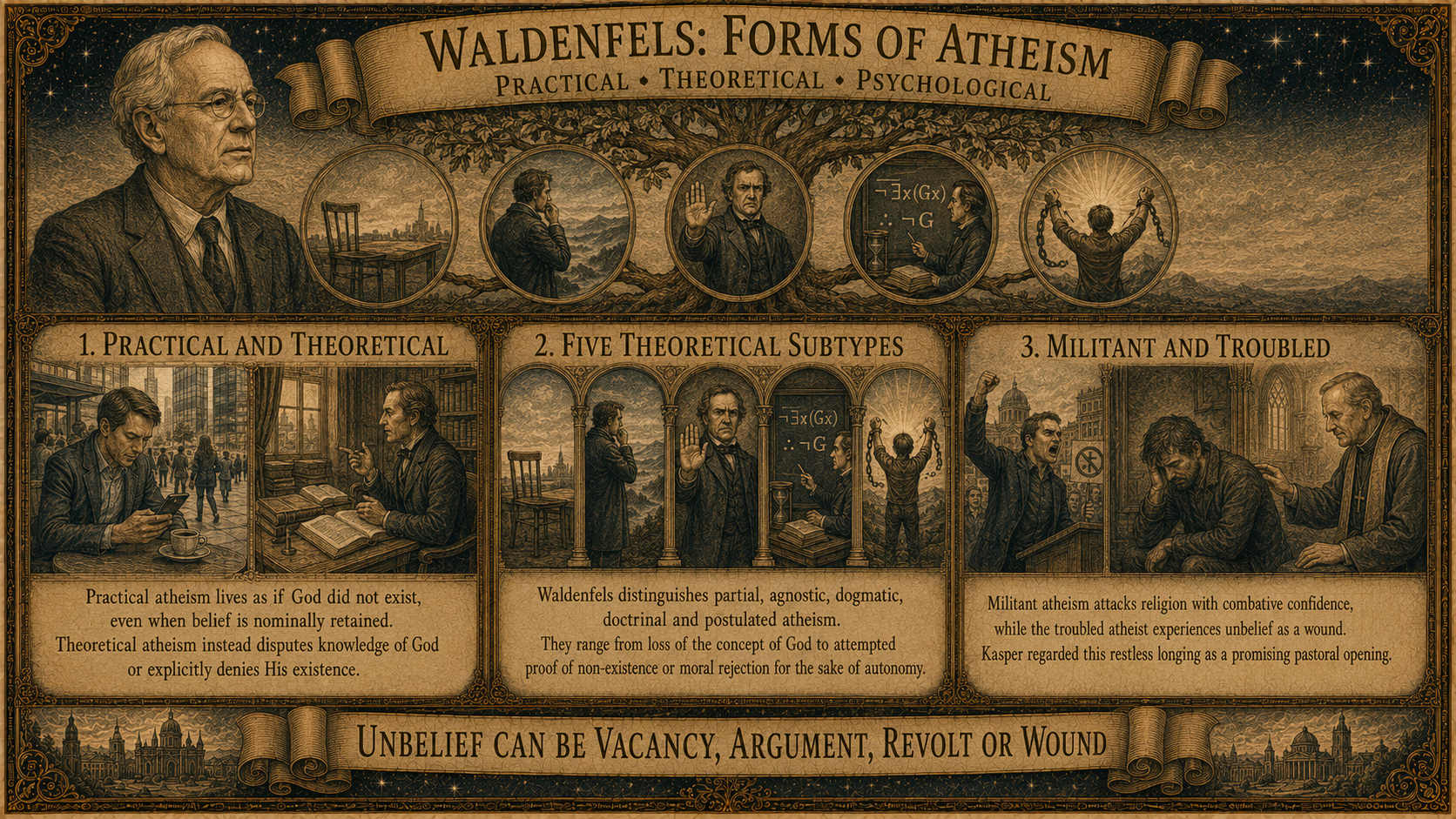
Hans Waldenfels, the distinguished German Jesuit and theologian of religions, proposes as his fundamental distinction that between practical atheism and theoretical atheism. This distinction, though not original to him, is philosophically important and deserves careful unpacking.
Practical atheism refers to the condition of those who, whatever their theoretical beliefs about God, live as if God did not exist. Such persons may nominally accept the existence of a deity but find no place for this acceptance in the actual conduct of their lives, their moral reasoning, or their emotional dispositions. This is, as Waldenfels notes, a widespread phenomenon in contemporary secular societies, and it poses a pastoral challenge that is in some respects more acute than that posed by theoretical atheism — for it represents not intellectual conviction but spiritual vacancy.
Theoretical atheism, by contrast, is the position of those who either deny the possibility of any certain knowledge of God or explicitly deny His existence. Within theoretical atheism, Waldenfels distinguishes five sub-types:
First, partial or negative atheism, in which the very concept of ‘God’ has been lost or become absent from thought — not through deliberate denial but through cultural erosion or semantic displacement. This corresponds to what Böttigheimer elsewhere calls ‘negative atheism.’
Second, agnostic or sceptical atheism, in which the possibility of knowledge of God is disputed. The agnostic does not deny God’s existence outright but maintains that it cannot be known. This is the position, in different forms, of Hume, Kant (on certain readings), and the modern agnostic tradition.
Third, dogmatic atheism or anti-theism, in which the existence of God is straightforwardly denied. This is atheism in the strictest and most common sense.
Fourth, doctrinal atheism, which goes beyond mere denial to attempt a rational demonstration of non-existence. This is the position of the more philosophically ambitious atheists, such as J.L. Mackie and Michael Tooley.
Fifth, postulated or humanist atheism, in which God’s non-existence is postulated not on strictly logical grounds but as a moral and anthropological demand — for the sake of human autonomy and dignity. This is the position of Feuerbach, and in a different register, Sartre: God must not exist because if He did, human freedom would be negated.
From a psychological standpoint, Waldenfels further distinguishes between militant atheism — which prosecutes its convictions with combative enthusiasm — and what Karl Rahner memorably called the bekümmerte Atheisten, the ‘troubled’ or ‘afflicted’ atheists, who suffer from their inability to believe, who experience the absence of God as a wound rather than a liberation. Walter Kasper calls this latter type ‘a happy pastoral occasion’: these are not lost souls but restless ones, and their restlessness is itself, as Augustine would have recognised, a sign of the soul’s orientation toward God.
§ 2.2 Wucherer-Huldenfeld’s Historical-Religious Typology
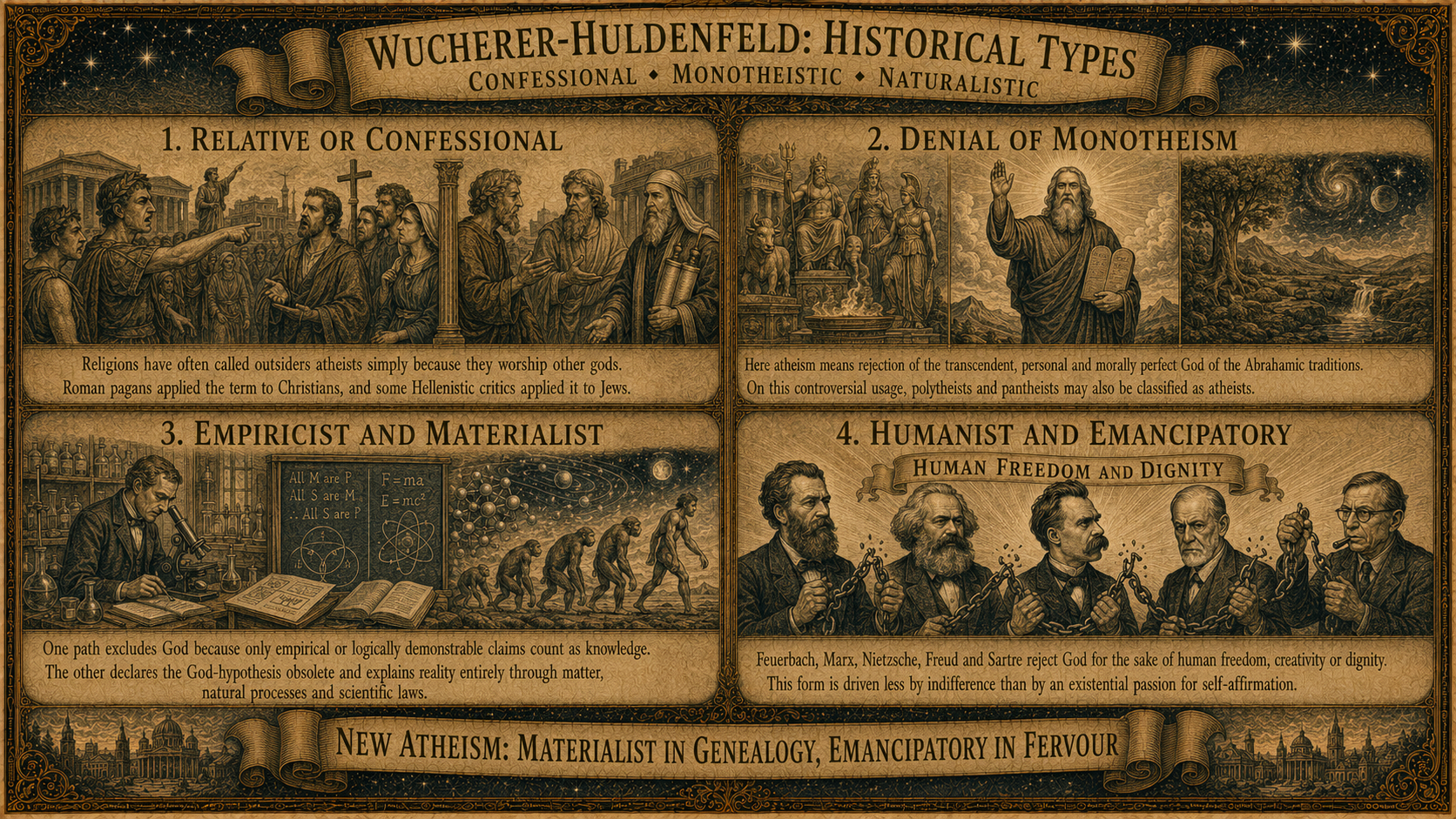
August Wucherer-Huldenfeld approaches the classification of atheism from the perspective of the history of religions, identifying three broad layers of meaning in which the charge of ‘atheism’ has historically been deployed.
In the first sense, religions throughout history have called atheists those who worship other gods — i.e., those who refuse the particular deity or deities of the community in question. In this sense, early Christians were called atheists by Roman pagans (as Tertullian and Justin Martyr’s apologetic texts abundantly document), and Jews were called atheists by certain Hellenistic critics. This is atheism in a relative, confessional sense.
In the second sense, ‘atheist’ is applied to those who deny monotheism — that is, who reject the God of the Abrahamic traditions characterised as transcendent, personal, omniscient, omnipotent, and morally perfect. On this definition, polytheists and pantheists may count as atheists, though this usage is controversial.
In the third and strictest sense, atheists are those who radically deny or are radically sceptical of any divine reality whatsoever, who claim to be able to account for belief in the divine entirely within a naturalistic framework. This third category — the one most relevant to the modern context — Wucherer- Huldenfeld further subdivides into three types based on their epistemological and motivational structures.
The rational-empiricist type, emerging from English empiricism (Locke, Berkeley, Hume) and eventuating in sceptical agnosticism (Mill, Spencer) and positivism (Comte), insists on confining legitimate knowledge claims to empirically verifiable data or logically demonstrable relations, thereby excluding any trans-empirical referent such as God. The result is atheism by epistemological default: not a positive denial of God but a refusal to admit God into the domain of legitimate discourse.
The materialist-ideological type, associated with the French Enlightenment materialists (Lamettrie, Diderot, Holbach) and their nineteenth-century successors (Büchner, Moleschott), declares the ‘hypothesis of God’ obsolete and undertakes to explain reality entirely through natural processes and scientific laws. This type received powerful ideological reinforcement from the social application of Darwinism, which appeared to provide a naturalistic account of biological complexity and thereby to undermine one of the most intuitive arguments for design.
The humanist-emancipatory type, inaugurated by Feuerbach’s anthropological critique of religion and developed by Marx, Nietzsche, Freud, and Sartre, denies God not primarily on empirical or logical grounds but for reasons of human self-affirmation. In this tradition, the existence of God is felt to be incompatible with authentic human freedom, creativity, or dignity. This is the postulatory atheism that Waldenfels also identifies, and it represents perhaps the most existentially serious form of atheism — because it is motivated not by indifference but by a kind of tragic passion.
Wucherer-Huldenfeld’s analysis is highly illuminating, and it enables us to locate the ‘New Atheism’ with some precision: it corresponds most closely to the materialist-ideological type, with significant elements of the humanist- emancipatory type — particularly in the quasi-religious fervour with which its proponents promote their vision of a world liberated from religion.
§ 2.3 Böttigheimer’s Refined Schema and the ‘New
Atheism’
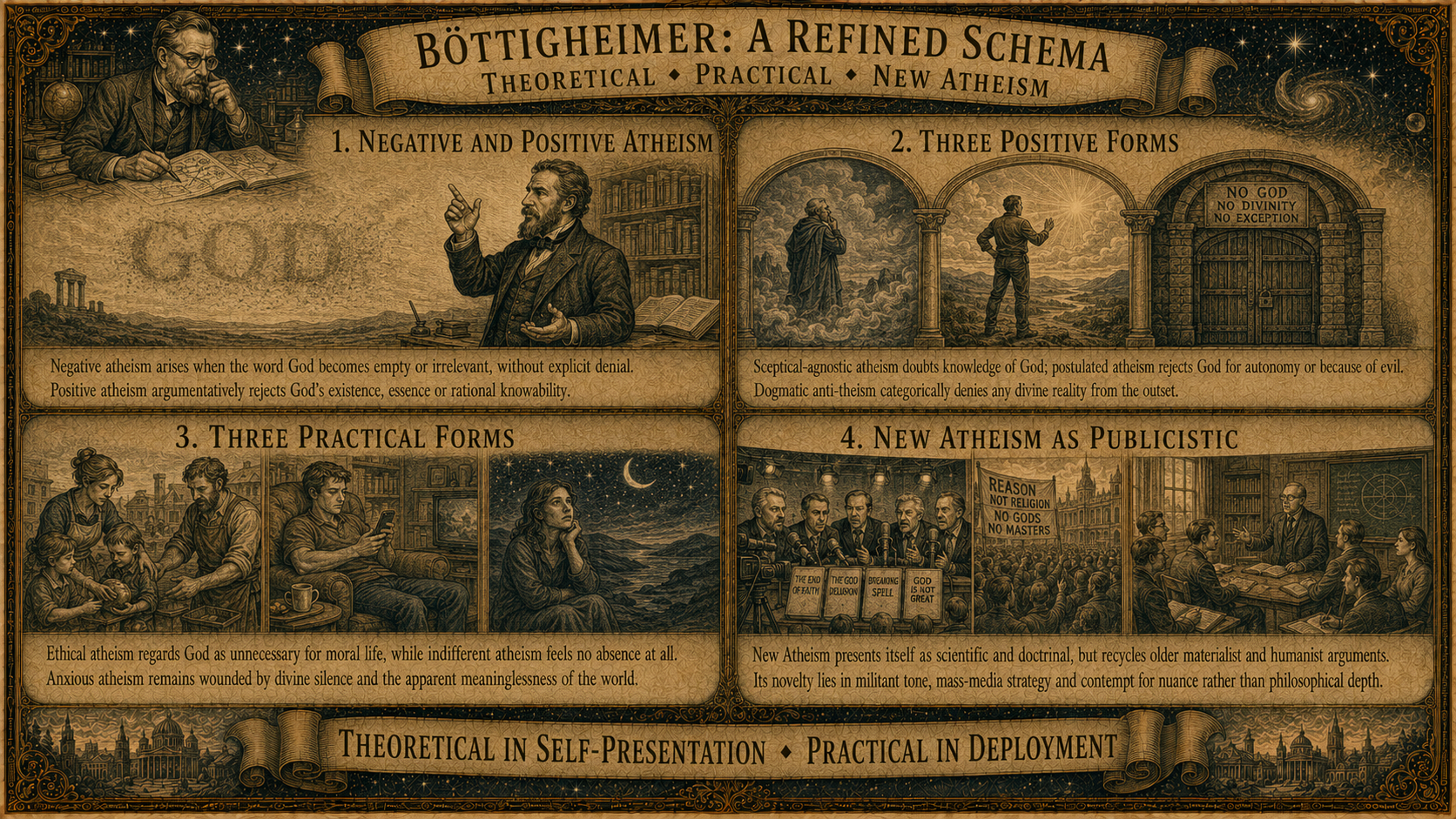
Christoph Böttigheimer’s taxonomy, which builds on and refines the preceding classifications, is perhaps the most systematic available in contemporary fundamental theology. He retains the basic distinction between theoretical and practical atheism but introduces important nuances within each.
Within theoretical (or argumentative) atheism, Böttigheimer distinguishes between negative atheism — in which the very term ‘God’ has become semantically empty or irrelevant — and positive atheism, in which the existence, essence, or rational knowability of God is explicitly and argumentatively denied. Positive atheism subdivides further into: (a) sceptical-agnostic atheism, which questions the possibility of true knowledge of God while refraining from categorical denial; (b) postulated atheism, which asserts God’s non-existence in the name of human autonomy and often invokes the problem of evil; and (c) dogmatic or anti-theistic atheism, which a priori and categorically denies any divine reality.
Within practical atheism, Böttigheimer identifies three forms: ethical atheism, in which God is simply not needed because the individual perceives himself as morally self-sufficient; indifferent atheism, which represents not conviction but vacancy — a complete absence of interest in the question of God’s existence, a condition in which, as Böttigheimer puts it, ‘the person lives without God and does not even feel that something is missing’; and what he calls ‘anxious atheism,’ in which the individual is overwhelmed by the apparent silence of God and the apparent meaninglessness of the world — a condition that, paradoxically, still bears the marks of religious seriousness.
Böttigheimer’s most significant contribution to the taxonomy is his treatment of the ‘New Atheism’ as a distinct category. He classifies it as a form of practical atheism precisely because what is new about it is not the intellectual content of its arguments — which are largely recycled from older materialist and humanist traditions — but the mode of their deployment: combative, populist, contemptuous of nuance, and aimed at mass audiences rather than at the academic community. The New Atheism is, in Böttigheimer’s apt phrase, primarily a publicistic rather than a philosophical phenomenon. Its arguments do not withstand serious philosophical scrutiny, and its polemical success depends on the cultivation of a cultural atmosphere of anti-religious contempt rather than on the force of its reasoning.
Having now surveyed these three complementary taxonomies, we are in a position to characterise the ‘New Atheism’ with some precision. It is simultaneously: theoretical in its self- presentation (it claims to be scientifically and philosophically grounded); doctrinal in its ambition (it seeks to demonstrate God’s non-existence); materialist-ideological in its genealogy; and militant in its psychological register. Its philosophical weaknesses, however, are severe — and to these we now turn.
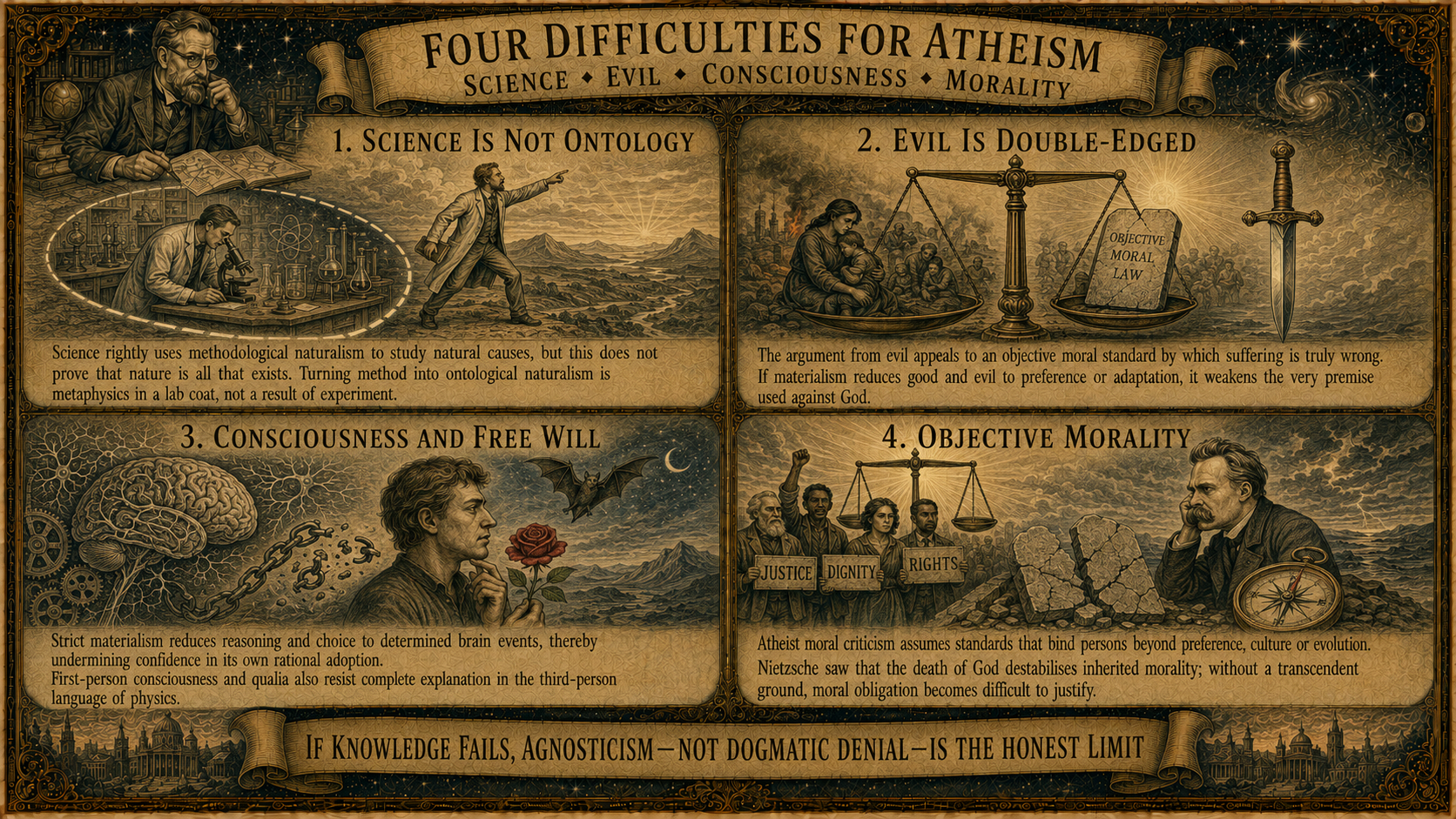
The critical evaluation of atheism is not merely a polemical exercise. It is a necessary component of fundamental theology’s constructive task: the rational justification of religious belief. If we are to demonstrate the reasonableness of faith in God, we must show, among other things, that the primary arguments against theism are insufficient. In this part of the lecture, I shall focus on four areas in which the atheist worldview — particularly in its materialist form — runs into what I consider insuperable philosophical difficulties.
§ 3.1 The Myth of ‘Scientific Atheism’
The first and perhaps most widespread claim made on behalf of modern atheism is that it alone is ‘scientific’ — that it follows the evidence wherever it leads, while theism represents a retreat into pre-modern superstition. This claim, repeated with great confidence by the New Atheists, is philosophically untenable, and it is important that we be clear about why.
Science, as a methodology, is committed to what philosophers of science call methodological naturalism: it investigates natural causes and processes using empirical observation and experimentation. This methodological commitment is entirely appropriate within the domain of natural science, and theists have no quarrel with it as a heuristic principle. The error arises when methodological naturalism is inflated into ontological naturalism — the metaphysical claim that natural causes and processes are all that exist. This is no longer a scientific claim but a philosophical one, and it goes well beyond what the evidence of natural science can establish.
As the philosopher Del Ratzsch has argued, natural science ‘can deal only with the purely natural and must strictly limit itself to this domain, regardless of whether reality includes something more than the purely natural.’ When scientists or popularisers of science make the claim that ‘the hypothesis of God is obsolete’ on scientific grounds, they have stepped outside the proper boundaries of their discipline. They are doing metaphysics in a lab coat.
The most authoritative statement of this point comes from the contemporary philosopher of science and Christian apologist C. Stephen Evans, who (jointly with Zachary Manis) argues that ‘religion and science, in general, are not in conflict — or at least need not be in conflict.’ The historical evidence strongly supports this conclusion: from Copernicus, Galileo, Kepler, and Newton, through Faraday, Maxwell, Mendel, and Lemaitre, to contemporary scientists of distinction such as Francis Collins, John Polkinghorne, and Alister McGrath, the history of science is populated by committed theists whose faith was not a hindrance but often a motivation for their scientific enquiry.
The claim that atheism is simply ‘what science teaches’ is, to put it plainly, dishonest. Science teaches atheism only if one has already smuggled in, as a prior philosophical assumption, the claim that only material entities exist — which is precisely what is at issue. Atheism, in its positive ontological claims, is a form of faith: specifically, faith in the ultimacy and self- sufficiency of matter. The Russian thinker S.S. Glagolev put this well when he observed that the materialist claim — that matter is eternal and self-moving — is not a discovery of positive science but a metaphysical assumption.
§ 3.2 The Problem of Evil: A Double-Edged Argument
The second great resource of atheistic argument is the problem of evil. It is presented as an argument of overwhelming force: if God is omnipotent, omniscient, and perfectly good, then He would prevent all evil; but evil manifestly exists; therefore, no such God exists. This argument has a long and distinguished philosophical history, and we must treat it with the respect it deserves.
However, there is a profound irony embedded in the atheist’s deployment of this argument that is not always noticed. If there is no God, there is no objective standard of good and evil. The categories of moral good and evil presuppose a moral order that is intelligible, binding, and not reducible to mere human preference or social convention. But on the materialist account of reality, there is no such order. Richard Dawkins, one of the leading exponents of contemporary atheism, writes revealingly: ‘the universe we observe has precisely the properties we should expect if there is, at bottom, no design, no purpose, no evil and no good, nothing but blind pitiless indifference.’ If Dawkins is right about this, then the ‘evil’ to which the problem of evil refers simply does not exist as an objective category. And an argument that begins from a category that does not exist is no argument at all.
If evil is real, then atheism is false. For the reality of evil implies the reality of a moral standard against which states of affairs can be measured and found wanting. And a moral standard that is truly objective — one that binds all persons regardless of their preferences or cultural conditioning — can only be grounded in an absolute moral legislator, that is, in God. The atheist who invokes the problem of evil has, in the very act of doing so, presupposed the existence of the very God whose existence he is trying to disprove.
The problem of evil, then, is a double-edged sword. This does not mean that the problem is without force from a theistic perspective — it remains a profound question about the nature of divine providence and the rationale for human suffering. But it is a question posed from within the theistic worldview, not an argument that can be used coherently from outside it.
The theistic tradition, of course, has resources for responding to the problem of evil that go beyond the mere tu quoque. Alvin Plantinga’s famous ‘free will defence’ — and more broadly his account of evil in terms of what he calls felix culpa, the ‘happy fault’ — represents the most sophisticated contemporary attempt to show that the existence of evil is not logically incompatible with the existence of an omnipotent, omniscient, and perfectly good God.
§ 3.3 Consciousness, Free Will, and the Crisis of Materialism
A third and perhaps the most philosophically devastating problem for atheistic materialism concerns the nature of consciousness and free will. This is an area where the internal tensions of the atheist worldview become most acute.
Materialism, as the ontological foundation of most contemporary atheism, holds that reality is exhausted by physical matter and its processes. Consciousness, thought, desire, and will are, on this view, wholly explicable in terms of neurological processes — electro-chemical events in the brain. This is not a fringe position among atheist thinkers; it is the mainstream.
The neuroscientist and atheist Francis Crick wrote: ‘You, your joys and your sorrows, your memories and ambitions, your sense of personal identity and free will, are in fact no more than the behaviour of a vast assembly of nerve cells and their associated molecules.’ Stephen Hawking was equally unambiguous: ‘It is hard to imagine how free will can operate if our behaviour is determined by the laws of nature.’ Richard Dawkins has argued that ‘as scientists we believe that human brains, though they may seem to generate freedom of choice, are part of the physical world, and the activity of neurons is determined by the laws of physics.’ Sam Harris has devoted an entire book — Free Will — to the thesis that free will is an illusion.
This is a coherent position, given materialist premises. But it has implications that should disturb anyone who thinks seriously about what it means to be a rational agent. If free will is an illusion, then the act by which one ‘adopts’ materialism as one’s worldview is not a free rational choice but a neurochemical event determined by prior physical causes. The materialist’s conviction that materialism is true is, on materialist premises, not a conclusion arrived at by reasoning but a product of brain chemistry. But in that case, the conviction that materialism is true has no more rational authority than the conviction that it is false — both are equally the products of undirected physical processes. Materialism, rigorously applied, undermines its own rational credentials.
Moreover, our consciousness and our free will are not merely theoretical constructs: they are the most immediately and indubitably evident features of our experience. Even if the entire external world were an illusion, the existence of the experiencing subject cannot be doubted. I am present to myself in every act of awareness. This self-presence of consciousness is precisely the starting point of all genuine philosophical reflection, and any worldview that fails to account for it, or that reduces it to a mere epiphenomenon of matter, has failed at the most fundamental level.
The problem of qualia — the subjective, qualitative ‘what-it-is-like’ character of experience — presses this point further. A complete physical description of the brain processes involved in seeing red does not tell me what red looks like. The subjective feel of redness — what philosophers since Nagel call the ‘what it’s like’ — is entirely absent from any third-person physical description. Consciousness, in other words, contains a first-person dimension that cannot be captured in the third-person language of physics and chemistry. The existence of qualia is a standing embarrassment to materialism.
Even the philosopher Thomas Nagel — himself an atheist — has acknowledged this difficulty. In his celebrated paper ‘What Is It Like to Be a Bat?’ and in his more recent book Mind and Cosmos, Nagel argues that ‘materialism is not adequate even to account for the physical world, because the physical world includes beings with consciousness, and this is the most remarkable thing about it.’ He concludes that ‘the neo-Darwinian materialist conception of nature is almost certainly false.’ This is a striking admission from one of the most distinguished philosophers of mind of our time.
§ 3.4 The Impossibility of Objective Morality Without God
The fourth area of philosophical difficulty for atheism concerns the status of moral claims. This is not unrelated to the argument from the problem of evil already considered, but it deserves separate treatment.
The Atheists are, by and large, passionate moralists. They are deeply outraged by what they see as the moral failures of religion. They appeal, repeatedly and with evident conviction, to moral standards that they regard as objective, binding, and universally applicable. They want, in short, to condemn religious actors for doing wrong.
But on materialist premises, as we have seen, there are no objective moral standards. If, as Dawkins asserts, the universe is characterised by ‘blind pitiless indifference’ at the fundamental level, then moral categories are not features of reality but projections of human preferences or evolutionary adaptations. If ‘behaviour is dancing to our DNA,’ as Dawkins has also claimed, then moral indignation is simply one neurological event objecting to another.
Nietzsche understood this consequence perfectly. If God is dead, then the entire moral framework that Western civilisation has inherited from its Judeo- Christian roots collapses with Him. ‘The herd’s voice will long echo in you,’ he wrote. The God who grounds the moral order has been killed, and human beings are now radically free — but also radically without guidance. Nietzsche did not find this comforting; he found it terrifying. The Atheists, by contrast, seem to think they can kill God on Sunday and continue observing His commandments on Monday — which is not intellectual coherence but mere cultural inertia.
The Russian religious philosopher Viktor Nesmelov made a related point about the psychological character of atheism. Atheism, he argued, is ‘not essentially a doctrine but a psychological disposition,’ arising not from genuine philosophical insight but from a ‘fear of the weak mind’ that, unable to achieve certainty in its search for knowledge, flees the anguish of honest inquiry by converting its ignorance of God into a confident assertion of His non-existence. The atheist who claims to know that God does not exist has actually done something intellectually dishonest: he has substituted a claim to positive knowledge for what is, at best, an admission of ignorance. The intellectually honest position, if one cannot know God, is agnosticism — not atheism.
§ 4.1 Atheism as a Perversion of Religious Impulse
Having surveyed the principal philosophical weaknesses of atheism, I wish now to offer some more properly theological reflections on the phenomenon. These reflections do not supersede the philosophical critique but deepen it by situating it within a specifically Christian framework.
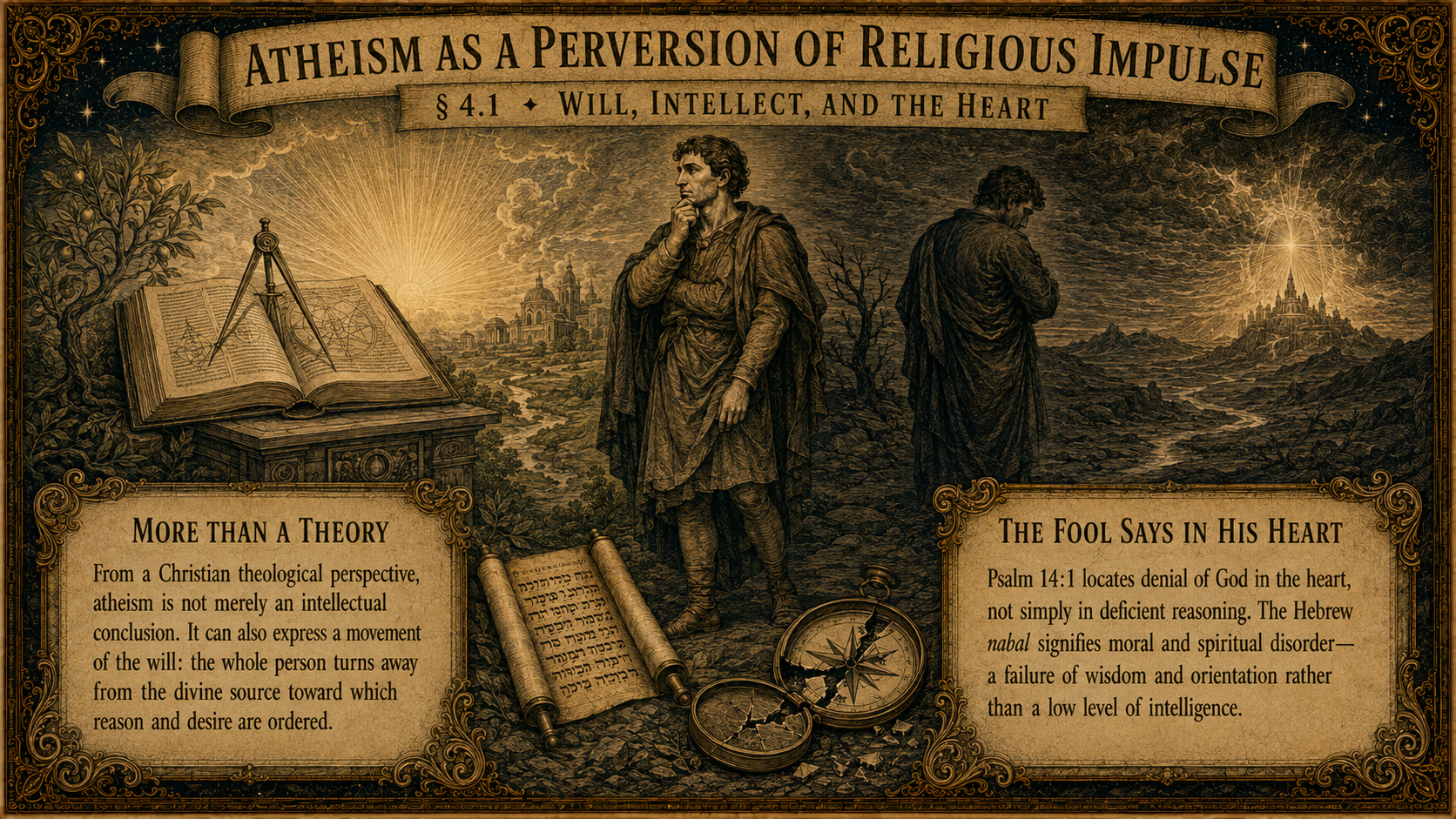
From a theological standpoint, the most illuminating observation about atheism is that it cannot be understood purely as a theoretical position. It is, at its root, a volitional phenomenon — a movement of the will, not merely of the intellect. This is not simply a polemical point; it is a claim with deep roots in Christian philosophical anthropology.
The Scriptures speak of the fool who ‘says in his heart: There is no God’ (Psalm 14:1). The word rendered ‘fool’ here (nabal in Hebrew) does not denote merely a lack of intellectual capacity but a moral and spiritual deficiency — a failure of the person as a whole, not merely of the reasoning faculty. The atheism of the Psalmist’s fool is not the conclusion of philosophical argument but the expression of a disordered orientation of the will.
§ 4.2 The Soteriological Value of the Atheist Challenge
It would, however, be a mistake to conclude from our critique that atheism offers nothing of value to Christian theology. This would be to misread the Christian theological tradition, which has consistently demonstrated an ability to appropriate truth wherever it is found. Nor would it be faithful to the spirit of genuine intellectual enquiry, which requires honesty about the force of opposing arguments.
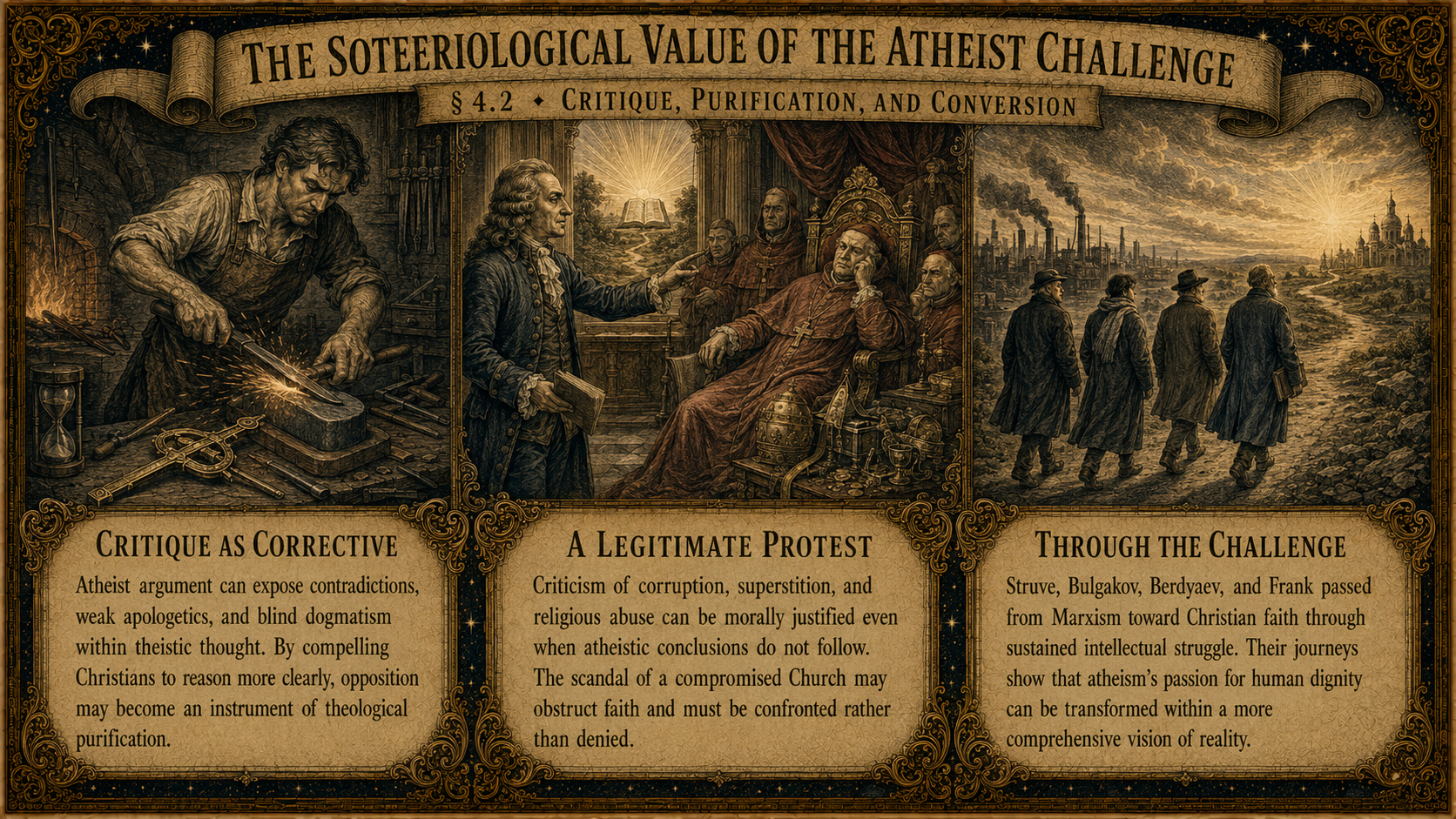
The atheist challenge has served, historically and continues to serve, as a powerful stimulus to theological purification. As Norman Geisler has noted, ‘all of us find it difficult to see the logical inconsistencies in our own thinking. Atheists serve as a corrective factor for identifying flaws in the reasoning of theists. Atheological argumentation against theism serves as a barrier against blind dogmatism.’ Atheists, for all their philosophical naivety, have at least performed a service in forcing Christian apologists to articulate their positions more clearly and defend them more rigorously.
More importantly, the atheist critique of corrupted or infantilised forms of religion has its own legitimacy. When Voltaire wrote, on the eve of the French Revolution, ‘is it any wonder that there are atheists in the world, when the Church behaves so abominably?’, he was making a point that no honest theologian can simply wave away. The history of Christianity is not a history of uninterrupted holiness. There have been — and continue to be — corruptions, compromises, and failures within the institutional Church that represent an obstacle to faith and a scandal to the Gospel. The atheist who attacks these corruptions is, in a certain sense, doing the Church a service, even if his ultimate conclusions are wrong.
The great Russian religious philosophers who underwent conversion from Marxism to Christianity — Struve, Bulgakov, Berdyaev, Frank — are instructive here. Each of them passed through a period of serious atheistic or materialist conviction, and each came to faith not despite but, in a certain sense, through their engagement with the atheist challenge. Their conversion was not a flight from reason but the achievement of a more comprehensive rationality. As Berdyaev wrote of Russian atheism: ‘in its first sources, Russian atheism had a heightened, almost ecstatic sense of humanity. But in its last results — in militant godlessness given political power — this humanity degenerated into a new inhumanity.’
The lesson here is profound: atheism, when it takes the form of an absolute and totalising worldview, cannot sustain the values it purports to champion. The experiment of state atheism in the twentieth century is the most terrible demonstration of this truth. But the initial impulse — the passion for human dignity, the refusal of a debased and superstitious religiosity — is not simply to be condemned. It is to be transformed and transcended through encounter with the living God, who is not the projection of human fears and wishes but their inexhaustible fulfilment.
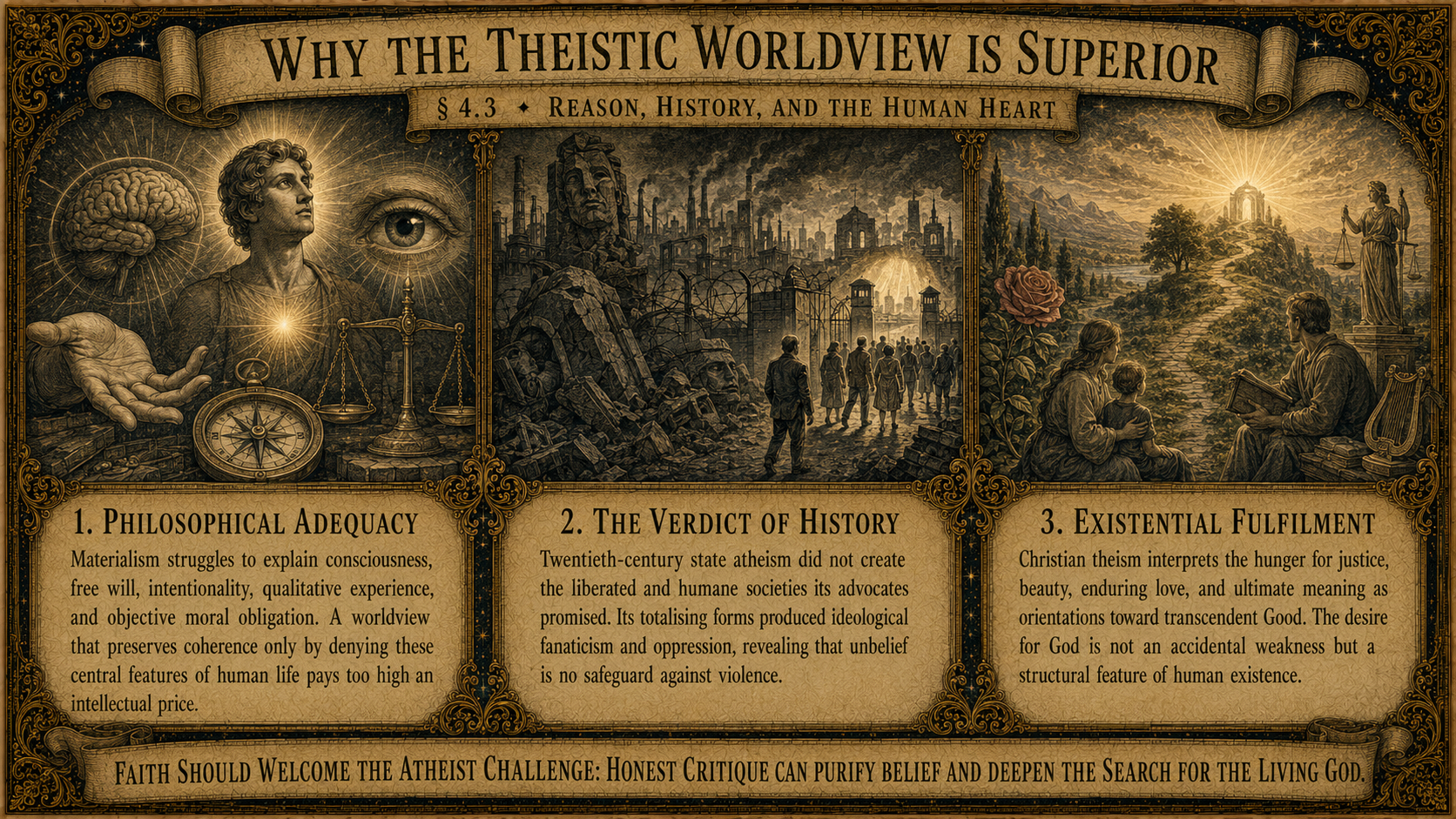
§ 4.3 Concluding Remarks: The Superiority of the Theistic Worldview
In conclusion, I wish to offer some brief reflections on why the theistic worldview is intellectually and existentially superior to the atheistic alternative.
First, from a strictly philosophical standpoint, atheism in its dominant materialist form fails to provide an adequate account of the most fundamental features of human experience: consciousness, free will, the intentionality of mental acts, the qualitative character of perception, and — crucially — the reality of moral obligation. These are not peripheral phenomena that a mature theory of reality can afford to neglect; they are central to what it means to be the kind of beings we are. A worldview that cannot account for them — or that can account for them only by denying their reality — has paid too high a price for its systematic coherence.
Second, atheism, as a worldview offered to human beings as a basis for living, has been tested in the twentieth century on a vast and tragic scale, and has been found wanting. The great experiment of state atheism — in the Soviet Union, in Maoist China, in Pol Pot’s Cambodia — did not produce the liberated, rational, humanised society that atheist visionaries had promised. It produced, on the contrary, systems of totalitarian oppression, ideological fanaticism, and mass murder on a scale unprecedented in human history. The myth of religion-as-the-source-of-all-violence is not only historically false; it is a piece of motivated self-deception on the part of those who have forgotten, or never knew, the history of the past hundred years.
Third, and most fundamentally: the theistic worldview — and specifically the Christian theistic worldview — provides a framework within which the deepest aspirations of the human spirit find their proper fulfilment. The hunger for justice, the longing for beauty, the need for love that does not die, the desire for a meaning that outlasts the individual life: these are not accidents of evolutionary history to be explained away, but orientations of the human person toward the transcendent Good that is their proper object. As Blaise Pascal recognised, and as Augustine before him had expressed with lapidary precision: ‘our heart is restless until it rests in Thee.’ The Christian claim is not that God is a consoling fiction for those who cannot face reality; it is that the desire for God is the deepest structural feature of human existence, written into the very grain of being.
None of this means that the way of faith is easy, or that the intellectual challenges posed by atheism can simply be dismissed. The problem of evil is real. The history of religious abuse and corruption is real. The temptation to a comfortable and uncritical religiosity is real. But the response to these challenges is not to abandon the quest for God but to pursue it more honestly, more humbly, and more rigorously — to allow the atheist critique to purify our faith of its idolatrous accretions and to drive us toward a more adequate and more living knowledge of the God who is not a projection of our needs but their inexhaustible source and end.
We may conclude with the hope expressed by one of the greatest of modern Christian thinkers. Nikolai Berdyaev, writing in the aftermath of the catastrophe of Russian Communism, observed that the first sources of Russian atheism had contained a ‘heightened sense of humanity’ — a genuine moral passion — that had been perverted and ultimately destroyed by its own inner logic when given absolute power. The cure for this perversion is not a retreat to intellectual complacency but the pursuit of that living faith in the God of Jesus Christ who alone can sustain the moral seriousness that atheism borrows from Christianity and then tries to deploy against it.
In this sense, the encounter between faith and atheism, properly conducted, is not a zero-sum competition but a dialectical movement toward greater truth. The Church, and Christian theology, must welcome this encounter — not with anxiety, but with the confidence of those who have met the living God and know that ‘perfect love casteth out fear.’
Please review the following discussion summary
Let us turn now to a specific and illuminating example of the theological- philosophical dialogue between theism and a serious form of doctrinal atheism — the debate between Alvin Plantinga and Michael Tooley, published in the volume Knowledge of God (2011) in the ‘Great Debates in Philosophy’ series.
Tooley’s central argument is that belief in God is not epistemically warranted — that there is no sufficient rational justification for accepting theism as true. He organises his case around three groups of arguments: a priori arguments against the very intelligibility of theism; a posteriori arguments without moral content (concerning the improbability of an immaterial mind); and a posteriori arguments with moral content, of which the most important is the argument from evil.
Tooley’s a posteriori argument without moral content rests on the claim that our knowledge of the relationship between mind and brain makes the existence of a disembodied divine mind highly improbable. He observes that brain damage impairs mental functioning, that psychological disorders arise from neurological disease, and that the rational capacities of non-human animals appear to be entirely brain-dependent. From these observations he infers that ‘conscious states are either identical to physical processes or dependent on physical processes,’ and that therefore ‘it is unlikely that there are non- physical minds, and so, if God is non-physical and conscious, it is unlikely that God exists.’
Plantinga’s response to this argument is incisive. He challenges Tooley’s inference from the correlation of mental and physical states to the identity or complete dependence of mind on matter. Correlation does not imply identity; and the dependence of mental functioning on neural processes in embodied beings does not establish that all minds must be embodied. Moreover, Plantinga argues, the concept of God as a necessary being — as ipsum esse subsistens — cannot be captured within the framework of Tooley’s probabilistic reasoning. If God exists necessarily, then His existence is not merely more or less probable than His non-existence: it is either absolutely necessary or absolutely impossible. Tooley’s probabilistic calculus, which assigns a prior probability of one-third to the existence of an omnipotent, omniscient, and perfectly good God, begs the question against the classical theistic tradition.
The most substantial part of the debate concerns the problem of evil. Tooley formulates the argument in various ways — deductive, inductive, axiological, and deontological — and concludes that the existence of severe and apparently gratuitous evil makes God’s existence highly improbable. He favours the inductive (probabilistic) form of the argument, which he regards as less vulnerable to the free will defence than the deductive form.
Plantinga’s response is multifaceted. In response to the deductive argument, he points out that premise three — ‘a morally perfect being would wish to prevent all evil’ — is not self-evidently true. It is plausible to suppose that a world in which creatures develop their highest virtues through engagement with adversity, suffering, and evil is better than a world from which all such challenges have been eliminated. On this view, the prevention of all evil would itself be a kind of evil — the evil of a morally stunted world.
More profoundly, Plantinga develops his celebrated ‘O Felix Culpa’ theodicy. The argument is as follows: God, in actualising our world, chose it from among an infinite range of possible worlds, each of which contains a particular balance of good and evil. The moral and spiritual perfection of created persons is an open-ended good — there is no maximum to the excellence that can be achieved. It follows that there may be no ‘best of all possible worlds,’ since for any world one can always conceive a better one. God’s wisdom consists not in actualising the best of all possible worlds — which may not exist — but in actualising a ‘weakly maximal’ good possible world: one in which the goods achieved are not exceeded by any achievable alternative.
On this account, the highest good of the created order is the Incarnation and Redemption: the entry of God Himself into human history, His assumption of human nature in all its vulnerability, His passion and death, and His resurrection from the dead. This supreme divine act of self-giving love transforms the meaning of suffering and evil, not by eliminating them but by incorporating them into a larger economy of salvation. As Plantinga writes: ‘Can one imagine a greater degree of divine love? And there is no greater violation of the ethical balance, when a person turns away from God and neighbour, drowning in sin. Hence Plantinga’s conclusion: God actualises the maximally necessary good world. Whatever volume of suffering the world contains, the goodness of God exceeds it.’
Plantinga’s argument has the merit of taking the problem of evil with full theological seriousness — as a specifically Christian problem, located within the framework of creation, fall, redemption, and eschatological fulfilment — rather than treating it as a merely logical puzzle to be dissolved by clever argument. It acknowledges the epistemic gap between the human and the divine: there are dimensions of God’s reasons for permitting evil that will forever exceed our comprehension. And it insists that the appropriate response to suffering is not philosophical resignation but participation in the redemptive suffering of Christ.
Related Concepts
- agnosticism-as-the-honest-alternative
- anti-theism
- apologetics
- augustinian-anthropology
- christian-anthropology
- church-reform
- classical-theism
- consciousness
- dialectical-encounter
- engels-dialectic-of-negation
- feuerbachs-projection-theory
- freedom
- history-of-religions
- mindbody-problem
- moral-life
- moral-perfection
- necessary-being
- new-atheism
- pastoral-care
- pastoral-theology
- plantingatooley-debate
- postulatory-atheism
- problem-of-evil
- psalm-141
- restless-heart-cor-inquietum
- science-and-religion
- secularisation
- surrogate-absolute
- szondi
- theoretical-atheism
- thomas-nagel