Fundamental Theology — Topic 7. Deism.
In conclusion, deism must be assessed as a philosophically and theologically unsuccessful attempt to resolve a real tension — between the demands of a mechanistic natural science, the memory of confessional violence, and the ineradicable human sense that there is a transcendent ground of being. The nineteenth-century Russian theologian Kudryavtsev-Platonov described it, aptly, as a ‘mechanical compromise between the spreading unbelief of the educated classes and the religious faith of the masses’ — a compromise in which a non-intervening Deity was attached, as a kind of ceremonial gesture, to a universe already conceived as fully self-explanatory in natural terms. The failure of this compromise was registered in both directions. Towards the secular end, the superfluous Deity was progressively eliminated, issuing in the materialism and atheism of the later Enlightenment and of much of nineteenth-century European intellectual culture. Towards the religious end, the thin and cold religion of natural reason proved incapable of sustaining the weight of genuine human spiritual need, and generated in reaction the great pietist and evangelical awakenings of the eighteenth and nineteenth centuries. The Christian response to deism is not a retreat into irrationalism, and it is not a dismissal of the genuine achievements that the deist tradition helped to make possible — above all, the extension of religious toleration, the development of natural-law thinking in international relations, and the recognition that the created order possesses a genuine rational integrity that can be investigated by science without continuous appeal to supernatural explanation. The Christian response is rather the affirmation that the God who is the rational ground of the universe is not a distant Architect who has retired from the building site, but a living Person who has entered his own creation, accompanied it through its deepest contradictions and suffering, and opened it to participation in a life that transcends everything nature can offer on its own. It is this God — the Trinity of love, the incarnate Lord, the Spirit who prays within us — who is the proper subject of fundamental theology. And it is against the background of the deist alternative that the distinctiveness and the necessity of this claim can be most clearly seen.
This lecture is the second part of our survey of the main types of worldview. In the previous session we established the broad map: theism, atheism, and pantheism. We now turn to a detailed examination of deism — a philosophical and religious movement that flourished in England, France, and Germany during the seventeenth and eighteenth centuries, and whose intellectual legacy continues to shape our culture in ways that are not always easy to recognise.
- Introduction
- Section 1. The Origins and Spread of Deism
- Section 2. The Doctrinal Content of Deism
- Section 3. The Critique of Deism
- Section 4. The Legacy of Deism and Its Continuing Relevance
- Conculsion
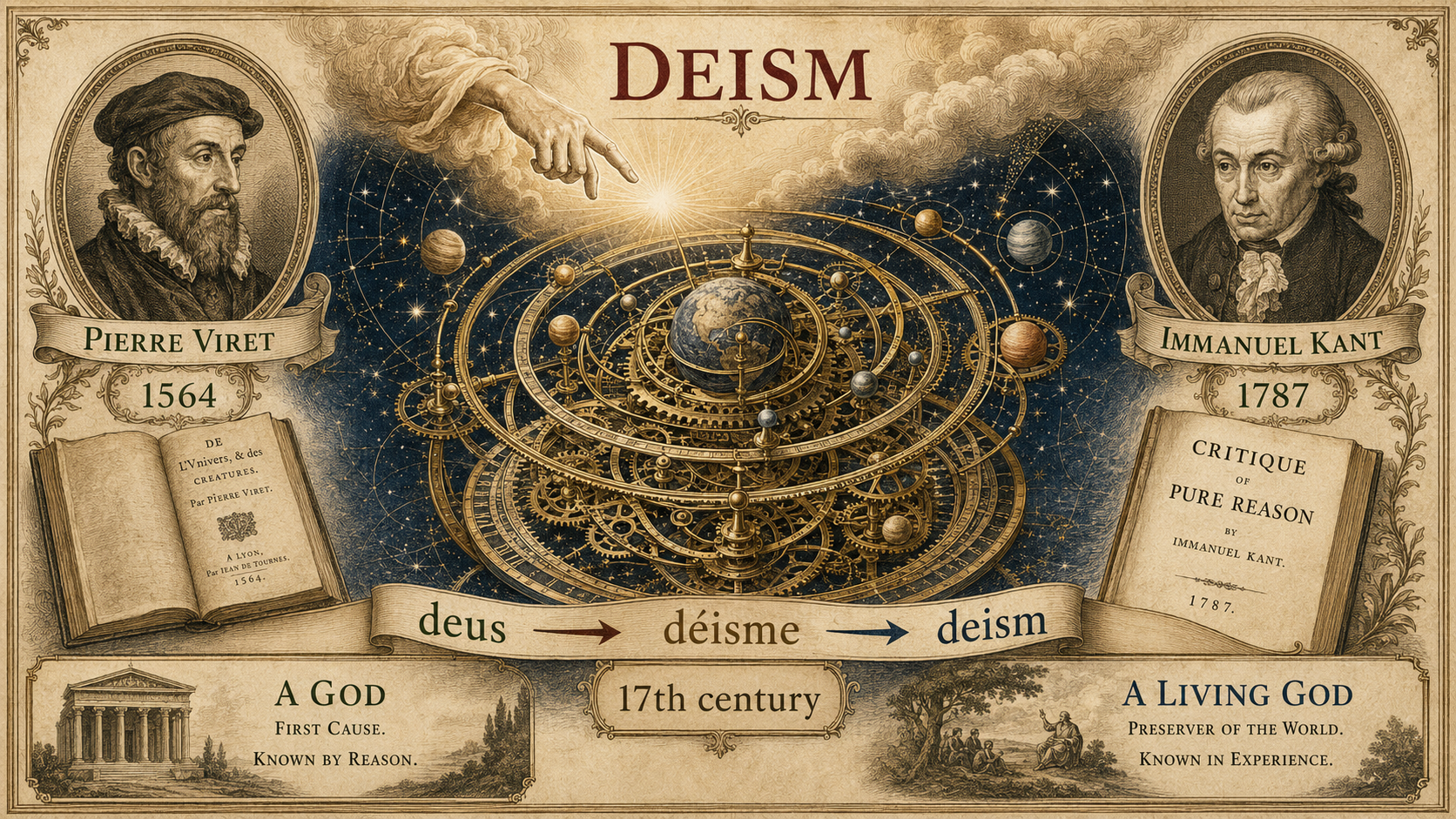
The word deism comes from the Latin deus, meaning God, via the French déisme. The word first appears in print in 1564, when the Swiss Reformed pastor Pierre Viret, writing in his Instruction chrestienne, described a group of contemporary freethinkers who called themselves deistes. Viret was alarmed by them. They acknowledged, he said, the existence of a God who created heaven and earth, but they refused to accept the doctrines of Christ and the Apostles, which they regarded as human invention. Some of them denied the immortality of the soul; others denied any providential involvement of God in the affairs of the world. Viret regarded their position as more dangerous than that of the Turks or the Jews, because those at least possessed a framework of divine revelation, however incomplete. These early deists, by contrast, claimed to honour God while stripping away everything that made Christian faith specifically Christian. For much of the seventeenth century the words ‘deist’ and ‘theist’ were used more or less interchangeably, both meaning simply someone who believes in God as opposed to an atheist. The sharper distinction — theism for a God who is personally active in the world, deism for a God who created the world and then withdrew from it — only became standard in the eighteenth century. The philosopher Immanuel Kant articulated it with characteristic precision in the second edition of his Critique of Pure Reason (1787): the deist believes in God through the concepts of pure reason alone, recognising only a first cause of the universe discoverable by rational reflection, whereas the theist believes in a living God who possesses understanding, will, and moral concern. Kant’s memorable formulation — ‘it is fairer and more modest to say that the deist believes in a God, and the theist believes in a living God’ — captures the essential difference we will be exploring throughout this lecture.
To understand why deism became so intellectually attractive in the seventeenth and eighteenth centuries, we need to appreciate the particular pressures that the educated European mind was experiencing at that time. Three factors above all deserve attention.
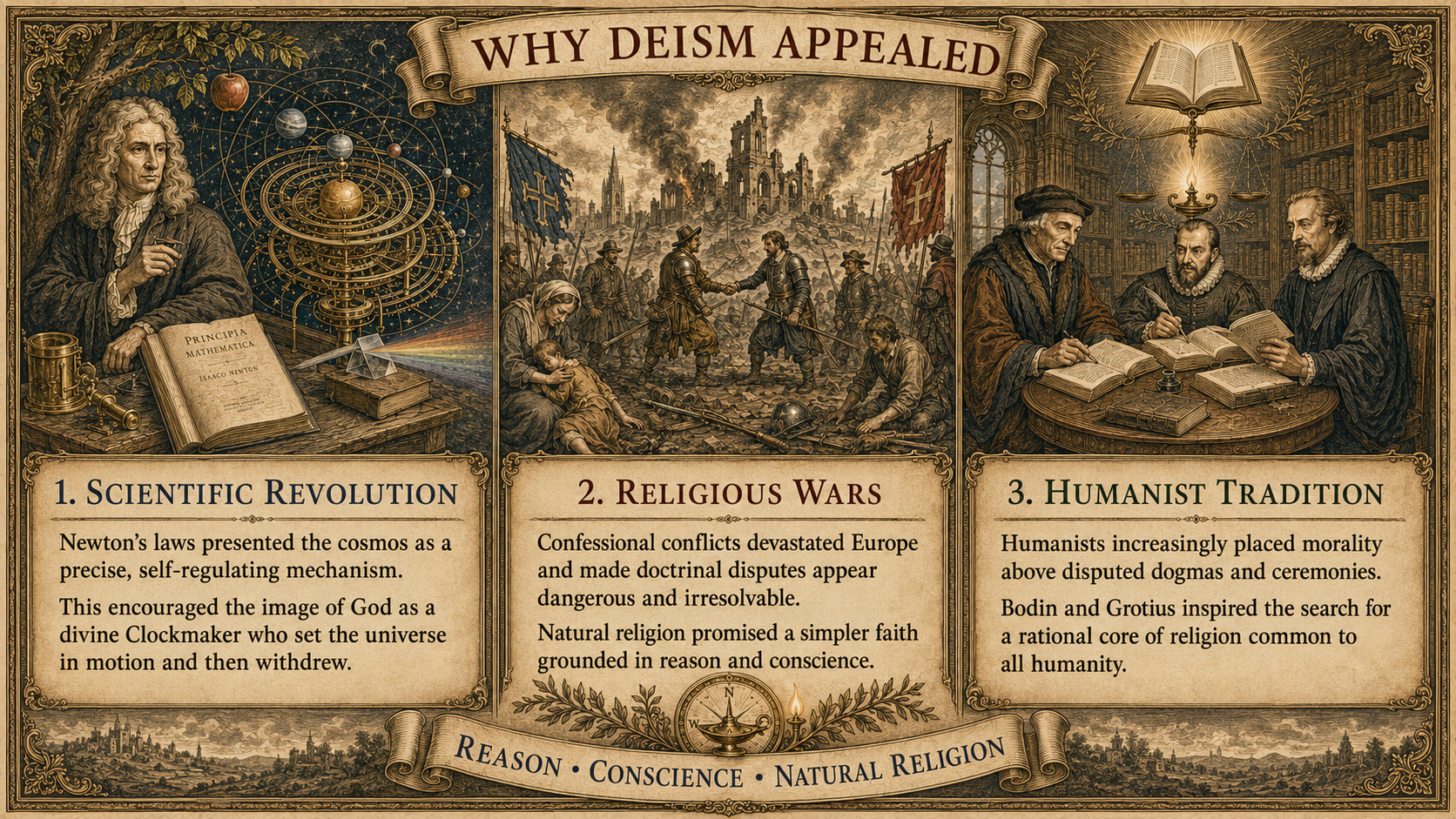
1. The first was the scientific revolution. The work of Copernicus, Galileo, and Kepler had already overturned the Aristotelian-Ptolemaic picture of the cosmos in which the earth stood at the centre of a hierarchically ordered universe. But it was Isaac Newton who provided, in his Principia Mathematica of 1687, a unified mathematical account of the entire physical universe — from the fall of an apple to the orbit of a distant planet — in terms of a small number of precise, universal laws. The effect on the imagination of educated Europeans was enormous. The cosmos now looked less like a living story in which God was constantly at work, intervening, guiding, sustaining, and more like an immense, perfectly designed mechanism that runs by its own inherent laws once set in motion. The favourite image of the period was the clock. God was the divine Clockmaker: he designed and built the mechanism, wound it up, and then — since a perfect mechanism needs no further adjustment — left it to run on its own. Newton himself was a deeply religious man who believed in providence and who thought that the regularities of the solar system testified to the wisdom of a divine Creator. But the philosophical conclusions that later readers drew from his physics were rather different: if the universe is a perfect self-regulating machine, why does the Clockmaker need to touch it again? And if the Clockmaker never touches it, in what sense is the Clockmaker still present?
2. The second major factor was the terrible memory of the religious wars. The French Wars of Religion, the Thirty Years’ War, and the English Civil War had between them killed millions of people and devastated large parts of Europe. All of these conflicts were entangled, in complex ways, with disagreements about Christian doctrine — about grace and predestination, about the nature of the Eucharist, about the authority of the Pope, about the correct form of church government. For many thoughtful people, the spectacle of Christians slaughtering one another over points of theology that seemed to resist any rational resolution produced a deep revulsion against the whole apparatus of confessional Christianity. Could there not be a simpler, quieter religion — one that all reasonable human beings could share, regardless of their particular confessional allegiance, based on what everyone already knows through reason and conscience, without needing bishops or synods or armies to settle it? The appeal to a religio naturalis — a natural religion common to all humanity and accessible to unaided reason — offered a way out of the seemingly endless labyrinth of confessional controversy.
3. The third factor was the humanist tradition that had been developing since the fifteenth century. Thinkers like Thomas More, Erasmus, and Jean Bodin had already encouraged the idea that the essential core of religion is morality — being honest, just, and kind — rather than any particular set of dogmas or ceremonies. Bodin, in his dialogue Colloquium Heptaplomeres (written around 1593, though not published until later), had already proposed a ‘rational minimum of faith’ — the existence of God, the immortality of the soul, and the necessity of moral virtue — as a basis for religious conversation across confessional lines. The Dutch jurist Hugo Grotius had applied a similar method to the domain of law: by stripping away the particular rules of each nation’s legal code, he claimed to identify a kernel of natural law common to all humanity, which stood above and judged the positive legal systems of the nations. The application of this same logic to religion — stripping away the particular doctrines of each church to find a kernel of natural religion common to all — was a short and attractive step.
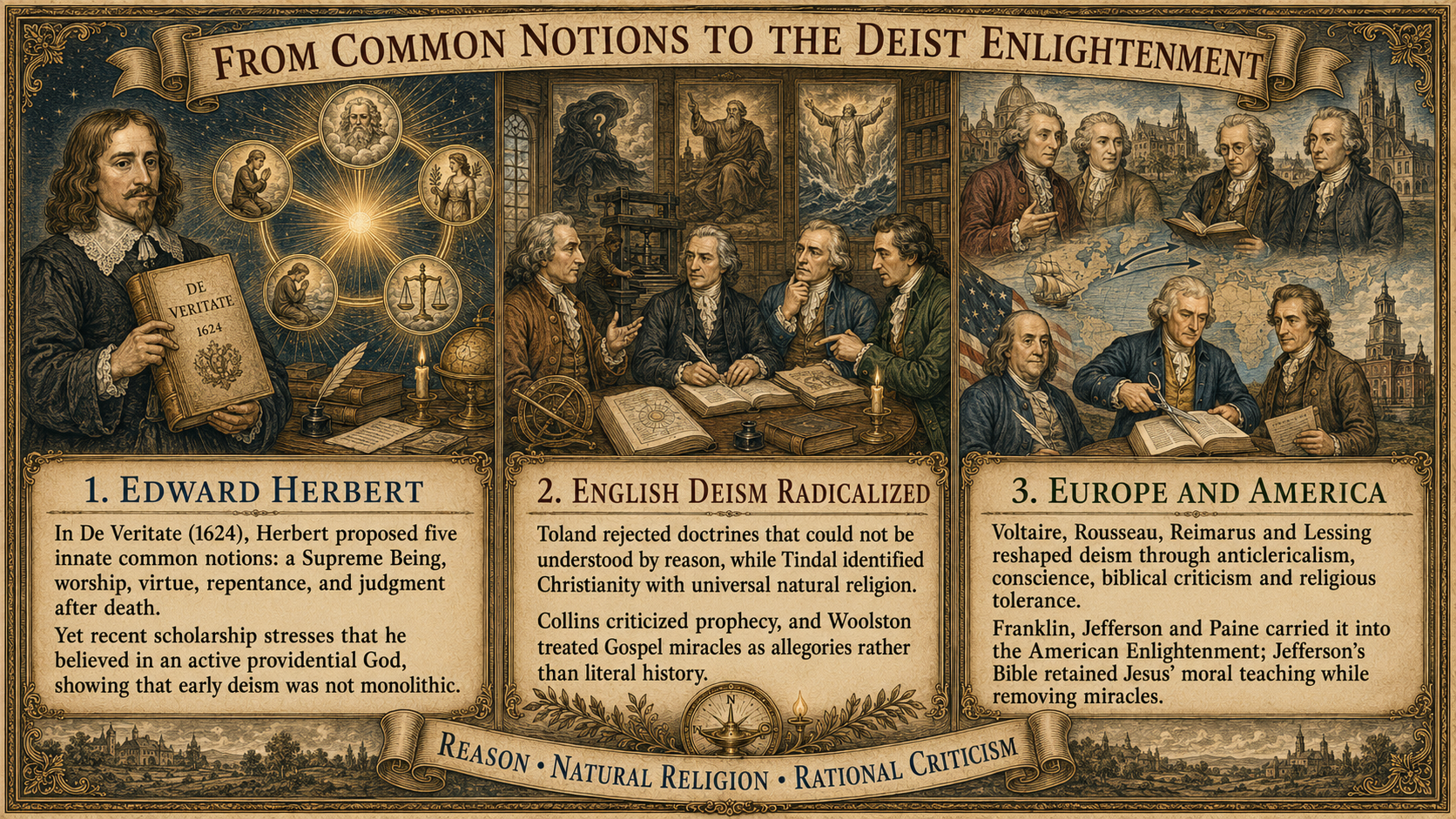
Первым мыслителем, изложившим деизм как целостную систему, был Эдвард Герберт из Чербери (1583–1648), которого часто называют отцом английского деизма. В своей книге «De Veritate» («О правде», 1624) он утверждал, что Бог заложил в сознание каждого человека с рождения пять основных религиозных истин — то, что он назвал notitiae communes, общими представлениями. Эти пять истин таковы: существует Высшее Существо; это Существо заслуживает поклонения; добродетель и благочестие являются лучшей формой поклонения; проступки требуют покаяния; и после смерти будут награды и наказания. Герберт утверждал, что этих пяти истин достаточно для подлинной и нравственно серьезной религиозной жизни. В той или иной форме их можно найти в каждой религии мира. Всё остальное — конкретные доктрины христианства, таинства, священническое служение, авторитет Священного Писания — это человеческое дополнение, наложенное на это универсальное религиозное ядро, часто духовенством, заинтересованным в сохранении своей власти над паствой. Герберт не отрицал прямо возможность откровения, но считал его излишним для тех, кто способен постичь пять врождённых истин посредством разума, и обязательным только для тех, кому оно было адресовано непосредственно и лично. Стоит отметить, однако, что недавние исследования подняли серьёзные вопросы о том, следует ли вообще классифицировать Герберта как деиста. Историк Дэвид Пайлин утверждает, что личные религиозные сочинения Герберта раскрывают человека с твёрдой верой в активного, провиденциального Бога, который напрямую общается с отдельными душами — едва ли отстранённого Часовщика классического деизма. Американский учёный Джозеф Валигор, основываясь на внимательном изучении подлинных трудов шестнадцати мыслителей, традиционно называемых английскими деистами, выдвинул более широкий аргумент, согласно которому большинство из них регулярно молились, верили в чудеса и стремились к личным и благочестивым отношениям с Богом, активно участвующим в делах человечества. Некоторые из них — Томас Морган, Мэтью Тиндал, Томас Амори — прямо называли себя «христианскими деистами» и настаивали на том, что они восстанавливают первоначальное, неискажённое христианство апостолов из-под институционального и доктринального мусора столетий. Это важное научное уточнение, и оно напоминает нам, что мы всегда должны быть осторожны, рассматривая «деизм» как единую, монолитную позицию.
Тем не менее, мыслители, сформировавшие популярный образ деизма в XVIII веке, придерживались значительно более радикальных позиций, чем Герберт. Джон Толанд (1670–1722) в своей книге «Христианство не таинственно» (1696) утверждал, что всё подлинно христианское может быть понято обычным человеческим разумом, и что все предполагаемые тайны и таинства Церкви — Троица, Воплощение, реальное присутствие Христа в Евхаристии — которые сопротивляются рациональному объяснению, являются более поздними изобретениями духовенства, а не подлинным учением Христа. Мэтью Тиндал (1657–1733) довел этот аргумент до систематического завершения в своей книге «Христианство столь же древнее, как и сотворение мира» (1730), настолько всеобъемлющей в своем изложении деистических принципов, что её называли «Библией деизма». Тиндал утверждал, что религия природы и религия Христа — одно и то же; что Бог заложил принципы естественной религии в сердце каждого человека независимо от национальности, образования или исторических обстоятельств; и что все догматические и ритуальные наслоения, накопленные церквями за столетия, являются искажениями, которые необходимо устранить рациональной критикой. Энтони Коллинз (1676–1729) подверг Ветхий Завет детальной критике, нападая на традиционную христианскую интерпретацию еврейских пророчеств как предвосхищающих Христа. Томас Вулстон (1670–1733) утверждал, что чудесные истории Евангелий, если воспринимать их буквально, морально и исторически невероятны и должны рассматриваться как аллегории. Из Англии деистические идеи быстро распространились по Европе. Вольтер (1694–1778), проведший три продуктивных года в Англии в конце 1720-х годов, вернулся во Францию восторженным приверженцем интеллектуального духа, с которым он там столкнулся. Остаток своей долгой и воинственной жизни он посвятил нападкам на католическую церковь — «Сокрушим эту позорную вещь» — был его боевой клич, — последовательно защищая при этом веру в рационального Бога- Творца. Жан-Жак Руссо (1712–1778) разработал более личную и эмоционально теплую форму деизма, наиболее ярко выраженную в «Исповедании веры савойского викария» в его романе «Эмиль» (1762). Для Руссо существование доброго и провиденциального Высшего Существа, бессмертие души и реальность моральной ответственности — это истины, познаваемые не столько посредством холодных логических рассуждений, сколько через свидетельство сердца — через то, что он называл «внутренним голосом чувств». В Германии наиболее значительной фигурой деизма был Герман Самуэль Реймарус (1694–1768), чья пространная «Апология рациональных поклонников Бога» сочетала защиту естественной религии с радикальной исторической критикой всего библейского повествования, предвосхищая многие выводы, к которым придет либеральная библейская наука XIX века. Фрагменты этого произведения были опубликованы посмертно Готхольдом Эфраимом Лессингом в период с 1774 по 1778 год.Собственная пьеса Лессинга «Натан Мудрый» (1779) — с её знаменитой притчей о трёх кольцах, представляющей иудаизм, христианство и ислам как одинаково допустимые выражения общей изначальной веры, — остаётся одним из самых элегантных художественных проявлений деистического духа. В Америке деистические идеи сформировали мировоззрение нескольких отцов-основателей. Бенджамин Франклин, Томас Джефферсон и Томас Пейн — все они придерживались явно деистических позиций. Так называемая «Библия Джефферсона» — версия Евангелий, из которой он буквально вырезал все упоминания о чудесах и сверхъестественном, — является, пожалуй, наиболее яркой практической иллюстрацией деистического подхода к христианскому Писанию: сохранить морального учителя, убрать воплощённого Господа.
Before examining what deists believed, we must acknowledge again that ‘deism’ does not designate a single, uniform position. It names a family of related views united by certain shared commitments — above all, the primacy of natural reason in religion and scepticism about supernatural revelation — but varying considerably in their positive content. The useful taxonomy provided by Samuel Clarke (1675–1729) in his Discourse concerning the Being and Attributes of God (1704–1705) identifies four types of deist.
The first group acknowledges God, providence, and natural religion, but denies the need for any revealed religion.
The second group goes further, additionally denying the immortality of the soul and any form of life after death.
The third group believes God governs the natural world but regards God as indifferent to moral questions, without the attributes of goodness and justice.
The fourth and most radical group holds that God’s only involvement with the world was the original act of creation; since then, God has been entirely absent from the natural order.
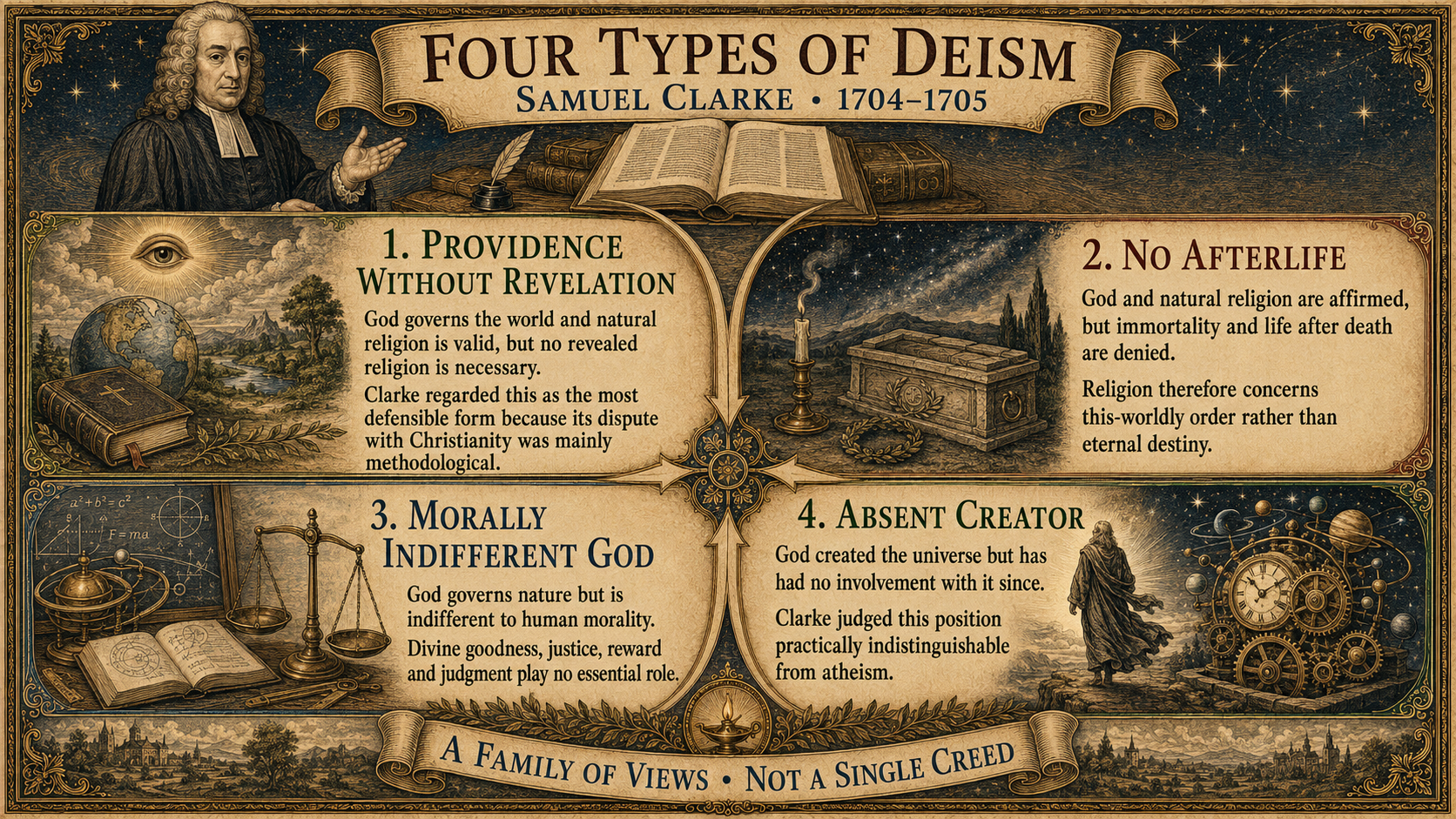
Clarke considered the first group the most defensible, as their disagreement with Christianity was primarily methodological; he considered the fourth group effectively indistinguishable from atheism in its practical implications. With this variety in mind, we can now identify the core ideas that characterise what might be called ‘classical’ deism — the kind of deism that most powerfully shaped the intellectual culture of the Enlightenment and left the deepest mark on subsequent history.
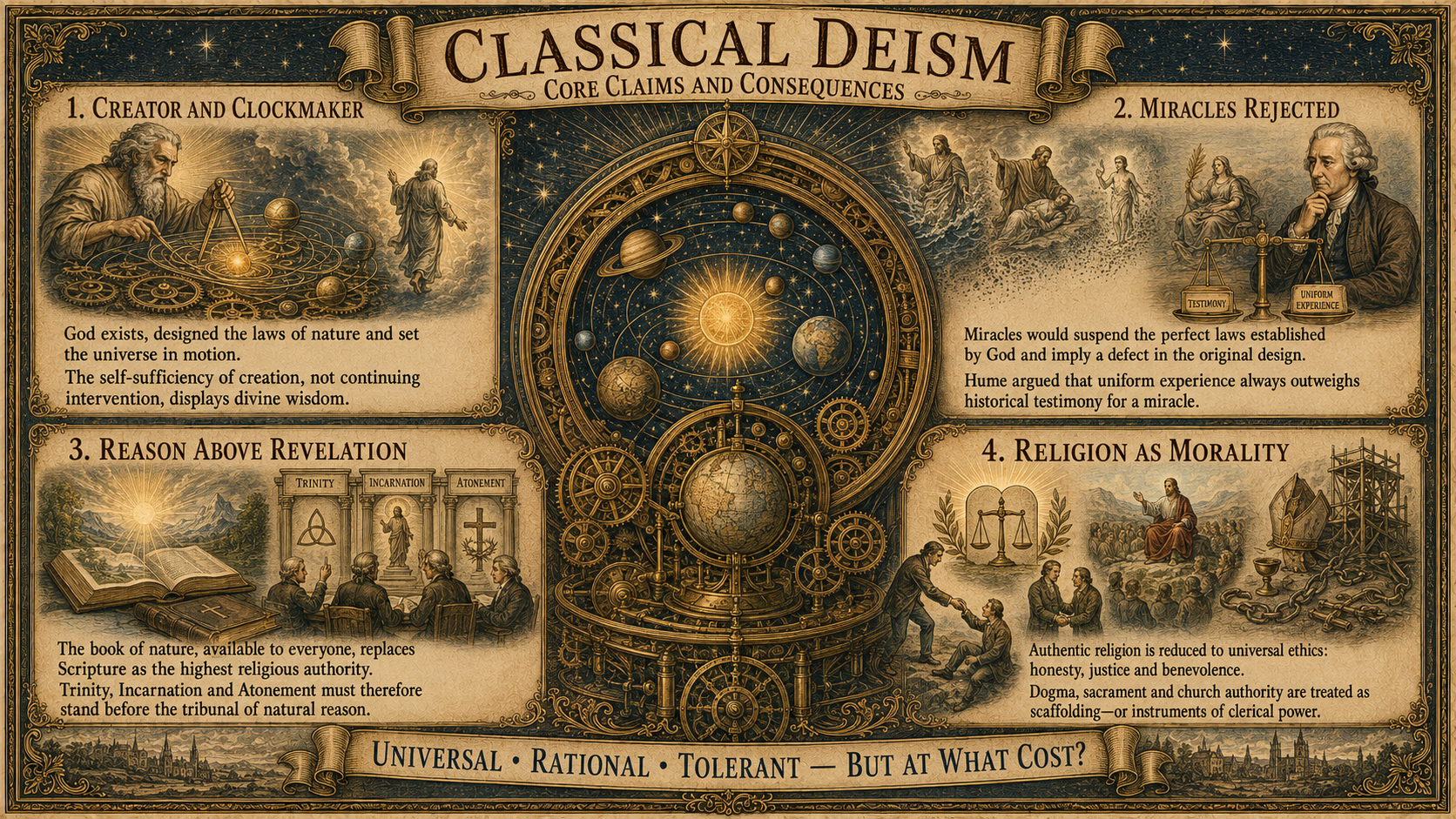
The first and most fundamental deist claim is that God exists and created the world. This is the one point on which all deists agreed without exception; it is, indeed, what makes them deists rather than atheists. Their primary argument for God’s existence was the argument from design: the order, complexity, and beauty of the natural world — the extraordinary intricacy of a living organism, the mathematical precision of planetary motion, the apparently purposive structure of the human body — point unmistakably to a designing intelligence of surpassing wisdom and power. This argument was not new; versions of it can be found in Plato and Cicero. But in the context of Newtonian science, it took on a new and particularly vivid form. The universe, Newton had shown, operates according to mathematical laws. Surely such laws did not arrange themselves. Surely they speak of a Lawgiver. Up to this point, many Christian thinkers would have agreed entirely with the deist argument. The crucial difference comes in the next question: what did God do after creating the world? The classical deist answer is: essentially nothing. God designed the laws of nature, set the universe in motion, and then stepped back. The universe runs by those laws without requiring any further divine involvement. This is the Clockmaker image. A perfect clockmaker builds a perfect clock; a perfect clock, precisely because it is perfect, does not need the clockmaker to keep winding it, adjusting its gears, or stepping in to override its mechanism. In the same way, a perfectly wise God would create a universe so well-ordered that no further intervention is needed. God’s greatness is demonstrated precisely by the self-sufficiency of the creation. This is the central deist conviction, and from it a number of important consequences follow.
The first major consequence is the rejection of miracles. A miracle, by definition, is a case in which God directly intervenes in the natural order, overriding or suspending the laws of nature in a particular instance. But if God is the perfectly wise Clockmaker, such interventions would be self- defeating: they would imply that the original design was inadequate. Why would a perfect Architect need to prop up a wall that should not have been built the way it was? The deist therefore looked at the miracle accounts in the Bible — the parting of the Red Sea, the multiplication of loaves, the healing of the blind, and above all the bodily resurrection of Jesus — and concluded that they were either misunderstandings of natural events, later legendary additions to the historical record, or moral allegories that should not be taken literally. The philosopher David Hume (1711–1776), though not a deist in the strict sense, gave the most philosophically sophisticated version of this anti-miracles argument in Section X of his Enquiry concerning Human Understanding (1748). His reasoning ran as follows: a miracle, by definition, is a violation of a law of nature; a law of nature is established by uniform and unvarying human experience; therefore the evidence against any particular miracle is always the strongest possible evidence, namely the entire weight of past experience; while the evidence for a miracle is always the comparatively weak evidence of historical testimony. No amount of historical testimony, however impressive, can outweigh the evidence of universal experience. This argument was highly influential and became a standard weapon in the deist armoury.
The second major consequence is the rejection of special divine revelation. If God has given every human being, from birth, the rational capacity to know the most important religious truths — the existence of God, the moral law, the immortality of the soul — then there is no need for God to deliver a special, historically localised message to one particular people at one particular moment in history. The Bible, for the deist, is not the unique, authoritative Word of God addressed to humanity. It is, at best, one human record of the encounter with the divine among others — valuable insofar as it agrees with what reason already knows, but not authoritative where it diverges from reason or makes claims that reason finds implausible. In Tindal’s formulation: ‘the Bible of the deists is not any written text but the book of nature itself.’ The implications for traditional Christianity are radical. If Scripture is not uniquely authoritative, then the doctrines derived from Scripture — the Trinity, the Incarnation, the Atonement — cannot demand the assent of rational persons simply on the grounds that Scripture teaches them. They must be able to establish themselves before the tribunal of natural reason. And when they come before that tribunal, the deist argued, they fail. The Trinity appears to contradict the law of non-contradiction. The Incarnation requires the impossible: that the infinite God should become finite. The Atonement — the idea that the death of one person can make satisfaction for the sins of others — seems morally arbitrary. Jefferson famously described Trinitarian arithmetic, where three equals one and one equals three, as ‘hocus-pocus’ — too harsh a judgment, as we shall see in Part III, but it captures the deist reaction perfectly.
The third major consequence, which in some ways subsumes the others, is the reduction of religion to morality. For the classical deist, the authentic content of all genuine religion is ultimately ethical: be honest, be just, treat others as you would wish to be treated. All the specific doctrines, sacraments, liturgies, and ecclesiastical institutions are, at best, useful aids for those who are not yet capable of grasping the moral law by pure reason — a kind of kindergarten version of ethics dressed up in religious imagery. At worst, they are instruments of clerical manipulation, mechanisms by which a priestly class maintains its power over the laity by claiming exclusive authority over the access to God. The deist had no difficulty admiring Jesus as a moral teacher: in Jefferson’s judgment, the ethical teaching of the Sermon on the Mount is ‘the most sublime and benevolent code of morals which has ever been offered to man.’ What the deist rejected was the claim that Jesus was the incarnate Son of God whose death made satisfaction for human sin — because that claim goes beyond the moral, into the realm of theological doctrine that reason cannot confirm and that requires the kind of supernatural intervention in history that the deist worldview excludes from the outset. The Kantian formulation of this view — in his Religion within the Bounds of Mere Reason (1793) — is the most philosophically developed version: true religion is morality seen under the aspect of divine command; the historical and institutional elements of particular religions are useful scaffolding that can be discarded once the rational moral core has been internalised. It is worth observing that this entire picture has a powerful intuitive appeal, especially for those who are weary of confessional conflict and suspicious of institutional religion. It seems clean, universal, tolerant, and morally serious. It promises a religion that is genuinely available to everyone, regardless of education, culture, or historical circumstance, because it is grounded in nothing more exotic than the rational capacity that all human beings share. The question is whether this apparent simplicity comes at too high a price.
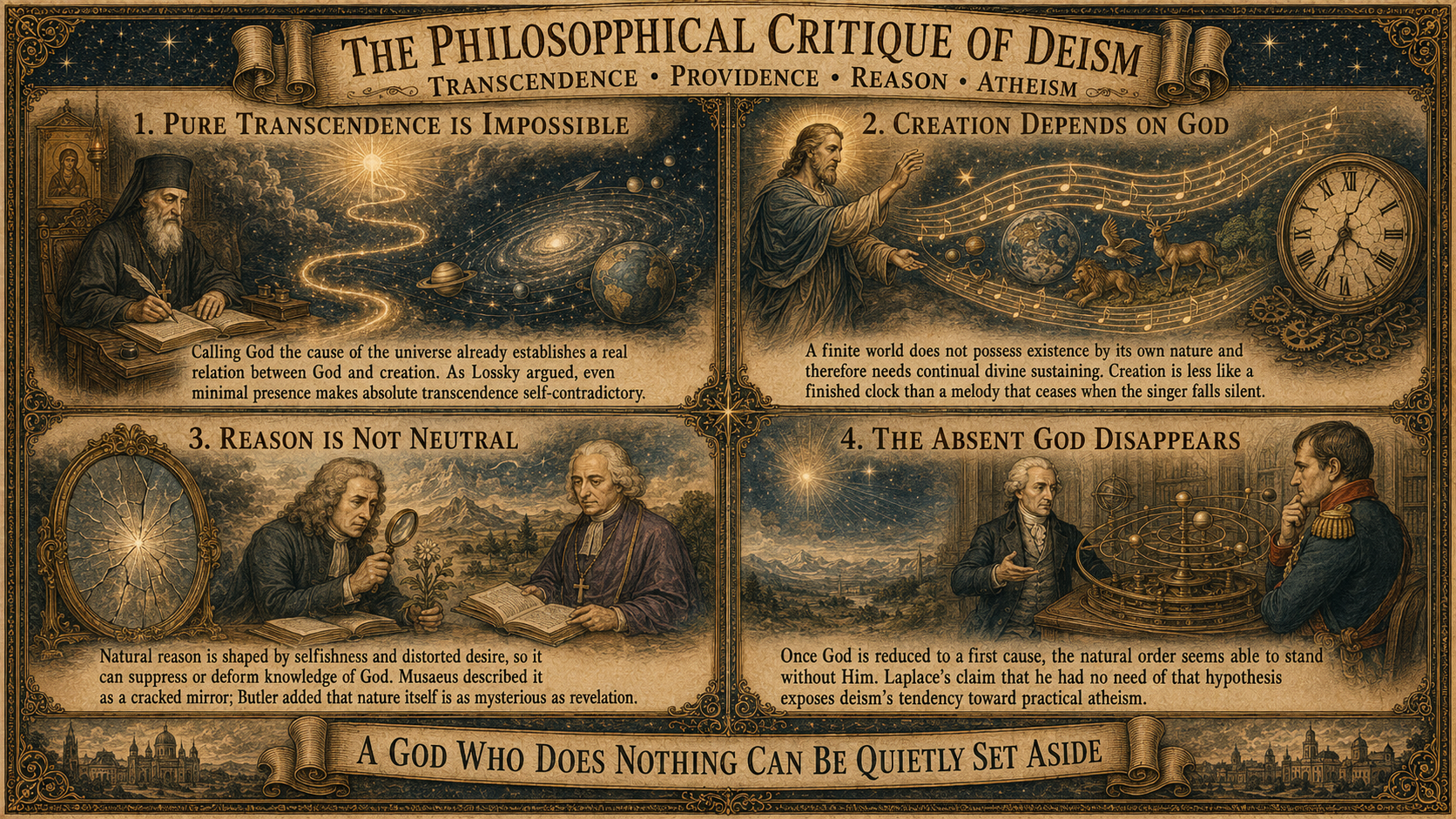
The critique of deism can be conducted at several levels — philosophical, theological, and practical. We will work through the main lines of objection in turn, moving from the more abstract to the more concrete, before arriving at the specifically Christian response. The first and most fundamental philosophical problem concerns the coherence of the deist concept of God. Deism insists on the absolute transcendence of God: God is wholly beyond and separate from the created order, and exercises no ongoing activity within it. But, as the Russian Orthodox theologian Vladimir Lossky argued with characteristic precision, the concept of a God of pure transcendence is self- contradictory. If we say that God is the transcendent Cause of the universe — the very thing the deist affirms — we have already posited a real relationship between God and the universe, namely the relationship of cause to effect. Any real relationship, however minimal, is a form of presence and immanence. A God whose connection with the world were truly zero could not be spoken of at all, not even in the formula ‘God is the cause of the universe,’ because that formula itself describes a bond between God and the world. To use Lossky’s own words: ‘Pure transcendence is impossible. If we know God even as transcendent Cause of the universe, then He is already not purely transcendent; His presence, even the most minimal, allows us to name Him as such.’ The deist position thus undermines itself: in the very act of affirming God as Creator, it establishes the kind of God-world relationship it is trying to deny.
A second major philosophical objection concerns the deist argument for God’s non-intervention from the perfection of creation. The argument runs as follows: God is a perfect Creator; a perfect Creator produces a perfect creation; a perfect creation has no need of ongoing divine involvement. This argument contains a serious confusion between two different kinds of perfection. The Christian tradition, drawing on a long metaphysical analysis going back at least to the Council of Nicaea, insists that the created world, while genuinely good — ‘very good,’ in the language of Genesis 1:31 — is not and cannot be infinitely perfect in the way that God is. If God were to create something equal to Himself in perfection, the distinction between Creator and creature would dissolve entirely, and the doctrine of creation would collapse into a form of emanationism or pantheism. The finitude of the created world — its character as a being that has received existence as a gift rather than possessing existence by its own nature — means that it is dependent on God not only for its beginning but for its continued existence at every moment. The world does not, so to speak, have existence stored up inside itself that it can draw on independently once God has set it going. It is more like a melody being sung: the melody does not exist apart from the ongoing activity of the singer; if the singer falls silent, the melody ceases. God’s sustaining of the world is not a correction of an initial imperfection but the condition of the world’s existence at all. Furthermore, the world as we actually find it is not a smoothly running machine. It is a world in which free rational beings have chosen to misuse their freedom in ways that cause enormous harm to other creatures and to the fabric of creation itself. The existence of moral evil — and the potential for that evil to threaten the very conditions of creaturely existence, as modern weapons of mass destruction tragically illustrate — makes the case for ongoing providential governance not weaker but stronger. The deist withdrawal of divine providence is not, as deists presented it, a recognition of the world’s noble independence; it is an abandonment of creation to consequences that a loving Creator cannot, by definition, be indifferent to.
A third line of critique concerns the adequacy of natural religion as a vehicle for genuine knowledge of God and for genuine moral and spiritual formation. The deist assumes that natural human reason, operating independently of any revelation and any community of faith, is capable of arriving at a reliable knowledge of the most important religious truths. This assumption rests on an unduly optimistic estimate of the condition of human reason. The Christian tradition, following St Paul’s account in Romans 1:18–32, has consistently argued that human reason is not simply a neutral instrument capable of delivering the truth about God if only applied correctly. It is a faculty that operates within the conditions of human existence, and those conditions — marked by selfishness, distorted desire, and a structural tendency to substitute false gods for the true one — mean that reason, on its own, tends to miss, distort, or suppress the knowledge of God that is in principle available to it. This is not an argument for irrationalism; it is an argument that reason needs to be purified, corrected, and oriented by something that comes to it from outside itself. The Lutheran theologian Johannes Musaeus made exactly this point against Herbert of Cherbury in the seventeenth century: Herbert fails to take seriously the corruption of reason by the fall, treating reason as a reliable mirror in which divine truth is clearly reflected, when in fact the mirror is cracked and distorted. Bishop Joseph Butler developed a related point in The Analogy of Religion (1736): the deist complains that revealed religion is obscure, full of paradox, and difficult to understand — but the same can be said of nature. Nature is full of suffering, apparent injustice, and impenetrable mystery. If the deist is prepared to accept nature as a vehicle of divine self-communication despite its obscurities and difficulties, consistency requires accepting that Scripture might be the same — more light on the same difficult matters, not a different and more problematic kind of claim altogether.
At a deeper theological level, the deist reduction of religion to morality misunderstands both the nature of religion and the nature of morality itself. Religion, in the Christian understanding, is not primarily a system of ethical instruction. It is a relationship — a living, personal relationship between the God who is love and the human being whom God has created for communion with Himself. This relationship involves worship, prayer, repentance, gratitude, and the reception of grace — none of which makes sense on the deist model. Worship of a God who is absent from the world and indifferent to human affairs collapses into a mere philosophical acknowledgement of a first cause. Prayer to a God who has arranged things so that He need never respond is, as John Wesley observed, at best a form of moral self-examination and at worst an exercise in self-deception. Wesley also made the important point that reason is not the only organ of religious knowledge. The religious affections — love, awe, contrition, joy — are themselves modes of apprehension that disclose truths about God and about the human condition that pure rational reflection cannot reach. The deist attempt to reduce religion to what reason can confirm without assistance leaves out precisely those dimensions of religious experience that are most characteristic and most important. The trajectory of deism towards atheism — clearly visible in the path from Voltaire through Helvétius and d’Holbach in France, and from Lessing through Feuerbach in Germany — is not accidental. Once God has been identified essentially with the rational structure of the natural order, the further step of asking whether this rational structure needs a God to explain it becomes irresistible. Laplace’s famous remark to Napoleon — that in his celestial mechanics he had ‘no need of that hypothesis’ — is the logical end-point of the deist reduction of God to a cosmic first cause. A God who does nothing, explains nothing that physics cannot explain, communicates with no one, and requires nothing from anyone is a God who can be quietly set aside without any practical loss.
From the perspective of specifically Christian theology, however, the deepest objection to deism is neither philosophical nor merely practical but soteriological — that is, it concerns the question of salvation. Christian faith is grounded in the conviction that the one God who created the universe is also the God who, in the person of His eternal Son, entered into His own creation — born of the Virgin Mary, living a fully human life, suffering crucifixion, rising from the dead — in order to rescue human beings from the power of sin and death and to open for them a share in the divine life itself. This is the doctrine of the Incarnation, and it is the centre of Christian faith. The Incarnation presupposes a God who is capable of genuine personal self-communication — a God for whom entering into relationship with creatures, even to the point of becoming one, is not a disruption of the divine nature but its supreme expression. The deist picture of God as the Clockmaker who has left the building is precisely the picture that makes the Incarnation impossible, not just unexpected or surprising but conceptually incoherent. If God’s relationship with the world ended at creation, there can be no Incarnation, no Resurrection, no sacraments, no answered prayer, no transformation of the human person by divine grace. The entire structure of Christian life dissolves. The deist rejection of the Trinity deserves a brief word, since it was often presented as a triumph of rational monotheism over theological obscurantism. It was not. The doctrine of the Trinity is not the arbitrary claim that one equals three in arithmetic. It is the claim that the one God who is the source of all existence is not a solitary, self-enclosed absolute but is in his innermost nature a communion of mutual self-giving love: the Father who gives himself wholly to the Son, the Son who returns himself wholly to the Father, and the Holy Spirit who is, as it were, this exchange of love in person. This doctrine is indeed beyond what unaided reason could discover by itself — but it is not irrational, any more than a mathematical theorem is irrational because it cannot be discovered without training. And it has profound implications for how we understand creation, redemption, and human existence: if God is in himself a community of love, then creation is the overflow of that love into the realm of finite being, and the human person, made in the image of God, is made for relationship — with God and with other persons — as the deepest structure of its existence.
Deism was not simply an intellectual episode of the eighteenth century that ended with the Enlightenment. It left a deep and lasting mark on the intellectual, political, and spiritual landscape of the modern West, and understanding that mark is part of understanding the world we live in today. The most sophisticated account of deism’s historical role has been given by the Canadian philosopher Charles Taylor in his book A Secular Age (2007). Taylor’s central question is: how did we arrive at a situation in which belief in God, which in 1500 was virtually universal in the educated West and practically unthinkable to deny, had become, by 2000, merely one option among many — and for increasing numbers of people, the less plausible option? Taylor resists the simple story according to which science disproved God and philosophy argued people out of faith. The real story is, for Taylor, considerably more interesting and considerably more paradoxical. It is, in large part, a story about the unintended consequences of specifically religious reforms.
Taylor argues that deism functioned as a crucial turning point in the long process by which the ‘enchanted’ world of pre-modern Christendom was progressively replaced by the ‘disenchanted’ world of modernity. In the enchanted world, God was understood to be intimately and immediately present everywhere — in the rhythm of the seasons and the liturgical calendar, in the providential ordering of history, in the local shrines and sacred sites and patron saints that gave specific places their spiritual character, and above all in the sacraments of the Church where the boundary between the natural and the supernatural was most palpably crossed. Deism erased all of this. In the deist universe, God creates the world, establishes its laws, and withdraws. Henceforth, the world is governed by natural causes alone. Divine providence is no longer an ongoing narrative of divine action in and through particular events; it has been relocated to the structure of natural law itself — which means it can be studied by the natural scientist but not encountered in prayer, felt in the sacraments, or discerned in the events of history. The world has become a closed causal system, and God, if acknowledged at all, dwells entirely outside it. Once this picture is firmly in place, the further step from ‘God is outside the world’ to ‘God is an unnecessary hypothesis’ becomes very short. What is striking, Taylor argues, is that this ‘disenchantment’ was not simply the result of anti-religious forces. It was, at least in part, the unintended consequence of the very religious reform movements — late medieval, Protestant, and Catholic — that had sought to purify Christianity of its magical and superstitious elements, to replace folk religion with an inward, rational, morally serious faith. The deists completed this purifying trajectory and took it to a conclusion that would have horrified most of those who set it in motion.
Taylor also illuminates the political consequences of deism through his analysis of what he calls the ‘Age of Mobilisation’ — the period, roughly from the late eighteenth to the mid-twentieth century, in which the older model of a social order grounded in a shared sacred narrative gave way to a new model in which individuals freely choose their religious affiliation and contribute to the building of a just and prosperous society on the basis of broadly shared moral values. This new model is deeply indebted to deist ideas. The constitutional documents of the United States are the clearest example. The Declaration of Independence appeals not to the God of Abraham, Isaac, and Jacob, or to Jesus Christ as Lord, but to ‘Nature’s God’ and to truths that are ‘self-evident’ — that is, accessible to any rational being regardless of confessional affiliation. The separation of church and state, the principle of religious toleration, and the idea that civic life must be organised around a thin moral consensus rather than the thick doctrinal commitments of any particular church — all of these reflect deist convictions. In the American case, as Taylor shows, the deist formula proved extraordinarily fertile: the concept of ‘one nation under God’ provided just enough theological content to unite people of widely different Christian denominations, while leaving the specific doctrines of each denomination as private matters to be settled within each congregation. The great diversity of Protestant denominations that flourished in America — and, eventually, the inclusion of Catholics, Jews, and other religious communities — was accommodated within this broadly deist civic framework. Taylor is neither uncritical nor dismissive of this development; he recognises it as a genuine achievement. But he also shows that it carries within it the seeds of the ‘Age of Authenticity’ — the present era — in which the link between religion and social belonging has been completely severed, spirituality has become entirely a private matter, and the shared moral framework itself is increasingly contested.
The legacy of deism is also traceable in the development of theology itself over the past two centuries. Liberal Protestant theology — associated above all with the names of Friedrich Schleiermacher, Adolf von Harnack, and Ernst Troeltsch — continued, in a more sophisticated register, the deist project of distinguishing the authentic moral-spiritual core of Christianity from its historical-doctrinal husk. Harnack’s famous What is Christianity? (1900) presented the ‘kernel’ of the gospel as the ethical teaching of Jesus about the fatherhood of God and the brotherhood of man, and treated the doctrinal and institutional developments of subsequent Christian history — the creeds, the councils, the sacramental system, the episcopate — as the encrustation of Greek metaphysical categories upon a simple original message. This is, in its essential structure, the same move that Tindal made in 1730: identify a universal moral-rational core, then show that the historical accumulations of the Church are deformations of that core. Troeltsch carried the relativising logic further, arguing that the historical-critical study of Christianity reveals it to be one historically conditioned religious tradition among others, without the absolute superiority that it has traditionally claimed. In our own day, the theology of religious pluralism — associated with figures such as John Hick, Paul Knitter, and Hans Küng — represents the most recent version of this trajectory. Hick argues that all the world’s major religious traditions are different ‘paths up the same mountain’ — different historically conditioned responses to a single ultimate transcendent reality. Christianity, on this view, must abandon its claim to the unique and normative status of Jesus Christ — above all the claim that he is the one Saviour of the world — in order to participate authentically in the dialogue of religions. The Orthodox scholar Vladimir Shokhin has pointed out with some justice that all these liberalising tendencies extract their concessions unilaterally from Christianity, while placing no similar demands on Islam, Hinduism, or any other tradition. The implicit assumption — which is recognisably deist — is that there exists a neutral, universal, rational standpoint from which all religions can be judged equally, and that Christianity, insofar as it makes exclusive claims, is in tension with this rational universal. What this assumption obscures is that the ‘universal rational standpoint’ is itself not neutral; it is a specific historical product of post-Enlightenment Western liberal culture.
There is, finally, a pastoral and practical dimension to the legacy of deism that students of theology cannot afford to ignore, because it concerns not the seminar room but the actual spiritual condition of people in contemporary societies. Archbishop Michael Mudyugin, in his lectures on fundamental theology that remain a standard text in many Orthodox seminaries, made the important observation that deism did not die with the Enlightenment. It survives, in a diffuse and unreflective form, as the de facto religious attitude of a great many people who nominally identify as Christians. These are people who believe, in a vague sort of way, that God exists and created the world; who present their children for baptism, attend church at Christmas and Easter, and expect a religious burial; but who otherwise live their daily lives without prayer, without reading Scripture, without receiving the sacraments, and without any sense that God has any particular claim on their decisions or their conduct. Their God is not the living God of Christian faith — the Father who knows the number of hairs on their head, the Son who suffered and rose for their sake, the Spirit who prays within them with sighs too deep for words. Their God is a remote first cause who set the world in motion and has shown no further interest in it. Mudyugin calls this ‘everyday deism,’ and he argues that it is in some respects more spiritually dangerous than outright atheism, because it allows people to remain comfortable in a religious identity that costs them nothing, while preventing them from ever taking seriously the question of what authentic Christian faith actually requires. At least the honest atheist has understood that the Christian God makes serious demands and has consciously declined them. The nominal Christian-deist has not understood what is being declined; he or she imagines that a vague and undemanding acknowledgement of a higher power is fully compatible with a thoroughly secular mode of life, and that this is, more or less, what Christianity asks for. Understanding deism — its intellectual origins, its internal logic, and its deep inadequacy — helps us to see with greater clarity what is missing in this widespread contemporary attitude, and to articulate with greater precision what the Christian faith actually claims and what it actually requires.
Related Concepts
- american-founding
- annunciation
- apologetics
- aristotles-god
- assumption-cathedral
- athanasius
- atonement
- body-of-christ
- charles-taylor
- communion
- deism
- divine-names
- divine-will
- exclusivism
- genesis-131
- historicity-of-revelation
- hugo-grotius
- hume
- immanence
- impersonal-god
- incarnation
- jesus-as-moral-teacher
- john-114
- john-hick
- kant
- liberal-protestant-theology
- lossky
- metropolitan-peter
- miracle
- miracles
- monotheism
- moscow-as-spiritual-center
- newtonian-science
- nominal-christianity
- objective-moral-facts
- on-the-incarnation
- only-begotten-son
- pastoral-theology
- personhood
- prevenient-grace
- providence
- rationalism
- reason
- relics
- religious-diversity
- resurrection
- revelation
- romans-1
- romans-215
- rome
- scripture
- separation-of-church-and-state
- shipwreck
- sin
- skepticism
- soteriology
- suffering
- the-real
- theism
- thomas-hobbes
- toleration
- trinity
- tureks-if-evil-is-real-then-atheism-is-false