Fundamental Theology — Topic 5. Rational Proofs for The Existence Of God
Let us begin with a thought experiment. Imagine someone who grew up in a thoroughly secular household and received an excellent education in the natural sciences at university. One day, this person asks a simple question with complete intellectual honesty and without hostility: Does God exist? He is not a polemicist. He is not a cynic. He simply wants to know. What would you say to them? Should we invite him to believe based on personal experience or religious authority alone? Or can reason itself guide him?
The tradition of rational arguments for the existence of God arose precisely in response to this kind of question, which has recurred throughout human intellectual history. These arguments, collectively known as theistic proofs, represent one of the most sustained and sophisticated conversations in the history of Western philosophy. From Socrates to Alvin Plantinga, their aim has been to demonstrate that theistic belief is not merely a matter of blind faith, cultural conditioning or psychological comfort, but rather the most intellectually reasonable response to the world in which we live.
However, before we proceed, a methodological clarification is essential. The proofs for God’s existence are not mathematical demonstrations. They do not carry the absolute certainty of a geometric theorem. It is not possible to write a sequence of propositions on a blackboard that concludes with ‘Q.E.D.[1] — God exists’, in the same way that one might prove Pythagoras’ theorem. Theistic arguments are better understood as abductive inferences, or inferences to the best explanation, as defined by the American philosopher Charles Peirce. Just as a detective lacking direct evidence may reach a highly probable conclusion by systematically eliminating alternatives and considering the cumulative weight of circumstantial evidence, so the theistic philosopher moves from observed features of the world to the hypothesis that best explains them. As the British theologian Richard Swinburne elegantly proposed, each argument is like an independent witness in a court of law: no single witness may be conclusive, but when many independent witnesses all point in the same direction, their combined testimony becomes powerfully persuasive.
With this in mind, the arguments serve three distinct but related functions in the intellectual life of the Church. Firstly, they have an apologetic function in that they demonstrate to the sceptic that, when pursued honestly, reason does not lead away from God, but towards Him. They remove what we might call the intellectual alibi for unbelief — the assumption that science and reason have somehow rendered theism untenable. Secondly, they fulfil a theological function by clarifying the concept of God itself and distinguishing genuine theology from naïve superstition and vague sentiment. Thirdly, they fulfil a spiritual function, encapsulated by the great Anselmian formula ‘fides quaerens intellectum’ — ‘faith seeking understanding’. A believer who has encountered God through prayer, the sacraments and the living tradition of the Church may not require these arguments to sustain their faith. However, she may desire them as a way of giving intellectual expression to what she already knows in her heart. As Augustine magnificently put it: ‘You have made us for yourself, and our hearts are restless until they rest in you’ — and the theistic arguments are, in a sense, a rational charting of that restlessness.
[1] Q.E.D. or QED is an initialism of the Latin phrase quod erat demonstrandum, meaning “that which was to be demonstrated”. Literally, it states “what was to be shown”. Traditionally, the abbreviation is placed at the end of mathematical proofs and philosophical arguments in print publications, to indicate that the proof or the argument is complete.
- Introduction
- Section 1. Historical Context
- Section 2. The Cosmological Argument: Why Is There Something Rather Than Nothing?
- Section 3. The Teleological Argument: The Universe as an Ordered Whole
- Section 4. The Moral Argument: The Law Written on the Heart
- Section 5. The Argument from Universal Religious Belief (Sensus Divinitatis)
- Section 6. The Ontological Argument: God as Necessary BeingThe Ontological Argument: God as Necessary Being
- Section 7. The Cumulative Argument: Convergent Testimony
- Section 8. The Problem of Objections: Kant, Darwin, and Modern Science
- Section 9. Faith and Reason: The Ultimate Purpose of the Arguments
- Summary of Key Arguments
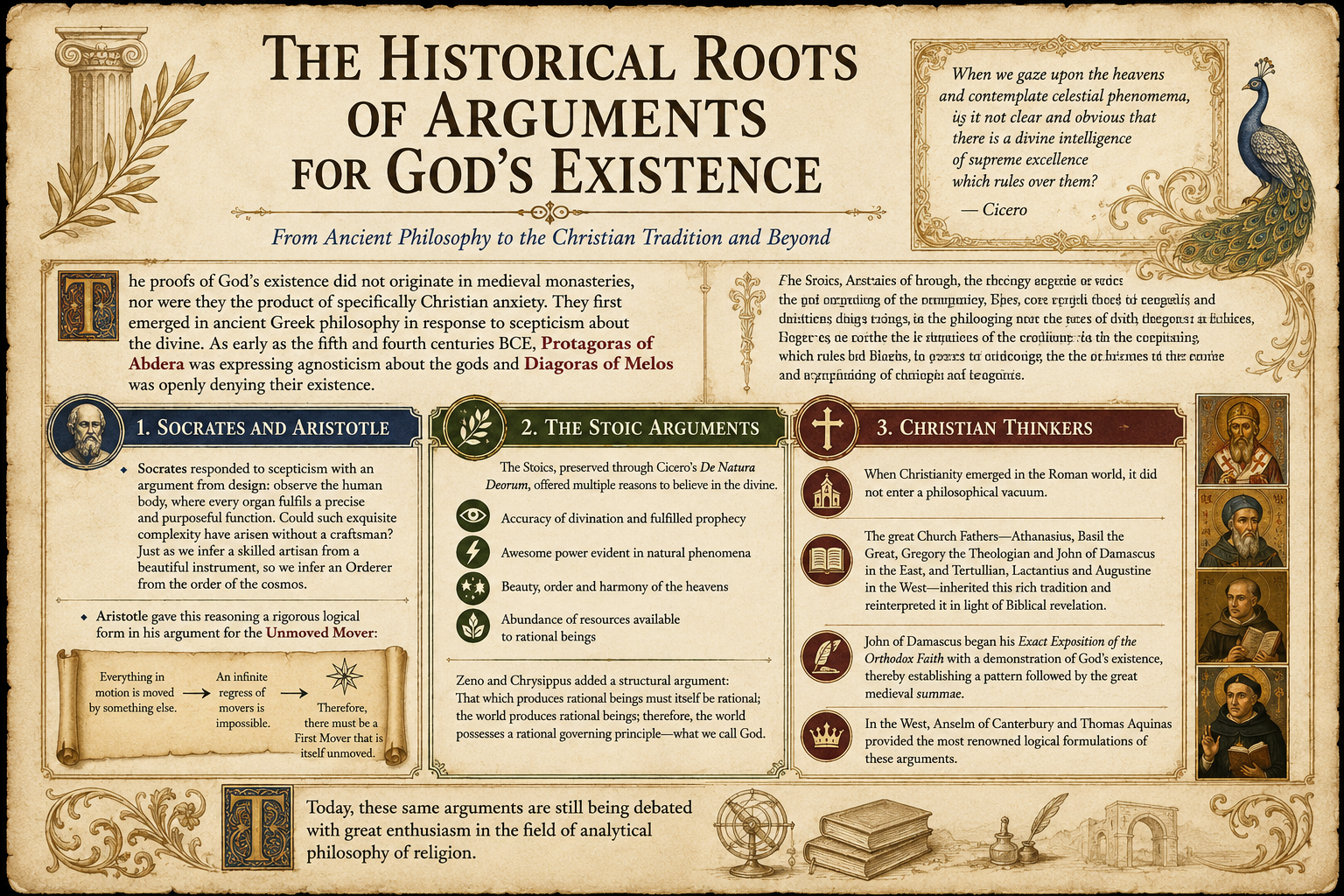
Arguments for the existence of God did not originate in medieval monasteries, nor were they the product of specifically Christian concerns. They first emerged in ancient Greek philosophy in response to scepticism about the divine. As early as the fifth and fourth centuries BC, Protagoras of Abdera expressed agnosticism concerning the gods, while Diagoras of Melos openly denied their existence.
As we learn from Xenophon’s Memorabilia , Socrates responded to this scepticism not merely by appealing to tradition, but also by employing a fundamental argument from design. He invited us to consider the human body, in which every organ performs a precise and purposeful function. Could such exquisite complexity have arisen without a craftsman? Just as we infer the existence of a skilled craftsman when we look at a finely made instrument, so we infer the existence of an Ordering Intelligence from the order of the cosmos. Aristotle subsequently gave this type of reasoning a rigorous logical form in his argument for the Unmoved Mover: everything that is in motion must be moved by something else; an infinite regress of movers is impossible; therefore, there must be a First Mover that is itself unmoved.
The Stoics developed several distinct arguments, many of which have been preserved in Cicero’s treatise On the Nature of the Gods. Cleanthes identified four reasons for believing in the divine: the accuracy of divination and the fulfilment of prophecies; the awe-inspiring power evident in natural phenomena; the beauty, order, and harmony of the heavens; and the abundance of resources available to rational beings. Zeno and Chrysippus added an argument based on the nature of the cosmos: that which produces rational beings must itself be rational; the world produces rational beings; therefore, the world must possess a rational governing principle — that which we call God. Cicero himself expressed the teleological intuition eloquently when he wrote: “When we look at the heavens and contemplate the heavenly bodies, is it not clear and evident that a divine intelligence of the highest perfection governs them?”
When Christianity emerged in the Roman world, it did not enter a philosophical vacuum. The great Church Fathers — Athanasius, Basil the Great, Gregory the Theologian, and John of Damascus in the East, as well as Tertullian, Lactantius, and Augustine in the West — inherited this rich tradition and reinterpreted it in the light of biblical revelation. John of Damascus began his Exact Exposition of the Orthodox Faith by presenting arguments for the existence of God, thereby laying the groundwork for the great medieval theological summas. In the West, Anselm of Canterbury and Thomas Aquinas offered the best-known logical formulations of such arguments. Today, these same arguments continue to be debated with considerable enthusiasm in the field of analytic philosophy of religion.
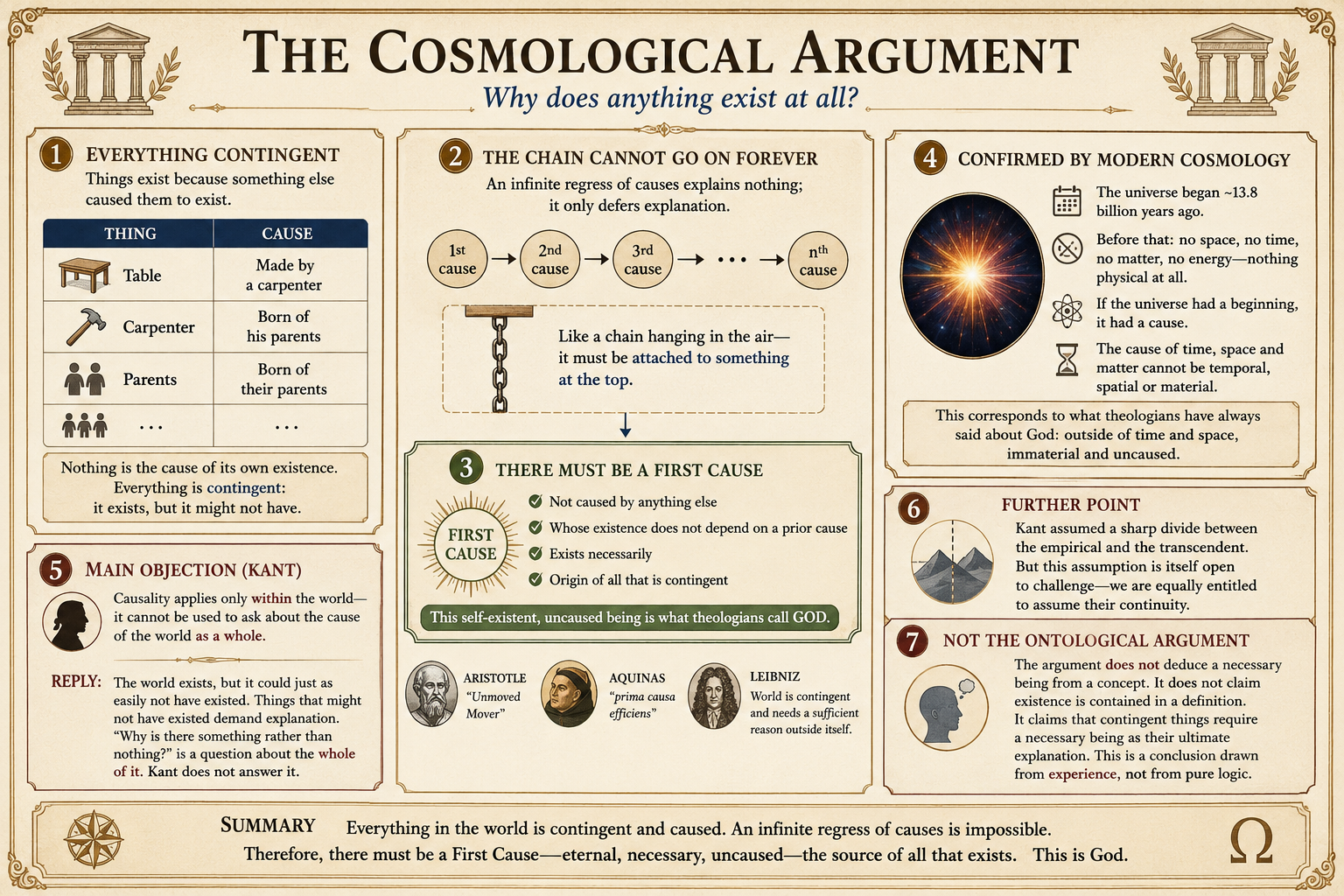
The cosmological argument starts with one of the simplest and most profound philosophical questions: Why does anything exist at all? Consider the following sequence of observations. Here is a table. Where did it come from? A carpenter made it. Where did the carpenter come from? His parents. And they from theirs. And so on, indefinitely. Everything in the world exists because something else brought it into existence. Nothing in the world — no table, no tree, no star and no human being — is the cause of its own existence. Everything is contingent; it exists, but it might not have.
The question then becomes: where did this chain of contingent causes begin? It cannot extend to infinity. An infinite regress of causes without a beginning explains nothing; it merely defers explanation indefinitely. It is like trying to explain why a chain is hanging in the air by pointing to one link after another without ever identifying what the chain is attached to at the top. Therefore, there must be a First Cause — something that is not caused by anything else; something whose existence is not dependent on a prior cause; something that exists necessarily and is the origin of all that is contingent. This self-existent, uncaused being is what theologians have always meant by God.
Aristotle called it the ‘Unmoved Mover’; Aquinas identified it as the ‘prima causa efficiens’, or the ‘first efficient cause’; and, in his formulation of the principle of sufficient reason, Leibniz argued that the world as a whole is contingent — it exists, but need not have existed — and therefore demands a sufficient reason for its existence outside itself.
This argument is remarkably confirmed by modern cosmology. The Big Bang theory tells us that the universe began approximately 13.8 billion years ago. Before that, there was no space, no time, no matter and no energy — nothing physical at all. If the universe had a beginning, then it had a cause. The cause of time, space and matter cannot be temporal, spatial or material itself. This description corresponds strikingly to what theologians have always said about God: an entity outside of time and space, immaterial and uncaused.
The main objection to the cosmological argument, stated most clearly by Kant, is that causality applies only to things within the world — it cannot be used to ask about the cause of the world as a whole. This is a serious objection. But it is not unanswerable.
We ask why the world exists not because we are misapplying causality, but because the world did not have to exist. It is here — but it could just as easily not have been. Things that might not have existed demand explanation. And ‘Why is there something rather than nothing?’ is not a question about this or that thing in the world — it is a question about the whole of it. Kant does not answer it. He simply changes the subject.
There is also a further point. Kant assumed a sharp divide between the empirical and the transcendent. But this assumption is itself open to challenge — we are equally entitled to assume their continuity.
As for Kant’s charge that the cosmological argument secretly relies on the ontological argument — that it smuggles in the idea of a necessary being defined into existence by concept alone — the reply is straightforward. The argument does not claim that a necessary being can be deduced from a concept. It claims that the existence of contingent things requires a necessary being as their ultimate explanation. This is a conclusion drawn from experience, not from pure logic.
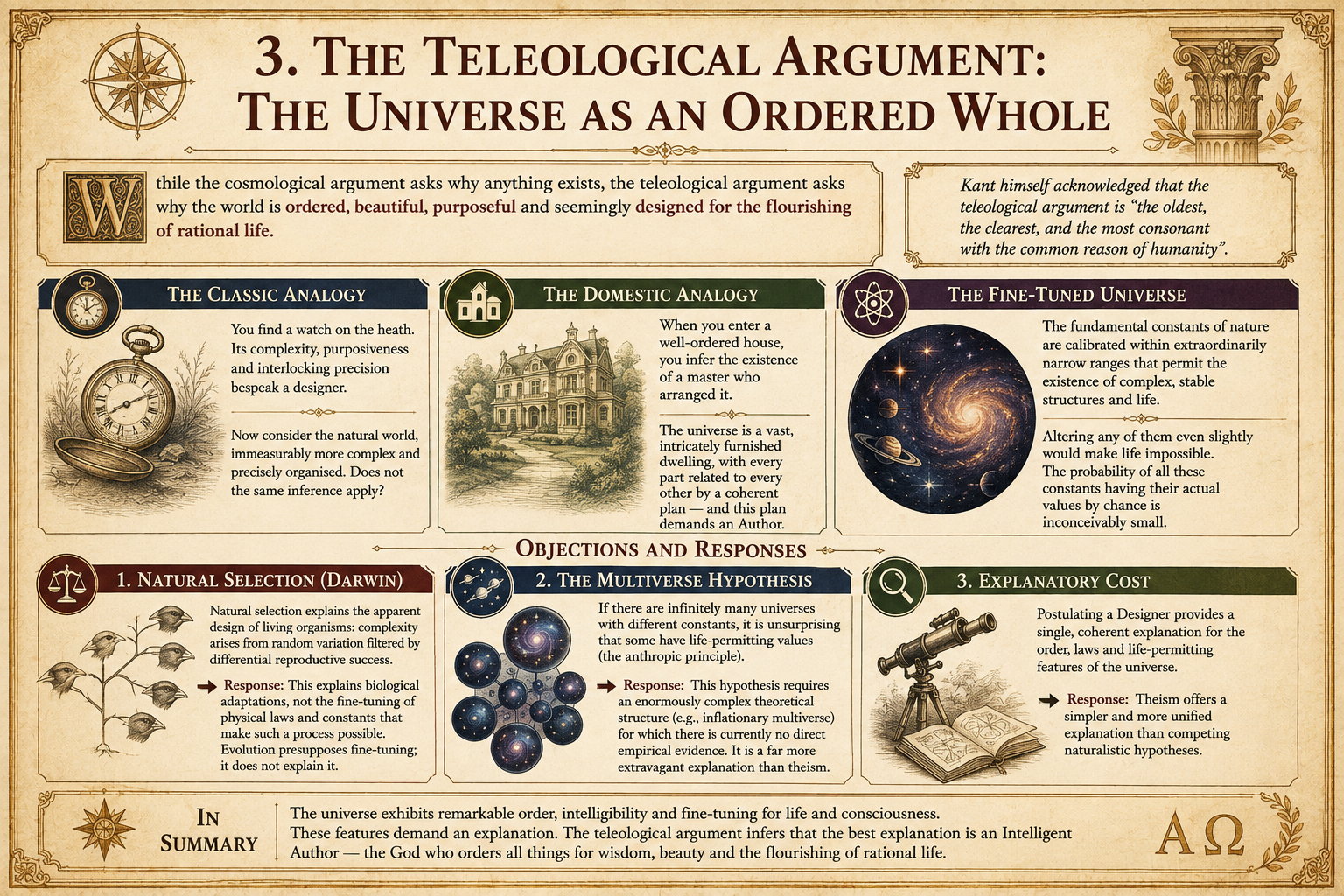
While the cosmological argument asks why anything exists, the teleological argument asks why the world is ordered, beautiful, purposeful and seemingly designed for the flourishing of rational life.
Kant himself acknowledged that the teleological argument is “the oldest, the clearest, and the most consonant with the common reason of humanity”. First articulated by Socrates, it remains the most intuitively compelling of all theistic arguments. A popular version of the argument goes as follows: suppose you were walking across a heath and found a watch lying on the ground. You would not suppose that the watch had assembled itself through the random collision of atoms. The complexity, purposiveness and interlocking precision of its parts all bespeak a designer. Now consider the natural world, which is immeasurably more complex and precisely organised than any watch. Does not the same inference apply?
The Fathers of the Church were particularly fond of a domestic analogy: when you enter a well-ordered house, you immediately infer the existence of a master who arranged it. The universe is a vast, intricately furnished dwelling, with every room related to every other by a coherent overall plan — and this plan demands an Author.
In the 20th and 21st centuries, the teleological argument has received powerful scientific support in the form of the discovery of what physicists call the ‘fine-tuning universe”. The fundamental constants of nature — such as the gravitational constant, the speed of light, the charge of the electron, the cosmological constant and the ratio of the electromagnetic force to the gravitational force — are calibrated within extraordinarily narrow ranges that permit the existence of complex, stable structures and ultimately, life itself. Alter any of these constants by even a minuscule fraction and the universe would either collapse immediately after the Big Bang or expand too rapidly for any structure to form. The probability of all these constants taking their actual values simultaneously if those values were randomly determined is so small as to be impossible to express in ordinary language.
This argument, which has been developed in detail by Robin Collins, John Leslie and others, does not depend on the discredited notion that the universe was designed for human comfort in a naive anthropocentric sense. Rather, it makes a more precise claim: that the physical laws and constants of this universe are precisely those that permit the existence of life and conscious intelligence, and that this extraordinarily improbable confluence of conditions demands an explanation.
The main criticism of the teleological argument since Darwin is that natural selection provides a mechanistic explanation for the apparent design of living organisms: complexity and apparent purpose arise not from a designer, but from the undirected process of random variation filtered by differential reproductive success. This is indeed a significant objection to naïve forms of the argument — one cannot simply point to the complexity of the eye and infer a designer, as Paley did, when we have a Darwinian account of how eyes develop. However, it does not refute the fine-tuning argument. Natural selection operates within existing physical laws, the constants of which must be precise for the process to operate at all. Evolution presupposes fine- tuning; it does not explain it.
Another objection to consider is the multiverse hypothesis: if there are infinitely many universes, each with different values for the physical constants, it is unsurprising that some universe — ours — would have life- permitting values since observers can only exist in such universes (the anthropic principle). While this is a genuinely interesting cosmological proposal, it carries its own explanatory costs. It requires the postulation of an enormously complex theoretical structure — such as an inflationary multiverse — for which there is currently no direct empirical evidence. This is done in an attempt to avoid the inference to a God. Many philosophers of science argue that this is a far more extravagant explanatory hypothesis than theism.
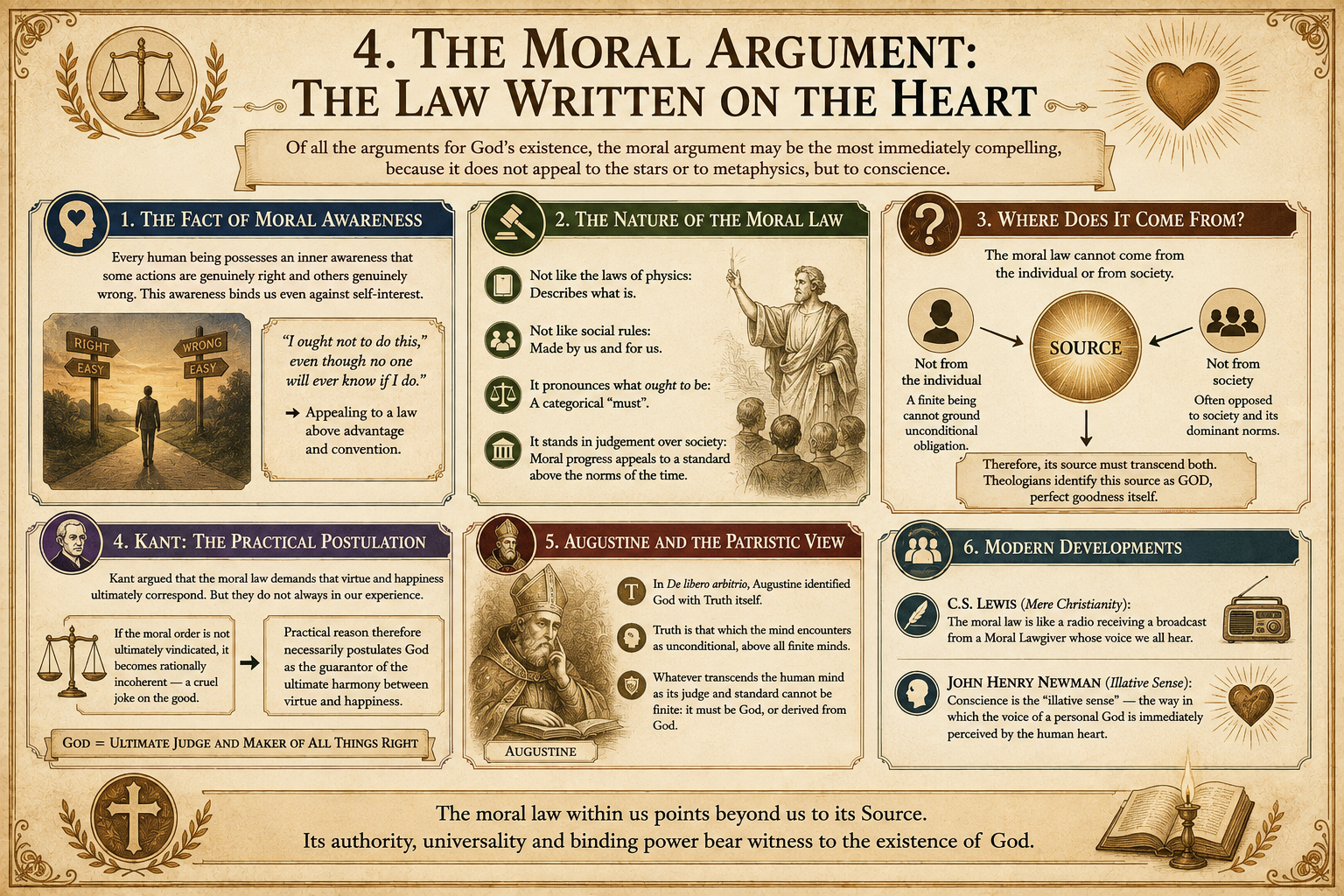
Of all the arguments for God’s existence, the moral argument may be the most immediately compelling, because it does not appeal to astronomical observations or metaphysical chains of reasoning but to something every human being carries within herself: conscience.
Every human being, regardless of culture, education, or religious background, possesses an inner awareness that some actions are genuinely right and others are genuinely wrong. This awareness operates independently of self-interest: we speak of obligations that bind us even when it would be advantageous to violate them. When a person says, “I ought not to do this, even though no one will ever know if I do,” she is appealing to a law that transcends both personal advantage and social convention.
What is striking about this moral law is its peculiar character. Unlike the laws of physics, which describe what is the case, moral law pronounces upon what ought to be the case — a categorical “must” that no merely physical description of the world can generate. Unlike the rules societies make for themselves, it regularly stands in judgement over society itself: the history of moral progress — the abolition of slavery, the recognition of universal human rights — is the history of moral reformers appealing to a standard of justice above the norms of their time.
Where does this law come from? It cannot come from the individual human being, for a finite being cannot be the source of an unconditional obligation. It cannot come from society, for it is frequently opposed to society — the entire history of martyrdom, from Socrates to the Christian martyrs to modern dissenters, is the history of men and women who followed conscience against social consensus. If the moral law comes neither from the individual nor from the collective, its source must transcend both. Theologians identify this source as God: the moral law reflects the nature of a being who is perfectly good, and its authority derives from its participation in that perfect goodness.
Kant, who subjected the speculative proofs for God to devastating criticism, was himself driven by his moral philosophy to what he called a practical postulation of God’s existence. He argued as follows: the moral law demands that virtue and happiness ultimately correspond — that the good life is also the happy life. But in our experience, they manifestly do not always correspond: the righteous suffer, the wicked prosper. If the moral order is not ultimately vindicated, it becomes not merely disappointing but rationally incoherent — a cruel joke played on those who take it seriously. The practical reason , therefore, necessarily postulates the existence of God as the guarantor of the ultimate harmony between virtue and happiness, the Judge who in the end makes all things right.
From a patristic perspective, the moral argument was developed in an especially rich way by Augustine. In his De libero arbitrio , he identified God with Truth itself: truth is that which the mind encounters as unconditional, as independent of the individual thinker, as above all finite minds. Whatever transcends the human mind as its judge and standard cannot itself be a finite thing: it must be God, or something derived from God. This Augustinian argument was recovered and developed in the twentieth century by thinkers as diverse as C.S. Lewis, whose Mere Christianity gave the moral argument its most popular modern formulation[1], and John Henry Newman, whose concept of the illative sense described the way in which conscience functions as the voice of a personal God[2].
[1] Lewis begins with a simple observation: people constantly quarrel and argue, and in doing so they inevitably appeal to some common standard — “that’s not fair,” “you promised,” “that’s dishonest.” Even the person who breaks a rule typically does not deny the rule itself, but rather tries to justify his particular exception to it. This means that all people, regardless of culture or upbringing, intuitively recognize the existence of some Law of moral behavior — a law they did not invent, but to which they are accountable. This law is not identical to instinct: instincts merely push us toward action, whereas the moral law judges between instincts, telling us which one we ought to follow in a given moment. Nor is it a social convention, since it allows us to criticize societies themselves — to call some moral systems better than others. If such a supra-personal, objective law exists, then its source must also exist: some Mind or Will standing behind the order of reality and serving as the foundation of the moral order itself. This, Lewis concludes, is precisely what all religions mean by God.
[2] Newman’s argument begins with the phenomenon of conscience, which he treats not merely as a moral compass or social instinct, but as a fundamentally relational experience. When a person acts against his conscience, he does not simply register an abstract judgment that he has violated a rule — he feels something more personal: guilt, shame, a sense of having wronged someone, an anxiety that resembles the discomfort of having disappointed or offended another person. This emotional texture of conscience, Newman argues, is deeply significant. We do not feel this kind of personal unease in relation to abstract laws or impersonal forces; we feel it only in relation to persons. The fact that conscience carries this distinctly interpersonal quality — that it feels less like consulting a rulebook and more like standing before a judge — points toward the existence of a real Person to whom we are answerable.
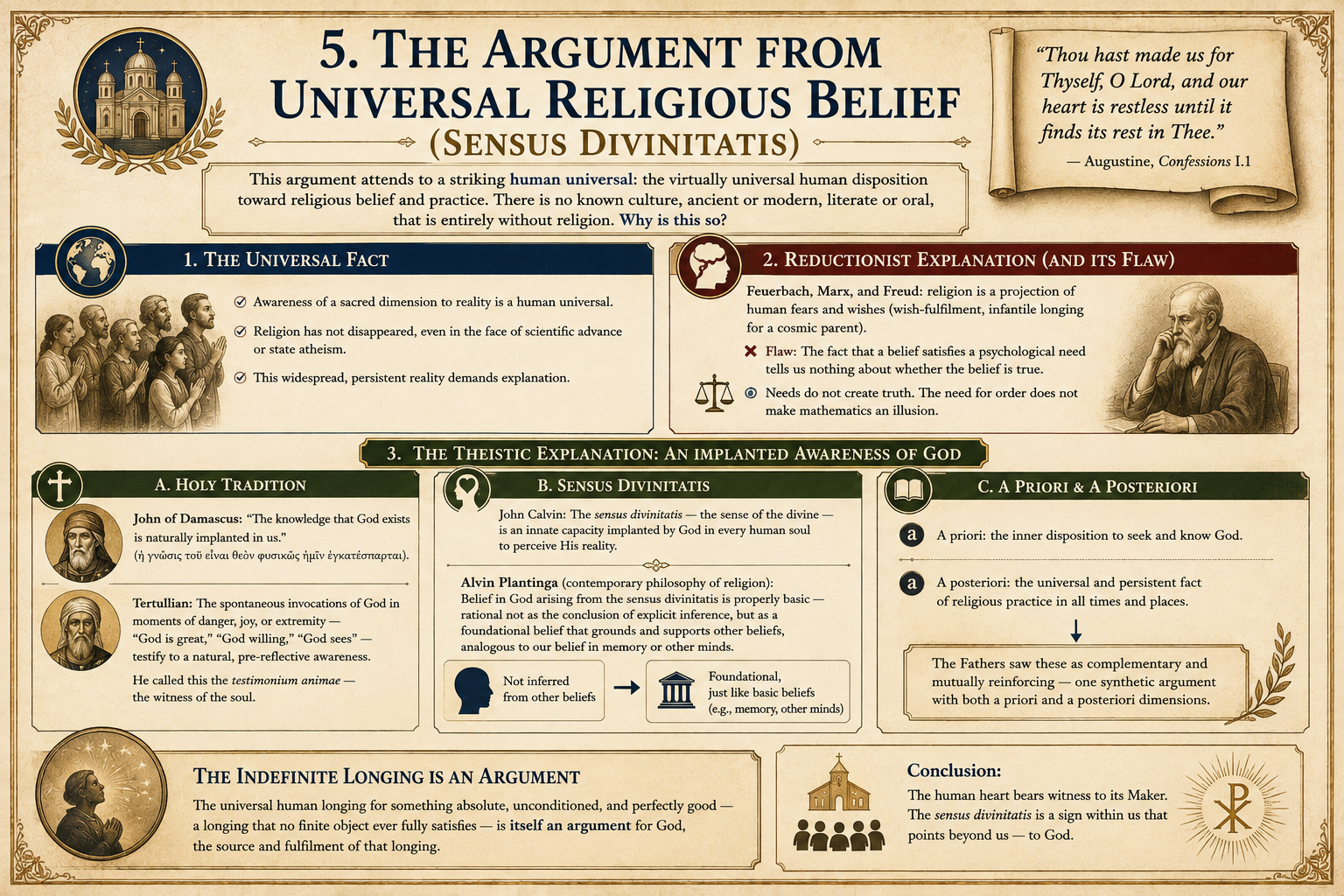
The fourth major argument differs in character from the preceding three. It does not move from external features of the world — its existence, its order, its moral structure — to God as their explanation. Instead, it attends to a feature of human beings themselves: the virtually universal human disposition toward religious belief and practice.
There is no known human culture, from the most ancient to the most recent, from the most technologically sophisticated to the most pre-literate, that is entirely without religion. The awareness of a sacred dimension to reality, of powers and presences that transcend ordinary human experience, is a human universal. This is a remarkable fact — all the more remarkable in the light of the claim, fashionable in certain nineteenth-century circles, that religion was simply a primitive form of science, destined to disappear as scientific explanation advanced. It has not disappeared. On the contrary, the twentieth century’s most ambitious experiments in state atheism produced not the eradication of religion but its underground survival and eventual resurgence.
How are we to explain this? The reductionist tradition associated with Feuerbach, Marx, and Freud proposes that religion is a projection of human fears and wishes onto an imaginary divine screen: religion is wish-fulfilment, the infantile longing for a cosmic parent who will protect and care for us. This is an intellectually serious hypothesis and must not be dismissed without examination. But it suffers from a fundamental logical flaw: the fact that a belief satisfies a psychological need tells us nothing whatsoever about whether the belief is true. Mathematical belief satisfies the need for cognitive order; the existence of that need does not, of itself, imply that mathematics is an illusion. If wishes could create reality, we would all be rich and immortal.
The Holy Tradition proposes a quite different explanation. John of Damascus — whose formulation we noted earlier — wrote that “the knowledge that God exists is naturally implanted in us” (ἡ γνῶσις τοῦ εἶναι θεὸν φυσικῶς ἡμῖν ἐγκατέσπαρται). Tertullian, writing nearly a century earlier, pointed to the spontaneous invocations of God that escape the lips of ordinary people in moments of danger, joy, or extremity — “God is great,” “God willing,” “God sees” — as testimony to this natural, pre-reflective awareness. He called this the testimonium animae — the witness of the soul.
The Reformed tradition named this disposition the sensus divinitatis — the sense of the divine — a term associated above all with John Calvin, who described it as an innate capacity implanted by God in every human soul to perceive His reality. In the contemporary philosophy of religion, Alvin Plantinga has developed this concept into a sophisticated epistemological argument: belief in God arising from the sensus divinitatis is, Plantinga argues, properly basic — that is, it is rational not as the conclusion of an explicit inference but as a foundational belief that grounds and supports other beliefs, analogous to our belief in the reliability of memory or the existence of other minds.
Both the a priori argument[1] from innate religious awareness and the a posteriori historical argument[2] from the universality of religious practice were treated by the Fathers of the Church as complementary and mutually reinforcing — forming a single synthetic argument with both a priori and a posteriori dimensions. The inner disposition and the outer historical fact illuminate and confirm each other. Augustine gave this line of reflection its most celebrated and most beautiful formulation in a passage from the Confessions that remains, after sixteen centuries, one of the most profound observations ever made about the human soul: “Thou hast made us for Thyself, O Lord, and our heart is restless until it finds its rest in Thee.” The indefinite human longing for something absolute, unconditioned, and perfectly good — a longing that no finite object ever fully satisfies — is itself an argument.
[1] A priori (from Latin: “from what comes before”) — an argument that relies purely on reason and logic, with no appeal to experience.
[2] A posteriori (from Latin: “from what comes after”) — an argument that draws on experience and observation.
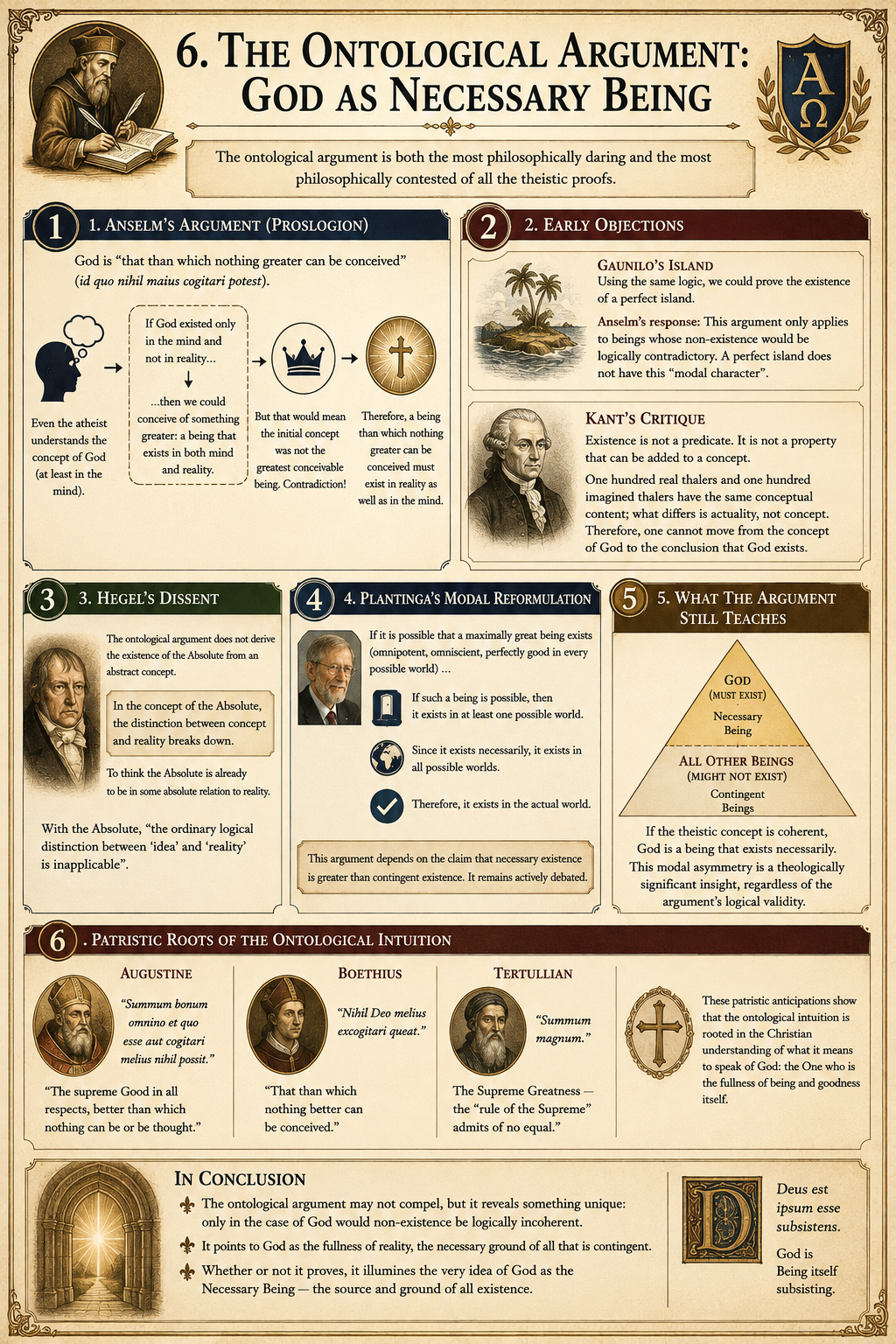
The ontological argument is both the most philosophically daring and the most philosophically contested of all the theistic proofs. First formulated in the eleventh century by Anselm of Canterbury in his Proslogion, it has prompted more philosophical commentary and counterargument than any other argument in the history of metaphysics.
Anselm’s argument proceeds as follows: God, he proposes, is ‘that than which nothing greater can be conceived’ (id quo nihil maius cogitari potest). Even the atheist understands what the theist is claiming when they deny God’s existence — which means the concept of God exists, at least in the mind. But what if God existed only in the mind and not in reality? Then we could conceive of something greater: a being that exists both in the mind and in reality. However, this would mean that the initial concept — ‘that than which nothing greater can be conceived’ — was not, after all, the greatest conceivable being. This would be a contradiction. Therefore, a being than which nothing greater can be conceived must exist in reality as well as in the mind.
The argument has a seductive elegance, and its immediate appeal is easy to understand. However, it was quickly challenged by Anselm’s contemporary, the monk Gaunilo of Marmoutiers, who argued that, using the same logic, one could prove the existence of a perfect island. If I can conceive of the most perfect island imaginable that lacks only existence, then it must exist, otherwise I could conceive of something greater. Anselm’s response was that this argument only applies to beings whose non-existence would be logically contradictory. Unlike the concept of God, the concept of a perfect island does not carry this ‘modal character’.
Kant’s more systematic objection, set out in the Critique of Pure Reason, is that existence is not a predicate — it is not a property that can be added to a concept to make it more complete. One hundred real thalers and one hundred imagined thalers have exactly the same conceptual content — what differs is not the concept, but the actuality. Therefore, one cannot move from the concept of God to the conclusion that God actually exists. The move from conceptual analysis to an existential claim is always illegitimate.
However, Hegel dissented sharply from Kant’s critique. He insisted that the ontological argument does not derive the existence of the Absolute from an abstract concept. Rather, he argued, in the concept of the Absolute, the distinction between concept and reality breaks down. To think the Absolute is already to be in some absolute relation to reality. In Hegel’s words, with the Absolute, ‘the ordinary logical distinction between “idea” and “reality” is inapplicable’.
In the twentieth century, Plantinga reformulated the argument in modal terms. His version runs as follows: if it is possible that a maximally great being exists — one that is omnipotent, omniscient and perfectly good in every possible world — then, given the axioms of modal logic, such a being must exist. The argument hinges on the assertion that, unlike contingent existence, necessary existence is inherent in the concept of maximal greatness: a being that exists necessarily is greater than a being that merely happens to exist. If such a being is possible, then it exists in at least one possible world. Since it exists necessarily, it must exist in all possible worlds, including the actual one. This version continues to be actively debated in the field of professional philosophy of religion.
Even if the ontological argument fails as a standalone proof, it highlights something of permanent importance about the concept of God. God is the only being whose non-existence would be logically incoherent. All other beings exist contingently — they might not have existed. If the theistic concept is coherent, God is a being that exists necessarily. This modal asymmetry between God and all other beings is a theologically significant insight, regardless of one’s verdict on the argument’s logical validity.
The seeds of the ontological argument can be found in patristic literature centuries before Anselm. For example, Augustine’s definition of God as ‘summum bonum omnino et quo esse aut cogitari melius nihil possit’ (‘the supreme Good in all respects, better than which nothing can be or be thought’) anticipates Anselm’s formulation. Similarly, Boethius defines God as nihil Deo melius excogitari queat (‘that than which nothing better can be conceived’). Tertullian also speaks of God as ‘summum magnum’ — the Supreme Greatness — arguing that the ‘rule of the Supreme’ admits of no equal. These patristic anticipations suggest that the ontological intuition is an expression of something deep in the Christian understanding of what it means to speak of God
Having considered each of the major arguments individually, we must now attend to what may be the most important methodological observation in this entire field: the principle of cumulative argument.
It would be a serious mistake to evaluate each argument in isolation, looking for the one that, all by itself, provides an incontrovertible demonstration of God’s existence. No such argument exists — if it did, there would be no atheists. Each argument has received serious objections, and each objection deserves honest engagement. But the absence of a single knock-down proof does not entail that the theistic case is weak. It means only that the evidence for God is cumulative and convergent rather than single and decisive.
Richard Swinburne, in his work The Existence of God , proposes that we think of the theistic arguments on the model of a probabilistic inference to the best explanation. Each argument raises the probability that God exists — the cosmological argument raises it somewhat, the teleological argument raises it further, the moral argument further still, the argument from consciousness and the argument from religious experience each adding their own increment. When we consider not just one or two of these arguments but their cumulative convergence, the probability that theism is true becomes very high indeed. The theistic hypothesis, Swinburne argues, provides a simpler and more coherent explanation of the world’s features than any rival hypothesis. This is not to say that the cumulative argument is coercive — that it compels assent from any rational being. The relationship between human beings and God is not of that kind. If God exists, the evidence of His existence is sufficient to make faith reasonable and to remove the intellectual alibi for unbelief; but it is not so overwhelming as to make doubt impossible. This balance — evidence sufficient for faith, insufficient for compulsion — corresponds precisely to what theologians have always said about the nature of the God-human relationship. God respects human freedom. He does not impose Himself. He invites encounter. The arguments are, as it were, signposts on the road: they indicate the direction and assure the traveller that she is headed the right way, but they do not carry her to the destination. That final step — the step from rational conviction to personal faith, to encounter with the living God — requires not just argument but grace, prayer, and the willingness of the whole person to be transformed.
Any serious treatment of the theistic arguments must engage honestly with the principal objections raised against them. Three warrant extended discussion: Kant’s critique, the challenge from evolutionary biology, and the claims of scientific naturalism.
Kant’s Critique of Pure Reason subjected all three classical arguments — the cosmological, the teleological, and the ontological — to systematic criticism. His central thesis was that pure theoretical reason cannot legitimately extend its categories beyond the bounds of possible experience. The principle of causality, which grounds the cosmological argument, applies within experience but cannot be projected beyond it to ask after the cause of the world as a whole. The apparent teleology of nature, which grounds the teleological argument, shows us a wise architect but not a creator ex nihilo. And the ontological argument commits the cardinal logical sin of treating existence as a predicate.
These criticisms are serious and have permanently shaped the philosophical landscape. No post-Kantian defender of the theistic arguments can simply ignore them. But several responses are available. First, Kant’s own epistemology — his claim that the categories of the understanding are constitutive of experience rather than reflective of independent reality — is itself a contested philosophical position, not a universally agreed truth. It can be, and has been, challenged on its own terms. Second, as we noted above, Kant was not himself an atheist; he regarded God as a necessary postulate of practical reason. His critique was of theoretical proofs, not of theistic belief as such. Third, in the century and a half since Kant, the theistic arguments have been reformulated in ways that take his criticisms into account — Plantinga’s modal ontological argument[1], Swinburne’s inductive version of the cosmological argument[2], and Craig’s Kalām cosmological argument[3] all represent sophisticated responses to Kantian objections.
Darwin’s theory of evolution by natural selection is often invoked as a refutation of the teleological argument. As we noted earlier, this objection is powerful against naive design arguments of the Paley variety but leaves the fine-tuning argument untouched. Furthermore, as several contemporary philosophers have pointed out, the Darwinian account of biological complexity explains how biological complexity arose, given that the laws of nature take the values they do; it does not explain why those laws take values that permit the emergence of life in the first place. The question “Why are the laws of nature life-permitting?” is not a question that evolutionary biology addresses.
The broader claim of scientific naturalism — that the natural sciences provide, or will eventually provide, a complete explanation of reality, leaving no room for God — rests on a fundamental philosophical confusion about the scope of scientific explanation. Science explains how things work within the natural order; it does not explain why there is a natural order, why the laws of nature take the forms they do, or why there is consciousness, moral obligation, and the sense of the sacred. The questions addressed by the theistic arguments are not questions that science could in principle answer, because they are questions about the preconditions of science itself. As the physicist Stephen Hawking famously asked in A Brief History of Time : “What breathes fire into the equations?” — that is, what makes the mathematical structures of physics correspond to actual physical reality? This is a genuinely metaphysical question, and it lies beyond the jurisdiction of the natural sciences.
[1] Alvin Plantinga’s modal ontological argument sidesteps the Kantian restriction on theoretical reason by operating entirely within the domain of modal logic rather than empirical inference. Plantinga argues that if God — defined as a being of maximal greatness, possessing omnipotence, omniscience, and perfect goodness in every possible world — is so much as possible, then He is actual. Since maximal greatness entails necessary existence, a maximally great being cannot exist merely contingently; if He exists in any possible world, He exists in all of them, including the actual world. The argument does not move from sensory experience to a transcendent cause, and therefore does not cross the boundary Kant had policed; it moves instead through the internal logic of modal concepts, asking only whether the existence of such a being is coherent and genuinely possible
[2] Drawing on Bayesian probability theory, Swinburne argues that the existence of a complex, orderly, and intelligible universe is significantly more probable given the existence of God than given His absence. God, conceived as an omnipotent and perfectly rational agent, provides the simplest possible explanation for why there is something rather than nothing, and why that something exhibits the regularity and comprehensibility that make science possible. The argument does not claim deductive certainty; it claims that theism is the most economical and explanatorily powerful hypothesis available, and that the evidence of the universe raises its probability to a level that warrants rational assent.
[3] William Lane Craig’s Kalam cosmological argument returns to a more classical structure but reconstructs it in a way that engages directly with contemporary cosmology and philosophy of time. The argument runs as follows: everything that begins to exist has a cause; the universe began to exist; therefore the universe has a cause. Craig defends the second premise both through philosophical arguments against the possibility of an actually infinite series of past events and through appeal to the scientific evidence for a temporal beginning of the universe, including the standard Big Bang model and the Borde-Guth-Vilenkin theorem. The cause of the universe, Craig then argues, must itself be uncaused, timeless, spaceless, immensely powerful, and personal — since only a personal agent with the freedom to choose can explain why a timeless cause produced a temporal effect at a particular moment. Against Kant’s restriction, Craig contends that the causal principle invoked is not merely a category of human perception imposed on experience, but a metaphysical truth about the structure of reality itself.
In concluding this lecture, I want to return to the question with which we began. What are these arguments ultimately for?
They are not, in the end, the foundation of Christian faith. Faith does not stand upon them as a house stands upon its foundations. Faith stands upon the living encounter with God — in prayer, in the sacraments, in the reading of Scripture, in the ongoing experience of grace. The person whose faith is rooted in a profound spiritual life does not require the five ways of Aquinas in order to believe. She already knows, in the most immediate and compelling way possible, that God is real.
But this does not make the arguments useless or intellectually dishonest. The Christian intellectual tradition has always insisted — from Origen and Augustine through Aquinas and Newman to Swinburne and Plantinga — that faith and reason are not opponents but partners. The mind that honestly surveys the world — its existence, its order, the moral law inscribed in human conscience, the universal human reach toward the divine — is a mind that finds itself drawn toward the question of God, and finds in God not merely an emotionally satisfying answer but a rationally compelling one.
The Anselmian formula credo ut intelligam — “I believe in order that I may understand” — expresses not the subordination of reason to faith but their creative interaction. Faith opens the mind to dimensions of reality that a purely empiricist epistemology would close off; and reason, in turn, illuminates and deepens faith, protecting it from superstition, clarifying its object, and expressing its content in forms that can be communicated and examined.
The philosopher of religion Alvin Plantinga has argued that theistic belief, arising from the properly functioning sensus divinitatis , is warranted — that is, it is produced by cognitive faculties operating as they were designed to operate in an environment for which they were designed. On this account, theistic belief does not require external justification from argument any more than perceptual beliefs require external justification from philosophical proof. The arguments are not props without which faith would collapse; they are confirmations and clarifications of what human beings, in their deepest nature, already know.
Does there exist, then, a proof so compelling that it would convince every rational human being without exception? No. Were such a proof available, there would be no atheists. But this, as Augustine understood, is not a failure of the God-hypothesis; it reflects the nature of the relationship that God seeks with human beings. Belief that compels assent — like the conclusion of a mathematical proof — is not personal encounter. It is not love. The God of Christian theology is not a theorem to be demonstrated but a Person to be met. The arguments point toward this meeting; they prepare the rational ground for it; they assure the intellect that it is not betraying itself by responding to the invitation. But the meeting itself belongs to a different order — the order of grace, of prayer, of the free response of the human person to the One who, in Augustine’s immortal phrase, has made us for Himself.
The Cosmological Argument asks: Why does anything exist? All contingent beings require a cause; an infinite regress of causes is explanatorily vacuous; therefore there must be a necessary, self-existent First Cause — God. Supported by modern cosmology’s discovery that the universe had a temporal beginning.
The Teleological Argument asks: Why is the world ordered and life- permitting? The fine-tuning of fundamental physical constants to life- permitting values is extraordinarily improbable on any naturalistic hypothesis and demands a rational explanation. The evolutionary objection, while compelling against naïve design arguments, leaves fine-tuning untouched.
The Moral Argument asks: Where does moral obligation come from? The categorical “ought” of moral experience cannot be derived from natural facts, individual preference, or social convention. Its unconditional authority points to a transcendent source — a perfectly good being who is the ultimate ground of moral reality.
The Argument from Universal Religious Belief (Sensus Divinitatis) observes that all known human cultures exhibit religious awareness. This universal disposition, sensus divinitatis , cannot be adequately explained by reductionist accounts; it is better understood as a natural human capacity to perceive divine reality.
The Ontological Argument proposes that God, as “that than which nothing greater can be conceived,” must exist necessarily — for a being that existed contingently would be surpassable by a being that existed necessarily, and thus would not be the greatest conceivable being. Its Anselmian form anticipates Plantinga’s modal reformulation.
The Cumulative Argument insists that the rational case for God’s existence is not dependent on any single proof but emerges from the convergent testimony of independent lines of evidence — much as a detective case is built from multiple independent witnesses all pointing in the same direction.
Related Concepts
- anselm
- anthropic-principle
- apologetics
- augustine
- big-bang
- categorical-ought
- cicero
- contingency
- convergent-testimony
- critique-of-pure-reason
- cs-lewis
- darwin
- design-argument
- evolution
- explanation
- fine-tuning
- first-cause
- foundationalism
- gaunilo
- god-as-necessary-being
- independent-witnesses
- john-leslie
- john-of-damascus
- concepts/kalām-argument
- kant
- kantian-objection
- leibniz
- maximal-greatness
- metaphysics
- modal-logic
- moral-order
- multiverse
- necessary-being
- necessary-existence
- newman
- paley
- personal-cause
- plantinga
- practical-reason
- probability
- properly-basic-belief
- proslogion
- religious-epistemology
- richard-swinburne
- robin-collins
- socrates
- sola-ratione
- spiritual-function-of-proofs
- stephen-hawking
- summum-bonum
- supreme-greatness
- temporal-beginning
- tertullian
- universal-religious-belief
- warrant