Fundamental Theology — Topic 4. Kant, Hegel, and Schleiermacher on Religion
Let us draw the threads together. We have examined three significant philosophical perspectives on religion, which have collectively influenced most of the assumptions held by educated Western culture regarding the subject over the past two centuries. Each has genuine merit. Each contains real insight. However, at the decisive moment, each reduces religion to something else, thereby losing what is most essential in the process.
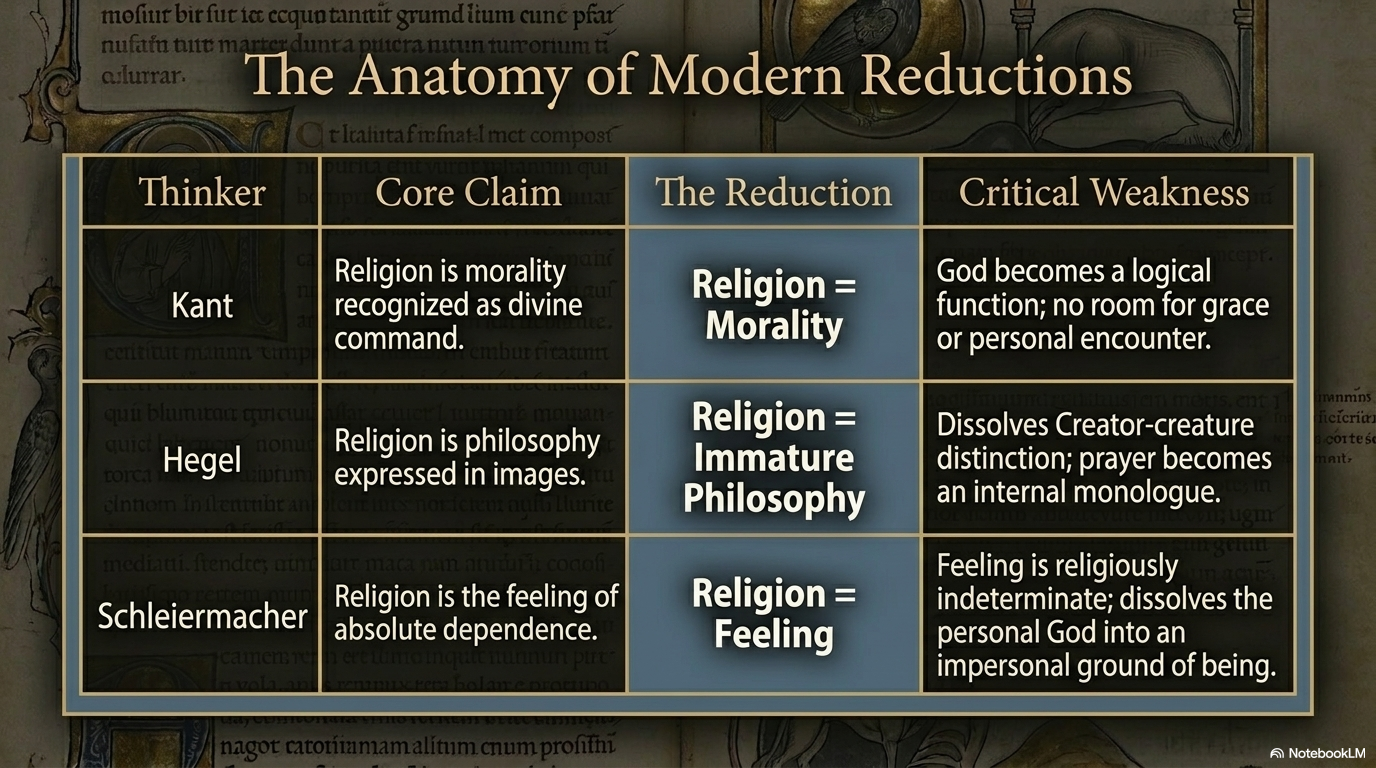
All three positions contain genuine observations. Kant was right in saying that religion cannot be reduced to theoretical metaphysics and that the moral dimension of human life points towards something absolute. Hegel was right that religion and philosophy are not enemies; that religious traditions contain real truths, even when expressed in images; and that the task of the educated person is to understand religious content more deeply, rather than dismissing it. Schleiermacher was right that religion has its own intrinsic content that cannot be found by examining doctrine and institutions alone, but rather by observing the actual experiences of individuals in their encounters with the transcendent.
However, each of these thinkers lost sight of the most essential aspect: the living, personal relationship between a human being and the personal God who is the Creator. Without that, you may have interesting philosophy. You may have edifying ethics. You may have a genuine aesthetic or contemplative experience. However, you do not have religion in the sense in which any of the great traditions have understood it or in the sense in which the Christian gospel speaks of it.
There is a deeper point worth making here that unifies all three critiques. All three of these thinkers are working within a common assumption that has proved to be a kind of trap. This assumption is that religion must be grounded in something within the human being — reason, the rational-moral structure of practical consciousness or the immediate structure of feeling. According to this assumption, God is something that the human being arrives at, whether through moral argument, dialectical self-knowledge or attending to the depths of inner experience. The movement is always from human beings towards God. What all three miss, or cannot accommodate within their frameworks, is the possibility that the movement goes in the other direction — that what is primary is not the human being reaching for God, but God coming to the human being. Revelation. Initiative. Word. The God of Abraham, Isaac and Jacob cannot be deduced through reasoning or feeling. He is the one who speaks first. He is the One who calls. He acts in history and enters it; He is not an idea, a postulate, or the basis of a feeling, but a person — indeed, more than a person — who has revealed Himself.
This is the point from which a genuinely theological account of religion must begin. Not from Kant’s rational subject, Hegel’s self-developing Absolute or Schleiermacher’s feeling subject contemplating its own dependence, but from the God who came before all of these — who created the subject, grounds the Absolute and is the source of the dependence that feeling recognises but cannot explain. The three philosophers we have examined were honestly and rigorously trying to make sense of religion in a world losing confidence in revelation. In that respect, they deserve serious engagement and genuine respect. However, the outcome of their endeavours, regardless of their intentions, was not a deeper comprehension of religion. Each time, it was an elegant and sophisticated dissolution of religion. It is important to be clear-eyed about this, precisely because the dissolution has continued and the forms these positions take in contemporary culture are no less influential for being less philosophically self-conscious than the originals.
Imagine someone who has not been raised in any particular religious tradition, yet is genuinely preoccupied with fundamental questions such as: What is the world? Is there order in it? What is the basis of morality? What happens after death? They are neither a nihilist nor a cynic, but simply someone who wants to think honestly about how things are without pretending to have certainties they do not possess. Such people exist in every generation, and they are often the most serious individuals you will encounter. Where does a person like that begin?
They almost inevitably turn to classical philosophy — the accumulated inheritance of human thought that attempts to understand the self and the world without recourse to divine revelation. Here, they encounter a variety of approaches to understanding religion as a phenomenon. Three of these — those proposed by Immanuel Kant, G. W. F. Hegel and Friedrich Schleiermacher — came to dominate German thought in the 18th and 19th centuries, and their influence on subsequent theology and philosophy cannot be overstated. Together, they shaped many of the assumptions that educated Western culture has made about religion, its purpose, and its relationship with morality, reason, and feeling. You cannot understand modern liberal Protestantism without Schleiermacher. Similarly, you cannot understand the trajectory of academic theology in the nineteenth century without considering all three thinkers. Nor can you understand what went wrong without knowing exactly where each of these thinkers took a wrong turn.
A word of caution before we proceed. The approaches we are examining keep
reappearing in contemporary culture, often without those holding them
realising it. For example, whenever an educated person who does not attend
church says something like ‘religion is really just about being a good
person’, they are repeating Kant. When someone suggests that the stories of
the Gospels are beautiful myths that express deep philosophical truths but
questions whether any of it actually happened, they are operating within
Hegelian logic. When someone says, ‘I’m not religious, but I have a strong
sense of something greater than myself — something I connect with in nature or
music’, they are, roughly speaking, describing the Schleiermacherian position.
These are not abstract philosophical curiosities. They are the actual beliefs
of many people in contemporary Europe. If you are engaged in any kind of
apologetic work, you will encounter these positions constantly — usually
without the person using any of these names. This is precisely why it is
important to understand them properly — not just what is right in each
position, but also what is wrong.
- Introduction
- Section 1. Kant on Religion
- Section 2. Hegel on Religion
- Section 3. Schleiermacher on Religion
- Conclusion
2.1. The Copernican Turn: What Reason Can and Cannot Know
To understand how Kant developed his theory of religion, it is necessary to start with the fundamental question that he placed at the centre of everything: what can human reason actually know, and where does its competence end? This is not a preliminary question to be disposed of quickly before moving on to more interesting material. For Kant, it is the central question on which everything else turns. His answer constitutes what he himself, with characteristic boldness, termed a ‘Copernican revolution’ in philosophy.
Before Kant, the dominant assumption had been that our cognition conforms to objects: we observe the world, and it imprints itself on us as it really is. Knowledge was conceived as a kind of receptivity — the mind opens itself to what is out there and takes in its form. However, Kant completely inverted this idea: it is not our cognition that conforms to objects, but rather objects that conform to our cognition. This means that we never perceive things as they are in themselves. They are always already shaped by the forms our minds impose on raw experience: space, time, causality and the other categories of the understanding. These are not optional lenses that we can choose to consciously adopt. They are built into the very structure of cognition and cannot be avoided, any more than a person can decide to hear without ears.
The consequence of this insight is important and genuinely uncomfortable for certain ambitions of reason. Anything that falls outside sensory experience — anything that cannot be given to us in space and time — is simply beyond the reach of theoretical reason. In principle. This is not a temporary limitation that better science or sharper thinking might overcome, but a permanent structural boundary. Kant is not saying that we do not yet know enough. He is saying that, by the nature of knowledge, certain things are entirely beyond the scope of theoretical cognition.
The most useful analogy here is this: Imagine a person who has worn blue- tinted glasses since birth. They have never taken them off, not once in their life. They see the sky as blue, the sea as blue, snow as blue and human faces as blue. When asked, ‘What colour is the world?’, they answer with complete sincerity, ‘Blue.’ They are not lying. They are not making a mistake, like misremembering a date or making a mistake in arithmetic. The blue is not a distortion of their perception — to them, it is simply how things are. They simply have no way of seeing the world without these blue-tinted glasses and therefore have no way of knowing what the world looks like without them.
For Kant, space, time and causality are those blue glasses. We did not choose to put them on. We cannot take them off. All experience arrives filtered through them — ordered, arranged in temporal sequence and linked by causal chains. Everything that enters our field of experience is automatically given this ‘colouring’. This has important implications: we cannot, in principle, know what the world is like in itself, prior to it being processed by our minds. Kant calls this inaccessible reality the ‘thing-in-itself’ (das Ding an sich). It exists — this is a point on which Kant insists, distinguishing him from the idealists who came after him. However, it remains permanently beyond the reach of theoretical knowledge. It remains on the other side of the glass.
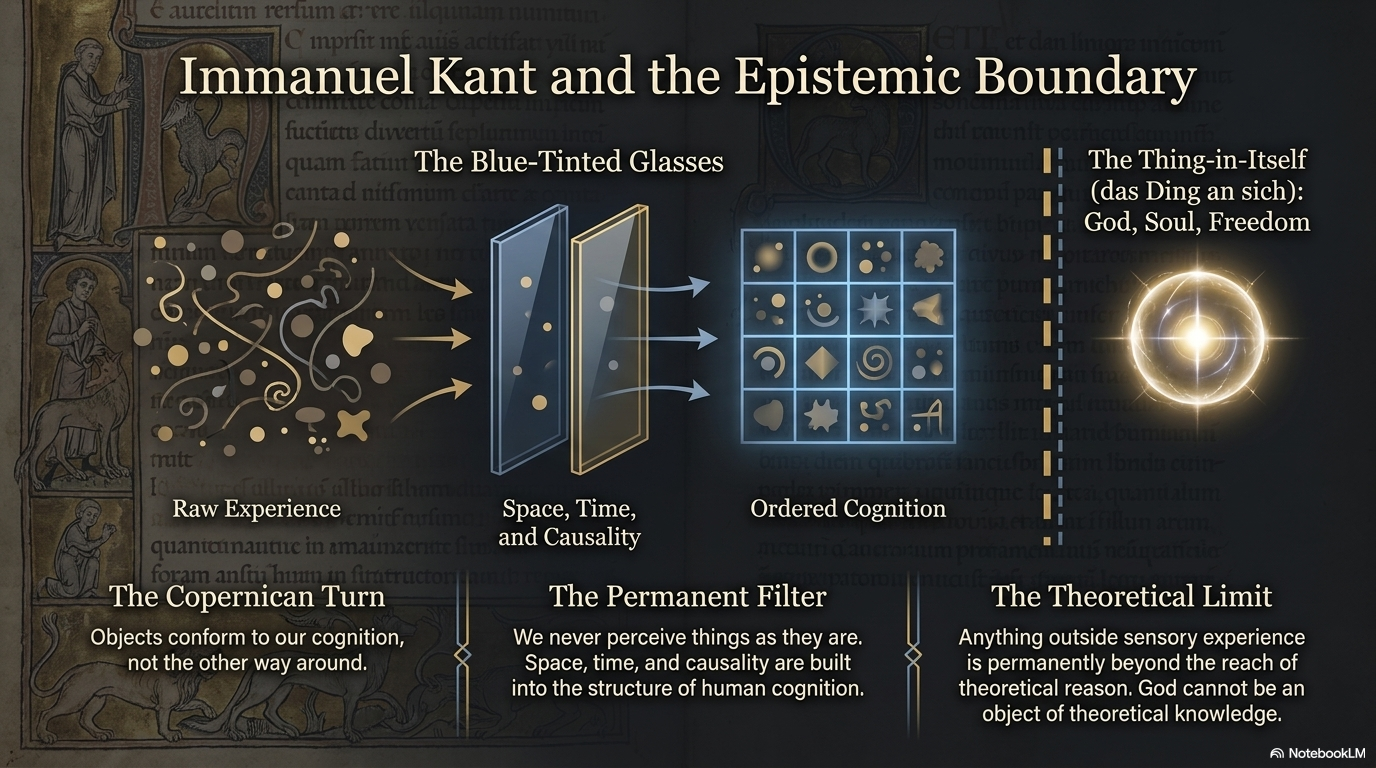
The soul, freedom and God — none of these are objects that the senses can grasp. None of them can be experienced in space or time. This means that, from the standpoint of theoretical reason, nothing reliable can be said about any of them. Kant examines the traditional proofs for God’s existence — the ontological, cosmological and teleological arguments — in detail, showing that each one, at the critical moment, makes a move that reason has no right to make: it steps from the world of appearances to what supposedly lies behind it without experiential justification. He is not debunking these arguments out of hostility to religion. He is doing something more fundamental: he is showing that theoretical reason simply does not have the tools to reach what these arguments are trying to reach. It is like trying to see ultraviolet light with the naked eye. The limitation is not in the argument, but in the instrument.
It is important to note what Kant is not doing here. He is not being an atheist. He does not say ‘God does not exist.’ Rather, he says, ‘God is not an object of theoretical knowledge.’ Reason cannot affirm or deny divine existence without exceeding its proper limits. According to Kant, both the person who claims to prove that God exists through speculative reasoning and the person who claims to disprove it are overstepping the same boundary. This distinction is important and worth bearing in mind as we proceed.
2.3. The Moral Law
This might seem to rule out religion entirely. If God cannot be theoretically known, and knowledge is what religion claims to be about, then religion appears to be a dead end. However, Kant immediately opens a different door, looking for religion elsewhere entirely: not in metaphysical reasoning about the cosmos or arguments from design or causation, but in the moral experience of the human person. Here, the argument takes a genuinely interesting turn.
Alongside theoretical reason, which knows the world, there is practical reason — reason that governs conduct. Here, Kant discovers something remarkable with no counterpart in the natural world: an unconditional moral demand. When a person hears the internal demand to act honestly, it is not dependent on whether it is advantageous, whether it will be noticed, or whether there will be a reward or punishment. It is unconditional — it does not say ‘if you want the benefit, do this’; it simply says ‘you must’. Kant calls this the categorical imperative and formulates it in one of the most famous sentences in the history of philosophy: ‘Act only according to that maxim by which you can at the same time will that it should become a universal law.’
The crucial point is that this law is not derived from experience. This is what makes it so philosophically significant. Neither observing nature nor studying history yields unconditional moral demands — they merely show us what happens, not what ought to happen. You could study the entire animal kingdom and all of human history and never encounter a single fact that tells you what you are morally required to do. The ‘ought’ cannot be inferred from the ‘is’. Therefore, the moral law is given to practical reason from the outset, a priori; it is rooted not in the world of appearances, but in the very structure of rational being. This is what makes the moral law unconditional, and it is precisely this that leads Kant to recognise something in the human person that transcends natural necessity. In this experience of unconditional obligation, Kant found what he could not find in metaphysical argument: a point at which human beings touch something absolute.
However, the moral law does not stand alone. It immediately confronts reason with questions that cannot be answered using theoretical resources alone — this is where the metaphysical concepts come back in, so to speak. Kant refers to these as the postulates of practical reason. They are not proofs or theoretical demonstrations, but rather necessary practical presuppositions — things that reason is compelled to assume if the moral order is to make sense.
The first postulate concerns the possibility of moral improvement itself. The categorical imperative demands that a person constantly moves towards the moral ideal or complete alignment between intention and duty. However, it is clear that no finite lifespan provides sufficient time for this. The gap between where any actual person stands morally and where the law requires them to be cannot be closed within a single human lifetime, no matter how conscientious the effort. Therefore, practical reason is compelled to postulate the immortality of the soul; without this postulate, the demand for moral perfection would be cruel — it would be like demanding the impossible from finite beings.
The second postulate is simpler but equally fundamental. The categorical imperative says ‘you ought’. However, ‘you ought’ only makes sense where ‘you can’ is also true; it is pointless to demand something from a person that is entirely outside their control. If all human actions are strictly determined by prior natural causes — in the same way that the trajectory of a stone is determined by physics — then the word ‘duty’ loses all meaning. You cannot hold a stone morally responsible for where it falls. The same applies if the human being is simply a more complicated stone. Therefore, reason is compelled to postulate freedom of the will, even though theoretical reason cannot demonstrate it and everything in the natural world appears to be governed by deterministic causes.
The third postulate is the most important for understanding Kant’s account of religion. The moral law demands not only virtuous conduct, but also that this conduct should ultimately make sense — that is, that virtue and happiness should correspond. Kant calls this the highest good (das höchste Gut): a state in which happiness is distributed precisely according to moral worth. The problem is that the real world conspicuously fails to fulfil this condition. Nature is entirely indifferent to morality. History is full of examples — too many to be dismissed as anomalies — of the righteous suffering and the wicked prospering. If this contradiction could not be resolved, the moral law would point towards something it could never achieve, making it rationally absurd. Therefore, there must exist a Being with all the necessary properties to bring about such a resolution: omniscience to know every action and intention; omnipotence to arrange the correspondence of virtue and happiness; and perfect goodness to will this correspondence. This being is what Kant calls God. God therefore enters the picture not through a cosmological argument or mystical experience, but as the guarantor that the moral order is not ultimately senseless.
2.5. Religion as Morality Recognised as Divine Command
Kant’s definition of religion follows directly from this. He states it briefly and unambiguously: ‘Religion is the recognition of all our duties as divine commands.’ It is worth pausing to consider what this actually means, because it is easy to miss how radical it is.
Duties exist independently of religion. They follow from the moral law, which a person discovers through practical reason alone, without any reference to God. God is not needed to create these duties, but rather to authorise them — to confer the highest possible sanction on them and guarantee their ultimate meaning. First, I understand that honesty is my duty, and only then can I say, drawing on the idea of God, that this is his commandment. Not the other way around. This is not a small point. It is the structural centre of Kant’s entire philosophy of religion. Morality comes first, and God comes second. Kant makes this explicit and unambiguous: ‘Morality has no need whatsoever of religion for its own sake; it has its foundation in pure practical reason.’ Religion merely supplements the moral system by providing what it lacks: a guarantee of ultimate meaning and a framework of sanctions. However, the content of religion is identical to the content of morality; there are no obligations that are specifically religious and distinct from moral ones.
This fundamentally contradicts the Christian understanding, in which God is primary and morality flows from one’s relationship with him. According to the Christian account, we do not first discover moral duties and then seek a divine authority to validate them. We know God as the ground of being and the source of all goodness, and our moral life is an attempt to live in accordance with who he is and what he wills. In Kant’s account, however, this order is reversed — and not incidentally, but as the whole point.
Kant draws the practical consequences of this without softening them, and they are severe. Everything in religion that exceeds morality — that is to say, most of what constitutes any actual religion — is either useless or harmful.
He calls prayer a ‘superstitious illusion’. God already knows our intentions and needs, so no verbal address adds anything to moral conduct, which is the only thing that has worth. For Kant, petitioning God in words is both redundant and slightly undignified — it suggests that we think we can inform or persuade an omniscient being of something it does not already know. The only form of ‘prayer’ that Kant is willing to accept is what he calls the ‘spirit of prayer’ — a kind of moral intention or inward orientation towards the good — which has nothing to do with words addressed to a personal God.
Worship and rites are, at best, symbolic reminders of moral truths — pedagogical aids for a stage of human development when people need external images and ceremonial props to help them fulfil their duties. They are, so to speak, moral scaffolding. Scaffolding is useful while a building is being constructed; once the structure is complete, the scaffolding is removed. As moral self-consciousness matures and people become capable of grounding their ethical life directly in reason, the need for ritual disappears.
Likewise, the sacraments are symbols and educational tools — not actions in which something real happens to a person and not channels of divine grace, but rather representations of moral states and transitions. Baptism represents a moral commitment to a new life, while communion represents a shared moral community of people united by a sense of duty. Nothing more.
The Church is not the mystical body of Christ or a Bogochelovechesky organism; it is an ‘ethical commonwealth under the laws of virtue’: a community of people united by shared moral goals. Kant calls its founding the founding of the Kingdom of God on earth, but by this he means precisely the moral transformation of society, not any eschatological reality of God’s presence among human beings.
Kant regards Christianity as the highest of the historical religions, but only because its moral content is expressed with the greatest purity and freedom from external compulsion. Above all, Christ is great as a moral teacher who proclaimed an autonomous morality addressed to the inner person. Whether he was God incarnate, whether he rose from the dead or worked miracles is, for Kant, beside the point and outside the scope of what matters. These are historical claims, and historical claims concern contingent particular facts, whereas morality is based on necessary universal principles. The value of the Gospel cannot depend on the contingencies of ancient history. True rational religion must be accessible to any human being, at any time and in any place, without revelation, the mediation of the Church or sacraments — only through honest moral reflection.
2.7. The Theological Critique of Kant
2.7. The Theological Critique of Kant
The theological critique of Kant begins with an observation that exposes what I believe to be the deepest tension in his system — a tension that was noticed by his immediate critics and was never resolved within his own philosophy.
Kant insists that the moral law is a priori — given to reason from the outset and independent of any external source. However, he does not address the question of where this law originated. The external world, or nature, cannot be its source — in nature, there is only what happens, not an ‘ought’. Human beings, as natural and finite creatures, cannot be the source of an unconditional law either: the finite cannot generate the unconditional any more than a bounded container can generate something boundless. If the moral law is truly unconditional and absolute, its origin must lie beyond nature and humanity. The most consistent answer is that its source is God, who placed this law within human nature when he created it. However, if this is the case, God is not merely a ‘consequence’ of morality or a postulate required to make moral effort meaningful; rather, he is the first cause of the moral order itself — its Creator and Lawgiver. The entire Kantian construction, in which morality is primary and God secondary, therefore collapses. God is revealed not to be the guarantor of the moral order, but its author. This fundamental inversion is something that Kant’s system cannot accommodate, and it is an issue that Kant himself never adequately addressed.
The second objection concerns the division between theoretical and practical reason on which Kant builds his system. He assumes that human beings can operate in two independent modes: theoretically not knowing whether God exists and practically behaving as though he does. However, this contradicts something fundamental about human psychology and integrity. A person is one thing, not two. Practical behaviour is shaped by what one perceives as real; beliefs and actions cannot exist in separate, non-communicating compartments. If I genuinely do not know whether the person I am addressing exists, I do not address them. To ‘practically believe’ in a God about whom ‘nothing theoretical is known’ is to rest on empty ground. Such faith has no object and, without an object, is not strictly speaking faith at all. At best, it is a useful fiction. However, religion has never been merely a useful fiction for those who live by it; it has been an encounter with what is most real.
The third objection is perhaps the deepest because it challenges the fundamental concept of the human person on which the entire system is based. Kant bases his morality on the idea of autonomy: the individual creates the moral law, fulfils it and moves towards moral perfection through their own efforts. Religion functions only as a framework here, providing meaning — not offering real help or facilitating transformative encounters. However, all serious moral experience — and above all, the testimony of Scripture — tells a different story. ‘For I do not do the good I want, but the evil I do not want is what I do’ — Paul writes this in Romans 7, and he is not describing the failure of willpower of one weak individual. He is describing the universal predicament of human nature that has been damaged and is oriented away from the good; a nature that cannot simply choose to reorient itself through an act of will. Virtue is not merely knowledge of what is right. It is a will that is actually oriented towards the good and capable of following it. And, as Christian anthropology has always insisted, the will is not in that condition by default. It needs healing. For that healing, grace is needed. However, in Kant’s system, God is not the living Lord who enters a person’s life and transforms them from within by sharing their weaknesses — he is merely a logical postulate and a guarantor of future reward. There is simply no room for grace in this account. This means there is no room for the central tenet of Christian experience.
Finally, there is a simpler observation that is no less important. Kant’s definition of religion as ‘the recognition of duties as divine commands’ is a description of moral philosophy — sophisticated and interesting, but still just moral philosophy. It does not describe religion in a way that would be recognised by the history of humanity or the Christian revelation. Religion is not a system of duties in which God plays the role of legislator. Rather, it is a living, personal relationship between human beings and God, involving love, fear, gratitude, repentance, prayer, answered prayer, encounter and estrangement, and faithfulness and failure. None of this features in Kant’s philosophy, not because he is hostile to it, but because his system simply has no category for it. This is why his philosophy of religion enjoyed such success in secularising nineteenth-century Europe — it offered a way of retaining the words ‘God’ and ‘religion’ while retaining nothing of what they actually represent. It was an honest and rigorous attempt. However, it was an attempt to describe only the shadow of religion
2.1. The Absolute Knows Itself Through Us
Kant said that reason cannot know God because God lies beyond experience. Hegel replies: Kant simply misunderstood what reason is. This is not a minor disagreement. For Hegel, the misunderstanding is fundamental and correcting it changes everything.
For Hegel, reason is not a tool in the hands of a finite human being who uses it to reach for the infinite but cannot quite grasp it. Rather, reason is the very nature of reality itself. The world is not merely rational in the sense that it is ordered and comprehensible; it is thought, thought unfolding itself through time and space. God, the world, history and human consciousness are not separate entities existing alongside one another, with God over here, the world over there and the human being stuck in the middle trying to build a bridge between them. They are all aspects of a single process, through which what Hegel calls the Absolute Spirit (der absolute Geist) becomes self-aware by experiencing the full diversity of existence. Nature is Spirit that has gone outside itself, becoming externalised and dispersed into matter and particularity. Human beings are Spirit beginning to return to itself, recognising itself in what it had taken to be other. The history of humanity is the path of that return. Philosophical thought is the highest point of this journey, because it is here that Spirit first fully grasps its true nature: the apparent duality of knower and known, finite and infinite, God and world is not a final duality, but a moment within a larger unity.
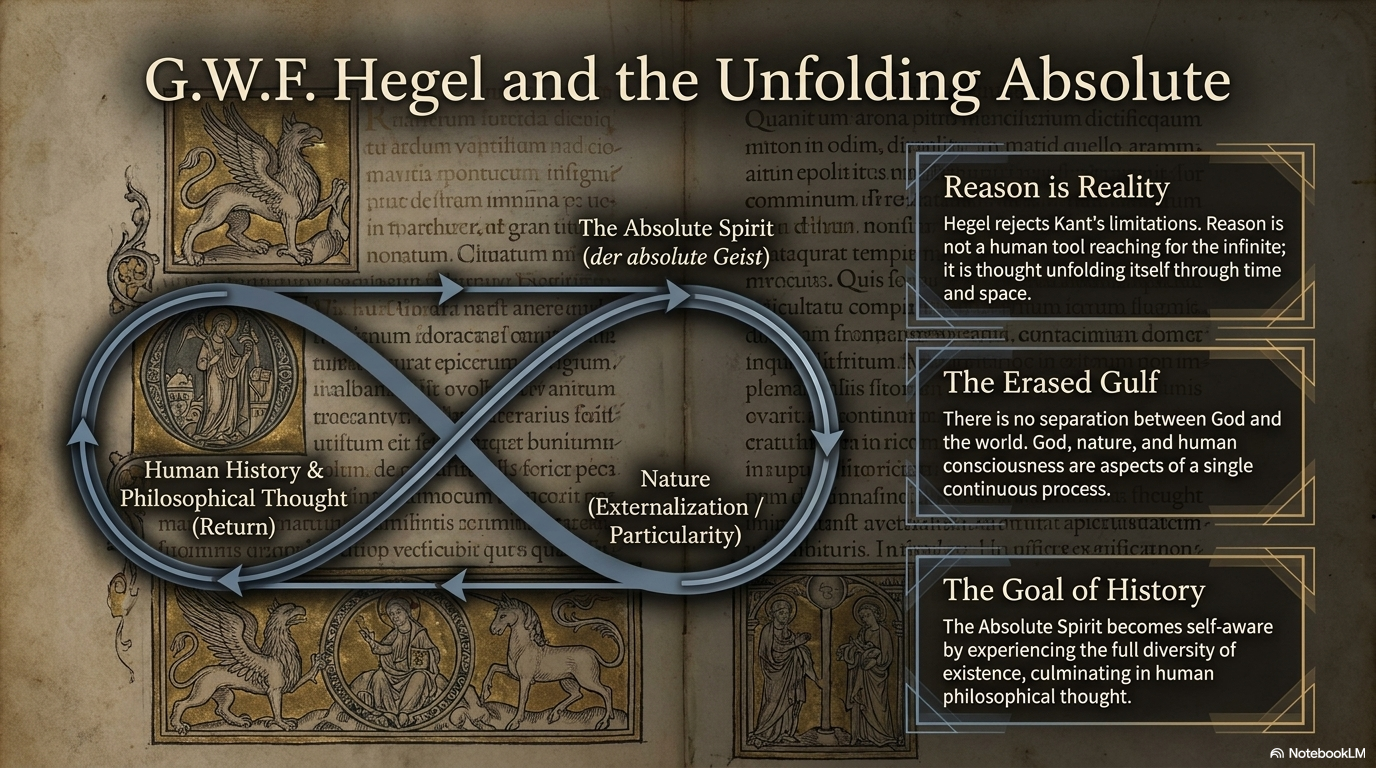
This sounds very abstract, and the abstraction is part of the problem. However, for our purposes, the essential thing to grasp is this: in Hegel, there is no gulf between God and the world. They do not exist as two distinct realities that oppose each other. The finite is simply the form through which the infinite expresses and realises itself. From this follows his account of religion.
Hegel devoted a full lecture series to the philosophy of religion, and his position is clear: religion and philosophy are not talking about different things. They are talking about the same thing — the Absolute, God, the nature of reality — but in different ways. The difference between them is one of form, not content. Religion expresses the truth through images, stories, symbols and representations — forms that address the imagination and emotions and can be understood by those who have not yet developed philosophical self- awareness. Philosophy, on the other hand, expresses the same truth in concepts — pure, precise and transparent thoughts that grasp the structure of reality as it actually is, without the mediation of image or narrative.
The relationship between the two is akin to the difference between a child’s and an adult’s account of something. You might tell a child, ‘God is in heaven and he loves you’, and this is not incorrect; it contains a real truth. However, it is a representation, not a concept. A mature thinker understands what lies behind that image: the Absolute Spirit’s eternal self-relation and the necessity of the infinite expressing itself through the finite. Representation is an immature and imperfect form of the concept. It is not false, but it is not yet fully itself. Therefore, the task of philosophy in relation to religion is to take what religion expresses in images and raise it to the level of the concept — to translate pictures into thoughts and feelings into understanding.
Hegel regards Christianity as the highest of the historical religions precisely because the truth about the unity of the finite and the infinite is expressed with unmatched clarity. For Hegel, the Trinity is essentially the philosophical formula for the dialectical self-movement of the Absolute: the Absolute in itself (Father), the Absolute in its self-externalisation (Son), and the Absolute returning to itself through and in the finite (Spirit). The Incarnation is the pictorial expression of the metaphysical truth that the finite and the infinite are ultimately not separate. God becomes human because, at the deepest level, the human and the divine are not two opposing things. The Cross and Resurrection represent the Absolute’s movement through negation in order to return — death and overcoming.
For Hegel, all of this is genuinely profound. He is not dismissing Christianity. However, he is celebrating it as a representation of what philosophy knows in a purer form. The logical consequence within his system is therefore unavoidable: where philosophical self-consciousness is sufficiently developed, religion, with all its prayers, sacraments, doctrinal commitments and communal practices, becomes unnecessary, though not false. The scaffolding again. Once the building of philosophical understanding is complete, the religious representation scaffolding can come down.
2.2. The Theological Critique of Hegel
The theological objection to Hegel starts with the most basic observation, which cuts through all the abstraction and hits upon something that anyone who has ever prayed will recognise immediately. In every religion, whether primitive or sophisticated, ancient or modern, the believer experiences themselves as standing before God: before One who is infinitely greater and Lord, while they are a creature of finite span and limited understanding. This ‘standing before’ is not a philosophical error that education can correct. Nor is it a failure to grasp the deeper truth that the finite and the infinite are one and the same. It is the very essence of the religious relationship. Prayer is only possible where there is someone praying, Someone to whom the prayer is addressed, and Someone Who hears and responds. Similarly, repentance is only possible where there is a sinner and One before Whom he is guilty, and from Whom forgiveness is sought. Similarly, gratitude is only possible where there is a giver and a receiver who knows they are receiving. None of this survives if God and the human person are ultimately aspects of a single process.
Hegel dissolves this asymmetry. Finite and infinite are not two different beings — they are two aspects of one self-moving whole. Once that shift occurs, prayer becomes a monologue of the Absolute with itself, repentance becomes a psychological episode in the Spirit’s self-development and the encounter with God becomes self-knowledge in religious guise. Philosophy remains, but religion — actual, living religion that involves a real address to a real Other — disappears. It is no coincidence that Hegel’s most devoted student, Ludwig Feuerbach, whom we discussed in the previous lecture, came to precisely this conclusion: there is no Absolute entity above the human being. What religion calls God is merely the idealised image of humanity projected outward. Hegel wanted to elevate religion to philosophy. However, what he actually did, despite his intentions, was create the intellectual conditions for the dissolution of religion. The left-wing Hegelians — including Feuerbach and, through him, Marx — drew the logical conclusion. One cannot accuse them of misreading Hegel.
A second, equally important objection concerns what Hegel leaves out of the
human person. He insists that religion primarily belongs to the sphere of
thought — that it is an imperfect form of the mind’s grasp of reality. It is
only through thinking that a human being becomes fully human; it is through
reason that they participate in the Absolute. However, this is a deeply one-
sided account of what a person is. A person is not just reason. There is also
will and feeling, neither of which is simply reducible to the rational. They
are not defective versions of thought; they are distinct dimensions of the
self, each with its own content and relationship to God. Religion addresses
the whole person, not just their intellectual capacity. This is why experience
so persistently and stubbornly contradicts Hegel’s logic: the depth and
authenticity of a person’s communion with God is not connected to their level
of philosophical education. An uneducated peasant woman who prays with genuine
faith, bringing her real life, her fears, her love and her gratitude to God in
her prayers, may be much closer to God than the most sophisticated professor
of philosophy, thinking deeply about the Absolute Spirit. If knowledge were
the essence of religion, this would be impossible. It would be a category
error, akin to someone claiming to be a better musician simply because they
know more music theory. But it is possible. It happens constantly. This simple
fact calls into question Hegel’s entire
conception.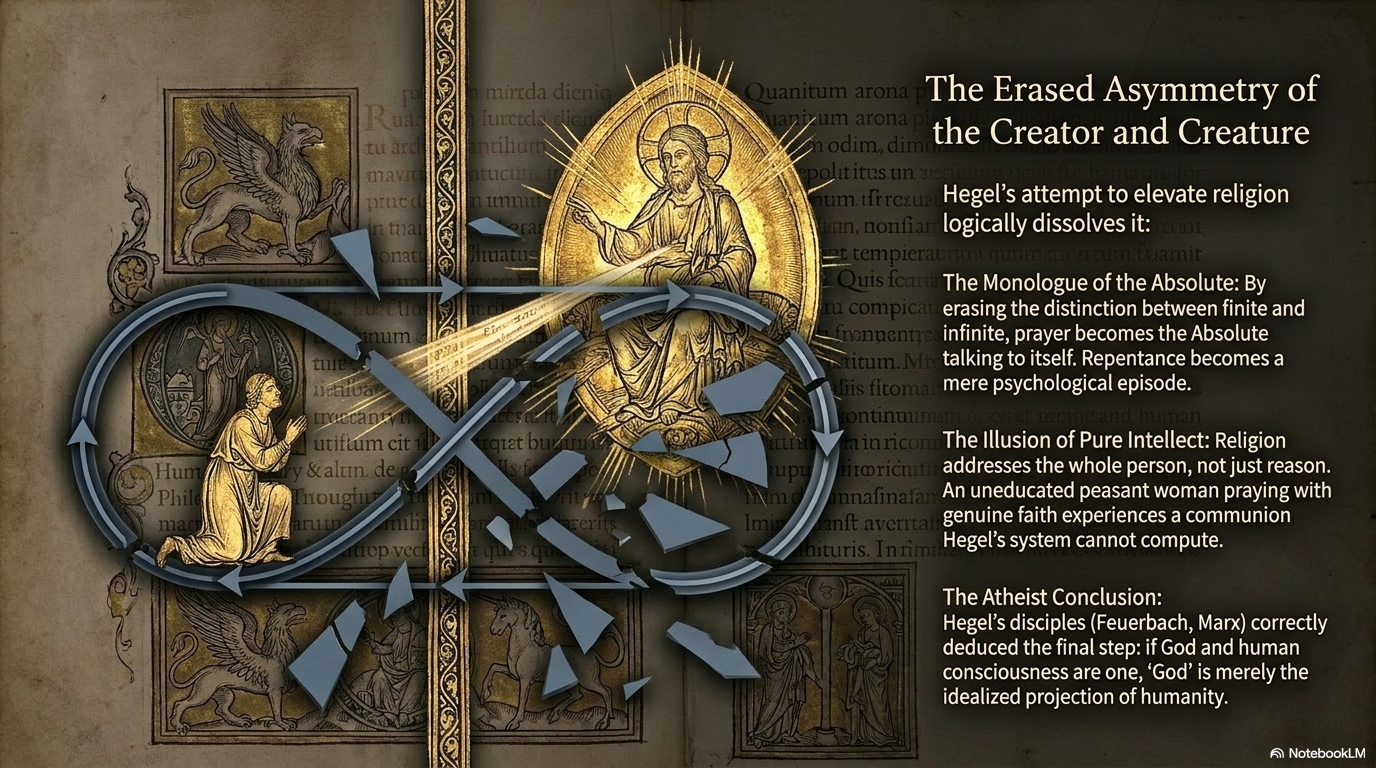
3.1. The Feeling of Absolute Dependence
Friedrich Schleiermacher approaches the subject of religion by rejecting the work of his predecessors, whom he deems inadequate. Having read Kant and Hegel, he concludes that they are both wrong in their fundamental approach, though not in their details. They were both looking at religion from the outside. They both searched for its essence in areas where it does not primarily exist. Kant placed religion within morality, while Hegel placed it within philosophy. In doing so, they reduced religion to something else — something that could, in principle, exist without religion. Kant’s moral system does not require God to function; God is merely an added extra. Hegel’s philosophical system absorbs and transcends religion. In both cases, religion becomes secondary — something that a sufficiently rational person might eventually outgrow.
Schleiermacher’s response is to say that they are both looking in the wrong place. Religion lives in feeling. Not in emotion, not in a passing mood and not in sentimental vagueness, but in that immediate, pre-reflective interior state which underlies and precedes thought and action. Before a person begins to reason about anything, before they make any decisions or form any intentions, in the simple and unavoidable fact of existence itself — religion is rooted there, in that primary givenness of existence. Schleiermacher calls this specific religious feeling ‘the feeling of absolute dependence’ (das Gefühl schlechthinniger Abhängigkeit). This is perhaps the most important phrase in his entire body of work and it is important to be precise about its meaning because it is often misunderstood.
It is not fear. It is not a sense of helplessness in the face of uncontrollable forces, though this is usually how people oversimplify the idea when they only vaguely remember it. The feeling of absolute dependence is more precise and interesting than that. It is the realisation that, if they pay sufficient attention to their interior experience, a person will find that they are not the cause of their own existence. They received their being, their nature, their capacities and their very existence as a self from something incomparably greater than themselves. This is not a conclusion reached by argument. It is an immediate interior awareness. ‘I did not make myself.’ I am held in existence by something that I am not. Schleiermacher takes this sense of radical finitude and dependence on what transcends oneself to be the primary and irreducible religious experience. It is present in every human being, even if not everyone notices or acknowledges it.
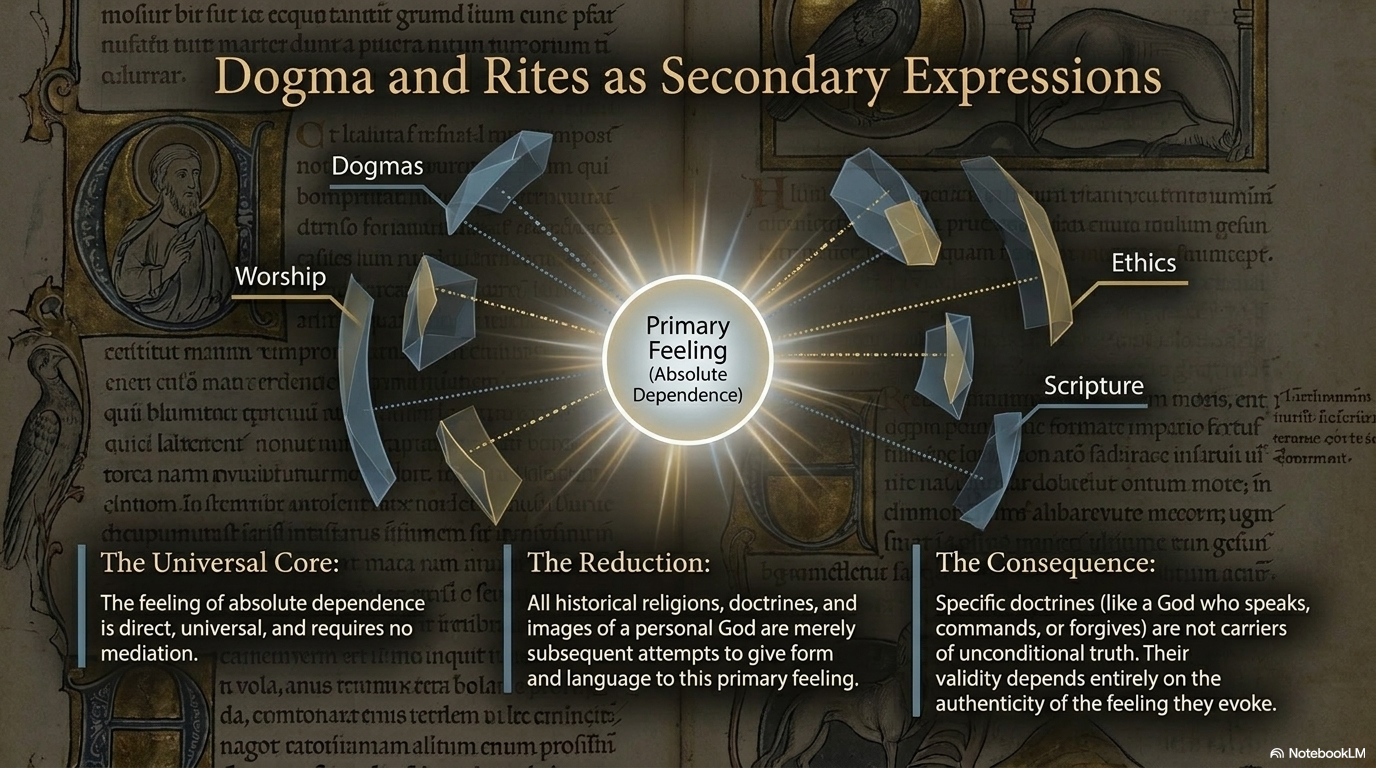
From this, everything else follows. All historical religions — their doctrines, worship, images of God and the sacred, ethical codes and community structures — are later articulations and expressions of this primary feeling. They are attempts to give form, language and shared practice to what is initially experienced directly. The experience itself requires no mediation at its source: it is direct and universal. Where it is present, genuine religion exists, regardless of the external form. Where it is absent, no external form — no matter how much doctrine, how regular the worship or how formal the community membership — can substitute for it.
Schleiermacher’s account of God stems from his account of religious feeling. God is the ultimate dependence of human beings: the source of all being, encompassing and underpinning the entire reality. Schleiermacher consistently brings God and the world very close together, without identifying them as one and the same, but insisting on their inseparability. God is unity, while the world is its plural, differentiated expression. God is not an entity that stands outside the world, a separate being that created it and now governs it from the outside. Rather, God is the ground and totality of all that is.
During Schleiermacher’s lifetime, this position was recognised as tending towards pantheism, and the criticism was not unfair. However, Schleiermacher always resisted this label, insisting that he distinguished between the concepts of God and the world even while holding them to be inseparable in reality. However, the critics had a point. This has consequences for specific images of God in historical religions, including all the stories, doctrines and representations of a personal God who speaks, commands, forgives and acts in history. Schleiermacher approached these with caution. They are useful as expressions and aids — ways of giving concrete form to the underlying feeling of dependence. However, they are not in themselves carriers of unconditional truth. Their validity depends on the depth and authenticity of the feeling they express rather than on any correspondence with a personal God who actually exists and does these things.
3.2. The Theological Critique of Schleiermacher
Schleiermacher’s contribution should not be undervalued, and it would be a mistake to let the following critique obscure what is genuinely important in his work. He was the first major thinker of his era to argue that religion has its own intrinsic value — it is not inferior to morality or an early attempt at philosophy to understand the Absolute; it is a distinct entity that can only be understood from the inside. This was an important and, in many ways, brave step, particularly in an intellectual culture that had become accustomed to explaining religion through ignorance, primitive fear or political calculation — in other words, anything but religion itself. Schleiermacher demanded that religion be taken seriously on its own terms and understood from the inside. This demand remains valid to this day. Many of the most significant developments in the academic study of religion in the century following his time owe something to this approach.
However, on closer inspection, his own account runs into serious difficulties, which I believe are ultimately fatal.
The first and most fundamental problem is this: Schleiermacher says that religion is a matter of feeling and that concepts are secondary and non- binding. However, feeling itself — even very intense feeling — has no specific content. Feelings are not assessed by their intensity or depth alone, but by what they are directed towards and what they are actually about. The sense of one’s own smallness and dependence can be experienced in the presence of a personal God-Creator who knows you by name and loves you — and that would constitute a religious experience in the truest sense. However, the same experience can be had when contemplating the vastness of the ocean, the night sky, the passage of geological time or the indifferent enormity of the cosmos, and there would be nothing specifically religious about it. It would be an aesthetic or philosophical experience. Without a clear and specific concept of who or what is behind this dependence, the experience itself remains indeterminate in a religious sense. It cannot tell you whether you are in the presence of the personal God of Abraham, Isaac and Jacob, the impersonal ground of being, the cosmos in its vastness or nothing in particular. Schleiermacher himself understood this well enough, which is why he introduced the concept of God as ‘the unity of worldly being’. However, in doing so, he contradicted his own central thesis: the concept turned out to be necessary after all. The concept he introduces is simply more diffuse and less demanding than the personal God of the biblical tradition.
The second objection concerns the completeness of what Schleiermacher calls religious experience. The feeling of absolute dependence is just one aspect of religious life — albeit a real and important one. However, it is far from the only one and probably not the most characteristic of specifically Christian religious experience. A Christian in prayer experiences more than just dependence. They also experience the nearness of God and his love, and the answer to their prayers. They experience forgiveness as an actual event, not just a philosophical concept. They experience parresia, or boldness, as described in the New Testament — the courage to approach God directly, as a child approaches a father. They experience joy, grief, gratitude, longing and the peculiar peace that Paul describes as surpassing all understanding. None of these feelings are variants of dependence. These are the experiences of a living, personal relationship with a God who is genuinely other, genuinely present and genuinely active. This is why theologians who have carefully examined Schleiermacher — from Ritschl to Barth — have observed that his description is closer to an aesthetic or quasi-mystical experience than to the religious experience of prayer and communion with the personal God of Christian revelation. The feeling before the sublime is real and valuable. However, it is not the same as kneeling before the One who said, ‘I am the Lord your God.’
The third and deepest objection concerns God himself. When Schleiermacher brings God and the world so close together that they become inseparable, he destroys the precondition without which religion in the Christian sense is impossible: the genuine distinction between Creator and creature. Christian faith recognises God as the one who brought the world into existence out of nothing (ex nihilo) by a free act of his will. He is not the totality of what exists, but rather the foundation of a reality that is genuinely distinct from him. He stands in relation to the world not as a whole to a part or as one to many, but as creator to creation. This distinction, which theology calls the Creator–creature distinction, is not a secondary doctrinal nicety that can be quietly softened without much loss. It is the structural condition of everything else that Christianity encompasses: encounter, dialogue, covenant, sin, forgiveness and love. Above all, love is only possible between those who are genuinely distinct and genuinely different from each other. You cannot love yourself in the full sense. The lover and the beloved must be two, not one. If God and the world are truly inseparable, and if human beings are merely modes of God’s self-expression rather than truly other than God, then what religion calls prayer becomes the Absolute addressing itself; what religion calls sin becomes a disturbance in the harmony of the whole; and what religion calls salvation becomes enlightenment or cosmic restoration rather than the reconciliation of a genuinely guilty creature with a genuinely holy and personal God. All of which, as I say, is very far from what the Gospel is about.
Related Concepts
- absolute-spirit
- apologetics
- autonomy
- canonical-unity
- christian-anthropology
- christianity-as-highest-religion
- dialectic
- doctrine-as-expression
- duty
- ex-nihilo
- experience
- feeling
- god-as-guarantor
- god-of-abraham-isaac-and-jacob
- grace
- ground-of-being
- hegel
- hegel-critique
- highest-good
- kant
- kant-critique
- kants-god
- kants-moral-religion
- kingdom-of-god
- limits-of-knowledge
- love-requires-two
- modern-apologetics
- moral-effort
- moral-law
- moral-order
- no-room-for-grace
- phenomenon
- philosophy-as-concept
- practical-reason
- reductionism
- religion-as-representation
- religious-experience
- revelation
- romans-7
- salvation
- scaffolding
- schleiermacher
- schleiermacher-critique
- self-government
- skepticism-about-metaphysics
- supernatural-knowledge
- theoretical-reason
- thing-in-itself
- uoc