Fundamental Theology — Topic 3. What Is Religion_
Now, let us bring all the threads together.
The word ‘religion’ has two fundamentally distinct meanings in its
history. The Ciceronian understanding (relegere) is religion as carefulness, attention and scrupulousness in performing cultic obligations, representing the external, ritual side. The second is the Lactantian and Augustinian understanding (religare/reeligere), which sees religion as a living spiritual union and renewed communion between God and human beings, representing the internal, personal side. Both dimensions matter and complement each other.
The primary feature of the religious worldview is transpersonal
spiritual experience — the lived encounter with something that transcends the human being. All the other elements of religious life — teaching, cult, ethics and community — grow from it.
All four of the atheist theories we have examined — the invention-by-
priests theory, the fear theory, animism and Feuerbach’s theory — share the same logical defect when examined carefully: they presuppose the very religious idea whose origin they claim to explain as already existing. None of them can answer the central question: where does the human being get the idea of an absolute, spiritual and infinite being when everything available to sensory experience is relative, material and finite?
The only logically satisfying answer is that the idea is not a human
fabrication, but rather a trace left in human nature by a real encounter with God, who discloses himself to his creatures. This theological account of religion’s origin states that religion is the response of human nature to the reality of God — a response that, despite its diversity of forms and inevitable distortions, bears witness to the fact that human beings are made for communion with God.
Before we start examining specific religious traditions, we should pause
to consider a question that may seem too obvious to ask: what is religion? However, this is precisely where we encounter some serious conceptual difficulties, and glossing over them would mean constructing everything that follows on unstable ground.
In contemporary society, a distorted sense of religion is commonplace,
both in terms of what it is and what it does for individuals and society as a whole. Much of the hostility towards religion, when examined closely, is actually directed at a specific version of historical or institutional Christianity. Therefore, before we can defend the Christian faith, we must first understand what religion is: what it consists of, what defines it and where it comes from.
To support this point, we will state at the outset of our lecture that
the word ‘religion’ is Latin in origin — religio — and that even for educated Romans in late antiquity, its original meaning had become uncertain. This is telling in itself. If a term claiming to describe one of the most fundamental dimensions of human existence cannot be precisely defined, then there is a problem.
- Introduction
- Section 1. Why ‘Religion’ is One of the Hardest Words to Define
- Section 2. Etymologies
- Section 3. The Essential Features of Religion
- Section 4. Four Atheist Theories of the Origin of Religion: A Critical Examination
- Conclusion
Religion scholars have long recognised this problem. The British
anthropologist R. R. Marett observed that ‘religion’ is the most difficult term to define. The American religious studies scholar Wilfred Cantwell Smith agreed, stating that despite having learned a great deal about religion, we have found that we have very little idea what we mean by the word.
It is worth understanding precisely where the difficulty lies. When
people talk about religion, they generally understand each other intuitively — each person brings their own meaning to the word, yet communication still happens. For everyday purposes, this kind of loose, conventional understanding is sufficient. However, it is not suitable for serious analysis. Different definitions of religion produce different objects of study, and researchers end up arguing past each other without realising it.
There is a deeper reason for the difficulty. Any definition of religion
inevitably reflects the worldview of the person who formulates it. Definitions that claim to characterise the essence of religion almost always carry ideological implications and presuppose a particular set of beliefs. Put simply, a believer and a non-believer describing the same phenomenon will emphasise entirely different aspects of it, and both will have a point.
This is what we might call the original problem of academic religious
studies. Studying religion from the perspective of an ‘objective’, deliberately detached observer is only possible within a framework that excludes any personal relationship with the subject. In other words, the ‘objective’ scholar of religion is a non-believer, someone who keeps an equal distance from all forms of religiosity. However, this stance prevents them from understanding the subject fully — from grasping its true nature.
A brief survey of how major reference works have defined religion
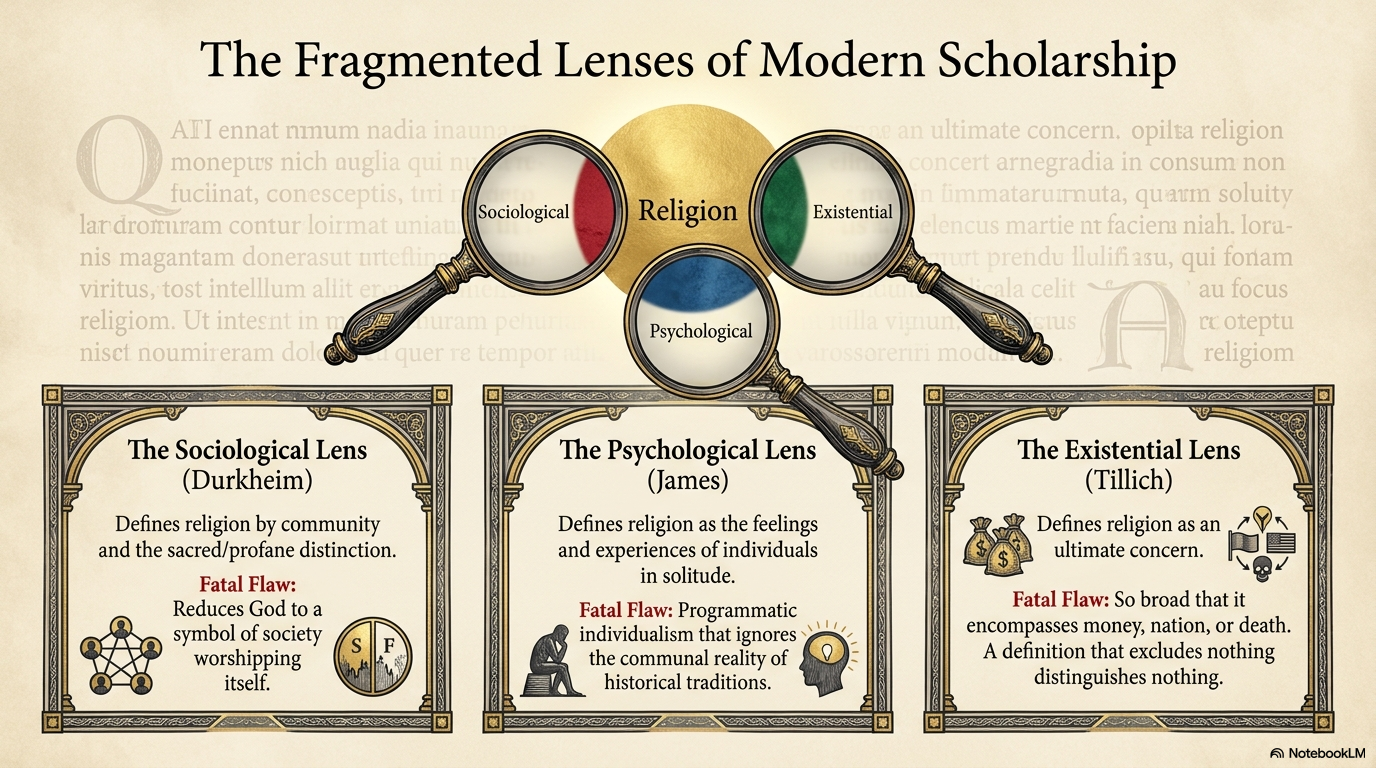
illustrates the problem. Each of the following definitions comes from a reputable source. Each captures something real. But each, on closer inspection, reveals its limitations.
The Oxford English Dictionary offers a better definition: ‘Belief in, or
acknowledgement of, some superhuman power or powers, especially a god or gods, that has or have power over nature and human fortunes; the practice of such belief, including worship and ritual observances.’ However, it places intellectual assent — belief — at the centre, and, as we will see in the future, this is not where faith actually resides.
The Encyclopaedia Britannica defines religion as ‘human beings’
relationship with that which they regard as holy, sacred, absolute, spiritual, divine or worthy of special reverence’. There is no content here at all, only a relationship with whatever the individual treats as sacred. The definition is circular: the sacred is whatever one regards as sacred.
Durkheim is sharper in The Elementary Forms of Religious Life (1912): ‘a
unified system of beliefs and practices relative to sacred things… which unite into one single moral community called a Church all those who adhere to them.’ He introduces the sacred/profane distinction and takes the communal dimension seriously — both of which are genuine advances. However, his underlying premise is to reduce God to a symbol through which society worships itself. Whether God actually exists becomes irrelevant on this account. This is honest atheist sociology. However, it is not a definition of religion from within.
In The Varieties of Religious Experience (1902), William James defines
religion as ‘the feelings, acts, and experiences of individual men in their solitude, so far as they apprehend themselves to stand in relation to whatever they may consider the divine’. Experience is indeed primary — we will return to this. However, ‘in their solitude’ reflects a programmatic individualism that sits uneasily with Judaism, Islam or Orthodox Christianity, where religion is inconceivable apart from community.
Paul Tillich’s formulation is the most succinct: ‘Religion is the state
of being grasped by an ultimate concern, a concern which qualifies all other concerns as preliminary and which itself contains the answer to the question of the meaning of our life.’ This ultimate concern can be anything — God, the nation, money or one’s own death, for example. Tillich was aware of this and even regarded it as a virtue. However, a definition that excludes nothing distinguishes nothing.
This survey does not show that these thinkers were careless. Rather, it
shows that a neutral definition of religion is not possible because the observer’s position is never indifferent to the subject. Dictionary entries are either too broad or too narrow. The sociological definition reduces religion to a function. The psychological definition reduces religion to inner experience. The existential definition dissolves religion into any sufficiently serious concern. This is not a technical difficulty that will eventually be resolved by better scholarship. It is inherent in the nature of the subject being studied.
Without claiming to be exhaustive, let us use the following as our
working definition, which covers the most significant features of the phenomenon:
Term: Religion
**A worldview grounded in the conviction that a spiritual realm exists
and that human beings can stand in relation to it. This includes mythology, doctrine (beliefs), specific ethical norms and religious practice (including cultic practice).**
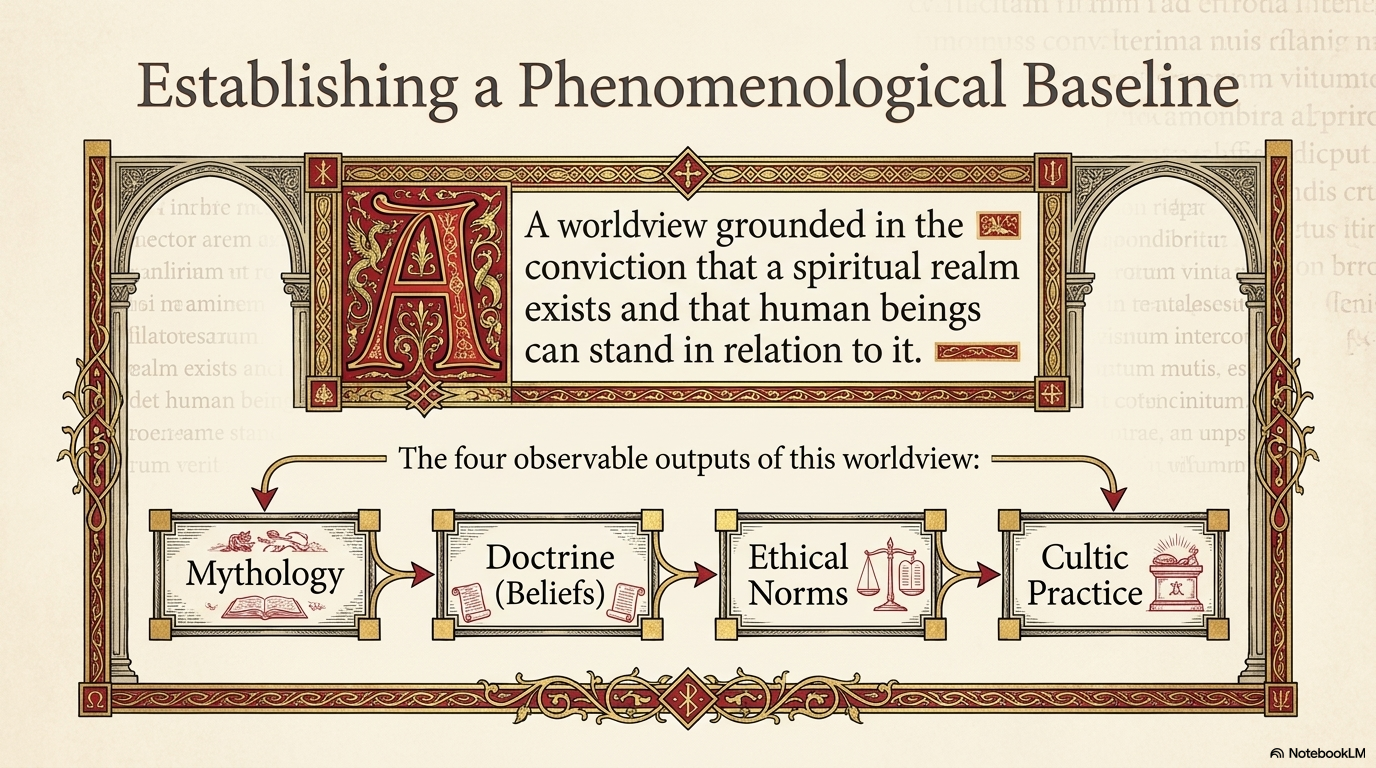
This definition is primarily descriptive — phenomenological, in the
technical sense. It describes the observable external features of religion without claiming to define its essence. Below, we will examine both these external features and the ‘internal’ understanding of religion, as seen from the perspective of someone who lives within a religious tradition. First, however, we will examine the etymology of the word itself, because the history of a term can illuminate its meaning in ways that analysis alone cannot.
The word ‘religion’ comes from the Latin religio. Even for educated
Romans in late antiquity, its original meaning was unclear. This is not an artificial technical term invented to describe a known phenomenon, but a living word whose roots reach back into the distant past and whose meaning has changed considerably over the centuries.
The German scholar Max Müller distinguished three types of religion
definition — etymological, historical and dogmatic — and observed that theologians have always been fascinated by etymology in the hope that it may help to establish the true meaning of a word. The history of religio does turn out to be instructive.
2.1. The Pre-Christian Context: Cicero
The first person to introduce religio into intellectual discourse and
provide a systematic explanation of it was the Roman orator and philosopher Marcus Tullius Cicero (106–43 BC), in his treatise ‘On the Nature of the Gods’ (45–44 BC), which was written prior to the existence of Christianity.
Cicero derived religio from the verb relegere — to re-read, to go back
over, to set aside for a special use, to separate from ordinary things — that is, to treat something with particular care and reverence. Those who carefully pondered everything relating to the worship of the gods, reading it through again as it were (retractarent et tamquam relegerent), were called religiosi — from relegere. Similarly, elegantes (people of taste) came from elegere (to distinguish); diligentes (the diligent) from diligere (to value); and intelligentes (the intelligent) from intellegere (to understand). All of these words share the root legendi — to gather, select or discern.
Two conceptual oppositions are essential to understanding Cicero’s view:
Religio is the antonym of neglegere (‘to neglect’). Religio is vigilant
attention and scrupulous care towards the sacred. Neglegere is indifference, carelessness and inattention. Religion is the opposite of negligence.
Religio is also the opposite of superstitio (superstition). ‘One cannot,
by extirpating superstition, destroy religion,’ writes Cicero. Religion is the norm of reasonable reverence for the gods, while superstition is its excessive, pathological distortion.
What is important to note here is that, in this pre-Christian, classical
sense, religio was inseparable from everyday, legal and political life in the Roman community. This was not personal faith or mystical experience. Above all, it was orthopraxy — the correct, attentive and conscientious fulfilment of religious obligations. A Roman was religious not because they held certain beliefs, but because they carefully performed the appointed rites.
The linguist Émile Benveniste, who studied the use of religio in early
Latin authors such as Terence, Plautus and the tragedian Accius, discovered something interesting. In the earliest texts, religio denotes hesitation that holds a person back from acting — an inner obstacle, or a kind of conscientious caution. It is not a feeling that propels you towards something; rather, it is restraint, an awareness of a boundary that should not be crossed lightly. It is something like what we would call the voice of conscience.
2.2. The Christian Context: Lactantius
It was thanks to the Christian apologist and scholar Lucius Caecilius
Firmianus Lactantius (c. 250–c. 325), whom Jerome called ‘the Christian Cicero’, that ‘religio’ became firmly attached to the Christian worldview and acquired a substantially different, deeper meaning.
Lactantius derives religio from the Latin religare — ‘to bind, to join
together’. In explicit disagreement with Cicero, he argues that ‘we are born with this condition: to render just and due obedience to God, who begot us; to know Him alone; to follow Him. Bound by this bond of piety, we are united with God — from which religion itself received its name.‘
According to this interpretation, religion is not merely the external
observance of rites, but rather a spiritual and personal bond between human beings and God — a living, internal relationship that presupposes a genuine encounter between the Creator and the creature. This is why acknowledgement of a personal God becomes a necessary condition of religion in this sense.
The difference from Cicero’s view could not be more pronounced. For
Cicero, religio is a human quality, a matter of how carefully a person attends to the divine. For Lactantius, however, religio is a quality of the relationship itself, not simply how one performs rites, but how one is bound to God. This represents a shift from ‘the rules of piety’ to ‘a living union’. As the historian of religion, Auguste Sabatier, put it, ‘In Lactantius’s interpretation, the word religio received, as it were, a baptism and took on a different meaning, more in keeping with the spirit of the Gospel.‘
From a philological perspective, it should be noted that Lactantius’s
etymology is disputed: both Müller and Benveniste argue that, in classical Latin, religare in the sense of ‘to bind’ is rarely applied to the religious sphere, and Cicero’s etymology is more linguistically defensible. However, Lactantius was not working as a philologist; he was working as a theologian, using the word to express an ontological truth about the relationship between God and the human person. It was his interpretation that left the deepest mark on European Christian culture.
2.3. Augustine: Religion as Reunion
Augustine of Hippo (354–430) offered another interpretation, deriving
the word from ‘reeligere’ — ‘to rejoin or restore a union between two beings that had become separated’. He wrote, ‘God himself is the source of our blessedness… Tending towards him, or rather rejoining him — from which word religion seems to take its name — let us strive towards him with love.‘
For Augustine, the prefix ‘re-’, indicating repetition or renewal, means
that religion is not simply a union of human beings with God, but a renewed union — one that was lost in the Fall and restored through the Incarnation. This definition is grounded in the concrete reality of sacred history: religion is not merely communion with God, but the restoration of a communion that had been broken.
Three Etymologies Compared
Author
|
Root
|
Meaning
|
Character
---|---|---|---
Cicero
|
relegere
|
attention, care, ritual conscientiousness
|
anthropological
Lactantius
|
religare
|
bond, union, personal obligation
|
ontological
Augustine
|
reeligere
|
reunion, renewal of what was lost
|
theological
Now, let us look systematically at the characteristics of a religious
worldview. These features can be grouped in two ways: those that are visible from the outside — what any observer can identify — and those that only become clear from the inside, from a theological perspective or from within the tradition itself.
A caveat before we begin: not every religious tradition exhibits all of
the following characteristics. This is precisely why researchers debate whether certain traditions — Buddhism and Confucianism, for example — are religions at all.
3.1. Phenomenological features
Feature 1: Primary transpersonal (spiritual) experience
This is the most important feature, and it is no coincidence that we
start with it. Spiritual experience takes precedence over all the other elements of religious life, such as doctrine, cult and ethics. It is where a religious tradition begins, and everything else grows out of it.
But what is this experience, exactly? It is the experience of
encountering something radically different — something overwhelming in its boundlessness, which simultaneously inspires awe and dread. Those who have had the most profound experiences of this kind often find that ordinary language simply cannot convey what they are trying to say. This is one reason why religious experience so consistently takes the form of intense imagery.
The philosopher Ivan Ilyin describes this experience as a ‘living bond
with God’ that ‘is realised and abides first of all within the human being’ and ‘is impossible without subjective, personal religious experience’.
Feature 2. The distinction between the sacred and the profane
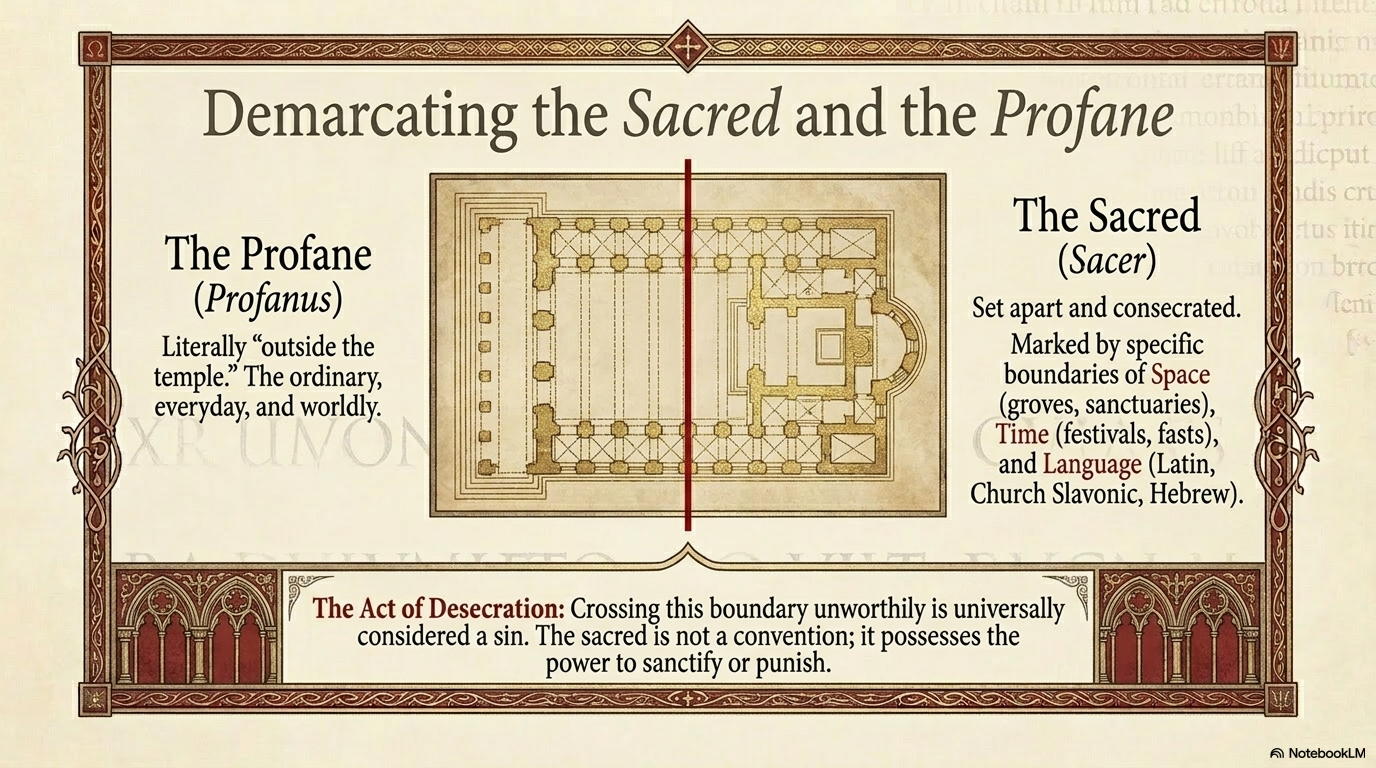
The religious worldview is usually founded on an opposition between the
profane (from the Latin ‘profanus’ — ‘outside the temple’) — that is, the ordinary and everyday — and the sacred: that which has been set apart from common use and devoted to higher powers.
Term: The Sacred and the Profane
The sacred (from the Latin sacer, meaning ‘holy’ or ‘devoted to the
gods’) is that which has been separated from the ordinary world and consecrated to a higher reality. It requires a particular kind of attention. The profane (from the Latin ‘profanus’ — standing before the temple, outside it) is the ordinary, the worldly and things not connected to religious cult. This distinction is one of the constants of religious consciousness in every culture.
This distinction is evident in both the most primitive and the most
sophisticated religious traditions. Archaic peoples marked out particular places (such as sacred groves, mountains and springs), objects (such as totems, idols and relics) and times (such as festivals and fasting days) — all of these are ways of marking the boundary between the sacred and the ordinary. Modern religious consciousness does exactly the same: the Orthodox church building, with its iconostasis dividing the altar from the nave, is a spatial embodiment of that boundary.
Interestingly, even people who are non-religious can easily identify a
church and would not mistake it for an office building. This suggests that the distinction between the sacred and the profane is deeply embedded in human culture, persisting even where conscious religiosity has died out. The concept of desecration — the violation of the sacred boundary or the mixing of the holy with the impure — is universal across all religious traditions. This indicates that the boundary is treated as something genuinely real, not merely conventional.
This is also why religious services throughout history have consistently
used a language other than everyday speech: Latin in Western liturgy, Church Slavonic in Orthodox liturgy and Hebrew in Jewish worship, for example. The same logic applies to liturgical vestments and the system of gestures and ritual prescriptions — all of which are ways of establishing and maintaining the boundary between sacred and profane spaces.
It is also significant that, in every tradition, crossing this boundary
in an unsuitable state — entering a sacred space unworthily, using sacred objects for mundane purposes or pronouncing sacred names carelessly — is considered a sin. This suggests that the sacred is not understood as a convention, but as something with which one can have genuine contact, and which has the power to sanctify or punish.
Feature 3. Belief in the existence of an invisible spiritual world
All religions are characterised by the conviction that visible reality
is not the only thing that exists. Beyond the world perceived by the senses, there is another world — invisible and beyond the scope of the senses — which is the true foundation and origin of the visible world. This higher spiritual reality not only coexists with the human world, it is also its origin, meaning and goal.
The nature of this world varies enormously across traditions. In
monotheistic traditions such as Christianity, Judaism and Islam, it is a personal Creator God who made the world from nothing and sustains it. In polytheistic traditions such as Greek, Roman and Hinduism, it is a multitude of gods and spirits, each responsible for their own domain. In Shinto, countless kami spirits inhabit everything: mountains, rivers, trees and natural phenomena. Buddhism offers a unique reality that is incomprehensible and fundamentally unlike anything we can imagine. Traditional folk religions are centred around ancestral spirits who continue to participate in the lives of the living. Despite all this variety, one thing remains constant: the conviction that the visible world is not the entirety of reality and that something greater lies behind it.
Feature 4: The belief that communication with the spiritual world is
possible.
The value of religious belief in the existence of a spiritual world is
realised, above all, in the experience of actual contact with it. After all, one can acknowledge the existence of a higher principle while still considering it unreachable in principle — indifferent to human beings and separated from them by an unbridgeable gulf. This is exactly how deism reasons: God created the world like a watchmaker creates a watch: he wound it up and withdrew. There are no miracles, no revelation and no personal encounters. Strictly speaking, such a view is no longer religious in the full sense, as it removes the very essence of religion: the possibility of encounter, dialogue and response.
Term: Deism: a philosophical-religious position widely held during the
eighteenth-century Enlightenment, according to which God created the world and established its laws, but does not intervene in its subsequent course. The deist God is the First Cause and Architect of the Universe, but not a personal God with whom one can pray, petition or receive revelation. Deism is fundamentally different from theism, for which the possibility of a living, personal relationship between God and human beings is central.
Religious practice is only possible if one believes not merely that God
exists, but that one can communicate with him. Prayer only makes sense if it is heard. Sacrifice makes sense only if it reaches its destination. Worship makes sense only if God is present. Once this belief disappears, religiosity gives way to other things, such as philosophical meditation, magic or agnosticism.
Term: Agnosticism is the philosophical position that the existence of
God — or, more broadly, any ultimate metaphysical reality — is neither known nor knowable in principle. The term was coined by the English biologist Thomas Henry Huxley in 1869 and is derived from the Greek ‘agnōstós’ meaning ‘unknown’ or ‘unknowable’. Agnosticism must be distinguished from atheism. An atheist makes a positive claim: that God does not exist. The agnostic makes an epistemological claim: we cannot know whether God exists. These two positions are logically independent. One may be an agnostic atheist, holding that God’s existence is unknowable and therefore not believing, or an agnostic theist, holding that God’s existence is unknowable yet still believing. Huxley’s original formulation was precise. He did not assert that God does not exist. Rather, he asserted that the question cannot be settled by the methods available to human reason and empirical inquiry. When it comes to matters that transcend experience, intellectual honesty requires us to suspend judgement. In the history of philosophy, agnosticism has taken several forms. Epistemological agnosticism, for example, holds that the human mind is simply not equipped to resolve questions about ultimate reality. In this spirit, Kant argued that we can know phenomena — things as they appear to us — but the thing-in-itself, including God, lies beyond the reach of theoretical reason. Methodological agnosticism takes a more limited stance, maintaining that the methods of empirical science are not suitable for answering metaphysical questions, without necessarily concluding that these questions cannot be answered by other means.
Feature 5. Specific ethical norms and cultic practice
Every religion requires its followers to lead a life that pleases God —
putting their convictions into practice in accordance with moral norms. This is not an accidental, external addition to religious teachings; it is an organic consequence of them. If God is the source and lawgiver of life, then a relationship with him will inevitably entail a particular way of life. It is impossible to profess belief in God and live as if he did not exist.
It is important to understand that religion is the primary foundation of
morality. Throughout most of human history, religion has provided the answer to the question, ‘Why should I act this way and not otherwise?’ — not because it is advantageous (utilitarianism), because society expects it (conventionalism) or because I feel it (subjectivism), but because God wills it and is the source of the moral order itself. This is precisely why atheism faces a serious philosophical difficulty: it is very hard to establish a moral imperative without appealing to something beyond the human being.
The ethical dimension of religion takes different forms across
traditions. In Judaism, for example, it is the observance of the 613 commandments of the Torah, which cover every aspect of life. In Christianity, it is the observance of the Ten Commandments and the Beatitudes of the Gospels, expressed through love of God and neighbour. In Islam, it is following the norms of sharia. In Buddhism, it is the practice of the Noble Eightfold Path, which leads to liberation from suffering. Despite the variety of specific content, one constant remains: religious norms are not understood as human inventions, but as requirements of a higher order to which human beings are obligated to adhere.
Alongside the ethical dimension, there is a cultic dimension comprising
a system of services, rites, sacrifices, prayers, fasts and feasts. Religious feeling naturally seeks outward expression; just as a person cannot contain intense joy, grief or love within themselves, religious experience inevitably seeks an outlet in the form of words, gestures or rituals. This is why there is no religious tradition without a cult; all of them involve worship, prayer, sacrifice, or equivalents.
Now is a good time to discuss what is sometimes called ‘faith in the
soul’ — the position taken by many people in contemporary culture of believing in God but not attending church or observing any rites. From a religious studies perspective, this position indicates either underdeveloped or merely nominal religiosity. The point is not that visiting a church is a ‘duty’ in any bureaucratic sense. Rather, religious feeling that does not seek expression through worship is probably not intense or real enough to be considered genuine. Worship confirms the authenticity of religious feeling and establishes a connection with God through communion.
Finally, it is a mistake to think of ethics and worship as two
independent elements of religion. In a genuine religious tradition, they are inseparable. The prophets of Israel criticised those who regularly brought sacrifices to the temple while oppressing the poor and widows, saying: ‘I hate, I despise your festivals, and I take no delight in your solemn assemblies’ (Amos 5:21). Jesus formulates the connection in the starkest possible terms: ‘Love the Lord your God with all your heart, and love your neighbour as yourself’ (Mark 12:30–31).
3.2. Internal (Theological) Features of Religion
In addition to the external features examined above, another type of
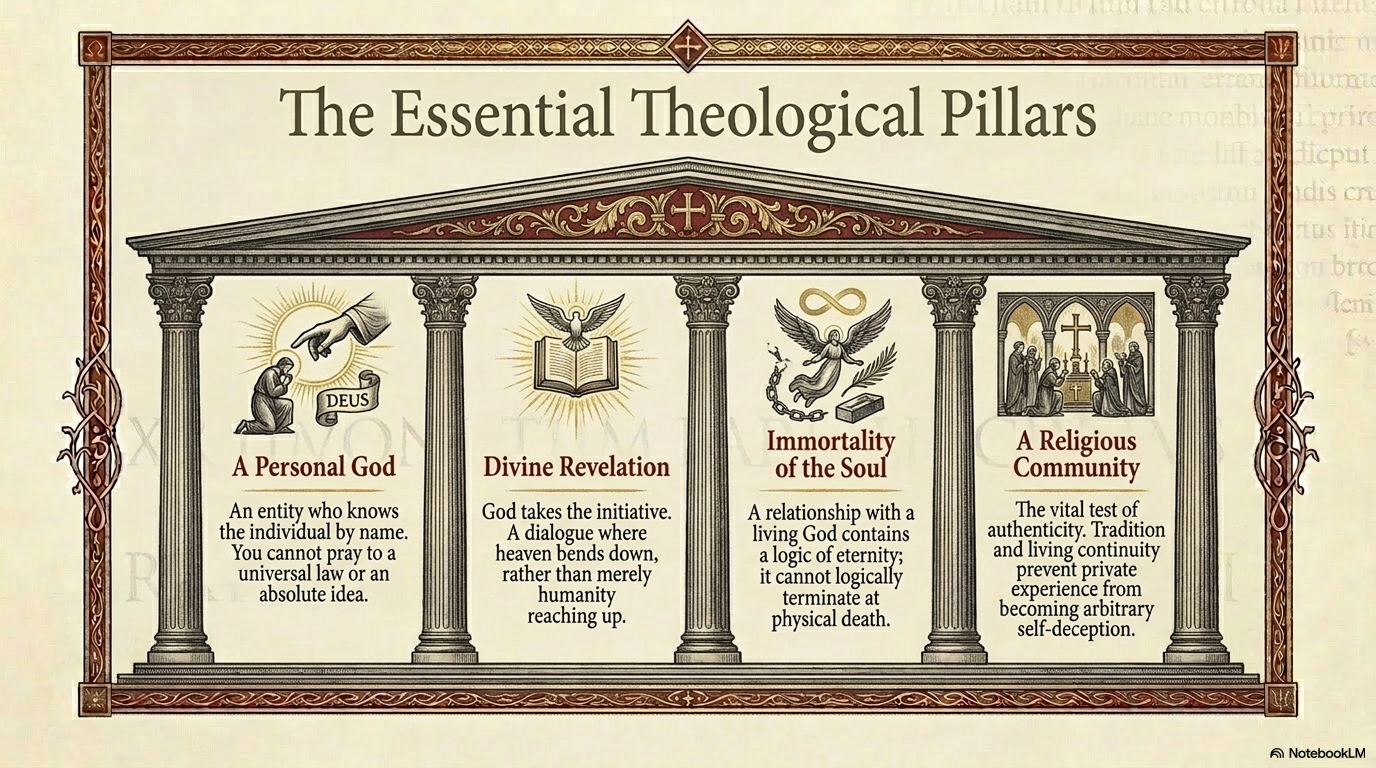
feature exists. These are not always visible from the outside or found in encyclopaedias. They only become apparent when you look at religion from within — through the eyes of a believer or a tradition that understands itself as a living bond with God rather than a ‘cultural phenomenon’. These features are precisely those that classical textbooks of fundamental theology call essential: without them, religion ceases to be religion in the proper sense and becomes something else — philosophy, ethics, aesthetics or psychology, for example — but not religion.
_Feature 1._Belief in a Personal God
Let us begin with the most fundamental point. Religion in the
theological sense is impossible without a personal God — that is, a God who can be spoken to and addressed, and who hears and responds.
Why does this matter so much? Because, without a personal God, the very
possibility of what constitutes the heart of religion — living union and communion — collapses. Imagine walking into a room hoping to speak with someone important, only to be told, ” ‘There is no one here. There is only an impersonal first cause. Or a universal law. Or an Absolute Idea.’ You cannot hold a conversation with an impersonal first cause. You cannot pray to a universal law. An absolute idea will not console you in grief or rejoice with you in joy. Such systems may be intellectually sophisticated and give rise to magnificent philosophy, but they do not give rise to prayer. Religion without prayer is something else entirely.
This is precisely why all philosophical and religious currents that
replace a personal god with an impersonal principle — whether pantheism, deism or abstract monism — are not religions in the strict sense, regardless of their intellectual seriousness. As one classical textbook puts it, “religion with an impersonal god is not religion in the proper sense, but only a semblance and surrogate of it, and can never satisfy the human need to feel bound to an almighty being and lean upon him”. A human being does not need a law or a principle. They need the One who knows them by name.
_Feature 2.__Belief in
DivineRevelation_
The next feature is closely connected to the previous one. If God is a
person, then he does not simply exist somewhere distant and indifferent to the world. A personal God speaks. He reveals himself, his will and things that a human being could never have worked out on their own, not because they lack intelligence, but because such things are simply beyond the reach of unaided human reason.
This is what is meant by
revelation. It is a foundational concept and worth understanding correctly because it is often confused with something vaguely mystical. Revelation is neither hallucination nor poetic inspiration. It is God’s initiative in communicating with humans: God takes the first step and makes himself known in ways that could not otherwise be known. Without this, religion becomes self-contained — it is merely the human being’s own searching, guesses and projections. With revelation, however, religion becomes a dialogue: the human person seeks God, and God responds.
This is precisely why all the great religious traditions are based on
revelation. In Judaism, the Torah is not a collection of folk wisdom, but a word transmitted by God to Moses. In Christianity, the Gospel is not the biography of a religious reformer, but a testimony to God entering history Himself. In Islam, the Quran is the speech of God, dictated to the Prophet. The same structure appears everywhere: not merely a human being reaching towards heaven, but heaven bending down towards the human being. Remove revelation, and what remains is philosophy. Perhaps even great philosophy, but not religion.
Feature 3. Belief in the immortality of the soul
The third feature is the conviction that death is not the final word.
The human person is not merely a body that is born, lives for a time and then vanishes without trace like a bubble on water.
Why is this feature specifically essential to religion? Because it
follows directly from everything that precedes it. If there is a personal God and Revelation, and a living bond is established between God and the human person, then it is difficult to imagine this bond simply ending at the moment of physical death. A relationship with a living God cannot end when one of the parties ceases to exist. From the very beginning, religion carries within itself a logic of eternity.
However, the specific understandings of what happens after death differ
considerably across traditions. Christianity speaks of resurrection and eternal life. Buddhism speaks of nirvana and liberation from the cycle of rebirths. Hinduism speaks of reincarnation. Traditional religions speak of a world of ancestral spirits who continue to influence the lives of the living. However, beneath this diversity of images, one conviction remains common: that the visible, physical world is not everything. Human beings do not belong to it alone. It is precisely this conviction that enables religion to impart meaning in the face of suffering, injustice and the death of loved ones, where without it, only meaninglessness would remain.
This is why belief in immortality is not just another opinion that a
believer can choose to accept or reject. It is a load-bearing wall of the religious worldview. Remove it and the entire structure begins to shake: why pray if there is nothing after death? Why endure suffering if it is meaningless? Why build a relationship with God if it is finite?
_Feature 4._The existence of a religious community
Finally — a feature that, at first glance, seems the least ‘internal’ of
the four, and the most external and organisational. But this is a misleading impression.
Authentic religiosity does not close in upon a single individual. It
naturally moves outwards towards others who share the same experience. This is not because it is required or more convenient, but because the very nature of religious experience demands it. Someone who has had a genuine experience wants to talk about it. Someone who has found meaning wants to share it. Someone who prays naturally prays with others.
Moreover — and this is the more important point — the religious
community serves as a test of the authenticity of individual experience. Left to their own devices, people can easily fall into error. Their own ‘religious experience’ could be anything: self-suggestion, exaltation or psychological projection, for example. It is tradition, community and living continuity that prevent individual religious experience from becoming arbitrary and self- deceptive. It is no coincidence that A. S. Khomyakov wrote that ‘full understanding and unblemished holiness belong only to the unity of all the members of the Church’. Truth is not revealed to one person alone in the silence of a study, but in the conciliar unity of love.
This is precisely why so-called ‘private faith’ — ‘I believe, but I
don’t attend church, I observe no rites and I have no connection to any community’ — is, from a theological point of view, a sign of immature religiosity. It is a faith that has not yet found its full embodiment. It is a seedling that has not put down roots. Authentic religiosity seeks community, not as an organisational structure, but as a living organism within which it can flourish.
We have examined what religion is. Now, we ask: where does it come from? In this section, we will focus on atheist theories — accounts of religion’s origin based on the rejection of any objective significance of the concept of God. These theories assume that religion is a purely human phenomenon and attempt to identify its ‘earthly’ origins.
Four of the most significant theories deserve careful consideration.
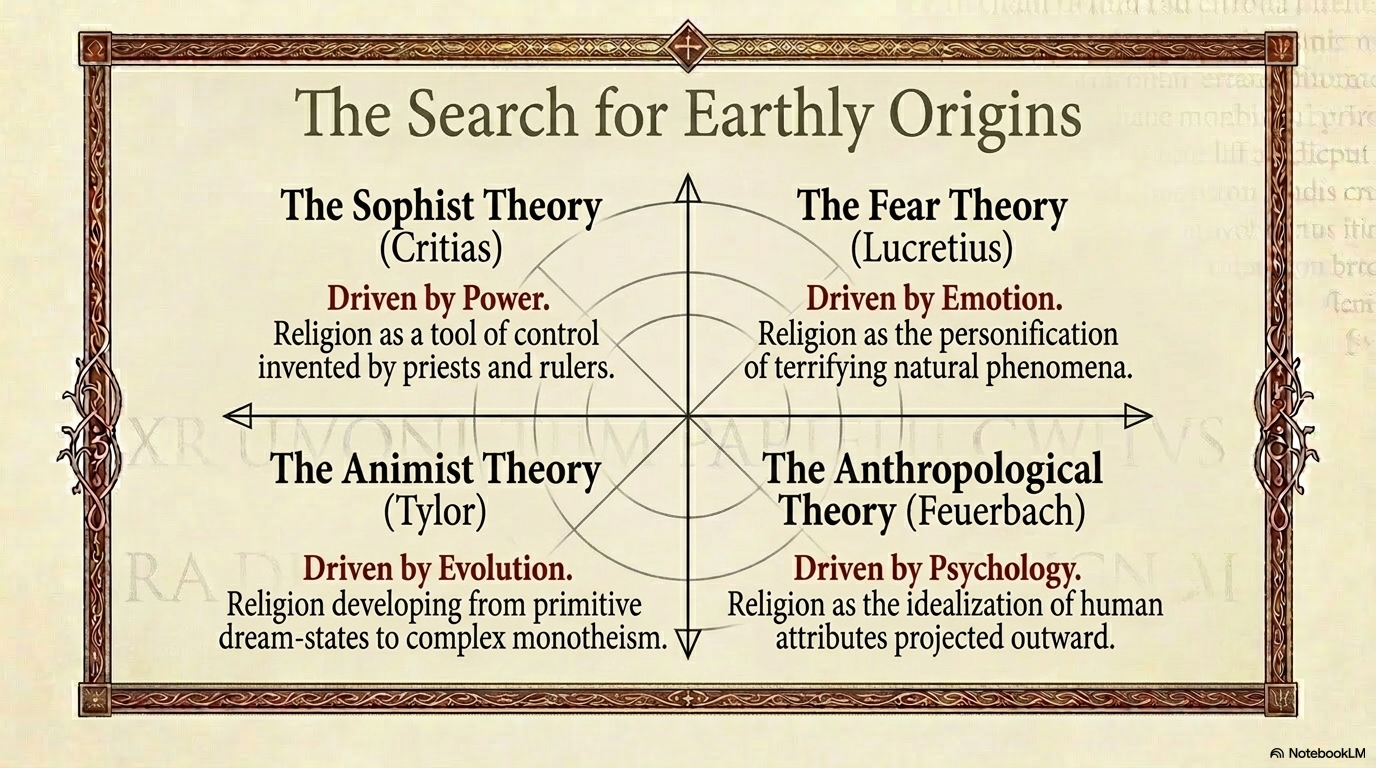
4.1. The Sophist Theory: ‘Religion as an Invention of Priests and Rulers’
This position was first put forward by the ancient Greek thinker Critias (fifth century BC), who was a member of the Sophist school.
According to Critias, religion was invented by those who found it useful and profitable, namely priests, legislators and rulers who wanted to anchor their institutions in a higher authority, as well as philosophers who wanted to establish moral truths in the popular mind. In its contemporary form, this theory takes the dismissive form of the claim that ‘religion is an invention of the clergy’. Simplified versions of it still circulate among people who are sharply antagonistic towards religion.
The most precise and rigorous critique of this theory was offered by Sextus Empiricus (c. 195–245), an ancient sceptic who was not a Christian and therefore had no personal stake in defending religion. His criticism is grounded purely in formal logic.
Sextus points out: “The question is: what principle did people use to arrive at the idea of gods? But these philosophers sidestep the substance of the question by saying that certain lawmakers instilled the idea of gods in people — without realising that the starting point remains unclear. One might well ask, after all, on what basis the lawmakers themselves arrived at the idea of gods if no one had spoken to them about them beforehand.’
In short, for priests or rulers to be able to ‘invent’ religion, they would already have had to be priests, i.e. bearers of a religious cult that must have existed before they allegedly invented it. This theory attempts to explain the origin of religion, yet it presupposes its existence. This is the logical error known as petitio principii, or ‘begging the question’.
The second argument is psychological. The idea of God has three characteristics: absoluteness (God depends on nothing; his existence is self- grounded), spirituality (God is non-material) and infinity (God has no spatial or temporal limits). The entire sensory world around us consists of conditional, material and finite things. Even the boldest human imagination cannot create something from nothing; it can only rearrange elements drawn from actual experience. This raises the question: where does the human mind get the idea of an absolute, spiritual and infinite being when all the material available to the imagination is conditional, limited and material?
Furthermore, if priests invented religion for personal gain, why does every religion demand personal sacrifices, fasting, continence and privation from priests to a greater extent than from everyone else? This is in direct contradiction to the theory’s assertion that religion’s founders were motivated by selfishness.
4.2. The Fear Theory
This famous formulation of the theory was given by the Roman materialist poet Titus Lucretius Carus (99–55 BC): ‘Fear made the first gods.’ Among modern thinkers, Thomas Hobbes and David Hume belong to this tradition.
According to this theory, fear and helplessness in the face of threatening and incomprehensible natural forces — such as storms, floods and disease — caused archaic peoples to personify and subsequently deify these forces. Wanting to appease these deities, people began to offer sacrifices and prayers, and the theory claims that this is how religion arose. Hume developed this argument further, adding that an ‘anthropomorphising power of imagination’ enabled people to perceive personal beings within natural phenomena and establish a religious relationship with them.
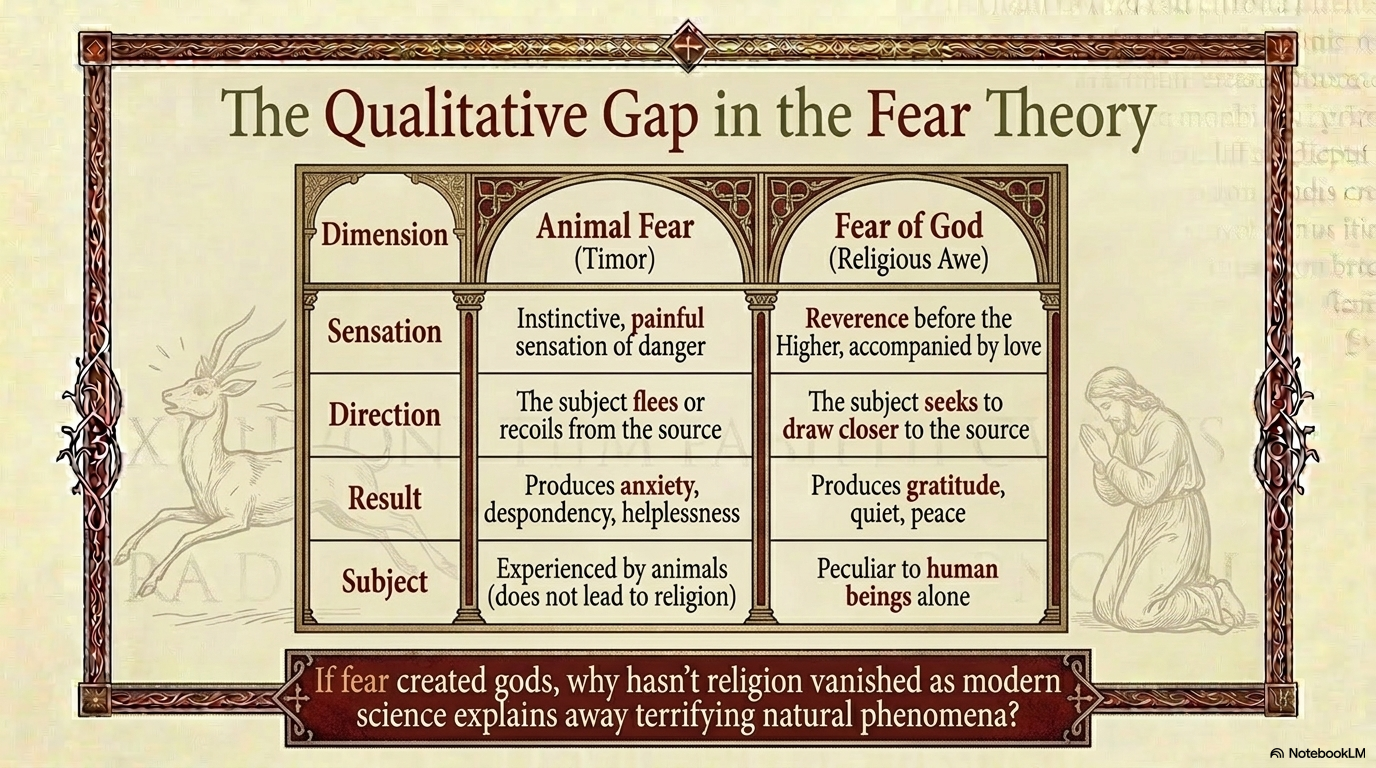
However, the central problem with this argument is that ordinary animal fear and the ‘fear of God’ — religious awe — are qualitatively different, so conflating them is not permissible.
The last observation is particularly important: animals experience fear of threatening natural phenomena with the same or greater intensity as human beings. Yet religious worship does not emerge in animals. Therefore, religious worship and natural fear are qualitatively distinct and cannot be reduced to each other.
Furthermore, the fear theory leaves unanswered the question of why religion persists. Suppose fear did produce the first gods. Science has now explained most of the natural phenomena that previously inspired terror. Why, then, has religious feeling not disappeared alongside the fear? If the cause has been eliminated, the effect should vanish — yet it has not.
4.3. The Animist (Evolutionist) Theory: E. B. Tylor
This theory was developed by the English scholar Edward Burnett Tylor (1832–1917), though its roots go back to Epicurus. In the late nineteenth and early twentieth centuries, it became foundational for Western scholarship on the history and philosophy of religion. It is also known as the evolutionist theory because it applies an evolutionary principle to religion, arguing that, like everything else, religion develops from simple to complex forms.
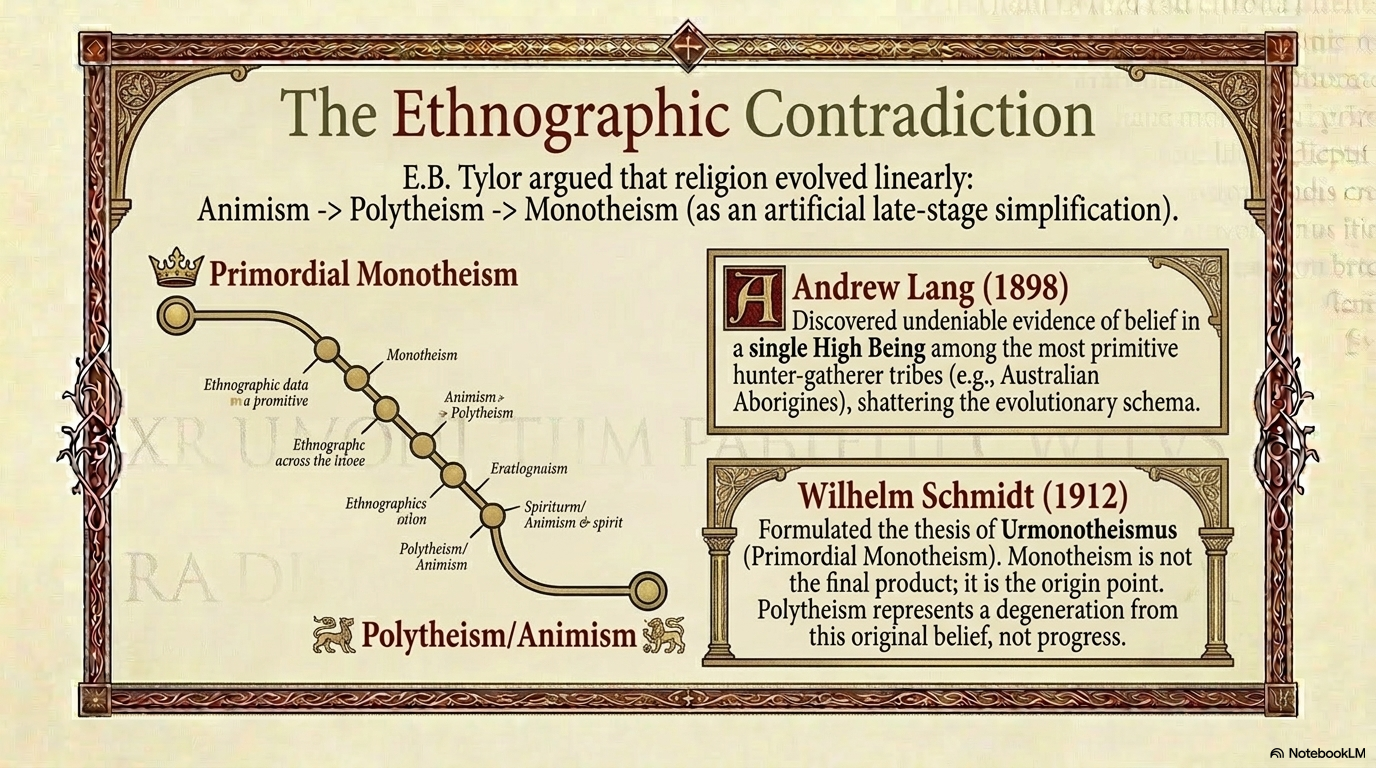
The argument runs as follows: Archaic human beings noticed that, although their bodies were motionless during sleep, they experienced themselves as active — hunting and speaking with the dead, for example. They concluded that each person has an incorporeal double — a soul. They gradually extended this idea to everything around them, populating nature with spirits. As they formed a religious relationship with these spirits — petitioning, thanking and appeasing them — they created animism, the initial stage of religion.
The argument continues that as intellect developed, the transition followed from animism to polytheism and then to monotheism. According to Tylor, monotheism is an artificial product of cultural development — the logical result of simplifying a complex pantheon. In other words, religion is entirely a human invention with no connection to any revelation.
There are several levels at which this theory can be criticised. Start with the logical one. For archaic human beings to enter into a religious relationship with the phenomena of nature — to begin to worship, petition and propitiate — they would already have needed the concept of divinity. Without some prior concept of the higher power, even if it is vague, the concept of gods simply cannot arise. Animism does not explain the emergence of the religious idea itself; the error of begging the question is again committed here.
The strongest criticism of Tylor’s theory came from ethnography itself. Initially a passionate defender of Tylor, the English scholar Andrew Lang (1844–1912) eventually turned against him. In his book The Making of Religion (1898), he pointed out undeniable evidence for belief in a single High Being among Australian Aborigines and other primitive peoples, which directly contradicted Tylor’s evolutionary schema. This directly contradicted Tylor’s evolutionary schema.
Even more significant was the contribution of Wilhelm Schmidt (1868–1953), who, in his work The Origin of the Idea of God (1912), formulated the thesis of ‘Urmonotheismus’ — primordial monotheism. Among the most undeveloped tribes, he argued, belief in a single High God — Creator and Sustainer — is discernible. Monotheism is not the final product of long development; on the contrary, it precedes polytheism, which is a degeneration, not progress.
It is worth noting that the scholarly community received Schmidt’s argument with reluctance and silence. This was not because the argument was weak, but because atheistic views had become dominant in academic circles by that time.
4.4. Feuerbach’s Anthropological Theory: ‘God as Idealised Man’
Ludwig Feuerbach (1804–1872) provided a pseudoscientific philosophical framework for the ancient concept of ‘religion as a human invention’ and applied it specifically to the origins of Christianity. This theory of religion became one of the philosophical foundations of Marxism.
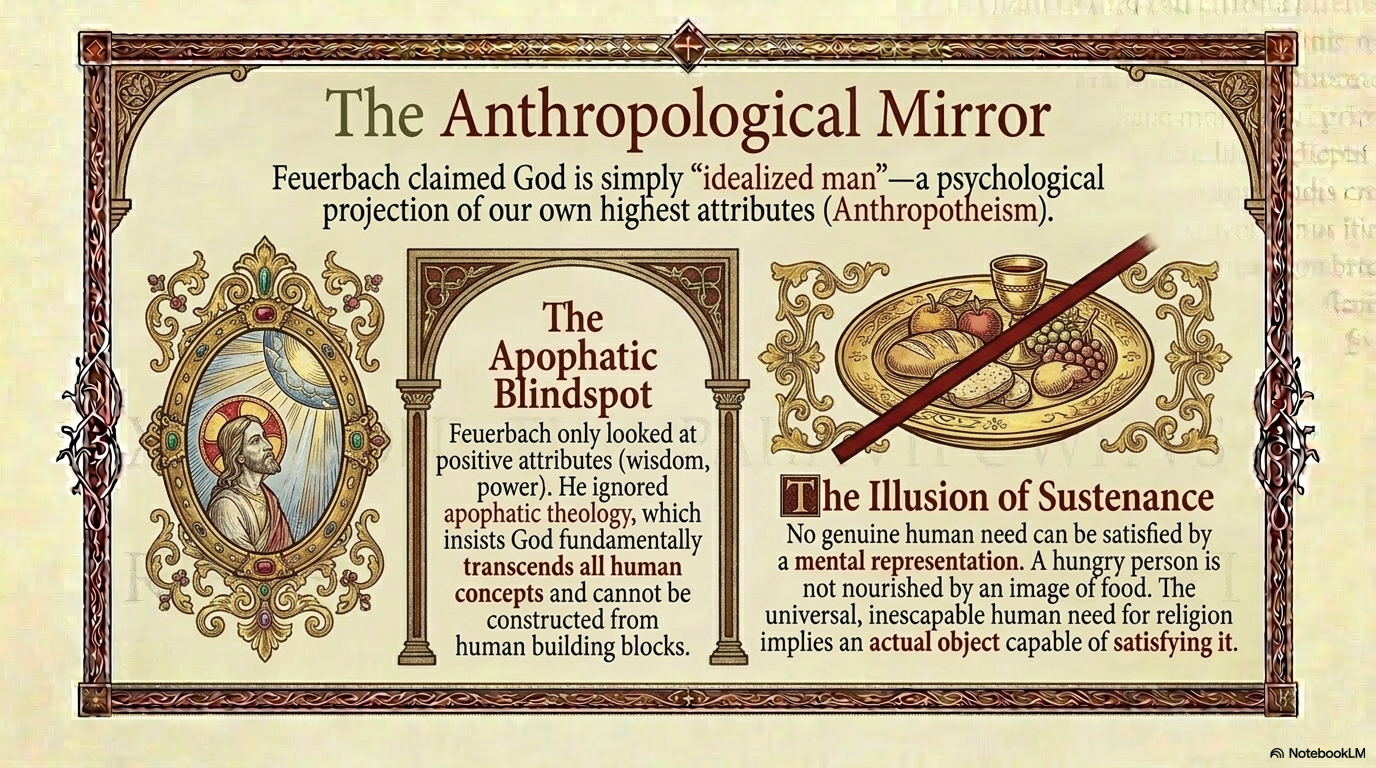
Feuerbach’s fundamental principle is strictly materialist: only human beings and nature exist. The concept of God is simply a product of the human imagination. He himself states the central thesis: ‘Divine revelation is nothing other than the self-consciousness of human beings… the attributes of God are nothing other than the idealised attributes of human beings themselves, and God is nothing other than human beings’ memorandum of their highest feelings.’
In other words, when we describe God as great, wise and perfect, we are idealising our own capacities and projecting them outward. God is a mirror in which the human being sees themselves, but does not realise it. Father Sergei Bulgakov aptly described this teaching as ‘anthropotheism’ — ‘a religion that elevates the human being himself to the place of God’.
The first argument against Feuerbach also comes from Sextus Empiricus, which is instructive in itself, as the ‘discovery’ of the nineteenth century had already been identified and refuted in ancient times. Sextus describes those who arrive at the attributes of God — eternity, incorruptibility and perfect blessedness — by negating human attributes. However, he points out that this reasoning is circular: to idealise human happiness to an ‘absolute’ level, we already need to understand what ‘absolute’ means — we already need the concept of God. In order to construct the concept of God from an idealisation of the human being, the concept of God must already be in place.
The second argument is apophatic theology. Feuerbach bases his theory on an analysis of the positive (cataphatic) attributes of God, such as goodness, wisdom and power. However, there is a formidable apophatic tradition in Christian theology which insists that God fundamentally transcends all human concepts and categories. According to this tradition, everything we say about God positively only points approximately and imperfectly towards a reality that infinitely exceeds human experience.
As the theologian Vladimir Lossky writes, ‘Apophatic theology purifies our concepts of God and prevents them from closing in on their own limited meanings… These are attributes and properties through which the deity communicates something of itself, but its hidden source can never be fully revealed to us.” In other words, Christians themselves acknowledge that their conception of God is inadequate — which is precisely why apophatics are a necessary complement to any positive theology. Feuerbach simply did not notice this.
The third argument is the universality of religious need. Given that religion is a universal and necessary phenomenon in human life, it is difficult to accept the idea that it is ‘an empty fabrication of a corrupt heart and unbridled imagination’. To do so would be to suggest that the entire human race is afflicted with chronic madness. Professor V. K. Shokhin rightly observes: “It is impossible to deceive everyone at all times, and if the disease has no origin and is inextricably linked to the functioning of the organism, it is no different to health.”
Finally, religious need cannot be satisfied by an illusion. No genuine human need can be met by a mere mental representation of its object: a hungry person is not nourished by an image of food, nor does a thirsty person quench their thirst by imagining water. Similarly, religious need can only be satisfied by an actual God, not an illusion created by human beings.
Related Concepts
- 1-timothy-616
- agnosticism
- amos-521
- animism
- anthropotheism
- aristides-of-athens
- atheism
- awe
- cappadocian-fathers
- cappadocians
- communion
- creator-and-creation
- critias
- cult
- deism
- desecration
- ecstasy
- epiphanius-of-cyprus
- eternal-life
- ethics
- fall
- false-devotion
- feuerbach
- fulfilled-prophecy
- fundamental-theology
- gregory-of-nyssa
- impersonal-god
- incomprehensibility-of-god
- ivan-ilyin
- kant
- khomyakov
- lystra
- magisterium
- mark-123031
- methodological-agnosticism
- monotheism
- moral-order
- mystical-knowledge-of-god
- neglegere
- neoplatonism
- nirvana
- orthopraxy
- particular-judgment
- piety
- private-revelation
- projection
- quran
- rationalism
- reeligere
- reincarnation
- relegere
- religare
- religio
- religion
- religious-experience
- resurrection
- revelation
- ritual
- sacred-history
- sacredprofane
- scripture
- sextus-empiricus
- sin
- skepticism
- superstitio
- taboo
- theism
- thomas-hobbes
- tylor
- universal-revelation
- unknowability-of-god
- urmonotheismus
- vladimir-lossky