Fundamental Theology — Topic 2. What Is Faith_
Let me draw the threads together and state what I take to be the central claim of this introductory part.
Faith is not simply an opinion about facts. When I say ‘I believe it will rain tomorrow’, or ‘I believe the Earth is round’, I am using the word in its most attenuated sense — as a synonym for ‘I think’ or ‘I suppose’. That is not the faith that matters for us. Genuine faith — faith as it has functioned in human life at its deepest — is something fundamentally different.
Return to Blondin and the wheelbarrow. The young man said ‘I believe you can’ — and stayed on the ground. He expressed an opinion. Whoever climbed in would have expressed faith in the genuine sense: trust, commitment, the acceptance of risk.
What does that kind of relation actually involve? Drawing on the sources we have examined — from pistis and emunah to fides formata caritate and the patristic inheritance — four dimensions seem to me inseparable.
Trust — the readiness to rely on someone or something without absolute guarantees.
Self-giving — the willingness to invest oneself, to put something real at stake. This is, etymologically, precisely what credo means: I give my heart.
Hope — an orientation towards what has not yet come to pass and cannot be proved in advance.
Fidelity — the readiness to sustain this orientation even when it is hard, even in the presence of doubt.
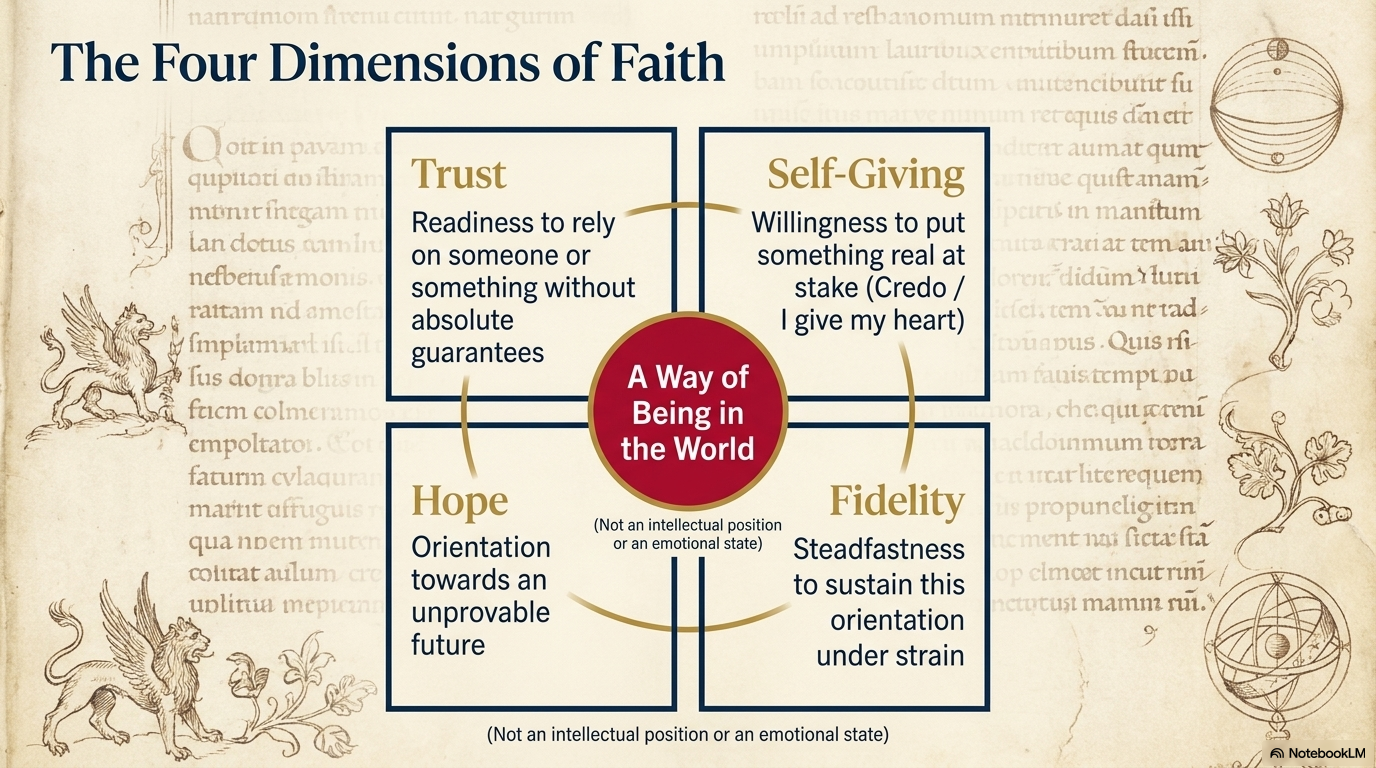
This is why faith cannot be reduced to knowledge, or to conviction, or to emotion. Knowledge says: I can prove this. Conviction says: I hold this to be true. Emotion says: this is how I feel right now. Faith says something different: I rely on this. I commit myself to this. I live as though this is real — and I am prepared to go on living this way even when it is hard. It is not an intellectual position, and not an emotional state. It is a way of being in the world.
And this is why faith is not an optional supplement to human life — something you can take or leave according to temperament. It is a necessary condition. Without trust, no genuine relationship with another person is possible. Without hope, action is impossible, because every action is directed towards a future that is never guaranteed. Without fidelity, no long-term purpose can be sustained, no identity held together over time. A person who trusts nothing and no one — not in any high theological sense but simply in the human sense — is not a liberated sceptic. He is paralysed: incapable of loving, acting.
This is what makes faith so difficult to analyse philosophically and so unavoidable for understanding what it is to be human. Difficult — because it fits none of our standard categories: not knowledge, not emotion, not simply a decision of the will. Unavoidable — because without it, human life in its fullness is simply not on the table.
There is a view, very widely held and almost never examined, which runs something like this: if you believe something, it is because you cannot prove it. Once you can prove it, it ceases to be faith and becomes knowledge. The two are mutually exclusive — where one ends, the other begins. You are either on the side of evidence or you are on the side of faith, and the educated person, naturally, chooses the former.
This is not merely an abstract philosophical position. It has consequences. The person who says they believe in God is immediately placed in an awkward position by the educated sceptic. Either their belief admits of no proof — in which case it is taken as a mark of intellectual weakness, a failure of critical nerve — or they claim actually to know the truth of their belief, in which case they are asked to produce evidence of the kind that would satisfy a scientist. They cannot. And so they end up looking either deluded or dishonest. The opposition of faith and reason quietly becomes the opposition of falsehood and truth, with faith assigned.
What I want to suggest in this lecture — and I will try to argue it carefully — is that this whole picture rests on a misunderstanding. Not a subtle or technical misunderstanding, but a quite fundamental one: a confusion about what the word ‘faith’ actually means, where it comes from, and what it has been understood to involve across the traditions in which it has played any serious role. The familiar definition — faith as the acceptance of what cannot be proved — is historically quite recent, philosophically contentious, and, when followed to its conclusion, deeply misleading.
- Introduction
- Section 1. Faith as a Universal Human Phenomenon
- Section 2. Terminological Complexity: Belief, Faith, and Knowledge
- Section 3. Faith as a Distinctive Mode of Consciousness
- Conclusion
Start with something obvious that turns out, on reflection, to be rather less obvious than it first appears. Think about how many times during a typical day you use words related to faith—to believe, to trust, to be certain of something or someone. A student says to a friend: ‘I know you’ll get through this exam.’ A physicist tells a colleague: ‘I think this is the mechanism.’ A believer says, ‘I believe in God.’ A patient takes the medicine her doctor prescribed. A supporter stays in his seat with the score at nil-three and ten minutes left. In all these cases, something of the same kind is at work — and this simple fact deserves a pause.
What it suggests is that faith is not first of all a religious or mystical phenomenon. It is woven into the very texture of human existence, and it appears long before anyone has to decide whether they accept any theological proposition. A preliminary claim, which I shall try to defend: faith is not merely common; it is necessary. Life without it is not an austerely rational alternative — it is not possible at all.
To see why, it helps to look at three areas in which faith announces itself with particular clarity: ordinary life, scientific, and religious experience. They are very different domains. But something is recognisably the same across all three.
1.1. Faith in Everyday Life
Take first what we might call non-religious faith — the trust that saturates ordinary experience quite apart from any theological commitments.
When you get into a car, you are implicitly accepting a whole cluster of things you have never verified. For example, that the engineers who designed it knew what they were doing, that the mechanics who serviced it were conscientious, Over the course of a single day, hundreds of such unverified acceptances occur — you take a tablet without personally analysing its chemical composition, you trust the clock, you believe things your teachers told you twenty years ago and have never had occasion to check. This is not a marginal feature of human cognition. It is the norm.
H. H. Price, in his 1965 paper ‘Belief “in” and Belief “that”‘[1], draws attention to the remarkable range of things people believe in — not just propositions but persons (the doctor, the engineer, the judge), institutions (courts, universities, banks), methods, ideals. And the list, as Price notes, resists any principled limit. We are dealing with something pervasive, not occasional.
In our personal relationships, faith takes a different and more intimate form. Every genuine relationship — friendship, love, marriage, professional partnership — rests on a foundation of trust that cannot in principle be reduced to knowledge. You do not have direct access to another person’s interior — to their real motives, their character under pressure, what they will do when loyalty becomes genuinely costly. And yet you trust. This is not naivety; it is what makes human community possible at all.
J. Derrida makes a still more radical observation. Even the act of speaking to another person presupposes a kind of elementary faith — the faith that your words will be heard, that they will be understood, that they will reach someone. Formulation: the ‘trust me, I am speaking to you’ belongs to the order of faith. Which means that faith, as trust, is constitutive of language itself — prior not only to religion but to any deliberate act of knowing.
There is a distinction worth noting here, because it will matter later. When I trust my doctor, I trust him as a doctor — I trust his competence in a specific domain. But when I trust a friend, I trust her as a person, as herself — not for what she can do for me but for what she is. The difference between instrumental and non-instrumental trust carries implications for how we understand religious faith
The football supporter who stays in his seat at nil-three illustrates one feature of faith that is worth marking: its irreducibility to a merely cognitive state. He does not simply ‘regard it as probable’ that his team will recover — contrary to every statistical indication, he sustains a particular orientation, a posture, that governs his behaviour and that is not the product of weighing evidence. Whether in sport or religion, we are dealing with something that is not propositional knowledge, and that does a specific job: it sustains orientation and action precisely in conditions where strict knowledge runs out.
This — faith as the orientation that makes action and relationship possible when certainty is unavailable — is what allows us to see ‘everyday’, ‘interpersonal’, and ‘sporting’ faith as expressions of a single phenomenon. It is the phenomenon of trust: of committing oneself to something or someone, of accepting risk, of going on. It precedes reflection. It underlies action as such.
1.2. Faith in Science
The idea that science and faith are fundamentally opposed — one grounded in proof, the other in ungrounded acceptance — is, as I say, deeply entrenched. It was shaped by Cartesian rationalism[2], by nineteenth-century positivism[3], and then sharpened by the polemics around Darwin. And on closer examination, it turns out to be considerably less clean than it looks.
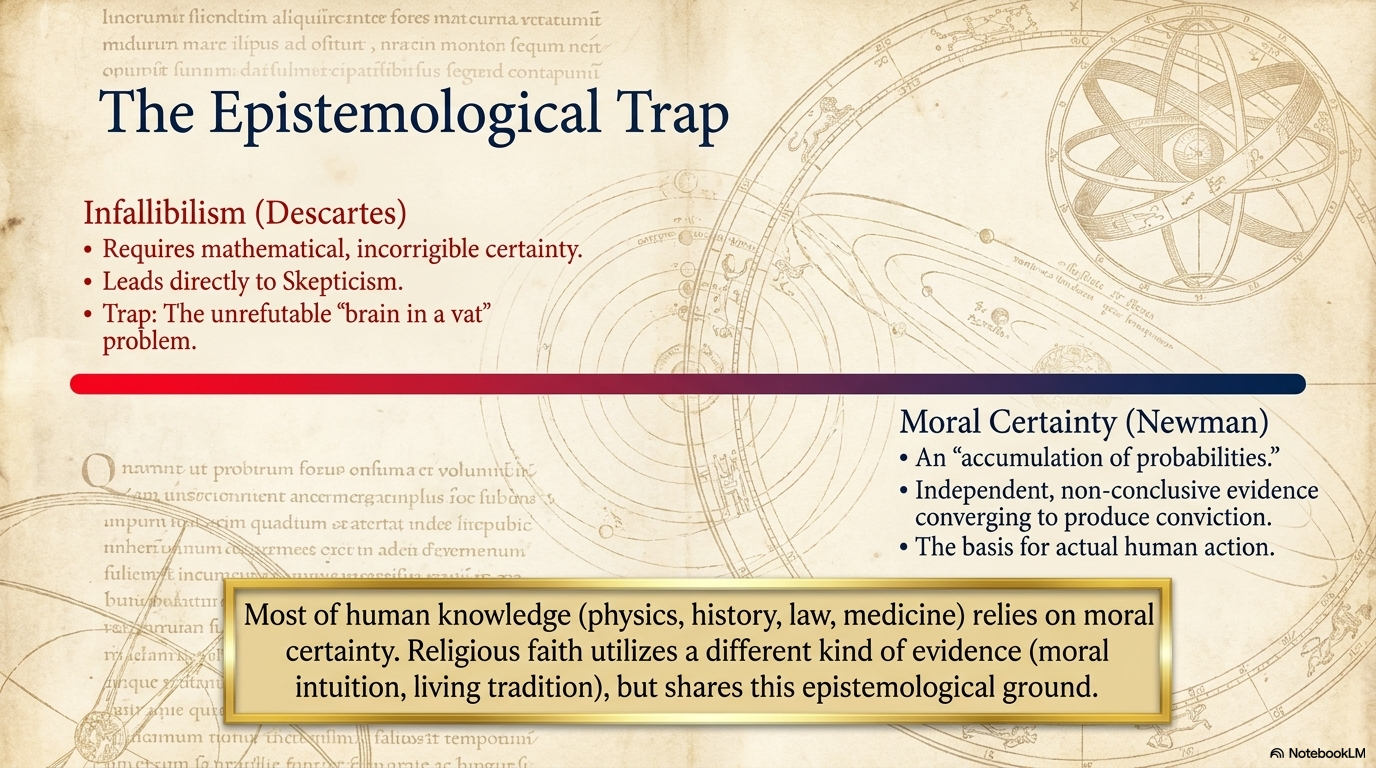
Most of what we are most confident about — including claims that carry the imprimatur of science — rests not on strict logical demonstration but on what called the ‘accumulation of probabilities’ : a convergence of independent pieces of evidence, none individually conclusive, which together produce a degree of conviction sufficient for reasonable action. Cardinal Newman called this ‘moral certainty’ — distinct from the mathematical certainty that Descartes thought was the only solid foundation of knowledge. The distinction matters more than it is usually taken to.
Consider a simple example. You are virtually certain that Great Britain is an island. But how many of you have personally sailed around its coastline? Very few, I should think. Your certainty is assembled from school lessons, atlases, maps, news reports, conversations with people who have crossed the Channel, incidental references in books and films. Each of these could, in principle, have been mistaken. But they all point the same way — and it is this convergence that produces firm conviction. The same holds for your certainty that Julius Caesar existed, or that the Earth is considerably older than any of us. These are not logical inferences from axioms. They are products of converging testimony.
Now, the scientist at the bench operates with a set of background commitments, none of which can be strictly proved within science itself. Let me name three.
The first: that the world is ordered by regularities, and that these regularities are in principle knowable. When a scientist begins an investigation, she proceeds on the assumption that behind observable phenomena lie stable patterns that can be identified, described, and tested. But this assumption is not the product of scientific investigation — it is its precondition. She does not prove it; she simply acts as though it were true. That is an act of trust. And it is prior to any particular inquiry.
The second: that the data produced by colleagues elsewhere can be relied upon as a basis for one’s own work. No scientist works in isolation. A physicist studying elementary particles depends on results from thousands of experiments conducted by researchers across the world. Personally re-checking even a fraction of those results is not possible. So she trusts — trusts the integrity of her colleagues, the reliability of their methods, the honesty of their publications. Science is held together by this trust in much the same way that civil society is held together by trust in legal institutions.
The third — and philosophically the most interesting — is the conviction
that the laws of nature operative yesterday will continue to operate
tomorrow. The whole logic of scientific inference rests on this. We observe
a phenomenon repeatedly, identify a regularity, and project it forward. But
this inference — from past observations to future cases — is not logically
necessary. This is precisely what Hume demonstrated in his formulation of the
problem of induction: from the fact that the sun has risen every morning for
billions of years, it does not follow with logical necessity that it will rise
tomorrow. The only ground for our expectation is trust in the stability of the
world’s order. This trust cannot be justified by science. And yet every
scientist who formulates a law or makes a prediction is quietly relying on
this unprovable commitment.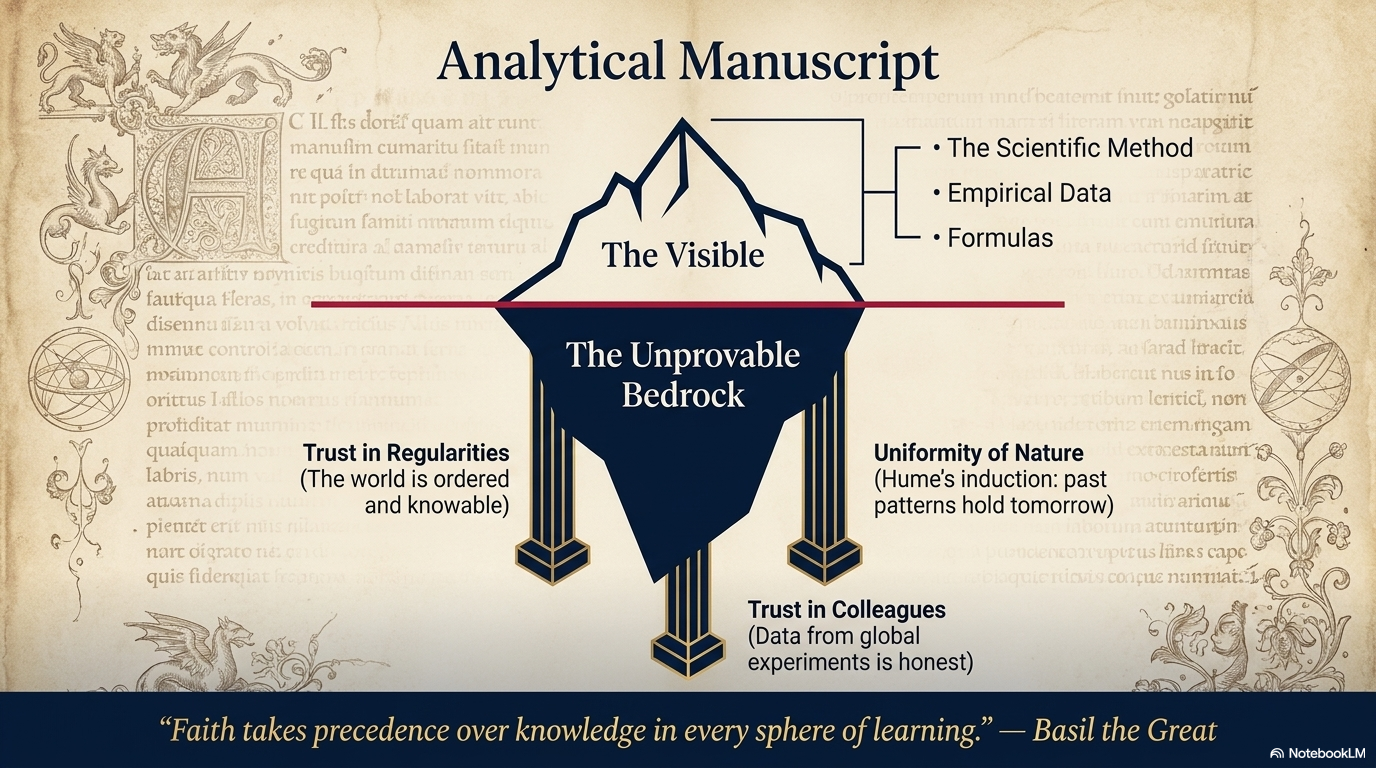
This position has respectable theological ancestry. Basil the Great put it with characteristic directness: ‘What comes first — knowledge or faith? We affirm that faith takes precedence over knowledge in every sphere of learning.’ This is not an invitation to credulity. It is an observation about the actual structure of human cognition: in any system of knowledge, there are foundational commitments that are accepted not on the basis of proof but on the basis of trust in reality — trust that precedes all reasoning. In mathematics, these are axioms. In physics, the laws of nature. In science as a whole, the conviction that the world is ordered and that this order is intelligible. None of these can be demonstrated by the science they underpin. They are held on faith — and this is not a weakness of science but a condition of its possibility.
None of this implies that science is unreliable, or that scientific results should be called into question. The point is more structural: scientific activity is possible only on the foundation of certain basic trusts which science does not produce but presupposes. In this sense — not in any irrational or mystical sense — science rests on faith.
The scientist trusts that the world is ordered. That memory is not systematically deceptive. That other human beings are minded. None of us has proved any of these things. We stand on them as on firm ground.
Alvin Plantinga asks what seems to me a very good question: why should belief in God be placed in a different category from these?
When someone demands ‘prove that God exists’, they rarely think to ask parallel questions: ‘prove that your memories are real’, or ‘prove that the people around you genuinely experience things rather than merely behaving as if they do’. There is no strict proof available for either of these. And yet belief in other minds, or in the general reliability of memory, is considered perfectly reasonable — nobody declares it irrational.
Plantinga’s point is that this constitutes a double standard. If we allow as reasonable those basic trusts without which science and ordinary life are impossible, we have no purely logical grounds for ruling out belief in God in advance from among such basic convictions. It stands in the same row — not lower, not higher — as the assumptions that precede proof and make cognition itself possible.
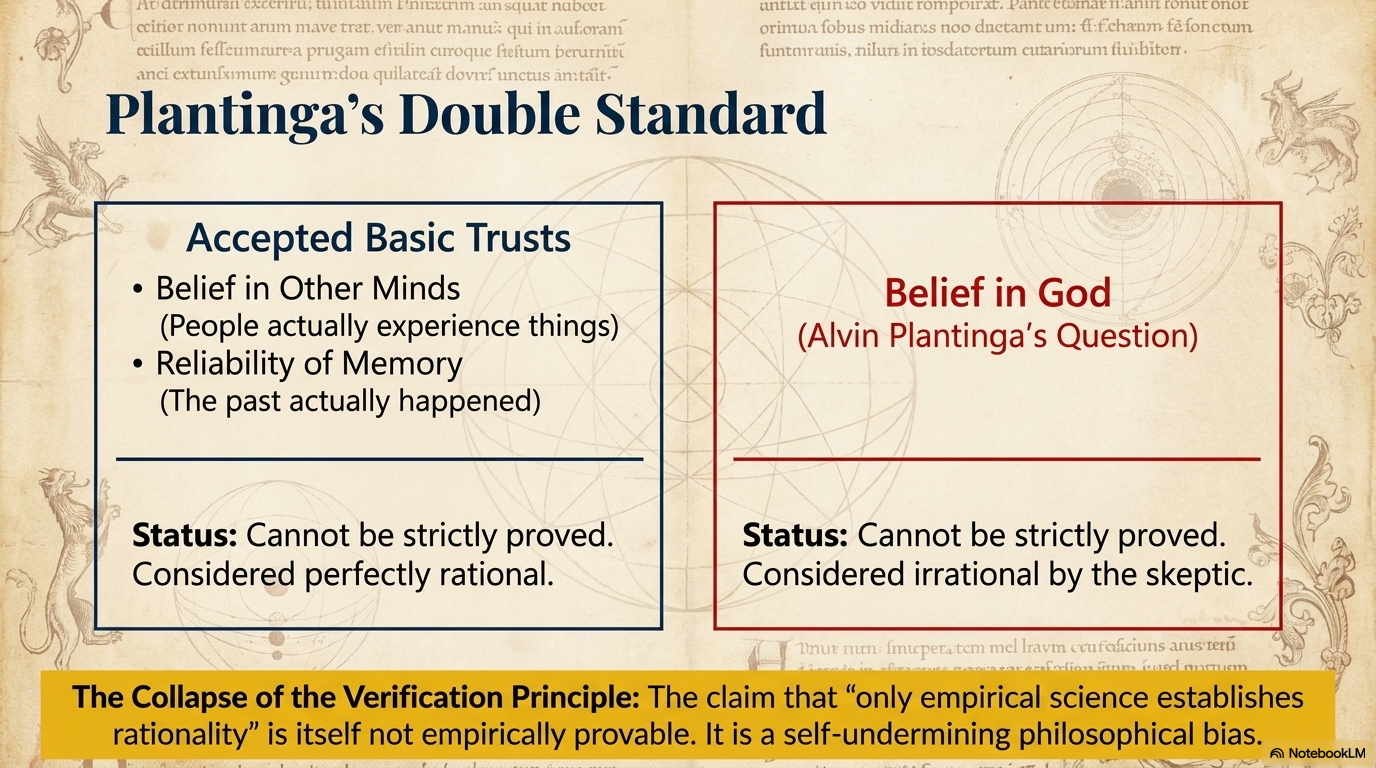 One can push this further. The
objection to religious belief is often framed as follows: religious claims are
not verifiable by the methods of empirical science, and therefore they fall
outside the domain of rational acceptability. But notice what this assumes. It
assumes that the methods of empirical science are the only methods by which
rational acceptability can be established. And this assumption is itself not
established by empirical science — it is a philosophical claim, and a
contested one. The logical positivists of the early twentieth century
attempted to formalise it in the verification principle: a statement is
meaningful only if it is either a tautology or verifiable by sense experience.
But the verification principle turned out to be self-undermining — it is
itself neither a tautology nor verifiable by sense experience, and so by its
own criteria it is meaningless. The project collapsed, and the philosophy of
science moved on.
1.3. Religious Faith
Religious faith is the most elaborated, most theoretically developed, and most philosophically contentious form of faith. It is in religious contexts that faith has been most fully interpreted and most fiercely disputed. But before we get anywhere near those disputes, we need to clear away a widespread and damaging misunderstanding.
Many people, when they hear the word ‘faith’, understand it to mean something like: accepting as true what cannot be proved. I have already suggested that this definition is historically recent. Let me now try to say what faith actually meant in the traditions from which Christianity emerged — because the contrast is important.
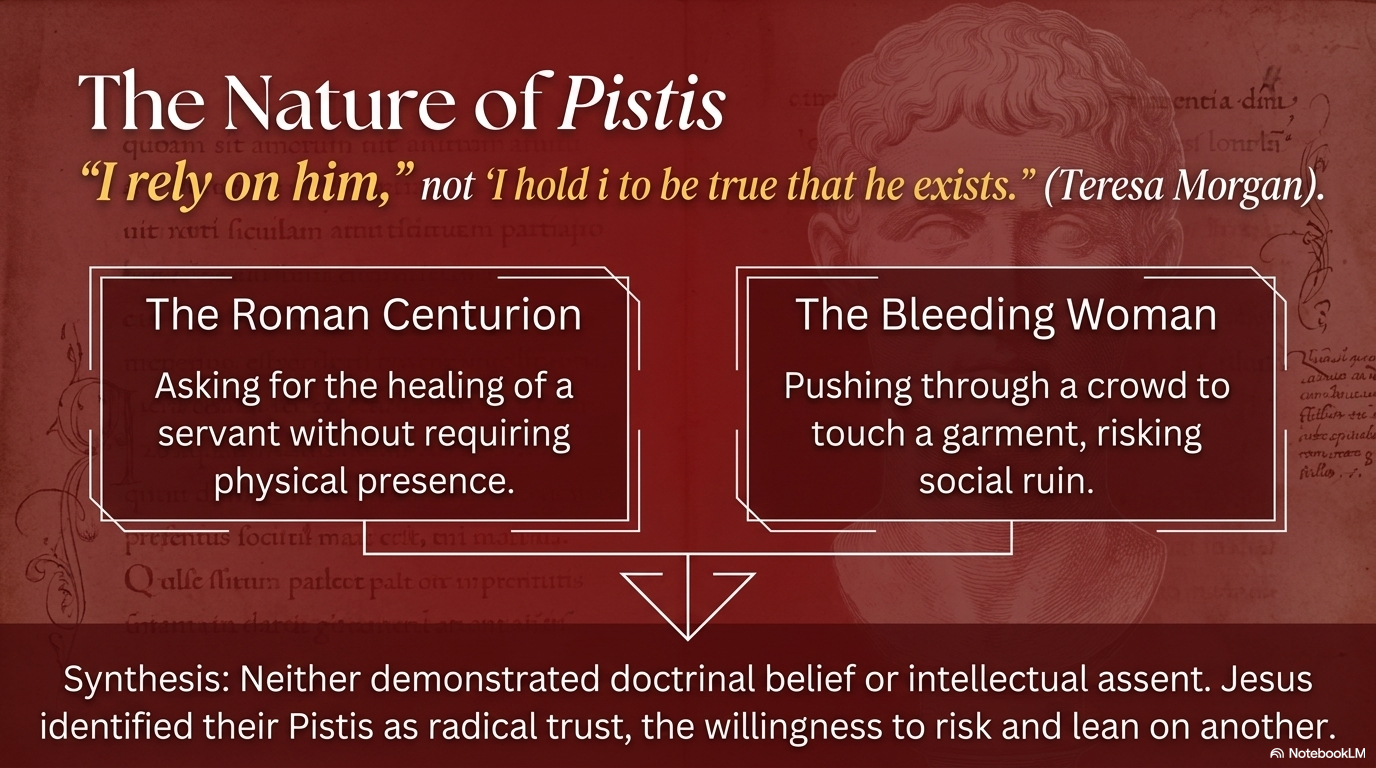
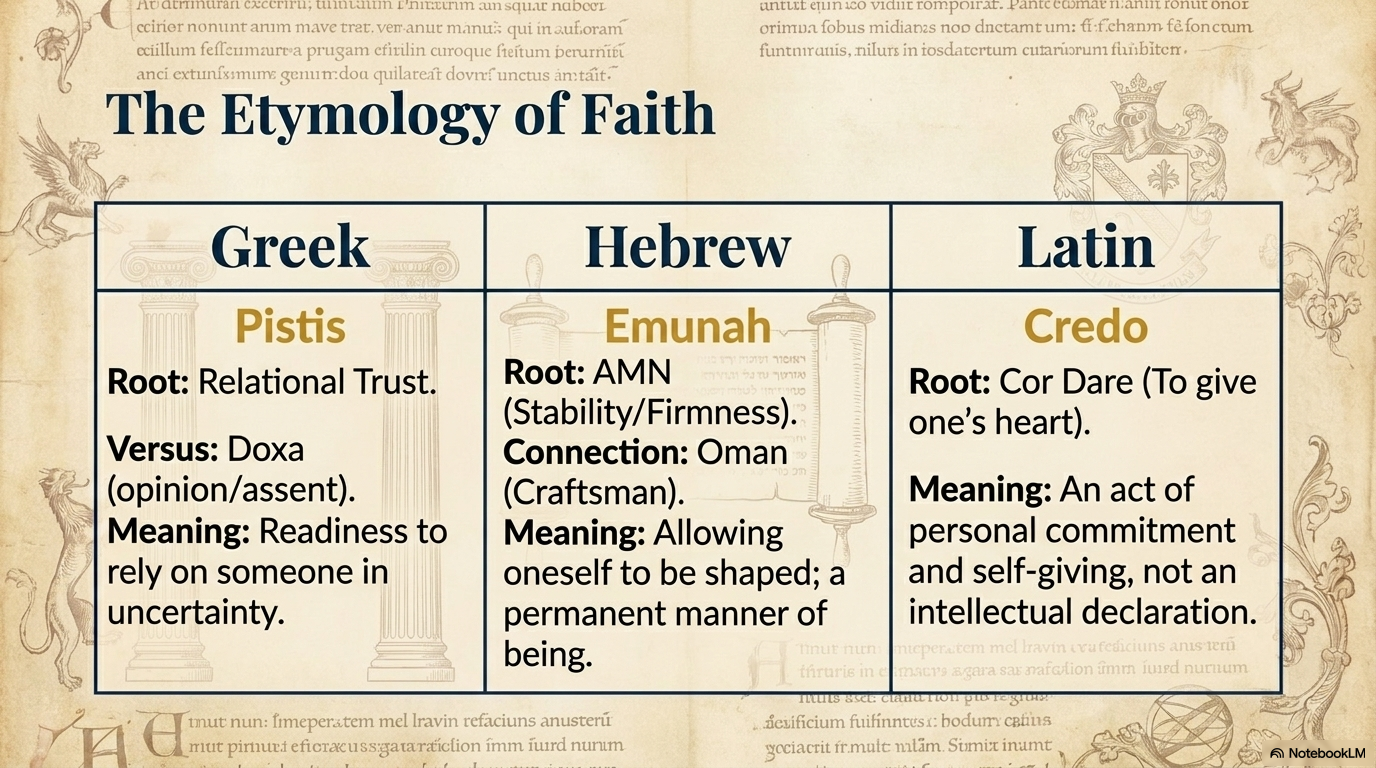
The New Testament is written in Greek, and its key term is πίστις — pistis — conventionally translated as ‘faith’. Teresa Morgan, in her extensive study of the Graeco-Roman world of the first centuries, has shown persuasively that in that cultural context pistis designated above all a relationship of trust between persons — or between a person and God — not assent to a set of propositions.
It helps to hold two Greek words side by side. For opinion, point of view, intellectual judgement about whether something is true, Greek had δόξα — doxa. Orthodoxy literally means ‘correct opinion’, not ‘correct faith’, though we tend to translate it the latter way. Pistis is quite different. It belonged to the sphere of personal relationships. It described the readiness to trust another person, to accept risk, to rely on someone in conditions of uncertainty, to maintain loyalty to a relationship even when it is difficult.
Morgan’s example from the Gospels is telling. When the woman with the haemorrhage pushes through the crowd to touch the hem of Jesus’s garment (Mk 5:25–34; Lk 8:43–48), or when the Roman centurion asks for the healing of his servant (Matt 8:5–13; Lk 7:1–10) — in both cases Jesus speaks of pistis. But what are these people demonstrating? Not a declaration of doctrinal belief, not intellectual assent. They are demonstrating trust: the willingness to risk, to lean on another, to commit themselves.
This is why Morgan concludes that when the first Christians said ‘I believe in God’, they meant not ‘I hold it to be true that God exists’ but something fundamentally different: ‘I trust God. I rely on him. I entrust myself to him.’ In the Graeco-Roman world of the first centuries, the existence of gods was rarely in question. The decisive question was a different one: can this God be trusted? Is he faithful? Reliable? Pistis answers that question.
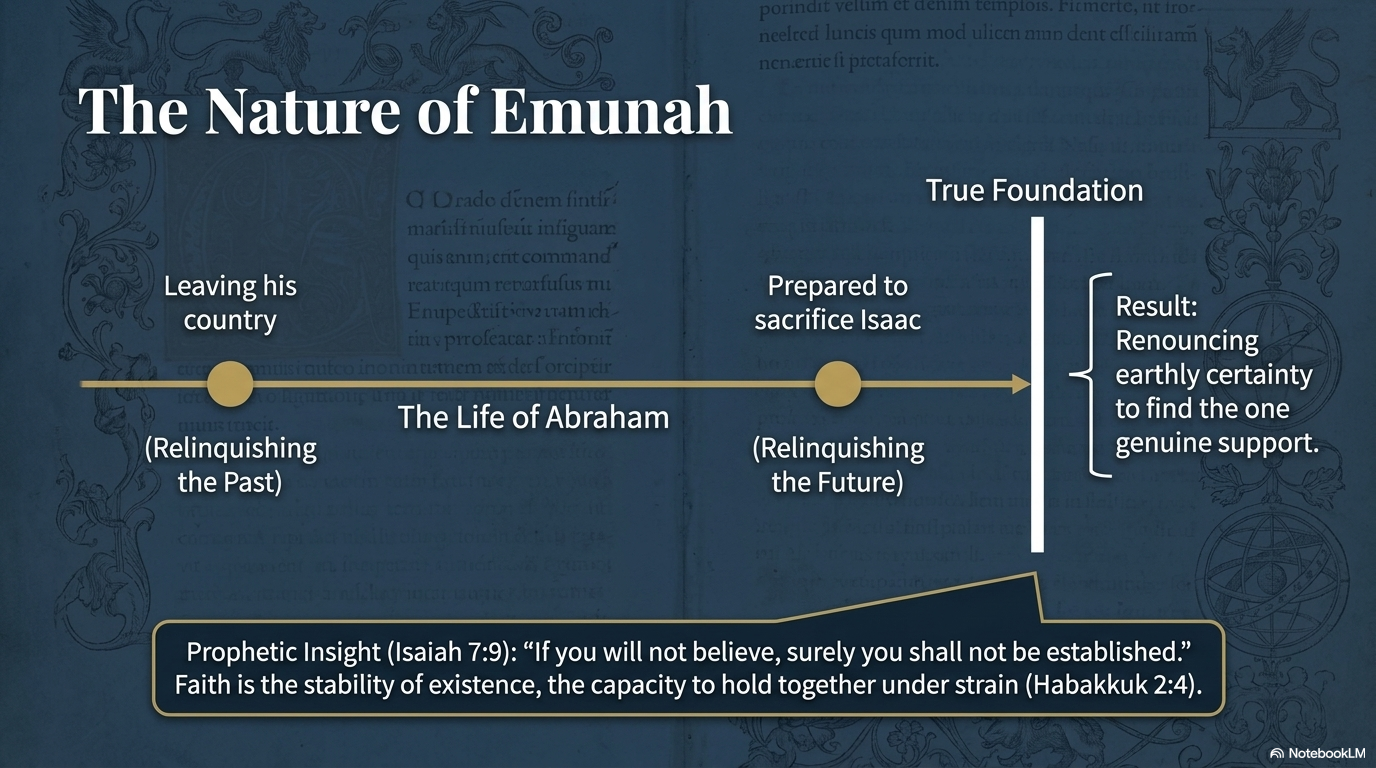
In Hebrew, the equivalent term is emunah — the word behind ‘faith’ in translations of the Old Testament. It derives from the root AMN, which is also the root of ‘Amen’. AMN in Hebrew denotes above all stability, reliability, firmness — the quality of something you can lean your whole weight on without it giving way.
And this is crucial: in the Old Testament, emunah is inseparable from a whole cluster of related ideas — the fear of God, love of God, hope in him, ‘walking before God’ — a concrete way of life in God’s presence. Faith in the biblical sense is not an isolated psychological state. It is a manner of being in the world.
This comes out most vividly in the story of Abraham. When Genesis says that ‘Abram believed the LORD, and he counted it to him as righteousness’ (Gen. 15:6), the reference is not to Abraham’s agreement with some proposition. Scholars of the Hebrew text note that the verb here is in a form describing not a single act but a continuing state — the patriarch’s permanent manner of being.
Abraham’s life is a story of steadily relinquishing earthly supports. He departs his country, his kindred, his father’s house — ‘not knowing where he was going’ (Heb. 11:8). He lets go of his past. Then he is prepared to sacrifice Isaac — and thereby lets go of his future. In both cases his faith is not an intellectual conviction. It is a radical act: the renunciation of every earthly ground for certainty, in order to find the one genuine support.
The Jewish theologian B. I. Berman draws attention to another dimension of the same root. Emunah shares its derivation with oman — craftsman, artist, master of a craft. To entrust yourself to God, in this light, is to recognise yourself as material in the hands of the Master, to allow him to shape your life into what he has envisioned. This is not passivity. It is active, conscious trust: the willingness to place yourself in his hands so that he may make of your life his own work.
The same theme of firmness and stability resounds in Isaiah: ‘If you will not believe, surely you shall not be established’ (Isa. 7:9). In the Hebrew, this is a wordplay — two words from the same root, the stability of faith and the stability of existence. The prophet speaks to King Ahaz in a moment of military crisis: your political survival — whether your dynasty stands — depends on your inner steadiness in trust in God. Faith here is not a religious experience separate from political reality; it is the most real political force there is. Similarly in Isaiah 28:16: ‘whoever believes in him will not be put to shame’ — which speaks of the person who has found a true foundation and therefore cannot be broken.
In Habakkuk there is a phrase that would become one of the most pivotal in New Testament theology: ‘the righteous shall live by his faith’ (Hab. 2:4). Scholars are at pains to point out that emunah here means not simply ‘faith’ in the sense of belief, but faithfulness, steadfastness, integrity, the capacity to hold together under strain. The righteous person lives not because he thinks correctly about God, but because he remains faithful in circumstances that should, by every calculation, have broken him.
This last point deserves a moment’s attention, because it runs directly against the way the question of faith is usually framed in popular religious controversy. The question is almost always posed as an epistemological one: does God exist? Can the existence of God be rationally established? Is there sufficient evidence? These are perfectly legitimate questions, but they are not the primary questions of faith as the biblical texts understand it. For the writers of the Psalms, for the prophets, for the Apostle Paul, the question is not ‘Does God exist?’ but rather: ‘Is God faithful? Can he be relied upon? Will he hold?’ The question is relational, not metaphysical. And the answer — what the texts call faith — is not a theoretical conclusion but a posture of life.
Now to Latin. Credo in unum Deum — I believe in one God. Most scholars trace credo to cor and dare: ‘I give my heart.’ In Latin culture, cor — the heart — meant not merely the organ, nor even simply the emotional centre of a person. It was the symbol of what is most essential in a human being: their will, their values, their identity. To give one’s heart is to give oneself; to offer what matters most.
Marcus Borg, reflecting on this etymology, observes that when the first Christians said Credo, they were performing not an intellectual act but an act of self-giving. Not ‘I hold the following propositions to be true’, but ‘I give my heart; I entrust myself; I dedicate my life.’ The difference is enormous. Two people may recite the same words of the Creed — but one does so as a declaration of intellectual positions, the other as an act of personal commitment. In terms of the original meaning of credo, only the second truly believes.
This is exactly the distinction Pascal had in mind when, in the famous
Memorial found sewn into his clothing after his death, he wrote: ‘God of
Abraham, God of Isaac, God of Jacob — not of the philosophers and scholars.’
The God of the philosophers is a concept, an object of inference, a conclusion
from reasoning about first causes. One may ‘believe’ in such a God in a purely
intellectual sense while remaining entirely cold and untouched. The God of
Abraham is altogether different. Abraham trusted him, followed him, relied on
him in situations that required genuine risk and genuine self-giving. That is
faith in its original, living sense — not assent to a proposition but a
personal relationship.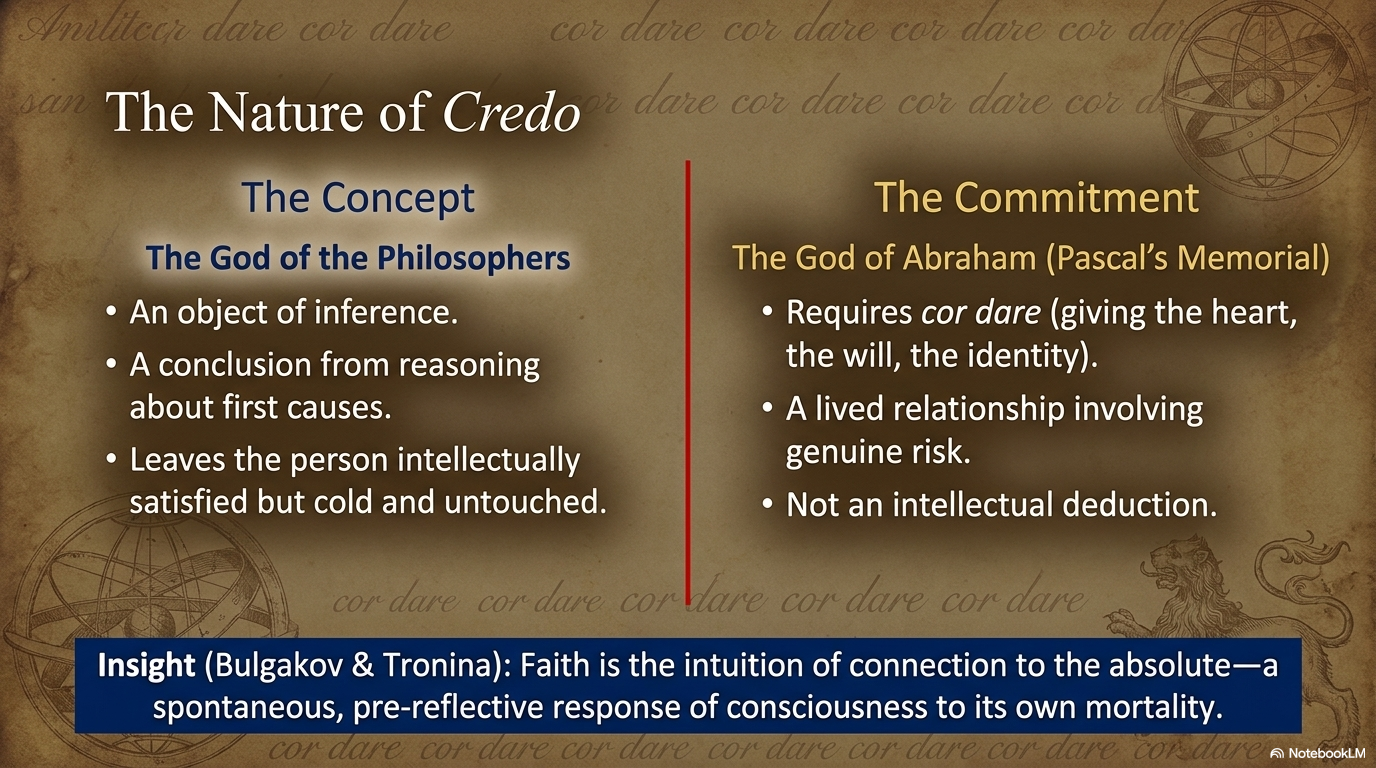
The Russian religious philosopher Sergei Bulgakov understood faith as ‘the sense of one’s connection with the whole, with the absolute’ — an inner experience of being rooted in being itself. A person exists meaningfully only when they feel themselves to be part of something greater — whether God, the cosmos, the moral order, or the historical life of a people. Faith is this sense of connection, the intuition that one is not alone and not accidental. Without it, Bulgakov argued, the human being inevitably contracts to their biological and psychological self with its instincts, fears, and passing desires — and loses the dimension that makes them genuinely human.
The phenomenologist L. A. Tronina offers a different but complementary angle. She proposes reading faith through the lens of the most elementary human experience: the awareness of mortality. The human being is the only creature that knows it will die. And it is precisely this knowledge that generates what she calls an ‘immanent experience of hope for the continuation of life’ — a deep, pre-reflective longing for life not to end, for death not to have the final word. On this account, faith is not first of all the product of religious formation or doctrinal instruction. It is a spontaneous response of consciousness to its own finitude.
Pulling this together: whether we turn to ancient Hebrew, Greek, Latin, or Slavonic, the concept of faith consistently points not to an intellectual operation of accepting propositions, but to a distinctive mode of human relation to reality — trust, steadfastness, personal engagement, the willingness to commit oneself to what exceeds our capacity for control and verification. The understanding of faith as ‘assent to unprovable claims’, which became standard in Western culture after the Enlightenment, is not a neutral description of the phenomenon. It is a significant reduction of it — the product of a specific philosophical climate at a specific moment in history. It is the broader, historically grounded understanding that will serve as our starting point throughout.
[1] Price H.H. (1965) ‘Belief “In” and Belief “That”’, Religious Studies , 1(1), pp. 5–27. URL: <https://www.cambridge.org/core/journals/religious- studies/article/abs/belief-in-and-belief- that1/7888208DE7CD384557A0F2D764D146FD>
[2] Cartesian rationalism is the philosophical position developed by René Descartes (1596–1650) and named after the Latin form of his name, Cartesius. It rests on three interconnected claims. The first is that reason, not sensory experience, is the only reliable source of knowledge. Descartes held that the senses deceive us systematically. Genuine knowledge can therefore be obtained only through pure rational inference, independently of experience. The second is that mathematics provides the model for all knowledge. Only those propositions that possess mathematical certainty — certainty so strong that doubt is literally impossible — deserve the name of knowledge. Descartes applied this standard not only to mathematics itself but to metaphysics, physics, and the theory of cognition. The third is the method of radical doubt. Descartes proposed rejecting everything that could in principle be doubted and rebuilding knowledge from a single indubitable foundation: cogito ergo sum — I think, therefore I am. This alone survives the method of doubt, because the very act of doubting confirms the existence of the one who doubts. in the context of our lecture, Cartesian rationalism is significant for a specific reason. It established the standard of certainty that was subsequently applied to religious belief — and to which religious belief, predictably, does not conform. If knowledge is restricted to what attains mathematical self-evidence, faith is automatically relegated to the domain of the unproved. The irony is that by the same standard the greater part of what we ordinarily call scientific knowledge fails to qualify as well.
[3] Positivism is a philosophical movement that emerged in the first half of the nineteenth century. Its founder is generally considered to be the French philosopher Auguste Comte (1798–1857).
The central claim of positivism is that the only legitimate source of knowledge is experience accessible to verification. Everything that lies beyond observation and experiment — metaphysics, theology, speculative philosophy — does not constitute knowledge and possesses no cognitive value.
Comte proposed a scheme of three successive stages in the development of human thought. In the theological stage, phenomena are explained by the action of supernatural forces. In the metaphysical stage, they are explained by abstract entities and hidden causes. In the positive stage — the highest — humanity abandons the search for first causes and confines itself to describing the laws that govern observable phenomena. In this scheme, science displaces both religion and philosophy.
English is actually helpful here in a way that many languages are not. Where Russian, for instance, must make do with a single word — vera — English philosophical usage distinguishes between belief and faith. The distinction is worth pressing.
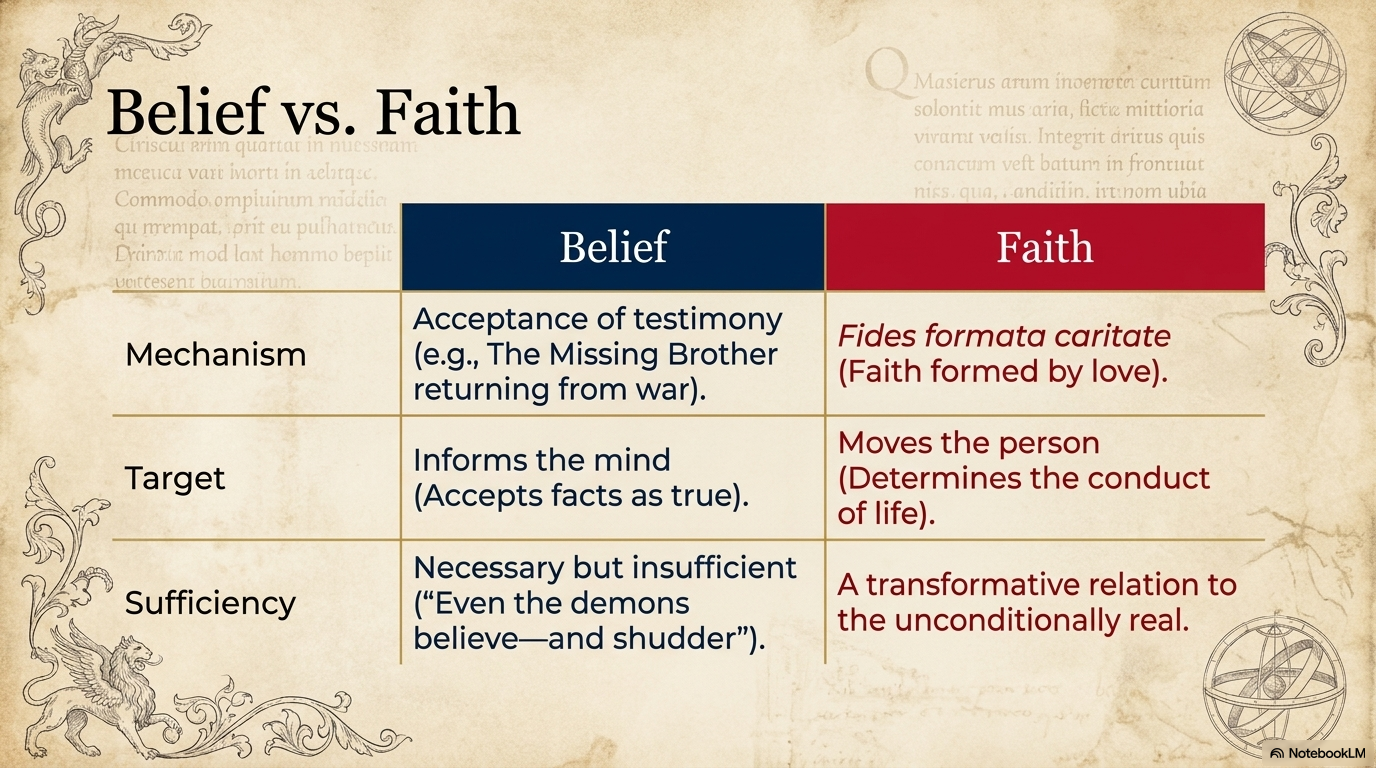
Belief, broadly, is the acceptance of something as true on the basis of another’s testimony. Josef Pieper offers a useful illustration. Your brother has gone missing in the war. A man returns from the front and reports that he saw him alive as a prisoner of war, describing him in ways that match everything you know. You cannot verify this personally. Nevertheless the testimony gives you adequate grounds for acceptance — not as certain knowledge, not as mere guesswork, but as something in between. This is belief.
Accepting things on the basis of testimony is not, it needs to be stressed, an exception to normal human cognition. It is the norm. Most of what any of us knows we have received not through personal experience but through intermediaries: other people, institutions, texts. We defer to biologists on cell structure, to historians on the past, to physicians on our own bodies. Testimony-based belief is not a deficiency of knowledge. It is how knowledge is transmitted.
But belief alone is not the whole of faith. One can in principle accept as true the existence of God, the reality of the Resurrection, the claims of revealed religion — and remain entirely indifferent to what follows from these for the conduct of life. St James makes the point bluntly: ‘even the demons believe — and shudder’ (Jas. 2:19).
Faith is something else. It is not merely the acceptance of truths but a personal orientation towards them. The orientation that determines everything else. In the Christian tradition this corresponds to fides formata caritate — faith formed by love. Here the intellect assents, the will is directed towards God as the highest good, and the whole person — not merely their convictions but their life — is set in motion. Belief informs the mind. Faith moves the person.
Belief is therefore a necessary but insufficient dimension of religious faith. Religious faith in the full sense is faith: a living, personal, transformative relation to what one recognises as unconditionally real.
Now for the larger question of faith and knowledge. Since Plato, Western philosophy has operated with a hierarchical assumption: to know is better than merely to believe. Knowledge is what is justified, verified, demonstrated. Faith is what one falls back on in the absence of sufficient evidence — a kind of intellectually inferior substitute. In the Enlightenment this hardened into something close to dogma: knowledge was identified with the scientific method, while faith was relegated to the realm of the subjective, the private, the unprovable. Faith appeared as a mark of intellectual inadequacy — what people resort to where genuine knowledge is unattainable.
But this picture depends on an unrealistic account of what knowledge is. The ideal of absolute, incorrigible certainty may be appropriate to mathematics. Apply it consistently to ordinary and scientific knowledge, and it turns out that we know almost nothing. We cannot demonstrate with absolute certainty the existence of the external world, the reliability of memory, the reality of other minds. Philosophers call this position infallibilism. And its consistent application leads directly to scepticism.
Consider the obvious case. You know you have hands. What could be more beyond question? And yet the philosophical sceptic immediately objects: what if you are «a brain in a vat»[1], receiving artificial signals? This possibility cannot be logically refuted. So, if knowledge requires absolute certainty, you do not know that you have hands.
In ordinary life, no one applies this standard. A judge does not require mathematical certainty to convict: he requires proof beyond reasonable doubt. A physician makes a diagnosis on the basis of available symptoms, tests, and clinical signs, no single one of which is individually decisive.
Own alternative seems to me compelling. Most of what we call knowledge is not absolutely certain but sufficiently reliable — reliable enough to act on, to stake decisions on. If this is right, the boundary between ‘knowledge’ and ‘faith’ turns out to be considerably less sharp than we are accustomed to suppose. This does not dissolve the distinction. But the distinction is not between the ‘proved’ and the ‘blindly accepted’, not between ‘rational’ and ‘irrational’. It is a difference in the kind of evidence on which we rely. Religious faith appeals to evidence of a different kind from physics or history — personal experience, moral intuition, the witness of a living tradition. That does not make it less well-grounded. It makes it differently grounded.
[1] The thought experiment known as “the brain in a vat” traces its classical formulation to the American philosopher Hilary Putnam’s Reason, Truth and History (1981), though its intellectual roots reach back to Descartes and his hypothesis of the evil demon. The experiment runs as follows. Suppose that a powerful scientist has removed your brain from your body and placed it in a vat of nutrient solution that keeps it alive. The brain is connected to a supercomputer that sends it precisely those electrical signals that would, under normal conditions, arrive from the sense organs: from the eyes, the ears, the skin, the muscles. The brain “sees” a room, “hears” voices, “feels” the hardness of a table. From its point of view — from your point of view — everything is perfectly normal. There is no way to detect the substitution from the inside, because any attempt to verify reality — looking at one’s hands, pinching oneself, asking another person — is itself part of the simulation. The philosophical force of the experiment lies here. In ordinary life we reason roughly as follows: “I see my hands, therefore my hands exist.” The inference seems so obvious that questioning it does not occur to us. But it rests on a silent assumption: that our perception reliably tracks the external world.
After all of this, I can say more precisely what the remainder of this lecture is about. What interests us is not faith in the sense of mere assent to facts — the acceptance of a set of propositions as true — but faith as a distinctive state of consciousness, a specific existential orientation. This distinction is, I think, the key to everything that follows.
Let me use an example that has become something of a classic in philosophical literature. Charles Blondin, the famous tightrope walker, crossed Niagara Falls on a wire on multiple occasions in the 1850s and 60s, sometimes pushing a wheelbarrow. The story goes that after one such crossing he turned to the watching crowd and asked: ‘Do you believe I can do this again, with a person in the wheelbarrow?’ A young man shouted: ‘Yes, I believe you can!’ ‘Then get in,’ said Blondin. The young man refused. The wheelbarrow remained empty.
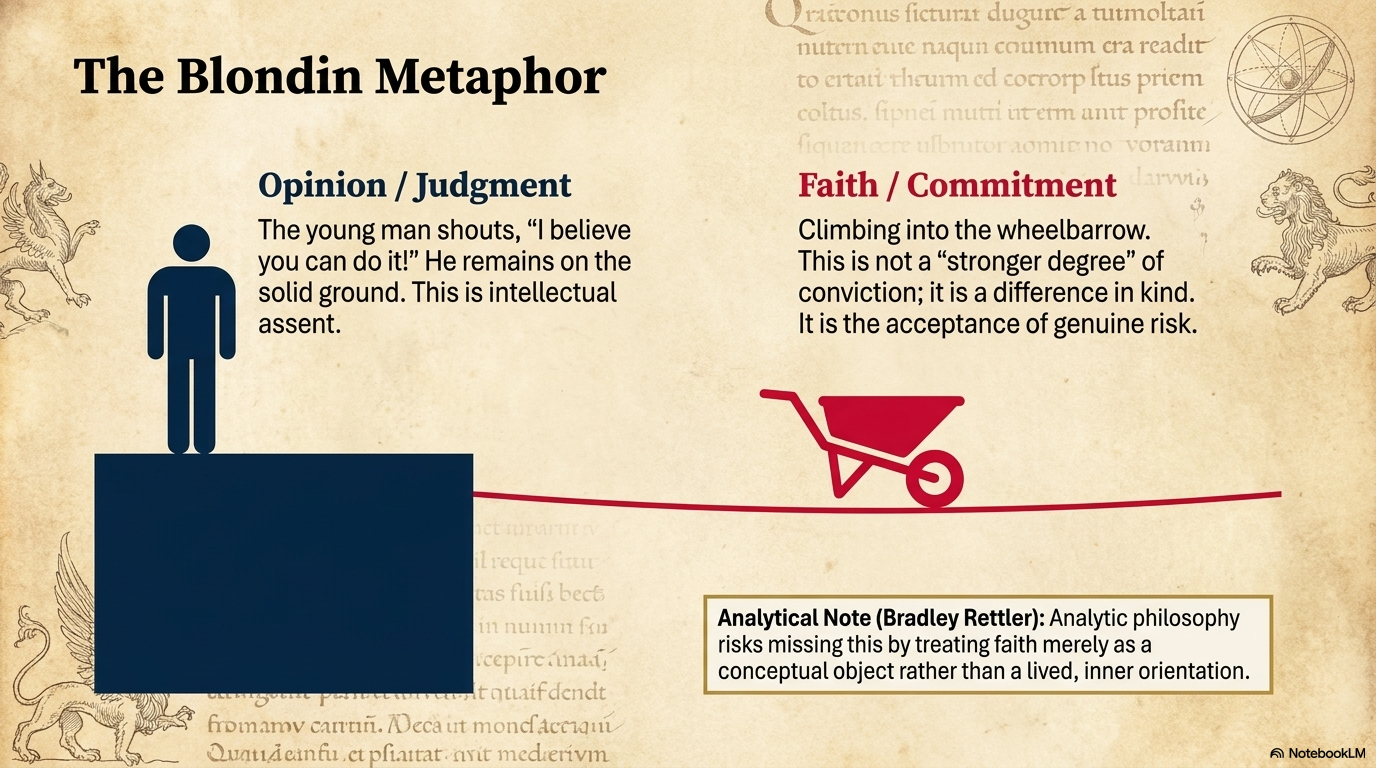
The example is sharp because it exposes a distinction that our ordinary use of language tends to blur. The young man expressed an opinion — an intellectual judgement about Blondin’s competence. Whoever had climbed into the wheelbarrow would have expressed something quite different: trust, the readiness to commit oneself to another person, the acceptance of genuine risk. These are not the same state. The difference is not one of degree — not just ‘greater confidence’ or ‘stronger conviction’. It is a difference in kind: a different type of relation to reality altogether.
Contemporary analytic philosophy of religion has conducted a great deal of careful discussion about where exactly this difference lies. Bradley Rettler’s survey of the main positions identifies several of the key fault lines. Is faith a state in which one simply finds oneself, or an action one performs? Does faith necessarily involve the conviction that something is true — or can one have faith without full conviction? How far does faith depend on the will? And what is faith ultimately aimed at — correct judgement, correct action, or correct inner orientation?
These may sound academic, but each has a real stake. The question of the will matters practically: if faith is entirely outside our control, it makes no sense to say that someone ought to believe, or that the absence of faith is either a credit or a failing. If faith depends at least partly on us, we bear responsibility for it. The question of the relation between faith and conviction lies behind the famous cases of ‘faith in doubt’ — where a person continues to pray, to serve, to love, even though they are no longer intellectually certain of what they once believed. Is this genuine faith, or self-deception? Analytic philosophy has tried hard to answer this question, and with considerable ingenuity.
And yet, for all its rigour, the analytic approach risks missing something. It treats faith as an object — dissecting it into components, classifying it, comparing definitions. But faith is not only an object of analysis. It is above all something one lives from the inside — something one inhabits. This inner, lived dimension of faith is precisely what tends to get lost when one becomes too absorbed in conceptual distinctions. The phenomenological and theological-ascetic traditions have something to contribute here that analysis, for all its virtues, tends to leave to one side. One thinks of Theophan the Recluse’s account of what he calls the ‘sympathetic movement of the heart’ — faith as a living orientation of the whole person that precedes and exceeds any formulation of it.
There is also a temporal dimension to faith that analytic treatments rarely foreground but which seems to me essential. Faith is not a snapshot — a moment of assent or commitment that either occurs or does not. It is something that unfolds over time, that is tested and renewed, that can deepen or atrophy.
Related Concepts
- abraham
- absolute
- amen
- anthropology
- ascetic-theology
- basic-beliefs
- belief
- blondin
- brain-in-a-vat
- bulgakov
- comte
- credo
- doxa
- emunah
- everyday-life
- faithfulness
- fidelity
- habakkuk-24
- heart
- hope
- hume
- induction
- intellect
- james-219
- knowledge
- mortality
- newman
- opinion
- order
- phenomenology
- pistis
- plantinga
- positivism
- religious-epistemology
- risk
- scepticism
- science
- self-giving
- testimony
- theophan-the-recluse
- tronina