Fundamental Theology — Topic 1. Introduction.
Fundamental Theology is not an introductory survey for beginners, nor simply a polemical arsenal for debates with atheists. It is an autonomous, mature, and indispensable theological discipline that takes upon itself the hardest task of all: to show that faith and reason are not adversaries, and that genuine Christian faith seeks to be not blind but responsible.
This task has been addressed differently in different ages — in early Christian apologetics, in medieval scholasticism, in early modern apologetics, and in contemporary Fundamental Theology. Emphases have shifted, methods have changed, philosophical languages have varied. What has remained constant is the original impulse articulated by the Apostle Peter: always be ready to give an account of the hope that is in you.
That hope is not the private possession of individual believers. It belongs to the whole Church. Fundamental Theology is therefore not a personal existential reflection but a scholarly, methodically ordered work that the Church undertakes on behalf of all its members before a questioning world. In the lectures that follow, we shall move to a more detailed examination of the discipline’s individual sections.
We begin our study of a discipline that has been forming within Christian thought over the course of centuries and that today occupies a central place in theological education. The subject is Fundamental Theology — a scholarly inquiry into faith, its rational grounds, and its claim to legitimacy within the broader domain of human knowledge.
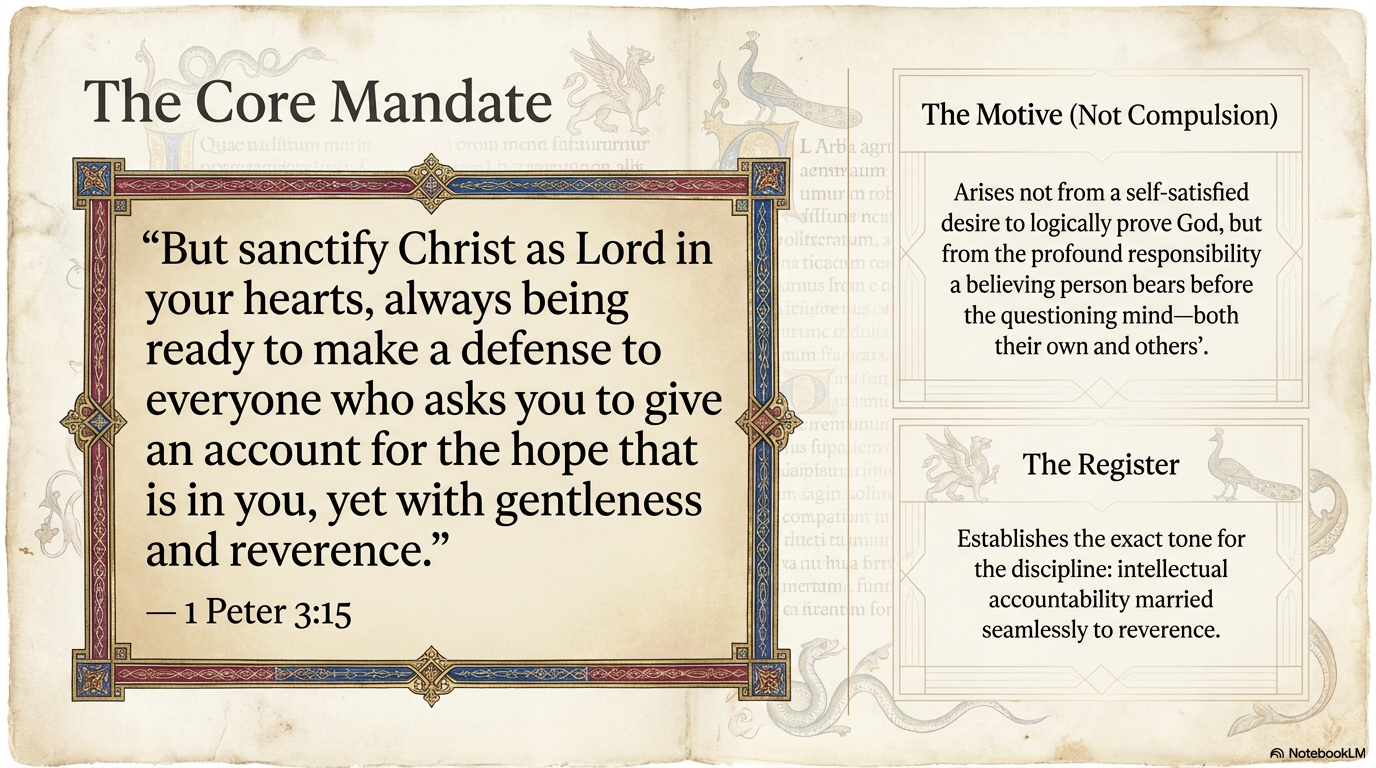
Before turning to individual topics, it is worth registering the particular tone this discipline demands. It arises not from any self-satisfied desire to “prove” God, but from the responsibility a believing person bears before the questioning mind — one’s own as much as another’s. The Apostle Peter gave this responsibility its classic formulation:
│ “But sanctify Christ as Lord in your hearts, always being ready to make a
defense to everyone who asks you to give an account for the hope that is
│ in you, yet with gentleness and reverence” (1 Pet. 3:15, ESV).
This verse serves as the Magna Carta of Fundamental Theology — a text that sets both the direction and the register of the entire discipline.
- Introduction
- Section 1. Definition and Subject Matter of Fundamental Theology
- Section 2. The Place of Fundamental Theology within the System of Theological Sciences
- Section 3. History of Development: From the Early Apologists to Contemporary Fundamental Theology
- Section 4. Relations with Philosophy, Dogmatic Theology, and Apologetics
- Section 5. Methods of Theological Knowledge
- Section 6. Distinctive Features of the Study of the Subject
- Section 7. Survey of Principal Textbooks and Scholarly Resources
- Conclusion
1.1. Origin of the Name
·······················
The term “Fundamental Theology” entered scholarly usage in the mid-nineteenth century as a direct borrowing of the German Fundamental-theologie. The discipline did not emerge from within any Orthodox theological school; it was received as a ready-made concept from the Western European — predominantly German-Catholic — academic milieu. This mode of reception characterizes Orthodox theology broadly during the period: the scholarly study of the foundations of faith proceeded largely through engagement with Western theological systems, which theologians subsequently adapted to the Orthodox context.
The German term itself appeared comparatively late. Its first documented use dates to 1843, when Anton Friedrich Ludwig Pelt (1799–1873) published his Theological Encyclopedia in Hamburg. Before Pelt, the same domain of knowledge went by the name of apologetics (Apologetik) or, in some systems, philosophical theology (philosophische Theologie). Pelt was not creating a new discipline — he was proposing a more precise name for a tradition of inquiry already long established.
The first university chair to bear the official title “Fundamental Theology” was established at the University of Prague in 1856. Its founder, the Austrian theologian Johann Nepomuk Erlikh (1810–1864), was explicit in his writings that this amounted principally to a renaming of the existing chair of apologetics rather than the creation of an entirely new structure. The change of name thus reflected a gradual reconceptualization of the discipline’s tasks and methodological standing — not the sudden appearance of something unprecedented.
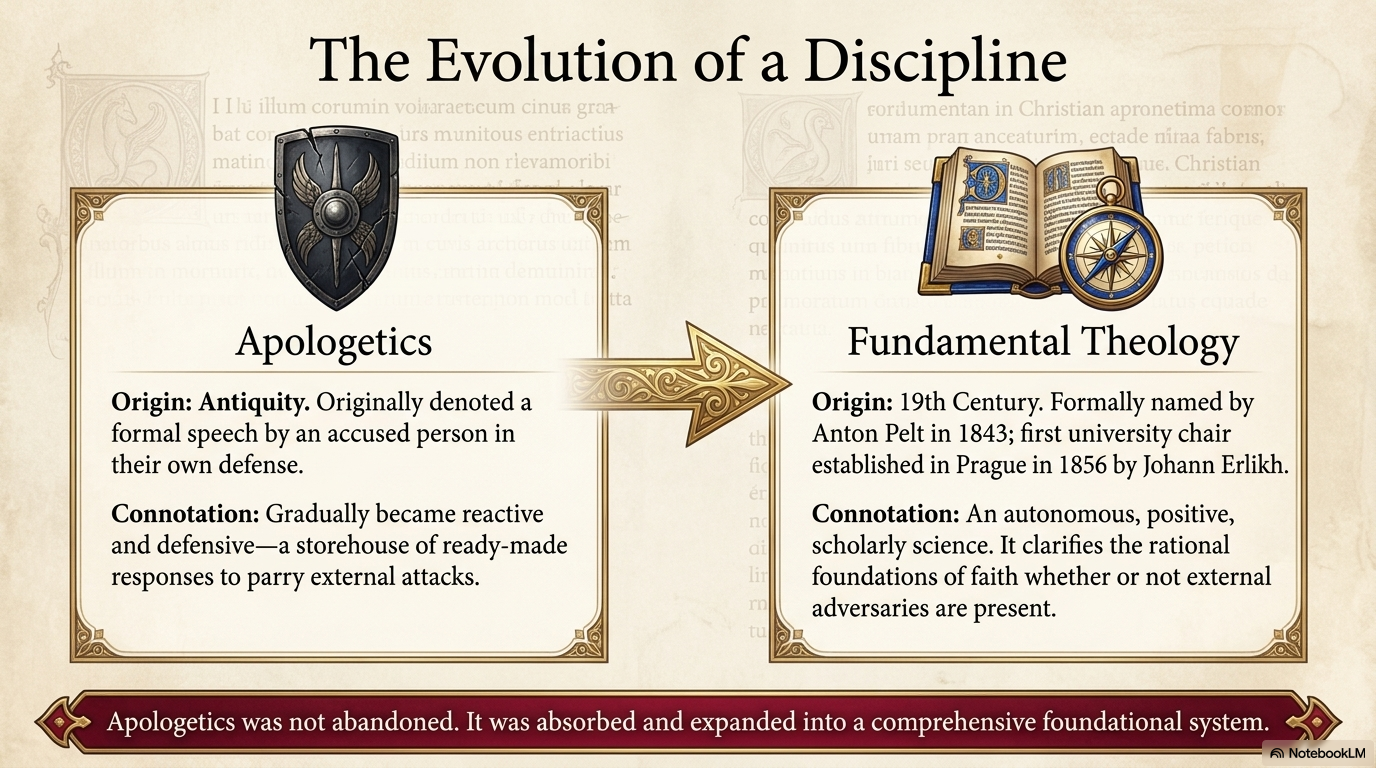
This renaming carries genuine theological weight. The word “apologetics” derives from the Greek ἀπολογία — a defense speech, a formal justification. In antiquity the term denoted the speech of an accused person in his own defense; it is in precisely this sense that the Apostle Peter exhorts Christians to “give an account” (ἀπολογία) to all who demand an explanation of their hope (1 Pet. 3:15).
Over time, however, “apologetics” came to connote something exclusively defensive and reactive — as though theology did nothing but parry attacks. In the nineteenth century it frequently degenerated into a storehouse of ready- made responses to objections, losing intellectual depth and its connection to the living theological search.
“Fundamental Theology” offered a different perspective. The discipline now positioned itself not as a shield against attacks, but as positive scholarly work directed toward clarifying the foundations of faith — work that must be undertaken whether or not external adversaries are present. It became an autonomous discipline with its own subject matter, methods, and purposes, rather than merely a service for repelling criticism. Crucially, this did not mean abandoning the apologetic task: it meant reconceptualizing and expanding it. Apologetics entered Fundamental Theology as one of its central functions, alongside the foundational one.
One further misunderstanding requires correction at the outset. The adjective “fundamental” in “Fundamental Theology” does not divide theology into “fundamental” and “non-fundamental,” “primary” and “secondary” — a reading that is among the most common errors at first acquaintance with the discipline.
The architectural metaphor makes the correct reading plain. A foundation is not more important than the walls or the roof; it is simply what makes them possible. It remains invisible once the building stands, yet it bears the entire structure. Fundamental Theology lays the intellectual and methodological foundation on which all other theological disciplines are built — dogmatics, moral theology, liturgics, patristics, church history. Without it, each of them risks becoming a collection of assertions accepted on faith without inquiry into why those assertions deserve trust. A theologian who bypasses these foundational questions resembles someone who has memorized the rules of a game without ever asking why the game is played.
To state the point more precisely: if dogmatics unfolds the content of Christian doctrine and moral theology charts the path of Christian life, Fundamental Theology asks the prior question — why does this edifice stand at all, rather than being an illusion or an arbitrary construct? It investigates the right of faith to exist within the domain of human knowledge. That question is not external to faith; it is generated by faith’s own inner demand for self-accounting — what Anselm of Canterbury called fides quaerens intellectum, “faith seeking understanding.”
1.2. What Fundamental Theology Studies
······································
Fundamental Theology may be defined as a scholarly inquiry into the rational grounds of faith — more specifically, as the theological demonstration that Christian faith admits of rational justification without thereby ceasing to be faith. Its subject matter comprises the foundational truths of Christian belief and life as these are examined in relation to the broader intellectual, cultural, and philosophical context.
The discipline does not aim to prove God in the manner of a mathematical theorem — with logical compulsion that leaves no room for free assent. Its aim is more modest and more honest: to show that Christian faith does not contradict reason, that it rests on serious grounds, and that to accept it is neither blind nor irrational. Faith remains what it is — a free personal act, not a forced inference.
Sergei Glagolev’s formulation captures this well: if religion as such concerns questions of faith, then the scholarly study of religion — Fundamental Theology — concerns questions of doubt in faith.[^1] Far from being a rhetorical flourish, this is a genuinely honest definition: Fundamental Theology takes upon itself precisely the hardest questions — those of the justifiability, rationality, and credibility of Christian faith.
Beyond specifically Christian truths, the discipline’s scope includes general religious meanings as well. In the history of religions, in psychology, in religious studies, and in philosophy, it seeks evidence and testimony that illuminates the reception and understanding of Christian claims.
1.3. The Foundational and Apologetic Dimensions
···············································
Within Fundamental Theology two principal orientations may be distinguished. The first is directed inward, toward theology itself: it involves elaborating a foundational account of faith, establishing the rational credentials of theology as a scholarly discipline, and clarifying its presuppositions and methods. Here the questions are: What does it mean to believe? What conditions make knowledge of God possible? How do faith and reason relate?
The second orientation is directed outward, toward those who pose questions or press objections. This is the apologetic dimension: establishing the credibility of faith and defending it rationally in the face of external doubt. Here the question becomes: What grounds does the non-believer or the doubter have for taking the Christian message seriously?
Max Seckler put it well: apologetic orientation and foundational-theological grounding are not two related disciplines. They are two aspects of a single task, unified at its deepest level but operative in distinct registers. A discipline that abandons the apologetic dimension risks collapsing into self- justification; one that reduces itself to polemics loses theological depth.
[1]: Glagolev S. S. “Fundamental Theology: Its Subject and Task.” Bogoslovskiy vestnik [Theological Bulletin] 1 (1912): 31.
2.1. The Integrative Character of the Discipline
Fundamental Theology does not simply stand alongside dogmatics, moral theology, or church history — in a certain sense it precedes them all. Its task is to prepare the ground on which every other theological discipline builds. For this reason it is sometimes called an integrative discipline: it provides the common rational foundation that holds the whole of theological knowledge together. In Western theology it bears the additional designation Theologia generalis, serving as an introduction to the entire theological curriculum.
Among seminary disciplines, Fundamental Theology is distinctive also for its markedly interdisciplinary character. It admits — and indeed requires — the consideration of perspectives on central Christian claims other than those formally received in the Church. In treating particular questions, the inquiry inevitably draws on biblical studies, history, philosophy, and the natural sciences in order to achieve a sufficiently broad grasp of the subject.
2.2. Distinction from Related Disciplines
Fundamental Theology occupies a position at the boundary between theology and philosophy. In its aims and starting points it is theological — it speaks of faith, Revelation, and God. In its methods and idiom it is philosophical — it reasons, frames questions, and constructs arguments.
From philosophy it is distinguished by its relationship to reason. The philosopher operates with what might be called “autonomous reason” — reason that determines truth by its own resources, without recourse to external authority. Fundamental Theology operates with “theonomous reason” — reason that is open to Revelation and recognizes it as a source of truth that exceeds reason’s own reach. Theonomous reason is not a deficient reason but a liberated one: it is capable of receiving a reality that autonomous reason excludes from consideration by definition.
From dogmatics it is distinguished by method. All other theological disciplines proceed from the accepted truth of Scripture and Tradition. Fundamental Theology, by contrast, asks the prior question: on what grounds should Scripture and Tradition be trusted? It must therefore argue in a register accessible to any thoughtful inquirer regardless of prior religious commitment. Dogmatics asks “what?”; Fundamental Theology asks “why?” and “on what grounds?”
From religious studies and the philosophy of religion it is distinguished by the researcher’s standpoint. The scholar of religion examines faith from the outside — critical distance is a methodological requirement. Fundamental Theology speaks of faith from within: the theologian is a participant in the tradition under investigation, and for that reason poses the question differently. The scholar of religion asks, “What is this religion?”; the theologian asks, “Why do I believe what I believe — and can I give a rational account of it?“
2.3. The Method of Fundamental Theology
The method of Fundamental Theology is positive and foundational. It draws heavily on rational argument and on evidence drawn from a wide range of non- theological literature — philosophy, history, natural science — precisely because it cannot appeal to the authority of Revelation as a starting given. That authority is itself what it must establish. Its language must therefore be legible to any educated reader regardless of religious conviction.
This is what distinguishes it from dogmatics. Where dogmatics begins with the received truth of Scripture and Tradition, Fundamental Theology poses the antecedent question: by what path can reason come to recognize their credibility?
2.4. Thematic Structure: Four Sections
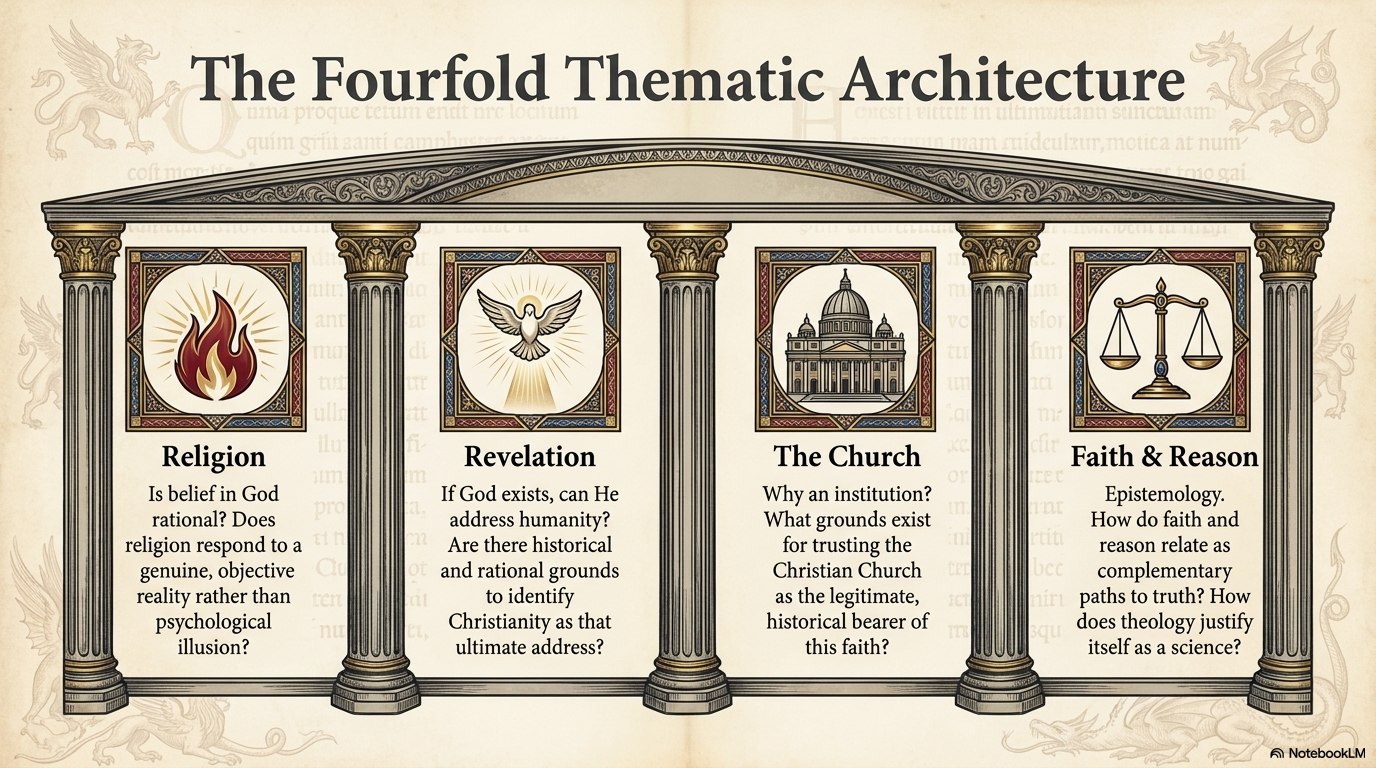
The historically established structure of Fundamental Theology involves a fourfold division. The first three sections were outlined as early as the sixteenth and seventeenth centuries; the fourth was definitively distinguished only at the beginning of the nineteenth.
The first section — Religion — establishes the reasonableness of religious belief by means of universally accessible argument. The governing question is simply: is belief in God rational? Is there ground for holding that religion responds to a genuine reality rather than to illusion?
The second section — Revelation — concerns the possibility of Divine Revelation and the claim that Christianity is the true religion, the one in which God communicates the fullness of His Revelation in Jesus Christ. If God exists — can He address Himself to the human person? And are there grounds for identifying Christianity as that address?
The third section — The Church — establishes the Christian Church as the legitimate bearer and expression of the content of Christian faith. Why is the Christian message transmitted through an institutional Church? What grounds exist for trusting this particular form of Christianity’s existence?
The fourth section — Faith and Reason — concerns the epistemological foundations of theology itself: theology as a scholarly discipline, the doctrine of theological knowledge, and the relationship between faith and reason as paths to truth. This is the most philosophical section: here theology poses questions about its own credentials.
2.5. Principal Themes
The general religious concepts examined within the discipline include: religion, faith, spirituality, cult and worship, sacrifice, the afterlife, and magical thinking.
The principal Christian truths that Fundamental Theology examines are: the existence of God — the Holy Trinity; the objectivity of the spiritual world; the personal immortality of the human person; Divine Revelation; the creation of the world and of the human person; the God- likeness (imago Dei) of the human person; the Fall and redemption; the Church as the Body of Christ; Divine Providence; and eschatology.
The course also addresses the relationship of Christianity to philosophy (particularly epistemology), to the natural sciences, to culture and technology, and the question of interreligious dialogue.
3.1. Apologetic Thought in the Early Church
Fundamental Theology as an academic discipline took its final shape only in the nineteenth century, but its underlying task is as old as the Christian message itself. The first Christian apologetic literature appeared at the opening of the second century, driven by three converging pressures: polemical disputes with Judaism, the need to establish Christianity’s legitimacy before pagan society, and the emergence of educated Christians capable of engaging the intellectual challenges of their age.
Christians were accused of atheism (for refusing the state cults), of hostility to the empire, and of immoral ritual practices. The apologists sought not merely to refute slanders but to demonstrate that Christian faith met the most exacting moral and philosophical demands of the time. As Markus Knapp observes, this required an unambiguous engagement with philosophy, in order to show that Christianity was consonant with philosophy’s best achievements and could not by any measure be regarded as irrational.[1]
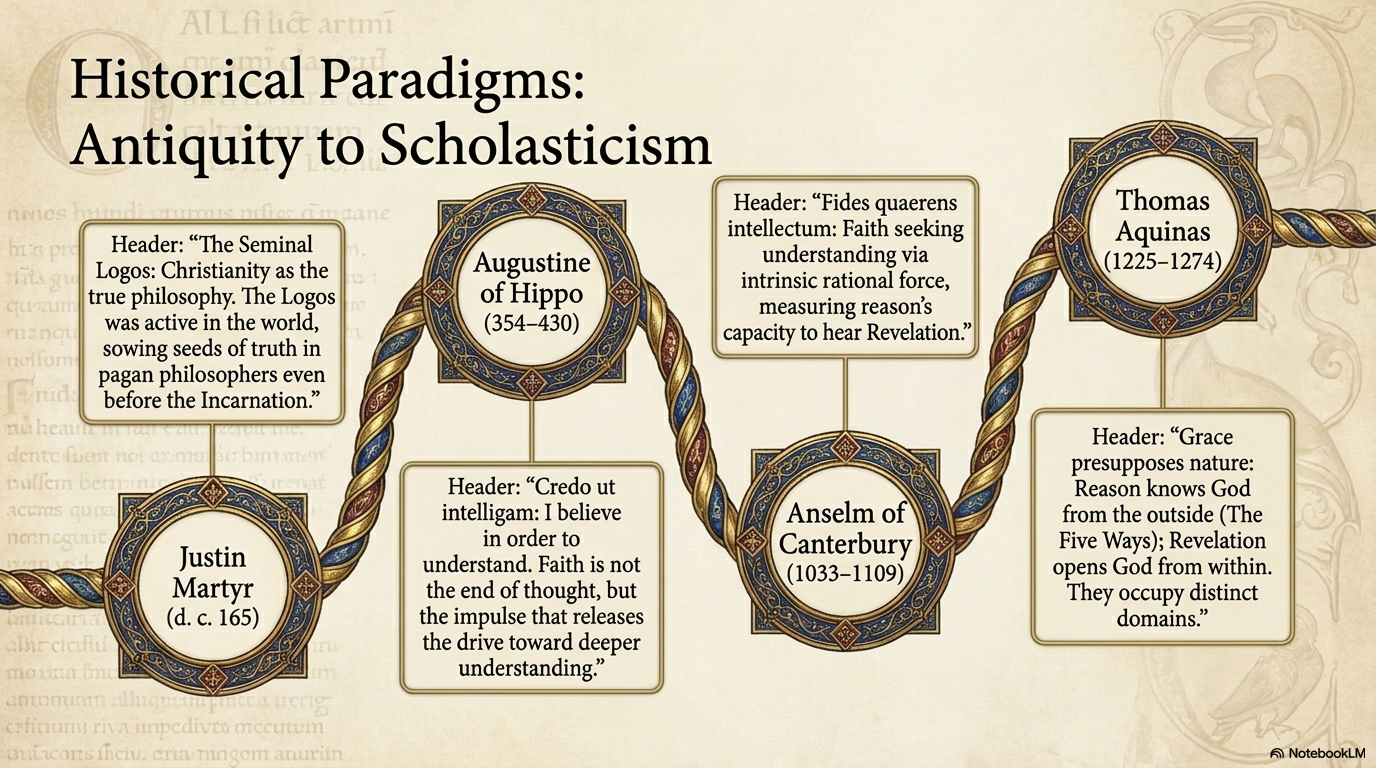
One of the most luminous apologists of the second century is Saint Justin Martyr (d. c. 165). Drawing on Platonic accounts of divine transcendence, he developed a doctrine of Christ as the Logos through whom God addresses and becomes knowable to the human person. Even before the Incarnation, the Logos was active in the world, sowing seeds of truth (λόγος σπερματικός) in the human mind. This “seminal logos” was present in the Old Testament prophets and in pagan philosophers alike — which is why Justin could speak of Socrates as “a Christian before Christ.”[2] By this concept he placed the Christian faith in a positive relationship to pre-Christian and non-Christian philosophy, arguing that Christianity is the “true philosophy,” possessing in fullness the truth toward which philosophy had been striving.
The apologetic efforts of the early Church reach their apex in Augustine of Hippo (354–430). In The City of God, the Christian apologia rests on the conviction that Christianity’s claim to truth can be upheld before philosophical reason. Assessing Platonism as the high-water mark of ancient philosophy, Augustine argues that Platonism must be completed by Christianity for the perfect reception of Divine truth. His synthesis of philosophy and faith crystallizes in the celebrated formula: credo ut intelligam — “I believe in order to understand.” Faith itself releases the impulse toward understanding, directing it toward a deeper grasp of the content believed.
3.2. Apologetic Thought in the Middle Ages
In the medieval period Fundamental Theology did not yet exist as an autonomous discipline, but its characteristic problems are live and pressing in the major thinkers of the age. The central question was the relationship between authority (auctoritas) and reason (ratio).
Anselm of Canterbury (1033–1109) gave the programmatic formulation: fides quaerens intellectum — “faith seeking understanding.” Impelled by faith, reason must measure its own capacity to hear and understand Revelation. Anselm insisted that this argument must proceed by reason’s own resources alone, without appealing to scriptural authority (sola ratione) — not because he doubted Scripture, but in order to show that the truths of faith carry their own intrinsic rational force, which reason can discover independently.
Thomas Aquinas (1225–1274) constructed a coherent system in which reason and faith each occupy their proper domain without encroaching on the other. Reason can establish a good deal about God independently — that He exists, for example. For this purpose Aquinas advanced his celebrated Five Ways,[3] five arguments for the existence of God based on the observation of the natural world.[4] But reason knows God only from the outside, as it were — it traces marks of His presence in the world without knowing Him as a person. Revelation opens God from within: it communicates His will, His design for salvation, and the human person’s ultimate end — none of which unaided reason can reach. The governing axiom of Aquinas: grace presupposes nature, just as faith presupposes natural knowledge.
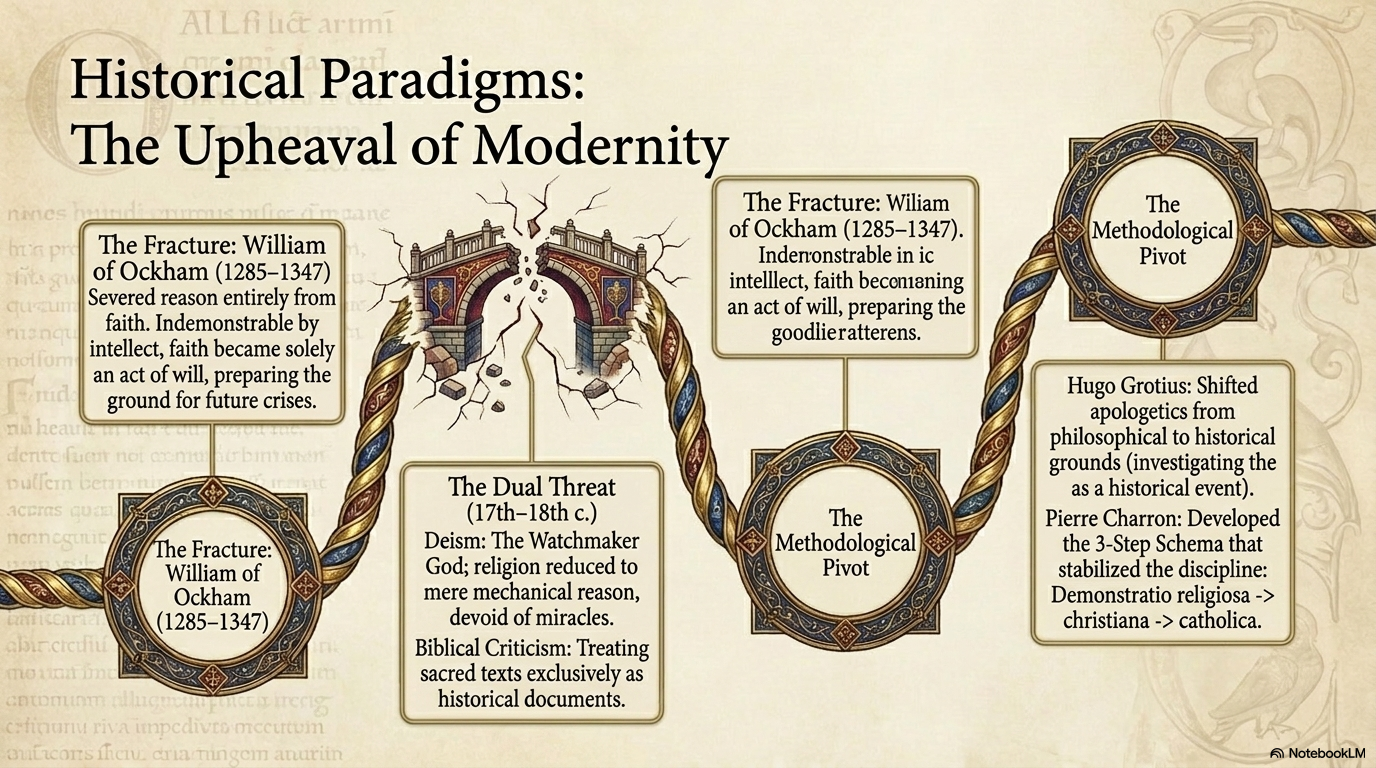
William of Ockham (1285–1347) dismantled this synthesis. In his view, reason and faith inhabit entirely separate worlds with no reliable bridge between them. The existence of God is rationally indemonstrable; faith is accepted not by the intellect but by the will. This severance prepared the ground for the crises of modernity — the Reformation, deism, and ultimately the open confrontation between science and religion.
3.3. Apologetics in the Early Modern Period
The seventeenth and eighteenth centuries brought a profound upheaval for Christian faith across Europe. Enlightenment thinkers proclaimed human reason the sole reliable arbiter of truth; religiosity came to be read not as wisdom but as intellectual immaturity. Two blows fell with particular force.
The first was deism. God exists, the deists maintained, but created the world as a watchmaker creates a clock — He set the mechanism in motion and withdrew. No miracles, no Revelation, no personal commerce between God and the human person: only a “natural religion” whose general truths reason can derive entirely on its own, without any Bible or Church.
The second blow was biblical criticism. Scholars began applying to the sacred texts precisely the methods used for any other historical document, raising questions of authorship, internal contradiction, and legendary elaboration.
Hugo Grotius (1583–1645), the Dutch jurist and theologian, offered an important innovation in this context. Rather than engaging Enlightenment skepticism on philosophical terrain, he concentrated on the historical question: what, in fact, happened? His argument was that the miracles of Christ — and above all the Resurrection — are historical events, investigable by the same methods as any other events of the past. This move transferred apologetics from philosophical to historical ground, issuing the challenge precisely where the Enlightenment felt most confident.
Pierre Charron (1541–1603) systematized the structure of apologetics in a three-step schema that subsequently shaped the discipline for centuries. The first step establishes that religion as such is rational (demonstratio religiosa). The second establishes that Christianity is the true religion (demonstratio christiana). The third establishes that the Catholic Church is the legitimate custodian of Christianity (demonstratio catholica). The schema reflected the internal logic of apologetic reasoning so aptly that it remained standard well into the twentieth century.
3.4. The Formation of Fundamental Theology as an Academic Discipline
By the early nineteenth century, theology had accumulated sufficient material and experience to pose the question directly: can it be considered a scholarly discipline at all? Two figures gave systematic answers.
Friedrich Schleiermacher (1768–1834) pressed the question of theology’s status as a Wissenschaft rigorously and consistently. He developed the concept of a “philosophical theology” — a propaedeutic section that must stand at the opening of the theological system and answer two questions: what is theology, and what is its inner structure? Behind this apparently abstract demand lies a simple but important point. Any discipline that takes itself seriously must be able to account for itself: what it studies, by what methods, and why in this way rather than another. Theology had long operated without providing such an account. Schleiermacher demanded it. He was not revising the content of faith — he was insisting on intellectual rigor.
Johann Sebastian Drey (1777–1853) approached the problem from a different angle. His concern was not “how is theology structured?” but the more fundamental question: why should Christianity be trusted at all? Dissatisfied with an apologetics that merely responded to specific charges, Drey wanted to establish on positive scholarly grounds that Christianity is a genuinely divinely revealed religion — and to do so not in abstraction from history but precisely through history. His argument was that when the entire history of religions is surveyed as a whole, Christianity appears not as one religion among others but as that in which Divine Revelation reaches its fullness. Apologetics thereby became, in Drey’s conception, a positive science — not a defensive maneuver but a constructive discipline that establishes Christianity as a coherent whole and so lays the foundation for all subsequent theology.
Schleiermacher and Drey addressed different questions, but together they established a common insight: theology requires a distinct foundational discipline standing at its source and bearing responsibility for its intellectual credibility. That discipline is Fundamental Theology.
3.5. Fundamental Theology in the Twentieth and Twenty-First Centuries
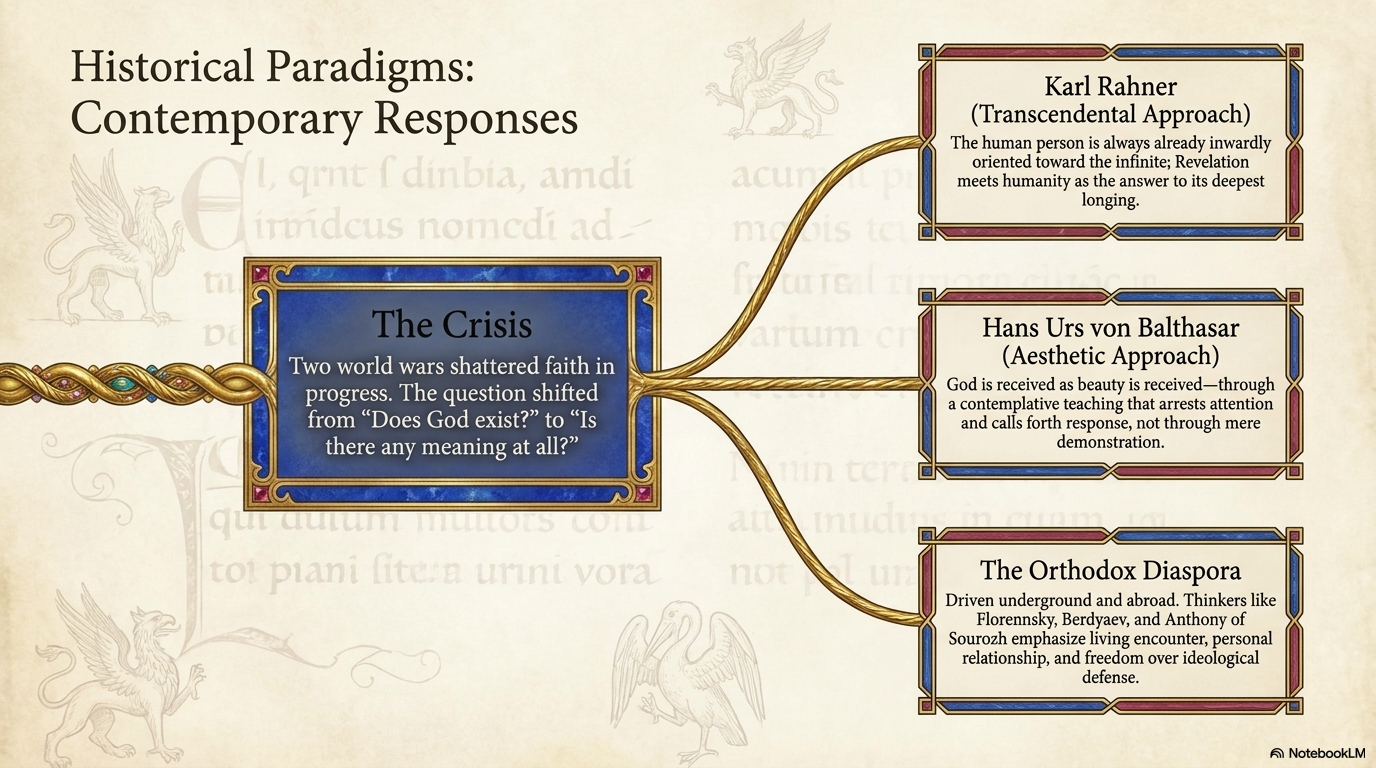
By the early twentieth century, traditional apologetics had reached an impasse. Conceived as a fortress defending against external assault — rationalism, atheism, biblical criticism — it could not adapt when the world changed too radically. Two world wars shattered faith in reason as the guarantor of progress; atheism became the state ideology for hundreds of millions; and the live question was no longer “has the existence of God been demonstrated?” but “is there any meaning in human existence at all?”
Karl Rahner (1904–1984) effected a genuine reorientation. Traditional apologetics regarded the human person as an outside observer to whom Revelation had to be “proved” from without. Rahner reframed the question: what if the human person is already inwardly open to God — simply not yet aware of it? As a spiritual being, the human person is always already oriented toward the infinite, even in the most ordinary questions about meaning, goodness, and death. This orientation is the very point at which Revelation meets the human person not as something foreign but as the answer to his deepest longing. This approach is designated transcendental.
Hans Urs von Balthasar (1905–1988) proposed a different response. God comes to us above all as a living Person, present in the figure of Jesus Christ. This figure is received as beauty is received — not through demonstration but through contemplation. Beauty does not need to be argued for; it arrests attention and calls forth a response. The task of Fundamental Theology, on Balthasar’s account, is to help the human person truly see this figure. He called his approach a “contemplative teaching” (kontemplative Lehre).
In the Protestant tradition, Fundamental Theology was for a long time not recognized as an autonomous discipline, largely owing to the influence of Karl Barth (1886–1968). In Barth’s view, apologetics is structurally compromised: it obliges theology to accept the terms set by unbelief, placing unbelief in the position of judge. Faith must proceed from its own ground — from Revelation, from the Word of God — and not look over its shoulder at the atheist’s objections.
A turning point came in 1970, when Gerhard Ebeling demonstrated that the demand for Fundamental Theology is rooted not only in the Catholic tradition but also in the evangelical — it had simply been forgotten. The task of the discipline, in Ebeling’s account, is to clarify the very essence of theology and to identify the criterion by which one can judge whether theology is genuinely doing its own work.
Wolfhart Pannenberg (1928–2014) took yet another direction. Christianity cannot simply proclaim itself true; it must justify its claim to universal truth within the broad horizon of the history of religions. Fundamental Theology, on this reading, becomes a “theology of religion”: it investigates the structure of religion across human cultures and shows why Christianity occupies a distinctive place within that horizon.
In the Orthodox tradition the twentieth century brought particular trials. The Revolution of 1917 destroyed the entire system of theological education in Russia. Apologetic thought did not disappear — it went underground and flourished in emigration. Nikolai Fioletov composed his Essays in Christian Apologetics in Tver in the 1930s, on notebook paper, without access to libraries, knowing that arrest might come at any moment (and it did). In the Russian diaspora, Archpriest Vasily Zenkovsky produced his Apologetics (Paris, 1957); Nikolai Berdyaev, Sergei Bulgakov, Ivan Ilyin, and Nikolai Lossky each in his own way grounded the Christian worldview in the face of secular culture. A special role belongs to Metropolitan Anthony of Sourozh (Bloom) — a witness to Orthodoxy in Western Europe, whose conversations circulated in Soviet Russia as samizdat. He spoke not of theological systems but of the living encounter with God, of the greatness of love and freedom, and of faith as a personal relationship rather than an ideological position.
[1]Knapp, Markus. Die Vernunft des Glaubens: Eine Einführung in die Fundamentaltheologie. Freiburg: Herder, 2009. S. 21.
[2]Justin Martyr. First Apology 46: “We have been taught that Christ is the first-born of God, and we have declared above that He is the Word of whom every race of men were partakers; and those who lived reasonably are Christians, even though they have been thought atheists; as, among the Greeks, Socrates and Heraclitus, and men like them; and among the barbarians, Abraham, and Ananias, and Azarias, and Misael, and Elias, and many others whose actions and names we now decline to recount, because we know it would be tedious.”
[3]The five ways are discussed in detail in Section 4.1. In outline: (1) From motion — every moved thing is moved by another; an infinite regress is impossible; therefore a Prime Mover exists. (2) From efficient causality — no cause is its own cause; the causal chain must terminate in an Uncaused First Cause. (3) From contingency — if all things were merely contingent, there would have been a moment of absolute nothingness; yet something exists; therefore a Necessary Being exists. (4) From degrees of perfection — comparative gradations of goodness, truth, and beauty presuppose an absolute maximum. (5) From finality — non-rational things consistently tend toward ends, which implies direction by an intelligent source.
[4]Aquinas himself did not regard these arguments as mathematical demonstrations that compel assent. They are rational pointers: a mind honestly attending to the world will in all likelihood conclude that something like God accounts for what it finds. The final step toward belief remains, nonetheless, an act of faith rather than of logic.
4.1. Fundamental Theology and Philosophy
The connection of Fundamental Theology with philosophy is at once the most intimate and the most delicate. Intimate, because both disciplines ask about the ultimate grounds of being, knowledge, and truth. Delicate, because their merger cannot be permitted.
Philosophy constructs its statements on the basis of autonomous reason. Fundamental Theology operates with theonomous reason — reason that remains open to Revelation and recognizes it as a source of truth exceeding reason’s own reach. Historically, the discipline has drawn on the philosophical methods of its day: Platonism in Justin Martyr, Aristotelianism in Thomas Aquinas, transcendental philosophy in Rahner, phenomenology in Von Balthasar. This is not accidental: philosophy furnishes the conceptual vocabulary needed to articulate theological ideas for any educated reader.
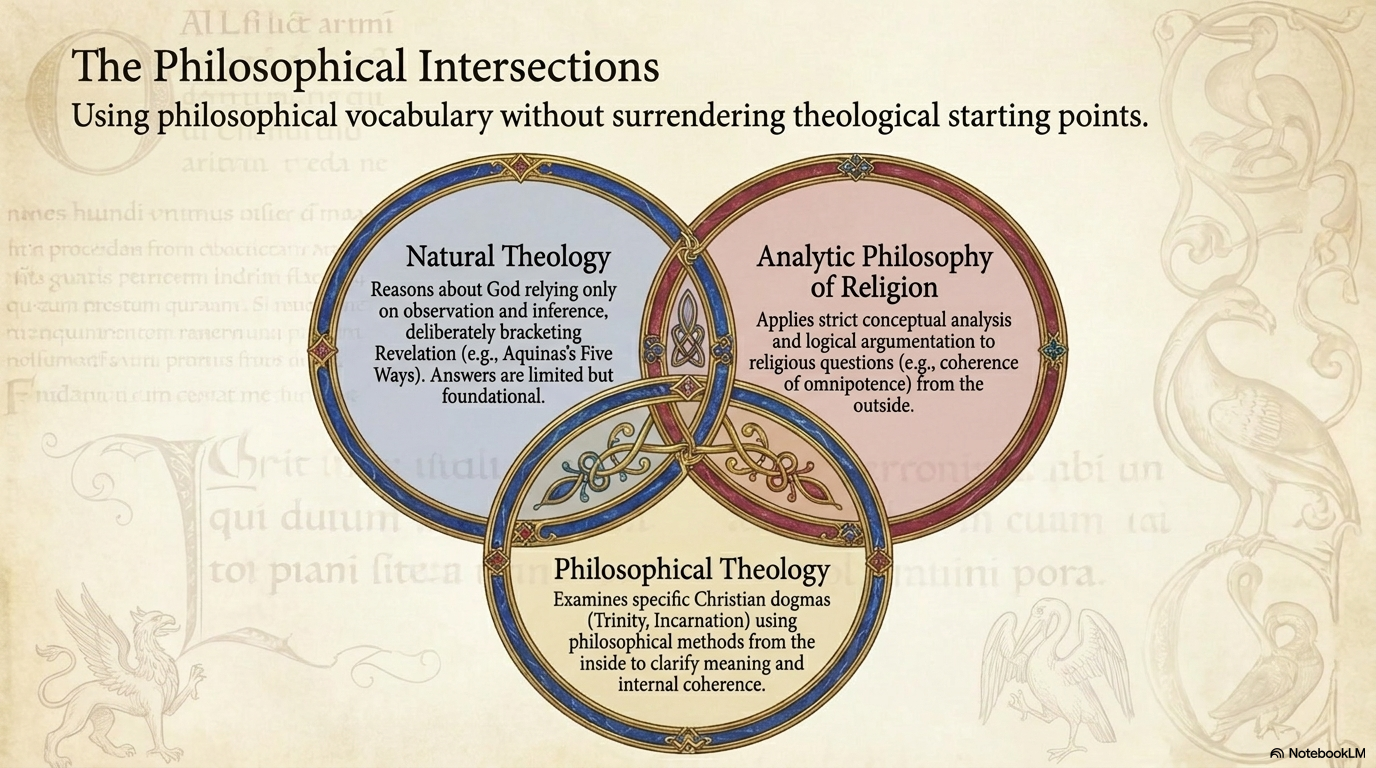
Three philosophical domains intersect especially closely with Fundamental Theology:
Natural Theology attempts to reason about God by relying on observation and inference alone, deliberately setting aside the data of Revelation. Its canonical questions: can the structure of the universe lead us to infer a Creator? Thomas Aquinas’s Five Ways represent the classical expression of this tradition. Natural theology intentionally brackets everything a Christian knows from Scripture and Tradition — it asks what an honest, open-minded inquirer could conclude without recourse to a sacred text. The answer is always limited: it may establish the existence of some ultimate ground of being, but it cannot reveal that this ground is a Trinity, that it became incarnate, or that it loves us. For that, Revelation is required. Fundamental Theology includes natural theology as one of its instruments, particularly in the first treatise on religion and God’s existence; but it is not exhausted by it.
Analytic Philosophy of Religion is a younger discipline, shaped largely in the Anglo-American tradition in the twentieth century. It applies the methods of analytic philosophy to religious questions: precise conceptual analysis, logical argumentation, and the testing of internal consistency. Its characteristic questions — Is the concept of omnipotence coherent? How can a timeless God act in time? — overlap substantially with questions of Fundamental Theology. The key difference is standpoint: the analytic philosopher of religion examines religion from the outside, without a prior commitment. Thinkers such as Alvin Plantinga and Richard Swinburne work productively at the intersection of the two disciplines, deploying rigorous analytic tools while openly defending the rationality of Christian belief.
Philosophical Theology works directly with Christian dogmas — the Trinity, the Incarnation, the Resurrection — but by philosophical methods. It takes a specific ecclesial teaching and asks: what exactly is being claimed? Is it internally coherent? How does it relate to what we know about time, personhood, and freedom? This is not an attempt to prove dogmas philosophically, nor a substitution of philosophy for theology. It is a joint undertaking: philosophy provides instruments for clarifying what the Church believes. The questions raised at the Ecumenical Councils — what does it mean for Christ to be fully God and fully human, in one person and without confusion of natures? — remain open to philosophical inquiry to this day.
4.2. Fundamental Theology and Dogmatics
If dogmatics builds the edifice of faith, Fundamental Theology investigates the right to build and the fitness of the ground. Both disciplines speak of the same faith, but from different vantage points. Dogmatics proceeds from the presupposition that Revelation is true and systematically unfolds its content. Fundamental Theology asks: why is Revelation true?
This does not mean that Fundamental Theology logically precedes faith. In practice, we are already living within the Christian tradition when we begin to reflect on it. The concern is not with proving faith to the unbeliever but with faith’s self-understanding — with giving an “account” of the hope that already lives within us.
4.3. Fundamental Theology and Apologetics
Both terms were long used interchangeably. Apologetics in the broad sense covers all apologetically oriented theology — Christianity’s self-defense, faith’s accountability, the demonstration of its credibility. Within the apologetic dimension of Fundamental Theology one distinguishes adversative apologetics (responding to doubts and objections from without) and transpositive apologetics (communicating the content of Christianity into non- Christian frameworks of understanding, aimed not at refutation but at genuine transmission).
5.1. The Unity of Three Methods
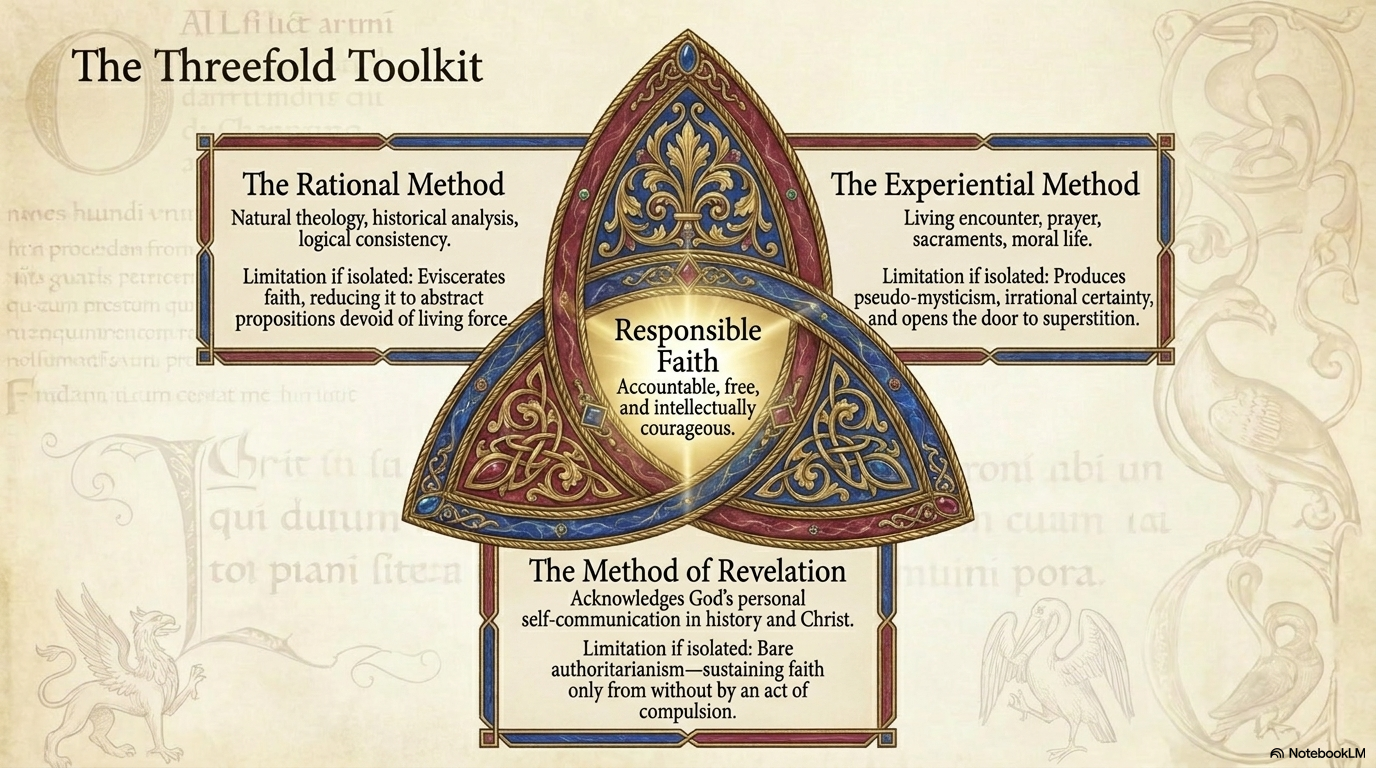
Fundamental Theology is not confined to any single method. Its strength lies precisely in its capacity to hold different paths of knowledge together without sacrificing any of them. Three principal methods may be distinguished, each operative within the discipline: the rational method, the experiential method, and the method of Revelation.
5.2. The Rational Method
The rational method rests on the conviction that human reason has a real, if limited, capacity for knowledge of God. It encompasses natural theology and its arguments for God’s existence, historico-critical analysis of the testimonies concerning Jesus Christ and the early Church, and logical examination of the internal consistency of theological claims.
The chief limitation of this method is that it cannot of itself produce faith. Reason can show that faith is not absurd and that it has adequate grounds — but the act of faith remains a free decision of the person. Cardinal Newman described the process with characteristic precision: when there are sufficiently many converging probabilities, and they are guided by a unifying sense, they engender firm conviction — even without formal demonstration.
5.3. The Experiential Method
The experiential method proceeds from the recognition that knowledge of God involves not only the intellect but a living religious encounter — a personal meeting with God in prayer, in the sacraments, and in moral life. Theology is not a cabinet discipline. It is born from the living practice of faith and returns to it. The Apostle Peter, it is worth noting, does not call Christians to give an “argument” but an account of their “hope” — of what they live by and breathe.
5.4. The Method of
Revelation
The method of Revelation acknowledges that God has made Himself known to the human person — in history, in Scripture, and above all in the person of Jesus Christ. Revelation is not merely the transmission of doctrinal propositions; it is an integral event in which God communicates Himself personally to the human person in order to bind Himself to him in love. This method does not cancel the rational and experiential methods — it encompasses and transforms them.
5.5. The Complementarity of Methods
The three methods do not compete; they complement. Pure rationalism eviscerate faith, reducing it to a system of abstract propositions devoid of living force. Pure experiential irrationalism produces pseudo-mystical certainty and opens the door to superstition. Bare authoritarianism — citing Revelation without the inner work of reason and experience — sustains faith only “from without by an act of compulsion,” making it incapable of becoming genuinely personal and free. Fundamental Theology seeks a responsible faith: one capable of giving an account of itself, open to dialogue, prepared to meet questions and doubts with intellectual courage.
Because Fundamental Theology deals with the central meanings of Christian faith, it demands an especially attentive and responsible approach. Theology cannot be treated as neutral information to be simply registered. The Christian truths in their fullness cannot be grasped without a transformation of the very mind that grasps them — otherwise the knowledge remains formal, superficial, and incapable of kindling faith in another.
Bishop Theophan the Recluse described how this process of apprehension actually works:
“Truth is akin to the spirit. Simply and sincerely expressed, it will find it; adorned with images, ornamented and embellished, it will remain in the imagination; encumbered with considerations and proofs, it will be detained in the intellect or soul, failing to reach the spirit and leaving it idle. One might say that all the unfruitfulness of preaching depends on the intellectualizing with which it is filled. But reveal truth simply, disclose what it is — and the spirit will be overcome.”
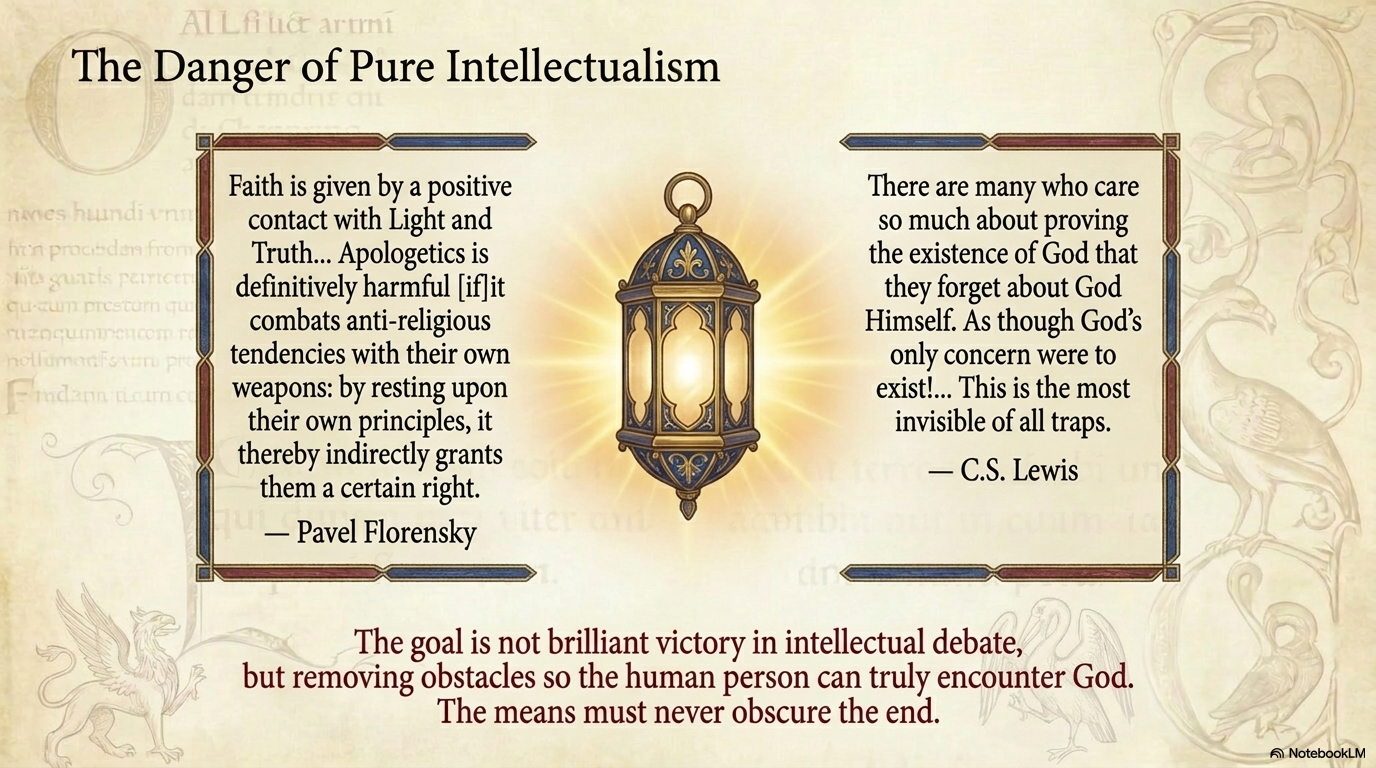
Pavel Florensky, Professor of the Moscow Theological Academy and later a martyr, was the foremost Orthodox apologist of his generation. Shortly before the Revolution he wrote with anguish about the dangers lurking in apologetic thought:
“Faith is given by a positive contact with Light and Truth. But our apologetics is of a negative character: it endeavors to show the falsity and inner contradiction of certain propositions. But this is a mistaken approach, because, first, even in religion there are antinomies, for life is antinomial, and, second, the affirmation of the falsity of one proposition does not yet establish the truth of another. Apologetics is definitively harmful, because it combats anti-religious tendencies with their own weapons: by resting upon their own principles, it thereby indirectly grants them a certain right.”
Preoccupation with external, formal proofs — without the truths in question taking root in the student’s own life — can generate a profound inner conflict, leading not to strengthened faith but to disillusionment. C. S. Lewis, in The Great Divorce, captures this danger in the figure of a scholar who spent his life producing proofs of the afterlife — only to arrive there unable to rest, because there was no longer anything to prove. Lewis draws the lesson:
“There are many who care so much about proving the existence of God that they forget about God Himself. As though God’s only concern were to exist!… This is the most invisible of all traps.”
Both testimonies — Florensky’s and Lewis’s — are of lasting importance for Fundamental Theology. They remind the discipline that apologetics and theology are not called to brilliant victories in intellectual disputes, but to help the human person truly encounter God. The means must not obscure the end.
7.1. The Russian Tradition
Rozhdestvensky, N. P. Khristianskaya apologetika: Kurs osnovnogo bogosloviya [Christian Apologetics: A Course in Fundamental Theology]. 2 vols. St. Petersburg, 1884. — One of the first systeamatic Russian-language courses in the discipline, covering both its theoretical foundations and extensive apologetic content.
Butkevich, T. I. “Osnovnoe ili apologeticheskoe bogoslovie i ego zadachi” [“Fundamental or Apologetic Theology and Its Tasks”]. Vera i razum [Faith and Reason], 1897. — An important methodological article examining the tasks and theoretical foundations of the discipline.
Glagolev, S. S. “Osnovnoe bogoslovie, ego predmet i zadacha” [“Fundamental Theology: Its Subject and Task”]. Bogoslovskiy vestnik [Theological Bulletin] 1 (1912). — A thorough academic treatment of the discipline’s identity and scope.
Zenkovsky, V. V. (Archpriest). Apologetika [Apologetics]. Paris, 1957. — A systematic work examining the relationship of Christianity to the natural sciences, to history, and to ecclesial life.
Lushnikov, D. (Priest). Osnovnoe bogoslovie [Fundamental Theology]. Textbook, 2015. — A contemporary manual offering a systematic account of the subject in dialogue with both the Russian and Western traditions.
Shokhin, V. K. “Ratsionalnaya teologiya i problemy s ratsionalnostyu” [“Rational Theology and Problems with Rationality”]. Trudy kafedry bogosloviya SPbDA [Proceedings of the Chair of Theology, St. Petersburg Theological Academy], 2019. — A current engagement with the nature of rational-theological discourse.
7.2. The Western Tradition
O’Collins, Gerald. Fundamental Theology. Russian trans. St. Petersburg, 1993. — An accessible and authoritative introduction by one of the leading Catholic systematic theologians of the late twentieth century.
Knapp, Markus. Die Vernunft des Glaubens: Eine Einführung in die Fundamentaltheologie. Freiburg: Herder, 2009. Russian trans. 2009. — One of the most rigorous contemporary introductions to the discipline, combining careful historiography with an original constructive argument.
Kern, W., Pottmeyer, H. J., and Seckler, M. (eds.). Handbuch der Fundamentaltheologie. 4 vols. Tübingen: Francke, 2000. — The most comprehensive reference work in the field; encyclopedic in scope, conceptually mature, and systematic in coverage.
Rahner, Karl. Grundkurs des Glaubens: Einführung in den Begriff des Christentums. Freiburg: Herder, 1976. Eng. trans.: Foundations of Christian Faith. — The most influential transcendental-theological introduction to Christianity in the twentieth century.
Related Concepts
- 1-peter-315
- adversative-apologetics
- aesthetics
- anthropological-turn
- apologetics
- aquinas
- augustine
- beauty
- christ-as-logos
- credibility-of-faith
- dogmatics
- epistemology
- five-ways
- foundational-discipline
- fourfold-structure
- fundamental-theology-and-apologetics
- fundamental-theology-and-philosophy
- hans-urs-von-balthasar
- history-of-religions
- inculturation
- integrative-discipline
- jesus-christ
- johann-sebastian-drey
- john-henry-newman
- justin-martyr
- karl-rahner
- newmans-converging-probabilities
- pannenberg
- philosophical-theology
- philosophy
- pierre-charron
- platonism
- pre-christian-philosophy
- rational-method
- religious-experience
- responsible-faith
- revelation
- schleiermacher
- scholasticism
- seckler
- self-accounting-of-faith
- sola-ratione
- spiritual-function-of-proofs
- theologia-generalis
- theological-knowledge
- thomas-aquinas
- transpositive-apologetics
- true-philosophy
- universal-truth-claim
- william-of-ockham