Dogmatic Theology — Topic 8
The Fall of Man
Corruption of the Mind
Blessed Diadochus speaks of the original unity and subsequent division of the faculty of the mind: “the perceptive faculty natural to our soul is single, but it split into two distinct modes of operation as a result of Adam’s disobedience;” therefore sometimes it is attracted by the passionate part of the soul, i.e. desire and irritation, and then aspires to worldly goods, while at other times it is aligned with reason and then delights in the heavenly beauties.[1]
Adam’s fall into sin radically affected the rational element of human nature. The mind has become confused and clouded. Unable to retain the memory of God, the mind of fallen man wanders among the objects of the external world. Man becomes more and more immersed in the experience of the multiplicity of objects around him, and the knowledge of God grows dim. In this condition the mind is incapable of watchfulness, concentration, prayer, mystical experience, but is entertained and disturbed by scattered thoughts and diverse images.
St. Anthony while speaking of the division of the mind call one side the “ordinary mind,” which is “worldly and vacillating producing both good and evil thoughts, because it is changeful by nature and directed towards material things.” The other side, whose intellect is “god-loving,” “participates in the life of virtue…(and) punishes the evil which arises spontaneously because of man’s indolence.”[2]
The Apostle Paul describes this distressing and divided condition as follows:
For we know that the law is spiritual: but I am carnal, sold under sin. For that which I do I allow not: for what I would, that do I not; but what I hate, that do I. If then I do that which I would not, I consent unto the law that it is good. Now then it is no more I that do it, but sin that dwelleth in me. For I know that in me (that is, in my flesh,) dwelleth no good thing: for to will is present with me; but how to perform that which is good I find not. For the good that I would I do not: but the evil which I would not, that I do. Now if I do that I would not, it is no more I that do it, but sin that dwelleth in me. I find then a law, that, when I would do good, evil is present with me. For I delight in the law of God after the inward man: But I see another law in my members, warring against the law of my mind, and bringing me into captivity to the law of sin which is in my members. O wretched man that I am! Who shall deliver me from the body of this death?(Rom. 7:14-24).
[1] [St. Diadochos of Photiki. On Spiritual Knowledge and Discrimination One Hundred Texts. 25, 29.](https://archive.org/details/Philokalia- TheCompleteText/page/n181/mode/2up)
[2] [(Pseudo) St. Anthony the Great. The Philokalia, vol. 1. On the Character of Men and on the Virtuous Life. 7.](https://archive.org/details/Philokalia- TheCompleteText/page/n229/mode/2up)
Death and corruption are not natural but results of sin.
Death and sin are inseparably connected: sin is the companion or colleague of death. Therefore, when the souls of people fell under the influence of sin, their bodies inevitably fell prey to death.
God did not create death, as is stated in the Wisdom of Solomon (Wisdom of Solomon 1: 13). According to the definition of the Local Council of Carthage of 419, “whosoever says that Adam, the first man, was created mortal, so that whether he had sinned or not, he would have died in body…not because his sin merited this, but by natural necessity, let him be anathema (Canon 109). God created man neither mortal nor immortal, but rather capable of either depending on his actions.[1]
The sin of Adam was the cause of the “common corruption” of human nature.[2] In the likeness of Adam’s crime the whole human race has put on decay, having been produced from one corrupted root.Who can bring a clean thing out of an unclean – asks the righteous Job and answers himself: not one (Job 14:4). As by one man sin entered into the world, and death by sin – the apostle Paul writes – and so death passed upon all men, for that all have sinned (Rom 5.12).
As a descendant of Adam and having inherited his nature, every human being is a partaker of sin from the moment of his birth. St. Macarius of Egypt speaks of the sinful “leaven” that all the descendants of Adam have partaken of, which ever “grows and increases, until the affections of sin have developed in them…(so totally, that – author) all humanity is leavened with evil.[3]
[1] St. Theophilus of Antioch. Three Books to Autolycus. Bk. 2. Ch. 27: The Nature of Man.
[2] St. John Chrysostom. Commentary on the Letter to the Romans. Homily 10.
[3] St. Macarius of Egypt. Fifty Spiritual Homilies. Homily 24, 2.
- The Biblical Account of the Fall of Man
- The Knowledge of Good and Evil
- Loss of the Divine Communion
- The Consequences of the Fall of Man
- The Consequences of the Fall of the Forefathers on Their Descendants
- Personal versus Natural/Inherited Sin of the Fall
- Death and corruption are not natural but results of sin.
- The Consequences of the Fall on the Spiritual and Bodily Make-up of Man.
- Corruption of the Mind
- The Consequences of the Fall for the Created World
Loss of the Divine Communion
Having
eaten the forbidden fruit, Adam, as soon as he heard the voice of God walking
in paradise, wanted to hide from Him. By breaking God’s commandment man lost
in an instant his knowledge of God, that innate insight and wisdom that he had
possessed from the moment he was created. Man knew from the beginning that it
was impossible to hide from God, being that God was present everywhere; but
his actions show that after breaking the commandment he lost this knowledge.
Having moved away from God his understanding of God was immediately distorted. Before he did not know and could not even suppose that God might be feared, that God could punish him. Now he tries to hide and seek refuge from God; the bond between man and God had been weakened. But Adam cannot hide from God, but rather he comes face to face with Him. The encounter, which before was a source of bliss and joy, now becomes a source of suffering and shame. Commenting on this encounter, St John Chrysostom says the following: “What are you saying – God strolls? Are we assigning feet to him? Have we no exalted conception of Him? No, God doesn’t stroll – perish the thought…So what is the meaning of this statement, “They heard the sound of the Lord God as He strolled in the garden in the evening?” He wanted to provide them with such an experience as would induce in them a state of anguish, which in fact happened: they had so striking an experience that they tried to hide from the presence of God.”[1]
Many of the Holy Fathers underline the fact that God offers both Adam and Eve a chance to take responsibility on themselves for their actions and repent. But neither of them takes this opportunity, but rather they shift the blame onto someone else: Adam onto Eve, Eve onto the snake. Thus they seal their fate.
[1] [St. John Chrysostom. Homilies on Genesis 17:3-4.](https://archive.org/details/saint-john-chrysostom-homilies-on- genesis-1-17/page/223/mode/2up)
Personal versus Natural/Inherited Sin of the Fall
Adam’s descendants did not personally participate in their forefather’s sinful transgression. The apostle Paul stated this in the letter to the Romans: death reigned from Adam to Moses, even over them that had not sinned after the similitude of Adam’s transgression (Rom. 5:14). However, this sinful state became the heritage of all men by virtue of the natural unity of all mankind (Acts 17:26). As the Prophet David wrote, this fallenness leaves its mark from the very moment of conception: behold I was brought forth in iniquity, and in sin did my mother conceive me (Ps. 51:5).
The original prelapsarian nature is not inherited by each person, but rather a nature distorted by sin and contaminated by the beginnings of the passions. Man is born mortal, which is evidence of the general corruption of human nature by sin; from infancy he is predisposed not only to good, but also to evil. Each time the descendants of Adam commit a sinful act, i.e. personal sin, they multiply the sinful inheritance of their forefather.
In the Western Christian tradition the doctrine of original sin is associated with the concept of “original guilt”, finding its roots in the work of Blessed Augustine. According to Augustine, Adam’s sin led to the radical corruption of human nature.[1] Since Adam comprised the entire human race, Adam’s sin began to be inherited (as children inherit not only property but also the debts of their parents) through the body, specifically through carnal intercourse. Blessed Augustine puts into Christ’s mouth the following words regarding man’s guilt: “Though your fault has changed you for the worse, and my grace has changed you for the better, I am not changed.”[2] Catholic Church’s teaching on original sin follows the view of Blessed Augustine, who acknowledged the universal guilt of men for the personal sin of Adam and Eve.
Of the grace of God Blessed Augustine says that it is ” is not given according to our merits, but is given according to His own most secret and at the same time most righteous, wise, and beneficent will; since those whom He did predestinate, them He also called (Rom. 8:30), with that calling of which it is said, The gifts and calling of God are without repentance (Rom. 11:29).[3]
The Orthodox tradition does not understand ancestral sin as hereditary guilt. Adam’s descendants inherit from him a corruptible and mortal nature, that is, the non-judicial consequences of sin. Each person is guilty only of his own personal sins, i.e. those committed of his own free will, not the sins of his parents, his forefathers or the first-created Adam. It is man’s personal sin that he is at fault for, not the general fallen state of the human race, to which everyone is bound by the fact of his birth. However, in spite of the lack of personal responsibility for Adam’s sin, all his descendants became by nature children of the wrath of God ([Eph. 2:3](https://www.kingjamesbibleonline.org/Ephesians- Chapter-2/#:~:text=Among%20whom%20also%20we%20all%20had%20our%20conversation%20in%20times%20past%20in%20the%20lusts%20of%20our%20flesh%2C%20fulfilling%20the%20desires%20of%20the%20flesh%20and%20of%20the%20mind%3B%20and%20were%20by%20nature%20the%20children%20of%20wrath%2C%20even%20as%20others.)) and therefore need to be saved.
[1] Blessed Augustine of Hippo. On the City of God. Bk. XIII. Ch. 3.
The Biblical Account of the Fall of Man
 The
Scriptures serve as the basis for the account of man’s fall into sin. The 3rd
chapter of Genesis begins by describing “the snake”
(nachash – נָחָשׁ) as the
subtlest or wisest (arum –
עָרוּם) of all of God’s creatures. This word is often used in the Scriptures
as a positive characteristic. The snake then begins to tempt Eve into
disobeying God’s commandment. Therefore, the biblical account expresses that
man fell away from God not solely of his own volition, but rather through
following the snake’s deceitful counsel. Thus from the most ancient times this
snake has been identified with “ the devil” (slanderer –
διάβολος) or “ the Satan” (the one
opposing - שָׂטָן), as St. John writes
in Revelation:the great dragon was cast out, that old serpent, called the
Devil, and Satan, which deceiveth the whole world (Rev.
12:9). Saint John
Chrysostom writes of this, “See the evil spirit’s envy and devious scheming.
He saw that man, creature though he was, had the good fortune to enjoy the
highest esteem and was scarcely inferior in any respect to the angels…The
author of evil, accordingly, seeing an angel who happened to live on earth,
was consumed by envy, since he himself had once enjoyed a place among the
powers above but had been cast down on account of his depravity of will and
excess of wickedness.. So he employed considerable skill so as to pluck the
human being from God’s favor, render him ungrateful and divest him of all
those goods provided for him through God’s loving kindness.”[1]
Why was the malevolent counsel of the serpent so enticing? The devil tricked man through a false promise and hope of deification, when he said, ye shall be as gods (Gen. 3:5). God had intended to deify man through obedience to the divine commandment. Both God and the devil promised Adam and Eve that they will be like gods. The first out of love wished to elevate man by his faithfulness to become by grace what God is by nature. The devil says that God out of jealousy forbid them from eating of the tree of knowledge of good and evil, because they will become like Him. The devil hides his deceit by mimicking God and promising the same thing God did, acting as if he has good intentions.
Eve was the first to succumb to the temptation: she ate of the tree of the knowledge of good and evil, thereby breaking God’s commandment. And when the woman saw that the tree was good for food, and that it was pleasant to the eyes (Genesis 3:6). She felt that the fruit would be sweet, and she preferred the sweetness of the forbidden fruit to the fulfillment of the divine commandment. She believed that there were precious things outside of God and apart from God. So she decided to disregard God’s commandment, to taste that which is apart from God. Following Eve, Adam tasted of the tree of the knowledge of good and evil. Immediately they both discovered their nakedness, they saw what they had not noticed before. They realized that apart from good there could be evil, apart from beauty there could be ugliness and nakedness, apart from joy there could be shame, apart from truth there could be falsehood.
[1] [St. John Chrysostom. Homilies on Genesis. Homily 16.3.](https://archive.org/details/saint-john-chrysostom-homilies-on- genesis-1-17/page/207/mode/2up)
The Consequences of the Fall for the Created World
The Fall of Adam and Eve had consequences not only for the human race, but also for the entirety of the created world. According to the teaching of the Apostle Paul, which was adopted in the Eastern Christian tradition, creation did not willingly succumb to vanity (ματαιότης),[1] but as a result of the fall of man: the earnest expectation of the creature waiteth for the manifestation of the sons of God. For the creature was made subject to vanity(ματαιότης), not willingly, but by reason of him who hath subjected the same in hope, because the creature itself also shall be delivered from the bondage of corruption into the glorious liberty of the children of God(Rom. 8:19-21).
Interpreting these words of the apostle, St. John Chrysostom says: “What is the meaning of, “the creation was made subject to vanity?” That it became corruptible. For what cause, and on what account? On account of you, O man. For since you have taken a body mortal and liable to suffering, the earth too has received a curse[2]…(but) it shall be freed, he says, from the bondage of corruption, that is, it shall no longer be corruptible, but shall go along with the beauty given to your body; just as when this became corruptible, that became corruptible also; so now it is made incorruptible, that also shall follow it too.[3]
[1] Strong’s Concordance – 3153: vanity, emptiness, instability, frailty.
[2] St. John Chrysostom. Commentary on the Letter to the Romans. Homily 14. Ver. 19-20.
[3] Ibid.
The Consequences of the Fall of Man
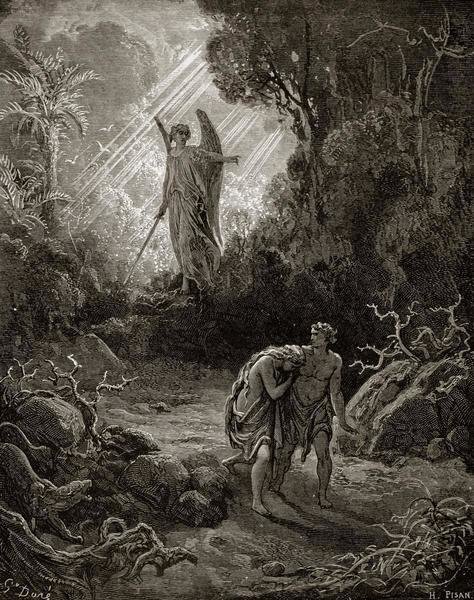
After testing Adam, God pronounces his judgment: man must be cast out of paradise. Not because God wants him to be, but because there is no place in paradise for evil, disobedience and unfaithfulness. Man who has tasted of the tree of the knowledge of good and evil can no longer be in paradise. Adam’s expulsion from paradise becomes the natural consequence of breaking God’s commandment: he made himself a stranger to paradise.
As a result of the Fall the relationship between man’s free will and God’s will radically changes. Original man had no sinful tendencies: his free will was in harmony with the will of God. However, after man had tasted of the “tree of the knowledge of good and evil,” that is had experienced evil and sin, his free will was faced with a constant choice between good and evil. At every individual moment of man’s life he must be making this choice. In order for the choice to be made correctly he must consciously direct his will towards the good.
St. Maximus the Confessor speaks of the presence in man after the Fall of a “natural” will inherent in all men, and a “productive” (or gnomic) will (the name “gnomic” comes from the Greek γνομή - opinion) This is the will on which choice is based, that is “free choice,” meaning the choice between good and evil and involving the responsibility for one’s deeds.
Spiritual perfection, which is necessary for man, presupposes the development of the gnomic (choosing) will, in the course of which its “freedom of choice” must be transformed into a new condition and become perfectly free; guided by this will in its perfected condition, the will no longer chooses between good and evil, but will forever only choose the good.
The Consequences of the Fall of the Forefathers on Their Descendants
The sin of Adam and Eve had consequences for all of mankind. The mark of sin made man’s nature dual: without completely losing the blessings of God, man partly retained the beauty of his image and at the same time brought the ugliness of sin into his nature.
St. Maximus the Confessor introduces the concept of a double sin: the first sin was Adam’s own transgression, and the second sin was the consequences that this sin had for human nature. The first sin was caused by the will voluntarily giving up the good; the second sin, having the first one as its cause, was the unavoidable result of man’s actions in which his nature involuntarily lost immortality. The first sin is worthy of blame, while the second, a change of nature from incorruption into corruption, cannot be cause for blame in of itself.
Adam, as the first-created man, was the progenitor of all mankind (Gen. 5:1-3) and therefore all human beings descended from him bear the consequences of his fall into sin because of their biological kinship.
After Adam’s fall into sin all men are born with a corrupted human nature, a corrupted image of God: as by one man sin entered the world, and by sin death, so death passed into all men, because in him all have sinned (Rom. 5:12). The traditional understanding of these words in the Eastern Church was expressed by St. Cyril of Alexandria: “Since we have become imitators of Adam’s crime, in that ‘all have sinned’, we have fallen under the same punishment as him.”[1]
Some Fathers of the ancient Church, including Blessed Augustine, held that the whole human race was originally contained in the seed of the first man, therefore the sin committed by the progenitor was transmitted to everyone in that very moment: “For we all were in that one man, since we all were that one man…not yet was the particular form created and distributed to us, in which we as individuals were to live, but already the seminal nature was there from which we were to be propagated; and this being vitiated by sin, and bound by the chain of death, and justly condemned, man could not be born of man in any other state.”[2] The basis for this view is sometimes found in the words of the apostle Paul to the Hebrews: Levi also, who receiveth tithes, payed tithes in Abraham. For he was yet in the loins of his father, when Melchisedec met him ([Heb. 7:9-10](https://www.kingjamesbibleonline.org/Hebrews- Chapter-7/#:~:text=And%20as%20I,Melchisedec%20met%20him.)).
[1] Cyril of Alexandria. Fragments on the Epistle of St. Paul to the Romans.
[2] Blessed Augustine of Hippo. The City of God. Bk. 13. Ch. 14.
The Consequences of the Fall on the Spiritual and Bodily Make-up of Man.
Man was created with a light, pure and incorruptible body, but after the fall into sin the body lost these properties and became decrepit, corrupt and mortal.
Sickness entered into the life of man. The interrelationship of sin and sickness can manifest itself in different ways. Sts. Barsanuphius and John say that sometimes sickness is a direct consequence of certain sins: Sicknesses arising from negligence and disorderliness (in life) naturally occur as a consequence (of this behavior)…It is up to you to be negligent or to live impurely and fall into sickness until you get better. In other cases sickness is sent from God as punishment for sin, for our benefit that we may repent. Some sicknesses arise from physiological causes, others from demons. Finally, sometimes God uses sickness as a trial for the spiritual development and advancement of a person.[1]
Sin had an effect on the spiritual element of man. After the Fall the soul was enslaved to the body and “being united to the body it was enclosed in the darkness of the body.”[2]
All the qualities and faculties of the soul had become corrupted and sickened. According to Abba Isaiah the Hermit, the natural desire of the soul for God was changed by the enemy into a shameful lust; zeal for God has changed into unnatural jealousy and envy of people towards one another; the ability to be angry with the devil, without which it is impossible to reject his temptations, has turned into anger at one’s neighbor because of many unnecessary and useless things.[3]
[1] Sts. Barsanuphius and John. Guidance Toward Spiritual Life: Answers to the Questions Of Disciples. Ch. 518, 514, 619.
[2] [(Pseudo) St. Anthony the Great. The Philokalia, vol. 1. On the Character of Men and on the Virtuous Life. 117.](https://archive.org/details/Philokalia- TheCompleteText/page/n241/mode/2up#:~:text=the%20soul%2C%20when%20it%20is%20united%20with%20the%20body%2C%20is%20bound%20up%20in%20the%20body%27s%20darkness)
[3] St. Isaiah the Solitary. Homily 2: On the natural law. Ch. 2.
The Knowledge of Good and Evil
St. Gregory of Nyssa says: the commandment was, “to touch nothing but what was Good, and to leave what was evil untasted; because impatience to remain any longer in ignorance of evil would be but the beginning of the long train of actual evil. For this reason it was forbidden to our first parents to grasp the knowledge of the opposite of the good, as well as that of the good itself; they were to keep themselves from the knowledge of good and evil, and to enjoy the Good in its purity, unmixed with even one particle of evil.”[1]
[1] St. Gregory of Nyssa. On virginity. Ch. 12.
Related Concepts
- 2-peter-14
- abba-isaiah
- adoption
- ancestral-sin
- anthropology
- assumption-of-human-nature
- augustine
- autexousion
- barsanuphius-and-john
- beasts-as-passions
- blessed-augustine
- catholic-church
- choice
- christ
- christ-as-true-god-and-true-man
- concentration
- corruption
- corruption-of-mind
- cosmic-consequences
- cosmic-redemption
- council-of-carthage
- desire
- devil
- diadochus
- diseased-will
- divine-will
- dyothelitism
- evil
- expulsion-from-paradise
- fall
- free-will
- freedom
- genesis-35
- gregory-of-nyssa
- holy-spirit
- human-nature
- human-will
- image-and-likeness
- inherited-corruption
- inherited-guilt
- irritation
- isaiah-the-hermit
- logos-of-nature
- maximus-the-confessor
- obedience
- orthodox-critique
- partakers-of-god
- passions
- personal-sin
- positive-dimension
- positive-redemption
- reason
- resurrection
- romans-7
- romans-8
- romans-819-21
- salvation
- self-rule
- seminal-presence
- sickness
- sin
- soul
- souls-faculties
- spiritual-development
- spiritual-perfection
- st-maximus
- the-two-ways
- two-natures
- watchfulness
- western-tradition