Comparative Theology — Topic 16. The Ecumenical movement.
The term “ecumenical movement” usually refers to the unification of Christians of different faiths to achieve a unity of all believers in Christ Jesus on the basis of the Savior’s words “May all be one” (John 21:7). Such movements developed in the twentieth century. The largest and most famous of them was the World Council of Churches. In addition, there are many regional ecumenical organizations: the Conference of European Churches, the Middle East Council of Churches, the All-African Conference of Churches, the National Council of Churches of Christ in the USA, etc.
The road to the formation of such movements was long and had several components. First, we should mention the so-called “branch theory” created by the Oxford Anglican Movement at the end of the 19th century, according to which denominations that adhere to the faith of the Ancient Church and have preserved the apostolic succession of bishops are, by definition, “branches” of the united Church. According to the Oxfordians, there are three such churches left in the world: the Church of England (“high”), the Roman Catholic and the Orthodox. At the same time, each of the apostolic churches does not possess the fullness of truth. Only in the unity of all three apostolic confessions can the Church be represented in its entirety. One of the activists of the Oxford Movement, Pusey, wrote: “The Greek Church anathematized Lutherans and Calvinists, but not us. If we voluntarily unite with this Church, we will enter into the Unity of the Universal Church.” In the future, the “branch theory” will develop and be modified. The variant that included both Oriental (Ancient Eastern) and Protestant churches among the “branches” of the united Church has become widespread in the ecumenical movement.
In the 19th century, the idea of uniting churches continued to develop in Anglicanism in its own way, not limited to the “theory of branches.” The issue of Christian unity was already raised at the first Lambeth Conference (1867). The Episcopal Church of the USA was particularly active in this issue, which discussed the unification of Christian churches at its conference in Chicago in 1886. The definitions of this four–point conference, known as the Chicago- Lambeth Quadrilateral, were adopted at the Third Lambeth Conference in 1888. According to the participants of the conference, these principles can become the basis for uniting Christians. The Fourth Lambeth Conference (1897) recommended organizing joint prayers of Christians of different faiths and joint conferences of representatives of Christian churches. In addition, the need was emphasized to include in the prayers a special petition for the unity of the Church based on the words of the Savior in the Gospel of John (John 21:7).
Equally important for the ecumenical movement was the so-called “evangelicalism.” In the English-speaking environment, the word “evangelicalism” refers to Protestant movements and denominations that arose in the process of the so-called “revivals” that took place in the XVIII-XIX centuries. in the UK and North America. Among the reasons that caused the formation of such movements was, firstly, the conviction of their participants that of the Lutheran and Reformed churches by the XVIII century. They acquired the features of rigid church structures, in which external order and excessive attention to the celebration of the sacraments and divine services, dogmatization of the faith, as well as the hierarchy of church positions overshadowed the main meaning of Christianity – ardent personal faith and a constant intense feeling of “abiding in the Lord.”
The organization that carried the ideology of “evangelicalism”, which served as one of the building blocks in the creation of the World Council of Churches and the Ecumenical movement as a whole, was the “Youth Christian Association”
- YMCA (Young Men’s Christian Association), which in Russia is simply called the YMCA. The YMCA was founded in 1844 in London with the aim of “improving the spiritual condition of young people.” Moreover, this improvement went in three directions: the body – strengthening health through sports, the mind – the development of education and profession, the spirit – the introduction to Christian values in the understanding of evangelicals. By 1851 YMCA branches have appeared in Australia, Belgium, Canada, France, Germany, the Netherlands, Switzerland and the United States. In 1855, the Paris Framework was adopted – the principles of the activities of individual divisions of the YMCA and the coordination of these activities. The motto of the foundation was the evangelical words “May all be one” (John 21:7). Thus, for the first time, the motto of the future world ecumenical movement was proposed by the YMCA. And the first basis of the World Council of Churches, which will be discussed below, was also based on the Parisian Basis of 1855.
The YMCA was also trying to gain a foothold in Russia. In 1900, one of the leaders of the organization, John Mott (1865-1955), who came from a Methodist family in the United States (later a Nobel Peace Prize laureate and founder of the World Council of Churches), arrived in the Russian Empire. Mott sought to “evangelize” Russia, hoping to turn Russians away from “wild” Orthodoxy and convert them to genuine “civilized” Christianity. The YMCA was registered as the Mayak cultural and Sports organization, which, in parallel with its official activities, organized Bible study circles and trained national young leaders to carry out Protestant expansion.
Subsequently, at the missionary conferences of 1910 (Edinburgh) and in 1911, the YMCA abandoned direct missionary work among the Orthodox, relying on the “reformation” of the Orthodox Churches, in particular on the realization of the idea of Christian unity. In addition, in order to increase the effectiveness of its work, the YMCA made “concessions” to the Orthodox, allowing the existence of monoconfessional units within the YMCA, which gave it the opportunity to register the Russian Student Movement in Russia in 1913. An important part of the YMCA’s work was the intensified search for “progressive” Orthodox Christians, from whom it was possible to form future leaders in the reform of Orthodoxy. The development and multiplication of the YMCA structures continued until the “October” revolution of 1917 and the establishment of the communist regime.
In 1918, when the Soviet government closed all YMCA structures in Russia, YMCA focused its efforts on Russian emigration, creating the Russian Christian Student Movement (RSHD) and the YMCA-Press publishing house in the early 1920s. At the same time, the RSHD Bulletin began to be published. In the early 1920s, the YMCA-Press publishing house in Prague and Berlin, and then in Paris, gathered around itself those who represented the intellectual force of emigration. In 1922, they were joined by philosophers and theologians expelled from Soviet Russia. N.A. Berdyaev immediately became the editor-in-chief of YMCA-Press, and B.P. Vysheslavtsev became his deputy. Not only the YMCA Press, but also the Religious and Philosophical Academy and the St. Sergius Orthodox Theological Institute in Paris enjoyed substantial financial support from the YMCA. The Church of England also helped financially by creating a special fund, The Russian Clergy and Church Aid Fund. At the same time, it should be noted that the Russian Orthodox Church Outside of Russia, established in 1921 under the leadership of the Archbishop Anthony (Khrapovitsky), at the Karlovac All-Foreign Council on November 16, 1921, banned all contacts with the YMCA. The YMCA certainly had a significant impact on the formation and development of the ecumenical movement, but it has not been institutionally included in the World Council of Churches, the main ecumenical organization of our time. Unlike the other three structures that were crucial to the emergence of the WCC: the International Missionary Council (IMC), Faith and Order, and Life and Work.
The International Missionary Council
 In 1910,
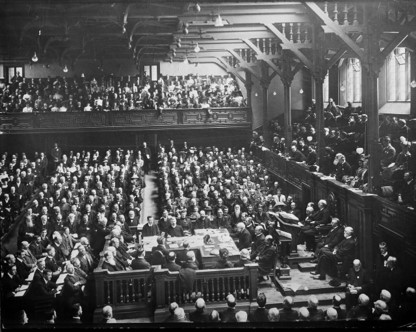
the first World Missionary Conference was held in Edinburgh, which brought
together more than a thousand delegates from Protestant churches. This
conference is considered as the beginning of an organized international
ecumenical movement. Although, strictly speaking, this is not entirely true,
since the World Missionary Conference remained a Protestant organization
almost until its full membership in the World Council of Churches in 1961.
Ecumenism presupposes the cooperation of all Christian denominations.
The call of the conference - “United Church, bringing the Gospel to the whole world” - united both missionary tasks and aspirations for the unification of Christian churches. The ecumenical nature of the conference was emphasized by Bishop Charles Brent of the Episcopal Church in the USA with his call “to create a single church, united not only in the field of missionary work, not only in the field of social activities, but also in the field of dogma and theology.” The result of this conference was the election of a Standing Committee headed by John Mott. In 1921, on the basis of the committee, the International Missionary Council (IMC) was established, which was given specific tasks.
After Edinburgh, the IMC met in Jerusalem (1928), in Madras (India, 1938), and after the end of World War II in Whitby (Ontario, Canada, 1947). Starting in 1938, when a concrete plan for the creation of the World Council of Churches was already being prepared, the IMC began to participate in the implementation of this the project. In 1948, the WCC and IMC officially declared their cooperation. By that time, the missionary organization already included 30 national and regional associations. Cooperation with the WCC was conducted as part of the commissions on international affairs, the ecumenical press service and the Joint Committee. The full integration of the IMC into the WCC took place only in 1961.
“Faith and Order ”
In October 1910, at the suggestion of the Anglican bishops, Ch. Brent and C.P. Anderson, as well as the active ecumenical layman R. Gardiner, created a commission to prepare for the World Conference on “Faith and Order.” Interestingly, the first meeting of the commission (May 1913) in New York was attended by Archpr. Alexander Hotovitsky (a future member of the Local Council of 1917 - 1918 and a martyr for the faith), as a representative of the Archbishop Platon (Rozhdestvensky), who became the successor of the future Patriarch Tikhon in the USA. Fr. A. Hotovitsky delivered a speech in which he promised full support to the Faith and Order movement. A resolution was adopted on the establishment of an executive committee and advisory committees for the convening of the world conference on Faith and Order. In 1915-1916, articles appeared in the Russian church press supporting this initiative. Of the well-known figures of the Russian Orthodox Church, only the archbishop Anthony (Khrapovitsky) and bishop Hilarion (Troitsky) gave a sharply negative assessment of this movement. In March 1918, as secretary of the Faith and Order commission, Robert Gardiner received a number of greetings from the “Russian friends” of the movement from Russia, including a letter from His Holiness Patriarch Tikhon with his assurances of support for the idea of a “week of prayers” for the unity of all Christians, invoking the Savior’s blessing on this cause.
Emigrants from Russia, who testified to Orthodoxy in the West, played an active role in establishing inter-Christian communication. Among them were, Archpr. Sergiy Bulgakov, N.N. Glubokovsky, N.S. Arsenyev, A.V. Kartashev, Prot. Vasily Zenkovsky, N.M. Zernov, G. Fedotov, N.A. Berdyaev. The Archpriest George Florovsky played a particularly prominent role in the ecumenical movement - he participated in almost all ecumenical conferences, was a member of Faith and Order and the central committee of the World Council of Churches.
Russian theologians and church leaders who participated in the pre–war ecumenical meetings did not belong to the Russian Orthodox Church and were not formally its representatives, since they belonged primarily either to the Russian Archdiocese of the Patriarchate of Constantinople or to the Russian Orthodox Church Outside of Russia.
In 1927, the first international conference ” Faith and Order ” was held in Lausanne (Switzerland). 439 delegates from 108 churches took direct part in it: Lutherans, Reformed movements, Old Catholics, Orthodox, Anglicans, Methodists, Congregationalists, Baptists and “Disciples of Christ”. Before the conference closed, a Continuation Committee was established. Charles Brent became its chairman. In 1928, the Committee met in Prague. More active cooperation with another movement, Life and Activity, was discussed. In August 1929, in Maloja (Switzerland) hosted the second meeting of the Committee. The archbishop of York William Temple became chairman, replacing Charles Brent, who died on March 27, 1929. Also at this meeting, a Theological Committee was established to develop theological topics for the next international conference held in Edinburgh in 1937.
In Edinburgh, special attention was paid to negotiations with the Life and Work movement in order to unite with it and create a global ecumenical organization based on these two movements - the World Council of Churches. In 1938, a Preliminary Committee of the WCC was created in the process of preparation, the secretary General of which became the famous ecumenical figure Willem Adolph Visser’t Hooft (1900-1985), at one time an active figure in the YMCA and the Student Movement, assistant to John Mott. The committee also includes George Florovsky.
After the creation of the WCC in 1948, the Faith and Order movement joined it as the Faith and Order Commission. At the same time, the commission retained the possibility of holding world conferences of its movement. Thus, the Third World Conference was held in 1952 in Lund, Sweden. During the conference, it was decided to change the Commission’s working method: to abandon the simple comparison of the religious positions of different churches and start real theological discussions on the most controversial issues. The fourth conference was held in 1963 in Montreal (Canada), the fifth in Santiago de Compostela (Spain) in 1993. The sixth conference on “Where is the visible unity now?” was held in Alexandria (Egypt) in 2025 and was dedicated to the 1700th anniversary of the First Ecumenical Council.
Churches that are not members of the WCC may, on the other hand, be members of Faith and Order. Thus, the Dicastery for the Promotion of Christian Unity of the Russian Orthodox Church is represented in the commission, although the Russian Orthodox Church itself is not a member of the WCC. The commission is also responsible for preparing texts for the annual “Week of Prayer for Christian Unity” in most Christian Churches.
“Life and work”
The third structural unit of the future World Council of Churches was the “Life and Work” movement. The movement was founded by the primate of the Lutheran Church of Sweden, Nathan Söderblom, Archbishop of Uppsala. Söderblom participated in a missionary conference in Edinburgh in 1910. In 1917, he tried to organize an ecumenical conference in Uppsala (Sweden), but it was not entirely successful, as the warring countries refused to issue passports; only five delegates from neutral countries arrived. Nevertheless, in the history of ecumenism, the 1917 conference, is usually called the “preliminary meeting of the Life and Work movement.” In 1920, a meeting was held in Geneva, assembled by Söderblom, to discuss the formation of a new movement. It was attended by 90 participants from 15 countries. Orthodox and Roman Catholics had been invited to participate in the new organization.
The Life and Work movement was finally formed in 1925 at a conference in Stockholm. The conference gathered 600 delegates from 37 countries. The Russian Orthodox Church refused to participate, but representatives of the Orthodox Churches and the main Protestant churches were present. The issues of the conference were not dogmas of faith, but methods of introducing Christian principles into life in all its forms and fields.
Before the closure, a Continuation Committee was established, which was reorganized in 1930 into a permanent body of the international Christian conference “Life and Work”. The next general conference on “Life and Work” was held in 1937 in Oxford. It was attended by 120 churches from 40 countries. One of the most important topics was the relationship between church and state, especially with the growing communist and nationalist movements. Of crucial importance was the consideration of the creation of a new “universal council of churches” together with the Faith and Church Organization movement.
The activities of the WCC are based on a common theological and historiosophical foundation for the Member Churches. The first formulation of the “basis” was approved by the First Assembly of the WCC in Amsterdam (1948): the WCC is “a community of Churches that accept our Lord Jesus Christ as God and Savior.” Subsequently, this formulation was changed and supplemented (not without the insistent demands of Orthodox theologians). The new “basis”, which referred not only to the Christological, but also to the trinitarian dogma, was approved by the 3rd Assembly, which took place in 1961 in New Delhi: The WCC is “a community of Churches that profess the Lord Jesus Christ to be God and Savior according to the Holy Scriptures and strive together to fulfill a common vocation for the glory of the One God, the Father, the Son and the Holy Spirit.” At the assembly in Amsterdam, it was also stated that the WCC is not a “universal Church” that stands above all other Churches, but a tool for achieving Christian unity and cooperation in matters requiring joint action.
In 1950, in Toronto (Canada), the Central Committee of the WCC adopted the declaration “Church, Churches and the World Council of Churches” (the so- called Toronto Declaration, in the development of which the opinion of the Orthodox Churches played an important role). The first paragraph of the third part of the declaration states that “The World Council of Churches is not and should never become a super-Church. This is not a super-Church. This is not a universal Church. This is not the Una Sancta (“one holy”) referred to in the Creed.” The third paragraph of the third part emphasizes that “there is a place in the World Council for the ecclesiology of any Church that is ready to participate in the ecumenical conversation and adheres to the point of view on which the Council is based, that it is ‘a community of Churches that recognize our Lord Jesus Christ as God and Savior.’” Decisions taken in the WCC are not binding on the member churches without their approval. The WCC sought to show that there is a place among its members for any church whose ecclesiology does not contradict its “Basis.” Membership in the WCC does not mean that each church must recognize the “presence of elements” of the true church in other churches on the Council, nor does it mean that all churches accept a single doctrine on the essence of Christian unity.
Although the Toronto Declaration still remains one of the fundamental documents of the World Council of Churches, many of its provisions gradually became obsolete, which led to the creation of a new declaration “Towards Common Understanding and Vision of the WCC”, presented in 1998 at the assembly in Harare. It recognizes that the member churches of the WCC cannot claim that they have reached a consensus on the “common understanding and vision of the WCC. The main thing is that the WCC is a community of Churches, not an organization or any church institution.”
The supreme governing body of the WCC is the Assembly, which meets once every 7-8 years. Its participants are representatives of all members of the WCC, delegated by churches and religious organizations, who have the right to vote. The Assembly elects eight Presidents of the WCC, who make up the Presidium of the WCC, and 150 (maximum) members of the Central Committee (in proportion to the number, confessional affiliation and geographical location of the churches). The Central Committee elects the General Secretary of the WCC, who is the head of the Executive Committee and the head of all administrative staff of the WCC. The General Secretaries were: V. A. Visser’t Hooft (1948-1966), Eugene Carson Blake (1966-1972), Philip A. Potter (1972-1984), Emilio Castro (1985-1992), Conrad Reiser (1993-2003) and Samuel Kobia (2004 -2009), Olaf Fuchse Tveit (2010-2020), prot. John Sauka (2020-2022), Jerry Pillay (2022 – present time)
In 1948, the Assembly created 12 main departments (36 employees), which were under the control of the General Secretariat. In 1956, at the assembly in Evanston, the activities of the WCC were divided into four large divisions, each of which had its own departments:
- Studies - “Faith and Church Structure”, “Church and Society”, “Evangelization and Missionary Studies”;
- Ecumenical Actions - youth, laity, “Women and men in the Church and Society”, Ecumenical Institute in Bossa;
- Interchurch Aid, Refugees and International Affairs;
- Information.
The Uppsala Assembly (1968) decided to change the structure “to simplify and better coordinate work.” In 1972, three departments were formed in the WCC: Faith and Witness, Justice and Service, and Education and Renewal. Each department worked on special programs. The purpose of this reorganization was to bridge the gap between theory and practice. At the Harare Assembly (1998), the activities of the WCC were divided into 4 main areas, divided into several groups (teams).
Currently, the WCC operates under three main programs:
- “Unity, Mission, and Ecumenical Relations”,
- “Public Witness and Diakonia” and
- “Ecumenical Education”.
Specialized commissions, as well as specialized groups, work in these areas.
- Definition. The background of the ecumenical movement
- The World Council of Churches: history and structure
- Ideology and structure of the World Council of Churches
- The place of Orthodoxy in the ecumenical movement
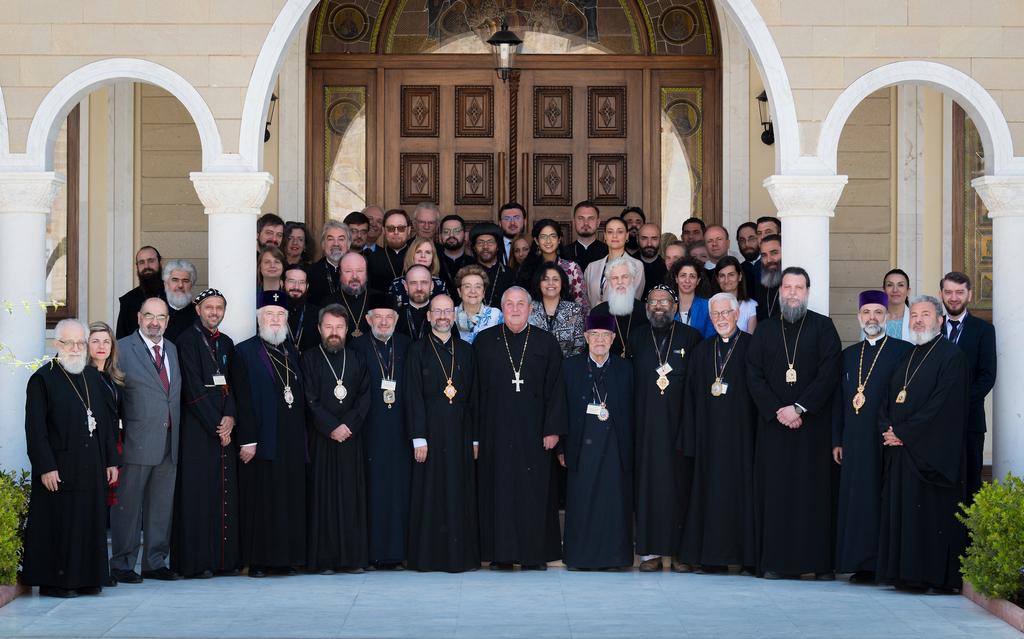
Initially, the principles of the participation of Orthodox Churches in the ecumenical movement were set out in the District Message of the Patriarchate of Constantinople to All Christian Churches, published in 1920. The message gave the following arguments for the participation of Orthodox theologians in inter-Christian meetings: representatives of other churches will draw their knowledge of the Orthodox Church from live communication with its representatives; communication with Protestants will help them gradually eliminate prejudices against Orthodoxy as second-class Christianity; Orthodox Christians will gradually understand the way of thinking of their Western brothers and will learn that different expressions of the Christian faith and life depend on historical circumstances and conditions that have not influenced the Eastern Churches in their long historical development.
In 1920, representatives of the Churches of Constantinople, Alexandria, Greece, Serbia, Bulgaria, and the Russian emigration took part in a “Christian meeting” that was called to prepare a large international conference on “Faith and church structure” in Geneva, where they proposed to create a “community of Churches” for “joint activities in the field of moral and social problems.” The archbishop Evlogy (Georgievsky) from the Russian Orthodox Church attended the conference - His Holiness Patriarch Tikhon blessed his participation in the Geneva meeting.
In 1927, 24 delegates from the Orthodox Churches attended the conference “Faith and Order” in Lausanne: Constantinople (four), Alexandria (two), Jerusalem (two), Greece and Cyprus (four), Romania (one), Serbia (one), Bulgaria (three), Poland (three), Russian emigration (three), Georgian (one). The Orthodox criticized the documents of the Faith and Order movement, which, from their point of view, offered only the external unity of Christians, allowing for excessive breadth in the interpretation of the Christian faith, considered any compromise in the doctrine unacceptable, and also found that the terms used in the documents allowed for two interpretations. Orthodox Churches also participated in the work of the Life and Work movement. So, in 1925 the first inter-church conference in Stockholm was attended by delegates from the Orthodox Churches of Constantinople, Alexandria, Jerusalem, Cyprus, Greece, Romania, Serbia and Bulgaria.
In 1936, the first Pan-Orthodox Congress of theologians was held in Athens, where, among others, the issue of the participation of Orthodox Churches in the ecumenical movement was discussed. The following resolution was passed: “Considering ecumenical work for the unity of the church and for practical Christianity to be a welcome expression of the awakening of new interest in the Church and theology, the Congress welcomes this movement and assures that it is ready to cooperate in this matter in the Orthodox spirit.”
At the next conference “Faith and Order”, held in Edinburgh in 1937, the contradictions between Orthodox and Protestant participants became even sharper. The Orthodox spoke about the need to venerate saints and especially the Mother of God, which met with a fierce reaction from Protestants. The issue of the intercommunion was extremely controversial. Protestants have put forward the idea of uniting churches through intercommunion - communion in the sacraments without achieving unity in faith. The Orthodox responded by saying that Eucharistic communion is a manifestation of existing unity, and not a tool for achieving it.
In 1946, the Russian Orthodox Church received an invitation from the “Provisional Committee of the WCC in the Process of Preparation” to participate in the formation of the World Council of Churches. A delegation led by Mitr Nikolai (Yarushevich), was appointed, but the alleged contacts and trips did not take place. Of course, the political situation played a crucial role in this case. In the context of the emerging Cold War, the leaders of the Soviet Union did not consider it possible to resolve international church contacts. But there was interest in the Assembly from the Russian Orthodox Church. So, in early 1946. His Holiness Patriarch Alexy I sent to the Chairman of the Council for the Affairs of the Russian Orthodox Church, G. G. Karpov, a report on the ecumenical obviously compiled by the Archpr. Grigory Razumovsky, an employee of the newly formed Department of External Church Relations under the chairmanship of Metropolitan Nikolai (Yarushevich). In particular, it states: «1. The ecumenical movement and the participation of the Russian Orthodox Church in it are considered to be the main factor in the reunification of Russian Orthodox dioceses abroad. 2. The Ecumenical Patriarch is recognized as having lost his authority in the Orthodox world, and other Eastern patriarchs are incapable of accepting this authority and the ability to accept the Russian Orthodox Church».
One of the future co-presidents of the WCC, Bishop George Bell of Chichester, wrote in a letter to His Holiness Patriarch Alexy I dated April 21, 1945: “If the Russian Orthodox Church and Churches under its influence do not participate in the WCC, it will be a tragedy. If the Russian Church is going to participate, it will be given a leading role.” Interestingly, the hierarchs of the Moscow Patriarchate were not one-sided in their awareness of the increased role of the Russian Church in the post-war period. Many leaders of the Christian churches of Europe also looked to the Russian Orthodox Church with great hopes.”
In the end, in February 1948, the Council for Religious Affairs made a final decision: the delegation of the Russian Orthodox Church would not go to Amsterdam for the Assembly.
In 1948, Moscow hosted the celebration of the 500th anniversary of the autocephaly of the Russian Orthodox Church and a meeting of the heads and Representatives of the Orthodox Churches. Representatives of the Local Orthodox Churches of Constantinople, Antioch, Georgia, Serbia, Romania, Bulgaria, Greece, Albania, and Poland arrived. Among other issues, the topic “On the attitude of the Orthodox Church to the Ecumenical movement” was discussed. The report was presented by the Russian Church Archpr. Grigory Razumovsky, who analyzed in detail all the stages of the development of world ecumenism, analyzed the documents of ecumenical meetings and concluded that the nascent WCC is a new, “ecumenical church.” As a result, a negative resolution on the ecumenical issue was adopted at the meeting.
As a result, only the Orthodox Churches of Constantinople and Greece participated in the first General Assembly of the WCC in Amsterdam. Russian theologians, intellectuals, clergy, and the hierarchy of the Russian diaspora, grouped around Mitr. Eulogy and the St. Sergius Theological Institute in Paris, owned by the Patriarchate of Constantinople, continued to actively participate in the ecumenical movement as a whole and in the activities of the WCC.
The adoption of the Toronto Declaration in 1950, which clearly stated that the World Council of Churches was not a Church and would never become a “super- church”, was seen as a positive fact in the development of the WCC. In August 1958, a delegation of the Russian Orthodox Church met with a delegation of the WCC in Utrecht (the Netherlands). The following year, Archpr. Vitaly Borovoy was sent to Geneva to study the activities and structure of the WCC. In December 1959, the first official delegation of the WCC, headed by V. A. Visser’t Hooft, arrived in Moscow. During the negotiations, at the suggestion of the Russian Orthodox Church, the above-mentioned draft of a new trinitarian basis of the WCC was worked out.
In early March 1961, a delegation of the Russian Church headed by the new chairman of the Department of External Church Relations Archbishop Nicodim (Rotov) arrived in Geneva for the final approval of the issue of the entry of the Russian Orthodox Church into the WCC. In March 30, 1961 Russian Orthodox Church Synod, having heard the report of the Chairman of the Commission on Inter-Christian Relations of the Russian Orthodox Church at the Holy Synod, Metropolitan Krutitsky and Kolomna Pitirim, decided: “Consider the entry of the Russian Orthodox Church in the World Council of Churches timely and ask His Holiness the Patriarch to send a letter to the Secretary General of the World Council of Churches with a statement of the desire of the Russian Orthodox Church to join the membership in the World Council of Churches”. The decision to join the WCC was also approved by the Bishops’ Council, which took place in July 1961. By joining the WCC, the Russian Orthodox Church joined the general Orthodox representation in this structure, which closely interacts with the Oriental churches, the official members of the WCC.
As noted in the Appendix to the document of the Council of Bishops “Basic Principles of the Orthodox Church’s attitude towards Non-Orthodoxy”: after 1948, “the formation of a positive attitude towards the WCC in our Church was facilitated by its evolution from the former pro-Western and pro-Protestant one-sidedness towards balanced and objective relations between the West and the East. In addition, in theological terms, the Council began to pay much attention to the development of a new, trinitarian basis, a clearer definition of the unity of the Church in faith and the foundations of the canonical structure, with the strengthening of elements of catholicism and ecclesiasticism.”
Nevertheless, by the early 70s, a crisis had already emerged in relations between the Orthodox Churches and the ecumenical movement. In 1975, at the Fifth Assembly of the WCC in Nairobi (Kenya), Orthodox Christians strongly protested against the resolution on the ordination of women to holy orders. In 1983, at the Sixth Assembly of the WCC in Vancouver (Canada), Orthodox Christians opposed the use of the so-called “inclusive language” - naming God in the feminine gender.
During the 80-90s of the twentieth century, significant changes took place in the inner life of Protestant denominations. Among them is not only the widespread spread of the female priesthood, and in some communities of the female episcopate, but also the denial of the sin of homosexuality, support for the rights of gays and lesbians, up to the consecration of their marriages and ordination to the pastoral and episcopal dignity of adherents of LGBT ideology.
At the Seventh Assembly of the WCC, which was held in Canberra, Australia, in 1991, a special Statement was adopted, signed by all Orthodox participants in the Assembly, which stated, in particular, that the Orthodox were concerned about the observed departure from the Basis of the WCC. As a result, “in many documents of the WCC, we do not find statements that Jesus Christ is the Savior of the world… We observe a departure from the biblically based Christian understanding of: a) the Triune God, b) salvation, c) the good news of the Gospel itself, d) man as created in the image and likeness of God, e) the Church, and other doctrinal issues.” The Statement also stated with concern that “some Assembly participants tend to assert the presence of the Holy Spirit with great ease, without distinguishing between many actions and events.”… We must beware of the tendency to substitute the Holy Spirit, who proceeds from the Father and resides in the Son, with “private” spirits, spirits of the world, and other spirits.” Finally, it was definitely stated about the dissatisfaction of the Orthodox with “decision-making methods” when their opinions are practically not taken into account, and the question of reviewing their relations with the WCC was raised.
The Russian Orthodox Church, as one of the main initiators of the changes in the WCC, conducted a study of the situation in the ecumenical movement by the Synodal Theological Commission, which prepared a report to the Bishops’ Council in 1994. As a result, the Council adopted a definition “On the attitude of the Russian Orthodox Church to inter-Christian cooperation in search of unity.” It noted that the participation of the Russian Church in the activities of the WCC for 35 years, first of all, is “a testimony of Orthodoxy in the face of the non-Orthodox world,” the task was to analyze ecumenical experience and only then draw final conclusions about the meaning of our participation in the ecumenical movement, including in the WCC.
In 1997 The Georgian Orthodox Church left the WCC, and in 1998 the Bulgarian Orthodox Church. The Serbian Church was also preparing to leave the WCC, but no final decision was made. The Russian Orthodox Church Bishops’ Council again considered the issue of ecumenism and whether the Russian Orthodox Church can remain a member of the WCC in 1997. It was decided to discuss the problem of the modern ecumenical movement at the pan-orthodox level. “At the same time, representatives of the Russian Orthodox Church should continue to participate in the work of international Christian organizations, noting the special importance of Orthodox witness in the sin-divided Christian world at this moment.”
In the spring of 1998, at the initiative of the Russian and Serbian Orthodox Churches, a Pan-Orthodox Conference was convened in Thessalonica. The participants of the meeting testified that over the years of the existence of the WCC, the doctrinal and moral gap between Orthodox and non-Orthodox has not only not decreased, but even increased. It was stated that the current structure of the WCC, the decision-making mechanism, and the organization of joint prayers are unacceptable for Orthodox Churches. They will either resign from the Council, or the Council must be radically reformed. The Russian Orthodox Church has proposed a new model of inter-Christian cooperation.: The World Christian Forum, which does not involve formal membership of churches and opens up opportunities for equal cooperation. The meeting adopted a joint communique “Assessment of new facts in relations between Orthodoxy and the Ecumenical Movement,” which, in particular, expressed Orthodox concern about “certain trends in the lives of some Protestant WCC member Churches reflected in the WCC debates,” lack of progress in ecumenical theological discussions, and the feeling that the existing structure of the WCC makes any meaningful Orthodox participation more and more difficult, and for some, impossible. In December 1998 at the Seventh Assembly in Harare, the declaration of the Orthodox Churches adopted in Thessalonica was made public. In response, the Assembly created a Special Commission for the Participation of Orthodox Churches in the work of the WCC consisting of 60 people from Orthodox, Ancient Oriental and Protestant Churches.
At the same time, the Russian Orthodox Church has developed a position on the ecumenical movement at the present stage. The Jubilee Council of Bishops, held in 2000, among others adopted the document “Basic Principles of the Relationship of the Russian Orthodox Church to Non-Orthodoxy,” which has an Appendix “Participation in International Christian Organizations.” It analyzes in detail the work of the Russian Orthodox Church within the framework of the WCC and expresses concern about the current state of the WCC on the points identified by the Pan-Orthodox Conference in Thessalonica in 1998. Meanwhile, the Special Commission carried out its work. Four plenary sessions of the Commission were held. The results of the work were announced in the final report at a meeting of the Central Committee of the WCC in Geneva in 2002. A Special Commission recommended that the WCC completely abandon the use of the term “ecumenical worship.” The Commission proposed to introduce into the statute of the WCC a provision on the need for members of the WCC to profess the Nicene-Constantinople Creed, raise the lower membership threshold from 25 to 50 thousand members, Orthodox Christians should make up at least 25% of the total number of members.
The final report of the Special Commission was submitted to the WCC Central Committee in February 2005, which approved the Commission’s amendments to the Constitution and rules of the WCC. These amendments introduce a new decision- making mechanism, which will now be adopted not by a majority vote, as it was before, but on the basis of consensus, assuming full agreement of the participants. If there is a dissenting minority, according to the new rules, the following options apply: decision-making is postponed; time is given for prayer and silent reflection; the decision is made, but the minority fixes a dissenting opinion.; the final document states that there are different opinions; the minority distances itself from the decision, but agrees with its implementation; the decision is not taken; the voting procedure takes place provided at least 85% of the participants agree to it. In any case, voting is not possible on issues affecting the ecclesiology of the WCC member churches. The amendments were finally approved at the IX Assembly of the WCC, held in February 2006 in Porto Alegre (Brazil).
The XI General Assembly of the WCC, held in Karlsruhe (Germany) in 2022, revealed new problems in relations between the Russian Orthodox Church and the ecumenical movement. Despite the official protest of the Moscow Patriarchate, representatives of the schismatic “Orthodox Church in Ukraine” were invited to the General Assembly as observers. The possible granting of this structure the status of an official member church of the WCC would call into question the need for the Russian Orthodox Church to remain in this ecumenical organization. In the meantime, this event has not happened, our Church will continue to testify to the non-Orthodox participants of the WCC about the truth of the Orthodox faith and offer them ways to restore unity with the true Church in the spirit of the covenant of St. Gregory the Theologian: “We are not seeking victory, but the return of the brothers, the separation from whom torments us.”
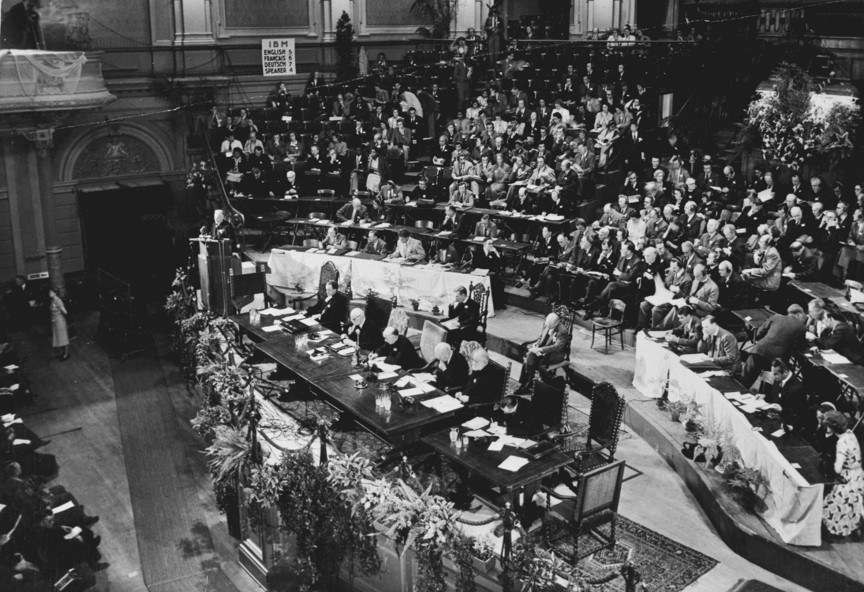
In July 1937, on the eve of the conferences of the movements “Faith and Order” in Edinburgh (Great Britain) and “Life and Work” in Oxford (Great Britain), their representatives met in London and decided to unite in the world inter- Christian assembly. U.S. Representative S. McCree Covert, a Presbyterian, suggested giving the assembly a name – the World Council of Churches. At their conferences, both movements discussed and adopted a proposal to unite and create a World Council of Churches. Each movement sent 7 representatives to the “committee of 14”, which in 1938 met in Utrecht (the Netherlands) and created an Interim Committee responsible for the WCC in the process of preparation (Provisional Committee responsible for the World Council of Churches in the process of formation). The archbishop Temple was elected Chairman of the committee, Dr. W. A. Visser’t Hooft - the General Secretary. The Committee worked on the development of the constitution and the structure of the future WCC.
In 1938, the committee sent invitations to 196 Christian churches, and the Archbishop Temple, as chairman of the committee and is the Secretary of State of the Vatican, was asked to join the WCC. In the same year, the International Missionary Council, at its conference in Tambaram (India), expressed interest in establishing the WCC, but did not express a desire to join it. Many Protestant missionary communities that were members of the council did not want to fall under the control of churches in North America and Europe for fear that they would not give a worthy place in the new world ecumenical organization to younger churches.
In early 1939, the Provisional Committee decided to hold the first assembly of the WCC in August 1941, but this was prevented by the outbreak of World War II. After the end of the war, the Provisional Committee met in 1946 in Geneva and in 1947 in Buck Hills (Pennsylvania, USA). By early 1948, 90 churches had officially announced their decision to join the WCC.
The first Founding Assembly of the WCC was held in August 1948 in Amsterdam under the motto “Men’s Disorder and God’s Design”. It was attended by representatives of 147 churches (351 delegates) from 44 countries. It adopted the organization’s charter, which was subsequently revised several times, and also defined the conditions (rules) for joining the WCC, and identified priority areas for the Council’s activities. The possibilities of establishing and maintaining links with other ecumenical organizations were discussed. The leadership of the WCC was elected. Dr. Visser’t Hooft became the General Secretary.
The 2nd Assembly of the WCC, held in 1954 in Evanston (Illinois, USA), was attended by 502 delegates from 161 Churches. Theme: “Christ - the Hope of the World”. The assembly held theological discussions on the understanding of “Christian hope.” European churches approached the problem from an eschatological point of view, while North American churches insisted on the possibility of a practical solution “here and now.” The appeals of the 1st Assembly to protect religious freedom and fight against racial discrimination were confirmed. Special attention was paid to the missionary work of the laity, who should be a kind of “bridges” between the world and the Church.
The theme of the 3rd WCC Assembly, held in New Delhi (India) in 1961, was “Jesus Christ - the Light of the World.” 577 delegates from 197 Churches participated in its work. The WCC accepted the International Missionary Council ecumenical organization into its ranks, which became a division of the WCC “World Mission and Evangelization”. The “Basis” of the WCC has been changed (see below). Orthodox Churches from Eastern Europe became members of the WCC: the Russian Orthodox Church, the Bulgarian Orthodox Church, the Polish Orthodox Church, and the Romanian Orthodox Church. The Assembly also discussed the issue of Christianity’s relationship to other religions and the possibility of dialogue with them, and adopted a resolution against anti- Semitism. The WCC began to pay more attention to helping the hungry, refugees, victims of natural disasters, etc., regardless of their religious affiliation.
The 4th Assembly was held in 1968 in Uppsala (Sweden). The Assembly was attended by 704 delegates from 253 churches. Theme: “Behold, I create all Things new”. Before the Assembly, a joint commission of representatives of the Roman Catholic Church and the WCC drafted the document “Catholicity and Apostolicity.” Catholicism was interpreted as an expression of the truth and mercy of Christ and the Holy Spirit, and its full realization is possible only with the coming of Christ in glory, that is, Catholicism in the ecumenical understanding acquired an eschatological dimension. There was a call to strengthen missionary activity and expand dialogue with the world. The possibility of the Roman Catholic Church joining the WCC was announced at the Assembly, which never took place.
In 1971, the World Council of Christian Education joined the WCC, which received the status of the Department of Education.
The 5th Assembly was held in 1975 in Nairobi (Kenya) and gathered 676 delegates from 285 Churches. Theme: “Jesus Christ liberates and unites.” It was declared that faith in the Triune God and conversion to Christ are closely linked to fulfilling socio-political obligations and actively participating in changes in economic and social structures for the benefit of humanity. The Assembly asked the WCC member Churches to send feedback on the document “Baptism, Eucharist, Ministry” prepared by the Faith and Church Structure Commission. The work of the assembly was aimed at discussing the principles of creating a fair, unified and sustainable society.
The 6th Assembly of the WCC was held in 1983 in Vancouver (Canada) with the participation of 847 delegates from 301 Churches. Theme: “Jesus Christ is the life of the world.” Among the priorities of the WCC’s work, the Assembly named the inclusion of WCC Member Churches in the process of recognizing responsibility for justice, peace and the integrity of creation in the world community. The assembly held the so-called Lima Liturgy, compiled by M. Thurian for the plenary session of the commission “Faith and Church Structure” in Lima (Peru, 1982), at which the final version of the document “Baptism, Eucharist, Ministry” was adopted. This document was an attempt to harmonize the teachings on the sacraments of different Christian churches. It was argued that the Churches, coming together within the framework of the WCC, enrich each other’s traditions, which was seen as an “ecumenical action of the Holy Spirit” aimed at creating a new “ecumenical tradition.” The Lima Liturgy contained liturgical elements borrowed from various Christian traditions, and was intended to be a visual expression of the ideas of the document “Baptism, Eucharist, Ministry” adopted at the Assembly.
The 7th Assembly was held in 1991 in Canberra (Australia). It was attended by 842 delegates from 317 Churches. The theme: “Come, Holy Spirit, Renew the whole Creation” (Come, Holy Spirit, Renew the whole Creation) was first formulated as a prayer call to the Holy Spirit. During the Assembly, it became clear that over the years the ecumenical movement has not achieved unity among its members in relation to issues such as the Eucharist, the Priesthood and the nature of the Church.
The 8th Assembly of the WCC was held in Harare (Zimbabwe) in 1998. It was attended by 966 delegates from 336 churches. Theme: “Turn to God and rejoice in hope.” The Assembly was held in the year of the 50th anniversary of the WCC and was mainly devoted to summarizing its activities, as well as forming plans for the future.
The 9th Assembly was held in 2006 in Porto Alegre (Brazil) on the theme “Lord, by Your grace, change the world” (God, in your grace, transform the world). It was attended by 700 delegates from 340 churches. The Assembly approved recommendations on the participation of Orthodox Churches in the WCC, prepared by a Special Commission.
The 10th Assembly was held in Busan (South Korea) in 2013 on the theme “God of life, lead us to justice and peace”. The largest in its history: 345 Christian denominations, about 1,000 official delegates from 110 countries, more than 500 observer guests, representatives of religious organizations outside the WCC (for example, the Roman Catholic Church), more than 1,000 volunteers from Korean churches, students of the World Ecumenical Theological Institute and the Korean Ecumenical Theological Institute, more than a hundred journalists from all over the world.
The 11th Assembly was held in Karlsruhe, Germany, in 2022. For the first time in the history of the WCC General Assembly, John Sauka, an Orthodox Christian, Archpriest of the Romanian Orthodox Church, supervised the work of the WCC General Assembly as Acting General Secretary. The Assembly discussed topics of Christian solidarity and mutual assistance in the face of persecution of Christians in various regions of the world, the situation of Christians in the Holy Land, and peaceful coexistence in Europe. The issues of economic and social injustice in modern society, racism and xenophobia, human rights violations, and environmental issues were raised. The 11th General Assembly of the WCC was attended by more than two thousand delegates from around the world.
Related Concepts
- anglican-church
- anglican-communion
- anglicanism
- baptism-eucharist-ministry
- bishops
- christian-unity
- church-order
- church-unity
- deacons
- dialogue-of-love
- diocesan-administration
- ecumenical-structures
- episcopacy
- episcopal-college
- episcopate
- evangelicalism
- feminism
- historical-continuity
- holy-spirit
- intercommunion
- lambeth-conference
- lima-liturgy
- liturgics
- matthew-parker
- matthias
- orthodox-anglican-dialogue
- orthodox-critique
- orthodox-influence
- orthodox-participation
- orthodox-proposals
- orthodox-protestant-relations
- orthodox-protestant-tensions
- oxford-movement
- penance
- personal-faith
- priesthood
- revivals
- sacrament-of-priesthood
- sacramental-guarantee
- second-vatican-council
- special-commission
- st-gregory-the-theologian
- thessalonica-1998
- trinitarian-theology
- wcc-alternatives
- wcc-governance
- wcc-membership
- wcc-reform
- wcc-roman-catholic-dialogue
- world-council-of-churches
- ymca