Comparative Theology — Topic 11.The Reformation in Switzerland.
- The beginning of the Reformation in Switzerland. Ulrich Zwingli
- The reformatory activities of Jean Calvin
- The Reformed doctrine of God’s absolute sovereignty.
- The Calvinist doctrine of predestination
- Reformed doctrine of the Church and the Sacraments
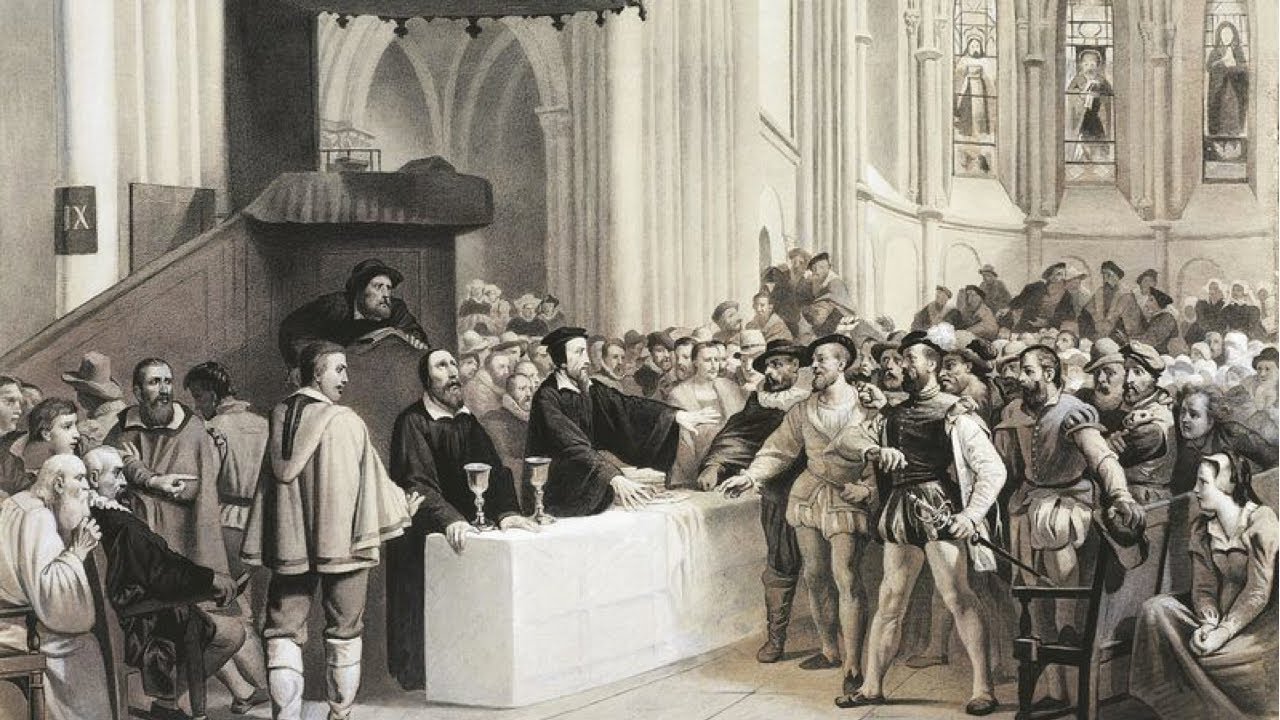
The doctrine of unconditional predestination could not but leave its mark on the Calvinist understanding of the nature of the Church and the sacraments. Calvin himself certainly understood the weaknesses of the situation. After all, if God and His grace are absolutely independent of external forms, and faith is given to a person directly, the question naturally arises – why should a Christian need the Church and its sacraments? Belonging to the church community and participation in the sacraments mean nothing to those who are predestined to perdition. In the same way, belonging to the Church and participation in the sacraments can do nothing for those who are predestined to salvation.
Calvin, who was equally alien to Luther’s sentimentality and Zwingli’s skepticism, emerged from this situation by proposing the author’s concept of the “symbolic” nature of the Church and its sacraments. In this case, the “symbol” should be understood as an earthly form, which, by virtue of God’s blessing, relates to spiritual reality and gives access to it like a key. From Calvin’s point of view, Christians experience God’s “adaptation” to human-like structures. In practice, this meant that, sharing Luther’s idea of an “invisible” church, the Geneva reformer insisted on the importance of preserving the earthly form of the church community: “there are many people who, being scattered all over the world, profess the same faith in God and in Jesus Christ, are baptized as a witness of their faith, and take part in the Lord’s Supper. By declaring their unity in faith and love, they accept the Word of God and, following the commandment of Jesus Christ, keep His preaching.” Following Luther, Calvin noted that the true Church exists “wherever the word of God is preached in purity and where the sacraments are performed according to the ordinance of Christ,” adding, however, that a church community cannot exist without discipline so that a member of the community leads a proper pious lifestyle.
Mainly in the context of church discipline, Calvin understood the nature and purpose of the church’s sacraments, which he gave two definitions: 1. “an external symbol with which the Lord imprints in our minds His gracious promises made to us in order to support the weakness of our faith”; 2. “a visible sign of a sacred object or a visible form of invisible grace.”
The Reformed understanding of Baptism is quite close to the Lutheran one. Calvin understood Baptism as “a sign of initiation through which we are accepted into the community of the Church.” At the same time, the sacrament itself is not capable of bringing salvation. For this, a justifying act of endowing saving faith is necessary: “Baptism has another advantage, because it shows us the death of our being in Christ and our new life in Him… Thus, gratuitous forgiveness of sins and justification are first promised, and then the grace of the Holy Spirit transforms us for a new life.” The Reformed practice baptism by sprinkling or pouring. Infants are allowed to participate in the sacrament.
Almost indistinguishable from the Lutherans in their views on the sacrament of Baptism, the Reformed differ significantly from them in their view of the Eucharist. The Reformed teaching on the Eucharist is based on the theological views of Zwingli and Calvin. Although at first the Zwinglian and Calvinist views on the Eucharist differed, in 1549 the compromise “Zurich Agreement” (Consensus Tigurinus) was signed, in which the Zwinglians, who joined the Calvinists, softened their positions, ceasing to consider the Eucharist just a memory. Calvin’s position on the sacrament of Communion is an integral part of Calvin’s entire theological system and is based on the dogma of Divine predestination.
Calvin taught that the Body and Blood of Christ reside in bread and wine spiritually, and not materially, while the spiritual substance of Christ (Divine grace) is communicated to those who partake of the Holy Mysteries only if they belong to the “elect,” that is, true believers. The rest accept simple bread and wine, which in no way affect their spiritual state. At the same time, Calvin did not recognize the Lutheran dogma that the unworthy receive communion in self-condemnation.
Just like Zwingli, Calvin believed that the human nature of Christ remains in paradise after the Ascension, therefore it cannot be materially present in the sacrament elements, however, according to Calvin, Christ is spiritually present in the Holy Gifts. At the time when a worthy Christian receives bread and wine, through the Holy Spirit, his mysterious union with Christ, who is in heaven, takes place. This is how he describes this process in the “Instructions in the Christian Faith”: “Jesus Christ gives us communion with Himself through His Spirit, which unites us with Him into a single whole in flesh, mind and soul. Therefore, the bond of this community is the Holy Spirit, which binds us together. And He is also a channel or a guide through which everything that Christ is and possesses descends to us.” In other words, according to Calvin, the eating of the Body and Blood is real, there is a real communion of the true essence of the Body and Blood of Christ, but this does not happen under the guise of bread and wine (according to Luther), but through the action of the Holy Spirit on the partaker at the moment of Communion. As an illustration, Calvin cited the example of the Sun, which, remaining in the sky, illuminates and warms the earth with its warmth. Similarly, the radiance of the Holy Spirit brings to us the effect of the Savior’s Body and Blood.
Arguing that Christ comes into us only by the Spirit, Calvin referred to the words of the apostle Paul: “But you do not live according to the flesh, but according to the spirit, if only the Spirit of God lives in you. But if anyone does not have the Spirit of Christ, he is not His. And if Christ is in you, then the body is dead to sin, but the spirit is alive to righteousness. But if the Spirit of Him who raised Jesus from the dead lives in you, then He who raised Christ from the dead will also give life to your mortal bodies through His Spirit who lives in you” (Romans 8:9-11).
Calvinists, as well as Lutherans, deny the sacrificial nature of the Eucharist, considering it only a reminder of Sacrifice. Since bread and wine for Calvinists are not the Body and Blood, but only symbols of Christ, the breaking of bread and the pouring of wine are not the sacrifice of Christ, but only symbols of His suffering. At the same time, Calvinists believe that the sacrament of Communion conveys grace because it is a Meal that has a sacramental connotation. The Eucharist in the Reformed Church has actually ceased to be a sacrament as a means of grace and has turned into a rite of communion, which is seen as a symbolic act of remembering the sacrifice of Christ. Nevertheless, Calvinists call the Eucharist a sacrament and believe that communion gives spiritual unity with Christ.
The teaching of the Reformed contradicts the Tradition of the Ancient Church. To prove this, it is enough to cite the definition of the Eucharist of the First and Seventh Ecumenical Councils. The fathers of the First Ecumenical Council teach: “At the Divine table, we should not just see the bread and cup offered, but, exalting our minds, we should understand by faith that at the sacred table lies the Lamb of God, “take away the sins of the world” (John 1:29), sacrificed by the priests, and, truly accepting the honest His Body and Blood must understand that this is a sign of our resurrection.” The definition of the Seventh Ecumenical Council states: “Neither the Lord, nor the apostles, nor the fathers ever called the bloodless sacrifice offered by the priests an image, but the Body Itself, the Blood Itself. After consecration, they (bread and wine) They are the Body and Blood of Christ, and that’s how they believe.
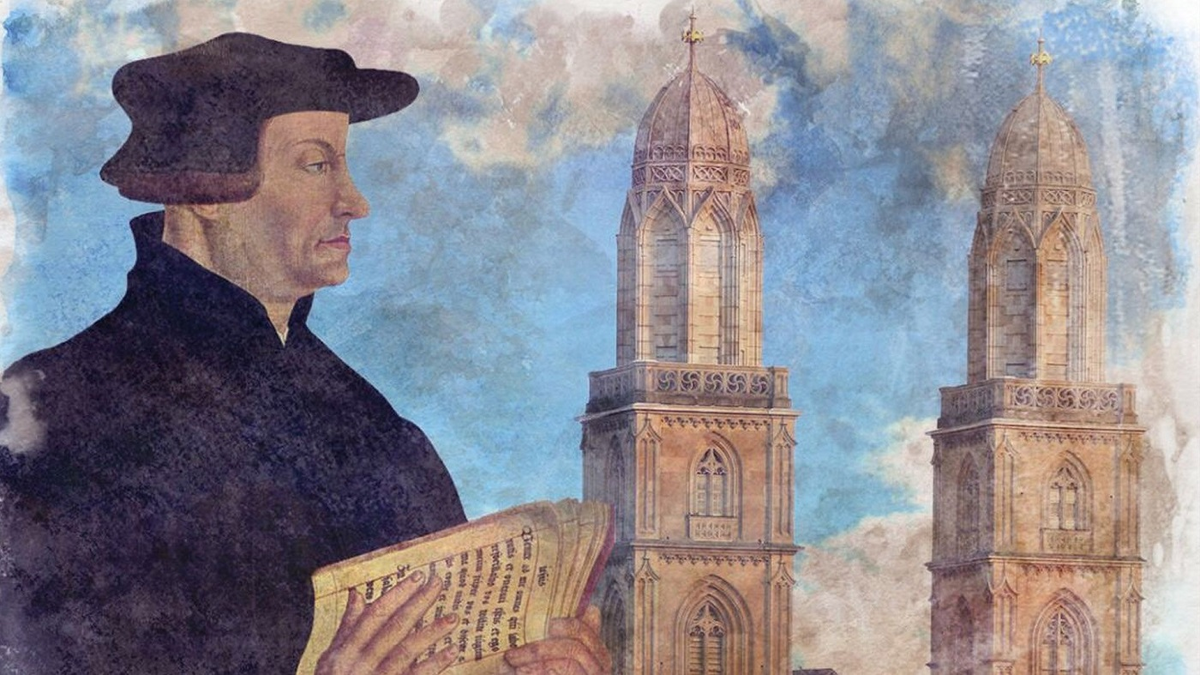
The Reformation developed in Switzerland almost simultaneously with similar processes in Germany. Ulrich Zwingli, the founder of the Swiss branch of the Reformation, was absolutely convinced that it was he (and not Martin Luther) who was the pioneer for the Protestants in Europe. But the issue of primacy turned out to be irrelevant after Zwingli died in a military confrontation with Roman Catholics. The leadership of the Swiss reformers went to Zwingli’s successor, Heinrich Bullinger, the leader of the Bernese Reformation, and then migrated to the more active French and, consequently, predominantly French- speaking theologian Jean Calvin. As a result, the initially German-oriented Reformation in Switzerland took on a different national and cultural form, the French one. Although later the Reformation turned into a supranational denomination, spreading all over the world.
Ulrich Zwingli (1484-1531), was born a few weeks after Luther. He received his primary education at schools in Basel and Bern, higher education at the Universities of Vienna and Basel, and then entered priesthood. Zwingli showed great interest in Renaissance humanism, corresponded with Erasmus of Rotterdam, and soon became convinced of the need to reform the Roman Catholic Church.
After receiving a bachelor’s degree in 1504 and a master’s degree in philosophy in 1506, he became a parish priest in Glarus and in his first sermons began to denounce the “wrong life” of the Roman Catholic clergy. Here he also proved himself to be a fierce opponent of the practice of military mercenary, which he considered “shameful human trafficking.” Zwingli himself twice had to perform the duties of a chaplain, accompanying detachments of Swiss mercenaries, and judged the situation from the inside. Zwingli’s protest led to a change in his ministry. In 1516, the future reformer found himself in a convent in Einsiedeln. Here he began to criticize the practice of pilgrimage, as well as the veneration of the local shrine – the statue of the Mother of God. Which led to another transfer. In 1518, Zwingli found himself in Zurich, where he began to serve in the cathedral under the direct supervision of the church authorities. But even here, the future reformer could not find peace.
Zwingli preached diligently, denouncing the morals of his contemporaries on the basis of Holy Scripture and arguing that the Bible is the only source for faith, and man is justified only by faith. On the basis of this thesis, Zwingli criticized Samson, the Dominican seller of indulgences, in 1519. The reformer’s activities aroused the sympathy of the secular authorities. In 1520, the Zurich City Council issued a decree ordering all local priests to explain the New Testament to parishioners. Strict conformity of interpretation with the text of Scripture was an indispensable condition.
Zwingli’s influence in the city grew. In 1521, and due to the influence of the reformer, the city council finally banned mercenary activities. During the same period, the reformer sharply opposed the trade in indulgences, and in 1522, against church posts. The clergy of the cathedral wrote a denunciation against Zwingli to the Archbishop of the German city of Constance, in whose jurisdiction Zurich was located. In turn, the reformer sent a message to the same archbishop, in which he spoke out against the celibacy of the clergy. This did not help and led to serious proceedings.
On January 29th, 1523, at the initiative of the Zurich authorities, a public dispute took place between Zwingli and the archbishop’s envoys. The winner remained in the city, the loser had to leave, renouncing any claims to ecclesiastical influence in Zurich. The dispute concerned the issues outlined in Zwingli’s previously published 67 theses: about the Holy Scriptures as the highest authority in religious matters, about Christ as the only true mediator between God and people, about faith as the only means of salvation, about the church as a union of all believers. Of course, in the behavior of the city council, one could see the same motives that guided Frederick the Wise in helping Luther. Namely, it was about gaining independence from both the pope and the Catholic Empire.
Zwingli won the debate. The Zurich City Council accepted the teachings of the reformer and began to manage church affairs independently. However, the Roman Catholic church was not going to give up easily. In October 1523, Zwingli’s second public dispute with Catholic opponents took place. This time, he touched on the topic of church authorities, the veneration of saints and shrines, as well as the existence of purgatory and the nature of the Mass. In January 1524, the third debate on monasticism took place. Zwingli was recognized as the winner in public disputes, which led, in particular, to the closure of monasteries and the secularization of their property. In early 1524, the city council decided to remove icons from churches, and use jewelry donated by believers to decorate shrines for charitable purposes.
Worship in Zurich had undergone significant changes. Instead of the Catholic Mass, special Zwinglian services began. Zwingli replaced Latin with German; communion was given under both forms; the organ and other musical instruments were banned (Zwingli himself publicly smashed his lute); monasteries were converted into schools, orphanages and hospitals, monastery property was secularized; celibacy of the clergy was abolished. In 1522, Zwingli himself secretly married Anna Reinhardt, the marriage remained secret until 1524.
In 1525, the reformer published his confession of faith, called “De vera et falsa religione” (“On the true and false Faith”), which is similar in most points to Luther’s teaching, with the exception of the question of communion, which led to the following definition: “The term “Zwinglianism” is used mainly to refer to the fact that Zwingli is convinced that Christ is not present in the Eucharist, which is considered only a memory of His death.” Zwingli insisted on an allegorical understanding of the words about eating Flesh and drinking Blood. In his treatise “An Account of Faith,” he wrote: “I believe that in the Holy Eucharist… the true Body of Christ is represented through the contemplation of faith…” In this regard, Luther tended more towards philosophical and theological “realism”, insisting on the reality of the existence of the heavenly Body and Blood of Christ, which are in temporary union with earthly bread and wine. Zwingli, on the other hand, was rather a Eucharistic nominalist who interpreted literally the Saviour’s covenant: “Do these things in remembrance of me” (Luke 22:19). Wishing to help the reformers overcome the Eucharistic differences, the political leader of the German Protestants, Philip of Hesse, arranged a meeting between Luther and Zwingli in Marburg in 1529. The theologians managed to reach agreement on all issues except the Eucharist. Luther refused to shake Zwingli’s hand at parting. Thus, in Marburg, the paths of the German and Swiss branches of the European Reformation decisively but not completely diverged.
But it would be wrong to see only the Eucharist as the reason for Luther’s and Zwingli’s disagreement. As noted above, they also understood the mechanism of soteriological justification “by faith alone” in different ways. At the time of the Marburg dispute, this was not yet so obvious, although even then Zwingli (albeit not as explicitly as Calvin later) preached the radical Augustinian doctrine of predestination: some people to salvation, and others to destruction. Subsequently, the issue of justification will receive no less weight in the discussions of Lutherans and Swiss Reformers than the Eucharist. In addition, Luther was less agressive in reforming church life, preserving what did not contradict Scripture. Zwingli turned out to be a tougher reformer, demanding the elimination of everything that did not find direct confirmation in Scripture.
Both reformers were influenced by secular authorities and were guided by the state system that favored them. Luther thus gravitated towards the feudal structure, which is why the episcopal ministry remained in the German- Scandinavian Reformation. Zwingli, on the other hand, leaned toward the Republican model, introducing the principles of collective management like a consistory into the church assembly.
Zwingli’s teachings from Zurich spread to Bern, Basel, Schaffhausen, St. Gallen, Glarus, and many free imperial cities in Germany. But the so—called “forest cantons” of Switzerland - Schwyz, Uri, Unterwalden, Lucerne — remained loyal to the Roman Catholic Church. Finally, a war broke out between Protestants and Catholics, as a result of Zwingli actions, he demanded a block on the supply of bread to Catholic cantons. On October 11, 1531, a battle took place between Protestants and Catholics on the Kappel plain. The supporters of the Reformation were routed, and Zwingli, who was fighting with weapons in his hands, was killed. Thus ended the life of the first Swiss reformer.
Ulrich Zwingli certainly played a major role in shaping the ideas of the early Reformation and spreading its influence. But he never had the same impact as Luther or Calvin, because he lacked the literary fecundity of the former and the systematic approach of the latter.
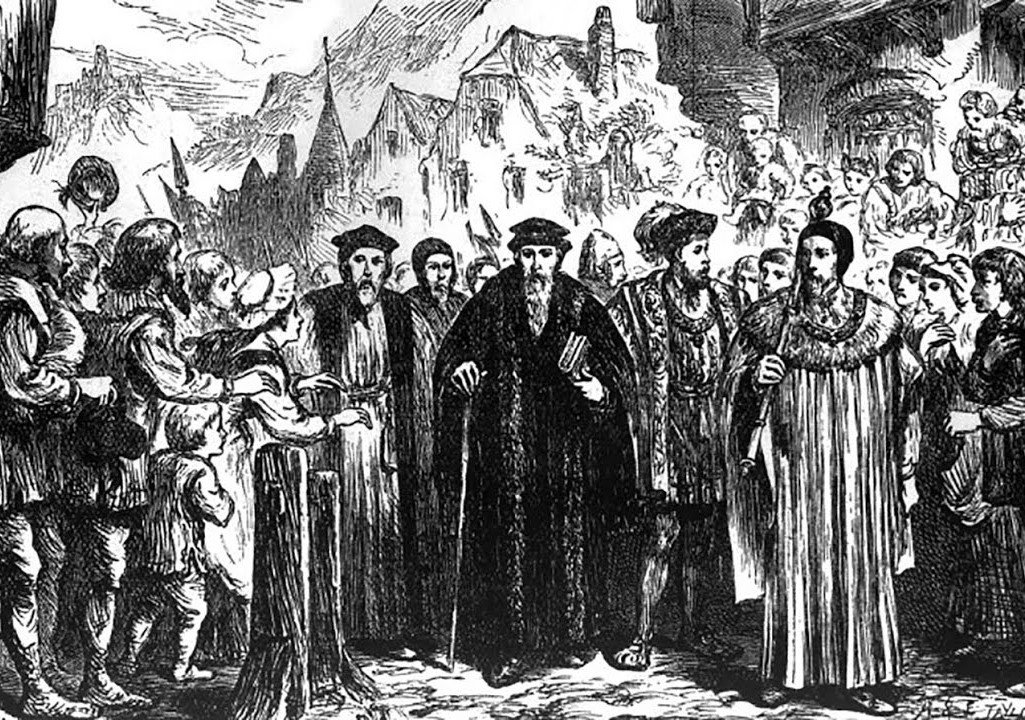
Preaching the idea of “sola fide” and pointing out that justifying faith is a gift from God, Luther and his supporters did not dare to draw conclusions that logically followed from these postulates. Reformed theology, represented by Calvin, dared to draw definitive conclusions from the conviction that a person who, as a result of original sin, had lost not only the desire, but also the opportunity to do true good, did not participate at all in the cause of his own salvation. And the initiative in this regard belongs exclusively to God, the possessor of absolute sovereignty.
Calvin, a more practical man than Luther and Zwingli, wondered why some people believe and are saved, while others refuse to believe and, consequently, go to hell. The Geneva reformer, refusing to recognize the existence of any kind of moral freedom in man, argued that “salvation is given to some by God’s will, while it is denied to others.” In this respect, Calvin differed from Zwingli, who believed that the topic of predestination should be addressed as rarely as possible and not discussed in detail. The Geneva reformer, striving to present all aspects of the Protestant faith as accurately as possible in his “Instructions”, decided to highlight the issue of predestination as clearly as it seemed to him. As a result, Calvin drew the following conclusion, combining Divine foreknowledge and predestination: God knows everything as He decrees it to be, therefore predestination and foreknowledge are broadly identical, and there is no foreknowledge in which God would know something that does not depend on Him, since everything depends on Him.
Calvin’s theological views did not arise out of thin air and fully fit the predestination relation into the logic of the “schola Augustiniana Moderna”, a theological and philosophical trend that gave a peculiar interpretation to the legacy of the St. Augustine. It is worth noting that Augustine, although he emphasizes the impotence and depravity of man, which is the reason for the decisive role of God’s grace in the matter of salvation, nevertheless points out that predestination (in the sense of selectivity of the gift of grace) concerns only the field of salvation. As for those who fall under Divine condemnation, Augustine asserts that the Lord does not destroy these people, but only passes them by. According to Augustine, predestination refers only to the Divine decision of redemption, and not to leaving the rest of fallen humanity without salvation.
Calvin could not accept this logic. He insisted on God’s extremely active position: to save or condemn. Therefore, from his point of view, God actively desires the salvation of those who will be saved and curses those who will not be saved. Predestination, according to the reformer, is “the eternal command of God, by which He determines what He desires for each individual person. He does not create equal conditions for everyone, but prepares eternal life for some and eternal damnation for others.” This is how the Calvinist doctrine of unconditional predestination arose. The word “unconditional” in this case indicates that God saves or does not save a person based on his own understanding and without focusing on any conditions, including the will of the person himself. It may seem strange, but Calvin was trying to demonstrate in this way how the grace of God manifests itself - the desire to redeem individuals, regardless of their merits.
In support of his doctrine of predestination, Calvin refers to the following words of the Apostle Paul: “When they (Esau and Jacob) had not yet been born and had done nothing good or evil (so that God’s permission in election might come not from works, but from the Caller), it was said… The greater will be enslaved by the lesser… I loved Jacob, but I hated Esau”… (Rom. 9:11-13). At the same time, the reformer ignored other Scriptures that testify to the conditionality of predestination. Based on the concept of unconditional predestination, Calvinists subsequently rejected the universality of the sacrifice of the cross and the gospel message. After all, according to their logic, the Lord suffered death on the cross not for everyone, but only for those whom He Himself chose to eternal life. This provision destroys the basic dogma of Christianity – the belief in the atonement of all, accomplished by the God-Man, and directly contradicts the words of the Apostle Paul. According to St. Paul, “The grace of God appeared, saving all men” (Titus 2:11).
Although the doctrine of predestination was not central to Calvin’s theology, it became the core of late Reformed theology through the influence of authors such as Peter Martin Vermigli and Theodor Beza. Starting in 1570, the theme of “chosenness” began to dominate Reformed theology and made it possible to identify Reformed communities with the people of Israel. Just as God once chose Israel, now He has chosen the Reformed communities to be His people.
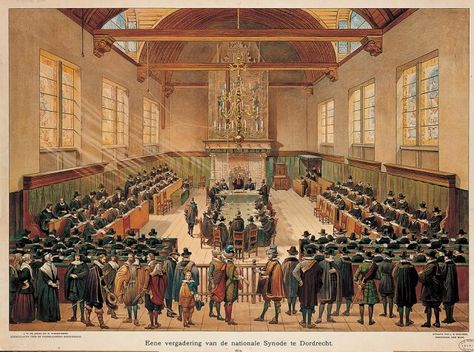
Later, the doctrine of predestination would become the subject of a dispute between “strict” reformers and “Arminians,” leading to the convening of the Synod of Dort (1618-1619), whose decisions on predestination would become an expression of Reformed “orthodoxy” on the subject. The Synod declared that: 1. Man is infinitely sinful and cannot save himself; 2. God chooses man not for any merit, but according to His sovereign will, and chooses those whom He wants; 3. Christ died for specific chosen people, and not for all mankind; 4. Man is unable to resist the action of Divine grace; 5. Once called (“saints”), they can no longer fall away from the Lord.
The decisions of the Synod of Dort were subsequently consolidated in the “Westminster Declaration” (an important symbolic text of the English-speaking Reformers). In particular, it is stated that: “A person cannot change by any actions, deeds or thoughts what is destined for him or deserve salvation. The chosen ones are redeemed By Jesus Christ, they are called, justified, adopted, and sanctified.” This feeling of “being chosen by God” has played a very special role in the history of Reformation: “The international Reformed social worldview is based on the concept of being chosen by God and the “covenant of grace,” a tangible sign of which is earthly prosperity, the conviction that “the Lord blesses those chosen for heavenly salvation with prosperity in their earthly lives,” which (well-being.– A.B.) was perceived not as a personal asset of a person, but as a gift from above, as a sign of God’s favor to man.”
The views of Calvin and his followers encroach on the very foundations of the Christian universe, on the image of God and the vocation of man in the world, therefore the Eastern Church considered it necessary to make its judgment on them. At the Jerusalem Council of 1672, the Reformed doctrine of predestination was condemned by the Orthodox hierarchs, and its preachers were called “the worst even of the infidels.” “The Epistle of the Eastern Patriarchs on the Orthodox Faith” from 1723. It also speaks directly against predestination.: “but what blasphemous heretics say, that God predestines or condemns, regardless of the deeds of those who are predestined or condemned, we regard as madness and impiety; for in such a case the Scriptures would contradict themselves. It teaches that a believer is saved by faith and his works, and at the same time represents God as the sole author of our salvation, because… He… He gives enlightening grace… without destroying a person’s free will.”
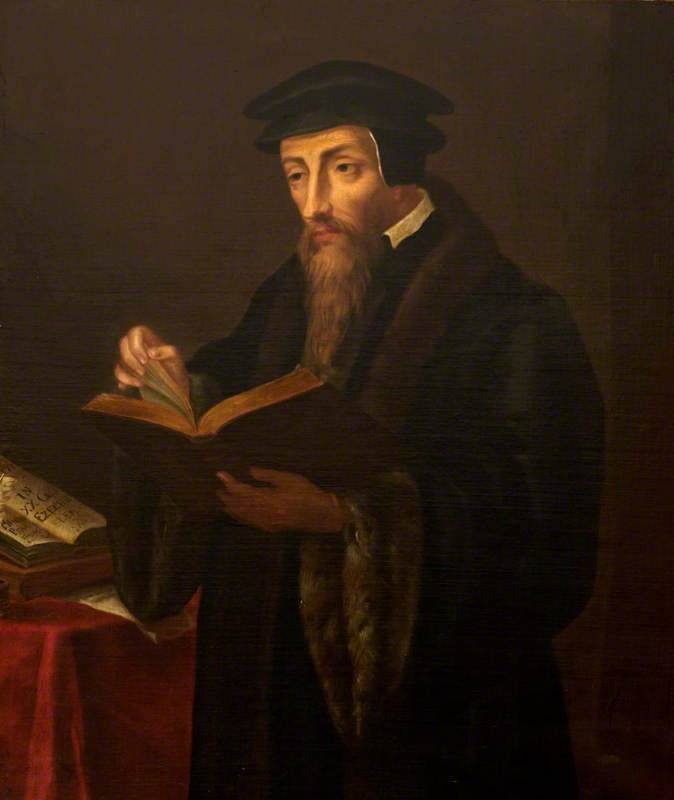
Jean Calvin (originally - Cauvin) (1509-1564) became (in many ways unexpectedly, even for himself) the successor of U. Zwingli in terms of leadership of the Reformation in Switzerland. In addition, it was Calvin who proved to be the main systematizer of Protestant theology in the sixteenth century, having influenced other Christian traditions.
Calvin was born in Noyon, northern France, into the family of a local bishop’s secretary. Thanks to his father’s position, the future reformer not only had the opportunity to study philosophy and theology at the University of Paris, but also served as a cleric of the Roman Catholic Church from the age of 12, receiving a salary from church donations. During his studies in Paris, Calvin changed his French surname Cauvin to the Latin Calvinus, which later formed the new French surname Calvin.
In 1528, Calvin became a master of theology, and in the same year his father came into conflict with his church superiors, which, in turn, led to a change in the trajectory of the future reformer’s studies. Instead of theology, he now had to study law. To do this, he first went to Orleans, then to Bourges. Then Calvin got acquainted with the humanistic environment and even wanted to become a humanist scientist, but abandoned these plans, becoming interested in Protestant theology. It is difficult to say exactly when Calvin finally left the Roman Catholic Church and joined the camp of supporters of the Reformation. This most likely happened by 1533 and remained a mystery to others until then. However, in October 1533, Calvin, who at that time held the position of secretary to the rector of the University of Paris, found himself at the center of a scandal. The reformer wrote a speech for his boss, which dealt with church reform. The performance caused outrage among conservative- minded listeners. First of all, the Franciscan monks. Calvin was forced to flee Paris. In 1534 he appeared in his native Noyon in order to give up the church posts that his father had arranged for him, although they were Calvin’s main source of income.
Fleeing from the persecution that the French Catholic authorities began against Protestants, the reformer went to Basel, Switzerland, where his main work, “Instructions in the Christian Religion,” was published in 1536. Written in Latin, the “Instructions” acquired the status of a bestseller – the circulation sold out in nine months. This circumstance played a huge role in the future fate of the reformer.
The “Instructions” were read by the leader of the Geneva Reformation, Guillaume Farel, and when he learned that the author of the book was in his city, he did everything he could to keep Calvin in Geneva, who arrived for only one night, on his way to Strasbourg. Calvin was initially Farel’s assistant, but went on to became the de facto leader of the local Protestant community. In 1537, Calvin proposed to the city council five principles for further reform. In addition, all residents of the city had to swear allegiance to the “Geneva Confession of Faith”, consisting of 21 articles. Very soon, the citizens of Geneva began to express dissatisfaction with Calvin’s authoritarian style. The party of opponents of his reforms gained great influence in the city, which led to the expulsion of Calvin and Farel from Geneva in 1538. Calvin first returned to Basel, and then went to Strasbourg, where he led the French-speaking community. In 1540, the reformer married the widow Idelette de Boer, adopting her children from her first marriage. He never had any children of his own.
By 1541, the situation in Geneva had changed yet again, which allowed Calvin to return – in fact, as head of the city (although the powers of the city council were not abolished). Immediately after his return, Calvin wrote his work “Ecclesiastical Ordinances,” in which he expounded his views on the church structure. The “Ordinances” contain the doctrine of “the four church ministries that the Lord has established for the management of His Church”: pastors (pasteurs), teachers (docteurs), elders (they are presbyters) (anciens), deacons (deacres). Calvin considered himself a teacher, but this was, of course, a formality. It is not for nothing that over time the reformer began to be called the “Geneva pope.” Calvin’s writings, along with the “Instructions in the Christian Religion,” contain other symbolic texts of the Reformation: “The First Catechism” (1536), “The Geneva Catechism” (1545)
The mainstay of Calvin’s regime were the elders, who were supposed to “monitor the life of every person” and admonish anyone who in any way sinned against the faith or led a “disorderly life.” For daily monitoring of the faith and life of the townspeople, as well as for reviewing any reports of violations by the elders, a special body was formed - the Consistory, that is, a commission of pastors and elders, which was to meet once a week, on Thursdays. Conflicts arose more than once between the consistory and the city council, as Calvin and his supporters tried to completely control the lives of citizens by establishing something like a theocracy in Geneva. In 1553, the opposition came to power in the city council, whose resistance Calvin suppressed thanks to the tribunal of Miguel Servetus– a doctor and theologian. Servetus had previously been persecuted by the Catholic Inquisition. Calvin also accused him of heresy, compiling a list of 38 indictments. The reformer’s opponents sided with Servetus, pointing out that the enemy of the Inquisition is by default a friend of the Reformation. The city Council sought advice from other Protestant cantons in Switzerland, and they all agreed that Servetus was a heretic not only by Catholic standards, but also by Protestant standards. The doctor was executed, and Calvin’s authority in Geneva became indisputable, which allowed him to carry out his main project in 1559 – to open the Geneva Academy, where young people from all over Europe studied Calvinist theology. The training consisted of two stages: “schola privata” and “schola publica”. Calvin held the position of “lecturer on Sacred Scripture” at the academy. The academy quickly gained European fame – at the time of the reformer’s death in 1564, about 1.5 thousand students had studied here.
Starting in 1555, the Swiss Reformation embarked on the path of expansion – Calvinist pastors were sent to preach in France. First in Poitiers, then in Orleans, La Rochelle and Nimes, Calvinist communities were established, called “Huguenots” (from French. huguenot – “brother, comrade”). In 1559, the first Huguenot Synod of France was held, at which the “Gallican Confession” was adopted - the religious symbol of the French Reformed Church. By 1560, approximately 10% of the French population belonged to the Reformed (slightly less than 2 million people). The growing number of Calvin’s followers led to the outbreak of the civil war, the tragic episode which was the so-called “St. Bartholomew’s Night” (1572). Subsequently, the Huguenots managed to achieve some relief thanks to the Edict of Nantes (1598), which was repealed in 1685, when the persecution of Catholics intensified again.
In Scotland, Calvinists, known as “Presbyterians,” began to spread in the middle of the 16th century and had a close connection with the political opposition of the Stuart dynasty. John Knox became the leader of the Presbyterians. During the reign of James I (1603-1625), a significant part of the Scots migrated to Ireland, primarily to Ulster, where they founded in 1642. The Presbyterian Church in Ireland.
Presbyterianism entered England at the end of the reign of Elizabeth I (1558-1603). The so-called “Long Parliament” in 1647 approved the Presbyterian Church as the official church in England, and the Westminster Assembly (1643-1647) adopted the fundamental documents of Presbyterian doctrine and system of worship. In particular, the Westminster Confession. After the restoration of the monarchy in 1660, Anglicanism regained the status of a state religion. Nevertheless, the Presbyterian Church in England has been preserved. The Evangelical Presbyterian Church of England and Wales and the United Reformed Church currently operate in England and Wales.
The English Puritans (Latin purus – “pure”) were quite close to the Calvinist doctrine. The Puritans sought a complete “cleansing” of the Church of England from Papist elements – first of all, as the Puritans believed, from the episcopal ministry. Some Puritans joined the Presbyterians of Scotland and Ireland, while others went their own way, becoming so–called Congregationalists or otherwise independents. They rejected and proclaimed the complete independence of individual communities (congregations) not only in matters of governance, but also in matters of faith. The movement remained illegal in their homeland for a long time, so independents joined the ranks of emigrants: in 1608, a group of believers migrated from England to Holland, and then to North America. The Independents (Pilgrim Fathers) who migrated to the New World became the founders of the Plymouth Colony (now the state of Massachusetts), one of the oldest English settlements in North America along with the Virginia Colony.
In the second half of the 16th century, Calvinists penetrated into Lutheran territories, in particular, into the Electorate of the Palatinate. The local ruler Frederick III “The Pious” (1515-1576) sided with the Calvinist Reformers. By order of Frederick, Calvinist theologians Kaspar Olevian and Zachariah Ursin in 1563 compiled a catechism, which was named “Heidelberg” and became the symbolic text of the German Reformers, who, before the conclusion of the Peace Treaty of Westphalia (1648), were located in the territory of the German Empire outside the law. The legalization of German Calvinism occurred only after the end of the Thirty Years’ War.
The development of Calvinism in the Netherlands turned out to be associated with the so-called “Arminianism”, a trend named after the Dutch theologian Jacob Arminius (1560-1609), who tried to soften the doctrine of soteriological predestination. Arminius argued that predestination is based on Divine foreknowledge of those people who will later believe in Jesus Christ. In other words, God established that all who subsequently believe will receive salvation, a point of view that later became known as “open predestination.” The official doctrine of Calvinism assumed that faith itself is the result of predestination, that from the beginning of creation, God, by His sovereign will, determined who would believe and who would not. To refute Arminius’ views, the so-called “Dorth (Dortrecht) Synod” (1618-1619) was convened, whose decisions definitively defined the Calvinist doctrine of predestination.
Currently, the followers of the Geneva Reformation are divided into three types, depending on the liturgical and administrative structure of their churches: Reformed (direct heirs of the Swiss Reformation), Presbyterians (followers of the Scottish tradition dating back to John Knox), Congregationalists (related to the Puritan branch). In addition, there are also reformed Anglicans and Reformed Baptists, denominational movements at the junction of Reformed Christianity and Anglicanism or Baptism, respectively.
At the international level, Calvinist communities seek to unite, first of all, the World Communion of Reformed Churches (WCRC). The community includes 233 participating churches from 110 countries. The WCRC unites more than 100 million people. The organization was founded in June 2010 through the merger of the Reformed World Council and the World Alliance of Reformed Churches. The latter was in dialogue with the Orthodox Church until 2008, when the dialogue was unilaterally interrupted by the Calvinists. Without explanation. In addition to the WCRC, there are also two other, less significant international Calvinist organizations: the World Reformed Fellowship (formed in 2000) and the International Conference of Reformed Churches (formed in 1981).
The face of modern Reformed theology is undoubtedly Karl Barth (1886-1968), a Swiss Reformed theologian and one of the most famous Christian thinkers of the 20th century. Barthes’ theology found its full expression in his thirteen- volume “Church Dogmatics” (Kirchliche Dogmatik). Here he chronologically examines the entire Christian teaching, interpreting it in such a way that each part of it represents a radical challenge to Jesus Christ and the impossibility of connecting God with human culture and its achievements. Barth was at the origin of the creation of the World Council of Churches, participated as an observer in the work of the Second Vatican Council.
It is not possible to determine the exact time of the appearance of the first Calvinist in Russia, but most likely it happened in the XVI century, when the first Reformed communities appeared: in Moscow, Arkhangelsk, Vologda and other settlements along the trade routes. In 1616, under Tsar Mikhail Fedorovich, the first Reformed Church appeared in Moscow, founded jointly by the British and the Dutch. Before the revolution, there was one Calvinist per 1,000 inhabitants of Russia. After the revolution, the Reformed churches in central Russia completely disappeared, remaining only in the Baltic States and Western Ukraine. A weak revival of the Reformed tradition began to occur after the collapse of the USSR, either by individual domestic enthusiasts or through the efforts of visiting preachers, but no serious success was achieved. The Union of Evangelical Reformed Churches of Russia has been operating in Russia since 1991, and the Evangelical Reformed Church of Russia since 2007.
It was noted above that the pioneers of the German and Swiss branches of the Reformation, M. Luther and U. Zwingli, could not find unity in understanding the Eucharistic transfiguration. In reality, this insurmountable contradiction concerning the reality of the presence of the Body and Blood of Christ in the liturgical bread and wine had deeper roots and served as a cultic expression of the difference in understanding of the relationship between God and man, as well as the nature of Divine grace. Both branches of the Reformation agreed that a Christian is justified “by faith alone” (sola fide), but while Luther and Melanchthon, as we found out earlier, nevertheless reserved some soteriological significance for deeds, implying human participation in the cause of salvation. Then Zwingli and Calvin took a different, more radical path, defending the idea of absolute Divine sovereignty.
Zwingli’s concept of the perfect independence of God (German: Souveränität Gottes) is set forth in his work “On Predestination” (De providentia), which is specifically devoted to this topic. Here, the reformer defends the unlimited omnipotence of God, pointing out that “Divine providence directs everything and arranges everything so that nothing happens without His will and command.” In the spirit of medieval realism, Zwingli believed that there was an insurmountable gap between the Deity and man. Therefore, God cannot be persuaded to make any decision. Even during Zwingli’s lifetime, some of his commentators pointed out that the reformer’s reasoning partly resembles ancient fatalism. It must be said that the Zurich theologian really loved the works of Seneca, however, with regard to Divine sovereignty and the concept of predestination related to this topic, he thinks quite like Augustine. Namely, Zwingli believed that the omnipotence of Divine mercy is manifested, first of all, in the salvation of sinners through their justification through the gift of faith. In the writings of Zwingli, we will not find the doctrine of predestination to perdition, which is found in Calvin, but was nevertheless developed by his followers, first of all, the first rector of the Geneva Academy, Theodore Beza.
For J. Calvin, the doctrine of God did not seem to be some kind of theological abstraction, but served as the ideological basis of his church reform. It was important for Calvin to describe the Creator as “the eternal Ruler and Guardian, who not only sets in motion the mechanism of the universe and all its parts, but also supports, nourishes and protects every creation” through the church structure He established on earth. Calvin considered Luther’s interest in personal experience to be too subjective and too focused on the individual. The legally minded mind of the Geneva reformer wanted to establish objective criteria on the basis of which society and the church could be reformed. And any significant changes were possible only if the church community was independent of the secular government, an independence based on Divine sovereignty. Calvin was motivated by the conviction that the will of God has already been manifested in eternity, but for it (will) to be known, it is necessary to create conditions in time. Thus, the Geneva theologian argued that Christ “alone must rule and guide the Church, ruling it undividedly and exercising rule and authority by His Word.” However, Christ is not visibly present in the church community; He “uses people whom He puts as His representatives.” Thus, the absolute Divine independence proclaimed in theory was subordinated in practice in the Church of Geneva to the will of Calvin and his consistory.
This step was necessary for the reformer both in order to establish administrative and moral control over the urban community, and in order to avoid accusations that the reformers preach and represent some kind of whimsical and capricious deity. Calvin describes the absolute sovereignty of God in two ways. On the one hand, he emphasizes that God is in no sense subject to the law, because that would put the law above God. However, “His will is the foundation of existing concepts of morality,” which (Christian morality) is represented in the Word of God and interpreted, as Calvin claims, by the church community in accordance with the Word. “Calvin was motivated by the desire to restore the true greatness of God, which Catholicism belittled by human reliance on the price of human good deeds,” but in fact we are dealing with the Reformed equivalent of the Catholic magisterium as a perverse attempt to dispose of the authority of the Deity for their own purposes.
Related Concepts
- augustine
- church-order
- communion
- consistory
- discipline
- election
- four-ministries
- geneva
- heaven
- holy-spirit
- initiation
- jerusalem-council
- lutheranism
- means-of-grace
- memorialism
- old-catholic-catechism
- real-presence
- reprobation
- social-worldview
- theocracy
- titus-211
- universal-grace
- universal-salvation
- works