Comparative Theology — Topic 10. The Reformation in Germany.
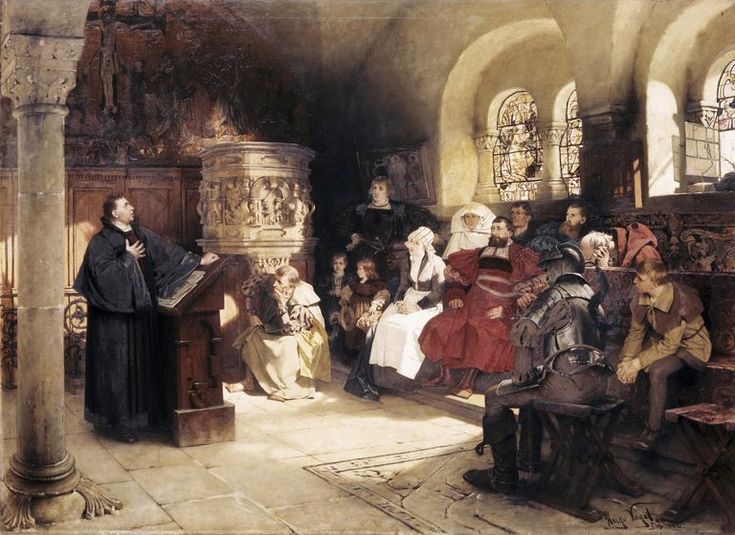
The further development of Lutheranism cannot be put into any one narrative track: theological, political, national and cultural. Therefore, we will need to consider these topics from different angles.
After Luther’s death, his closest friend and the author of several symbolic books of the Lutheran denomination, Philip Melanchthon, began to claim the place of the ideological leader of the movement. His systematic exposition of the doctrine of the German Reformation, known by the abbreviated name “Loci communes”, became the main manual for the study of Lutheran theology in the second half of the 16th century. But the Lutheran community was far from exclusively composed of “Philippists.” There were those who believed that Melanchthon had distorted the views of the late Luther. These Lutherans were called “solid” or “hard”. The brewing conflict between the “Philipists” and the “hard Lutherans” broke out in full force after the adoption of the “Augsburg Interim” by the Empire in 1548, a temporary compromise agreement between Roman Catholics and Lutherans. Melanchthon and his supporters did not abruptly reject this initiative, but offered it an alternative – the so-called “Leipzig interim”, which also had a compromise nature.
The “firm Lutherans”, led by Mathias Flacius, accused the “Philippists” of betraying the faith. Lutherans have been caught up in internal controversy over the purity of their faith. Melanchthon himself did not live to see the end of the controversy; he died in 1560. It was only 17 years after his death that Lutheran theologians drew up the so–called “Formula of Consent” (it was finally approved in 1580), which completed the process of forming the corpus of symbolic books of Lutheranism - the “Book of Consent”, which consists of: three symbols of faith (“Athanasius”, “Apostolic” and “Niceo- Constantinople”)., works by F. Melanchthon (“The Augsburg Confession”, “The Apology of the Augsburg Confession”, “On the Authority and Primacy of the Pope”) and M. Luther (“The Schmalkalden Articles”, “Small Catechism” and “Large Catechism”).
The “Formula of Consent”, on the one hand, put an end to disputes within the Lutheran milieu (between supporters of Philip Melanchthon and the so–called “hard” Lutherans), on the other hand, it drew a clear line between Lutheranism and Calvinism. The further development of Lutheran theology took place under the sign of the development of the so-called Lutheran scholasticism. Its representatives wrote extensive systematic works comparable to the medieval “Sums of theologies.” For example, Johann Gerhardt’s work consisted of 9 volumes, which turned into 23 volumes in the second edition. In 1655-1677. Abraham Kalov published a work on systematic theology in 12 volumes. The second distinctive feature of Protestant scholasticism, which brought it closer to medieval Roman Catholic theology, was the use of Aristotle’s philosophy. The reaction to such a theologization of Lutheran theology was the so-called “Pietistic” (from Latin. pietas – “piety”) movement.
The originator of this trend was Jacob Spener (1635-1705), who, starting in 1670, began to hold “instructive meetings” (collegiae pietatis) at his home in Frankfurt. Spener believed that the spiritual life could not be limited to the study of dogma, as the scholastic pastors assumed. The Pietists, without rejecting the concept of sola fide, attached special importance to personal piety. Spener and his followers preached “self-discipline, which includes withdrawal from cards, dancing and theater, moderation in food, drink and clothing.” Subsequently, the fundamental principles of pietism were developed: Bible study; concentration on personal relationships with God; preaching the idea of the spiritual priesthood of all believers; the need for good deeds, charitable activities; active missionary activity. Along with Spener, August Hermann Franke (1663-1727), Christian Thomasius (1655-1728), and Gerhard Terstegen (1697-1769) became prominent representatives of Pietism. In 1694, the Pietists established their own university in Halle. Thus, the XVIII century. For Lutheran theology, it was marked by a confrontation between Scholastics and Pietists. By the 19th century, the relevance of the controversy had faded, partly due to the rise of rationalist and liberal movements, partly due to the degeneration of scholasticism and pietism themselves.
In 1527, Lutheranism gained a Scandinavian origin. The Swedish King Gustav Vasa initiated the Lutheran Reformation in what is now Sweden and Finland. In 1536, Lutheranism became the state religion of Denmark, which at that time included Norway and Iceland. In 1561, Lutheranism gained a foothold in the Baltic States when the last Landmaster of the Teutonic Order in Livonia, Gotthard Kettler, renounced Catholicism and founded the Duchy of Courland. In the same year, Swedish Lutheranism took root in Estonia. A distinctive feature of Scandinavian Lutheranism was that the local bishops, like the Anglican bishops, insisted and continue to insist on preserving apostolic succession. Even despite (if we talk about the current state of affairs) outright violations of evangelical morality and morality in general. In the German version of Lutheranism, ordination has actually lost the status of a sacrament, becoming a rite of delegation by the community to its representative (a person with proper educational competencies) the right to preach and perform the remaining two sacraments – baptism and the Eucharist.
But let’s return to the homeland of Lutheranism. The Augsburg Peace Treaty of 1555, which put an end to the religious and political conflict in Germany between Roman Catholics and Protestants, could not last forever. Catholics perceived the provisions of the treaty as an annoying concession to heretics and were preparing for revenge. Protestants, on the other hand, did not accept this peace, since it did not concern all followers of the Reformation, but only Lutherans. Calvinists, for example, who lived in large numbers in Germany, remained outlawed for a long time. Secondly, according to the text of the treaty, freedom of religious choice was granted only to the feudal lords, to whom the subjects had to adapt (“Whose power is what faith is” - “Cuis regio, eius religio”).
The first alarm bell sounded in 1606, when a conflict broke out in Donauwerth at Easter between Protestant townspeople and monks, residents of the local Roman Catholic monastery. Roman Catholic troops from neighboring Bavaria arrived to protect the monks, as a result of which the supporters of the Reformation began to be forcibly baptized. The Protestant princes reacted to this event by uniting in a military-political alliance. The following year, a Roman Catholic League (union) was established in the empire, which included Roman Catholic princes. For the next ten years, the conflict smoldered, but did not flare up. Until, finally, in 1618. The so-called “Prague defenestration” did not take place, when members of the Czech parliament threw the ambassadors of the German emperor out of the window of the meeting room. So they protested against the infringement of Czech autonomy.
This event marked the beginning of the Thirty Years’ War (1618-1648), the last major European military conflict between Catholics and Protestants. The Thirty Years’ War had four periods, named according to who was at war with the German Empire: 1. “Czech” (1618-1624); 2. “Danish” (1625-1629); 3. “Swedish” (1630-1635); 4. “Franco-Swedish” (1635-1648). The Thirty Years’ War remained one of the most severe European conflicts before the World Wars of the XX century. The total losses, according to various estimates, ranged from 5 to 8 million people. In 1648 The belligerent powers signed the Peace Treaty of Westphalia, according to which religious tolerance was declared throughout the German Empire, Calvinists were equalized with Lutherans, and religion, in general, was recognized as a phenomenon related to private rather than public life. The latter makes it possible to call the Peace Treaty of Westphalia the starting point in the history of European secularism.
Even before the conclusion of the Peace of Westphalia, attempts to unite Lutherans and Calvinists began in Germany. In 1640, the Prince-Elector of Brandenburg, Frederick William I, a Lutheran but raised in a Reformed environment, issued the “Edict of Tolerance”, which implied a fusion of Lutheran and Calvinist confessional traditions. In 1817, the king of Prussia Friedrich Wilhelm III had finally United reformed and Lutherans in the framework of the Prussian Union, which caused the formation of the movement “stealware” and their emigration from Germany, including in North America and Russia. In the USA, Lutheran immigrants established numerous communities in Missouri (1847) and Wisconsin (1850), where Lutheran synods appeared, uniting Lutherans of a conservative orientation.
- The beginning of the German Reformation. Martin Luther
- Further development of Lutheranism
- The current state of Lutheranism. Lutheranism in Russia
- The Lutheran doctrine of the sources of the Faith and Salvation by the Faith.
- Lutheran teaching on the Church and the Sacraments
Ecclesiology became, according to A. McGrath, the “Achilles heel” of Lutheranism. M. Luther was forced to balance between two equally unacceptable extremes.: 1. Catholic, when the Church was understood as a predominantly earthly institution; 2. radically Protestant, when the Divine Heaven became the seat of the true and holy Church.
The situation was aggravated by the fact that Luther and his supporters, who shared the principles of “sola fide” and “sola Scriptura,” did not actually need the Church as such. After all, the principle of “sola fide” presupposes the expression of personal religious experience and the presence of direct (without any intermediaries) communication with God. The principle of “sola Scriptura” rejects any kind of doctrinal mediation, assuming exclusively personal Christian communication with the Word of God. Thus, by fighting with the Roman Catholic Church, the Lutherans have jeopardized the very idea of the Church. After all, according to Luther, true believers, having the only Advocate in the person of Jesus Christ, are taught by Him, are sanctified directly by His Spirit, and are directly connected with Christ by faith.
In an attempt to escape from the trap he had created, Luther created the doctrine of the “invisible” Church. Instead of a Church performed in the sacraments, the Reformation established the image of a church built by the faith of each of its participants. Luther did not turn to the Divine principle of church life, but replaced the Catholic extreme with the opposite, but also earthly one. Instead of the experience of a corporate community led by the pope, he proposed to consider the religious experience of an individual as a kind of basis for church life. In other words, it turns out that the Church does not exist by the power of the Holy Spirit, but rather is a consequence of the fact that Christians, justified by the principle of sola fide, simply united into a kind of (ecclesiastical) community.
The concept of the “invisible” Church, from Luther’s point of view, solved the problem of the sinfulness of its members. The German Reformation began to teach that among those who call themselves Christians and form a visible church, the true Church invisibly resides, to which the true believers and the righteous justified by this faith belong: sinners, from the point of view of Lutherans, do not really belong to it, i.e. the church of saints always invisibly separates itself from those temporarily residing in among sinners. However, the doctrine of the “invisible” church has led to new problems. The first was that if faith is the criterion of belonging to a true church community, and faith is given exclusively by God, then it is God who determines who will be saved and who will not. The second problem was that the “invisible” church could turn into an unknown, intangible church. Therefore, Luther began to focus on the meaning of preaching and the sacraments: “The true Church has external signs by which it is recognized, namely, it is undoubtedly where the word of God is preached purely and the sacraments are performed according to the word.”
Speaking about the structure of the church community, Luther criticized those elements of church life that, from his point of view, did not correspond to the Word of God. Lutherans eventually abandoned the veneration of icons and other shrines. Pointing out that “Mass for the dead is useless,” the reformer refused to pray for the deceased. Without denying the possibility of man achieving a state of sanctification, Luther nevertheless forbade the veneration of saints, declaring this veneration idolatry. In the German period of the Reformation, the sacred hierarchy ceased to exist – Lutheran pastors and bishops actually became administrators of church life at various levels.
Of course, the reformer was mistaken, forgetting that faith in the Church is, first of all, faith in the work of Christ, Who is not the savior of disunited individuals locked in their personal faith. Christ is the “Savior of the body” (Ephesians 5:23), that is, the totality of living and dead Christians belonging to His Church. To reject the gracious help of the saints and prayer for each other (the living for the dead, the dead for the living) on the grounds that we have one Intercessor is possible only by misunderstanding.
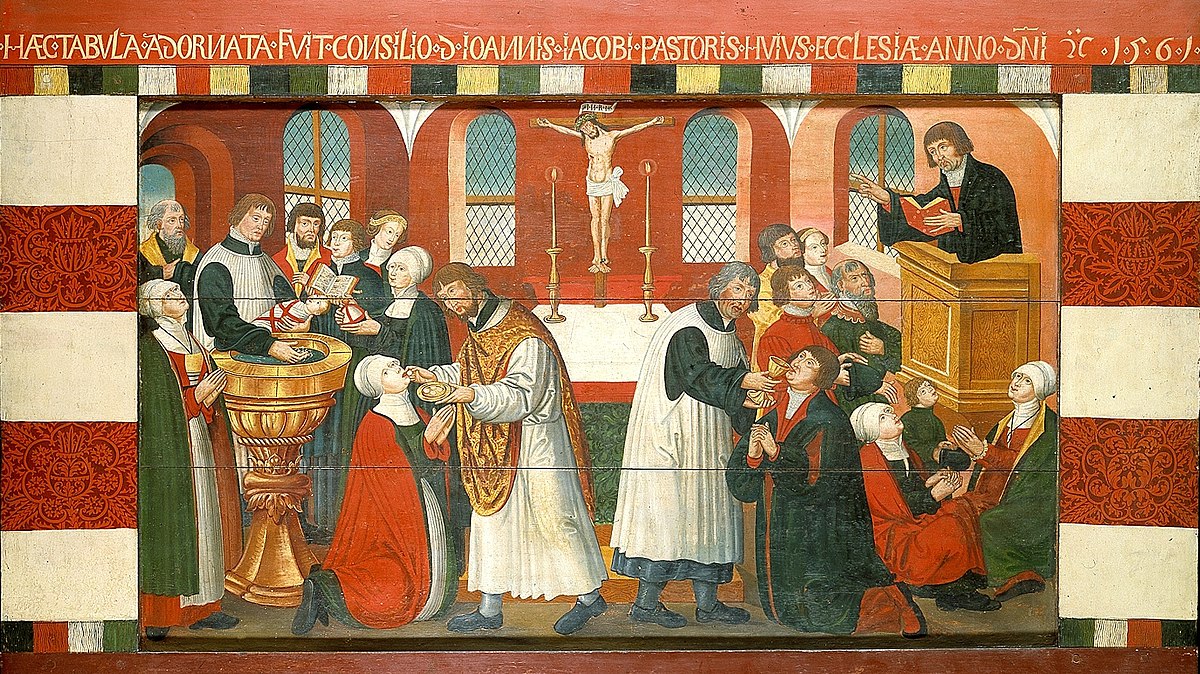
Speaking about the sacraments, Luther stated that “it seems right to recognize as sacraments only those promises of God that are supported by a sign. The rest, which are not related to signs, are just promises. Therefore, strictly speaking, there are only two sacraments in the Church of God — baptism and the breaking of bread. Only in these two do we find a God-ordained sign of the promise of forgiveness of sins.” On this basis, it was concluded that there are only two sacraments: Baptism and the Eucharist. At first, repentance retained the status of a sacrament among Lutherans, but then it turned into a blessed rite, as well as confirmation, marriage, ordination, and unction.
Baptism in the Lutheran understanding symbolizes the death and resurrection of a believer with Jesus Christ. Baptism is a way of entering the church community, and baptism is necessary for salvation. Moreover, in this case, Luther definitely stands on the positions of the concept of the Roman Catholic Church ex opere operatum, which he condemns: “[God] commands that the whole world receive his [Baptism]. By the power of this command (from which no one is excluded) We baptize everyone confidently and freely, excluding no one except those who oppose him and refuse to accept this covenant [sacrament]. If we follow His command and baptize everyone, we leave to Him the faith of those who baptize.” Unlike the teaching of the Orthodox Church, which sees in baptism deliverance from original sin and the renewal and rebirth of human nature, Lutheran baptism does not free it from original sin itself, but only from punishment for sin, it is not healing from sin, but amnesty. The fullness of Christ’s redemptive merits, imputed to those who are baptized according to his faith, completely covers any sin, depriving a person’s will of the visible need to strengthen and develop the state of grace to which he participates in baptism.
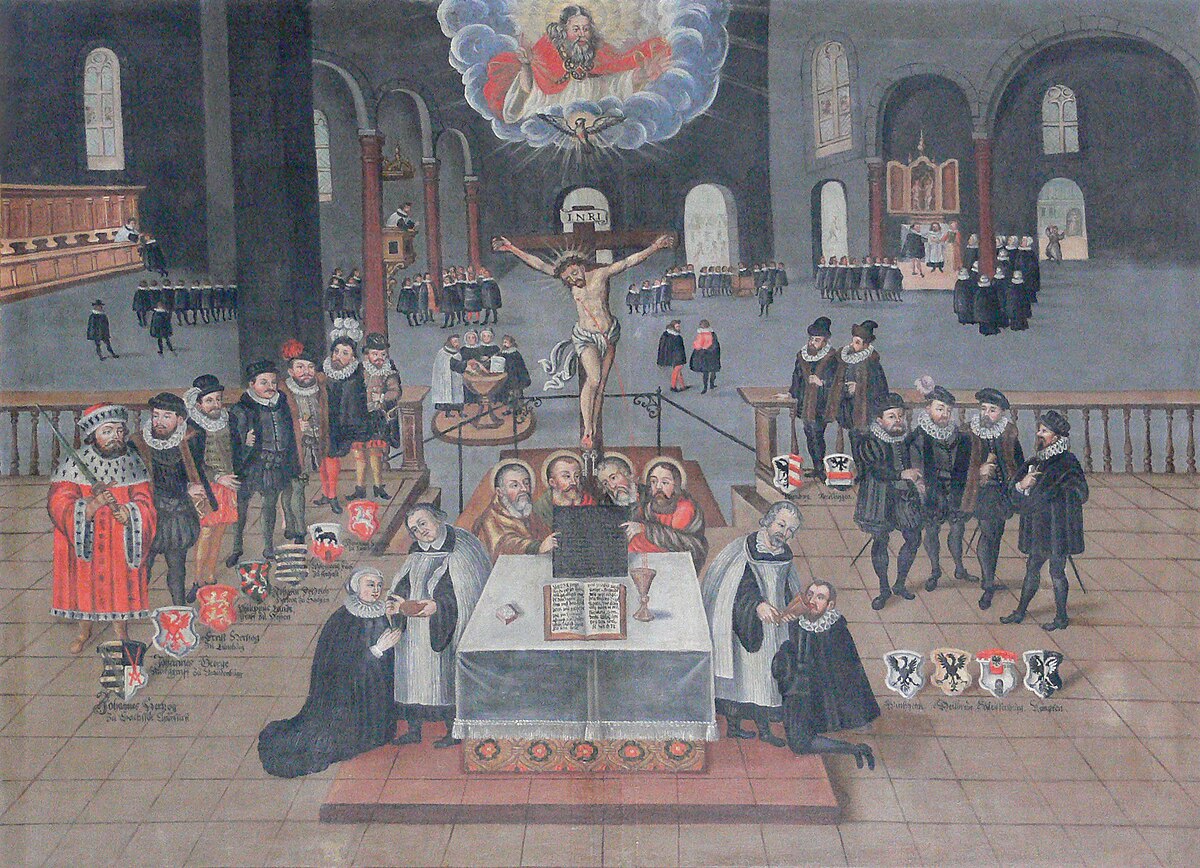
Lutherans, although they rejected the doctrine of transubstantiation, did not completely abandon the idea of the real presence of Christ in the Eucharistic Gifts. Recognizing the real presence of Christ in the Holy Gifts, Luther believed that the essence of bread and wine did not disappear completely and irrevocably. The leader of the German Reformation developed the doctrine of “consubstantiation” - the co-presence of the Body and Blood of Christ with Eucharistic bread and wine: “in order for the sacrament of communion to have a genuine Body and genuine Blood, it is not necessary that bread or wine be transformed into another substance (transubstantiated), therefore, that Christ be contained under accidents; but, Since both bread and wine remain, it is truly possible to say, “This bread is my Body, this wine is my Blood,” and vice versa.” In the sixth article of the Minor Catechism, Luther discusses the Eucharist in this way: “These are the true Body and Blood of our Lord Jesus Christ contained in bread and wine, which we Christians must eat and drink according to the ordinance of Christ Himself.”
The Formula of Consent clarifies that the “consubstantiation” lasts only until the end of the communion of the laity. After that, the bread and wine acquire their original state. Thus, Lutherans, in their opinion, were able to avoid violating the commandment on the inadmissibility of idolatry, the form of which is the rite of adoration: “Transubstantiation, in addition, brings with it excessive concern for this bread, its preservation and worship (ἀρτολατρεία) – in addition to its very use, established by Christ.”
The Lutheran teaching on the denial of the sacrificial significance of the Eucharist is fully described in Philip Melanchthon’s “Apology of the Augsburg Confession.” The “Apology” divides the concepts of “sacrament” and “sacrifice.” The sacrament is defined by Melanchthon as a sacred rite in which God gives grace to man. Sacrifice, on the other hand, is a religious act in which a person does something for God. According to the text of the Apology, a heartfelt sacrifice is praising and thanking God, professing one’s faith through patience and good deeds, and calling upon God with one’s heart. In the “Apology”, the Eucharist is presented as a gift from God to people, and therefore, by definition, does not possess the property of sacrifice.
We find a refutation of the Lutheran teaching on the Eucharist in the Epistle of the Eastern Patriarchs on the Orthodox Faith of 1723: “We believe that in the celebration of the Eucharist our Lord Jesus Christ is not symbolic, not figurative… and not through the penetration of the bread, so that the Divinity of the Word enters into the bread offered for the Eucharist essentially, like the followers of Luther… It is unworthily explained, but it is true and valid, so that after the consecration of the bread and wine, the bread is transformed into the truest Body of the Lord… and the wine is decomposing… in the truest Blood of the Lord.” Orthodox Christianity, criticizing the Lutheran understanding of the sacraments, points not only to the inconsistency of this understanding with the traditional biblical vision, but also to a legal approach that does not relate to the inner spiritual life of a Christian, which fully manifested itself in the next branch of the Reformation – the Swiss.
As noted in the previous section, the Reformation did not arise from scratch. Flashes of the coming Reformation took place in various countries of Western Europe at that time, and various theologians and church leaders claimed the laurels of the initiator of a full-scale reform of the Roman Catholic Church. However, it was in Germany, in the Saxon town of Wittenberg, that the most successful combination of circumstances developed for the emergence of Protestantism, and the catalyst turned out to be an Augustinian monk and a professor at the local university, Martin Luther.
Martin Luther (1483-1546) is one of the most controversial figures in the history of Christianity. Contradictory assessments are caused not only by the personality of the reformer, but also by his achievements in the field of theology and biblical studies. According to G. Sasse’s assessment, for example, Luther’s exegesis became “a theological discovery in the field of Bible interpretation.” A. McGrath believes otherwise, pointing out the rather strong dependence of Luther’s theological and biblical methodology on the humanist movement of the XV–XVI centuries. But despite the existing contradictions in terms of assessing the personality and activities of the German reformer, the following fact should be recognized – it was Martin Luther who initiated the Protestant revolution in Europe.
Luther was born in 1483 in the German town of Eisleben. His father, who was extremely harsh, influenced and contributed to far from positive role in shaping the personality of the future reformer. It was from his tyrant father that Luther fled in 1505 to the Augustinian monastery in Erfurt, where he was again influenced by an equally iconic figure, Johann von Staupitz (1465-1524), vicar General of the Augustinian Order, one of the founders of the University of Wittenberg. Staupitz’s influence on young Luther was so great that the latter even included a letter to Staupitz in his book on indulgences (Resolutiones disputationum de indulgentium virtute).
However, in 1508, Luther was forced to leave the Erfurt monastery. The reason was a crisis of faith that the future reformer was going through. Staupitz felt that Luther could repeat the path of the St. Jerome of Stridon - with the help of science to overcome despondency. In 1512, Luther received his doctorate in theology and began teaching Bible courses at the university. First according to the Psalter, and then according to the epistles of the Apostle Paul. It was the epistle to the Romans that played a key role in Luther’s life. Trying to comprehend the words of the apostle: “The righteous shall live by faith” (Rom. 1:17), - the future reformer came to the conclusion that righteousness belongs not to man, but to God. And it is possible to obtain the desired justification only through the gift of faith (sola fide), which, according to Luther, does not depend at all on man and his virtues, but comes exclusively from God.
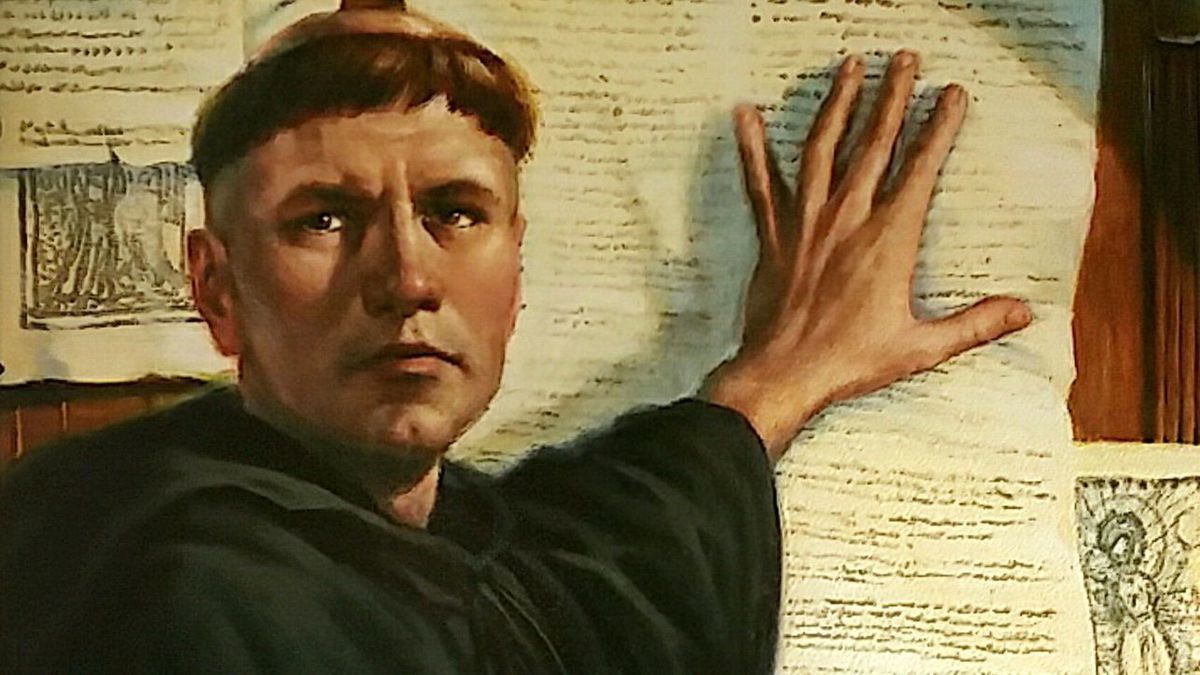
A further development of events in Luther’s life turned out to be caused by this “discovery.” In 1517, the Dominican monk I. Tetzel, a seller of indulgences, arrived in Wittenberg. Outraged by Tetzel’s rhetoric, Luther published his famous 95 theses, in which he outlined the concept of “three only”: man is saved only by faith; faith can be gained only through God’s grace, and not as a result of any personal merit; the authority in matters of faith is only the Holy Scriptures. Luther’s words and actions received wide support among the common and noble population, giving impetus to the development of the anti-papal opposition movement. The local church authorities accused the monk professor of heresy. But the Prince-Elector of Saxony and the patron of the University of Wittenberg, Frederick the Wise, came to his defense, deciding to support Luther not without political motivation. With Luther’s help, Frederick intended to gain autonomy from both the papacy and the Catholic emperor, but Luther also realized that he could not do without the help of the German feudal lords.
The year 1520 was a turning point for Luther’s biography. First, he writes a work “To the Christian nobility of the German Nation on the improvement of the Christian condition,” where he proposes a program of church and political transformations, setting out the doctrine of the “universal priesthood” of the faithful. In his essay “On the Babylonian Captivity of the Church,” Luther criticized the Catholic teaching on the sacraments, stating that only three of them (Baptism, Penance, and the Eucharist) have justification in Holy Scripture. In the same year, 1520, Pope Leo X issued the bull “Exsurge Domine”, which contained a threat of excommunication against Luther. In response, the reformer published an essay “On the Freedom of a Christian,” where he pointed out that in matters of faith a Christian does not obey anyone, and in matters of public order (the area of “carnal” freedom), the secular authorities are the guarantors of order. This statement actually became the manifesto of the German Reformation – its leaders claimed exclusively for church reform, and not for the socio-political restructuring of society, thereby inviting secular feudal lords to their side.
In the spring of 1521, Luther was summoned to the Diet (the Reichstag) in Worms, where the emperor tried to force him to renounce his beliefs. The dialogue was conducted in Latin, since Charles V did not know (and was not going to) learn German. Luther, demonstrating that he defends not only the principles of “true” Christianity, but also the dignity of the German nation, switched from Latin to German during the response (in particular, he uttered the famous words in German: “I stand on this and cannot do otherwise”). The emperor became confused, and Luther, taking advantage of the situation, escaped from Worms and then, by order of Frederick the Wise, Luther was given sanctuary in his Wartburg castle, where he began translating the Bible into German. Luther’s undoubted merit is not so much the complete translation of the Bible but the creation of the German literary language. During almost a year spent in Wartburg, the reformer translated all the books of the New Testament. The Old Testament appeared in German by 1534. The final version of the complete German Bible, edited by Luther, was published in 1545.
By translating the Scriptures into the national language, Luther was convinced that he removes all obstacles in a person’s personal communication with God, since “Scripture explains itself” (“scriptura sui ipsius interpres”). But soon enough, his romantic ideas were disrupted by life itself. Luther had to leave Wartburg, despite the threat of imperial persecution, in order to prevent the development of radical Protestantism in Wittenberg. It turned out that not all supporters of the Reformation understood the Bible the way Luther did. This circumstance concerned both university professors and participants in the peasant uprising of 1524-1525. Both were supporters of Luther, but they drew their own conclusions based on the ideas put forward by the reformer. The first demanded a radical change in church life, including the destruction of icons and relics, the dispersal of monasteries, and the forcible expropriation of the property of bishops and abbots. The second (peasants) insisted on improving their lives and establishing social justice according to the Scriptures. Luther not only had to break with both parties, but also had to ask the secular authorities to suppress both the radical Reformation and peasant riots (according to historical information, over 100,000 peasants were killed). Thus began Luther’s decline. His reputation declined even more when he married the former nun Catherine von Bork in 1525.
Meanwhile, the degree of need that the German princes felt for Luther as the engine of the national-religious revolution against the pope and the emperor began to decrease. In 1526, in the face of new foreign policy problems, the empire allowed the feudal lords to resolve doctrinal issues before the convocation of the Ecumenical Council “as if they were responsible only to God and his imperial majesty.” By 1529, the position of the Protestant princes had become so strong that at the next Reichstag, the Second Speyer, they expressed an official protest against the persecution of Lutheran followers. In 1530, at the Augsburg Reichstag, Protestant theologians (not only Lutheran) had the opportunity to present their faiths to the emperor. Luther was afraid to appear on the Reichstag, so his position was presented by Philip Melanchthon, who wrote “The Augsburg Confession” at the beginning of the Reichstag and, responding to criticism from opponents of his (religion) “Apology”.
In the 30s of the XVI century. Luther actually lost the palm tree in terms of the development of the German Reformation to the Hessian Landgrave Philip I the “Magnanimous”. Back in 1527, he founded the first Protestant university in Europe in Marburg, and in 1531 he united the Protestant princes into the Schmalkalden military-political union. The civil war was approaching, but its beginning was prevented by military and political circumstances. In 1532, a peace treaty was concluded in Nuremberg between the emperor and the Protestant princes. He allowed the supporters of the Reformation to strengthen their position even more: Lutheranism was rapidly spreading across German lands. But without Luther’s preaching, who, once again, was increasingly receding into the shadows. Finally, the reformer left the historical arena in 1540, after a scandal involving the secret blessing of Philip of Hessian’s second marriage without the dissolution of the first. It turned out that Luther, Melanchthon, and M. Bucer, referring to Scripture, allowed Philip to actually restore Old Testament polygamy.
The reputational fall of the leader of the Protestant party was not the only disaster for the supporters of the Reformation. In 1546 (shortly after Luther’s death), the civil war between Roman Catholics and Protestants nevertheless began. And the supporters of the Roman Catholic Church won it, but the successes achieved on the battlefield were offset by political intrigues. In 1555, the so-called Augsburg Religious Peace was concluded, which recognized the princes’ freedom to choose their religion.; subjects, on the other hand, had to follow their feudal lord in matters of religion according to the principle: “Whose power is what faith is” (“Cuis regio, eius religio”). As a result, the German Empire was divided between two faiths. The whole of northeastern Germany, as well as the lands of Saxony and Würtenberg, were ceded to the Protestant camp. In the Catholic area, the southeastern part remained with the lands of the Habsburgs, Bavaria and the western part of Germany.
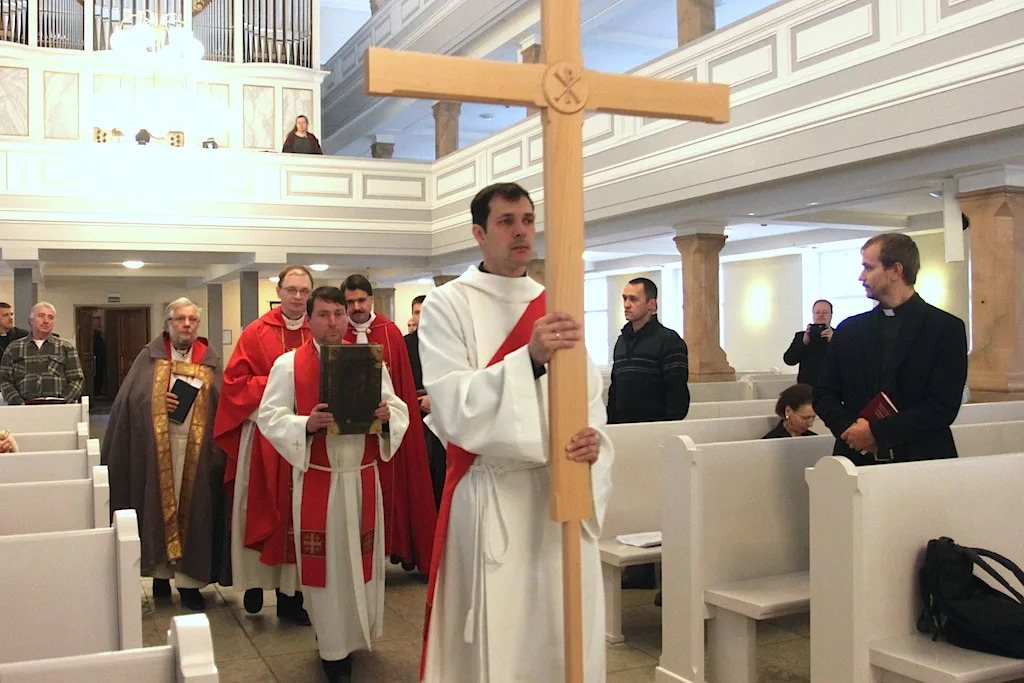
Currently, there are three organizations in the world that claim to unite Lutherans living in different countries and regions of the world: the World Lutheran Federation, the International Lutheran Council, and the Confessional Evangelical Lutheran Conference.
The Lutheran World Federation (LWF) is the most representative international association of churches of the Lutheran tradition, established in 1947 in Lund (Sweden). The LWF includes 148 participating churches in 99 countries, representing 66.7 million Lutherans. The headquarters of the Federation is located in Geneva (Switzerland). The LWF is an association of liberal churches in which there is an institution of women’s pastoral care, same—sex unions and euthanasia are blessed. On the territory of the Russian Federation, its members are the Evangelical Lutheran Church in Russia and other countries and the Evangelical Lutheran Church of Ingria in Russia, which have a single vote in the Council of the VLF.
The International Lutheran Council (ILC) has existed in its current form since 1991. The members of the ILC declare that they recognize the Holy Scriptures as the infallible Word of God, and the Lutheran confessions contained in the Book of Concord as the true and faithful expression of the Word of God. The member churches of the ILS do not recognize female pastoralism (women can only be deaconesses). There are 54 Lutheran churches in the ILS. Among the more representative ones are the Malagasy Lutheran Church (Madagascar), the Lutheran Church – Missouri Synod, the Evangelical Lutheran Church of Brazil and the Lutheran Church of Canada. In total, the ILS includes about 7 million Lutherans. Some Lutheran churches, mainly in the CIS and the “third” world, are both members of the WLF and the ILS. In Russia, the Church of Ingria and the Siberian Evangelical Lutheran Church (SELC) are members of the ILS.
The Confessional Evangelical Lutheran Conference (CELC) is an association of the most conservative Lutheran denominations that has been in existence since 1993. The Evangelical Lutheran Synod and the Wisconsin Evangelical Lutheran Synod play a dominant role in CELC. The CELC has about twenty participating churches today. In Russia, the Evangelical Lutheran Church “Consent” belongs to the CELC, in Ukraine — the Ukrainian Lutheran Church. The participating churches of the CELC strictly profess the doctrine of sola Scriptura – they consider “the canonical books of the Old and New Testaments to be the infallible Word of God and obey this word of God as the only infallible rule and authority in all matters of doctrine, faith and life.” They also accept “the confession of the Evangelical Lutheran Church contained in the Book of Concord of 1580, but in so far as this confession is in agreement with the Word of God.” In general, the CELC is characterized by a literal understanding of the text of Scripture. The CELC members may not associate with churches whose doctrine or practice deviate from the CELC confessional standard.
Rudolf Bultmann (1884-1976), Paul Tillich (1886-1965), and the martyred pastor Dietrich Bonhoeffer (1906-1945) made significant contributions to the development of modern Lutheran theology. Bultmann is known as the creator of the concept of the “demythologization” of the New Testament. Tillich’s name is mainly associated with the development of “theology of culture.” Bonhoeffer went down in history primarily as a public and political figure, an opponent of the Nazi regime (He was killed in a concentration camp) and the creator of the so-called “irreligious Christianity.” The development of the so-called the “theology of hope” was studied by Jurgen Moltman (1926-2024), who became the successor of Tillich and Bonhoeffer at the same time in terms of deepening some ideas. Another important area of modern Lutheran theological thought has become hermeneutical theology, which studies the phenomenon of language from a theological perspective.
Determining the time of the appearance of Lutheranism in Russia is not a difficult task. The first German Lutheran immigrants arrived in Russia in the 16th century. Subsequently, their number increased due to the peculiarities of the policy of the government of the Russian Empire, which encouraged the influx of European specialists. In 1832, the scattered Lutheran communities (with the exception of Finland and Poland proper) were united into the Evangelical Lutheran Church in Russia (ELCR). In Soviet times, this church was destroyed by 1938. In September 1948 the restoration of Lutheranism in the USSR began – the first Evangelical Lutheran community was registered in Latvia. In the 80s, the Lutheran parishes united into the “German Evangelical Lutheran Church in the Soviet Union,” which also split after the collapse of the USSR, resulting in several branches of Russian Lutheranism.
- Union of Evangelical Lutheran Churches (based on the German Lutheran tradition);
- Evangelical Lutheran Church of Ingria (based on the Finnish Lutheran tradition);
- Siberian Evangelical Lutheran Church (represents the result of the activities of Estonian missionaries, unites the descendants of Siberian Germans);
- Evangelical Lutheran Church “Consent” (formed in the 90s of the twentieth century as a result of the activities of American missionaries);
- Evangelical Lutheran Church of the Augsburg Confession (established in 2006; claims to unite all Russian branches of Lutheranism).
In total, about 250,000 people in Russia identify themselves as Lutherans.
It would be wrong to interpret Lutheran teaching “sola Scriptura” as solely a confrontation between Scripture, which Luther called for to be revered, and Tradition, which, accordingly, the reformer demanded to be rejected. Things are a bit more complicated.
Firstly, Luther was not fighting against Tradition as such, but against one of its varieties. Thus, the German reformer was dealing with two types of Tradition: “Tradition 1” and “Tradition 2.” “Tradition 1” was a “way of interpreting Scripture in the community of believers” — a fixed tradition, the roots of which went back to the patristic era. This kind of tradition suited Luther perfectly, because it was just a necessary theological and historical context for a proper understanding of the Bible. Luther himself used Tradition 1 to interpret the text of Scripture, but with some reservations. At the same time, the reformer completely rejected the “Tradition 2”, which by the end of the XV century received in Catholicism the status of a source of Divine Revelation separated from Scripture. The “Tradition 2” includes, for the most part, the decisions of the Ecumenical councils of the Roman Catholic Church, which approved as dogmas such elements of the Catholic faith as papal supremacy, purgatory, etc., which are not mentioned in the Bible.
The second thing that needs to be taken into account when analyzing Lutheran attitudes to Scripture is Luther’s own dependence on the methodology of Renaissance humanists – first of all, on the idea that the biblical text is not just a complex literary work, but a special transmitter of spiritual experience. This perception of the Bible would become the basis for Luther’s understanding of Scripture as the Word of God — in fact, another form of Divine Incarnation, which, in turn, allowed him to fearlessly reject the authority of the Pope, putting the Divine Logos in the form of Scripture in his place at the head of the Christian community. This combination has been vividly defined by the church. St. Hilarion (Troitsky): “From the Bible, Protestants who rebelled against the human pope created a “paper pope,” and the last flattery was more bitter than the first.”
The reformer found confirmation of this view of Scripture in the text of Scripture: “In the beginning was the Word, and the Word was with God, and the Word was God” (John 1:1). According to Luther, the creative and powerful Word of God was embodied in Jesus of Nazareth, who became God’s greatest revelation and God’s greatest work, consisting in the redemption of the human race. And the same Word is reflected in the pages of Scripture, which alone, from Luther’s point of view, has the right to be the only and infallible source of faith. However, the ideal theory began to falter in practical use. Luther found himself in a situation of “vacuum” of authority. Namely, he realized that it was virtually impossible to interpret Scripture on the basis of Scripture itself. How impossible it is to determine its canon on the basis of Scripture.
Given the personal crisis that the reformer was going through, it is not surprising that he began to search for authority in interpreting Scripture not externally, but internally — trying to listen to the voice of God. In other words, Luther made himself and the criterion “sola fide” derived by him the basis for determining what the Word of God is: “The Word of God is in the Bible, but (the whole) Bible is not the Word of God.”
Luther, although he insisted on the ultimate authority of Scripture, spoke negatively about some parts of it. For example, he called Deuterocanonical books “apocrypha” under the influence of I. Reichlin. Luther ranked the New Testament works into “inspired” (for example, the Gospel of John and the first 13 epistles of the Apostle Paul), “morally useful” (for example, the Synoptic Gospels) and “straw” or “empty”. The latter included the epistles of the Apostle James, the Apostle Judas (because they spoke about the importance of good deeds in the matter of salvation), the epistle of the Apostle Paul to the Hebrews (Luther considered it spurious) and the Revelation of the Apostle John the Theologian (because it confuses minds). As a result, these books were not excluded from the canon, but moved to the end of it, becoming in fact an appendix.
Another form of refutation of the concept of “sola Scriptura” by the Lutherans themselves was the appearance of their own tradition – symbolic books, which actually replaced the rejected tradition of the Roman Catholic Church. Luther, in fact, was well aware that Holy Scripture, which is not always clear and understandable in itself (see 2 Peter 3:16), can easily be distorted without the guidance of Tradition. Therefore, both he and F. Melanchthon compiled symbolic books, and representatives of the second generation of Lutheran theology in the Formula of Consent indicated that “symbols should check all other books as to whether Christian dogmas are correctly stated in them and in accordance with the word of God” and determines that the symbols contain a teaching that “existed and must forever exist in the church."".
Luther needed the concept of “Scripture as the Word of God” not only to debunk the sacred status of the above-mentioned “Tradition 2” for the Roman Catholic Church, but also to respond to the counter criticism of Catholics. The latter rightly argued that the Scriptures were created by the Ancient Church for ecclesiastical needs. And it was the Church, for example, that determined which books should be included in the canon. Luther believed that Scripture was not created by the Church, just as the Church was not created by Scripture. Both, for him, arose as a result of the action of the incarnate Word of God. But the Scriptures, according to Luther, have been less distorted over the past centuries than the corruption-obsessed Roman Catholic Church. In general, we repeat, the reformer was influenced by humanism, which believed that the text was more important than human testimony.
This thesis contradicts traditional biblical theology, which claims that the appearance of Holy Scripture did not abolish oral Tradition, as evidenced by Scripture itself: the Apostle Paul, for example, did not leave all his thoughts in the text format, pointing out: “I will arrange the rest when I come” (1 Corinthians 11:34); “Brethren, stand fast and keep the traditions which you have been taught either by our word or by our epistle” (2 Thess. 2:15). In addition, by defining the priority of Scripture in theory, in practice Luther actually subordinated the authority of Scripture to the institution of symbolic books, which became a form of Lutheran tradition. In order to avoid such a distortion, Lutherans should recognize that Scripture is one of the forms of Tradition, understood not as an unwritten tradition, but, above all, as the action of the Holy Spirit, expressing itself as “an invisible, real gift of grace and sanctification…” And Tradition in its content is not something different from Holy Scripture or It is parallel to it; on the contrary, Tradition is identical in content with Scripture. Thus, the Orthodox Church asserts not only the equivalence, but also the absolute wholeness, the interpenetration of various forms of God’s Revelation.: “We believe that the testimony (i.e. Tradition) The Catholic Church has no less power than the Divine Scriptures. Since the author of both is the same Holy Spirit, it makes no difference whether one learns from the Scriptures or from the Universal Church…”
Luther, as it seemed to him, was guided by a good intention. Speaking of Scripture as the second form of God’s Incarnation, he thereby pointed out that the life of Christ, His teachings and sufferings reflected in Scripture also apply to those who read Scripture with faith: “God saves the godless, as Augustine says, when He makes them pious and righteous in heart and when He preserves those who have already been saved. Or Him… it leads to the goal of salvation… those who say, “I hope to receive help from You, Who is the Savior of the pious and the just God.” This understanding of salvation (as a gracious gift from God to a humbled person), which arose in Luther through the Christological exegesis of Scripture, led the reformer to a key theological conclusion for the Reformation, which had to do with the opposition of law and grace, to the theological dilemma of the truth of God (Rom. 3, 21). This opposition was eventually overcome in Protestantism through the establishment of the primacy of the “saving faith” (sola fide).
It was noted above that the doctrine of salvation by “faith alone” was formulated by M. Luther on the basis of a misinterpretation of the words of the Apostle Paul: “In him the righteousness of God is revealed from faith to faith, as it is written: “The righteous shall live by faith” (Rom. 1:17). The reformer came to the conclusion that righteousness belongs not to man, but to God. And it is possible to obtain the desired justification only through the gift of faith (sola fide), which, according to Luther, does not depend at all on man and his virtues, but comes exclusively from God.
Subsequently, the reformer developed and clarified the concept formulated by him. A significant part of it was the discussion about the nature of original sin. Luther strongly opposed the teaching of the Roman Catholic Church about the primordial state of man and the fall, in which nature remained intact. The German theologian believed that the independent ability to do good devalues the saving merit of Christ. Luther’s task, therefore, was to prove that as a result of original sin, the first parents, and through them the entire human race, had lost any opportunity to do good that would have an impact on the cause of salvation. Luther used images that are quite close to Orthodoxy when describing the human condition before the fall, then the consequences of original sin in the presentation of the German Reformation seem to be something terrifying: “one must believe that Adam, by his fall, lost the original righteousness or image of God that belonged to him by nature… Instead of the image of God, which he had lost, there was… the deepest… the corruption of his whole nature.”
Subsequently, Luther’s concept was softened by representatives of the second generation of German reformers. Thus, the “Formula of Consent” distinguishes between human nature, in which sin lives, and sin, which lives in nature, but nevertheless has not become identical to it. The Augsburg Confession recognizes the limited possibility of goodness or the so-called “righteousness of the flesh” for people: “Although we recognize human powers as freedom and the ability to perform external acts of the law, we do not attribute spiritual deeds to these powers, such as true fear of God, true faith in God… These are the works of the first Tablet, which the human heart cannot accomplish apart from the Holy Spirit. The Spirit.”
Of course, Luther needed to describe the deplorable and completely helpless state of man after the fall in order to emphasize the ultimate need for salvation by “faith alone.” It should be understood that by denying the importance of good deeds in the matter of salvation, Luther did not advocate moral relativism. His task was, first of all, to refute the teaching of the Roman Catholic Church about the need to bring personal satisfaction to God, a concept on which the existence of indulgences condemned by the Reformation was based: “Whoever confesses that he has earned grace through works neglects the merit of Christ and … seeks the way to God by human forces besides Christ.” In addition, Luther’s arguments about the “saving faith” were influenced by his personal spiritual search for guaranteed salvation: “Although I lived the innocent life of a monk, I felt like a sinner with a conscience, uncleanness before God. I also couldn’t believe that I had pleased Him with My efforts. I was far from loving this righteous God Who punishes sinners, in fact I hated Him… And finally… I began to understand that the “righteousness of God” by which a righteous person lives is a gift from God (faith) and that these words, “the righteousness of God is revealed,” refer to passive righteousness, according to which the merciful God justifies us by faith, as it is said, “the righteous will live by faith.” I immediately felt reborn, as if I had entered the open gates of paradise.”
The faith that Luther writes about is not just the knowledge that Christ is the Redeemer. The reformer himself wrote: “The reason why some people don’t understand that faith alone justifies is because they don’t know what faith is.” He himself explained that 1. Faith is a personal, not a purely historical category. 2. Faith is about trusting in Divine promises. 3. Faith unites believers to Christ: “The only faith that deserves to be called Christian is this: you unconditionally believe that Christ was Such not for Peter and the saints, but for yourself, and for you more than for anyone else.”
According to Luther, the guaranteed consequence of having faith, which is “the gift of God” (see Ephesians 2:8), are good deeds, which, however, have no significant significance in the matter of salvation: “The grace of God justifies us for Christ’s sake through faith alone, without good works, while how faith abounds with good deeds.” Thus, from the point of view of Lutherans, God Himself does everything necessary for the salvation of man, fulfilling through the atoning sacrifice of Christ the condition necessary for the justification of a believer – the proclamation of a sinner as righteous (the so-called “pronunciation”).
The Lutheran understanding of salvation has been subjected to justified criticism from Orthodoxy, the essence of which boils down to the statement of the ultimate legalism of Protestant soteriology. The Reformation, of course, sought to free itself from the vicious logic of Catholics, but it remained in the same legal field of perception of the relationship between God and man. The purpose of justification was not to get rid of sin, but to avoid punishment for it. Lutheranism says nothing about the inner change of a person (which, by default, is impossible), but only about the external justification, which turns out to be an “act… what happens in God, not in man.” Therefore, the authors of the District Epistle of the Eastern Patriarchs (1723) urge us to look at Christian salvation from a moral and existential perspective, rather than a legal one: “We believe that a person is justified not just by faith alone, but by faith facilitated by love (i.e., faith as an active force), that is, through faith and deeds.”… It is not only the ghost of faith, but the faith that exists in us through works that justifies us in Christ.” Patriarch Sergiy (Stragorodsky) shares the same idea: “One should not ask why a person receives salvation, but rather how a person accomplishes his salvation.”
Related Concepts
- 39-articles
- adoration
- anglicanism
- aristotle
- augsburg-confession
- augsburg-peace
- authority-of-scripture
- biblical-canon
- book-of-concord
- calvinism
- christ-as-true-minister
- church-structure
- command-of-god
- consubstantiation
- council-of-trent
- cyril-of-alexandria
- ecumenical-councils
- episcopacy
- existentialism
- forensic-justification
- formula-of-consent
- good-works
- halle-university
- imputation
- jacob-spener
- laity
- liberalism
- lutheran-sacramentology
- magisterium
- marks-of-the-church
- new-moses
- opus-operatum
- orthodox-critique
- papal-authority
- patristic-tradition
- paul
- peace-of-westphalia
- pietism
- protestant-fragmentation
- protestant-reformation
- protestant-theology
- protestant-tradition
- rationalism
- real-presence
- reformation-program
- rejection-of-papal-authority
- religious-tolerance
- romans-321
- sacramental-efficacy
- secularization
- spirituality
- systematic-theology
- thirty-years-war
- treasury-of-merit
- validity