Comparative Theology — Topic 8. The current state of the Roman Catholic Church.
**
**
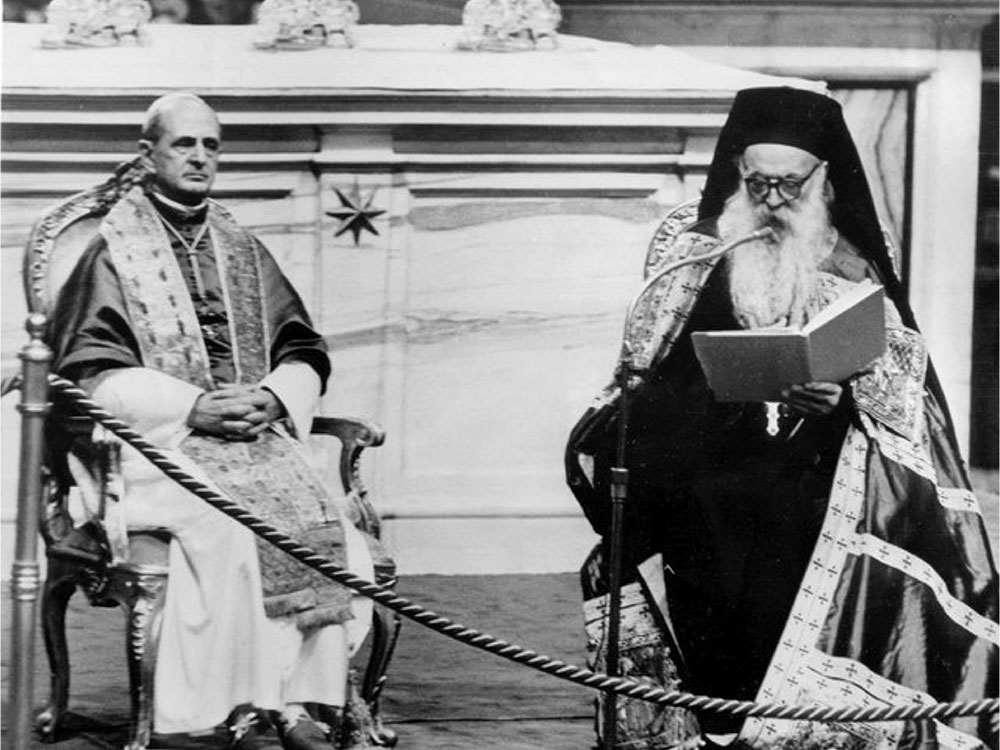
The decree “Unitatis redintegratio” emphasizes the special closeness to Catholicism of the Orthodox Churches, which are recognized as true Local Churches with valid sacraments and apostolic succession. At the same time, the Catholic side, despite all sorts of positive statements, does not abandon the policy of union, unacceptable to the Orthodox and regarded by them as proselytism. The Orthodox side, in turn, is dissatisfied with the unresolved number of dogmatic issues (Filioque, “dogmatic development”, etc.) that formed the basis of the church division.
The beginning of the Orthodox-Catholic dialogue at the latest stage was laid in 1965, when the anathemas of 1054 were abolished. In 1976, the Joint International Orthodox-Catholic Commission for Theological Dialogue began its work in Rome. The first meeting of the commission was held in 1980 on Rhodes Island, and sub-commissions and a joint coordinating committee were established. In 1980-1981, the sub-commissions worked on the general theme “The Mystery of the Church and the Eucharist in the light of the mystery of the Holy Trinity.” This topic was continued at the second meeting of the committee in Munich (1982). The third session was devoted to the topic “Faith, the sacrament and the unity of the Church” (Crete, 1984). The same topic, as well as the topic “The Sacrament of the priesthood in the sacramental structure of the Church, in particular the importance of apostolic succession for the sanctification and unity of the people of God” were discussed at the fourth meeting in Bari, Italy (1986 and 1987). The issue of the sacrament of the priesthood was continued at the fifth meeting, which was organized in Finland, at the Novo-Valaam Monastery (1988).
At the initiative of the Orthodox Churches, in connection with the beginning of the political events of the first half of the 90s in Eastern Europe, the question of uniatism was raised, related to the existence of Catholic churches of the Eastern Rite. A corresponding sub-commission was established, which met in Vienna in January 1990; the documents of the sub-Commission were reviewed by a Joint Commission in June 1990 in Freising (Germany). The joint document sharply criticizing the Uniate communities was not approved by Rome. New document (after the meeting of the subcommittee in June 1991 in Arissi near Rome) was debated by a Joint commission in Balamand (Lebanon) in 1993 and received the approval of John Paul II (in a letter to Patriarch Bartholomew of Constantinople on November 30, 1993).
However, despite all the assurances of the rejection of the union, the Apostolic See continued to support Uniate structures, in particular, the Ukrainian Greek Catholic Church. Thus, Pope John Paul II has repeatedly (since 1979) met with representatives and top hierarchs of the UGCC; confirmed the legitimacy of the Brest Union (1596); participated in the Synod of Bishops of the UGCC (1980), which resolved the issue of succession of power in the Uniate Church.; participated in the Synod of Bishops of the UGCC (1980), which adopted a resolution on the invalidity of the decisions of the Lviv Council (1946), which annulled the main provisions of the Brest Union.
In 1992, the Pontifical Commission Pro Russia issued the instruction “General Principles and practical norms for the coordination of evangelistic activities and ecumenical obligations of the Catholic Church in Russia and other CIS countries,” which indicates the inadmissibility of proselytism, understood as pressure on conscience. In practice, the activity of Catholics in the canonical territory of the Russian Orthodox Church in the late 1990s – the beginning. The 2000s represented a real expansion. For example, Pope John Paul II made several official visits to the countries of the former USSR. In June 2000 The Congregation for the Doctrine of the Faith of the Roman Catholic Church issued a note “On the expression ‘Sister Churches,’” which stated in part: “In the true meaning of the word, Sister Churches are considered to be local Churches (or associations within local Churches, such as patriarchates or metropolitan districts). Nevertheless, it should be obvious even when the expression “Sister Churches” is used in the direct meaning that the Universal, United, Holy, Catholic and Apostolic Church is not a sister, but the mother of all local Churches.”
In 2002, Apostolic administrations (pre-diocesan structures) The Roman Catholic Church in Russia was replaced by four Catholic dioceses, forming a separate ecclesiastical province. The names of these new dioceses do not contain territorial references. However, this step had a clear proselytizing dimension, since the missionary potential of the new province of Catholics was directed not only at ethnic Catholics, but also at the entire population of Russia.
Despite the tension that has arisen, the Russian Orthodox Church has continued to participate in the dialogue between the Local Orthodox Churches and the Roman Catholic Church. Although there were obstacles to this, organized not by Catholics, but by the Patriarchate of Constantinople. Thus, representatives of the Russian Church did not sign the final document of the tenth meeting of the Mixed Catholic-Orthodox Commission in Ravenna, protesting against the participation of clergy of the non-canonical Estonian Apostolic Orthodox Church in the meeting. The Russian Church did not sign the Ravenna document, which contains an attempt to describe an understanding of papal primacy acceptable to Catholics and Orthodox Christians. Later, the Russian Orthodox Church presented its vision by publishing the document “The Position of the Moscow Patriarchate on the issue of primacy in the Universal Church.” The topic of Church primacy was then discussed at the XI-XIV meetings of the Mixed Catholic-Orthodox Commission (2009, Cyprus; 2010, Vienna, Austria; 2014, Amman, Jordan; 2016, Chieti, Italy). Already in 2010. The majority of participants in the dialogue from the Orthodox side stated that the dialogue with Catholics in terms of understanding church primacy and papal primacy has reached an impasse, since the Orthodox side has no opportunity to see anything in the ministry of the primate of the Roman Catholic Church that would exceed the authority of the primate of a separate Local Church.
After the criminal interference of the Patriarchate of Constantinople in the life of Ukrainian Orthodoxy and the creation of the so-called “Orthodox Church in Ukraine” in 2019, the Russian Orthodox Church withdrew from all international dialogues, where a representative of Constantinople presides on behalf of the Orthodox fullness. This decision also affected the pan-Orthodox dialogue with Catholic Rome. At the same time, the bilateral dialogue with the Roman Catholic Church continues. A significant episode of this interaction was the signing in 2016. Joint declaration of Patriarch Kirill of Moscow and All Russia and Pope Francis of Rome in Havana. This event could not have happened without a significant decrease in the missionary and proselytizing activity of Rome in the canonical territory of the Russian Orthodox Church in the 2010s.
- The “Roman Question” and its resolution
- The Second Vatican Council (1962-1965): background, history and main decisions.
- The Roman Catholic Theology after the Second Vatican Council
- The structure of the Roman Catholic Church.
- Dialogue with the Orthodox Church
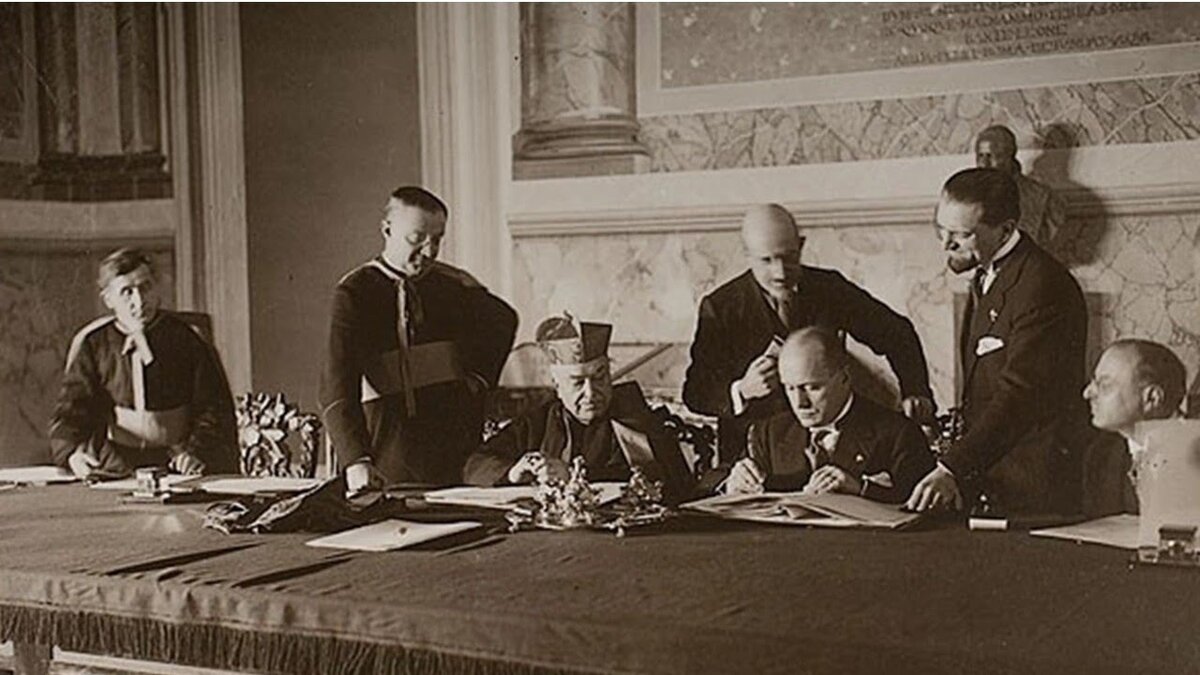
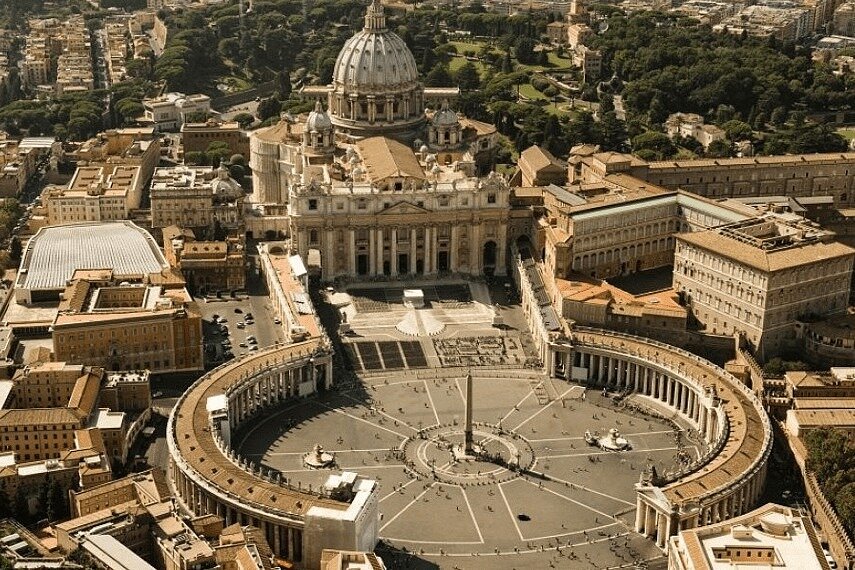
The pontificates of Popes Leo XIII (1878-1903), Pius X (1903-1914), Benedict XV (1914-1922), Pius XI (1922-1939) and Pius XII (1939-1958), who led the Roman Catholic Church in the first half of the twentieth century, were marked by the absolute supremacy of the Roman pontiff, which was confirmed in the categorical form of dogma. on infallibility in matters of faith and morals at the First Vatican Council (1869-1870). However, the first three of these popes did not have secular power, being in the position of “prisoners of the papal palace” until the Lateran Agreements of 1929. The state sovereignty and the neutral status of the “Vatican City” have not been determined.
Signed on February 11, 1929 at the Lateran Palace and subsequently ratified by the Italian Parliament, the agreements settled the legal problems between the Apostolic See and the Kingdom of Italy that had accumulated since 1870, when the Papal State was abolished. These events marked the beginning of the existence of the so-called “Roman question”, when the popes, while still in the Italian capital, stayed there without any official, from the point of view of secular legislation, status.
The package of Lateran agreements includes: a peace treaty, a financial convention and a concordat (that is, an agreement on cooperation). Catholicism was recognized as “the only state religion of Italy.” The agreements also established the secular sovereignty of the Apostolic See (including international affairs), special citizenship for its subjects, recognized the existence of a sovereign territory governed by the Apostolic See, with the name “Vatican City” (Città del Vaticano), and defined its borders. According to the financial convention, Italy was obliged to pay the Roman Catholic Church $750 million. The lira in 5% securities, and the Apostolic See renounced financial claims against Italy, which arose due to the abolition of the Papal Region. Subsequently, some provisions included in the package of the Lateran Agreements were revised. In order to centralize the Vatican’s financial operations, the Vatican Bank, the Istituto per le opere di religione (“Institute of Religious Affairs”), was created in 1942 by a papal decision, in which only persons with religious dignity can open accounts.
External challenges also affected the internal life of the Roman Catholic Church. Two world wars, the rapid development of science, and the rapid change in socio-political structures led to the emergence of a demand for renewal within Catholicism, expressed by the so-called “modernists.” Modernism, called by the papal authority “the totality of all heresies,” was not only a reaction to external changes, but also a painful consequence of the policy in the field of theological research pursued by the leadership of the Roman Catholic Church in the second half of the 19th century. The response to the challenges of the time was first the so—called new scholasticism, a reworking by a number of theologians (primarily Gaetano Sanseverino and Joseph Kleitgen) of the doctrinal legacy of the Council of Trent (1545-1563). Subsequently, the new scholasticism, having turned into Neotomism, acquired the status of the official doctrine of Catholicism. In 1879, Pope Leo XIII issued the encyclical “Aeterni patris”, in which he pointed out the only possible format for a Catholic theological and philosophical vision based on the legacy of Thomas Aquinas. Thomas’ philosophical and theological system represented the ideal embodiment of Catholic knowledge about the transcendent and created world. However, neotomism has not remained a fixed form. Thanks primarily to the efforts of Jacques Maritain and Etienne Gilson, it has become a space of quite lively theological and philosophical thought. But that was later. Thomas’s monopolization (in fact, by his commentators from the 16th century) of the sphere of theological research caused outrage among a stratum of conventionally progressive-minded Catholic clergy and university professors. This reaction led to the emergence of modernism and the subsequent modernist crisis. The Modernists have never been a cohesive movement. The combination of their names into a list occurred rather outside, not without the influence of the Vatican censors. For various reasons, modernists included: in France — A. Loisy, L. Duchene, M. Blondel, in Germany — G. Shell, in Great Britain — G. Tyrell, and in Italy — R. Murri and A. Fogazzaro.
The “modernists”, each in different ways, but pursuing similar goals - to find ways to update Catholic doctrine based on the situation of the dominance of scholasticism. And if the proposals of A. Loisy and J. If L. Tyrrell’s ideas looked rather radical, then, for example, L. Duchene’s work can be assessed as quite constructive. After all, he did not want to destroy the Catholic tradition, but rather to give it new points of support in the face of biblical and ecclesiastical archaeology, as well as current historiosophy. This led, among other things, to the final destruction of the myth of the truthfulness of the “Donation of Constantine” - the papacy’s privilege to own lands in Italy.
The figure of another representative of the modernist camp stands out – the self-taught theologian Baron Friedrich von Hugel, who, along with Cardinal Newman, is called one of the most influential figures of European Catholicism at the turn of the XIX-XX centuries. Positioning himself as a visionary theologian, Hugel created his own analogue of the theory of dogmatic development - the “doctrine of the three elements”, under the influence of which the doctrine of the Church is gradually formed and formulated. The three elements were meant to be the historical, scientific, intellectual, and mystical components of church life. According to Hugel, a certain kind of friction constantly occurs between them, when each of the elements strives to break out into a dominant position. As a result of this conflict, a dogmatic development takes place. For Hugel himself, the mystical component had priority, which, according to the theologian, has a pronounced innovative character. It is to the boldness of some of its visionaries that Catholicism ultimately owes the emergence of new (and dubious from the point of view of Orthodoxy) elements in its doctrine.
One of the most original Catholic theologians of the twentieth century, Pierre Teilhard de Chardin (1881-1955), was also given the status of a “modernist” by the Vatican censorship. Being not only a theologian, but also an anthropologist, Chardin tried in every possible way to overcome the conflict between faith and science, which led to rather unexpected results. In an effort to “churchify” the already mentioned theory of evolution, the Catholic thinker not only allowed the possibility of rethinking the biblical narrative of the creation of the world, but also pushed the boundaries of evolution throughout the history of the universe. Chardin defines three global stages of his own vision of evolution in this way: “pre-life” (lithosphere), “life” (biosphere) and “human phenomenon” (noosphere). The noosphere, an area and at the same time the result of the interaction of intelligent beings, is also subject to various changes. They will ultimately lead humanity, according to Chardin, to a transition to a qualitatively new level of being, which will occur during the Second Coming of Jesus Christ: “The end of the world is a reversal of balance, the separation of consciousness, which eventually reached perfection, from its material matrix, so that from now on it can rest with all its power.” in the Omega God.” It is not surprising that Chardin was persecuted by the Vatican censors for his overly original views.
Ultimately, the conflict between the modernists and the leadership of the Roman Catholic Church, which had been firmly rooted in the Scholastic tradition in its Thomistic presentation since the time of Pope Leo XIII, led to the emergence of the so-called “new theology” - a rather conventional name for a group of Catholic theologians belonging to the Dominican and Jesuit monastic orders. The participants of the “new theology” themselves preferred to refer to the current into which they were identified by the already mentioned Vatican censors as theologie de ressourcement, that is, “theology of origins” or “theology of return.” The center of the Dominican wing of the “new theology” became the theological school Le Saulchoir, which was located in Tours, Belgium, until 1939, and then moved to Paris. The Jesuit part of the “new theology” was located until 1974 in the seminary at the Cathedral on Fourviere Hill in Lyon. Representatives of both movements were concerned about the double gap that the modernist crisis revealed: first, between the Christian faith and modernity, and, secondly, between the Catholic Church and the world. Neo-scholasticism and modernism were unable to bridge this gap and only exacerbated it. Representatives of the “new theology” in the person of the Dominican Ambroise Gardeil and the Jesuit Jean Danielou pointed out ways to overcome the modernist crisis, stating the need to return Catholic theology to its roots: the Holy Scriptures, the works of the holy fathers of antiquity, the liturgical experience of the early Church. However, these initiatives were not evaluated by the official Vatican at that time.
However, it cannot be said that the Papal See responded to internal demands and challenges only with threats and prohibitions - attempts were also made at peaceful reform. In particular, Pope Pius XII tried to carry out the renewal of Catholicism with the maximum preservation of the old order. First of all, in the field of worship, theological and biblical studies. In 1950, the dogma of the Assumption, or taking of the Virgin Mary to Heavenly glory, was proclaimed – researchers perceive this fact as the beginning of preparations for the proposed cathedral. But Pius XII failed to convene it. How it was not possible to make the upcoming Second Vatican Council an ideological continuation of the First Vatican Council.
As noted above, the Second Vatican Council was strongly influenced by the “new” theology, a trend that was conditionally divided into two directions: the Jesuit (A. de Lubac, J. Danielou and partly H.W. von Balthazar) and the Dominican (A. Gardeil, M.-D. Chenu, I. Congar). For example, thanks to the work of I. Congar, the Roman Catholic Church came to define the Church as “the people of God”: the Church is the people of God, Christ the Lord and the High Priest made these people “kings and priests of God” (Rev.. 1, 6; 5, 9-10). The Jesuit part of the “new theology” mainly paid attention to patristics, but also spoke about the importance of mystical experience. This was especially expressed not only in Lubak’s works devoted to the legacy of Dionysius the Areopagite and the Christian analysis of Buddhism, but, above all, in the famous trilogy by Hans Urs von Balthazar.: “Theoesthetics” (“Theology of Beauty”), “Theodramatics” (“Divine Drama”) and “Theology” (“Theology of Truth”).
Balthazar’s trilogy is based on a desire to creatively comprehend the Gospel quote: “And the Word became flesh, and dwelt with us, full of grace and truth; and we saw his glory, glory as of the Only begotten of the Father” (John 1:14). Balthazar distributes the individual phrases and words from this verse between the components of his trilogy: ”… we saw His glory, glory as the only begotten of the Father” (the first part of the trilogy), “full of grace” (the second part), “and truth” (the third part).
In parallel with von Balthazar, Karl Rahner (1904-1984), another representative of the Society of Jesus, developed his own vision of the interaction between God and man. Rahner, who was influenced by the philosophy of Martin Heidegger, carried out the so-called “anthropological turn” in Catholic theology. If Balthazar’s reasoning was based on the idea of God’s omnipotence and the beauty of His plan, then it was more important for Rahner to look at certain spiritual phenomena from the point of view of the value of human existence.
Karl Rahner also went down in history as the popularizer of the idea of “anonymous Christianity”, partially formulated back in the XV-XVI century by the Jesuits from the University of Salamanca. It can be stated with confidence that such a point of view influenced the ecclesiological theology of the Second Vatican Council, which put forward the statement that “all people are called to the catholic unity of the People of God,” i.e., to the Church. Faithful Catholics, other believers in Christ, and, finally, all people in their totality, called by God’s grace to salvation, belong or are destined to Him in different ways” (Lumen gentium, 13).
The so-called “liturgical movement” also influenced the decisions of the Second Vatican Council. One of the initiators of its creation was the Benedictine Lambert Baudoin (1873-1960), the author of the monograph “La piete de l’Eglise” (“The Piety of the Church”), the manifesto of the liturgical movement, as well as the creator of monasteries of the Byzantine rite (the most famous is Cheveton). Subsequently, I. Herwegen, O. Kazel, B. Bott and A. Martimore contributed to the development of liturgical theology. However, first of all, it is worth mentioning the name of Romano Guardini, whose book “The Spirit of the Liturgy” was no less important for the liturgical reform than Baudouin’s monograph. Thanks to the liturgical movement, Catholic Eucharistic worship has acquired a more communal character, and Mass has ceased to be exclusively the work of a priest. Although some other changes initiated by the Second Vatican (for example, the actual abolition of the daily liturgical cycle and calendar revision) can hardly be assessed as positive.
The innovative nature of the decisions of the Second Vatican Council provoked a mixed reaction from a number of prominent hierarchs and theologians of the Roman Catholic Church. To some, the council’s resolutions seemed insufficient, since they did not correspond to the desired degree of liberalization of church life. Others, on the contrary, demanded that all implemented reforms be urgently curtailed in order to restore the previous state of affairs. Still others saw the Second Vatican as the necessary basis for the development of fundamentally new areas of theological thought for traditional Catholicism.
Hans Kyung (1928-2021) was the first to express the views of the first group (which advocated the expansion of freedom in the Church). Kyung was a member of the group of theological consultants of the Second Vatican Council. Having consistently published several monographs (“The Council, Reform and Reunification” (1962), “Structures of the Church” (1964), “The Church” (1968)), the Swiss theologian attracted the negative attention of the church administration. But the end point for the Vatican’s patience was his book “Infallible?” (1971), which questioned the faithful and moral infallibility of the Roman Pontiff. In 1979, the Congregation for the Doctrine of the Faith stripped Kyung of the right to teach Catholic theology. No longer bound by confessional restrictions, he continued his specific research. In particular, he began to develop the so-called “Christology from below” (Christologie von unten), which became an attempt at a radical understanding of the anthropological turn in theology, undertaken, in particular, by K. Rahner. Subsequently, Kyung moved away from purely dogmatic issues, focusing on the field of interreligious dialogue, as well as the interaction of science and religion.
Kung and the aforementioned K. Rahner, J. Danielou, H.W. von Balthazar, I. Congar, A. de Lubac became the founders of the international magazine “Concilium” (“Cathedral”). The task of this periodical, which exists to this day, is to popularize the decisions of the Second Vatican Council. In 1972, Lubak and Balthazar left the editorial board of the magazine, founding their own – “Communio” (“Communication”), where they were joined by J. Ratzinger (future Pope Benedict XVI) and Walter Kasper (future cardinal and head of the Pontifical Council for Promoting Christian Unity). The reason for the appearance of the new edition were differences not only in the methodology of theological research, but also in the vision of church reality as such. The editorial board of Communio took a more conservative position, trying to offer the readership a more balanced interpretation of the results of Vatican II.
Archbishop Marcel Lefebvre and members of the Pope Pius X Society, which he founded, became the exponents of a pronounced oppositional point of view towards the theology of the Second Vatican Council. Lefebvre criticized, in particular, the doctrine of conciliarity and freedom of conscience. Lefebvre’s opposition activities led to his excommunication from the Catholic Church in 1988 for having performed four episcopal ordinations without a papal mandate. The death of the leader of the Pius X Society did not abolish the organization itself – it still actively promotes the principles of pre-Reformation Catholicism. The bishops ordained by Lefebvre are recognized by the Vatican as holders of the valid apostolic succession, obtained, however, illegally.
Modern Catholic theology is not limited to the names and concepts listed above. Along with the official line, recorded, in particular, in the Catechism of 1992, the Roman Catholic Church has a wide range of authors and various concepts, which allows us to state a significant variety of trends in Catholic theology at the present stage. In turn, this makes it possible to diagnose the presence in modern Catholicism of phenomena both close to Orthodoxy (for example, the “new theology” in certain manifestations of this trend) and extremely far from it (such as, for example, the liberal logical constructions of X. Kung’s or M. Lefebvre’s reactionary ideas).

**
**
The Second Vatican Council, convened by Pius XII’s successor, John XXIII (1958-1963), was held under the auspices of the so-called Ajormento. “updating”; “modernizing”, “bringing it up to date”). This desire did not arise spontaneously. The tendencies towards the renewal of Catholicism are visible in the writings not only of the “modernists” condemned by the Vatican (first of all, J. Tyrrell, A. Loisy), but also of a number of influential theologians of the twentieth century recognized by the Roman Catholic Church: the Jesuits K. Rahner (1904-1984) and J.K. J. J. Murray (1904-1967), who emphasized the need to combine the modern experience of mankind and the principles of the Church given by Christ; the Dominican J. Congar (later cardinal) (1904-1995), the Jesuit A. de Lubac (later cardinal) (1896-1991), and others, who sought to bring biblical and theological science closer to the Roman Catholic Church towards the ideals of the Patristic Tradition of the East.
As a result, Pope John XXIII (1958-1963), who was considered a “transitional figure” at the conclave, was able to accomplish something that no one expected of him. On January 25, 1959, the Pontiff announced the decision to convene the Roman Diocesan Synod and the “General Council of the Universal Church.” At the same time, the official closure of the First Vatican Council was announced. The agenda of the future council included topics related to the renewal of the Roman Catholic Church: worship, ecumenism, a return to biblical and patristic sources, and the “rediscovery” of the Church. The Pope saw the council’s task as renewing Catholicism, reorganizing and renewing church life, and removing obstacles to the unity of all Christians under the papal omophorion.
Not all Catholic hierarchs approved this plan. The episcopate was divided into “progressive” and “conservative.” The first group supported the pope’s innovative ideas in everything. The second, on the contrary, sought to prevent the convocation of the council. But despite the division that had emerged, in the Christmas bull Humanae salutis (December 25, 1961), John XXIII informed the Catholic world that the Second Vatican Council would be held in the near future. His main goals were outlined here.: 1) to make the Church’s contribution to solving world problems; 2) to achieve the renewal of church structures; 3) to propose ways to achieve Christian unity.
Especially surprising for the Catholic public was the information that representatives of non-Catholic Christian communities would be invited to the council. As a result, observers from 9 Local Orthodox Churches and 8 Protestant denominations attended the Second Vatican Council. From the Russian Orthodox Church: Protopr. V. Borovoy (all sessions), Protopr. I. Ilich (2nd session), Protopr. L. Voronov (3rd session), Archimandrite (later Metropolitan) Juvenal (Poyarkov) (4th session); from the Russian Orthodox Church Outside of Russia: Bishop Anthony (Bartoshevich) of Geneva, Archpriest I. Troyanov, S. Grotov and a delegation from the Paris St. Sergius Theological Institute, consisting of the rector, Bishop Kassian (Bezobrazov) of Catan and Archpriest A. Schmemann.
The work of the Second Vatican Council took place in four periods or general congregations (which are often and, as researchers emphasize, incorrectly called sessions):
-
October 11 – December 8, 1962;
-
September 29 ‑ December 4, 1963;
-
September 14 – November 21, 1964;
-
September 14 – December 8, 1965
The “progressives” came to the council in a very organized manner. Even before the start of the council’s work, they had formed a real coalition, uniting the liberal-minded bishops of France, Germany, the Netherlands, Switzerland and Austria. The active position of the “progressives” (organizing conferences, publishing materials defending a liberal position on the issues under discussion) allowed them to win over the conciliar majority. Behind the scenes, the “progressives” were supported by Pope John XXIII. The conservatives or “integrists”, represented by the cardinals of the Curia and the bishops of Italy, Spain and Latin America, relied entirely on the Roman Curia’s ability to resist liberal ideas and therefore initially neglected to unite their forces. The consolidation of the Integrist party thus occurred later, when they suffered several humiliating ideological defeats.
The Cathedral, attended by 2,540 participants, was inaugurated on October 11, 1962. The first general congregation was marked by fierce discussions between conservatives and liberals. As a result, not a single conciliar document was adopted during the first congregation. And on June 3, 1963, Pope John XXIII died. The pope’s death sparked discussions about the need for the council to continue its work. However, the new Pope Paul VI, in his first urbi et orbi address on June 21, 1963, confirmed that the work of the council would continue.
Under the leadership of the new pontiff, the participants of the Second Vatican Council were able to find points of compromise, which led to the adoption of important documents for the modern Roman Catholic Church. The Council adopted 4 constitutions, 9 decrees and 3 declarations: the Constitution on the sacred liturgy “Sacrosanctum Concilium” (SC; December 04, 1963), the dogmatic constitution on the Church “Lumen gentium” (LG; November 21, 1964), the dogmatic constitution on Divine Revelation “Dei Verbum” (DV; November 18 1965), the pastoral Constitution on the Church in modern times. The world of Gaudium et spes (GS; December 07, 1965), Decree on mass communication “Inter mirifica” (IM; December 04, 1963), Decree on the Eastern Catholic Churches “Orientalium Ecclesiarum” (OE; November 21, 1964), Decree on ecumenism “Unitatis redintegratio” (UR; November 21, 1964), Decree on pastoral ministry of bishops in the Church “Christus Dominus” (CD; October 28, 1965), decree on the renewal of the life of monastics in modern conditions “Prefectae caritatis” (PC; October 28, 1965), decree on preparation for the priesthood “Optatam totius” (OT; October 28, 1965), Decree on the apostolate of the laity “Apostolicam actuositatem” (AA; November 18, 1965), Decree on the missionary activity of the Church “Ad gentes divinitus” (AG; December 07, 1965), Decree on the ministry and life of priests “Presbyterorum ordinis” (PO; December 07, 1965), declaration on Christian education “Gravissimum educationis” (GE; October 28, 1965), Declaration on the Church’s attitude towards non-Christian religions “Nostra aetate” (NA; October 28, 1965), Declaration on religious freedom “Dignitatis humanae” (DH; December 07, 1965). All the accepted documents were solemnly signed and proclaimed by Pope Paul VI.
On December 7, 1965, a “Joint statement of the Roman Catholic and Orthodox Churches of Constantinople” was also announced, stating that Pope Paul VI and Patriarch Athenagoras, in order to develop “fraternal relations” between the Churches, wished to remove “some obstacles” to these relations (namely, the mutual anathemas of 1054). They expressed mutual regret for “insulting words, unfounded reproaches and reprehensible actions.”
The Second Vatican Council is still perceived by researchers (including Catholic ones) as a complex and rather contradictory phenomenon. The Council certainly showed that the Roman Catholic Church’s self-image has changed significantly since the Council of Trent and the Counter-Reformation. The attention to other religions, the recognition of evangelical and Christian values in Orthodoxy and Protestantism, the emphasis on the search for universal peace and human development – all this has given Catholicism a completely different mode of being. At the same time, there have been no fundamental changes in a number of positions (primarily in the field of ecclesiology: the doctrine of the Roman Catholic Church as the only true Church; papal primacy and infallibility, etc.), which condemned the Roman Catholic Church to a difficult existence in the format of further confrontation between liberals and conservatives.
****
The administrative and canonical structure of the Roman Catholic Church
The legal foundations of the organization and activities of the Roman Catholic Church are fixed in the “Code of Canon Law” (Codex iuris canonici, CIC) of 1983, which replaced the so-called “Pius Benedict Code”, adopted in 1917. CIC regulates issues related to church law‑making, the rights and duties of church members, hierarchy, rules for the administration of the sacraments, The CIC regulates canonical legal relations for Latin Rite Catholics, including the management of church property, church discipline, and others. It also became the basis for the “Code of Canons of the Eastern Churches,” which guides the Eastern (Uniate) Catholic Churches in their lives.
The hierarchy of the Roman Catholic Church includes numerous degrees: Pope, patriarch (the title of hierarchs who head the Eastern Catholic Churches with the status of a patriarchate, as well as, according to historical tradition, the heads of the Metropolitans of Venice and Lisbon, the Patriarchate of Jerusalem of the Latin Rite, as well as the titular patriarchs of the Eastern and Western Indies), cardinal (the highest clergyman appointed by the Pope belonging to one of the three degrees of the priesthood: cardinal deacons, cardinal priests, and cardinal bishops; historically, the practice of appointing lay people to the cardinal degree is no longer used), supreme archbishop, primate (the honorary title of a hierarch with supreme spiritual jurisdiction over other bishops of a particular country), metropolitan, archbishop, ordinarius (bishop), coadjutor (titular bishop who holds the rank of bishop but is not an ordinary of the diocese; appointed by the Holy See to a specific diocese to perform episcopal functions along with the diocesan bishop, with the right to inherit the episcopal see), auxiliary (a vicar bishop appointed to assist the ordinariate), suffragan (bishops of a diocese belonging to an ecclesiastical province headed by a metropolitan in the rank of archbishop), titular bishop (the title of bishops with dignity, but having no jurisdiction corresponding to it).
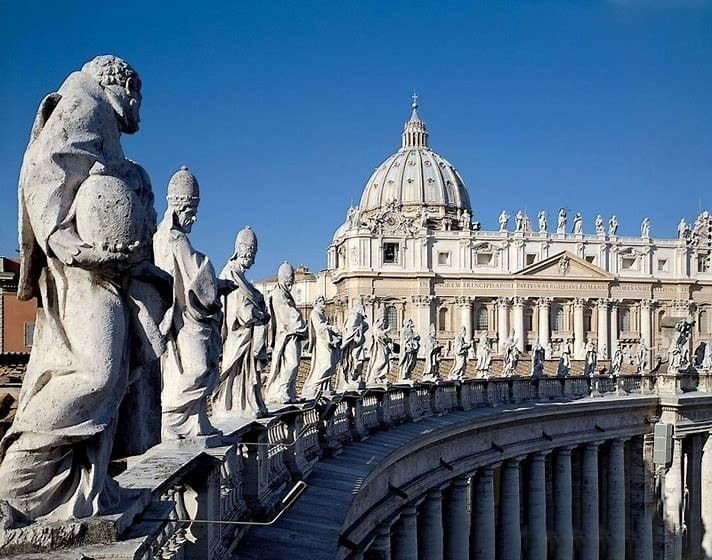
The Roman (or Papal) Curia (Curia Romana) is the main administrative body of the Holy See, the Vatican and the Roman Catholic Church as a whole. Its individual departments, in the name and authority of the Pope, answer questions, consider appeals, complaints and requests addressed to the Holy See, issue orders, decisions and sentences, take initiatives, etc. The modern Roman Curia includes a State Secretariat dealing with national affairs and diplomacy, 1 secretariat, 16 dicasteries, 3 tribunals, 6 pontifical commissions and committees, 5 inter-ministerial commissions. There is also a Synod of Bishops, personnel and other services, as well as historically established institutions (including the Vatican Apostolic Library and Archive, as well as Pontifical Universities).
The Roman Catholic Church is divided according to territorial and ceremonial principles. The territories of all countries with a dominant Catholic population and most other countries are divided into dioceses (about 3,000), headed by bishops (ordinaries). The most important dioceses are headed by archbishops. The higher clergy of dioceses (archbishops, bishops, etc.) act within the framework of ordinary (legally related to the position) jurisdiction. Some prelates and abbots, as well as priests within their parish and in relation to their parishioners, also have this right. Most dioceses are united into metropolitanates, headed by archbishops and metropolitans. Dioceses consist of parishes (sometimes they are united into deaneries), headed by priests appointed by bishops. In addition to ordinariates (bishops of dioceses), there are titular bishops who do not head dioceses, whose competence is to carry out special papal assignments in the pastoral, scientific or diplomatic spheres.
In addition to dioceses, the territorial structure of the Roman Catholic Church includes a small number of entities with territorial or personal jurisdiction extending to a specific group of persons in a particular territory or throughout the world (territorial prelatures and abbeys, apostolic vicariates, prefectures, administrations, exarchates and ordinariates, military ordinariates, missions sui iuris (i.e. with their own charters), patriarchal and archiepiscopal exarchates and one personal prelature – Opus Dei). The clergy of the Roman Catholic Church is divided into regular (from Latin. regula is a “rule”; this is the name of the monastic clergy of various orders, of which there are about 70) and secular (diocesan; this is the name of the parish and other clergy appointed by the bishop).
The vast majority of Catholics belong to the Latin Rite. There are also structures of Eastern Catholic (Uniate) churches that worship according to the rites of five Eastern traditions: Alexandrian, Antiochian, Armenian, Chaldean, and Byzantine. They exist both on their own territory and in other territories (where they operate in parallel with the structures of the Latin Rite and with each other).
There are over 5,000 bishops in the Roman Catholic Church. The bishops are united in 114 permanent episcopal conferences on a regional basis. To resolve special issues, representatives of the episcopate are gathered by the pope at a synod, in exceptional cases the entire episcopate may be gathered by the pope at an Ecumenical Council. All Latin bishops are appointed by the Pope, while the bishops of the Eastern Churches are nominated by the relevant church and approved by the Pope. Monastic associations that report directly to the pope and operate in the territories of dioceses in agreement with the ruling bishops or under a direct papal mandate have been withdrawn from episcopal jurisdiction.
Related Concepts
- aggiornamento
- assumption
- balamand-document
- brest-union
- canonical-territory
- congar
- danielou
- de-lubac
- dignitatis-humanae
- district-epistle-of-1894
- concepts/hügel
- john-henry-newman
- karl-rahner
- lefebvre
- leo-xiii
- liturgical-reform
- loisy
- lumen-gentium
- lviv-council
- mass
- modernism
- neo-thomism
- new-theology
- orthodox-catholic-dialogue
- patristics
- priesthood
- proselytism
- rahner
- renewal
- royal-priesthood
- sacrosanctum-concilium
- salvation
- scholasticism
- teilhard-de-chardin
- thomas-aquinas
- traditionalism
- tyrell
- ugcc
- vatican-i
- vatican-ii