Comparative Theology — Topic 7. The Roman Catholic Theology of the Sacraments.
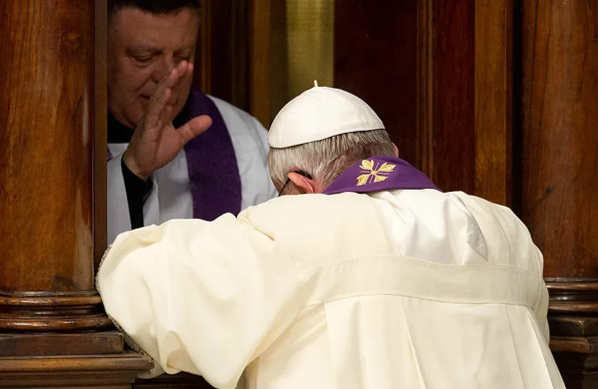
The Latin word sacramentum, adopted in the Roman Catholic Church to refer to the sacrament (along with the concept of mystery taken from the Greek language), was originally used in a socio-legal context. In Roman culture, it was the name given to the public ritual of taking a sacred oath, primarily a military oath. This circumstance played an important role in shaping the legal perception of the sacraments in the West to the detriment of mystical depth. The term sacramentum itself began to be associated to a greater extent with the ceremonial side of the sacrament. So, it’s already blj. Augustine understood it rather as a visible sign of the sacrament and supplemented it with the ontological concept of res (lit. “thing”), meaning grace as the inner content of the sacrament. Subsequently, this logic was expanded and refined, turning into a kind of sacramentological scheme: sacramentum tantum (only a sign) — res et sacramentum (grace and sign) — res tantum (only grace).
Modern Catholic teaching (quite in the spirit of Orthodoxy) points to the close relationship between the sacraments and the Church, which itself is a visible, Christ-descended “wondrous mystery of salvation.” Sacramentology in the Roman Catholic Church does not exist on its own at present, but is related to Christology, soteriology and ecclesiology. Since the second half of the 20th century, more attention has also been paid to the pneumatological and triadological aspects. Under the influence of Protestantism, the role of its edifying side, preaching, has significantly increased in modern Catholic Sacramentology.
The Catholic doctrine of the sacraments was dogmatically finalized at the Council of Ferrara-Florence (1438-1445). By this time, under the influence of scholastic theology, the idea of the seven sacraments of the Church had been established: Baptism, Confirmation (Chrismation), the Eucharist, Penance, the last unction (Unction), Priesthood and Marriage. At the same time, three of them — Baptism, Confirmation and the Priesthood — according to the teachings of the Roman Catholic Church, mystically leave a spiritual mark in a person, impose on his soul an inner sign (spirituale signum, sigillum), an “indelible seal” (character indelebilis), which in practice means the impossibility of their (these sacraments) cancellation.. In the Catholic tradition, the sacrament of Marriage is close in nature to Baptism, Confirmation, and the Priesthood.
The rest of the sacred rituals (actus cultus Divini), except for the seven highlighted ones, were attributed by Catholics to sacraments (secret rites). These usually include: church burial (exsequia), consecrations of substances and objects (dedicatio), consecrations (consecratio), benedictions (benedictio) of believers, exorcisms and processions. The Council of Trent condemned Protestant attempts to revise the established Sacramentological scheme and threatened anathema to those who “say that the sacraments of the New Testament were not established by our Lord Jesus Christ or that there are more or less than seven of them” ([1] CTrident. Decretum de sacramentis. 1). The Orthodox doctrine of the sacraments was subsequently influenced by these Catholic beliefs.
Despite the desire of the modern Roman Catholic Church to overcome the legal notion of the existence of exactly seven sacraments, at the official level such numbering remains valid to this day, although the theological emphasis has shifted to the community of all sacred rites in terms of their blessed origin “from the Paschal mystery of the passion, death and resurrection of Christ, from Whom all the sacraments receive their power “for the sake of a single goal — the sanctification of all aspects of human life.
According to the decree of the Ferraro-Florence Council, in order to be an effective instrument of the real impact of God’s grace on a person, the sacrament must consist of three structural “elements”, or originate from three causes: matter (sacramental objects, visible ritual actions), form (certain verbal formulas) and the personality of the priest (persona ministri), “teaching the sacrament with the intention of doing what the Church does. If one of these elements is missing, the sacrament is not performed” (Cfl. Exsultate Deo). And vice versa: if all these prescriptions are fulfilled, one should speak with confidence about the gracious validity (validitas) of the sacrament taught. The only condition for its perfect effectiveness (efficiacitas) is the absence of a conscious volitional obstacle (obex) on the part of the perceiver, which, on the one hand, excludes the automatic action of the sacraments, however, on the other hand, reduces human participation in the sacrament only to a passive role. The faith and inner disposition (dispositio) of the recipient of the sacrament, as well as the spiritual and moral qualities of the priest who teaches the sacrament, affect only the fruits of assimilation of the sacraments, without affecting their “objective” nature, so that grace is taught “by virtue of the very fulfillment (ex orege operato) of the sacraments” (CTrident. Decretum de sacramentis. 6, 8).
The concept of “ex orege operato” has often become the object of Orthodox and Protestant criticism, as it has become associated primarily with the correct performance of the external rite. In the new coverage of this principle in Catholic theology, along with an indication of historical misunderstandings, it is noted that its true meaning lies in pointing to the effective presence and absolute priority in the sacramental acts of the “saving work (operis) of Christ, accomplished once and for all.” Therefore, “when the sacrament is performed according to the intentions of the Church, the power of Christ and His Spirit works in him and through him, regardless of the personal sanctity of the priest (minister).” Thus, the true performer of the sacraments, according to this teaching, is Christ Himself, who is present in them by His Own power. However, in practice, this emphasis is often ignored. And in the understanding of the Roman Catholic Church, sacramental reality and salvation are synonymous, which inevitably leads to an almost magical perception of a particular sacrament.
This is not to say that the Roman Catholic Church is not trying to change the current state of affairs by approaching the Orthodox understanding of the sacraments. For example, in the twentieth century, within the framework of the “liturgical movement”, an attempt was made to identify the inner connection of dogmatic formulations with the liturgical and anthropological components of the sacraments. The impetus for the attempt to renew Sacramentology was Pope Pius X’s call for the active participation (participatio actuosa) of the Christian flock in liturgical acts and church sacraments. In this context, the strict separation of the authorized minister of the sacraments (minister) and the recipient of them (recipiens, suscipiens) was relaxed. The dogmatic position on the celebration of the sacraments by the hierarchical priesthood, which guarantees the genuine action of Christ in them by the power of the Holy Spirit, was supplemented by the idea of joint “celebration” (celebratio) by the people of God, so that all “come to that full, conscious and active participation in the celebration of the liturgy, which its very nature requires” (CVatII. Sacrosanctum Concilium. 14).
From this point of view, the sacramental ministry of clerics should be considered not only as a sacred act “in the person and in the name of Christ” (in persona et in nomine Christi), but also as acts “in the person and on behalf of the entire church community” (in persona totius ecclesiae) (CVatII. Presbyterorum ordinis. 2). The laity, according to the call of the Second Vatican Council, should not only receive the sacraments frequently and reverently, but also participate in divine services fruitfully, acting cooperently with the grace above (CVatII. Christus Dominus. 30. 2). From this point of view, “the entire congregation participates in the celebration of the sacraments, which becomes a “liturgy,” each in his own role, but in the “unity of the Spirit” acting in all.” However, these attitudes still exist today in the Roman Catholic Church mainly at the theoretical level, but in practice one can most often see the implementation of the medieval doctrine of “opus operatum”.
- General concepts
- The peculiarities of understanding and performing the sacraments in the Roman Catholic tradition (the Baptism, the Confirmation)
- The Eucharist
- The peculiarities of understanding and performing the sacraments in the Roman Catholic tradition (the Repentance, the Anointing of the sick)
- The peculiarities of understanding and performing the sacraments in the Roman Catholic tradition (the Priesthood, the Marriage)
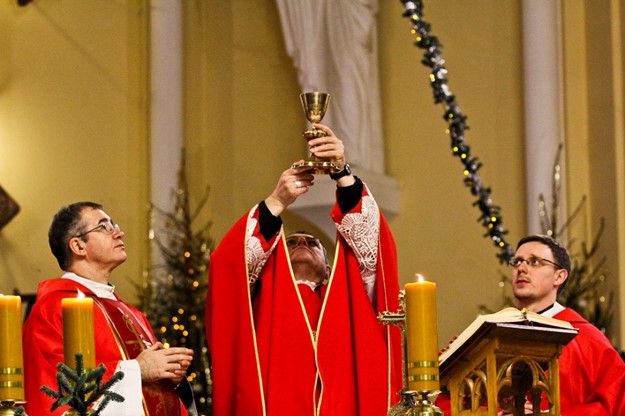
The sacrament of remembering His last Supper with His disciples, established by Christ, has various names in Catholicism: “Eucharist”, “Mass”, “Communion” (communio). The Catholic tradition is characterized by two points in understanding the role of the Eucharist in the liturgical and spiritual life of the Church. On the one hand, it is considered as the third and final sacrament of Christian initiation, as well as an “effective” means of sanctifying people, outpouring and multiplying grace, and eradicating sins. On the other hand, the Eucharist holds the first and foremost place in the sacramental hierarchy.: It is the central mystery (mysterium) of faith, established by the High Priest Christ, the “center and peak”, the “source of all Christian life”, to which the rest of the sacraments strive, the symbol of unity and love, the summary and sum of faith. The justification for the exceptional role of the Eucharist is the idea of the real, bodily presence of Christ in this sacrament, and the fundamental importance of the Eucharist as the “soul of the Church,” the meaning of which is comparable to that of Holy Scripture.
According to Catholic tradition, the sacramental formula of the Eucharist is “the words of the Savior with which He performed this sacrament”: “Take, eat” and “drink from it, all of you.” Thus, the sacrament of the Eucharist is performed, according to the Russian Orthodox Church, through the consecration of the Eucharistic Gifts by a priest through the power of his spoken words “as if on Behalf of Christ.” This view demonstrates a significant difference from the Orthodox teaching on the transfiguration of the Eucharistic Gifts by the sending down of the Holy Spirit in response to the prayerful invocation of the community and its primate (epiclesis). Although, to be fair, it is worth noting that the latest documents of the Russian Orthodox Church indicate the important role of epiclesis. It is emphasized that the real “presence of Jesus Christ in the Eucharist is achieved not by a magical or mechanical act, but, on the contrary, by prayer addressed to God the Father in the name of Jesus Christ for the gift of the Holy Spirit (epiclesis).” In the rite of the Mass, this idea is reflected in a different rite from the Orthodox one: first the epiclesis is pronounced, then the ordinal words (the so-called secret formula) and only then the worship of the consecrated Gifts is performed.
In contrast to the patristic understanding of the celebration of the Eucharist by the entire Church and in the Church, scholastic theology saw the celebrant of the sacrament exclusively in the priest, who received from God the power to convert bread and wine into the Body and Blood of Christ by the power of the ordinal words. In this regard, since the eighth century, monasteries, and then in parish churches, began to practice the celebration of Mass in private, that is, by one priest, without the participation of the people. Modern Catholic teaching insistently emphasizes that the Church, represented not only by the clergy, but also by the laity, is the subject of the Eucharistic sacrifice, offered “by the hands of the elders” “on behalf of the whole Church” (CVatII. Presbyterorum ordinis. 2). It is obligatory to commemorate the Pope during Mass as the head of the Russian Orthodox Church and the guarantor of its unity.
The fundamental soteriological function of the Eucharist, according to Catholic teaching, is that in the Mass there is a “renewal of the covenant of the Lord with people,” “the work of our redemption” and “the mystery of salvation” are accomplished. The basis of this view is the identical Orthodox doctrine of the Eucharist as a commemorative and bloodless Sacrifice (sacrificium).
Modern Catholic theology, using the example of the Eucharistic sacrifice, demonstrates how the principle of “ex opere operato” is implemented. Thanks to the Eucharist, the participants of the Mass and the deceased commemorated at it join in the Sacrifice of Christ on the cross, which is endlessly renewed bloodlessly on church altars, receiving absolution. However, although the redemptive power of the Sacrifice on the cross is transmitted in the very act of celebrating the Eucharist (ex opere operato), the degree of assimilation of its redemptive fruits depends on the depth of faith and worship of those for whom and by whom the sacrifice is performed, and can increase from time to time.
The main differences from the Orthodox practice of celebrating the Eucharist in the Russian Orthodox Church include the substances used in the sacrament, the order of communion, and some forms of Eucharistic piety.
According to Catholic teaching, the substance of the sacrament of the Eucharist is wheat bread and white grape wine slightly diluted with water. However, already in the early Middle Ages (c. IX century), unleavened bread was used in the Latin Mass instead of leavened bread. It was believed that since the Lord followed the precepts of the Jewish law on the Passover meal when celebrating the Eucharist at the Last Supper, He could only use unleavened bread. Based on 1 Corinthians 5:7-8, the idea of the conformity of the “unleavened bread of purity” with the sinless nature of Christ was added to this idea, while the “leaven of vice and deceit” was given the meaning of sinfulness. The Byzantine interpretations of leaven as a symbol of the Holy Spirit or the soul of Christ were rejected, and its comparison with the Kingdom of heaven in the gospel parable was not given due attention. Since the 14th century, Catholic practice has also included the custom of using small bread wafers for the Eucharistic consecration, designed for individual communicants. At about the same time, Catholics began using white wine instead of red wine to celebrate the Eucharist.
Until the 9th century, in the Western Christian tradition, communion was practiced under two types, with the Eucharistic bread usually given by hand, and the Eucharistic wine drunk from a cup. Then, oral communion was approved for the laity, and at the same time, by the 12th century, under the pretext of the danger of spilling Eucharistic wine, the practice of communion only under the guise of Eucharistic bread gradually spread, which received official justification at the Council of Constance (1414-1418). The Council’s decree, which exposes the errors of Jan Hus, contains references to “the true and complete content of the Body and Blood of Christ in the Eucharist, both under the guise of bread and wine.” Later, this argument was supported and developed by the Ferraro-Florence and Tridentine Cathedrals.
In the Middle Ages, communion of only adult lay people became common in Catholicism, which was quite rare. Officially, believers were required to share their previous confession at least once a year at Easter Mass. In this situation, the concept of “spiritual communion” (spiritualis communio, spiritualis manducatio) has entered into church theological usage, which occurs when believers, without physically communing, are mentally stimulated by “visible religious and pious signs to contemplate the supreme reality hidden in this Sacrifice” (CTrident. Doctrina de ss. Missae sacrificio. 5–6).
With the introduction of Corpus Christi by Pope Urban IV in 1264, a new form of Eucharistic piety emerged, performed outside the rite of Mass.: During solemn processions, accompanied by hymns dedicated to the Eucharist, the transubstantiated host is visibly displayed to the people in a special tabernacle and displayed for prayerful worship. Processions of thousands bearing the Eucharistic bread are also held during the regular Eucharistic Congresses, which began in 1879 with the blessing of Pope Leo XIII. Catholic theologians and clergy from around the world discuss various issues of the ministry and veneration of the Eucharist.
At the beginning of the 20th century, active attempts to attract believers to more frequent communion began to be undertaken by Popes Leo XIII and Pius X. At the same time, up to the Second Vatican Council, careful preparation for communion was the norm, including abstinence and obligatory participation in the sacrament of Penance. Currently, most of these requirements have been lifted, and one hour of Eucharistic fasting before communion and confession of only grave sins are considered sufficient. Believers are given permission in principle to receive communion under both types, although in practice this does not happen often. The most common way of receiving communion was to take the Eucharistic bread in hand before consumption. Not only presbyters, but also deacons and pious members of the community can distribute consecrated receptions to communicants. In justified cases, it is permissible to receive communion several times a day.
The Baptism
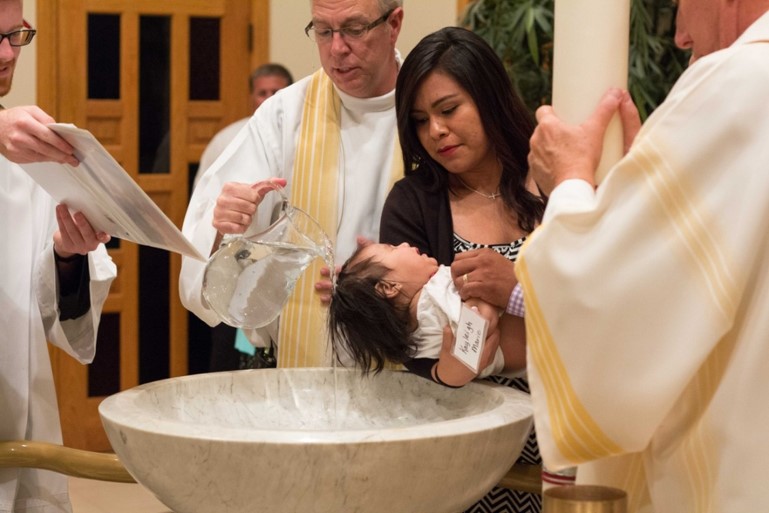
Baptism (baptismus) in the Roman Catholic Church refers, along with Confirmation and the Eucharist, to the sacraments of Christian initiation, that is, entry into the Church, the beginning of sacramental and spiritual life. Baptism as the “first sacrament of faith” is considered by Catholics as what is necessary for salvation. Quite in the Orthodox way, Catholics believe that baptism regenerates a person, communicates to Christ and His sufferings, frees from all sins, including original sin and its consequences. Since Catholic teaching believes that this sacrament imposes an indelible spiritual seal of belonging to Christianity (character Christianitatis) on the soul, it is under no circumstances performed on a person again.
In the Scholastic formulation, baptism performs the function of an “instrumental reason” for justification. The new doctrinal documents speak about the healing, “medical” effect of baptismal grace as a gift, “with which God gives us His life, infused by the Holy Spirit into our soul,” communicates to the Paschal mystery, clothes in Christ and adopts. The consequence of this sacramental rebirth of man should be his constant effort to grow “in goodness through moral virtues.” Together with the gifts of grace, the baptised are subject to obligations in relation to church regulations and laws, first of all, to “profess to people the faith received from God through the Church” and actively participate in liturgical life.
In modern practice, two baptismal rites are used: for adults and for children. Adult baptism is preceded by a thorough catechumenate, which lasts up to 3 years, and the baptism of children is preceded by a pastoral conversation with parents and godparents, one of whom may not be a member of the Roman Catholic Church. If their religious and moral intentions are not sufficiently serious, church law prescribes postponing the teaching of the sacrament to infants at a later date. The rite of infant baptism allows for certain rituals to be performed by parents or godparents (for example, anointing with oil).
Baptism can be performed both during and outside of Mass. In the Roman Rite, ordinary ministers of the sacrament include not only the bishop and the presbyter, but also the deacon. In cases of extreme necessity, everyone is legally allowed to baptise, including the unbaptised, provided that they sincerely intend and follow the correct sacramental form. The fact is that the Catholic baptiser is given an instrumental role, the official performance of the ceremonial side (sacramentum), while the saving spiritual reality of the sacrament (res sacramenti) is invisibly created by God. Therefore, in reality, “when someone baptises, it is Christ Himself who baptises” (CVatII. Sacrosanctum Concilium. 7).
The baptismal formula in the first person “I baptise you…” (ego baptizo te…), which became generally accepted in Latin Christianity by the 8th century, is most widespread. At the same time, the use of other grammatical variants, from the point of view of the Roman Catholic Church, does not affect the validity of the sacrament if it is performed with the invocation of the Holy Trinity.
Unlike the Orthodox tradition in Catholicism, since the Middle Ages, confirmation and communion have been separated from baptism by several years, with the exception of adult baptism. Since the 13th century, triple pouring (less often sprinkling) has become standard, but after the Second Vatican Council, it is also allowed to baptise by immersion in water, which is consecrated by means of the so-called “Paschal” - the Easter candle (the Catholic equivalent of the Easter three-candle used in Orthodox liturgical practice).
Catholicism has long been dominated by the idea that the re-baptism of those who have been baptised in the name of the Holy Trinity is not allowed. At the Second Vatican Council, it received an extended ecumenical interpretation: all those baptised in the name of the Holy Trinity, even those who received the sacrament outside the Catholic tradition, become “sons of the (Catholic) Church,” although to varying degrees of communion with it. The ideas about the impossibility of justification without baptism have been clarified in the modern Roman Catholic Church: for salvation, baptism is “necessary for those to whom the Gospel was proclaimed and who had the opportunity to ask for this sacrament.” This is also connected with the refusal to determine the posthumous fate of unbaptised infants, who are allowed to be buried by the church rite, “entrusting them to the mercy of God.” Catechumens who died before being baptised may be honored with a church burial.
The Confirmation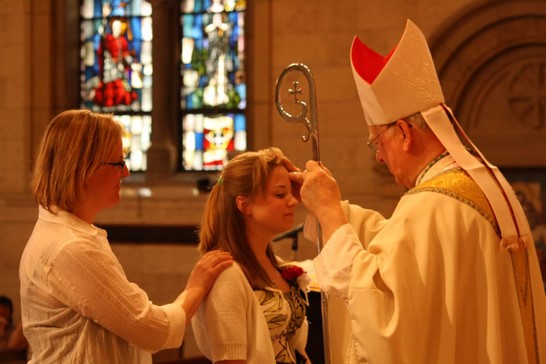
The Roman Catholic sacrament of Confirmation (confirmatio, from confirmare — “to strengthen, confirm”) is generally similar to chrismation in the Orthodox Church, however, in accordance with the practice established by the 13th century, it is accepted separately from infant baptism as its “completion” (perfectio) at the age of 14-18, that is, “with the approach of conscious age.” which is most often viewed through the prism of a specific Catholic anthropology, which sees the presence of sinfulness in the bodily nature of man. Confirmation is usually performed on a group of baptised teenagers who have previously received catechetical training. This sacrament, from the point of view of Catholicism, “imposes on the soul an indelible spiritual seal (character), which is a sign that Christ marked a Christian with a seal (sigillo). His Spirit”, and does not allow repetition.
The bishop is the ordinary celebrant of the sacrament of confirmation, which was mainly responsible for the formation of a separate order from baptism. An exception is possible only in case of mortal danger or during adult baptism, when, in accordance with the new “Rite of Christian Initiation of Adults” (1972), all three sacraments of initiation are taught by the presbyter directly after each other.
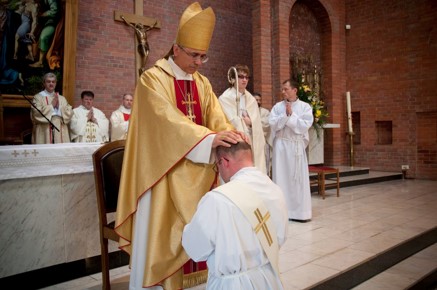
The central moment of the sacrament is the cruciform anointing (unctio) of the confirmant’s forehead with chrisma, consecrated on Holy Thursday by the diocesan (ruling) bishop. Before the anointing, the laying of hands on the head is usually performed with the recitation of a prayer and the recitation of the ancient Byzantine formula “Receive the sign (signaculum) of the gift of the Holy Spirit,” which since 1971 replaced the Latin formula of the XII century. Acceptance of confirmation grants the right to participate fully in the life of the church community, to choose and be elected to certain positions and ministries, and is also a prerequisite for ordination to the priesthood and desirable for entering into a church marriage.
In order to consciously confirm the baptism received in infancy, the confirmant is recommended to personally repeat the baptismal vows, renounce Satan and pronounce the Creed. It is highly desirable that the recipients participate in the sacrament, at best the same as at baptism. Confirmed Catholics receive the opportunity to receive communion regularly. However, in most cases, confirmation is already preceded by the first communion at the age of 7-8, and many Catholic theologians note the inconsistency of this medieval order with both historical church practice and sacramental logic, according to which participation in the Eucharist is the pinnacle and goal of Christian initiation. According to the Joint International Commission for Theological Dialogue between the Orthodox and Roman Catholic Churches, the custom of receiving communion from children before confirmation contradicts the liturgical tradition of the Ancient Church and needs to be rethought.
**
**
The Priesthood
In Catholicism, the sacrament of the Priesthood (sacramentum ordinis; ordo — “rank, estate, rank”) is understood as a special election (segregatio) and sacramental consecration (consecratio). It is allowed to be taken only by baptised and confirmed males through the church rite of ordination (ordinatio), similar to Orthodox ordination. Nowadays, when speaking about the meaning of the priesthood, Catholics put at the forefront the service of the people of God, “to all members of the Church,” which consists in continuing the mission of salvation entrusted by Christ through the Holy Spirit to the apostles. Therefore, the Roman Catholic Church understands ordination as entry into direct “apostolic succession” (successio apostolica), which serves as one of the main criteria for the sacramental completeness and authenticity of the official, hierarchical priesthood (sacerdotium ministeriale seu hierarchicum), in contrast to the general priesthood (sacerdotium commune) of all baptised.
As in Orthodox teaching, in the Catholic view, the priesthood, on the one hand, is a single divinely established “sacrament of apostolic ministry,” on the other hand, it has received a hierarchically organized structure in the tradition of the Church — it “has three levels (gradus): Episcopal, presbyterian and deaconal”.
Through ordination (impositio manuum), candidates, from the point of view of Catholics, receive the anointing of the Holy Spirit, as a result of which they are “sealed with a special seal (speciali charactere) and become so like Christ, that the Priest can act on behalf of Christ, the Head of the Church (in persona Christi Capitis).” Ordained priests carry out a mysterious connection (vinculum sacramentale) “with what the apostles said and did, and through them with what Christ said and did, the source and basis of the sacraments”; they are connected with the action of Christ, that the Priest can in a special way replace Him, His Personality (personam), becoming, as it were, His “icon”.
The Church’s canonical exclusion of women from ordination to the priesthood is also justified by the idea of the “iconic” nature of this sacrament, rooted in the economy of salvation: ordination of women is impossible, because “The Lord Jesus chose men to form the college of the twelve apostles, and the apostles then did the same, choosing their collaborators”; following tradition, “The Church recognizes itself bound by this choice of the Lord Himself.” Despite the fact that the issue of women’s priesthood has recently been actively discussed at the theological level and in the public environment, the official position of the Roman Catholic Church remains unchanged.
Another controversial topic in modern Catholicism is the issue of the sexual orientation of candidates for the priesthood. In order to regulate it, Pope Benedict XVI approved the instruction of the Vatican Congregation for Catholic Education on the inadmissibility of taking holy orders both by persons with homosexual tendencies and those who are loyal to the manifestation of such inclinations.
Together with the irrevocable “seal” of the official priesthood, the sacrament communicates the “sacred authority” (sacra potestas) to serve “the people of God through teaching (munus docendi), worship (munus liturgicum) and pastoral administration (munus regendi).” Therefore, although the general priesthood of the faithful and the hierarchical priesthood of clerics are directed towards each other and interrelated, the difference between them, according to Catholic Sacramentology, is significant, “and not only in degree” (essentia et non gradu tantum differant). The consequence of this difference is that it is “essentially” impossible for those who have received priestly grace through ordination to become lay people again.
The celibate lifestyle, which has been canonically prescribed to Latin Rite priests since the 11th century, serves, according to Catholics, as a sign of a special vocation to unity with God. At the same time, modern Catholicism is dominated by the view of priestly celibacy as a sacred tradition, which does not relate, however, to divine institutions and does not affect, respectively, the dogmatic essence of the priesthood. In this regard, the assumption of marital status for Uniate presbyters of the Eastern Rite is legitimate in modern Catholicism and is not considered flawed.
The scholastic concept of the “visible sign” or “matter” of the sacrament of the priesthood has undergone a radical revision in the history of Catholic Sacramentology. For a long time, the “matter” of the sacrament was traditionally understood as the transfer of liturgical vessels with Eucharistic wine and bread, which was recorded in the instructions of the Ferraro-Florence Cathedral. In this regard, significant changes took place in the twentieth century: “the matter — and the only matter — of the holy orders of the diaconate, presbyterate and episcopate is the laying on of hands.” The form of the sacrament is contained in the prayer accompanying the ordination, which reveals the main goals of the ritual actions.: “Likewise, the form—and the only way—consists of words that define the use of this matter and signify the effects of the sacrament (effectus sacramentales), in other words, the authority of the priesthood and the grace of the Holy Spirit.” Ordination in the Roman Catholic Church is performed during the Eucharistic divine service.
The fullness of the sacrament of the priesthood, from the point of view of Catholics, is revealed in the episcopal dignity (ordo episcoporum). After the Second Vatican Council, the diocesan (i.e. ruling) bishop was largely restored to its previously lost independent significance.: As the “vicar of Christ” and the “visible head” of the local Church, he was entrusted not only with the priestly “authority of dignity” (potestas sacramentalis) for the administration of the Mysteries of God and the preaching of the Gospel, but also with the pastoral and administrative “authority of jurisdiction” (potestas iurisdictionis) in his diocese. As a result, bishops “should not be considered as vicars of the Roman Pontiff.” At the same time, the episcopal ministry in Catholicism must necessarily be performed “under the authority of the pope, the successor of St. Peter.”
Special rights and responsibilities in the administration of the Roman Catholic Church - firstly, the right to participate in the process of electing the pope (conclave) — are vested in bishops who have been awarded the cardinal title at the discretion of the Pope. Within the Catholic episcopate, they form a separate college headed by the dean to assist the Pope in resolving important issues. However, promotion to the dignity of cardinal is not a sacramental ordination to a hierarchical degree. Thus, a cardinal is, first of all, an administrative position.
The ministry of presbyters and deacons in Catholicism can be carried out only in unity with a higher bishop. At the same time, in liturgical rites and sacraments, presbyters act on behalf of their church community, “standing before God in the prayer of the Church, and especially performing the Eucharistic sacrifice.” Deacons are located at the lowest rung of the church hierarchy. Traditionally in Catholicism, it was believed that when ordained, they received the grace of service, not the priesthood (non ad sacerdotium, sed ad ministerium). In the Middle Ages, their liturgical functions were reduced in fact only to the reading of the Gospel, and the diaconate was considered only as a necessary preliminary stage for admission to the presbytery. The situation changed after the Second Vatican Council, which set out to restore the institution of permanent diaconate in Catholicism and allowed married men at least 35 years old to join it in addition to celibacy. The deacons’ ministry has been given a sacramental character, with regular powers to teach communion during and outside the Eucharist, perform baptism and most sacraments, as well as preside over the rite of the sacrament of Marriage; it is allowed to pronounce a church sermon and perform some pastoral functions.
The Marriage
The systematic teaching of the Catholic sacrament of Marriage (matrimonium) developed in the medieval scholastic tradition. Subsequently, it was approved by the dogmatic decrees and canons of the Council of Trent. Its distinctive feature is the underlying legal approach: according to Roman legal theory, marriage is considered as a bilateral contract, or a mutual agreement (contractus, consensus matrimonialis), between a man and a woman. It follows from this that married Christians do not so much accept the church sacrament as they create and teach it to each other.
At the same time, Scholasticism was still able to clearly answer the question of the “matter” and “form” of the sacrament of Marriage. According to the modern Catholic interpretation, “matter is the mutual commitment (traditio) of spouses. The form is the mutual acceptance (accepatio) of this dedication.” At the same time, one of the central sacramental moments of marital mutual giving is physical union (copula carnale) for the sake of procreation: “A valid marriage between baptised persons is called approved only if it has not yet become completed.”; approved and completed if the spouses have humanly committed a marital act between themselves, intended in itself to produce offspring. Marriage is directed to this act by its very nature, and the spouses become one flesh through it” (CVatII. Gaudium et spes. 48–49).
If there is a valid reason, the dissolution of the marriage is possible only by the decision of the Roman Pontiff and only if it is incomplete. “An approved and completed marriage cannot be dissolved by any human authority and for no reason other than death,” but it can be annulled. Thus, the next marriage, which one of the spouses enters into, will be considered his first and only.
The participation in the wedding of a clergyman of any degree (including a deacon) or, in some cases, a lay person appointed by a bishop has a more representative function, expressed in the testimony of the ecclesiastical nature of the ceremony through the teaching of benediction (benedictio) to the married couple on behalf of the Roman Catholic Church. However, since the presence of church representatives does not affect the sacramental essence of the rite, a marriage concluded in exceptional circumstances without their participation only in front of witnesses is considered valid and does not require liturgical completion.
In the 20th century, Catholic Sacramentology has been striving to overcome a narrow legal view of marriage, especially after the Second Vatican Council, which used the term “matrimonial union” (matrimoniale foedus) instead of “contract” in relation to this sacrament and approved the thesis that “marriage is established not only for the sake of procreation.” Christian marriage is considered in the modern Roman Catholic Church as a sacramental source and instrument of holiness, a means of obtaining grace-filled help in the fight against sin and selfishness on the way to the Kingdom of God and eternal life. Attention is also drawn to the pneumatological aspect, which is that “in the epiclesis of this sacrament, the spouses receive the Holy Spirit as a union of love (communionem amoris) of Christ and the Church.” In this context, its dissolution (divortium), which has been the subject of recent discussions in Catholicism, is not possible from a dogmatic point of view either, because “divorce is an insult to the Covenant of Salvation, the sign of which is the sacrament of Marriage.”
At the same time, the liturgical practice of Catholics does not deny the possibility of annulment of the sacrament of Marriage. There may be several reasons for such a procedure. But this list does not include, oddly enough, the adultery of one of the spouses. “In the case of adultery, separation is permissible, but since the obligation assumed by a person in marriage is irreversible, spouses living apart cannot remarry.” Annulment of a marriage is possible only with so-called marital consent of the spouses, which, from the point of view of Catholicism, should include the following elements: the actors of the marriage union — a man and a woman — must be baptised (although exceptions are possible here), free to marry and voluntarily express their consent.
“To be free” in this case means not to be forced, not to have obstacles from the point of view of natural or ecclesiastical law, not to be married in another church, or not to take vows of monasticism. Unlike Orthodox practice, in modern Catholicism, spiritual kinship is not considered an obstacle to church Marriage according to the Latin rite. Annulment, that is, the recognition of this marriage as invalid, is subject to that marriage union, which is concluded under physical and moral pressure, which must be proved in a church court, concluded as a madman, a person legally incapacitated, again, before the marriage, and this must also be proved. And also with a monk who took permanent vows and was not released from them by the highest church authority before marriage. If a husband and wife prove in a church court that such circumstances took place, then their marriage is declared invalid, and their cohabitation for some time, maybe even for a long time, turns into a simple cohabitation.
**
**
The Repentance
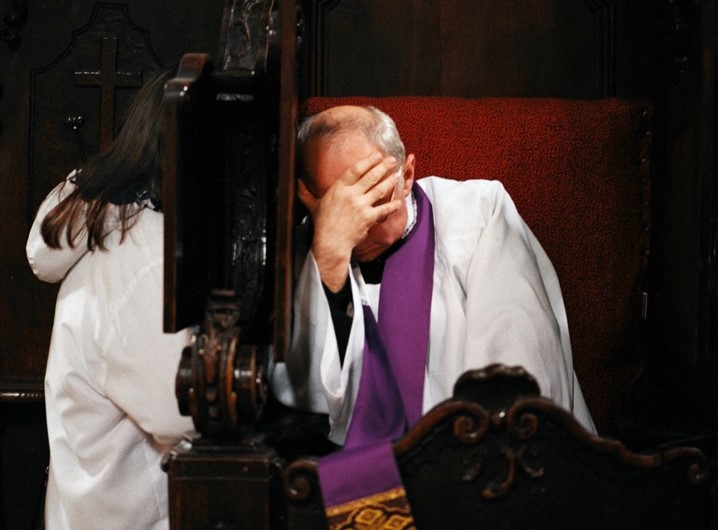
According to the Roman Catholic teaching, in order to forgive the sins committed by believers after baptism, Christ established the sacrament of Penance (paenitentia/poenitentia) and transferred this authority to the Church in the person of its clergy. This is the soteriological function of the sacrament: “this sacrament is necessary for the salvation of those who have fallen after baptism.” It also has other names in the Catholic tradition: “conversion” (converso), “confession” (confessio), “reconciliation” (reconciliatio). According to Catholic teaching, repentance serves to restore the baptismal grace of justification (iustificationis gratia), lost through personal sins, a new acquisition of righteousness (iustitia), healing of the soul and spiritual resurrection. At the same time, “there is not a single sin, no matter how grave, that the holy Church cannot absolve,” since the fundamental possibility of sacramental forgiveness (venia) and remission (remissio, dimissio, absolutio) of sins is provided by the redemptive merits of Christ. However, the validity of this sacrament also requires the penitential effort (procuratio) of the sinner himself in response to the calling initiative of God. The unity of these components is realized in the church rite, which includes a personal confession of sins. Therefore, in the understanding of Catholics, repentance is “both a highly personal act and a church liturgical ceremony.”
In the logic of scholastic thought, the conditional “matter” (quasi materia) of the sacrament refers to certain actions of the penitent. Firstly, repentance, which comes from contrition of the heart, can be twofold in spiritual and moral terms: perfect contrition (contritio) is always caused by sincere aversion to sin; imperfect contrition (attririo) is caused only by fear of hellish punishments, however, from the point of view of Catholics, it is sufficient for the validity of the sacrament. Secondly, secret confession is the oral confession of sins to a priest (oris confessio); It should be as complete as possible, especially with regard to mortal sins, because what is not confessed cannot be forgiven.
Thirdly, the bringing of satisfaction (satisfactio) prescribed by the confessing priest for committed offenses against the justice of the divine law. Its fulfillment is associated, as a rule, with fasting, prayers and works of charity. This sacramental element is carried beyond the limits of the liturgical rite, since in most cases it is realized by the penitents chronologically later and after the forgiveness of their guilt.
The “form” of the sacrament of Penance is in the words of absolution from sins (verba absolutionis), pronounced by the priest on his own behalf (“ego te absolvo…”) in the name of the Holy Trinity. Although some changes to the sacramental formula or additions to it with other prayers are permissible, they, according to the Council of Trent, “do not relate to the essence (essentiam) of this form itself and are not necessary for the performance (administrationem) of this sacrament.”
An essential condition for secret confession is considered to be direct personal contact between the confessing priest and the penitent believer, carried out only in the mutual presence. Since the beginning of the XVII century. For this purpose, confessionals (confessionales), small booths with a continuous partition or grating separating both participants in the sacrament for the sake of partial or complete visual anonymity and preserving the secrecy of confession, but not preventing them from hearing each other, have become mandatory in Catholic churches. If desired, in modern practice, it is allowed to conduct confession face to face in the so-called “reconciliation room” located in the temple.
The ministers of the sacrament of Penance may be bishops or “priests who have received the right to profess from the church authorities.” They have the power to make a kind of legal decision in the sacrament “like a judge,” reconciling the sinner to God and the Church. The legal aspect of penance plays an essential role in Catholic Sacramentology. The logic of legal relations is reflected in the fact that this sacrament is understood mainly as a judicial act (actus iudicialis) designed to resolve the conflict between a sinned person and a “mortally offended” God as a result. In order to correct his guilt, the sinner must bring appropriate satisfaction and propitiate the Lord for his transgressions with many efforts, “as required by God’s justice (iustitia),” because “divine mercy does not absolve us of our sins without satisfaction.” In the plane of legal relations, there is also the doctrine and practice of granting indulgences by the church hierarchy, serving the “partial or complete” liberation of repentant believers from the “temporary punishment (poenae) for sin.”
In modern Catholic theology, attempts are being made to rethink the sacrament of Penance. The impulses for renewal were given by the Second Vatican Council, which noted that “the sacrament of penance greatly promotes success in Christian life.” After that, much theoretical and pastoral work was carried out to reveal the spiritual content of repentance in its relation to the life of an individual within the church community. The traditional judicial and legal characteristics of the sacrament are now balanced by arguments about God’s mercy and humanity, with which He, as a loving Father, receives penitents. In this context, the need for reconciliation of sinners with the Church through repentance is primarily due not to legalistic considerations, but to the fact that they “inflicted wounds on her with their sins.” This is how the Roman Catholic Church adopted the Orthodox view of the healing, “therapeutic” nature of repentance.
The Anointing of the sick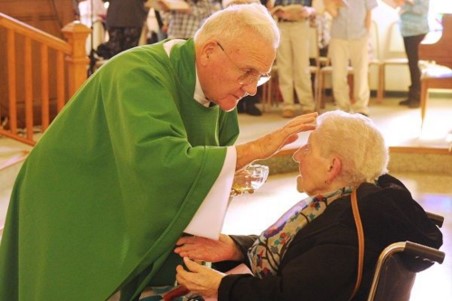
In modern Catholicism, after the liturgical reform, the name of the sacrament was changed from the “Last Unction” (extrema unctio) to the “Unction of the Sick” (unctio infirmorum). The renaming actually reflects the rejection of the previous dogmatic interpretation of the anointing of the sick as the “sacrament of the dying” (sacramentum exeuntium, sacramentum moribundorum), which completes the life of a Catholic and gives him sacramental parting words along with the last communion (viaticum). Instead of the outdated perception, a new one was given – going back to the ancient Christian idea of a sacrament performed primarily on believers suffering from illnesses under various circumstances. Thus, the new Catholic understanding of the sacrament became closer to the original Orthodox teaching on Unction (Unction).
The impetus for rethinking was given by the Second Vatican Council in the constitution on the sacred Liturgy “Sacrosanctum Concilium”: “The Last Unction, which can also be called (sounds better) “Anointing of the sick,” is a sacrament intended not only for those who are on the verge of death. Therefore, the appropriate time for accepting it undoubtedly comes already when the faithful are in danger of death due to illness or old age” (CVatII. Sacrosanctum Concilium. 73). In the later definition of the Catholic Catechism, there is no longer any ambivalence in the naming: “The Church believes and confesses that among the seven sacraments there is one specifically designed to strengthen those who are exhausted by illness: the Anointing of the sick.” Therefore, the sacrament can be performed more than once in a lifetime, which is almost universally the practice of the past, although other cases have never been completely excluded. Nevertheless, even in modern times, the emphasis remains unchanged on the condition that it is committed mainly in case of a real threat to life.
The main content of the sacramental effect of anointing the sick is seen by Catholic theology not so much in physical recovery, which is more of a miracle, as in spiritual relief and improvement achieved by prayerfully entrusting “the sick and the suffering to the Lord and the glorified.” The Roman Catholic Church considers the vegetable oil consecrated by the bishop on Holy Thursday and the anointing of the five sensory organs of the sick person to be the “matter” of the sacrament, but as an exception, one anointing of the forehead or another part of the body is allowed. Catholics consider only bishops or presbyters to be the usual ministers of the sacrament. Some theological and pastoral arguments cited in modern Catholicism in favor of the possibility of teaching the sacrament of anointing to the sick in special cases by deacons or even laypeople have not received official approval.
Along with Penance and the Eucharist, the sacrament of the anointing of the sick is allowed by the Russian Orthodox Church to be performed for Eastern Christians (Orthodox and non-Chalcedonites), provided that “they themselves ask for it and are properly disposed.” A similar procedure has been established for Catholics who do not have the physical or moral ability to request the teaching of one of these sacraments to a Catholic priest. The celebration of the sacrament over Protestants is possible if they express faith in its validity.
In addition to the bishop, “any presbyter can consecrate the oil, if necessary, but only during the actual celebration of the sacrament”; first of all, this concerns the practice of Uniate churches in accordance with the Eastern rite. Usually, one priest performs the anointing of the sick and teaches it to one believer. However, concelebration is possible in principle, and joint unction of several patients at once is allowed only on the instructions of the diocesan bishop, provided they are properly experinced and prepared. The requirement for meaningful acceptance of the sacrament also applies to children after the age of 7, who are allowed to be anointed if they have already been confirmed. Applying the oil is prescribed to be done directly by hand, unless there are any compelling contraindications. To better match the age or specific difficult situation of the patient, the new order provides for variability in choosing from seven possible so-called healing prayers.
Related Concepts
- actus-cultus-divini
- adoration
- anaphora
- annulment
- anointing
- anointing-of-the-sick
- article-28
- article-31
- benedictio
- bishops
- bloodless-sacrifice
- calvary
- catechumenate
- catholic-doctrine-of-the-mass
- celebratio
- celibacy
- character
- christ
- christ-as-true-minister
- church-life
- church-order
- clergy
- command-of-god
- communion
- confirmatio
- confirmation
- consecration
- contrition
- council-of-ferrara-florence
- council-of-trent
- deacons
- dedicatio
- diocesan-administration
- diocese
- dispositio
- eastern-rite
- efficacitas
- epiclesis
- episcopacy
- episcopal-college
- episcopate
- eucharistic-controversy
- healing
- historical-continuity
- holy-gifts
- holy-spirit
- indulgence
- initiation
- intention
- judge
- justice
- laity
- matter-and-form
- matthew-parker
- matthias
- minister
- mysterium
- obex
- opus-operatum
- ordo
- orthodox-anglican-dialogue
- penance
- piety
- pope
- priesthood
- remembrance
- res
- sacrament-of-priesthood
- sacramental-economy
- sacramental-efficacy
- sacramental-form
- sacramental-guarantee
- sacramental-theology
- sacramentals
- sacramentum
- sacrificium
- satisfactio
- satisfaction
- scholastic-theology
- sigillum
- sign
- spirituale-signum
- transformation-of-the-gifts
- valid-sacraments
- validitas
- validity
- vatican-ii
- viaticum