Comparative Theology — Topic 6. The Roman Catholic doctrine of the Mother of God.
- The Dogma of the Immaculate Conception
- The refutation of the Roman Catholic dogma of the Immaculate Conception of the Virgin Mary
- The Roman Catholic dogma of the bodily ascension of the Virgin Mary and its refutation
- Modern Mariological discussions in the Roman Catholic Church.
An important component of Catholic Mariology is the teaching of the intercessory ministry of the Mother of God. This teaching is not a dogma of the Roman Catholic Church, but it has long been widespread. It is based on the idea of the atonement of Mary, which dates back to the 15th century, but received dogmatic recognition only in the 20th century, largely in connection with the dogma of the bodily ascension of the Ever-Virgin. The encyclical of Pius X “Ad diem illum” asserts that Mary is “united by Christ with a redemptive act”, the encyclical “Mystici Corporis” defines that Mary “being free from all sin … is most closely united with Her Son, presented Him on Calvary to the Eternal Father, offering in addition Her rights and Her love to the Mother as a burnt offering… for all the sons of Adam,” the mention of Mary’s atoning ministry is also contained in the Munificentimissimus Deus. The Virgin Mary participated most directly in the incarnation and, accordingly, she should accompany her Son in the feat of redemption, although her participation is secondary and incommensurable with him.
The intercessory ministry of the Mother of God continues even after the redemptive death of her Son. The Mother of God is entrusted with intercession for the human race before Him, because according to Leo XIII’s encyclical “Octobri mense”, “one cannot come to the Father Above except through the Son … similarly, one can come to the Son only through His Mother.” Just as the Source of grace came into the world through the Mother of God, through Her the gift of grace is communicated to the world. According to Bernardine of Siena: “She is the neck of our Head, through which all spiritual gifts are communicated to His mystical Body.” Many Catholic theologians, including Bernard of Clairvaux, Bellarmine, and others, wrote about Mary’s grace-filled mediation. According to the teaching of the Roman Catholic Church, Mary is also the Mother of the Church, for having given birth to her Head in humanity, She still leads the flock of the saved, who turn to her as a true Mother for help.
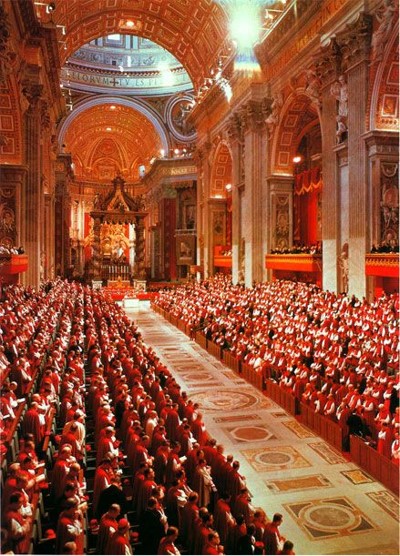
In the modern development of Catholic Mariology, it is necessary to note the reasonable caution shown in this matter by the participants of the Second Vatican Council. The teaching of Mary itself was included in the general dogmatic constitution “On the Church”, although at first it was planned to adopt a separate mariological document. The chapter dedicated to the Virgin Mary is distinguished by dogmatic restraint, although both Marian dogmas and the mediation ministry of the Virgin Mary received conciliar confirmation in it. To a certain extent, the apostolic exhortation of Paul VI “Marialis cultus” (1974) is a continuation of this restrained approach. In marked contrast to the previous deification of Mary, this document emphasizes the earthly, human dimension of Her ministry, which becomes a symbol of femininity and motherhood so necessary for the modern world. The Catechism of the Roman Catholic Church pays considerable attention to the ecclesiological ministry of Mary.
In the recent history of the Roman Catholic Church, Mariology remains one of the most intensively developing areas, two of the three new dogmas are devoted to the teaching of the Mother of God. Paradoxically, such intense attention to the personality of the Virgin Mary stems from the profound distortion of the image of the Savior to which he was subjected in the medieval religious consciousness of Catholicism. As the archbishop writes about it. Mikhail (Mudyugin): “The main reason … for the Mariological enthusiasm, which we see especially vividly in the late Middle Ages, as well as in our time, is the loss of Catholics’ perception of Christ Jesus as the Savior in the Middle Ages… and the transformation of the evangelical image of Christ into the image of… The judge… and the bailiff. Such a substitution… led to the estrangement of the Catholic soul from his Lord… to destroy the inner unity with Him and to replace him with a consciousness of legal responsibility, which existed even in the Old Testament Church.” The fear of an infinitely just but ruthless God inevitably generated rejection and a sense of religious impotence, which permeated the entire consciousness of medieval Catholicism. On this basis, there is a desire to find a replenishing Divine principle that is merciful to man and brings his prayer closer to God, because “we cannot find anyone who would be more full of merit … to appease the wrath of the Judge.” The Virgin Mary is gradually becoming the embodiment of these searches, and the human consciousness sees her as an intercessor closer to herself than her Son. The danger of such substitute worship is that it objectively weakens faith in God, who became man and suffered for man, and devalues the basic tenets of Christianity – the Incarnation and Redemption.
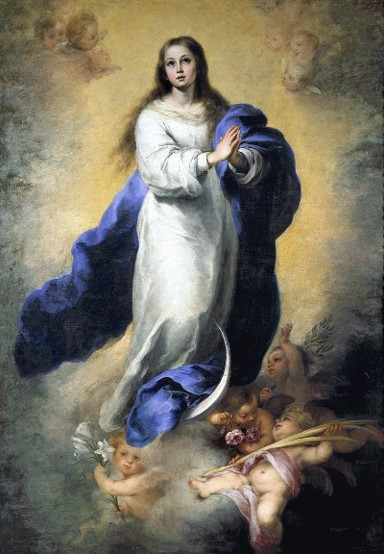
The doctrine of the immaculate conception of the Virgin is not a theological analogy or a synonym for the immaculate conception of the Lord Jesus Christ. This can be seen even at the level of terminology. If the conception of the Son of God by the Holy Spirit is called virginalis conceptio (“virgin conception”) in Latin theology, then the conception of the Mother of God is immaculata conceptio (“immaculate conception”). The Roman Catholic Church, without denying the physical participation of St. Joachim in the conception of his Daughter, proceeded from the desire to protect God, who became man, from any taint of sin or any other imperfection inherent in the human race by default. From the point of view of the Roman Catholic Church, in order to become a “perfect man,” the Divine Word needed a perfect nature, free from sin.
To do this, it was necessary to “deliver” Mary from sin, who gave the Savior flesh, because, according to Thomas Aquinas, “she would not have been a proper Mother of God if she had ever sinned. Therefore, we must… recognize that the Blessed Virgin has never committed any sin.” However, it should be noted that in this perspective, the teaching of Catholics does not differ from the Orthodox view. As well as other conclusions of Thomas Aquinas, who pointed out that the Virgin Mary’s Mother-of-God presence in close proximity to the Son of God is the natural basis of her special purity: “the closer something is to the root cause, the more it participates in its action. And of all creation, Mary… is most close to Christ, the source of grace.… Accordingly, she becomes involved in the highest measure of grace.”
However, the doctrine of the Immaculate Conception of the Mother of God presupposes faith not only in the moral purity of the Virgin, but also in Her original natural purity. According to the Roman Catholic Church, the Virgin Mary, having begun Her life like any other person, nevertheless, was specially protected by God from original sin and its consequences. Or as the official wording of the Catholic dogma says: “We declare, proclaim and define that the teaching that adheres to the fact that the Blessed Virgin Mary was from the very first moment of Her Conception, by the special grace and favor of Almighty God, in view of the merits of Jesus Christ, the Savior of the human race, preserved unblemished by any stain of original sin, is the teaching revealed by God, and therefore it must be firmly and constantly believed by all the faithful” (Ineffabilis Deus). In other words, the Mother of God, from the point of view of the Roman Catholic Church, was not only able to benefit from the redemptive fruits of Her Son’s mission long before the Redemptive Sacrifice actually took place, but also acquired a special status as a de facto “co-redeemer” of the human race: “The consequence … of the community of suffering and feelings between Mary and Jesus is that Mary “fully deserved to become the restorer of fallen humanity,” and therefore the distributor of all the treasures that Jesus acquired for us through His death and His Blood” (Ad Diem Illum).
The Roman Catholic dogma of the Immaculate Conception has undergone several periods of development: in the first (I–IX centuries) it was at the stage of origin (dogma implicitum); in the second (IX–XIX centuries) it remained in the form of a controversial and non–binding opinion; and in the third (since the XIX century) it became an approved dogma (explicitum). The first attempts at a theological justification of the immaculate conception of the Virgin Mary are associated with the name of a Western theologian of the 9th century. Radbert’s Easter. The ancient church Tradition, while admitting the moral purity of the Blessed Virgin, did not recognize natural purity, pointing out the impossibility of the so-called “premonitions” of the Mother of God. However, the first and second types of chastity, due to the specific ideas of the Christian West about the human structure, were combined by Rabdert in relation to the Mother of God. This is how the Western theologian tried to justify the need for the Son of God to inherit pure nature from a pure source. At the same time, Paschal Radbert opposed the Tradition of Mary’s ascension to heavenly glory. He wrote that the teaching of the Church should be based on the evidence of the Holy Scriptures, and there is no mention of the Dormition of the Mother of God.
The further development of the doctrine was due to historical rather than theological reasons. In the eleventh century, Pope Gregory VII finally approved mandatory celibacy in the Western Church. This innovation encountered stubborn resistance among the Catholic clergy. In contrast to the forcible establishment of celibacy, the veneration of the immaculate (that is, pious) conception began to develop (the term was borrowed from the Eastern Church) The Blessed Virgin Mary, who sanctified the dignity and sanctity of marital life in all its fullness. Already at the present stage, reference to the experience of the Orthodox tradition has found a place in the current Catechism of the Roman Catholic Church.: “The Eastern fathers of the Church call the Mother of God “All-Holy” (Panagia), they glorify Her as “protected from all defilement of sin, as if formed by the Holy Spirit and created as a new creation.” By the grace of God, Mary remained free from all personal sin throughout Her life.”
In this case, we are talking about the same mixture of two types of purity – natural and moral. And it is precisely by the example of the holy fathers of the East that we see how these two types subtly and reverently differ. St. John of Damascus writes: “Noah built the Ark to avoid the flood, and Christ, Who is our world, prepared Mary for Himself in order to redeem the human race… The ark was made of rotting trees, and Mary was filled only with virtues. He was floating unharmed over the waters of the flood; She had not experienced a sinful shipwreck. Through the ark, the chosen ones were saved from the flood of water; Through Mary, all who heed the calls of grace are saved. From Noah, who came out of the ark, the human race began anew, and from Christ, who was born of Mary, a new life was imparted to mankind.” The Ark was made of trees that grew in a sinful world that God destroyed through the flood. The Mother of God belonged by nature to the humanity of the Old Testament, which had not yet been redeemed. However, just as the ark saved Noah and his family, giving hope for the future, so the Virgin Mary served the cause of salvation, giving birth to his Savior for the world. St. Peter also wrote about the distinction between natural and moral purity. Ephraim the Syrian: “You, Lord, like Your Mother, are both holy. For You are without blemish (i.e. original sin) and Your Mother is without sin (i.e. personal sin).”
But let’s return to the history of the formation of the Catholic doctrine of the Immaculate Conception. Soon enough, the conception of the Blessed Virgin by Joachim and Anna was no longer considered in the context of protecting the marriage of the clergy from the encroachments of the papacy. The desire to emphasize the absolute natural sinlessness of the Virgin Mary, supposedly necessary for the miracle of the Incarnation, came to the fore. The feast of the Conception of the Holy Virgin by the Righteous Anna, which penetrated into the Western Church from the East, gave reason to attribute the consecration of the Mother of God to conception itself. Or as Catholic theologians argued: The Holy Virgin Mary was consecrated at Her very conception, otherwise the Church could not celebrate Her conception. In this regard, Western Christians who were influenced by the specific asceticism and soteriology of the blj. According to St. Augustine, they made a mistake – the “immaculate conception”, which the Eastern authors wrote about, did not have any special mystical meaning. It was just that the righteous Joachim and Anna, who lived piously, and their beloved Daughter conceived immaculately, that is, piously, chaste.
However, theological and historical circumstances led to the fact that in the West, the feast of the conception of the Blessed Virgin Mary, which was unpopular among the church people in the 12th century, acquired the status of an integral element of church tradition by the 15th century. And this is despite resistance from some extremely influential theologians. In the 12th century, Bernard of Clairvaux opposed the first manifestations of the doctrine of the immaculate conception. Thomas Aquinas also spoke with caution about the Immaculate Conception. The “angelic” doctor was preoccupied with questions: in what sense did the Holy Virgin belong to Adam’s sin, in an ideal, legal, or in a real, ontological one? Had She been informed of the sinfulness of Adam’s nature, or had She not been informed? Answering these questions, Thomas not only admitted the participation of the Mother of God in original sin in the sense of inheriting the guilt of the grandparents, but also argued that the Virgin Mary was informed of the sinfulness of nature, which does not allow believing in the Immaculate Conception.
In contrast to Thomas and other critics of the concept of the Immaculate Conception, the Franciscan theologian John Duns Scotus argued that the Mother of God was involved in sin only ideally, legally; natural sinfulness was not communicated to Her from Her parents. Answering the question, “Was the Blessed Virgin conceived in original sin? – Scott indicates that there are three possible answers: “God could have made sure that She was never in original sin; He could also have made sure that She was in sin for just one moment.; He could also have caused Her to be in sin for some time, and at the end of that time She would be cleansed from sin.” Scott himself opted for the first answer (unlike Thomas, who adhered to the third version), pointing out that he gives special glory to the Mother of God and “attributes something more perfect to Mary” than other Western theologians.
At the same time, Scott understood that his preaching of the Immaculate Conception of the Virgin Mary, which presupposes that She has the gifts of Christ’s saving mission, calls into question both the sacred history of the Old Testament and the integrity of the redemption of the human race. After all, if the Mother of God turns out to be free from the guilt and consequences of ancestral sin, then She does not need redemption, which ceases to be universal. Believing that Mary was freed from sin, John Duns Scotus pointed out that She needed redemption, and on this basis put forward the idea of “pre-redemption” (praeredemptio). “A more important boon is to protect from evil than to allow oneself to fall into evil,” therefore, from the point of view of Cattle, God, by the power of the impending atonement, freed the Virgin from sin at the very first moment of Her existence. Thus, the Immaculate Conception turns out to be the first and perfect fruit of the Atoning Sacrifice even before the events of Golgotha and the subsequent Resurrection. Thus, according to Scott, the grace of God did not rid the nature of the Mother of God of sin, but prevented its appearance in Her.
Scott’s arguments gained popularity among the Franciscan monks, who became preachers of the de facto cult of the Immaculate Conception. And already in the XV century the first attempt to dogmatize this doctrine took place. The Basel Council sought to adopt the dogma of the immaculate conception of the Virgin Mary in 1439, but the participants of the council, who at that time were in conflict with Pope Eugene IV, actually went into schism. Therefore, the decision of the Basel Council was not accepted by the entirety of the Roman Catholic Church, and the doctrine of the Immaculate Conception itself was almost discredited by the Schism. Pope Sixtus IV, who belonged to the Franciscan Order before his election, “saved” the situation. In 1476, with his bull, he supported the liturgical celebration of the Immaculate Conception of the Blessed Virgin Mary, but did not insist on the obligatory veneration of this teaching.
The debate about the Immaculate Conception took place at the meetings of the Council of Trent, which issued the following definition: “The Council has no intention at present to insist on this definition.” With the words “at the moment,” the council indicated that it had no intention of dogmatizing the Immaculate Conception itself (since it did not want to create new obstacles for Protestants in terms of their return to the bosom of the Roman Catholic Church), but did not forbid doing so in the future. After the Council of Trent, the doctrine of the immaculate conception was protected by the Society of Jesus. The environment in which the new doctrine developed was Central Europe, mainly France, then Germany, and from the 17th century onward, keen interest in it moved to a country untouched by the Reformation, Spain.
In 1617, Pope Paul V forbade publicly refuting the Immaculate Conception. Pope Gregory XV stated that the Holy Spirit did not reveal to the Church the entire mystery of the Immaculate Conception, but he further tightened the prohibition of Paul V, extending it to any statements against this doctrine in writing. In 1661, Alexander VII fixed the universal ecclesiastical veneration of the Immaculate Conception with a special bull, although he did not proclaim an unambiguous dogmatic definition. In 1708, Pope Clement XI established the feast of the Immaculate Conception of Mary as obligatory for the entire Roman Catholic Church. Following this, a number of dioceses, cities and countries recognized the Blessed Virgin as their patroness. Several monastic congregations were also founded in honor of the Immaculate Conception.
The veneration of the Immaculate conception of the Virgin Mary became more widespread. Thus, starting in 1840, French prelates literally demanded that the pontiff define the dogma of the immaculate conception of the Virgin Mary. And in 1854, Pope Pius IX bull “Ineffabilis Deus” approved the dogma of the immaculate conception of the Virgin Mary (Maria Immaculata), which determined that “The Virgin Mary was from the very first moment of Her Conception a special grace.”… By the Almighty God, because of the merits of Jesus Christ … preserved unblemished by any stain of original sin” (CVatII. Lumen gentium. 8. 52). According to this dogma, from the moment of the conception of the Mother of God, without any of Her participation, Her Divine Son, until His incarnation and death on the cross, extended the redemptive effect of the Calvary sacrifice to the Mother of God. Unlike all people who can be freed from original sin by the atonement of Christ, Mary, according to the Roman Catholic Church, was initially free from infection by it. According to the definition of the encyclical of Pius XII “Mystici Corporis” (1943), the Mother of God was “free from all sin, whether personal or hereditary.” This state of nature of the Mother of God, from the point of view of the Roman Catholic Church, is a consequence of a special action of God - He restores to Her nature the grace lost by her forefathers in the fall. ”… with this gift of exceptional grace, She greatly surpasses all other created beings, both heavenly and earthly” (CVatII. Lumen gentium. 8. 53).
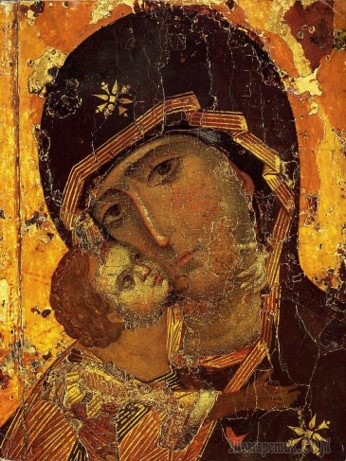
The modern Catechism of the Roman Catholic Church in relation to the Immaculate Conception proclaims the following: “This “radiant and completely unique holiness” with which She was “endowed from the first moment of Her conception” was entirely given to Her by Christ.: She is “redeemed in the most exalted way by the foresight of Her Son’s merits.” More than any other created being, the Father blessed Her “in Christ with every spiritual blessing in heaven” (Ephesians 1:3). He chose Her “before the foundation of the world, that she might be holy and blameless before Him in love.” In this case, we are talking about the traditional understanding of grace for Catholics, as an external veil or inner gift that does not mix with human nature, and about the so-called “foreknowledge” - a unique “advance” that was given to the Virgin Mary by God because of the upcoming redemptive merits of Her Son.
The Roman Catholic Church is trying to confirm its belief in the Immaculate Conception of the Mother of God through references to the text of Holy Scripture. The so-called Proto-gospel is often used for this purpose: “And I will put enmity between thee and the woman, and between thy seed and her seed; it shall bruise thy head, and thou shalt bruise his heel” (Gen. 3:15). Catholics understand these words of Scripture differently from Orthodox Christians. The Roman Catholic Church points out that the Mother of God is called together with her Divine Son to participate in the enmity with the serpent-devil, and victory over him is possible only if the “wife” (that is, the Mother of God) is not under his power, in other words, is not under the power of original sin.
The greeting of the Archangel Gabriel “Hail, Full of Grace! The Lord is with You” (Luke 1:28) is also interpreted by Catholic theology as proof that in the very calling to the ministry of the Mother of God, Mary is full of grace (gratia plena), Eve becomes Ave. In the words of the righteous Elizabeth, “Blessed art thou among women, and blessed is the fruit of thy womb!” (Luke 1:42), there is an indication that Mary receives the same blessing as her Son, and therefore should be, like Him, immune to sin. Or as they say in the current Catechism: In order to be the Mother of the Savior, Mary was “given by God gifts commensurate with such great service.” The Angel of God greets Her as “Gracious” at the Annunciation. Indeed, in order to freely respond with the consent of faith to the proclamation of Her vocation, it was necessary that She should be completely embraced by the grace of God.”
The explanation of the Catechism, in fact, calls into question the free will of the Mother of God, who, judging by the text, was under the full control of Divine grace, which contradicts the Patristic Tradition of the East, expressed, in particular, by Nicholas Kavasila in his sermon on the Annunciation: “The Annunciation was not only a feat of the Father, His Power (Logos) and His Holy Spirit, but also by the feat of the will and faith of the Blessed Virgin. Without the consent of the Immaculate One, without the participation of Her faith, this intention would have been just as impossible as without the intervention of the three Divine Persons themselves. It is only after God has taught and convinced Her that He takes Her as His Mother and borrows from Her the flesh that She wishes to provide for Him. Just as He was voluntarily incarnated, He wanted His Mother to give birth to Him with free will”.
The adoption of the dogma of the Immaculate conception by the Roman Catholic Church was not without pragmatic prerequisites. On the one hand, this decision was a dogmatic prelude to the adoption of the doctrine of the infallibility of the Roman Popes, as an obvious example of the fact that the opinion expressed by the pope alone, without a council, coincides with the general belief of the Church. In addition, it has become an equally obvious realization in Catholic church life of the idea of dogmatic development. On the other hand, by dogmatizing the doctrine of the Immaculate Conception of the Virgin Mary, Pius IX was trying to counteract the Italian revolutionary movement, which wanted to abolish the Papal State. Proclaiming the conception of the Mother of God “immaculate,” Pius IX called on the Virgin Mary to protect Rome from encroachments by the enemy of papal authority. The end of the history of the dogma of the immaculate conception was the “Lourdes Apparitions of the Virgin” of 1858, which many, although completely unfounded, perceived as its miraculous confirmation.
The veneration of the Mother of God by Catholics at a certain point began to bear the features of a real Mariological cult, the observance of which is necessary for salvation: “nothing is given to us, by the will of God, except through Mary. Just as one cannot come to the Father Above except through the Son, in a similar way one can come to the Son only through His Mother” (Octobri Mense). At the beginning of the twentieth century. the soteriological role of the Mother of God in the destinies of mankind has become an obvious fact for the Roman Catholic Church: “Mary “fully deserved to become the restorer of fallen humanity,” and therefore the distributor of all the treasures that Jesus acquired for us through His death and His Blood… we do not attribute to the Mother of God the power that produces supernatural grace, the power that comes from one God. However, because Mary extends it to everyone and because She is united by Christ with the Redemptive Act… She is the supreme minister of the distribution of (redemptive) gifts” (Ad Diem illum). The current catechism, despite criticism of the doctrine of the Immaculate Conception, does not try to soften the medieval formulations, pointing to the exceptional circumstances of the beginning of the Virgin’s existence: “Over the centuries, the Church realized that Mary, “filled with grace” by God (cf. Luke 1:28), received redemption from the moment of Her conception.”
The dogma of the Immaculate Conception was condemned by the “District Epistle of the Church of Constantinople” (1894): “The one, holy, Catholic and Apostolic Church of the seven Ecumenical Councils teaches only one pure and immaculate conception: the supernatural incarnation of the Only Begotten Son and the Word of God from the Holy Spirit and the Virgin Mary. But forty years ago, the papal Church introduced an innovation again, establishing the newly- revealed dogma of the immaculate conception of the Virgin and Virgin Mary, unknown to the ancient Church and strongly disputed by the more prominent Papist theologians.”
The Orthodox Church has several reasons to strongly reject the doctrine of the Immaculate Conception. Firstly, this dogma of the Roman Catholic Church is in conflict with the reality of the mortality of the human race - mortality resulting from original sin.: “Sin entered the world, and death became sin” (Rom. 5:12). Orthodox Tradition explicitly states that the Mother of God died, and then was taken to Heaven by Her Son in such a way that Her body did not know corruption. Catholics are still in an unsolvable situation for themselves. After all, if the Mother of God was free from the guilt and consequences of original sin, she had the opportunity not to die. If She died, how does this relate to the doctrine of the Immaculate Conception?
The second reason for Orthodox Christians’ disagreement with the dogma of the Roman Catholic Church lies in its unhealthy scholasticism, which expresses itself in the “technical” nature of the fruits of the Atonement and the way they are assimilated. According to V.N. Lossky, this dogma “erases the actual character of the feat of our redemption and sees in it only the abstract merit of Christ, imputed to a human person before the suffering and Resurrection of Christ, even before His Incarnation.”
The doctrine of the immaculate conception of the Virgin Mary, as already noted above, calls into question the freedom of the Virgin Mary. The ancient Church saw in the Virgin Mary the personification of the Messianic expectations of Old Testament humanity, the purifying feat of holiness that preceded the Incarnation. If the moral purity of the Mother of God was forced, then she is no longer an accomplice to the feat of the Old Testament saints. Moreover, the Immaculate Conception casts doubt on the unity of the Virgin Mary with the human race as a whole. After all, if She turned out to be speculatively removed from the totality of the heirs of Adam and Eve, then, accordingly, the universal meaning of Mary’s consent to the coming of the Savior into the world in response to the archangel Gabriel is lost (Luke 1:38), in which, according to Thomas Aquinas, “the consent of the Virgin was expected instead of the consent of the whole human nature”.
Rejecting the doctrine of the immaculate conception of the Mother of God, the Orthodox Church expresses the belief that the Virgin Mary, like other people born before the redemptive mission of the Lord Jesus, was under the power of original sin and its consequences.: “I do not do the good that I want, but the evil that I do not want, I do” (Rom. 7:19). However, in the person of the Mother of God, people were shown how, having full freedom of will, one can coordinate one’s will with Divine providence and achieve the greatest holiness with the help of God’s grace. That is why the Mother of God deserves to be called the Most Holy and Immaculate.
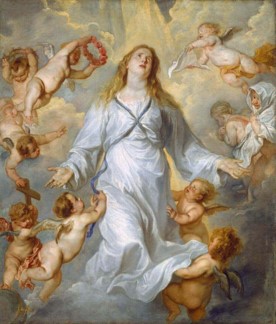
The Roman Catholic dogma of the bodily ascension of the Virgin Mary became a logical continuation of the doctrine of the Immaculate Conception of the Virgin Mary. Interestingly, as in the case of the first dogma, the doctrine of bodily ascension in the Roman Catholic Church turned out to be associated with the manifestation of papal “infallibility” in matters of faith and morals. If in 1854 Pope Pius IX established the dogma of the Immaculate Conception with the help of a bull, thereby testing the Catholic public’s willingness to recognize the pontiff’s right to proclaim the most important dogmatic provisions alone, then in November 1950 Pope Pius XII has already made full use of the possibilities of papal teaching. The Pontiff, in an ex cathedra format, proclaimed in the apostolic constitution “Munificentissimus Deus” that “The Immaculate Mother of God, the Ever-Virgin Mary, having completed the path of Her earthly life, was taken with body and soul to Heavenly Glory.” Catholics, however, try to identify significant differences between the ascension of Jesus Christ and the Mother of God: “Christ ascended like a God by His power, therefore His Ascension is called Ascensio in Latin – Ascension to heaven. The Mother of God was taken to heavenly glory by God by His grace, without having Her Own power to ascend, therefore Her Ascension is called in Latin Assumption – Taking to heaven.”
The teaching of the Roman Catholic Church about the taking of the Virgin Mary to Heavenly glory only resembles in form the Eastern tradition about the Dormition of the Mother of God and Her taking to Heaven not only in soul, but also in body. If the Orthodox side claims that the mysterious disappearance of the body of the Virgin after Her death, the Dormition, was the result of Her Son’s good intervention in the natural order of things in order to protect Mary’s body from corruption and make Her a partaker of Divine glory, then according to Catholic dogma, the ascension of the Mother of God turned out to be the logical result of Her non-subjection to original sin. Thus, the ascension of Mary has a clear parallel with the autocratic Ascension of the Son of God.
The Catholic dogma of the bodily ascension of the Virgin Mary has even less biblical basis than the doctrine of the Immaculate Conception. Pope Pius XII does not provide any direct references to the text of Holy Scripture, which would allow us to see the significant exegetical basis in the event of Mary’s “taking to Heavenly glory.” It is also not surprising that the constitution “Munificentissimus Deus” avoids the question of whether the Virgin Mary died or was taken to Heaven still alive. The Orthodox Church through the mouth of St. Peter. Kliment Ohridsky answers this question directly: “Since Adam was told after his crime: “For you are the earth and you will go to the earth” (Gen. 3:19), and we have the beginning of our existence from him, as well as the end, our Lord Jesus Christ came to earth and accepted death. flesh, and for our sake he tasted death with flesh, not with Divinity. Therefore, Our Most Pure Lady and Ever-Virgin Mary, Mother of God, tasted death in the flesh.”
The Patristic Tradition contains various images related to the death of the Mother of God. John of Damascus, speaking of the death of the Mother of God, calls Her death a “ferry to immortality”, vital and life-giving (ζωηφόρος), in contrast to the death of Christ, which he calls life-giving (ζωοποιός). Similar expressions are used by St. John and St. Gregory Palamas (“Her death was life-giving, transmigrating into heavenly and immortal life”), and St. Peter the Great and St. Theodore the Studite (“the life-giving Dormition”), and St. Peter the Great and St. Filaret of Moscow (“the life-giving Assumption”) and others.
It is quite difficult to trace the historical roots of the Roman Catholic Church’s understanding of the Ascension of the Mother of God. At the initial stage, Western Christians’ ideas about the Dormition were virtually indistinguishable from Eastern Ones. In the early Middle Ages, Western authors, in the spirit of the Eastern tradition, spoke rather cautiously about the posthumous fate of the Virgin Mary. Thus, the Martyrology of Usuard (9th century), which was widely used in the church West, leaves the question of the image of the death of the Virgin Mary open. After 1054 Among Western Christians, pseudo-Augustine’s work “On the Reception of the Blessed Virgin Mary [to Heavenly Glory]” was popular, where for the first time one can see the features of the nascent Mariological cult. Thanks to this work, since the second half of the 13th century, the opinion of the bodily reception of the Mother of God into heaven began to prevail in Catholic theology. Such famous Western scholastic theologians as Albert the Great, Thomas Aquinas, Bonaventure, Peter Canisius, Alfonso Maria de Liguori, and others became supporters of the doctrine. Thanks to them, the doctrine of the bodily reception of the Virgin Mary into heavenly glory gradually became the property of all Western Christianity.
Since the second half of the 17th century, popes began to receive requests to assign the doctrine of the ascension of the Mother of God the status of dogma. R. Cesario Squanin (1692-1769) was the first to make such a request in his letter to Pope Clement XIII (1758-1769). Over time, the number of such requests began to increase. Western theologians began to deal especially intensively with the issue of the ascension of the Virgin Mary with body and soul to heavenly glory after the First Vatican Council (1869-1870), 204 participants of which proposed to Pope Pius IX to declare this teaching a dogma. Later, in 1902, at the Freiburg Catholic Congress, it was decided to ask Pope Pius IX to purge the divine service on the feast of the Dormition of the Virgin of all that points to Her death, and “raise the doctrine of the bodily ascension of the Mother of God to heaven to the degree of dogma.”
In 1921-1937, a movement arose in the West in defense of the bodily ascension of the Blessed Virgin to heaven. In 1942, the Vatican published a two-volume work by G. Gentrich and R. Gualter de Mohs entitled “Petitions for the determination of the bodily Reception of the Blessed Virgin Mary to heaven, addressed to the Holy See, arranged in hierarchical, dogmatic, geographical and chronological order to reveal the unanimity of the Church,” which provided a history, as well as a statistical overview of all petitions with 1863 to 1941
In 1944, at the suggestion of Pope Pius XII, Augustinian M. Jugy, professor at the Lateran Pontifical Seminary in Rome, wrote a historical and theological study “The Assumption and Ascension to Heavenly Glory of the Blessed Virgin,” which later became the theological basis of the apostolic constitution “Munificentissimus Deus.”
On May 1, 1946, Pope Pius XII (1939-1958), taking into account the requests of 113 cardinals, archbishops and bishops, 82,000 priests and more than eight million believers, conducted a survey of the entire Catholic episcopate in a special message “Deiparae Virginis” in the form of: “Do you consider, venerable brother, by virtue of your outstanding insight and wisdom, that Mary’s bodily acceptance into heaven can be represented and defined as a thesis of faith? And do you want this together with your clergy and your people?” The pope received approval for this survey, after which the Roman pontiff stated: “So, from the universal consent of the ordinary church magisterium, it is possible to draw a true and indisputable conclusion that the bodily ascension of the Blessed Virgin Mary to heaven is a truth revealed by God.”
Thus, relying on public opinion and using the right to unmistakable definitions “ex cathedra”, Pope Pius XII on November 1, 1950, by the constitution “Munificentissimus Deus”, approved a new mariological dogma on the ascension of the Virgin Mary, body and soul, to heavenly glory: “The Immaculate Mother of God, the Ever-Virgin Mary, having completed the path of Her earthly life, was taken, body and soul, to heavenly glory.” In the text of this dogma, the Pope does not refer to either Holy Scripture or Holy Tradition, but relies only on the “authentic faith” of the overwhelming majority of Christians of that time. The Russian theologian A.S. Merzlyukin puts it this way: “The pressure to dogmatize this belief was very great. Over the past 100 years, 2 local (national) councils; 14 conferences of bishops; 14 international congresses; 11 local congresses; 852 cardinals, archbishops and bishops have personally insisted on the promulgation of the dogma of the ascension (resurrection) of the most pure body of the Blessed Virgin Mary.”
From the text of the definition of the constitution “Munificentissimus Deus” by Pope Pius XII, it can be seen that the reason for the dogmatic decree is the immaculacy of the Mother of God and Her Ever–Virginity, and the consequence is Her taking body and soul to heavenly glory. The definition says that the Virgin Mary, “having completed the path of earthly life,” was taken to heavenly glory with body and soul. This theological concept does not imply any statement about the location of the glorified body of the Mother of God. By saying “having completed the path of earthly life,” the pope avoids specifying how the Virgin Mary ended Her earthly life. Thus, he narrows down the meaning of the definition of the Virgin Mary’s bodily ascension to heaven, pointing out only one of the aspects that usually encompass the concept of ascension, while ignoring death, incorruptibility and resurrection.
Later, in his encyclical Fulgens corona gloriae (September 8, 1953), Pius XII emphasized the essential unity of the dogmas of the Immaculate Conception and Bodily Ascension (“due to the closest inseparable connection through which these two dogmas are connected with each other, after the solemn proclamation and proclamation of Mary’s ascension to heaven, which is, as it were, the crown and completion of the first the advantages of Mary, the harmony of that wise Counsel of God became known with greater clarity and completeness, by virtue of which God willed that the Blessed Virgin Mary should be free from original sin” (Fulgens corona gloriae). In 1954 Pius XII proclaimed the Virgin Mary the Queen of Heaven and crowned her icon.
Despite the status of dogma assigned to the doctrine of the ascension of the Mother of God, two main views on the death of the Blessed Virgin can currently be distinguished in Catholic theology. According to the views of the so-called immortalists, death did not touch the Mother of God at all, and She was taken to heaven immediately from her earthly life. This view clearly contradicts the ancient church tradition of the Dormition. There is also a current of “mortalists” who claim that the Mother of God was taken to heaven by her Son after a brief state of death. Although this view does not contradict the general church Tradition, it generates a serious theological contradiction, because death is a consequence and a sign of original sin, to which all people are subject. If the Mother of God was free from the power of original sin from birth, as the dogma of the immaculate conception says, then She, like Christ, was not subject to death, which, in this case, becomes voluntary and, therefore, redemptive, which clearly contradicts the faith of the Ancient Church.
The Orthodox Church not only does recognize not only the theological content of the dogmas of the immaculate conception and the bodily ascension of the Virgin Mary, but also the very image of their ecclesiastical affirmation, which is based, on the one hand, on the dogma of the doctrinal infallibility of the Roman pontiff, on the other hand, on the idea of dogmatic development.
Related Concepts
- ad-diem-illum
- ancestral-sin
- annunciation
- anselmian-satisfaction
- assumption
- bernardine-of-siena
- calvary
- catechism
- co-redeemer
- cyril-of-alexandria
- district-epistle-of-1894
- dogmatic-differences
- dormition
- duns-scotus
- eastern-fathers
- ephesus
- ephraim-the-syrian
- ever-virgin
- first-vatican-council
- foreknowledge
- holy-spirit
- concepts/hügel
- iii-ecumenical-council
- ineffabilis-deus
- john-henry-newman
- john-of-damascus
- leo-xiii
- lumen-gentium
- mariology
- mediation-of-mary
- mortality
- munificentissimus-deus
- nestorius
- nicholas-cabasilas
- octobri-mense
- personal-sin
- pre-redemption
- resurrection
- second-vatican-council
- thomas-aquinas
- virgin-mary
- virginity
- vn-lossky