Comparative Theology — Topic 4. The Roman Catholic doctrine of the descent of the Holy Spirit from the Father and the Son (Filioque).
The Roman Catholic doctrine of the descent of the Holy Spirit not only from the Father, but also from the Son (Filioque) is still one of the most significant dogmatic differences between Catholicism and Orthodoxy. This is not surprising, because this Catholic misconception affects the very core of Christian theology – the dogma of the Holy Trinity. The doctrine of the Filioque, which arose in the fifth century, was dogmatically consolidated by Catholics during the Councils of Lyon (1274) and Ferraro-Florence (1438-45). According to both Eastern and Western hierarchs and scholars, the doctrine of the double descent of the Holy Spirit was one of the main reasons for the rupture between the Orthodox and Roman Churches that occurred in 1054. In any case, Cardinal Humbert Silva-Candida, head of the papal embassy, accused Patriarch Michael Kerulari of Constantinople of rejecting the Filioque in the text of his anathema. Despite the mutual lifting of the anathemas in 1054, carried out by Patriarch Athenagoras of Constantinople and Pope Paul VI in 1965, the Filioque issue remains unresolved. Moreover, the Catholic teaching about the descent of the Holy Spirit not only from the Father, but also from the Son has been called “real heresy” at the pan-Orthodox level. However, it would not be fair to forget about the attempt made by Catholics to clarify their position on the Filioque issue and align it with the opinion of the Orthodox Church. In 1995, on behalf of Pope John Paul II, the Pontifical Council for Promoting Christian Unity published the document “The Greek and Latin Tradition on the Descent of the Holy Spirit.”
The Latin term “Filioque” consists of two connected words. Filio is the Latin
noun “filius” (“son”), which stands in the ablative. Latin nouns used in the
ablative are most often translated by using the preposition “from”, thus
“Filio” means “from the Son”. “Que” is a conjunction that, according to the
rules of Latin, is attached to a noun interacting with it, translated as
“and”. So, “Filioque” translates from Latin as “and from the Son.” From a
technical point of view, Filioque refers to the insertion made by Roman
Catholic theologians into the eighth article of the Creed: “Credo … et in
Spiritum Sanctum, Dominum et vivificantem, qui ex Patre Filioque procedit” (“I
believe … and in the Holy Spirit, the Lord of life, Who proceeds from the
Father and from the Son”). In a broad sense, Filioque has served as a
designation for the Catholic 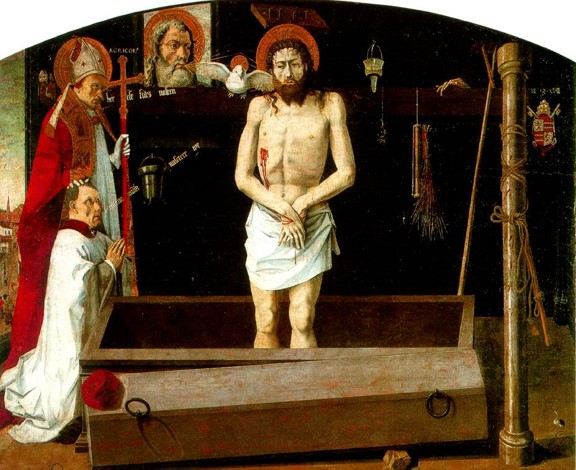 doctrine of the Holy
Trinity and, in particular, the existence of the Holy Spirit.
- Introduction
- The theological legacy of St. Augustine of Hippo and Filioque.
- The post-Augustinian development of the doctrine of the Filioque.
- The modern understanding of Filioque in Catholicism. Criticism of Orthodoxy.
After the Ferraro-Florence Council and the failure of the union, which was concluded at it, the issue of Filioque was not raised in the framework of the Orthodox-Catholic dialogue until the middle of the twentieth century. The Roman Catholic Church took the initiative here - Pope Paul VI tried to harmonize Orthodox and Catholic approaches to triadology, which is reflected in the Catholic catechism.: “The Eastern tradition primarily reflects the nature of the Father’s first cause in relation to the Spirit. Confessing the Spirit as One who “proceeds from the Father” (Jn 15:26), it asserts that the Spirit proceeds from the Father through the Son. The Western tradition expresses above all the consubstantial communion between Father and Son, saying that the Spirit proceeds from the Father and the Son (Filioque). It says this “according to law and reason,” because the eternal order of Divine Persons in their consubstantial communion implies that the Father is the first cause of the Spirit as the “beginningless principle,” but also that as the Father of the Only Begotten Son, He together with Him constitutes “one principle from which proceeds the Holy Spirit.” This legitimate complementarity, if it does not become a subject of aggravation, does not affect the essence of faith in the reality of the same professed mystery.”
The idea of complementarity between the two triadological models was voiced in 1995, when Pope John Paul II instructed the Pontifical Council for Promoting Christian Unity to clarify “the doctrine of Filioque behind the liturgical Latin translation of the Creed, so that it could be shown to be fully consistent with that of the Ecumenical Council held in Constantinople in 381.” As a result, a document was published stating the alleged complementarity of the Catholic and Orthodox approaches to understanding the Holy Trinity, as well as the fact that Filioque, from the point of view of the Roman Catholic Church, is not actually an insertion that distorts the text of the Nicene- Constantinople Creed, but, on the contrary, adds a new one to it in the Latin version, a deeper meaning. On August 6, 2000, the declaration “Dominus Iesus” (“Lord Jesus”) was published. In this document, in the second paragraph of the first part, the text of the Creed is given without the Filioque: “Et in Spiritum Sanctum, Dominum et vivificantem, qui ex Patre procedit, qui cum Patre et Filio simul adoratur et conglorificatur, qui locutus est per prophetas.” (“And I believe in the Holy Spirit, the Lord, the Giver of life, who proceeds from the Father, who, together with the Father and the Son, deserves worship and glory, who spoke through the prophets.”) This text testifies to the doctrinal pluralism existing in the modern Roman Catholic Church regarding the Filioque.
The Orthodox position regarding the Filioque has remained unchanged for centuries. The doctrine of the double descent of the Holy Spirit, which was not accepted in the era of the Uniate councils, was authoritatively rejected in a time period closer to us. In 1848, the District Epistle of the Eastern Patriarchs on the Filioque states the following: “The One Holy Catholic and Apostolic Church now once again proclaims in a conciliar manner that this new- found opinion that the Holy Spirit proceeds from the Father and the Son is a veritable heresy, and his followers, whoever they may be, are heretics. The societies that are made up of them are heretical societies, and any spiritual liturgical communion with them by the Orthodox children of the Church is lawless.”
Russian theological science has also contributed to the understanding of the Filioque. In the late 19th and early 20th centuries. The Russian Church participated in negotiations on the issue of unification with the Old Catholics, a group that broke away from the Roman Catholic Church and did not accept the teachings of the dogmatic and moral infallibility of the Roman Pope, which was proclaimed at the First Vatican Council. The issue of Filioque was also discussed then. The main role in the analysis of the concept of the double descent of the Holy Spirit was assigned to Professor V.V. Bolotov of the St. Petersburg Theological Academy, who drew a methodological distinction between dogma, theologumen, and theological opinion. By theologumen, Bolotov meant “the same theological opinion, but only of the fathers of the one undivided church and men who are worthily called “teachers of the universe.” Bolotov points out that Filioque is the theologumen of the Western Church, created by St. Augustine and tolerated for a time in a single undivided Church.
Bolotov’s position was ambiguously received both in Russia and abroad. One of the critics of this approach was V.N. Lossky, a professor at the St. Sergius Theological Institute in Paris. In a report entitled “The Exodus of the Holy Spirit in the Orthodox Doctrine of the Trinity,” delivered at Oxford in 1947, Vladimir Nikolaevich Lossky explicitly states that “the question of the exodus of the Holy Spirit, whether we want to admit it or not, was the only dogmatic reason for the separation of East and West.”
Both V.N. Lossky and other Orthodox theologians of our time point to the mentioned feature of the heritage of the BLJ as one of the main reasons for the emergence of the doctrine of Filioque. St. Augustine, which has become a key topic for Western theology. Augustine thought of God as an absolutely simple Being, in whom everything is, everything is essence. This attitude led Catholic theologians to confuse intra-Trinity existence and oikonomia.
The lack of a clear understanding of where the intra-Trinity life ends and oikonomia begins led Catholic theology to introduce the doctrine of Filioque, and as a result, distorted the spiritual tradition of the Christian West. The appearance of the Filioque has finally confirmed ordinary Catholics in the idea of the “technical” nature of the actions of the Holy Spirit, which is a kind of instrument in the hands of the Father and the Son. Protopr. John Meyendorff writes: “An ordinary Western Christian does not understand the trinity. He believes in the man Jesus, who brought us deliverance from our sins, and in the Holy Spirit, who is the source of joy and happiness. But why do we need three Hypostases and so on, he does not understand. The absence of the trinity theology or distrust of it leads to deism, to a generalized philosophical approach to God, and at the same time the meaning of a personal encounter with God and the meaning of our salvation is blurred and clouded.” Another outstanding theologian of the 20th century, Archimedes. Placida (Desei) points out: “If in the East the Spirit is professed to be equal to the Father and the Son, and therefore the Spirit, spiritual freedom and contemplation of the living God reign in Orthodoxy, then in the West the Spirit is thought of in a subordinate position, hence a different understanding of the Sacraments, fear of all the mysterious, rationalization of Christianity.”
It has already been mentioned that in recent years the Russian Orthodox Church has made attempts to soften its triadological theology. At the moment, the Russian Orthodox Church officially recognizes the possibility of the coexistence of two triadic models: eastern and Western, and the insertion of the Filioque itself is nothing more than an explanation in the Latin version of the Nicene-Constantinople Creed. In practice, this position is implemented in such a way that nowadays the liturgical rite of the Russian Orthodox Church involves the use of both the Symbol of Faith with Filioque and without this insert. The Orthodox Church is certainly positive about such changes, but at the same time avoids any compromise on this issue. In the framework of bilateral theological interviews with the Russian Orthodox Church, the Orthodox side insists that Filioque will cease to be considered heresy and will become a private theological opinion of the Western Church under two conditions: 1) if causality is excluded from the understanding of the Filioque, that is, Catholics will point out that the Son is not the source of the existence of the Holy Spirit; 2) if the exodus of the Spirit “and from the Son” is attributed exclusively to the field of temporary messengership (that is, oikonomia or house-building). However, as explained above, the Filioque doctrine is only the tip of the iceberg, indicating that there is a deeper problem that is relevant to the Catholic understanding of the nature of God and the ways in which God interacts with His creation. This becomes obvious when considering the features of Catholic soteriology.
The Trinity theology of St. Augustine would have remained in the category of a
private theological opinion, if not for certain historical circumstances. In
the sixth century, thanks to the efforts of missionaries, the Arians-Visigoths
joined the Universal Church on a massive scale. In order to consolidate the
success achieved, at the III Council of Toledo in 589, a confession of faith
was proclaimed, containing the Filioque: “Spiritusque sanctus confitendus a
nobis, et praedicandus est a patre et filio procedere” (“And the Holy Spirit,
professed by us, and proclaimed to proceed from the Father and the Son”). The
equalization of Father and Son was necessary for the Spanish Church to prove
to the Arians-Visigoths the Divine dignity of the Son. The extremely
“Augustinian” understanding of the double descent of the Holy Spirit not only
from the Father, but also from the Son was set forth in its symbol by the XI
Council of Toledo (675). And the XII Council of Toledo (681) has already
inserted the Filioque directly into the text of the Nicene-Constantinople
Creed. At the XV Council of Toledo (688), the Spanish Church officially
declared that it adheres to the teachings of Augustine.
In the official documents of the Roman Church, the doctrine of Filioque appeared in the middle of the seventh century, when the confession of faith of Pope Theodore I (642-649) attracted the attention of the East, which contained a reference to the dual nature of the exodus of the Holy Spirit. The Pope’s confession was not accepted by Constantinople. The resolution of the brewing theological conflict was handled by St. Maximus the Confessor, who stated that the Romans “have proved by numerous testimonies … that … they do not make the Son the cause of the Holy Spirit. They know that the one principle of both the Son and the Spirit is the Father, the one through birth, the other through descent. But their formulation is intended to show that the Spirit proceeds through the Son and thus establish the unity and identity of the essence.” As we can see, St. John the Baptist Maxim uses the phrase “through the Son”, the meaning of which does not correspond to the Filioque.
An attempt to impose the doctrine of the double descent of the Holy Spirit on the entire Western Church took place at the Aachen Council, convened by order of Emperor Charlemagne in 809. This initiative was driven by political rather than theological reasons. Charles needed to convict Constantinople of heresy (in this case, non-recognition of the Filioque) in order to prove the illegitimate character of the Eastern Empire and, consequently, the true character of his own empire. It should be noted that the decision of the Aachen Council was not taken by Rome. Pope Leo III, despite his internal agreement with the doctrine of the double descent of the Holy Spirit, refused to change the text of the Creed and even ordered the casting of silver plates with the Greek and Latin text of the Creed without Filioque.
A substantive theological examination of the Western doctrine of the double descent of the Holy Spirit was carried out in the 9th century by St. Photius of Constantinople. Photius’ interest in the topic of Filioque arose after the future Pope Formosus, who was then Latin bishop in Bulgaria, introduced the singing of the modified Creed in the territory under his control. Having learned about this, St. Photius compiled four groups of arguments against Filioque, which he described in his essay “The Mystery of the Exodus of the Holy Spirit.”
Commenting on the arguments of St. John. Photius, Archim. Plakida (Desei) states: “St. Photius’ objections amount to the following: In God, everything that is essence is common to all three Persons, and what They have in common is only what relates to essence. On the other hand, what is personal can belong to only one Person, and vice versa: what belongs to a Person is exclusively personal. So, nothing can belong jointly to two Persons, excluding the third.”
Photius’ argument was accepted not only by the East, but also by Rome, at the Great St. Sophia Council (879-880). His decision prohibited the modification of the Nicene-Constantinople Creed. The Western Church, represented by Pope John VIII, agreed with this decree. During the years of the “pornocracy”, when the Roman Throne was under the control of the Italian nobility, the issue of Filioque was not raised in the West. The modified Creed was used on the territory of the German Empire, but this tradition did not become a common practice of the Western Church. The change occurred after the papacy came under the influence of the Germans. In 1014, at the coronation of Henry II by Pope Benedict VIII, the Creed with the insertion of the Filioque was solemnly sung in Rome. In the forty years that had passed before the events of 1054, the Roman Church’s view of the Filioque had been transformed in the strangest way. If at the time of adoption the amended text of the Creed was considered as a valuable but Western tradition coexisting with the Eastern one, then already in 1054 the Church of Constantinople was accused by the head of the Papal Embassy of the heresy of non-recognition of the Filioque. In response to the anathema, the Synod of the Constantinople Patriarchate of Michael Kerularia decided: “And besides all this, they also absolutely do not want to think about it, they declare that the Spirit does not come from the Father [only], but also from the Son — as if they do not have the evidence of the evangelists about this, and as if they do not have the dogma of the Ecumenical Council regarding this slander. For the Lord our God says, “The Spirit of truth, which proceeds from the Father.” But the parents of this new wickedness speak of the Spirit that comes from the Father and the Son.”
A new stage in the discussion of the Filioque question between East and West began with the beginning of the era of the Uniate Councils: II of Lyon (1274) and Ferraro-Florence (1438-1445). The union with the Greeks, which Roman Catholics wanted to conclude, pursued political goals, but was based on theological principles. Rome wanted the East to accept the doctrine of the Filioque. The Greeks, however, were no longer accused of heresy, as happened in 1054. Catholics tried to convince the East that the Filioque was just an explanation that helped to better understand the content of the Creed. This is exactly the formulation proposed by the theologian-unionist John Vekk, who in his “Apology”, in particular, argued that the Filioque does not contradict the statements of the fathers of the Ancient Church, for example, St. John the Baptist. St. Basil the Great, who used the expression “through the Son” in reference to the exodus of the Holy Spirit. The response to the new interpretation of the Filioque by Catholics was the theological reasoning of Patriarch Gregory the Cypriot of Constantinople, who separated the “exodus” and the “eternal ascension.” According to Gregory, “descent” means the origin of the hypostatic existence of the Holy Spirit from the Father as the cause, and “ascension” means consubstantiality with the Son, through whom He proceeds in eternity – which is the unity of the Divine essence.
In the 14th century, St. Gregory Palamas clarified the doctrine of the exodus of the Holy Spirit, definitively distinguishing between two concepts: the inner being and the outer act of the Deity (oikonomia). A full explanation of the Orthodox Church’s position on the issue of the descent of the Holy Spirit is contained in the “District Epistle of the One, Holy, Catholic and Apostolic Church to All Orthodox Christians” (1848): “this new opinion that the Holy Spirit proceeds from the Father and the Son is a real heresy, and his followers, whoever they may be “heretics.”
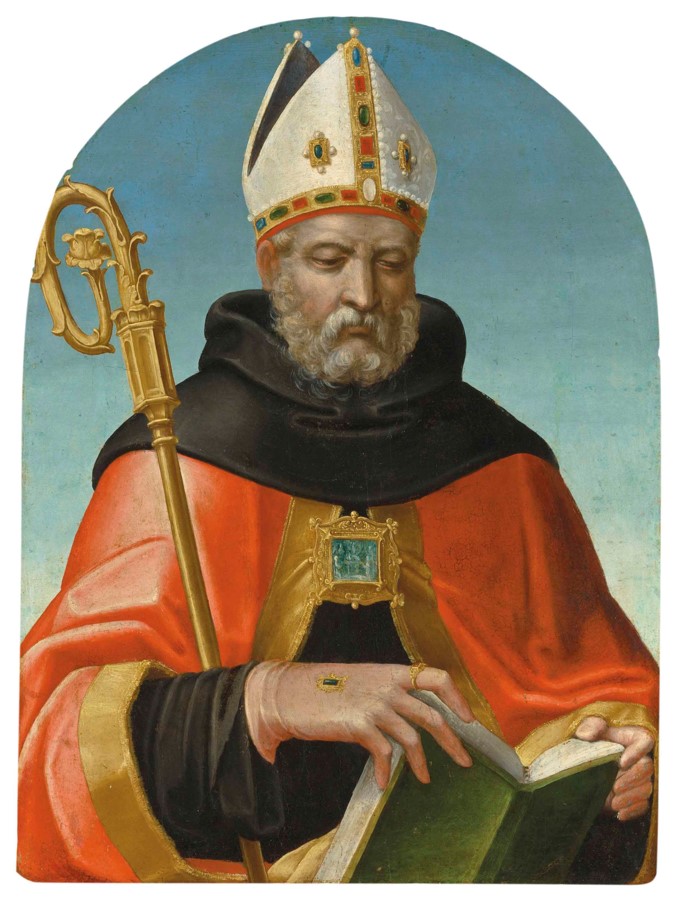
The theological legacy of St. Augustine of Hippo certainly played a decisive role in the formation of Catholic Triadology. In a systematic way, Augustine expounded his triadic views in his work “On the Trinity” (De Trinitate). Discussing the mystery of the Holy Trinity, the North African saint chooses an original method, different from that used by the Cappadocian fathers. If for them the beginning uniting the Trinity is the Hypostasis of God the Father (the “monarchy of the Father”), then for Augustine the basis of the unity of the Trinity is the “divine essence-substance”, which manifests itself through the relationship of three Divine Persons. However, Augustine cannot be accused of so-called “essentialism”, that is, of the absolute primacy of essence over a person, because he himself, for example, notes: “In the same way that for Him to be means to be God… in the same way for Him to be means to be a person (ita hoc illi est esse quod personam esse — De Trinitate V, 11)
Nevertheless, Augustine’s distance from the dogmatic terminology verified by the Cappadocians led to a significant difference between the concepts of “hypostasis” and “person”. If “hypostasis” denotes, as already mentioned, a specific form of nature’s existence, then “persona” (the term used in Ancient Rome to call an actor’s mask) meant primarily a visible image or manner of behavior. In relation to the Trinity, this manifested itself as follows. For the Eastern Church, each of the Hypostases of the Trinity fully possesses the Divine nature, truly manifesting its fullness. For Augustine, Person-Persons are devoid of “essentiality.” In his system, the Persons of the Holy Trinity are, as it were, secondary and derivative in relation to the Divine essence, turning out to be its “basic properties” or “images of existence.” Augustine, of course, did not profess the heresy of modalism, but in some cases it seems that in his explanation the Person-Persons turn out to be the very ancient masks under which the same divine, but at the same time faceless “divine essence” appears.
The peculiarity of St. Augustine’s triadology was also due to his fascination with Neoplatonic philosophy, from which he derived the idea of the possibility of knowing the Divine reality through self-knowledge. From Augustine’s point of view, the image of God, embedded in man and the basis of his being, serves as a mirror in which one can see the reflection of the Creator (just like Plato’s the real world is a reflection of the world of ideas). From the point of view of the thinker, the image of God has three main properties: memory, thinking and will. According to Augustine, these three properties are nothing more than a reflection of the three Persons of the Holy Trinity. Memory, as the basis of human existence, is an indication of the Father, thinking (“logos”) is a designation of the Son. The will, the highest manifestation of which is love, for the thinker serves as a designation of the Holy Spirit. The psychological analogy coined by Augustine became the basis for his Trinity theology. Combined with the concept of the priority of the Divine essence over three Persons, it was the reason for the emergence of fililoquism. Which is quite understandable. After all, in fact, the three Persons of the Trinity are reduced by Augustine to relationships and can differ from each other only if there are properties that distinguish Them. The Father differs from the Son and the Spirit in that He begets the Son and harasses the Spirit. The Son differs from the Father by His eternal birth, and the Spirit by His descent. To identify a property that would allow establishing a relationship between the Son and the Spirit, Augustine is helped by the psychological analogy he put forward, according to which the Spirit (as love) comes from the Son too.
The Augustinian understanding of the Trinity, according to which the Holy Spirit is the communion and connection between the Father and the Son, is clarified as follows: The Spirit is the common love that the Father and Son mutually love each other. Since the will (or love) in a person is born from the depths of his spirit, or memory, and provides the necessary connection between memory and thinking, the Holy Spirit in the Trinity, although originally and primarily emanates from the Father, but at the same time emanates from the Son and is the mutual Love of the Father and the Son. “The Son is eternally begotten of the Father, and the Holy Spirit is directly from the Father (principaliter), and since it is given without any interval, the Spirit proceeds jointly from Both.” An important role in the formation of Augustinian and all subsequent Western triaodology was played by the fact that, according to St. Augustine, God is an absolutely simple being in whom everything is, everything is essence. The idea of the existence of uncreated Divine grace was initially alien to the West. Western theologians saw a created miracle in the appearance of the Tabor light, the lights of Pentecost, etc., but not theophany. In cases where it was impossible to deny the direct action of the Deity, it became customary to say that the Father and the Son act in the world by the Holy Spirit, who occupied a subordinate place in the Western Church’s view, and the Trinity turned into a “Duality.” Nevertheless, St. Augustine’s teaching about the descent of the Holy Spirit not only from the Father, but also from the Son remained as a private opinion within the framework of his theological legacy. This teaching acquired the outlines of the doctrine after the saint’s death.
Related Concepts
- augustine
- basil-the-great
- begottenness
- bolotov
- bonn-conferences
- cappadocian-theology
- catholic-orthodox-dialogue
- causality
- complementarity
- de-trinitate
- double-procession
- ecumenical-councils
- essentialism
- filioque
- goths
- gregory-palamas
- gregory-the-cypriot
- holy-spirit
- holy-trinity
- john-paul-ii
- mark-of-ephesus
- maximus-the-confessor
- meyendorff
- nicene-constantinople-creed
- nicene-constantinopolitan-creed
- one-principle
- orthodox-condemnation
- person
- photius
- plakida
- procession
- second-ecumenical-council
- st-augustine
- st-maximus-the-confessor
- theological-opinion
- theologumen
- third-ecumenical-council
- triadology
- trinitarian-taxis
- unbornness