Comparative Theology — Topic 3. The Roman Catholic teaching about the Church.
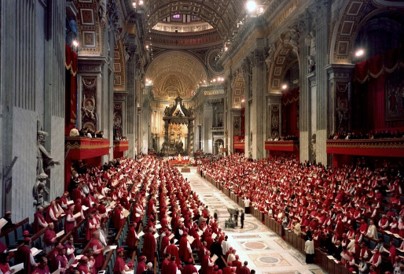
The Roman Catholic Church asserts that “by divine right of apostolic succession,” the Pope is placed over the entire Church, he is given to represent her and be the “supreme judge.” Therefore, pastors of any rank and rite, as well as the entire body of believers, undertake to render him real obedience and hierarchical subordination “not only in matters of faith and morality, but also in the discipline and administration of the Church spread throughout the world” (Pastor aeternus. 3). Those who “claim that it is permissible to appeal to the Ecumenical Council regarding the decisions of the Pope, as if this council were an authority higher than the pope,” are deviating from the path of true faith (Ibid.).
According to the Catholic interpretation, the direct Divine establishment of papal primacy is seen in the evangelical words of the Savior.: “You are Peter, and on this rock I will build my Church, and the gates of hell will not prevail against it; and I will give you the keys of the kingdom of heaven: and whatever you bind on earth will be bound in heaven, and whatever you loose on earth will be loosed in heaven” (Matthew 16:18-19; see also John 21:15-17). According to this logic, the Apostle Peter is considered by Catholics to be the first bishop of Rome, and his successors in the Roman see are “vicars (vicarii) of Christ.”
On the one hand, the Second Vatican Council confirmed the doctrine of the full, supreme and universal teaching and jurisdictional authority of the Roman Pontiff over all members of the Church by virtue of his office. On the other hand, the Council tried to partially restore the rights of the conciliar component of ecclesiology, noting that the Pope governs the Church not alone, but together with the bishops. At the same time, in modern Catholicism, the pope is still assigned the universal role of “vicar of Christ and Pastor of the entire Church on this earth,” his primacy as a special grace of service is presented by Catholics as “a great gift from Christ to Their Church” and a necessary condition for fulfilling its saving destiny (“Il primato del successore di Pietro nel mistero della Chiesa”. 2. 4.). One of the main functions of the papal primacy at the present stage is to serve the visible unity of faith and church order, the beginning and foundation of which is the pope, while preserving the diversity of local traditions.
The pope receives all these impressive powers for a life term (unless he himself wishes to abdicate) as a result of secret elections carried out by cardinals at a conclave. This is the name of the meeting of the College of Cardinals convened for the election of the pope, which takes place in a special format protected from the gaze of external observers (“conclave” from Latin. “cum clave” – “locked up”). At the same time, from the point of view of the Roman Catholic Church, the source of papal authority is not the College of Cardinals, but God, whose vicar and bearer of authority the Pope, according to Catholics, is. This explains the strange wording from the current canonical Code of the Roman Catholic Church: “The Roman Pontiff obtains full and supreme power in the Church by virtue of his own legitimate election” (CIC. 332). Paradoxically, the newly elected pontiff receives full power over the Catholic Church not as a result of any religious act, but as a result of the outcome of the elections and the consent to accept their outcome. According to Catholic beliefs, the person elected by the conclave becomes the bearer of the charisma of papal ministry at the moment of pronouncing consent to become the new pope. The enthronement, which takes place in a couple of days, does not really add anything to his powers - it is only a ceremony to present the newly elected pontiff with the external attributes of his power, and not the presentation of the power itself to him.
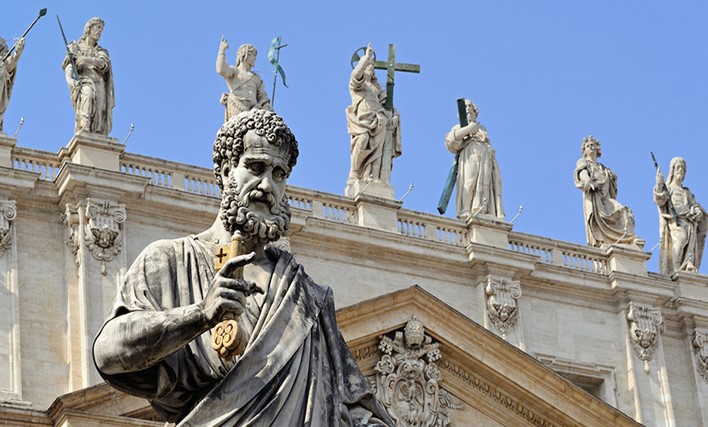
To substantiate the doctrine of the primacy of the Roman bishops, the Roman Catholic theology draws a parallel between the role of the Apostle Peter in the community of apostles and the authority of the Roman bishops in relation to other bishops in the Roman Catholic Church. According to Catholic teaching, the Apostle Peter not only occupied the first place in the assembly of the Twelve, but was the head of the “apostolic collegium”, the prince of the apostles (Latin: princeps apostolorum). According to Catholics, Christ established the twelve apostles “as a college or permanent association, headed by Peter, who was chosen from among them. Just as by the decree of the Lord, St. Peter and the other apostles form a single apostolic council, so the Roman Pontiff, Peter’s successor, and the bishops, the successors of the apostles, form a single whole” (Catechism of the Catholic Church, 880).
According to the teaching of the Roman Catholic Church, the Lord Jesus entrusted the Apostle Peter with a special mission, which boils down to the following main points:
1. to be a stone (Greek: πέτρος - “stone”), that is, the foundation of One’s Church;
2. keep the keys to the Church and the Kingdom of Heaven (that’s why the papal coat of arms depicts two keys – gold and silver);
3. to shepherd the whole “flock”, that is, to lead the Church as the people of God.;
4. to instruct and establish the whole Church in faith, since Peter’s faith will never fail.
Catholic theologians base these main points on the following passages of Holy Scripture:
· “You are Peter, and on this rock I will build my Church, and the gates of hell will not prevail against it” (Matthew 16:18).
· “And I will give you the keys of the kingdom of heaven; and whatever you bind on earth will be bound in heaven; and whatever you loose on earth will be loosed in heaven” (Matthew 16:19).
· “Feed My sheep” (John 21:15-17).
· “I have prayed for you that your faith may not fail; and when you are converted, strengthen your brothers” (Luke 22:32).
The Roman Catholics emphasize that it was thanks to the Revelation received solely from God the Father that Peter confessed: “You are the Christ, the Son of the Living God.” In response, the Lord said: “You are Peter, and on this rock I will build my Church, and the gates of hell will not prevail against it” (Matthew 16:18). According to the Catholic Catechism, “Christ, the ‘living stone’ (1 Peter 2:4), gives His Church, built on the Peter stone, a sure victory over the forces of death. By virtue of his professed faith, Peter will be an indestructible rock, the pillar of the Church. His mission will be to preserve this faith from impoverishment and strengthen his brothers in it” (Catechism of the Catholic Church, 552). According to Catholics, the Church is not built on the Stone of Christ, but on the “stone of Peter,” which is the indestructible rock and pillar of the Church, thanks to which God gives the Church victory over the forces of death. It seems quite obvious to what extent this teaching, which allows an imperfect person to be endowed with essentially Divine powers, is at odds with the patristic, Orthodox understanding, as well as with the very letter of Scripture.
According to Catholic teaching, in the words: “And I will give you the keys of the Kingdom of heaven; and whatever you bind on earth will be bound in heaven; and whatever you loose on earth will be loosed in heaven” (Matthew 16:19), Jesus endowed Peter with a specific authority—“the power of the keys.” The “power of the keys,” according to the Catechism, is “the definition of the right to govern the House of God, which is the Church. Jesus, the “good Shepherd” (John 10:11), confirmed this appointment after the Resurrection.: “Feed My sheep” (John 21:15-17). The power to “bind” and “resolve” means the power to absolve sins, make doctrinal judgments, and make disciplinary decisions in the Church” (Catechism of the Catholic Church, 553).
The catechism of the Roman Catholic Church recognizes that Jesus entrusted the pastoral and disciplinary authority to the church hierarchy, but emphasizes that this ministry is carried out primarily by Peter, the only one to whom the Lord “directly entrusted the keys of the Kingdom of Heaven” (Catechism of the Catholic Church, 554). This inconsistency in the formulations of the concept of “the power of keys” is explained by the liberal reform of Catholic theology undertaken at the Second Vatican Council (1962-1965). The previous Roman Catholic Church magisterium was more categorical in these matters.
From the Orthodox point of view, the apostle Peter, although he occupied a certain preeminent position in the community of the apostles, nevertheless did not have authority over the other apostles. The Orthodox understanding of Peter’s primacy and the primacy of the church in general was set out in the “Response of the Eastern Orthodox Church to the District Letter of Pope Pius IX” (1848): “The Eastern Church has never recognized and does not recognize from its very beginning… Peter, or any other (person), the foundation of the Church. The first foundation stone, it confesses with faith the one Jesus Christ. But no one can lay any other foundation except him who is lying down, that is, Jesus Christ (1 Corinthians 3:11).” According to the Orthodox “Reply,” Christ’s words “You are Peter,” and so on, were said to the other apostles: “Whatever you bind on earth will be bound in heaven” (Matthew 18:18). And also the words: “on this stone I will build my Church,” He said to all the apostles, and even to the prophets.”
The question arises, why does Peter then turn to the Savior? In this case, it is simply a description of the structure of the conversation between Christ and the apostles. Peter, on behalf of the apostolic community, confessed Jesus as the Savior. And he, and through him, the entire community, was given the task of binding and resolving.
With regard to the special prayer for Peter (“but I prayed for you that your faith might not fail; and you, once converted, strengthen your brothers” (Luke 22:32)), Orthodox theologians make it clear that in this case we are not talking about granting any special powers, but that Christ prayed that Peter, having washed away his sin with repentance and tears and converted to his former faith, would become a model of saving affirmation for other brothers who wavered in faith.
And finally, with regard to the threefold commission “Feed My sheep” (John 21:15-17), the Orthodox point of view is that through the threefold commission, Peter is not given any special powers, but the sin of the threefold abdication is forgiven, and Peter’s apostolic dignity is renewed.
While criticizing Catholicism for understanding the primacy of the Apostle Peter through the prism of papal ministry, Orthodox theology does not deny the primacy of the Apostle Peter as such. In the 1960 collection “Peter’s Primacy in the Orthodox Church” (La Primauté de Pierre dans l’Église Orthodoxe. Neuchatel, 1960) published an article “St. Peter in Byzantine Theology” by Protopr. I. Meyendorff. Fr. John examines the monuments of Byzantine writing, which address the issue of the Apostle Peter and his succession, and comes to the conclusion that Peter’s primacy as such was not denied by the ancient Church. However, there was a completely different interpretation of this ministry.
According to Meyendorff, it is possible to recognize the existence of a certain correlation between the primacy of Peter among the apostles and the primacy of the Bishop of Rome among other bishops. This ratio is called “analogical”. Both in the face of the apostles and in the episcopal college, “by analogy” there should be the “first” (not in authority, but in honor) who maintains “good order” for the sake of the deanery of the church. A similar analogy applies both within a separate Local Church, where there is a bishop who is the first in honor, and at the inter-church level, when the primacy of honor is given to the oldest Church in the diptych. However, this primacy depends on faithfulness to Christ and obedience to the conciliar mind of His Church, and certainly does not imply either primacy or dictate. Just as Peter, having betrayed the Savior, lost his primacy and fell away from communion with the disciples, so the bishops of Rome, who wanted not to be first in faith and virtues, but to rule over the Church, deprived themselves of communion with her. By analogy, this can happen to any other bearer of the primacy of honor.
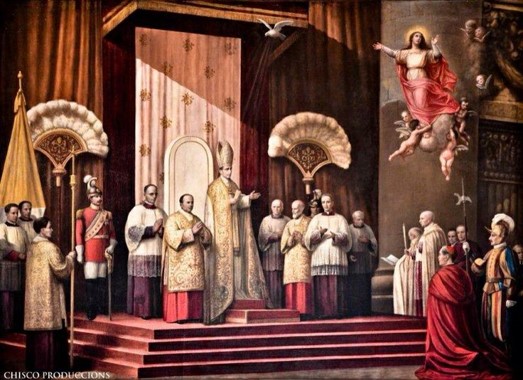
The doctrine of the infallibility of the Bishop of Rome in the field of faith- and moral teaching acquired the status of dogma in the Roman Catholic Church during the First Vatican Council (1869-70): “Firmly adhering to the tradition that has come down to us from the beginning of the Christian faith, we, for the glory of God our Savior, for the exaltation of the Catholic religion and for the benefit of Christian peoples, with the consent of the Holy Council, teach and define how the revealed teaching is that when the Roman pontiff speaks from his pulpit (cum ex cathedra loquitur), that is, when fulfilling his ministry as a pastor and teacher of all Christians, By virtue of his supreme apostolic authority, he determines the doctrine of faith or morality that the whole Church must contain, and through the Divine help promised to him in the person of blessed Peter, he possesses that infallibility (infallibilitate) that the Divine Savior was pleased to bestow on His Church to determine the doctrine of faith and morality, and that therefore these kinds of the definitions of the Roman pontiff are immutable by themselves, and not with the consent of the Church (ex sese, non autem ex consensu ecclesiae irreformables). If anyone dared to contradict this definition of ours, from which God forbid, then let him be anathema.”
As an evangelical confirmation of the dogmatic infallibility of the Bishop of Rome, the same passages are usually cited as to justify his supreme ecclesiastical authority. This is, first of all, the Savior’s address to Peter: “Simon! Simon! Behold, Satan has asked to sow you like wheat, but I have prayed for you that your faith may not fail; and you, once converted, strengthen your brothers” (Luke 22:31-2), the promise of the Lord to establish a Church on the rock of Peter (Matthew 16:18) and the restoration of Peter in apostolic dignity through the Risen Christ (John 21:15-17).
Of these testimonies, the first passage from the Gospel of Luke can be attributed most of all to the infallible teaching of the Bishop of Rome, although in its direct meaning it does little to confirm the so-called “Vatican dogma.” Although the Savior calls Peter to confirm the brothers, this is not an affirmation of his special dogmatic rights, but, above all, the Lord’s prayer for him in view of his impending abdication, as is prophesied in the following verse (Luke 22:34).
The church tradition of the first millennium does not know the dogmatic infallibility of the Roman pontiff and recognizes not his definitions as the rule of faith, but “what was believed everywhere, always, by everyone.” At that time, Rome aspired more to administrative power, but did not dare to openly declare dogmatic power. They tried to justify Filioque and other innovations by referring to their alleged antiquity, rather than to the authority of the Roman pontiff. The second millennium ushered in a new era in the formation of the idea of the dogmatic infallibility of the Roman pontiffs. Its strengthening could have been indirectly facilitated by the West’s detachment from the dogmatic pursuits of the Ancient Church. The idea of the Ecumenical Council as the supreme guardian of the doctrinal truth has not taken root in the West with such force as in the East. In part, on the contrary, the historical disasters of the Byzantine Empire, which was torn apart by dogmatic disputes, strengthened the Christian West in its desire to avoid such a fate, to abandon the church-wide preservation of faith and entrust it solely to the pontiff.
Papal infallibility was confirmed at the First Vatican Council, which took place from December 8, 1869 to September 1, 1870. Like the Council of Trent, it was called for a new self-determination of Catholicism in the face of dramatic historical changes that resulted in the onset of secularization and atheism. The dogma of papal infallibility was supposed to strengthen Catholic resistance to these threats. Nevertheless, about a quarter of the council’s participants opposed its adoption, and many of them agreed with the limited infallibility of the Roman Pontiff when she expresses the testimony of the entire Church and is subject to her approval. The opposition’s resistance was broken, and on July 17, 1870, the Dogma of the religious and moral infallibility of the Roman pontiff was adopted almost unanimously. After the end of the Council, some of the opposition representatives, mainly from Germany and Switzerland, founded the Old Catholic movement, which will be discussed later.
In the twentieth century, the convocation of the Second Vatican Council (1962-1965) became an indirect revision of the dogma of papal infallibility approved by the First Vatican Council, which actually questioned the need for holding councils in the future. In the dogmatic constitution of the Second Vatican Council, there is a “Lumen gentium” along with the Roman Pontiff, “in whom alone is present the grace-filled gift of infallibility of the Church itself” (Lumen gentium. 25), the bishops act as “witnesses of the Divine and catholic truth.” Moreover, the faithful of the Church also act as guardians of the faith, they cannot “err in faith and show this special property in the supernatural understanding of faith by the whole people when … they express their universal agreement in matters of faith and morals” (Ibid. 12). On the other hand, an extended interpretation of infallibility arises: the faithful are instructed to show “obedience to the will and reason … in relation to the authentic teaching of the Roman Pontiff – even when he does not say ex cathedra” (Lumen gentium. 25), in other words, all the official statements of the popes acquire the meaning of infallible.
Since the adoption of the dogma in 1870, in fact, the only case of its application in the life of the Catholic Church was the proclamation in 1950 by the Apostolic constitution of Pius XII “Munificentissimus Deus” of the dogma of the Ascension of the Virgin Mary. Signs of infallible magisterium are also contained in the apostolic letter of John Paul II “Ordinatio Sacerdotalis” (1994), in which the Pope forbids the ordination of women to holy orders “in fulfillment of his vocation to strengthen the brethren (Luke 22:32).”
The dogma of papal infallibility is refuted not only by church history. It contradicts the doctrinal principles of the Ancient Church. Namely, Orthodox criticism points to a contradiction in the text of the dogma. According to the meaning of the text, it follows that the Roman high priest possesses infallibility, which belongs to the Church, but testifies to it independently of the Church, and this shows the obvious inconsistency of this definition. In fact, the knowledge of the truth is given to the pope independently, personally, without connection with the Church.
Eastern Orthodox Christianity consistently maintains that the infallible magisterium belongs to the entire Church. This ecclesiastical preservation of the truth was historically convincingly manifested in the era of the Ecumenical Councils. At the same time, believers, members of the Ancient Church, were not only Church taught, but were directly involved in the preservation of dogmatic truth.
In Eastern Christianity, there is no categorical division into a teaching and a learning Church, which was consolidated by the First Vatican Council. The ministry of the testimony of faith in the Orthodox Church is entrusted primarily to the episcopate, but this testimony is possible only with the consent of the Church. The episcopate expresses the faith preserved by the entire Church, but does not define it. The consent of the Church manifests itself in the reception or assimilation of dogmatic decisions by it, and the absence of such assimilation is also possible, i.e. the disagreement of the faithful with the proposed teaching. This doctrinal role of the people of God is based on the fact that they are the very body of the Church, the ecumenical Eucharistic community in a sacramental communal life, acquiring a dogmatic intuition (sensus fidei) that allows us to separate truth from error.
- The Roman Catholic teaching on the structure of the Church
-
2. The Roman Catholic teaching on the authority of the Pope -
- The relationship of the Apostle Peter to the other apostles in the Roman Catholic and Orthodox understanding
-
- The Roman Catholic teaching on the religious and moral infallibility of the Roman Pope
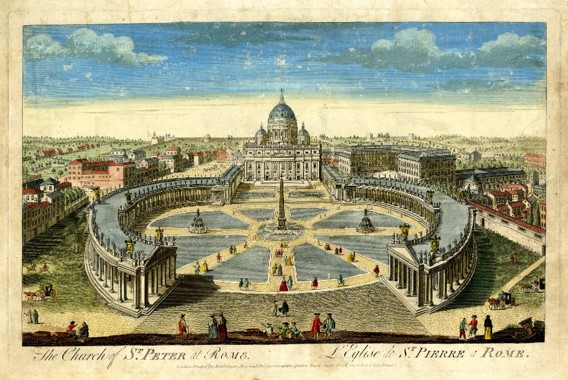
For centuries, Catholicism has adhered to the principle of monarchical centralism, according to which all the highest teaching, pastoral and administrative power in the Roman Catholic Church is concentrated in the hands of the Bishop of Rome, whose canonical powers extend not only to the entire Roman Catholic Church, but also beyond its borders. This is confirmed by the official title of the Pope: “Bishop of Rome, Vicar of Christ, successor of the Prince of the Apostles, Supreme Pontiff of the Universal Church, Great Pontiff, Patriarch of the West, Primate of Italy, Archbishop and Metropolitan of the Roman province, sovereign of the Vatican City state, servant of the servants of God.”
The official title of Bishop of Rome is not a fruit of ancient church etiquette, but it is a description of the area of the pope’s real authority, which was definitively defined by the First Vatican Council (1869-70), approving the Pope in the status of “vicar” (that is, the vicar of Christ on earth), as well as endowing him with infallibility in matters of faith and morals. However, not always, but only in cases where the pontiff speaks “ex cathedra” – that is, officially, on behalf of (and in practice on behalf of) the entire Roman Catholic Church as its head and at the same time the foundation.
Like any other heresy, the Catholic doctrine of the primacy of the Roman Pope and his infallibility did not arise without good intentions. In this case, it was originally an attempt to compensate for the institution of imperial power in the West, which disappeared in 476, understood primarily as a tool that united the various peoples inhabiting the territories of the western Roman Empire within a single Christian civilization. Subsequently (mainly in the 19th century) papal supremacy was considered by its adherents (“ultramontanists”) rather, in an ideological sense, as a bulwark of Christian conservatism, leading the fight against various forms of sinful free thinking. But as a result, a monarchical and theocratic institution has emerged that contradicts the Tradition of the ancient Church and claims to exercise truly Divine powers on earth.
From the point of view of the Roman Catholic theology, the papal ministry is important not only for Catholics, but also for Christians of other church traditions. This idea is confirmed by the decisions of the Second Vatican Council (1962-1965), which tried to soften some aspects of the Roman Catholic ecclesiology, but in fact only reinforced its misconceptions. Thus, according to the dogmatic constitution on the Church, Lumen gentium, the true Church “resides (subsistit) in the Catholic Church, governed by Peter’s successor and the bishops in communion with him (i.e., the Pope),” while outside the Roman Catholic Church there are only “many principles (elementa) of sanctification and truth” (Lumen gentium. 8), stemming from the fullness of grace entrusted to the Roman Catholic Church. Despite the fact that the use of the term ” resides ” instead of the originally intended “is” indicates the recognition by Catholics of the work of saving grace outside the Roman Catholic Church, later Catholicism reinforced the view that the usefulness of the church of other Christian communities directly depends on the degree of their proximity to Catholicism. And the Pope is the supreme pastor for both Catholics and all other Christians.
The monarchical structure of Catholicism inevitably gave rise to a rather rigid clericalism, which has not been eliminated to this day. Until the Second Vatican Council, the Roman Catholic Church adhered to the strict division of the church body into two parts - the teaching (ecclesia docens) and the listening (ecclesia discens). Moreover, only the first (teaching) part, consisting of clerics, was often referred to as the Church as such. The second one, represented by the laity, was given a passive role. The “listening” part was not perceived as a valid, integral part of the Church and depended on the clergy in everything. Outwardly, this was reflected in the practice of laity communion only under the guise of Eucharistic bread.
At the present stage, when describing their ecclesiology, Catholics focus not on administrative and institutional aspects, but on the idea of a living ecclesiastical organism, consisting, by analogy with Jesus Christ, of Divine and human elements. The earthly part of the Roman Catholic Church is called the Second Vatican Council, the wandering Messianic people of God gathered around the Son of God, but in fact, of course, around the Roman Pontiff. Indeed, in the “Code of Canon Law”, the section on hierarchical organization reflects mainly the vertical of authority assigned to the hierarchy (and above all, to the Bishop of Rome) in the organizational structure of the Church. The laity are mentioned only as members of church institutions and societies.
The teaching of the papal ministry imposes restrictions on the ministry of Catholic bishops. Although each bishop, from the point of view of Catholicism, personally manages the individual Church entrusted to him (Latin: ecclesia particularis) and leads the celebration of the Eucharist in it, from the moment of episcopal ordination he is a member of the college uniting the entire episcopate headed by the Roman Pontiff. Thus, with the doctrine of collegiality, the Second Vatican Council tried to balance the strictly monarchical ecclesiology of Roman Catholicism of the previous era. However, communication within the episcopal college is once again strictly hierarchical (Latin: communio hierarchica), since it depends entirely on unity with the Pope.
Obviously, this model does not correspond to the image and nature of the relations within the assembly of the apostles led by the Apostle Peter, which are given as an analogy in the Roman Catholic teaching about the Church. At this structural level, the duality of the Roman Catholic ecclesiology is evident. On the one hand, the bishops have been declared full-fledged primates of their diocesan Eucharistic communities. On the other hand, bishops can never legitimately participate in teaching, pastoral administration and mission without the will of the Pope as the successor of the Apostle Peter and their supreme head. According to Catholic doctrine, the Episcopal Collegia, like the Ecumenical Councils, have the infallibility of magisterium and ecclesiastical authority only in conjunction with the Roman Pontiff and never without him or his consent. In addition, as in previous centuries, impressive powers and influence belong to the administrative apparatus of the Vatican — the Roman Curia, which is under direct papal control.
Related Concepts
- apostolic-college
- binding-and-loosing
- bishop
- bishops
- church-order
- clericalism
- collegiality
- communion
- communion-under-one-kind
- deacons
- diocesan-administration
- dissent
- ecclesia-docensdiscens
- ecumenical-councils
- episcopacy
- episcopal-college
- episcopate
- feed-my-sheep
- first-vatican-council
- florentine-union
- historical-continuity
- laity
- liberal-opposition
- lumen-gentium
- magisterium
- matthew-1619
- matthew-parker
- matthias
- orthodox-anglican-dialogue
- pastor-aeternus
- penance
- people-of-god
- petrine-succession
- priesthood
- primacy-of-honor
- reception
- roman-catholic-ecclesiology
- roman-catholicism
- sacrament-of-priesthood
- sacramental-guarantee
- ultramontanism
- uniate-cardinal
- unity
- universal-pastor
- vatican-i
- vatican-ii
- whole-church