Comparative Theology — Topic 2. The Roman Catholic Doctrine of Revelation.
- The nature of Revelation and its types
- Scripture, Tradition, and the Ecclesiastical Magisterium
- The theory of dogmatic development and its criticism from the Orthodox tradition
Universal revelation, as a source of doctrine, is structurally divided by Catholicism into three types:
- The Holy Scriptures,
- Sacred Tradition and
- The magisterium of the Church (Latin: magisterium Ecclesiae, “ecclesiastical magisterium”).
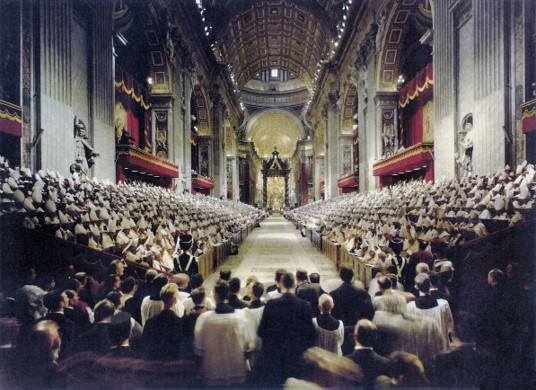 For Roman Catholics, Scripture and Tradition, which are equivalent,
constitute the so-called “treasury” or “pledge of faith” (Latin: depositum
fidei), which inevitably leads to the problem of “two sources”. Indeed, if
Scripture and Tradition are two different, independent and complementary
sources of doctrinal truth, then it turns out that each of them preserves the
Divine truth only partially.
Roman Catholics were forced to equalize Scripture and Tradition with their transformation into parallel sources of doctrine. Far from all elements of Catholic doctrine were based in Scripture, being part of an unwritten tradition peculiar exclusively to Catholicism. For example, the doctrine of the treasury of the merits of saints and indulgences as a way of forgiving punishment for sins. Subsequently, Protestant theologians harshly criticized the Catholic Church for the biblical frivolity of its tradition, constantly emphasizing that their (Protestant) doctrine, on the contrary, relies solely on the Word of God, that is, on Holy Scripture, as the only source of doctrine (Latin: Sola Scriptura, lit. “only Scripture”).
The Roman Catholic Church, responding to Protestant criticism within the framework of the Council of Trent (1545-63), not only did not abandon the theory of two sources, but also tried to deprive Scripture of dogmatic self- sufficiency, emphasizing that Revelation was given by God in two forms, each of which (Scripture and Tradition) individually does not have sufficient completeness. On the one hand, this made it possible to raise the authority of Tradition, within the framework of which the specific elements of the faith inherent in Catholicism could only exist. But on the other hand, it aggravated the problem of two sources. Indeed, if Scripture and Tradition speak about the same thing in different ways, what should we believe?
First, the First Vatican Council and then the Second Vatican Council tried to overcome this duality, but, in fact, they only aggravated the problem. The latter, for example, pointing out that “Sacred Tradition and Holy Scripture are closely and mutually related, flowing from the same Divine source, merge in some way into one” (Dei Verbum. 9), formulated the Catholic teaching on the ecclesiastical “magisterium”: “The duty to truly interpret the written or transmitted Word of God has been entrusted to one living teaching of the Church,” which “does not exceed the Word of God, but serves him” (Dei Verbum. 10). In theory, the Church magisterium in the Roman Catholic church is subject to Scripture and Tradition, but in practice, the magisterium of the Church, which is in the hands of the Pope, surpasses in importance the two-pronged source of doctrine. Thus, Scripture and Tradition turn out to be only material for Catholic Church teaching.
In order to restore unity with Orthodoxy, Catholics need not only to admit that they have doctrinal errors, but also to accept the Orthodox point of view that Scripture is one of the forms of Tradition, understood not as an unwritten tradition, but, above all, as the action of the Holy Spirit expressing itself (according to St. Filaret of Moscow) as “an invisible, real gift of grace and sanctification…” With this understanding of the relationship between Scripture and Tradition, no magisterium is simply required. After all, Tradition in its content is not something different from Holy Scripture or parallel to it; on the contrary, Tradition in content is identical to Scripture.
The famous theologian of the Russian diaspora, V.N. Lossky, rightly pointed out in this regard: “One can even say: The Church could do without Scripture, but could not exist without Tradition.” Thus, the Orthodox Church, unlike Catholicism, asserts not only the equivalence, but also the absolute wholeness, the interpenetration of various forms of God’s Revelation.
“For it pleases the Holy Spirit and us.” (Acts. 15,28), - with these words, pronounced at the Apostolic Council (50), the resolutions of all subsequent councils of Orthodoxy, Ecumenical and Local, traditionally begin. These same words indicate that it is Tradition, as the living action of the Holy Spirit, that is subordinated to church teaching in Orthodoxy. Only by being in agreement with the Revelation of God can a council properly explain certain elements of Tradition. Conversely, no external forms or conditions guarantee the truth of a conciliar decision if it contradicts Revelation. In this case, the most representative cathedral, even claiming to be ecumenical, can turn into a robber council.
The modern Roman Catholic Church, discussing the nature of Divine Revelation, divides it (Revelation) into two types:
- “Universal revelation” (Latin: revelatio publica). All Catholics are required to believe Universal revelation. The forms of its expression are the Holy Scriptures and Tradition in the form in which they are recognized by the church consciousness of Catholicism. In other words, the content of Universal Revelation in Catholicism is determined by the so-called “church magisterium” or church magisterium, carried out mainly by the Pope.
- Personal or private revelations (Latin: revelatio privata) of Catholic saints. It is necessary to make a reservation here. When the Catholic Church canonizes an ascetic and thereby confirms the truthfulness of his spiritual experience, it only points out that in the private revelations of this saint there is nothing contrary to the faith and moral teaching of Catholicism. At the same time, ordinary Catholics are not required to believe the private revelations of saints.
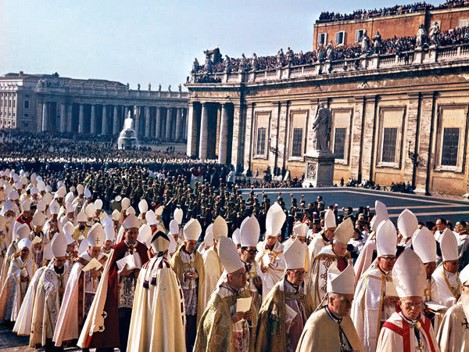 Let us return to the consideration of the nature of Universal
Revelation in the understanding of Catholicism. Significant changes took place
among Catholics in the twentieth century. This is clearly seen when comparing
the positions of the First Vatican Council (1869-70) and the Second Vatican
Council (1962-65). The First Vatican Council in the constitution “Dei Filius”
discusses Universal Revelation in the spirit of strict scholasticism. Namely,
he points out that Universal Revelation is “a doctrine of faith that God has
revealed”, that it is a “divine pledge” entrusted to the magisterium of the
Church for safekeeping, disposal, and infallible proclamation in an
unchangeable sense. This statement contains an explicit reference to the
Catholic teaching of papal infallibility in matters of faith and morals.
The Second Vatican Council, which sought to distance itself as much as possible from the scholastic campaign, in the constitution “Dei Verbum” in relation to Universal Revelation emphasizes the historical and moral significance. The Son of God who came into the world, “by words and deeds, signs and wonders, especially by His death and glorious resurrection from the dead, and finally by the sending down of the Spirit of Truth, completes Revelation in its entirety and confirms it with divine testimony, which means: God is with us to free us from the darkness of sin and death and to raise us up in eternal life” (Dei Verbum. 4.). The presented statement is quite consistent with the Orthodox understanding of Revelation. The same cannot be said about the following.
Along with stating the impossibility of any new universal Revelation until the Second Coming, the same constitution “Dei Verbum” expresses the idea of a gradual deepening of the understanding of Revelation, which implies, among other things, the identification of its new elements (Dei Verbum. 8). Here we are dealing with a reference to the theory of dogmatic development, The author of which, Cardinal John Henry Newman– is an absolute authority for the Second Vatican Council. Newman’s theory of dogmatic development will be discussed below. In the meantime, we note that modern Catholic theology not only does not deny the possibility of the “development” of dogmatic teaching, but also recognizes that Universal Revelation manifests itself beyond the boundaries of the Catholic faith, and even beyond Christianity as such. This is stated in the declaration of the Second Vatican Council “Nostra aetate”: in other religious traditions, there is often a “ray of Truth that enlightens all people”, since all nations are deeply connected to the Creator and are naturally receptive to His saving intentions, which extend to everyone without exception (Nostra aetate. 1-2). The Orthodox Church, for example, when discussing the activities of ancient philosophers, calls them “Christians before Christ”, but in this case it is more a rhetorical device than a real recognition of the possibility of a full-fledged manifestation and assimilation of Revelation beyond the boundaries of a community faithful to the true God.
 As noted above, the Roman Catholic Church allows for the possibility
of expanding the boundaries of Tradition and the appearance of completely new
elements in it from a historical point of view. We are talking about the so-
called “dogmatic development”, the possibility of which was recognized by the
roman catholics in the 19th century. Of course, not by chance. After all, it
was in the 19th century that Catholics adopted two new dogmas that caused a
significant public outcry - about the Immaculate Conception of the Virgin Mary
and about papal infallibility in matters of faith and morals. At that time,
Catholic theology faced an extremely painful problem: How can one justify the
appearance of such dogmatic innovations in the Catholic faith?
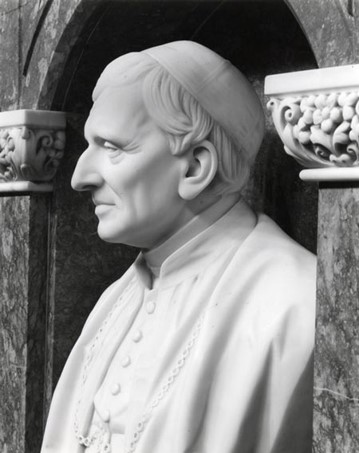
The dubious merit in justifying both accepted dogmas and the very possibility of dogmatic development belongs to the cardinal John Henry Newman (1801-1890), who left Anglicanism and joined the Roman Catholic Church. It cannot be ruled out that Newman was ideologically influenced by liberal Protestant theology of his day, with his belief that Christian doctrine was supposedly constantly evolving, being directly influenced by constantly evolving philosophical ideas.
It is worth noting that Newman did not question the original integrity and completeness of Revelation given through Christ to the early Church, but argued that Revelation at this stage was only a seed. It began to grow and gradually turn into a tree. Following this analogy further, we can assume the following. On the one hand, we can tell exactly what type of tree will grow from a planted seed, but on the other hand, what kind of real tree came from the seed can only be said when it has already grown, having experienced certain natural influences, as well as the care of the gardener.
In other words, for Newman, Revelation in its entirety was given by God to the Church (in his understanding, the Roman Catholic Church). And this church, governed by the “vicar of Christ” on earth, exercises the right to develop this Revelation in the direction and format that it considers correct and important from the point of view of pastoral responsibility (or from the position of a teaching “magisterium”). Once again, the cardinal’s task was to justify the innovations in the field of dogma that the Roman Catholic Church implemented during the second millennium: the doctrine of papal supremacy and infallibility (when speaking ex cathedra), purgatory, the treasury of the extraordinary merits of saints, the immaculate conception of the Virgin Mary, etc., however, Newman’s apologetic theory, by eliminating one problem, created the ground for another, more dangerous one – the so-called “modernism” or the theory of the need to renew Catholic Christianity. The creators of these projects believed, based on Newman’s theory, that if Revelation could develop, then it was necessary to take steps towards increasing the actualization and modernization of theology (in some cases, even at the cost of sacrificing Tradition).
The Orthodox Church agrees that, under the influence of historical circumstances and in order to show pastoral concern for the preservation of the purity of faith, the church hierarchy has to verbally define certain previously unarticulated elements of Tradition. But, firstly, these actions are forced, due not to vain love of wisdom or mercantile calculation, but to a challenge from heretical teachings that distort the purity of the apostolic faith. And secondly, we are talking about giving verbal form to elements known to the church consciousness, rather than the emergence of fundamentally new dogmas unrelated to the faith of the ancient Church.
The Roman Catholic Church has repeatedly expanded its tradition with the help of doctrinal components unknown to the ancient Church consciousness, and it has not always done so involuntarily, but based on the desire to achieve certain goals. Including socio-political ones, as in the case of the proclamation of the dogmas of papal infallibility or the Immaculate Conception of the Virgin Mary. Thus, the Roman Catholic Church, in theory declaring the immutability of the content of Revelation and the impossibility of the appearance of new elements in it, in practice significantly supplemented and distorted its own tradition. This raises important questions. Is it possible to allow certain revealed truths to be preserved in the consciousness of the Church and temporarily excluded from its testimony, i.e. is it possible to recognize the Church’s testimony as historically flawed? How does the Church determine the authenticity of the newly revealed doctrinal truth?
The Orthodox answer to the first question contains the “Circular Epistle of the Eastern Patriarchs” (1848), which reads: “Whoever accepts the new teaching recognizes, as it were, the imperfect Orthodox faith taught to him. But it, having already been fully revealed and imprinted, does not allow for either diminution or addition …” Excluding the possibility of dogmatic progress, the Orthodox Church proceeds from the fact that Christian teaching is always identical in its content, and development is possible only to the extent of assimilation of the revealed truth, but not in its objective content. The revealed teaching preserved by the Church was and remains complete. Development is possible only at the level of formulations, but not at the level of content.
Related Concepts
- 39-articles
- acts-1528
- assumption
- authority-of-scripture
- biblical-canon
- circular-epistle-of-the-eastern-patriarchs
- co-redeemer
- communion
- council-of-trent
- district-epistle-of-1894
- dogmatic-differences
- first-vatican-council
- fulfilled-prophecy
- fundamental-theology
- holy-spirit
- concepts/hügel
- john-henry-newman
- loisy
- magisterium
- mariology
- modernism
- new-theology
- nostra-aetate
- papal-authority
- pre-redemption
- private-revelation
- protestant-reformation
- protestant-theology
- protestant-tradition
- quran
- rejection-of-papal-authority
- scripture
- st-filaret-of-moscow
- teilhard-de-chardin
- tyrell
- universal-revelation
- vatican-i
- virgin-mary